







Abstract
This study details the development of microstructure of Ti14 alloy as a function of the forging temperature and forging ratio in semisolid state and influence of resulting microstructure on the mechanical properties. The results reveal that dynamic recrystallisation occurred during semisolid forging, and the grain refinement was attained. Grain size increased in the forging temperature and decreased in the forging ratio. High ultimate tensile strengths and low elongation have been achieved after semisolid forging. The strength decreased with increasing forging temperature, while the ductility increased with increasing forging ratio. The relative contributions of tensile properties were attributed to the varieties of grain size obtained by thixoforging.
Introduction
Semisolid forming is an effective near net shape forming manufacturing process for metals. 1 Alloys in a semisolid state can be processed more easily with lower deformation resistance, lower energy cost and reduced porosity.2,3 Consequently, it enables a decrease in machining costs and improves formability. The semisolid deformation and processing behaviours of Al alloys, Mg alloys and steel have been carried out by many scientists and engineers all over the world, and many useful results have been obtained.4–10 However, the previous researches 11 on the deformation behaviour and processing technology of titanium alloys are in the solid state, and the main results showed that titanium and its alloys are difficult to machining in a solid state due to poor formability, such as high strength, relatively low modulus of elasticity, high chemical reactivity and high energy cost. In order to improve the formability of titanium alloys, most recently, the authors’ group12,13 investigated the semisolid deformation behaviours of Ti14 alloy and reported that a lower deformation resistance was obtained at semisolid temperature range from 1000 to 1100°C. However, no further work has been performed on the exact microstructure and mechanical properties of titanium alloy after semisolid processing. In the present work, forging tests were carried out to understand the microstructure of the Ti14 alloy14,15 (Ti–1Al–13Cu–0·2Si) after semisolid processing with different parameters. The room temperature tensile properties and hardness values of the forged alloy were provided to investigate the influence of forging on mechanical properties, which may provide bases for breakthrough of titanium alloy processing technology.
Experimental
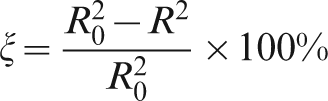
The Ti14 alloy used in this paper is a new α+Ti2Cu type burn resistant Ti alloy. The melting point of Ti2Cu is 990°C, which means that Ti2Cu will change to liquid and the alloy will change to a semisolid state when the deformation or testing temperature goes up to 990°C. Ti14 ingot of 25 kg was used in the experiment. After conventional ingot break-up, it was forged to bars with a diameter of 40 mm and then reforged to 30, 25 and 20 mm diameter bars at 1000, 1050 and 1100°C respectively at a forming speed of 500 mm min–1. All the samples were fast quenched with water after forging, and the forging ratio was calculated by the following equation
Microstructures after the forging were analysed by optical microscopy (Olympus GX71), and grain sizes were calculated using Olympics 3m software and mean transversal method;
16
the reduction in grain sizes were calculated by the following equation

The mechanical properties of the Ti14 alloys after semisolid forging were evaluated by hardness and tensile tests at room temperature. Specimens for tensile testing, with a diameter of 4 mm and a gage length of 45 mm, were machined from the centre of the forged bar. The machined specimens were wet polished using waterproof emery paper up to no. 1500. Tensile tests were performed at a nominal strain rate of 4·2×10−3 s−1 using an Instron system at room temperatures. Vickers hardness at 10 kg load was measured by MH-5 Digimatic Vickers hardness tester, and the dwell time is 30 s. A total of five indents were taken for each sample, and average value of hardness was reported here.
Result and discussion
Cross-sectional microstructures of the specimens after forging at different temperatures are shown in Fig. 1. It is found that grains grew obviously with the increase in forging temperature. The grain sizes of the forged specimens are listed in Table 1. It is clear that all forged specimens have smaller grain sizes than the specimen before forging ( = 700 μm), 15 and the grain sizes tend to increase as forging temperature increases, which suggests that dynamic recrystallisation occurs during forging, and grain refinement is obtained. Many researches4,17,18 on the semisolid deformation behaviours of Al alloys indicate that, near the solidus, the deformation is also controlled by the plastic deformation of solid particles, the same as in solid state. For forging of Ti14 alloy at temperature >1000°C, similarly, it is suggested that specimens are deformed by slip due to dislocation movement in the interior of grains. The slip due to dislocation movement causes dynamic recrystallisation, resulting in grain refinement.
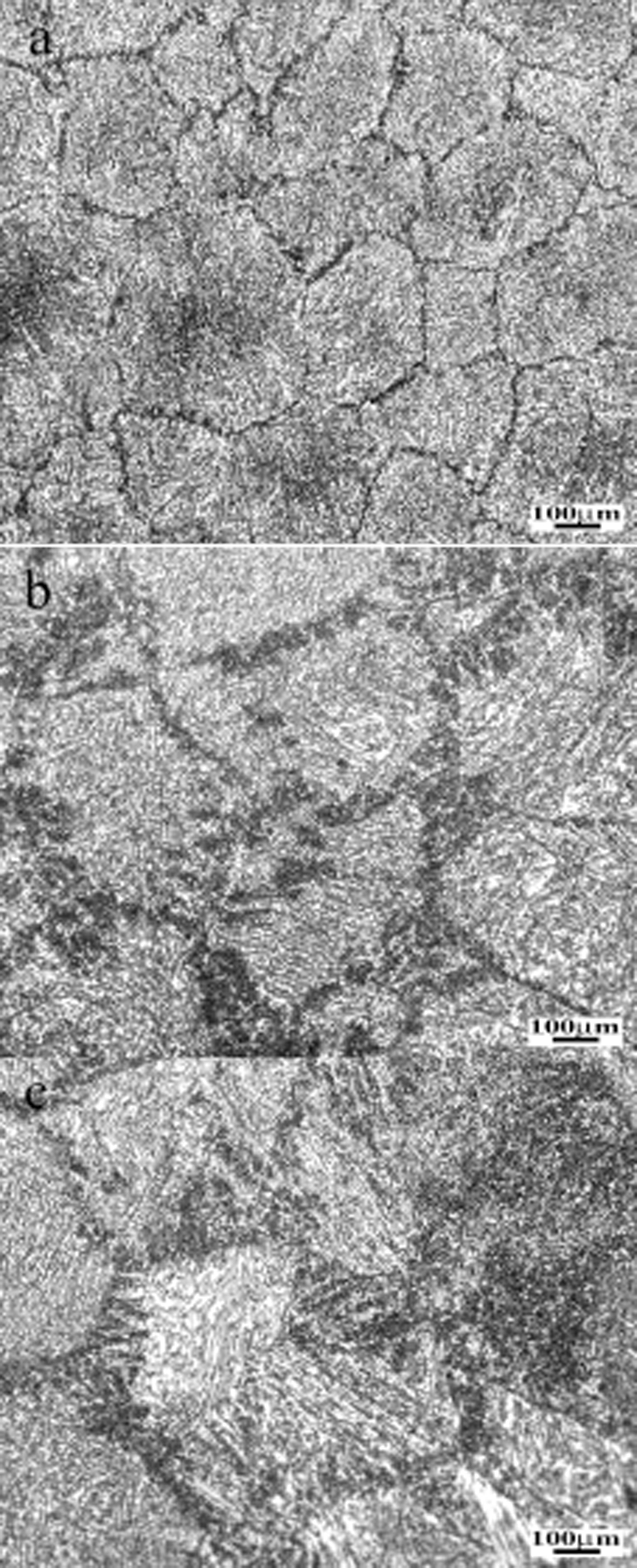
a 1000°C; b 1050°C; c 1100°C
Grain size of forged Ti14 alloy
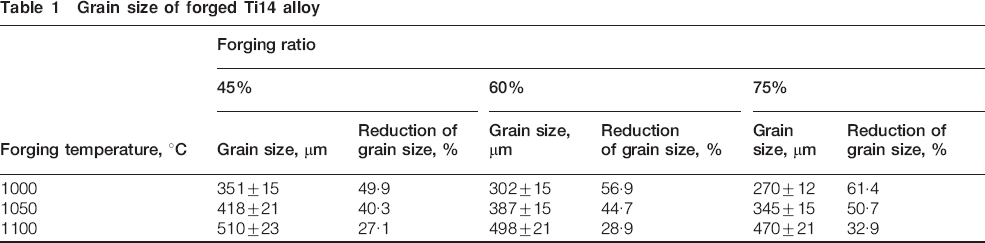
Cross-sectional microstructures of the specimens forged at 1050°C with different forging ratios are shown in Fig. 2. It is obvious that grain sizes decrease with the increase in forging ratio. For example, the grain size reduced by 40·3, 44·7 and 50·7 after forging with the forging ratio of 45, 60 and 75 at 1050°C respectively, compared with that of as received specimen, as shown in Table 1. The relationship between the grain size and forging ratio suggests that high compressive rate accelerated dynamic recrystallisation and grain reduction. The recrystallisation mechanism played an important role and gradually made the grains particularly rounder and finer during the semisolid deformation, which would be favourable for the formability and mechanical properties.
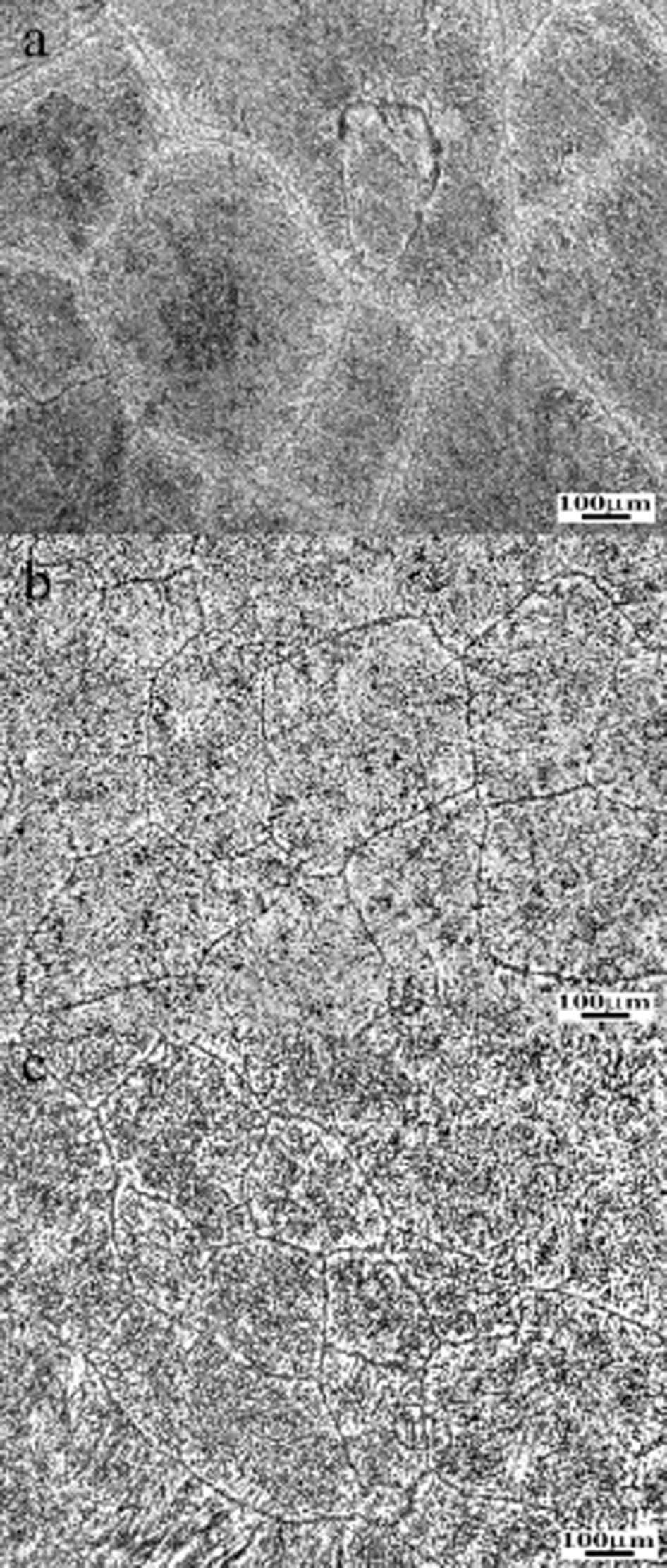
a 45; b 60; c 75
Figure 3 shows the room temperature tensile properties and hardness of as received alloy and the alloy after semisolid forging at 1000, 1050 and 1100°C with the forging ratios of 45, 60 and 75 respectively. It can be seen from Fig. 3a, b and d that the forged specimens have higher strengths and hardness than the as received specimen, which agrees with the authors’ earlier results on mechanical properties of titanium alloys after semisolid deformation at 1000°C. 11 However, the strengths and hardness decrease with the increase in semisolid forging temperature, especially after forging at 1050°C. In comparison, the influence of forging ratio on the strength of forged specimens is slight. These results can be reasonably explained by referring to the dependence of grain size on the temperature and the forming ratio. It is well known that a kind of hexagonal close packed metals, such as titanium, exhibits a strong grain size dependence on strength and hardness due to the lack of slip systems. 19 Therefore, the high strength in the forged specimens is attributed to grain refinement caused by hot forging.
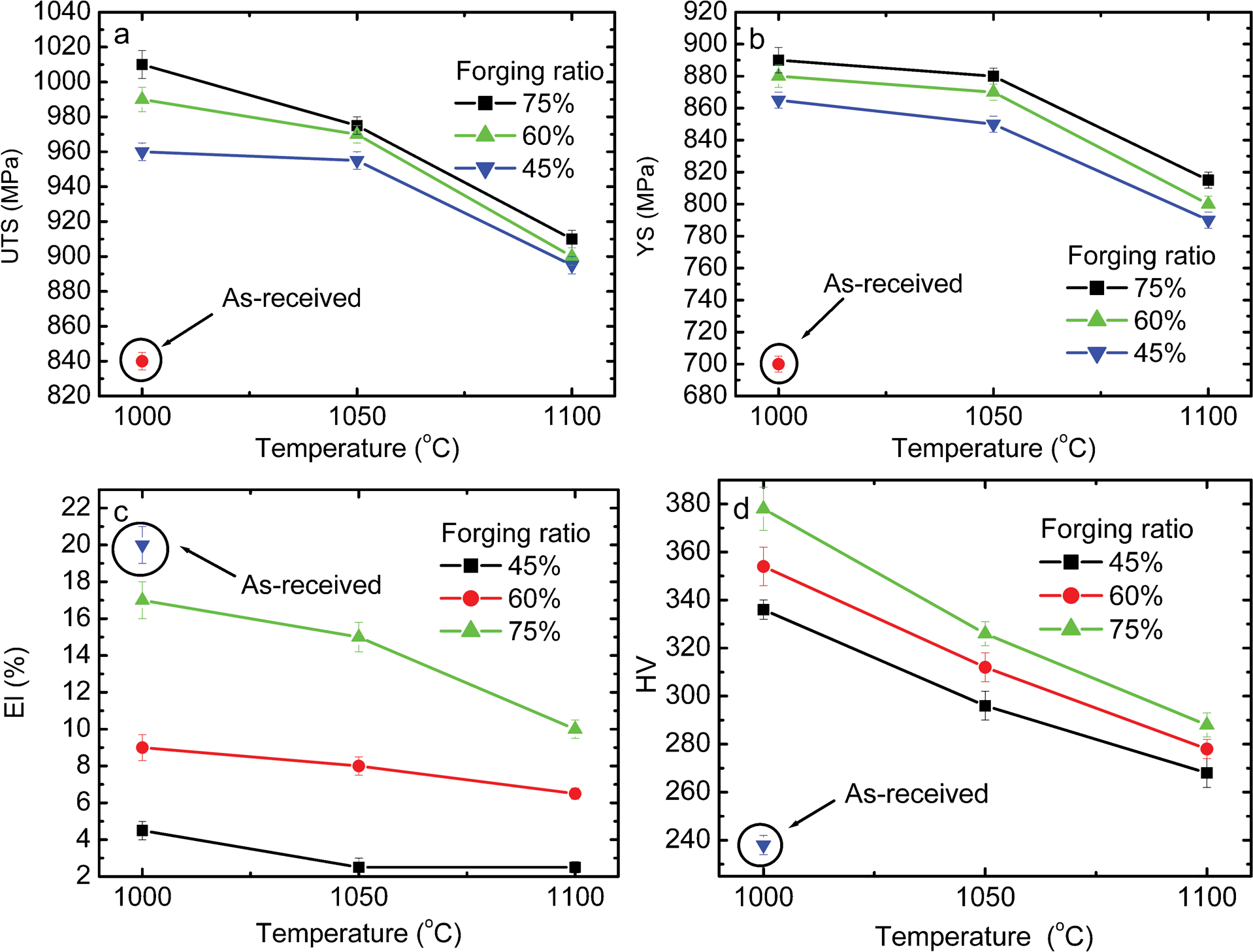
Tensile properties and hardness of forged Ti14 alloy (UTS: tensile strength; YS: yield strength; El: elongation)
Figure 3c shows the elongation of as received as well as forged alloys. All forged specimens exhibit low elongation compared with the as received alloy. The elongation gradually decreased after forging at 1000, 1050 and 1100°C, but it increases as the forging ratio increases at the same forging temperature. This reveals that forging ratios have significant effect on the ductility. The experimental results show that semisolid forging can be employed to improve the tensile properties of Ti14 alloy by controlling temperatures and forging ratios.
Conclusions
This study has shown the microstructure and mechanical properties of Ti14 after forging at different temperatures and with different forging ratios. The conclusions are as follows: the dynamic recrystallisation occurred during semisolid forging, and grain refinement was attained. High strengths as well as hardness and low elongation have been achieved after semisolid forging. The strengths and hardness decreased with increasing forging temperature, while the ductility increased with increasing forging ratio. The relative contributions of mechanical properties were attributed to the varieties of grain size caused by semisolid forging. In general, semisolid forging could improve mechanical properties by controlling the forging temperatures and forging ratios.
Footnotes
Acknowledgement
The authors wish to thank the support from the Project of National Important Fundamental Research (project no. 2005CCA06400) and 973 Programme (grant no. 2007CB613807).