







Abstract
The microstructures and tensile properties of electrodeposited nanocrystalline Ni (nc-Ni) with a broad grain size distribution after annealing at 150, 200 and 300°C for 500 s were investigated. The as deposited broad grain size distribution nc-Ni sample exhibited a moderate strength σUTS of ∼1107 MPa but a markedly enhanced ductility ϵTEF of ∼10, compared with electrodeposited nc-Ni with a narrow grain size distribution. Annealing below 200°C increased the strength but caused a considerably reduction in tensile elongation. This behaviour is attributed to the grain boundary relaxation and the increased order of grain boundaries after annealing, which can make the grain boundary activities, such as the grain boundary sliding and grain rotations, more difficult. Further annealing at 300°C decreased both the yield strength and tensile elongation significantly due to significant grain growth.
Introduction
In recent years, the mechanical properties of nanocrystalline (nc) metals (grain size <100 nm) have been the focus of many experimental and theoretical studies. These materials exhibit extremely high strength and hardness, and recent experimental investigations have demonstrated that, in the absence of processing defects, such as pores and impurities, they have reasonable tensile elongation.1–3 The exceptional properties are attributed to their unique microstructure, i.e. a large volume fraction of grain boundaries. These boundaries can act as sources and sinks for dislocations and facilitate such stress relief mechanisms as grain boundaries sliding;4 therefore, they play an important role in the deformation of nc materials. Using the molecular dynamics simulations, grain boundaries with different degrees of order were created to mimic the as deposited and annealed conditions for nc-Ni,5 the results showed that the grain boundary relaxation due to annealing resulted in a reduction in plasticity and an increase in strength. Recently, Wang et al. had studied the effect of annealing (100–300°C for 1 h) on the mechanical behaviour of electrodeposited nc-Ni with a narrow grain size distribution of 10–50 nm.6 The results showed that annealing of this material below 150°C increased the strength, but there was no obvious reduction in the tensile elongation, namely 2–3. Annealing at 200°C, a bimodal grain structure was developed, resulting in a slightly decrease in strength but an increase in the tensile ductility to 7. Annealing above 250°C caused remarkably grain growth, and the samples fractured intergranularly within the elastic limit due to the significant segregation of sulphur to grain boundaries. The results of Wang et al. do not support the simulation results; therefore, further experimental data are needed to verify the suggestions from computer simulations.
More recently, Shen et al. prepared an electrodeposited nc-Ni with a broad grain size distribution (BGSD nc-Ni) ranging from 10 to 160 nm, which exhibited both high ultimate strength and reasonably good ductility.7 However, the effect of annealing on the mechanical behaviour of electrodeposited BGSD nc-Ni has not been carried out until now; therefore, in this study, the authors investigated the microstructure and tensile properties of BGSD nc-Ni deposits annealed at low temperatures (150, 200, 300°C) for a short time (500 s). Furthermore, the authors have been successful in fabricating high quality BGSD nc-Ni deposits with a low sulphur concentration (∼150 ppm), which allows investigating the annealing effect without the interference from the increased concentration of sulphur at grain boundaries upon grain growth.8
Experimental
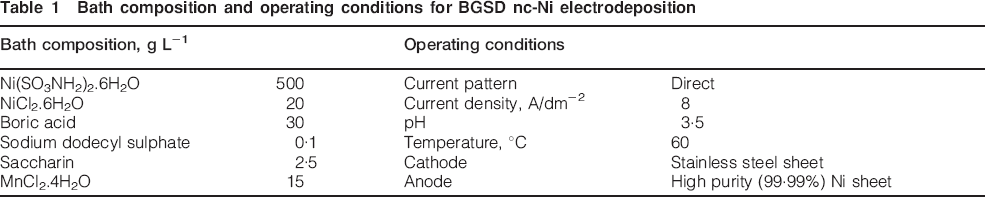
The bath composition and electrodeposited conditions for BGSD nc-Ni electrodeposition are listed in Table 1. Under these conditions, BGSD nc-Ni with a thickness of ∼200 μm was deposited on stainless steel substrate, which had been polished to a mirror-like finish surface before electrodeposition. After deposition, the deposit was mechanically stripped from the substrate.
Bath composition and operating conditions for BGSD nc-Ni electrodeposition
The dog bone shaped specimens with a gauge cross-section of 6·0×0·2 mm and a gauge length of 10 mm were cut using an electrodischarging machine. The heat treatment was conducted in silicon oil at 150, 200 and 300°C for 500 s. This procedure did not cause any oxidation or discoloration of the samples. The tensile tests were performed at room temperature with a strain rate of 10−4 s−1. The morphologies of the fracture surfaces were inspected on scanning electron microscopy (SEM, Philips XL30).
The impurities in as deposited BGSD nc-Ni were analysed by inductively coupled plasma atomic emission spectrometry (IRIS Intrepid ER/S). The microstructures of the as deposited and annealed samples were characterised by transmission electron microscopy (TEM). Transmission electron microscopy observations were performed using a Tecnai G2 F20 transmission electron microscope operating at 200 kV. Transmission electron microscopy samples were prepared by double jet electropolishing using an electrolyte consisting of 5 perchloric acid and 95 ethanol at a temperature below −20°C. The statistical grain size distributions of all samples were determined from several dark field TEM images. A total of 300 grains were measured for each distribution. The surface microhardness of the samples was measured using a Vickers tester (DHV-1000) with an applied load of 100 g. Each sample was measured 10 times.
Results and discussion
Microstructural characterisation
Table 2 lists the main impurities contents (mass parts per million) of as deposited BGSD nc-Ni. All impurities were introduced from the used chemicals and the anode material. In addition, although 15 g L−1 MnCl2.4H2O was added during deposition, the Mn content in the deposit was only 120 ppm due to the larger difference between the standard electrode potentials of Ni (−0·257 V) and Mn (−1·185 V).
Chemical impurity contents of as deposited BGSD nc-Ni
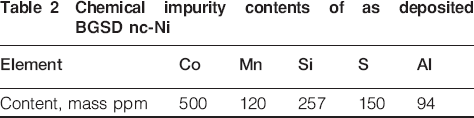
Figure 1 shows the bright field TEM images and their corresponding statistical grain size distribution plots of the BGSD nc-Ni, as deposited and annealed at 150, 200 and 300°C respectively. As shown in Fig. 1a, the as deposited Ni exhibits a very BGSD from 5 to 120 nm, and the average grain size is 27 nm. After annealing at 150°C, the average grain size changes only slightly to 30 nm. Abnormal grain growth was observed for annealing at 200°C; for example, one grain marked by circle in Fig. 1b grew to ∼195 nm, while most grains remained unchanged in size or slightly grew, and the average grain size increased to 38 nm. A comparison of the grain size distribution in Fig. 1a–c reveals that, within the grain size range of <100 nm, the grain size distributions in both cases are similar; the difference is that, for the 200°C annealed sample, there are several large grains. This observation once again confirms the abnormal grain growth. Further annealing at 300°C, extensive grain growth took place, most grains grew to the range of 300–1100 nm, and the average grain size increased to 597 nm.
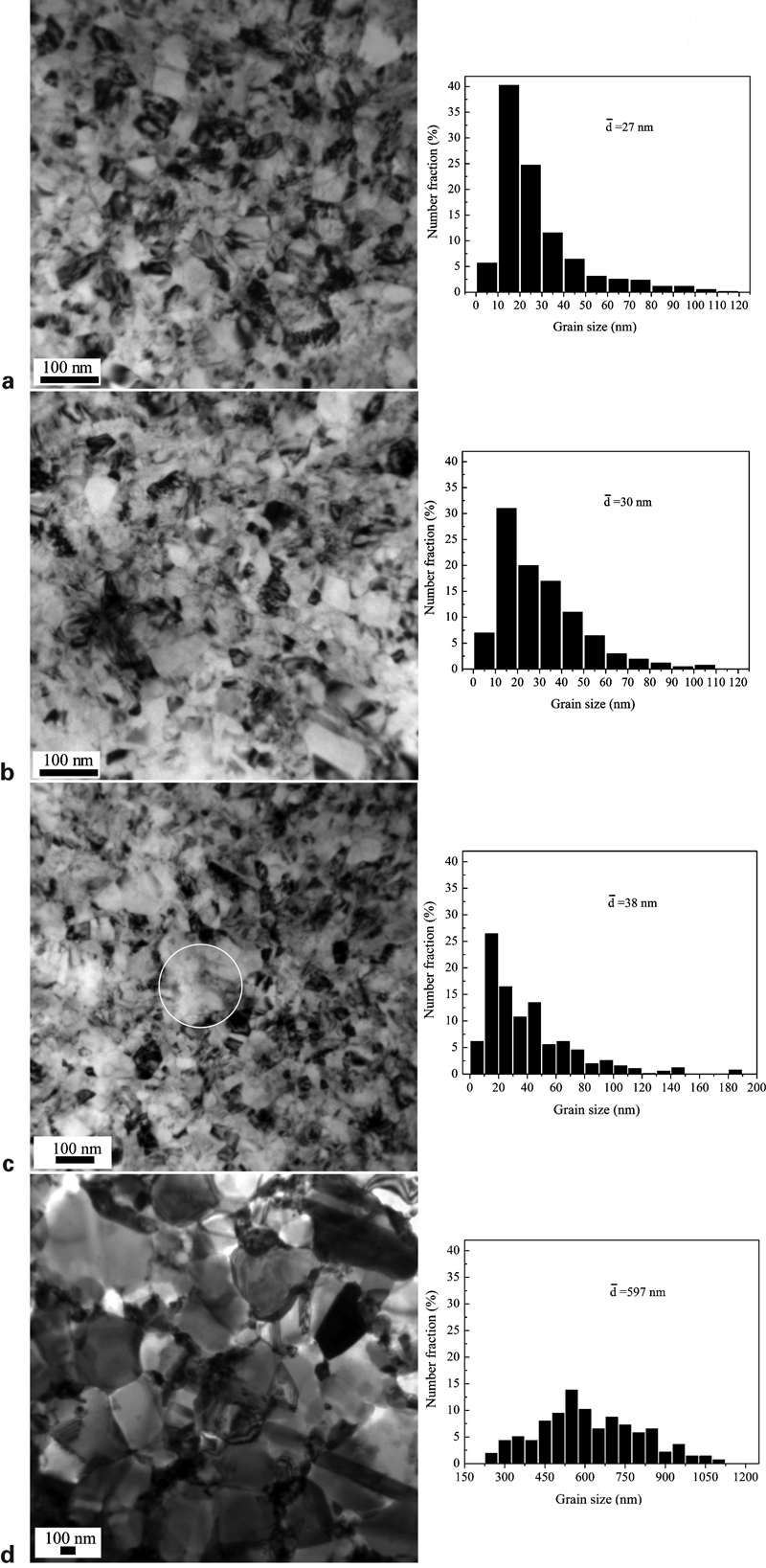
Bright field TEM images and statistical grain size distributions of a as deposited, b 150°C annealed, c 200°C annealed and d 300°C annealed electrodeposited BGSD nc-Ni
Mechanical behaviour
Figure 2 illustrates the change in the microhardness with the annealing temperature. As shown in Fig. 2, after annealing at 150°C, the microhardness increased quickly, although the grain size remained almost constant and then decreased slightly as grain growth set at 200°C. When increasing the temperature to 300°C, the microhardness decreased considerably as a result of the rapid grain growth.
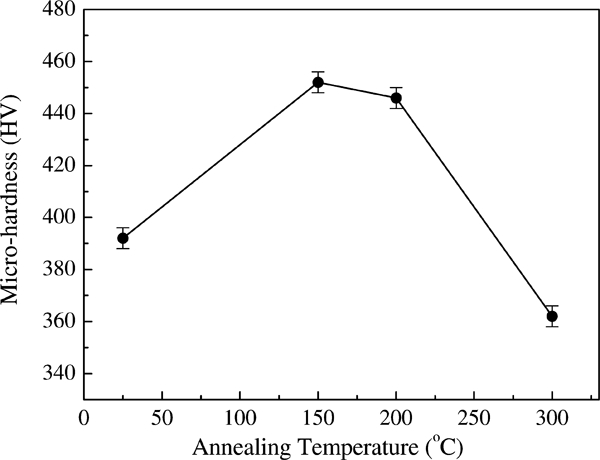
Variation of microhardness with annealing temperatures
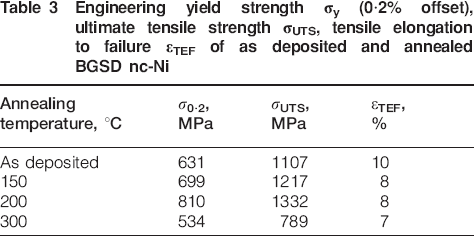
Figure 3 shows room temperature tensile engineering stress–strain curves of as deposited and annealed BGSD nc-Ni at a strain rate of 10−4 s−1. A summary of tensile tests results is given in Table 3. As can be seen in both Fig. 3 and Table 3, compared nc-Ni with a narrow grain size distribution of 10–50 nm, which exhibits a high strength σUTS of 1200–1300 MPa and a low ductility ϵTEF of ∼4,6,9–11 this as deposited BGSD nc-Ni has a moderate strength σUTS of ∼1107 MPa but a markedly enhanced ductility ϵTEF of ∼10. Annealing of this material at 150°C increased the yield strength (0·2 offset) from 631 to 699 MPa, and a further noticeable increase to 810 MPa took place on annealing at 200°C in spite of abnormal grain growth; however, in both cases, the tensile elongation decreased considerably from 10 to ∼8. Moreover, the initial strain hardening rate increased with increasing the temperature. Compared with as deposited BGSD nc-Ni, the increase in the strength and the loss of the tensile elongation after annealing below 200°C (Table 3) are consistent with the molecular dynamics simulations described in the section on ‘Introduction’. Owing to significant grain growth, annealing at 300°C decreased the yield strength markedly to 534 MPa and also decreased the tensile elongation significantly to 7. In addition, it is noted that the stress–strain curve of all samples exhibits a maximum indicative of plastic instability, which is a characteristic of the tensile behaviour of the conventional ductile metals. Scanning electron microscopic observations (Fig. 4) confirmed that all samples exhibited ductile features with dimple sizes several times larger than the grain sizes, strongly suggesting that all samples fracture by microvoid coalescence mechanism.
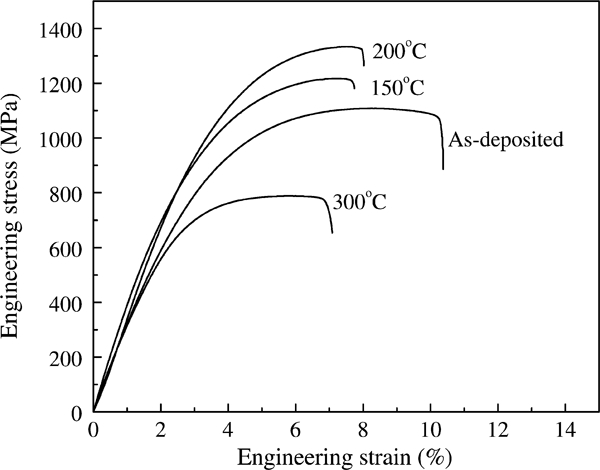
Room temperature tensile engineering stress–strain curves of as deposited and annealed BGSD nc-Ni at strain rate of 10−4 s−1
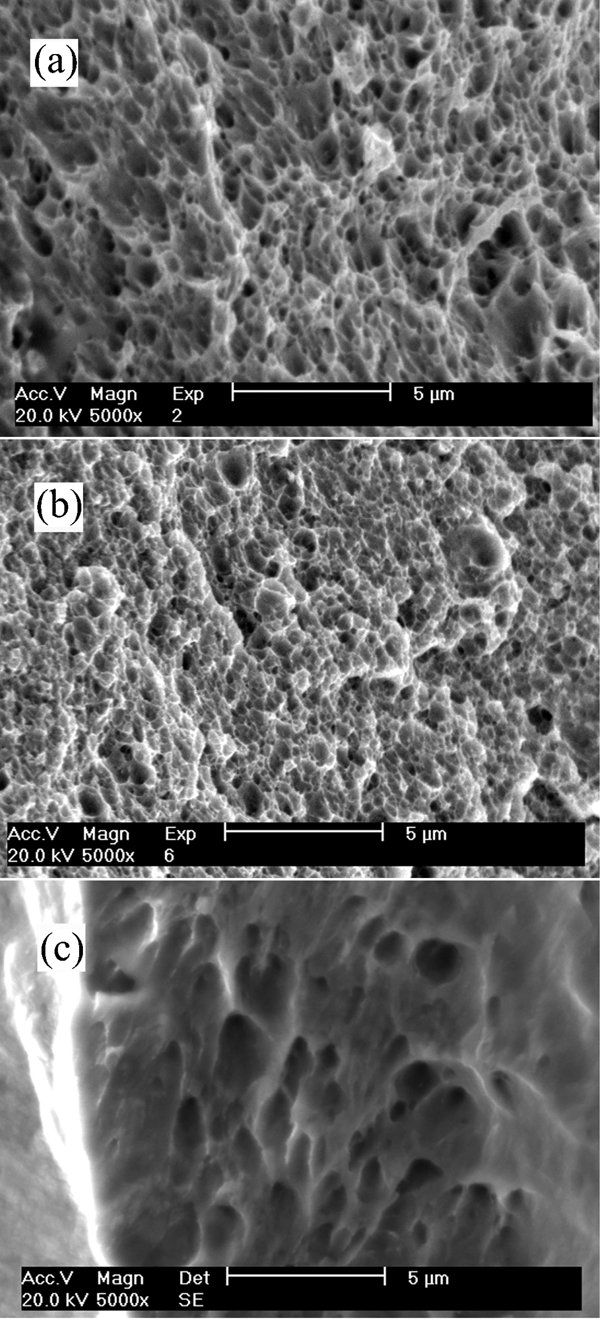
Fractographs (SEM) of a as deposited, b 200°C annealed and c 300°C annealed Ni samples
Engineering yield strength σy (0·2 offset), ultimate tensile strength σUTS, tensile elongation to failure ϵTEF of as deposited and annealed BGSD nc-Ni
Discussion
A major factor limiting the ductility and particularly uniform elongation for nc metals is the tendency for plastic instability, such as shear band formation or necking. Localised deformation modes may occur in the early stages of plastic deformation due to the decreased strain hardening capacity; consequently, it is expected that any improvements of the strain hardening will be beneficial to enhance the plastic deformation.12 In the case of as deposited BGSD nc-Ni, the plastic deformation is a combination of grain boundary sliding and the dislocation activity; the existence of some large grains allows appropriate dislocation accumulation and induces strain hardening.13,14 Meanwhile, the internal stresses arising from the strain incompatibility among various grain sizes also cause strain hardening.1,15 Therefore, the enhanced ductility (∼10) of as deposited BGSD nc-Ni is attributed to a higher level of strain hardening capacity due to the presence of differently sized grains.
The present work demonstrates that low temperature annealing (⩽300°C) for a short time (500 s) has a significant effect on the mechanical properties of BGSD nc-Ni, especially in the temperature below 200°C, where significant grain growth will not take place. Strengthening of BGSD nc-Ni after annealing below 200°C is due to the grain boundary relaxation and the increased order of grain boundaries. The rationale is that it would become more difficult for such relaxed grain boundaries to emit dislocations or undergo grain boundary sliding, thus increasing the yield strength (Fig. 3).5 Consistently, a higher initial strain hardening rate of the annealed samples is due to the large internal stresses arising from the difficulty of the grain boundary sliding. For annealed samples, decreased ductility associated with a relatively fast drop in the strain hardening rate implies that, without the continuous participation of smaller grains via the grain boundary governed mechanism, i.e. grain boundary sliding and grain rotation, the deformation of the larger grains does not provide further strain hardening, resulting in immediate necking.16 Moreover, both the theoretical model17 and experimental results18,19 suggest that the grain boundary diffusion is beneficial to suppress nanocrack generation in nc materials and thereby enhance the ductility. In terms of these suggestions, after low temperature annealing, the grain boundary diffusion becomes difficult, which is not able to suppress the nanocrack nucleation, resulting in the early failure and then the low tensile elongation.
Conclusions
The microstructures and tensile properties of a BGSD nc-Ni with a low sulphur concentration (∼150 ppm) in as deposited and annealed states (150, 200 and 300°C for 500 s) were investigated. The results of this study led to the following conclusions.
Compared with typical normalised grain size distribution (10–50 nm) nc-Ni, which exhibited a high strength σUTS of 1200–1300 MPa and a low ductility ϵTEF of ∼4, this as deposited BGSD (10–120 nm) nc-Ni sample with an average grain size of 27 nm had a moderate strength σUTS of ∼1107 MPa, but a markedly enhanced ductility ϵTEF of ∼10.
Annealing at 150°C increased the yield strength from 631 to 699 MPa, and a further noticeable increase to 810 MPa took place at 200°C in spite of abnormal grain growth; however, in both cases, the tensile elongation decreased considerably from 10 to ∼8. These observed phenomena are attributed to the grain boundary relaxation and the increased order of grain boundaries after annealing, which can make the grain boundary activities such as the grain boundary sliding and grain rotations more difficult.
Owing to significant grain growth, annealing at 300°C decreased the yield strength markedly to 534 MPa and also decreased tensile elongation significantly to 7.
Footnotes
Acknowledgements
The financial supports of this work by the Natural Science Foundation of Fujian Province, China (grant no. E0810006) are gratefully acknowledged.