







Abstract
An ultrafine grained (UFG) structure developed in precipitation hardenable Al alloys through cryorolling by suppression of dynamic recovery followed by low temperature aging has received great research interest because of its high strength and very good ductility. In the present work, Al 6061 alloy was solution treated and deformed by cryorolling up to an effective true strain of 2·6 and then subjected to annealing at the temperature range from 150 to 350°C to study the effect of annealing on the microstructure and mechanical properties. The evolution of microstructure and precipitates was investigated by employing X-ray diffraction (XRD) and transmission electron microscopy (TEM) techniques. Vickers hardness and tensile testings were performed at room temperature to evaluate the effect of annealing on the mechanical properties. It was observed that the strength and ductility increased upon annealing at 150°C, and further annealing at high temperatures (200–350°C) results in reduction in hardness and strength but increase in ductility. A significant improvement in strength observed at low temperature annealing (150°C) is due to the precipitation of metastable phase β″. It overcompensates the reduction in hardness that occurred due to the softening caused by the recovery effect. It was found that the cryorolled Al 6061 alloy with UFG structure is thermally stable up to temperatures 250°C with slight grain coarsening. At this temperature, the TEM studies revealed that second phase Mg2Si particles are effectively pinning the grain boundaries due to the Zener drag effect. Owing to the presence of heterogeneities in the material, a duplex structure was observed upon annealing at temperatures 150 and 200°C. Abnormal grain growth was observed after annealing at high temperatures (300°C).
Keywords
Introduction
Ultrafine grained (UFG)/nanostructured materials developed through severe plastic deformation have attracted much attention from the past decade by virtue of its high strength and good toughness and free from porosity.1 Equal channel angular pressing, accumulative roll bonding and high pressure torsion are some of the popular severe plastic deformation (SPD) techniques used to produce the UFG structure.2–5 Cryorolling is a relatively simple method to produce a UFG structure from its counterpart with lower strains than equal channel angular pressing, high pressure torsion and accumulative roll bonding, where it involves high strains. This method was originally introduced by Wang et al.6; it involves severe cold rolling the material with liquid nitrogen temperature cooling of the materials between consequent rolling passes.6 It has been used to produce a UFG structure in bulk metals and alloys.7–9 A wide range of aluminium alloys have been cryorolled (CR) to modify its grain structure from the micrometre regime to the nanometre or submicrometre regime8–14 to increase its strength and toughness. The major problem associated with the UFG structured material is its microstructural stability at high temperatures due to its high stored energy.15 Driver16 computed and reported that the driving force available for grain growth in fine grain structured material, where the grain size ∼0·1 μm, is 103 times more than for the material with grain size of 100 μm, and it may lead to some solid state transformations.
In recent years, several studies have been carried out on the annealing behaviour of pure metals and alloys processed by cryorolling. Lee et al.7 and Rangaraju et al.17 investigated the annealing behaviour of pure Ni and pure Al. Panigrahi and Jayaganthan18,19 and Lee et al.9 studied the thermal stability of Al alloys. Metals with second phase particles are considerably more stable than pure metals. The presence of second phase particles has a significant influence on microstructural stability by pinning and impeding the grain boundary motion.10 In the present study, the Al 6061 alloy was processed through cryorolling followed by annealing at different temperatures from 150 to 350°C. The major alloying elements in Al 6061 alloy are Mg and Si, and it will form Mg2Si precipitate. The strength and ductility of the CR Al alloys were further enhanced through the formation of nanosized precipitation by giving proper heat treatment. Therefore, it is very essential to understand the role of second phase particles in Al 6061 alloy processed by cryorolling for achieving thermal stability.
Experimental
The high purity Al 6061 alloy in T6 condition was received in the form of 1 inch plate from Hindustan Aeronautics Ltd, Bangalore, India. Samples with 12×30×40 mm dimensions were machined from the plate and heated to 530°C to dissolve all the precipitates and then water quenched to room temperature. The solution treated (ST) samples were then CR up to a true strain of ∼2·6 by dipping the samples into liquid nitrogen temperature for 10 min initially and 5 min before each rolling pass. The diameter of the roll was 110 mm, and the speed was 8 rev min−1. To study the effect of annealing on microstructure evolution and mechanical properties, all the rolled sheets were annealed at various temperatures ranging from 150 to 350°C with 50°C interval for 1 h. To evaluate the mechanical properties of ST, CR and CR+annealed samples, hardness and tensile tests were carried out at room temperature. Vickers hardness was measured on the surface plane parallel to the rolling direction; an average of at least eight readings was taken to obtain the hardness. The tensile samples were machined according to ASTM E8 standard, and a minimum of four samples were tested on an S-Series, H25K-S materials testing machine with initial strain rate of 5×10⁻⁴ s−1.
To examine the microstructure evolutions in the samples after cryorolling (CR), the electron backscattered diffraction (EBSD) technique was used. To study the precipitate evolution after annealing at different temperatures of CR samples, transmission electron microscopy and X-ray diffraction (XRD) techniques were used. The samples for EBSD analysis were mechanically polished up to 1200 grit emery paper, and mirror finishing was achieved with fine cloth polishing using MgO2 powder and then finally electropolished at −15°C using the electrolyte of methanol/perchloric acid (80∶20) at 11 V dc power source. Samples for TEM analysis were ground up to 100 μm thickness using 320, 600, 1000 and 1200 grit emery papers followed by twinjet electro polishing using an electrolyte of 70% methanol and 30% nitric acid at −20°C with 15 V dc power source.
Results
Mechanical properties
The thermal stability of Al 6061 alloy after cryorolling up to 92% reduction was analysed by performing Vickers hardness test and tensile test at room temperature. Figure 1a illustrates the variation of Vickers hardness of CR samples after annealing at the temperature range from 150 to 350°C for 1 h. After annealing at 150°C for 1 h, the Vickers hardness value of the Al 6061 alloy was increased from a value of ∼101 to 114 HV, which is an indication of the aging effect. The Vickers hardness value started dropping gradually from 114 to 108 HV after annealing at 200°C. After annealing at 250°C, the hardness drops suddenly from 108 to 70 HV, and the drop proceeds with the same rate up to 300°C. After annealing at 300°C, the hardness nearly becomes constant at further temperatures. Figure 1b shows the variation in ultimate tensile strength (UTS), yield strength (YS) and percentage elongation with increasing annealing temperature. The variation in UTS and yield strength has followed the same trend as observed in Vickers hardness variation shown in Fig. 1a. A simultaneous rise in strength (UTS, 296–340 MPa) and ductility (4·5% to 8%) is observed after annealing at 150°C. The rise in ductility is due to the reduction in dislocation density due to the recovery effect. Further annealing after 150°C, the ductility increased from 8 to 13% at 200°C, from 13 to 22% after annealing at 250°C and from 22 to 30% after annealing at 300°C.
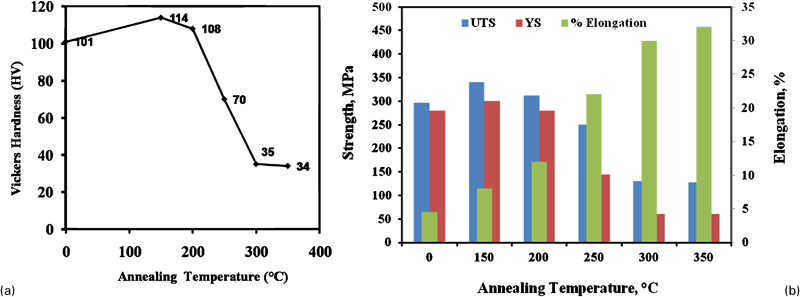
Variation in mechanical properties of CR Al 6061 alloy with annealing temperature
XRD results
Figure 2 depicts the XRD patterns of Al 6061 alloy after cryorolling, followed by annealing treatment at different temperatures. The XRD was performed on Al 6061 alloy immediately after cryorolling. The CR sample has shown peak pertaining to undissolved AlFeSi phase, and it does not show any peak corresponding to Mg2Si phase. The peak corresponding to Mg2Si phase appeared after annealing for 1 h at 150°C. The intensity of the peaks increased with increasing annealing temperature. The major second phases appearing in CR Al 6061 alloy after annealing treatment are Mg2Si and AlFeSi.
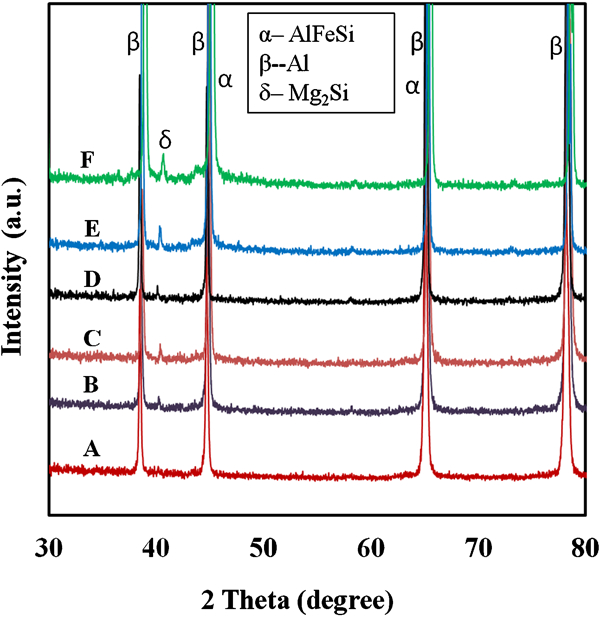
X-ray diffraction patterns of CR Al 6061 alloy sample annealed at different temperatures for 1 h
Microstructure
Figure 3 shows the optical microstructure and EBSD micrographs of the as received Al 6061 alloy after solution treatment at 520°C for 2 h and after cryorolling up to 92% reduction. The microstructure of the starting ST material before cryorolling exhibits equiaxed grains with an average size of 80 μm, in which a dendritic segregation structure is clearly seen (Fig. 3A). Figure 3B corresponds to the CR sample after 92% reduction, in which a severely deformed structure along the rolling direction is not clear through optical microscopy. The EBSD micrograph of CR 92% reduction sample with misorientation distribution is shown in Fig. 3C and D. Black and white lines correspond to low (1·5, 15°] and high angle grain boundaries (≥15) respectively, as shown in Fig. 3C. The fraction of low angle grain boundaries observed in CR 92% reduction samples is 0·71. Figure 4 shows the TEM images of CR Al 6061 alloy and CR followed by annealing at different temperatures 150, 200 and 250°C. The CR sample shown in Fig. 4A depicts elongated dislocation cells and subgrains along the rolling direction with ill defined grain boundaries. High densities of entangled dislocations were also present. After annealing at 150°C for 1 h, significant changes were observed in the dislocation density. The formation of subgrains with an average size of 350 nm by the rearrangement of dislocation into the subgrains can be seen from Fig. 4B. Figure 5 shows the appearance and disappearance of dislocation networks along with recovered grains by tilting the sample. After annealing at 200°C for 1 h, the formation of a subgrain structure with 400 nm sizes can be observed in Fig. 4C. Figure 6 shows a big second phase particle associated with very fine grains at its boundary along with unrecovered dislocations networks. Very fine grains in the order of 100 nm were recrystallised (particle simulated nucleation) around a big second phase particle. Figure 7 shows the equiaxed and slightly elongated subgrains in the Al 6061 alloy after annealing at 250°C for 1 h. In Fig. 7, it is very clear that second phase precipitates are pinning the grain boundaries. Grain coarsening has occurred, and a duplex microstructure was observed with grain sizes ranging from 500 nm to 1 μm. Figure 8 shows the alloy annealed at 300°C, where fully coarse grains with ∼4 μm sizes are presented. It also shows reasonably uniform distribution of second phase within the grains and grain boundary. After annealing at high temperatures (300°C), these particles were grown and strongly interact with the grain boundaries and the residual dislocations within these grains, as shown in Fig. 8A. The interactions of second phase particles with grain faces, grain edges and residual dislocation inside the grain are clearly represented in Figs. 7 and 8A. Figure 8B shows the presence of spherical and rod shaped precipitates oriented in specific direction in another location of the same sample annealed at 300°C for 1 h.
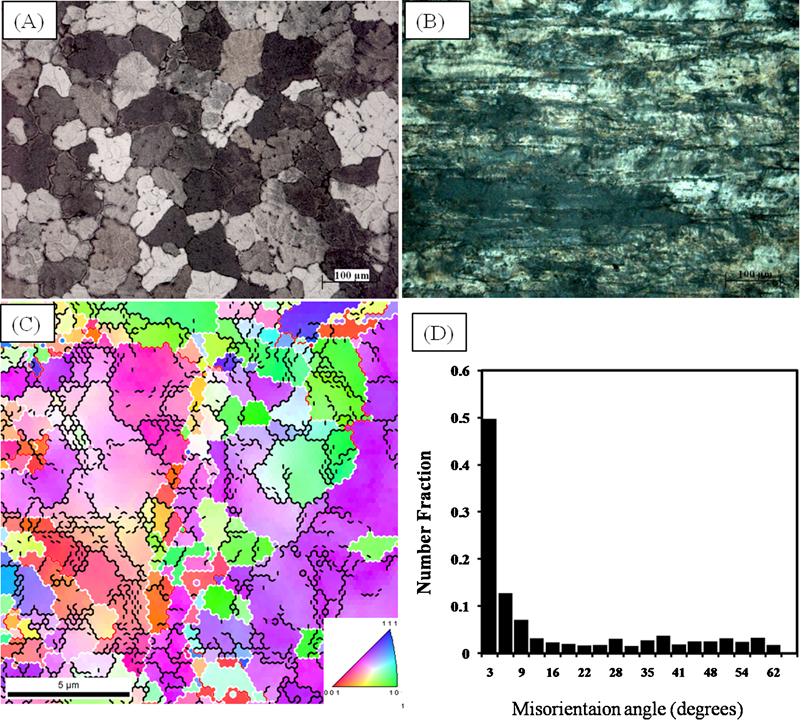
Optical and EBSD images of CR Al 6061 alloy
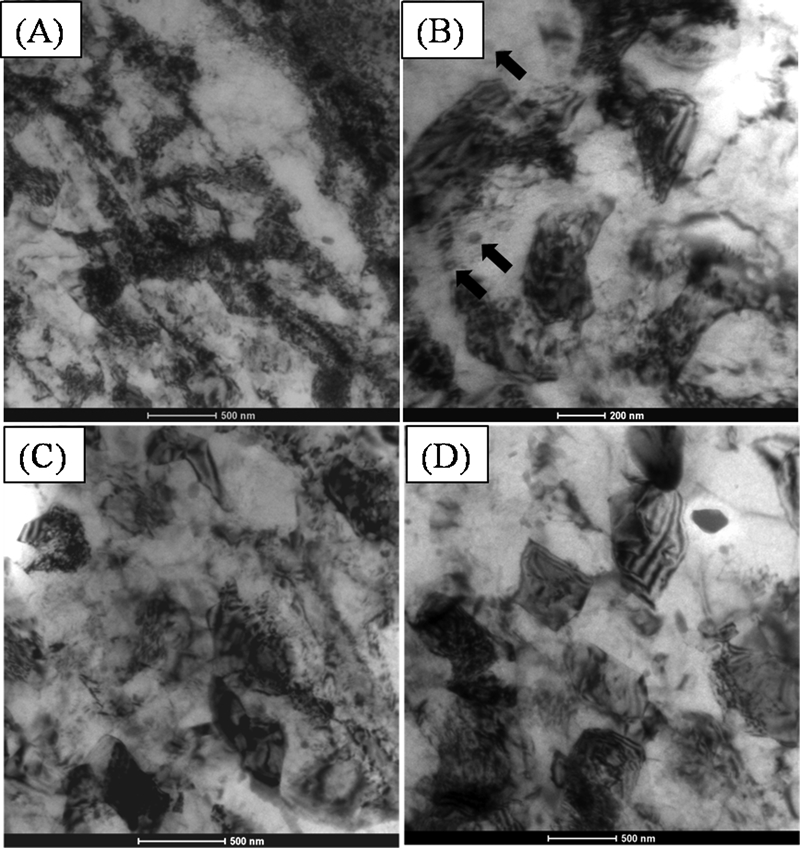
Images (TEM) of CR Al 6061 alloy annealed at different temperatures for 1 h
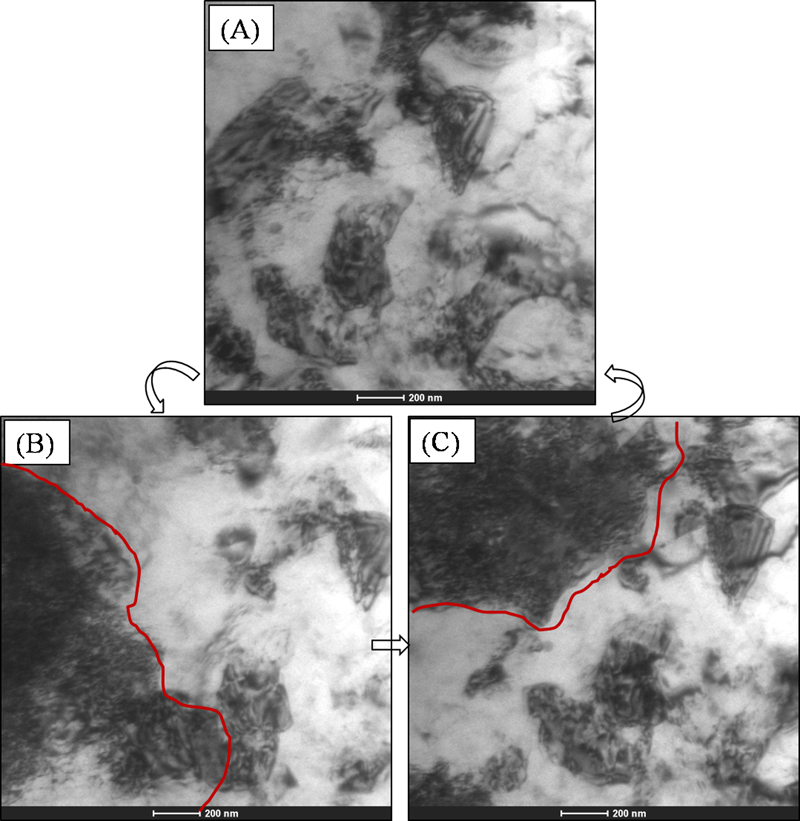
Images (TEM) of CR Al 6061 alloy annealed at 150°C for 1 h: appearance and disappearance of dislocation network with small tilt of sample
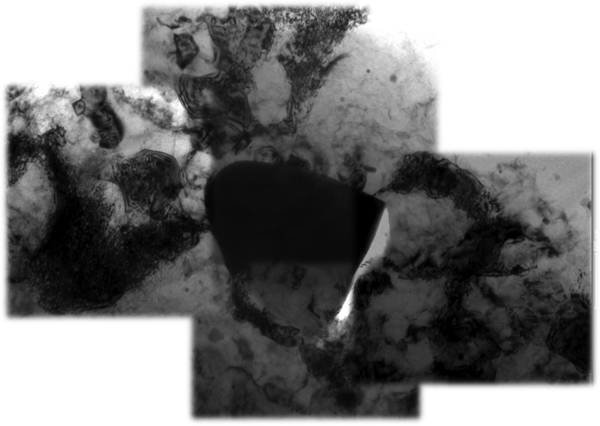
Images (TEM) of CR Al 6061 alloy annealed at 200°C for 1 h: nucleation of very fine grains at periphery of big second phase particle (particle stimulated nucleation)
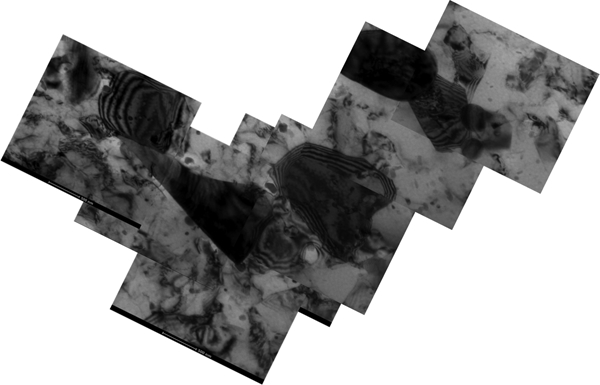
Images (TEM) of CR Al 6061 alloy annealed at 250°C for 1 h: pinning of second phase particles at grain boundaries and grain faces
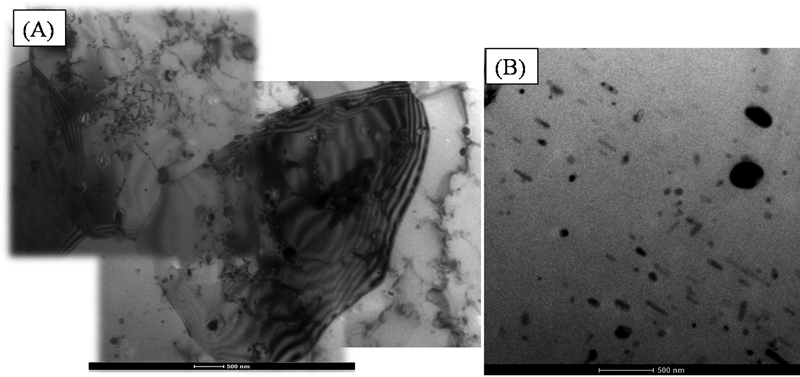
Images (TEM) of CR Al 6061 alloy annealed at 300°C for 1 h
Discussion
Effect of annealing on mechanical properties
The strengthening effect of Al 6061 alloy after cryorolling is due to the combination of grain size strengthening, high dislocation density and solid solution strengthening. Rolling at very low temperature induces the accumulation of dislocations by suppression of dynamic recovery, which leads to a high density of dislocations in the material.6 After annealing at 150°C for 1 h, the increase in UTS (296–340 MPa) and ductility (4·5–8%) is primarily due to the formation of nanosized precipitates and recovery effect. During annealing, the dislocation density gets reduced due to the recovery effect, which results in an increase in ductility. The strengthening effect due to precipitation hardening and the softening effect due to recovery are competing during annealing of CR Al 6061 alloy. The rise in strength, observed in the sample after annealing at 150°C, reflects the strengthening effect due to precipitation hardening, which dominates softening due to recovery. The slight drop in hardness from 114 to 108 HV after annealing at 200°C indicated that the softening effect due to annealing is dominating the precipitation hardening effect. Annealing temperature beyond 200°C, hardness and strength drop suddenly where the ductility increases significantly. The rise in ductility is mainly due to the formation of dislocation free equiaxed grains due to the recrystallisation effect. The softening effect due to recovery is much less than the softening due to recrystallisation.9 Increasing the annealing temperatures beyond 200°C, precipitates lose its coherency with the matrix; hence, its hardening effect is lost.18 As shown in Figs. 4D and 7, the alloys annealed after 250°C 1 h have shown a duplex microstructure consisting of equiaxed grains with 0·5–1 μm and slightly elongated grains. This observation is in agreement with the literature on the annealing behaviour of Al 5083 processed by cryorolling and Al–Mg alloys processed by ECAE, as reported by Lee et al.9 and Morris and Munoz-Morris20 respectively. At annealing above 300°C, the hardness value became almost stable, and also there is not much change observed in the strength and ductility values. The ‘β’ phase precipitates in rod shape were observed in the annealed sample at 300°C. The presence of ‘β’ phase, which is incoherent with the matrix, does not show any strengthening effect.
Role of second phase in evolution of microstructure during annealing
The major alloying elements in Al 6061 alloy are Mg and Si, and this will present in the form of dispersed particles, which get dissolved in Al to form a solid solution during solution treatment. During annealing treatment of CR Al 6061 samples, precipitation takes place simultaneously with recrystallisation. Precipitates will keep growing with increasing annealing temperature and play a significant role to stabilise the microstructure at high temperatures. These second phase effects on recrystallisation occur as follows: (1) stored energy is increased by the particle, which creates an extra particle matrix interphase or trap dislocations; (2) large particles serve as nucleation sites for recrystallisation; and (3) pinning of the grain boundaries by the particles.15 The TEM image in Fig. 4B reveals the recovered microstructure after annealing at 150°C along with very fine precipitates, which were marked in the micrograph. From the hardness evolution and XRD patterns of CR samples annealed at different temperatures, as shown in Figs. 1a and 2, it can be concluded that these fine particles correspond to β″ precipitates, which impart strength to the materials with its coherency with the matrix. With tilting of the sample, as shown in Fig. 5, it was observed that even after annealing at 150°C for 1 h, high density dislocation zones are still present without recovery. The presence of coarse second phase particles act as nucleation sites for the recrystallisation of dislocation free equiaxed grains as observed in the sample after annealing at 200°C. The presence of a duplex microstructure in the samples annealed at 200°C (Fig. 6) may be due to the heterogeneities in the sample. A discontinuous grain growth in samples after annealing at 250°C results in little variation in grain size ranging from 0·5 to 1 μm. Continuous grain growth can be expected in the fine-grained microstructure with a fraction of high angle grain boundaries >0·6.21,22 The fraction of high angle grain boundaries in the CR Al 6061 alloy is not sufficient enough for continuous grain coarsening to take place.23 Second phase particles are effectively controlling the grain growth by pinning effect at the grain boundaries, leading to the stable microstructure with grain sizes of ⩽1 μm in the samples annealed at 250°C. The volume fraction and the size of second phase particles play a major role in the effective control of grain growth. The grain growth of particle containing alloys depends on the Zener drag pressure [Pz = K(fγ/r)], which acts against the driving pressure for grain growth (Pg = αγ/D), where f is the particle volume fraction, γ is the grain boundary energy per unit area, r is the particle radius, D is the diameter of the grains, α is a geometric constant and K is a constant related to coherency.24,25 If Pz = Pg, it is known as the equilibrium case. If Pz>Pg, then the Zener drag by the second phase particle is expected to occur, and if Pz<Pg, grain growth is expected to occur. Annealing after 300°C, abnormal grain growth was observed, which reflects that, at high temperatures, the available driving pressure for grain growth dominates the Zener drag pressure exerted by the particle. It is clear that the CR Al 6061 alloy microstructure is thermally stable up to ≤250°C.
Conclusions
In the present investigation, the effect of annealing on the microstructure and mechanical properties of Al 6061 alloy processed through cryorolling was studied, and the following conclusions are drawn.
Annealing at low temepratures (150°C for 1 h), the strengthening effect due precipiataion hardnening overwhelms the softening effect due to recovery, resulting in a simultaneous increment in strength and ductility.
Annealing at 200°C results in a drop in strength (UTS: 340–312 MPa) and increase in ductility (8–13%) due to the nucleation of dislocation free grains by recrystallisation. The drop in strength at the annealing temperatures of 200–300°C is drastic due to the increase in volume fraction of the recrystallised grains.
The presence of local heterogenities results in a duplex microstructure consisting of equiaxed grains with grain size range from 150 to 500 nm along with subgrain structure with full dislocation content. Hence, a good combination of high strength (UTS: 312 MPa) and elongation (13%) is observed in the samples annealed at 200°C for 1 h.
Annealing for 1 h at different temperature ranges from 150 to 300°C reveals that the submicrometre grains of CR Al 6061 alloys are thermally stable up to a temperature of 250°C due to the effective retardation of grain growth through pinning of grain boundaries by Zener drag effect of fine second phase particles.