






Abstract
As part of a recent collection of papers discussing bearing steels published in the January 2012 issue of this journal, Kim and Lee have presented the properties of a Si modified 100Cr6 grade. Using a modified 100Cr6 grade (1·0C–0·25Mn–0·35Mn–1·45Cr (wt-)) with addition of >1Si, the authors investigated the effects of this addition on both microstructure and rolling contact fatigue. The following comments discuss the results presented in the context of published research dating back approximately 10 years.
Introduction
Kim and Lee1 have recently published a first set of fatigue results on Si modified 100Cr6. In this investigation, Kim and Lee used industrially produced 100Cr6 and modified 100Cr6 with addition of an undisclosed amount of Si to prevent formation of cementite. They report results from four-ball rolling contact fatigue (RCF) tests carried out on both materials, the conventional 100Cr6 being tempered at 170°C and the modified 100CrSi6 at 210°C, with respective hardnesses of 61·7 and 63·5 HRC. These RCF tests show an improvement of L10 life by a factor of approximately 3·4.
While these results are interesting in that they add to previously published research, it must be noted that none of the published conclusions can claim to be new, the properties of Si modified 100Cr6 having been extensively investigated in the past.2,3 The following comments briefly outline virtually identical results published previously.
Previous investigations
In previous published work, Daguier et al.,2 Cercueil-Sarete3 and Baudry et al.4,5 discussed the influence of additions of Si on the retained austenite stability of 100Cr6 grade bearing steel. In an investigation that included the effects of Mn (0·3–2), Si (0·2–2·5) and austenitising temperature (865–970°C), these authors not only demonstrated the superior stability of retained austenite with increasing Si content, but also the possibility to adjust the retained austenite content in two ways. First, through Mn additions, which result in the depression of Ms and thus in increased retained austenite content. A second method simply consisted in adjusting the carbon content of the austenite by changing the austenitisation temperature; this also results in modification of the Ms temperature and thus of the retained austenite content after quenching.
The stability of retained austenite was investigated using magnetic saturation measurements on quenched specimens (austenitised at 895°C, tempered for 1 h at various temperatures differing in increments of 20°C). In general,3 the retained austenite content did not change significantly until a critical temperature was reached beyond which it rapidly dropped to negligible contents. The temperature at which the retained austenite content fell below 80 of the initial content over the duration of tempering was reported as a function of Si and Mn content (Fig. 1).
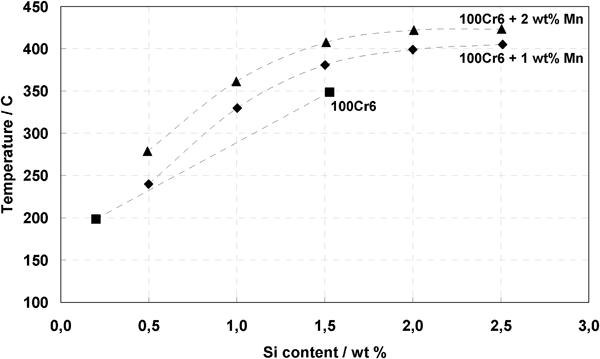
Tempering temperature to achieve destabilisation of retained austenite in 100Cr6 and modified 100Cr6 grades: after Refs. 2 and 3
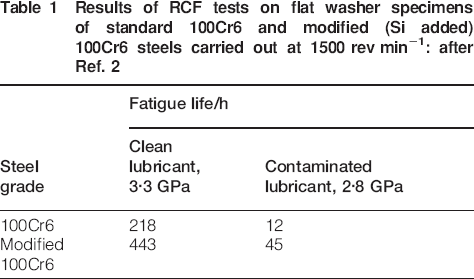
The cited authors also carried out fatigue tests: on flat washer specimens, for Hertzian contact pressures of 2·8 and 3·3 GPa, and on actual wheel and gearbox bearings, for contact pressures of 3·4 and 3·8 GPa. The results are summarised in Tables 1 and 2.
Results of RCF tests on flat washer specimens of standard 100Cr6 and modified (Si added) 100Cr6 steels carried out at 1500 rev min−1: after Ref. 2
Results of RCF tests carried out on actual bearings of standard 100Cr6 and modified (Si added) 100Cr6 steels: after Ref. 2
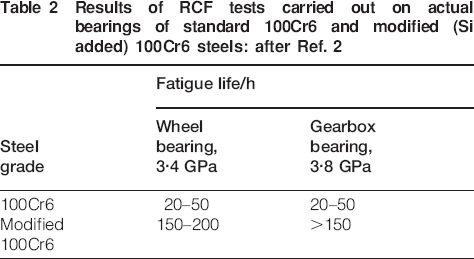
Both steels were heat-treated to achieve similar hardness (a higher tempering temperature was used for the modified 100Cr6+Si). In both types of test, the modified 100Cr6 grade performed 2–4 times better than the standard 100Cr6. The results published by Kim and Lee1 thus could confirm the improved performances of the Si modified 100Cr6 grades, even at the very high loads used by these authors (5·8 GPa). It would, however, be prudent to ensure that the perceived improvement in this case is not related to the higher hardness of the modified 100Cr6 steel.
Conclusions
The results published by Kim and Lee1 bring additional evidence of the interest of Si added 100Cr6 grades for bearings operating in severe conditions (high loads, contaminated lubricants). However, caution must be exercised as the higher hardness of the Si added grade may in part explain the improved performance reported in this case.
The claim that the steel, its microstructure and RCF properties are new should be reconsidered in view of the existing literature.
Ascometal CREAS, BP 70045, 57301Hagondange Cedex, France
Kim and Lee respond
We appreciate the discussion of our paper1 by Sourmail, Méheux, and Auclair, who also provide a useful summary of the extensive work they and colleagues have performed previously.2,4,5 The results they summarise indicate that the rolling contact fatigue performance of 100Cr6 steel can be increased significantly by optimising alloy design, where not only Si but also Mn content was increased. The effect of Mn on martensite start temperature is usually larger than that of Si;6 therefore, if Mn is increased together with Si, the stability of retained austenite will be higher than if Si content alone were increased. In our work,1 the rolling contact fatigue life of 100Cr6 steel has been improved markedly by increasing Si alone. This implies that Mn is not necessary to improve the rolling contact fatigue characteristics of 100Cr6 steel, a conclusion that is distinct from the results of Daguier et al.2
Sourmail et al. also comment that it would be prudent to ensure the perceived improvement in fatigue performance of these modified 100Cr6 steels is not related to their higher hardness. As stated in the paper,1 the higher stability of retained austenite in the Si modified steel than in unmodified 100Cr6 (in spite of the two alloys having the same carbon content) is considered to play a favourable role in enhancing the fatigue life. However, the effect of increased hardness on the fatigue life of 100Cr6 steel cannot be ignored, because hardness affects a material's resistance to penetration, and hence wear, and can therefore influence the rolling contact fatigue characteristics of bearing steels.7 Nevertheless, the higher stability of retained austenite is, we believe, a more convincing explanation for the improvement of rolling contact fatigue life reported for the Si modified steel.1
Finally, we would like to emphasise that the fundamental finding of our paper is not that superior rolling contact fatigue characteristics of 100Cr6 steel can be achieved by modifying its composition, but to determine why the retained austenite is more stable in Si modified steel, leading to the improvement of rolling contact fatigue resistance. Daguier et al. showed the superior rolling contact fatigue characteristics of 100Cr6 steel in which both Mn and Si contents were increased, but did not address the underlying mechanisms. In our paper, the higher stability of retained austenite (proposed as the main factor contributing to the longer fatigue life of Si modified steel) is shown to result from the absence of precipitation of fine ϵ-carbides during tempering. If carbide precipitation does not occur during tempering, the carbon atoms supersaturated in martensite by quenching will be partitioned into retained austenite during tempering, increasing the stability of the austenite phase.
Wire Rod Research Group, Technical Research Laboratories, POSCO, 1, Geodong-dong Nam-gu, Pohang, Gyeongbuk, 790–785, Korea