







Abstract
By accelerated tests and electrochemical measurements, the characteristic of four self-assembled monolayer (SAM) covered silver, which were octadecanethiol monolayer from aqueous solution (OSA), octadecanethiol monolayer from organic solvent (OSO), phytic acid monolayer (IP6) and silicon tungstemic acid monolayer (STA), was studied. The results indicated that the OSA, STA, IP6 and OSO on the silver provided a practical method to prevent silver from tarnishing. All SAMs acted as cathodic inhibitors. The protection effect of OSA was similar to that of OSO, both of which were more effective than IP6 and STA. The charge transfer resistance increased from 76 Ω cm2 for bare silver up to 1456, 474 , 1050 and 1212 Ω cm2 for OSA, STA, IP6 and OSO covered silver respectively. The 48 h accelerated tarnishing tests proved the protection efficient of SAMs, in the order OSA≈OSO>IP6>STA, which indicated that STA and IP6 were not the completely compact film.
Introduction
Silver is applied in various fields, such as jewellery, cutlery, art, electronic industries, photographic film, etc., for its lustrous surface and excellent physical property. Unfortunately, when silver is exposed to the atmosphere, it will tarnish rapidly. This is a serious problem in industry and archaeology.
Nowadays, many surface treatments have been developed to prevent silver from tarnishing. The widely used methods are chromate based antitarnish method, oxide layers technique, lacquer coating, metal layers and thiol based antitarnish film. The chromate based antitarnish method had been successfully used in industry, but it was very poisonous and dangerous. Although the other methods could also reduce the aggressiveness of the atmospheric pollutants, they either were expensive, such as metal layers, or brought the additional visual change in silver colour, such as the coatings of zapon and stoving lacquers. For silver coin, it is highly important that the protective film not only should not alter its appearance but also should be easily applied and removed for repair purpose.
Recently, the application of alkanethiol self-assembled monolayers (SAMs) was used to protect silver substrate. Burleigh et al. developed a four-step procedure to inhibit the silver from tarnishing by depositing hexadecanethiol SAMs onto its surface.1 Magali found that the hexadecanethiol SAMs on silver were invisible and could prevent silver from tarnishing in the highly aggressive medium containing 0·5M NaCl and 0·01M Na2S solution.2 Bernard et al. found that the antitarnish effect of hexadecanethiol SAM film was more efficient than that of poly(amino-triazole)3 and fluorinated amidethiol films.4 By forming covalent-like bond between silver and sulphur atoms, these adsorbed alkanethiols formed dense monolayers onto the silver. Since SAMs were only a few nanometres in thickness, they were undetectable by the naked eyes and were an ideal treatment to slow the silver coin's atmospheric tarnishing without changing its lustre and appearance. Although several SAMs have been used to prevent silver coin from tarnishing, there are few references about comparing their protective action among several SAMs on the surface of silver coin.
In this paper, octadecanethiol SAMs, which were formed on silver in micellar aqueous solution, were used to prevent silver from tarnishing. Its antitarnish performance was systematically studied and compared with that of SAMs formed in organic solvent, phytic acid solution5 and silicon tungstemic acid solution.6
Experimental
Chemicals
1-Octadecanethiol (97·5%, 74731; Fluka,Milwaukee, WI, USA), cetane trimethyl ammonium bromide (CTAB; 99·0%, Kermal, Tianjin, China), phytic acid (70%) and silicon tungstemic acid(α-H4SiW12O40.12H2O) were commercially available (Guangdong Guanghua Sci-Tech. Co., Ltd.). Deionised (DI) water (18·2 MΩ cm) from an arium 611Uv system (Sartorius, Goettingen, Germany) was used to prepare the micellar aqueous solution and rinse the samples in the experiment. All other reagents were analytical grade (Tianjin Kermel Chemical Reagent Co., Ltd.).
Substrate treatment
The silver substrates and the silver coins (>99·99% pure) were supplied by Shenyang Mint (Shenyang, China). The substrates were cut into 2×2×1 cm slices. Before use, the sample was polished successively with SiC paper up to 2000 grade and then with 0·3 μm Al2O3 powder to a smooth mirror, rinsed with DI water and then degreased with acetone in ultrasonic bath for 12 min.
Self-assembled monolayer preparation
Octadecanethiol SAMs formed in aqueous solution (OSA)
Silver substrate was first etched with 10% sulphuric acid for 5 min, rinsed with DI water and then immersed into micellar aqueous solution containing 40 g L−1 CTAB and 0·15 mol L−1 octadecanethiol at 60°C for 5 min. After the sample was spray rinsed with isopropanol and DI water and dried with nitrogen, octadecanethiol SAMs were obtained.
Octadecanethiol SAMs formed in organic solvent (OSO)2
Silver substrate was etched with 10% sulphuric acid for 5 min, rinsed with DI water and then immersed into isopropanol solvent containing 0·15 mol L−1 octadecanethiol at 60°C for 12 h. After the sample was spray rinsed with isopropanol and then dried with nitrogen, octadecanethiol SAMs was obtained.
Phytic acid SAMs (IP6)5
Silver substrate was first reduced at −0·25 V for 120 s, then at −0·5 V for 60 s in 0·1 mol L−1 KCl solution. Pt wire and a saturated calomel electrode were used as auxiliary and reference electrodes respectively. After being rinsed with DI water, the silver sample was immersed into 0·01 mol L−1 phytic acid solution for 0·5 h at room temperature. Then, the sample was spray rinsed with DI water and dried with nitrogen.
Silicon tungstemic acid SAMs (STA)6
Silver substrate was first reduced at −0·8 V for 10 min in 0·5 mol L−1 HClO4 solution. Pt wire and a saturated calomel electrode were employed as auxiliary and reference electrodes respectively. After being rinsed with DI water, the silver sample was immersed into the aqueous solution having 0·1 mmol L−1 H4SiW12O40 and 0·1 mol L−1 HClO4 at room temperature for 2·5 h. The sample was spray rinsed with DI water and dried with nitrogen.
Electrochemical tests
Electrodes
A Princeton K0235 flat cell (Princeton Applied Research, Oak Ridge, TN, USA) was used as the electrochemical test set-up. The working electrode was silver plate with 1 cm2 exposure area. A platinum grid was used as counterelectrode, and the reference electrode was Ag/AgCl with saturated KCl solution.
Solutions
Solutions, having 0·5 mol L−1 NaCl and 0·01 mol L−1 Na2S, were used for open circuit potential and electrochemical impedance spectroscopy (EIS) measurement. For cyclic voltammogram test, the solution was 0·5 mol L−1 NaOH. All solutions were predeoxygenated for 30 min with Ar and protected by Ar during the test.
Electrochemical measurements
Electrochemical measurements were carried out with a Princeton Applied Research equipment (EG&G 2273). The procedure was controlled by the Powersuit software, and the data were calculated with ZsimpWin. Electrochemical impedance spectroscopy measurement was made at the open circuit potential with a 5 mV ac perturbation. The frequency domain was controlled between 100 kHz and 0·01 Hz. Cyclic voltammograms were recorded between −0·2 and 0·8 V with a scan rate of 5 mV s−1.
Tarnish test
Accelerated tarnish tests of silver with and without SAMs were performed according to BS EN ISO 4538:1995 (TAA test). The test conditions were as follows:
medium: thioacetamide
temperature: 18–25°C
relative humidity 75%.
Results and discussion
Morphology of SAMs
Figure 1 shows the scanning electron micrograph of a silver coin covered with OSA, STA, IP6 and OSO respectively. All SAMs were compact, homogeneous and had no defect. Silver corrosion was not observed during the process of preparing SAMs.
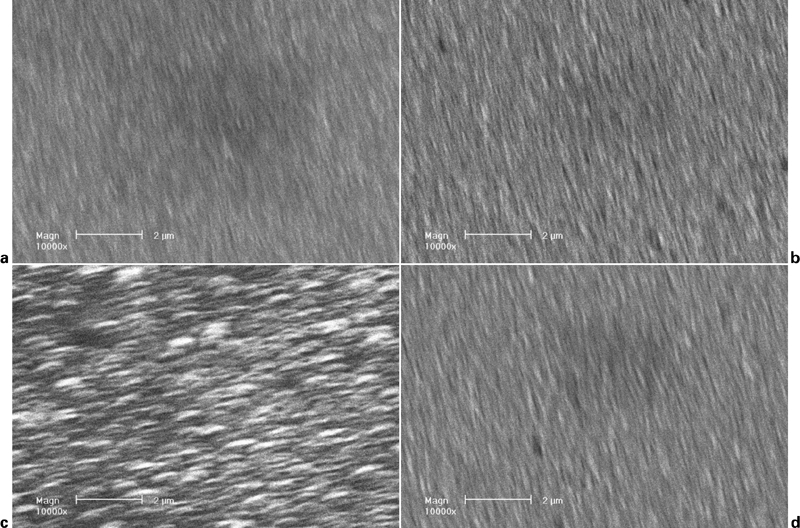
Image (SEM) of silver coin covered with SAMs of a OSA, b STA, c IP6 and d OSO
Change in open circuit potential during tarnishing
The changes in open circuit potential for unprotected and protected silver are shown in Fig. 2. After 500 s, the open circuit potentials of silver, covered with OSA, STA, IP6 and OSO, were −0·69, −0·71, −0·71 and −0·70 V respectively while that of the blank was −0·74 V. The steady state potential values for covered silvers were obtained after 3000 s, which were about −0·71 V, whereas the blank's potential was still about −0·74 V. The results indicated that the SAMs were steady.
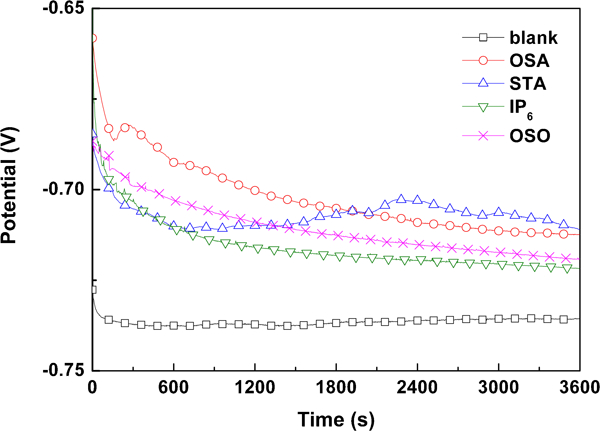
Potential changes during corrosion test for bare silver coin and silver with SAMs of OSA, STA, IP6 and OSO in 0·5 mol L−1 NaCl+10 mmol L−1 Na2S
Polarisation curves
Figure 3 presents the polarisation curves of the bare and the covered silvers in 0·5 mol L−1 NaCl+0·01 mol L−1 Na2S aqueous solution. From the figure, for covered silvers, both the anodic and the cathodic procedures were all suppressed, and the suppressed effect for cathode was better than that for anode. The protective effect of OSA and OSO was greater than that of STA and IP6. From the above results, it can be inferred that the monolayers acted as cathodic inhibitors by retarding the oxygen depolarisation. The cathodic current densities for silver covered with OSA and OSO were 11 μA cm−2 at −0·1 V while that with STA and IP6 were 26 μA cm−2. For anodic procedure, the order of the protective action for the four SAMs was OSO>OSA>IP6>STA.
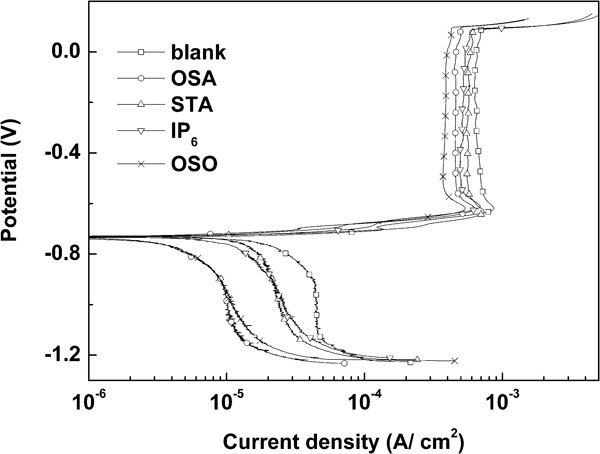
Polarisation curves of bare silver coin and silver with SAMs of OSA, STA, IP6 and OSO in 0·5 mol L−1 NaCl+10 mmol L−1 Na2S
Table 1 illustrates the corrosion current densities determined by extrapolating the Tafel line of the polarisation curve. Based on Table 1, the protecting efficiencies (P%) of the SAMs were calculated using the following formula: P% = 100×(1−i/io), where i and io are the corrosion current densities of the protected and the bare substrate respectively. According to the above formula, the protection efficiencies for SAMs are also given in Table 1. It manifested that the antitarnish performance of OSO and OSA was more efficient than that of STA and IP6.
Corrosion current density, Tafel slopes, polarisation resistance and protection efficiency η of bare silver coin and silver with SAMs of OSA, STA, IP6 and OSO in 0·5 mol L−1 NaCl+10 mmol/L Na2S

Cyclic voltammetry
Figure 4 shows the cyclic voltammetric curves of silver oxide's formation/removal in 0·1 mol L−1 NaOH on the bare and the covered silver. The curves for the bare silver exhibited two oxidation peaks at ∼0·36 V (peaks a and b) and 0·74 V (peaks c and d) and two large reduction peaks at ∼0·37 V (peak e) and 0·04 V (peak f). Peak b was related to the formation of Ag2O layers. The oxidation of silver included many steps according to Ref. 7. The oxidation peak at 0·36 V was often divided into tripeaks. Before peak b, there usually had two satellite peaks. When the scan rate was slow, the two satellite peaks would join into an indistinct one. Peak b was related to the oxidation process of silver from Ag to Ag2O

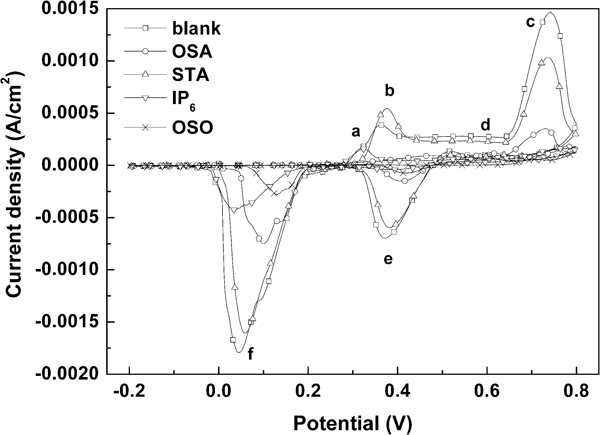
Cyclic voltammograms for bare silver coin and silver with SAMs of OSA, STA, IP6 and OSO in 0·5 mol L−1 NaOH (the scan rate is 100 mV s−1)
There were several small peaks in the cyclic voltammetric curve for the silver covered by SAMs. From the figure, both the anodic and cathodic peaks, which corresponded to the redox of silver, were all strongly inhibited, especially for silver covered with SAMs formed in TX-10 aqueous solution. It manifested that the diffusion of OH− to the silver's surface was controlled by the SAMs, and the silver electro-oxidation only took place at the defective sites within SAMs. At the same time, the cathodic peaks e and f were larger than the anodic peaks b and c, which attributed to the gradual removal of the monolayers from the silver substrate via electrochemical desorption.8,9 The peak currents with and without monolayer were obtained in Table 2. The peak currents of the silver covered by OSA and OSO were smaller than that of STA and IP6.
Peak current of cyclic voltammograms of bare silver coin and silver with SAMs of OSA, STA, IP6 and OSO in 0·5 mol L−1 NaOH
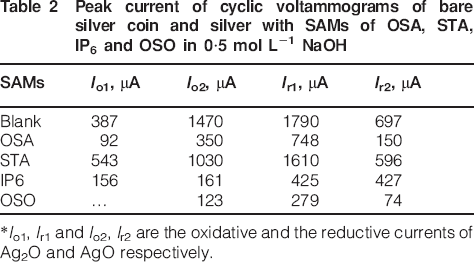
Io1, Ir1 and Io2, Ir2 are the oxidative and the reductive currents of Ag2O and AgO respectively.
Electrochemical impedance spectroscopy
Electrochemical impedance spectroscopy had been successfully applied in investigating SAMs.2,3,10 Electrochemical impedance spectroscopy provided a method to characterise film coverage on electrodes, which was related to charge transfer resistance Rt. Interface capacitance was also used to characterise the film. Figure 5 presents the Nyquist plots of both the bare and the protected silver by SAMs. The impedance of the covered silver was several orders of magnitude greater than that of unprotected silver. Therefore, the SAMs provided significant protection against corrosion.
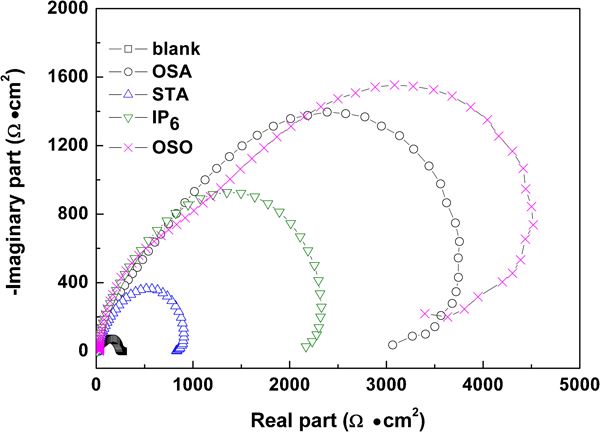
Nyquist impedance plots for bare silver coin and silver with SAMs of OSA, STA, IP6 and OSO in 0·5 mol L−1 NaCl+10 mmol L−1 Na2S
The EIS data were fitted using the ZsimpWin software (EG&G) based on Takenouti's model,2 which is shown in Fig. 6. In the figure, Rsol was the solution resistance between the reference electrode and the counterelectrode. Cf and Rf represented the capacitance and electrical leakage through ionic conduction of the surface film respectively. For bare silver, these two parameters were discarded; Cd and Rt corresponded to the double layer capacitance and charge transfer resistance. The resistance could be related with the corrosion current; CF and RF represented faradic impedance involving corrosion product. In practical electrode system, the impedance spectra were often depressed semicircles with their centre below the real axis.11 This phenomenon was the dispersing effect. Therefore, a constant phase element (CPE) was used as a substitute for the ideal capacitor.12 The impedance of CPE could be expressed as

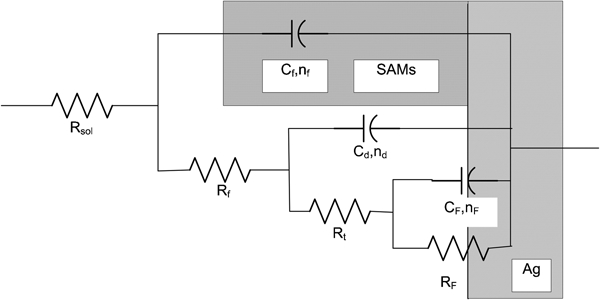
Equivalent circuits used to model EIS data for SAM covered silver
The calculated values of the parameters are summarised in Table 3. The values of Cd for bare silver was 317·2 μF cm−2 and that for OSA, STA, IP6 and OSO covered silver were 51·1, 403·2, 219·1 and 81·5 μF cm−2 respectively. The decrease in Cd was due to forming close packed interconnected structure film on the silver surface.14 The characteristic of STA was less than that of the others.
Values of elements of equivalent circuits of covered silver with SAMs of OSA, STA, IP6 and OSO and calculated film coverage θ
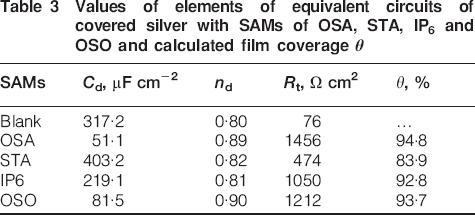
Rt of bare silver was 76 Ω cm2. After being covered by OSA, STA, IP6 and OSO, the value was increased to 1456, 474, 1050 and 1212 Ω cm2 respectively. The increase in Rt implied the inhibiting effect increasing. Sabatani and Rubinstein15 suggested that the increase in the charge transfer resistance was related to the electrode coverage. Areas of the metal covered with organic film were chemically inert, and all the current passed by the pinhole and defects in the electrode. The coverage θ of the film on silver surface was given as

 and Rt are the charge transfer resistance of bare silver and SAMs covered electrode respectively. The results are shown in Table 3. It could be seen that the coverage of OSA was the largest and that of STA was the smallest.
Accelerated tarnishing tests
Figure 7 illustrates the visual aspects of silver coin after 72 h tarnishing tests. For bare silver, the surface was covered by a red brown layer, and many dark brown stains appeared. The silver with OSA and OSO had no marked change in visual inspection. There were several brown spots distributed on silver coin covered by IP6. Many stains appeared on the silver coin protected by STA. It could be concluded that OSA, OSO, IP6 and STA could prevent silver substrate from reacting with sulphur pollution. Both OSA and OSO provided excellent protection.
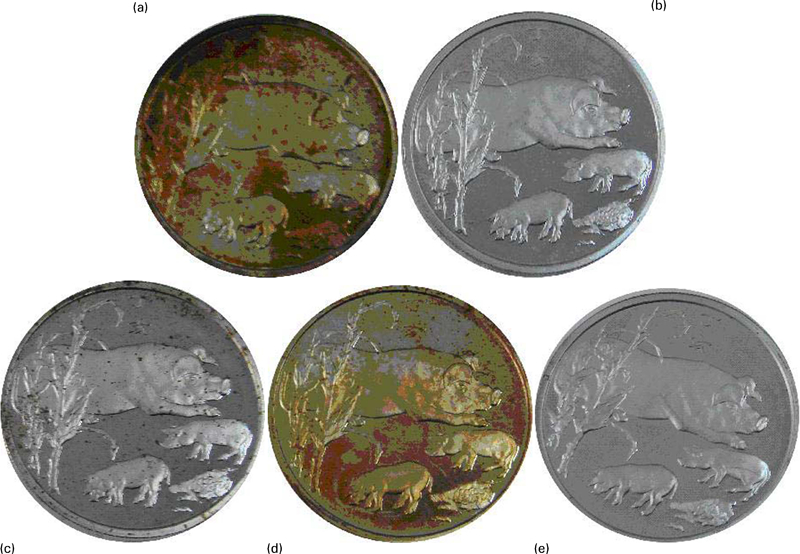
Image of a bare silver coin and the SAMs coated silver coin from b CTAB, c IP6, d α-H4SiW12O40 and e isopropyl after 72 h accelerated test
Conclusions
The OSA, STA, IP6 and OSO on silver provided a practical method to prevent it from tarnishing. The monolayer films provided resistance to atmospheric effects without affecting the appearance of the metal. All the SAMs acted as cathodic inhibitors. The protection effect of OSA was similar to that of OSO, both of which were more effective than IP6 and STA. The charge transfer resistance increased from 76 Ω cm2 for bare silver up to 1456, 474, 1050 and 1212 Ω cm2 for OSA, STA, IP6 and OSO covered silver respectively. The 48 h accelerated tarnishing tests proved that the order of the SAM protection efficient was OSA≈OSO>IP6>STA. This indicated that STA and IP6 on silver coin were not a completely compact film.