






Abstract
Text-based reasoning has, naturally, been crucial to intellectual activity; but it does not represent the entire map in cognition and education. With modern students so responsive to visual stimuli, visual analogy provides a fascinating resource in the exploration of fresh learning interfaces between subject areas, galvanising important new modes of creative-critical teaching across the disciplines and carrying the potential to ignite deeply participatory interdisciplinary discussions. The type of analogy emphasised here is termed a ‘scientific Visualization’; it derives from observable phenomena in technology and science, and is put to use, in this paper, chiefly within literary studies. A spectrum analogy for intertextuality is introduced, developed later into a filter analogy providing a particular perspective on translation. Further analogies examine various aspects of textual reception through genetics, crosstalk and chaos theory. Attractive, novel and accessible, these materials open up a range of cross-disciplinary prospects in research and teaching. Offered in a spirit of serious play, the examples presented in the figures establish the basis for a much wider pilot study; the hope is that the approach will eventually be deployed across many fields.
Keywords
Introduction
With the student body increasingly attuned to visual input, and tertiary education involved in modular degree-building, visual analogy might contribute a pertinent means to investigate new learning interfaces between disparate subject areas, helping to galvanize fresh modes of creative-critical teaching across the disciplines. Indeed, David Bohm's hypothesis of an ultimately unified universe (interpreted here, for conceptual space, via a 3D Venn diagram) might even suggest that any visual analogy — by its very existence — opens a potential window on the infinite ‘whole’ of intertextual discourse. Whether or not this proves to be the case, there is a growing sense in some quarters of education that conventional text-based methods and models are, at best, partial. The type of educational analogy emphasized in this paper — termed a ‘Visualization’ — consists of a visual abstraction derived from observable phenomena. A number of Visualizations arising from technology and science are presented, including a spectrum analogy for intertextuality, subsequently developed into a filter analogy casting a particular light on translation. Further examples include reception processes framed in terms of genetics, crosstalk and chaos theory. These attractive scientific forms, offered in a spirit of serious play, represent a work in progress, requiring consolidation; but they serve to prime the more ambitious enterprise of exploring the potential of this approach across many fields of study. Having already been used to ignite participatory discussions among literary studies students, this work has as its eventual goal the provision of an array of Visualizations operating across the sciences and humanities.
A tripod opening
Essentially, my approach rests on: (1) an interpretation of Kant's analysis of perception and cognition (at the start of ‘Transcendental doctrine of elements’; Kant 1934); (2) the writings of David Bohm; (3) an insistence upon analogies as opposed to models.
Leg 1: Visualization and Visualizability
The fuse for deepening and consolidating my early attempts to link literary studies and the sciences through visual analogy was provided by Kant's distinction between sensation and intuition, concepts which have since been developed as the technical terms ‘Visualizability’ and ‘Visualization’ (Kant 1934, 41; Miller 1996, 45). In fact, Miller was invaluable in testing my terminology, since I had already coined ‘Visualization’ for myself and was thinking through my own interpretation of Kant's distinction: sensation (or Anschaulichkeit) as the Visualizability presenting itself as concrete physical behaviour; and intuition (or Anschauung) as the abstract Visualization deduced by the observer. The details of Kant's (or any subsequent) use of these expressions need not concern us here, particularly as my wording and sense may not correspond with what is given elsewhere in the literature. For the specific purposes of this paper, I define the relevant terms quite generally, as below.
A useful illustration here is the familiar physics experiment, where iron filings are sprinkled on a piece of card lying on a bar magnet. Tapping the card generates 2D patterns in the filings which, though never quite identical, are distinct and recognizable, arising from the Visualizability of the magnetic field as expressed in that type of set-up. Varying the experiment enables a systematic and intuitive observer to map out the Visualizability, and eventually to discern (as stated in the definitions above) the underpinning ‘pattern of behaviour informing’ it, thereby extracting a 3D representation of the magnetic field in terms of lines of force. This generalized, abstract representation is the Visualization. My relatively straightforward example should not lead, however, to the misconception that a Visualization is just a technical drawing of observed results, an imitational diagram that merely simplifies or cleans up the perceived Visualizability. Visualizations reach deeper than that: cognitively realized as an abstract form, they preserve (however obviously) some aspect of the organizing forces involved. Often, this abstraction is quite different, visually, from its originating phenomena: the emission spectrum for hydrogen, for instance, observed (in part) as a series of coloured parallel lines on a dark background (=the Visualizability), may be interpreted through the much-used Visualization of a quantized solar system, where an electron orbits the nucleus at definite energy levels.
In a previous incarnation as a physicist, I worked with Visualizations all the time; more recently, I have begun to ask whether there are Visualizabilities operating within (or between) texts which might correspond, however weakly, to Visualizations deployed in scientific circles. Here, I extend the phenomena of my definitions beyond the merely physical processes of science, to include systems of signification such as text, cultural artefacts and conceptual operations. Might it be possible then, in this reformulation, to develop specific scientific Visualizations that operate as analogies for certain aspects of critical-creative discourse in literary studies, thus forging new links between the two fields? My initial impetus of curiosity rapidly evolved into a constructive challenge against those regions of literary investigation conventionally, and overwhelmingly, rooted in text.
Leg 2: Implicate order, conceptual space: The Venn Visualization
My reasons for pursuing this research are partly intuitive, mainly empirical (invigorated students, elated colleagues) and, to a degree, theoretical. In this last respect, Bohm provides some of the pivotal concepts, excavating issues at the very core of science, perception and order (Bohm 1983, 1996, 1998; Bohm and Peat 2000). Put simply, and in deep paraphrase, Bohm's Explicate Order is what we observe when the universe delivers itself to our senses or instruments according to clear (i.e. stable, recurrent) patterns of behaviour — as with the iron filings above. It is akin to Kant's sensation. An Implicate Order, however, denotes a hidden layer of organization which underlies the Explicate Order and from which the explicate behaviours unfold. One might tentatively suggest, then, that Visualizability is related to Explicate Order, while Visualizations reflect the deeper organizing forces of Implicate Order (these, I stress, are provisional thoughts generated within and for this particular study). For Bohm, Implicate Orders continue without limit, implicating the whole in every explicated part, so that even (what may seem to us) unrelated, random or chance phenomena will make sense at some buried level (Bohm and Peat 2000, 127). The totality at the deepest levels of Implicate Order is termed the holomovement, which is ‘unknown and undescribable’ (180).
Bohm's term holomovement (from Gk. hólos, ‘entire’ or ‘whole’, as in ‘hologram’) is precisely constructed, indicating that apparently discrete entities or separate phenomena are simply the local expressions of an essentially fluxile, ultimate unity. The self-contained, autonomous entities of science are thus approximations: seen in a sufficiently broad context, they constitute particular unfoldings of the undivided holomovement, ‘rather than disjoint and separately existent things in interaction’ (Bohm 1983, 157). Bohm applied his ideas to language, literature, music and art — drawing all life and, indeed, our very consciousness into the holomovement. If there is anything to his conjecture, then it is important to continue the cross-exploration of subject areas traditionally kept well apart, utilizing all the means at our disposal. There would seem no obvious reason not to include visual analogy, at least initially, among the candidate tools, particularly as analogy is a key method by which likenesses are revealed. In any case, however hypothetical and experimental the enterprise may seem, I find it irresistible that the formulation of cross-disciplinary analogies may be nibbling a little way into theuniverse's underlying structures.
If Bohm's ideas (or my application/interpretation of them) were to prove erroneous, my approach would still not be altogether sunk. After all, in our everyday operations, ‘we almost always express ourselves by conceptualizing one domain of entities in terms of another ’ (Miller 1996, 219, invoking the work of Lakoff and Johnson 1980), suggesting that analogy plays a major role in language and thought. Indeed, for some theorists, analogy is fundamental to the whole of human cognition and perception (Chalmers et al.1991; Hofstadter 2001). What is more, given that linguistic and visual forms overlap on some level cognitively, then it is plausible to suggest that the ability of language to connect widely different aspects of experience and knowledge may be reflected by a similar capability among visual forms (as evidenced, to some extent, by existing visual analogies). In short, using visual analogy to engage the possible concurrences between such disparate concerns as (say) electronics and translation may not be as absurd as it first appears.
One should note that ‘non-Bohmian’ science, too, driven by the desire to rectify its theoretical and experimental anomalies, seeks to expand its understanding through a continuing process of consolidation, extension and assimilation, revealing deeper cognitive layers that not only deliver fresh insights and raise questions of greater profundity but also (importantly in this context) enable hitherto unrelated zones of scientific observation to be yoked together. In physics, for example, magnetism and electricity were spliced (as electromagnetism) through Maxwell's equations, themselves then shown to be consistent with Einstein's Special Relativity. The attempt to unite all the forces of nature under a single banner continues, ultimately leading (many hope) to Grand Unification Theory and that holy grail, a Theory of Everything. By analogy, then, and given an equivalent desire across many fields of inquiry to overcome artificial delineations and the various anomalies these create, the activity outlined in this paper might warrant some attention.
Figure 1a attempts to represent aspects of the above thinking, via a Visualization of conceptual space drawn from Venn diagrams. Extended from their usual two dimensions into 3D, the Venn circles here become Venn spheres (or ‘bubbles’). Each bubble is a portion of conceptual/cognitive space, standing (in our case) for some means of understanding text: an analytical technique, say, or a particular theory or model; or, for that matter, a Visualization concerning text. Bubbles have correspondences with other bubbles, which is where (and why) they overlap. Since each bubble overlaps with many others, the analogy only really works in n-dimensional space, i.e. within the totality of conceptual space. Such a space, however, is not easy to Visualize (i.e. to represent as a Visualization); so the 3D perspective will have to do. Figure 1b extends the analogy to suggest that logical/conceptual space only represents part of the picture. Other modes of textual reception can be Visualized, creating ‘bubble-rafts’ which also overlap in a Venn manner (again, in n-dimensional space). These complex overlapping spaces provide a possible Visualization (albeit rendered in a primitive, approximate way) for the complete human experience or sum (=Σ) of a text.
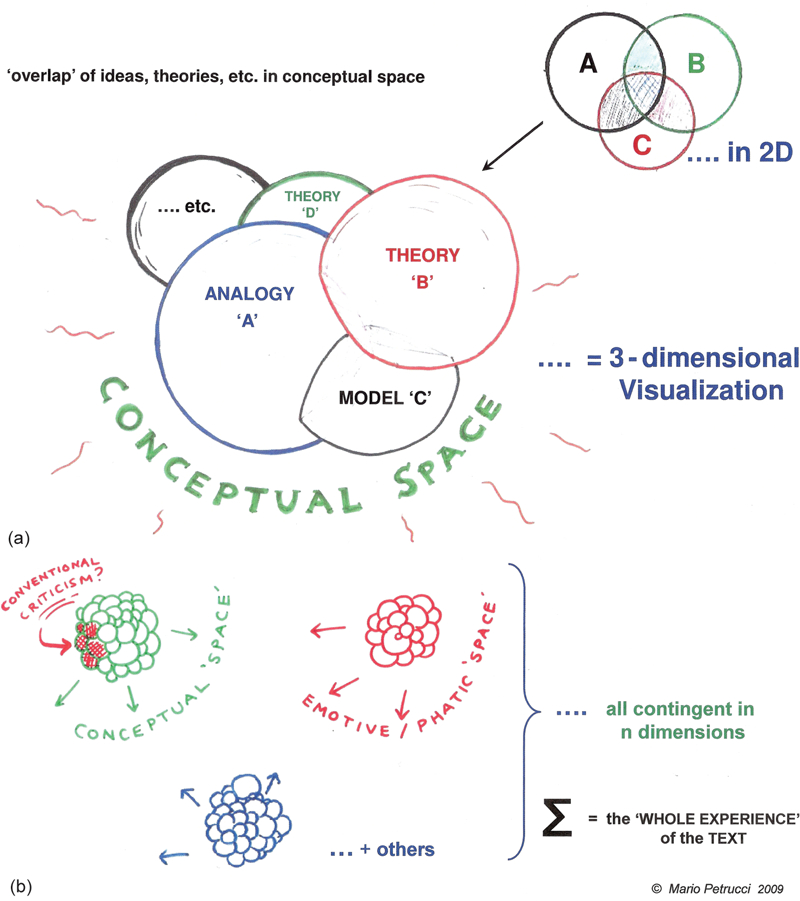
a Venn analogy (‘overlap’ of ideas, theories, etc. in conceptual space); b Extension of Venn diagram analogy to multi-dimensional space.
Within this Venn analogy, the limitation of a critical commentary relying upon a few separated-out bubbles of conceptual space is not difficult to spot. Nor is it a huge step to a striking hypothesis: if consciousness itself — along with its concept-making — arises from Bohm's holomovement (which is, admittedly, unproved, and may even be unprovable), then it follows that every conceivable bubble in my analogy (i.e. any theory, model or Visualization we can construct or imagine) must somehow, at the deepest levels of Implicate Order, overlap with all the others by mere virtue of its conceivability. It is then a matter of what forms those overlaps take and how (or if) they can be made clear or describable. Also, is an analogy its own discrete bubble overlapping strongly (with the source-target bubbles it interrelates), or is it part of the content within that overlap itself? Either way, one supposes that most overlaps would occur at too profound a level to be easily grasped or explored; but that may not be true of them all. This, in a sense, restates the teacher's instinct that ideas produced by students in moments of intuition, however wild in content and form, can usually be turned to some good — and here, at the very least, is a mechanism (albeit a hypothetical one) by which Visualizations derived from one field of study may have resonances (or perhaps even applications) in another.
Leg 3: Analogies versus models
My final, stabilizing leg differentiates models from analogies. ‘Analogy’ stems from the Greek análogos, meaning conformable or proportionate; ‘model’ is based on the Latin modulus, denoting measure. Models are characterized, tested and assessed by their ability to (measurably) repeat and predict; analogies are generally more fluid, flexible and interpretable, operating through suggestion or parallels. Analogy, I suggest, rides much closer to simile and metaphor than to theoretical modelling. The Shorter OED defines analogy as ‘equivalency or likeness of relations’ or ‘presumptive reasoning based on the assumption that if things have some similar attributes, their other attributes will be similar’. A model, however, is (in The Concise Oxford Dictionary): ‘a simplified description, especially a mathematical one, of a system or process, to assist calculations and predictions’. I do not claim this distinction as universal, or that models and analogies are unrelated; but I do emphasize how the modes of analogy espoused here focus on inventive connectivity over predictive rigour.
Scientists (in spite of their reliance on scientific method and mathematics as major means of expression, prediction and verification) frequently resort to simile, metaphor and analogy (rather than models) in the explication and popularization of their ideas, as well as in the perception of phenomena. Such use can be described as ‘a process of transferred pattern recognition’ (Wall and Tudor Jones 2006, 467). This — our innate, developing ability to recognize transferable patterns — is far from exhausted. I believe analogies can be exploited more extensively in the provision of broad and accessible gateways into and between a variety of subjects. After all, scientists themselves have long recognized the benefits, in teaching contexts, of a good analogy over a precise model. A model is subject to the concepts, conventions, procedures and terminology of its discipline, and so requires from the novice an (often) extended process of cognitive acquisition along distinct pathways; a good analogy, though, makes up for what it may lack in rigour by having one foot in something more familiar to the student than the specialist field it relates to, thus generating important initial inroads and insights for fledglings of that new or difficult terrain.
My key reason, however, for keeping these investigations model-free (at least at this stage of the project) is that attempting to formulate thoroughgoing models linking the sciences with textual analysis would probably lead to something complex, technical, arcane, programmatic and (particularly for non-specialists) dull. I prefer to develop attractive, accessible visual analogies that might prove exhilarating, fruitful and liberating. Progress has already been made: some pilot Visualizations, drawn from the scientific domain, are offered below to act as analogies for certain aspects of textual reception. Each therefore has (to some extent) the inbuilt character both of an analogy and of a scientific Visualization. From here onwards, wherever the simple term ‘Visualization’ appears, it may well refer to a Visualization of this analogic type. Moreover, although it has been helpful in these opening passages to define and understand Visualizability, discussion will now tend to focus on Visualizations, particularly for practical application.
Intra-textuality and the textual continuum
My first Visualization from physics is based on a spectrum, the best-known example of which is the electromagnetic spectrum. This has (short wavelength) X-rays and gamma rays at one end and (long wavelength) radio waves at the other, with the rainbow of visible colours arrayed between. Figure 2 relates this straightforwardly linear visual structure to intertextuality (a term I deploy, here, in a most general way, to accommodate the whole variety of possible characteristics of texts as well as the relationships between/within texts and their language bases). The resulting analogic textual continuum is available to intertextuality in its various degrees, gradations and types. Along this line, relevant features of the text(s) are identified, related to other texts or characterized according to familiar intertextual modes. For instance, blatant plagiarism, direct quotation and (at the very limit, perhaps) verbatim reproduction occupy the most explicit (Pope 2002) extreme. My Intra→Implicit→Explicit progression is in no way definitive, however, and the figure's detailed annotation is mutable, a particular example of what might be envisaged. The way a given text is placed on (or profiled/mapped along) the line will of course depend on how the continuum is interpreted, what it is in the text that interests us, and the stage of composition/reproduction/reception at which such issues are addressed. One student might deem the figure to be little more than a convenient axis whose wavelengths loosely signify specific intertextual insights; another, that peaks in the spectrum correspond to particular, characterizing modes of intertextuality and their cultural reception, as though we were seeking to register a series of resonances between the given text and literature/culture at large.
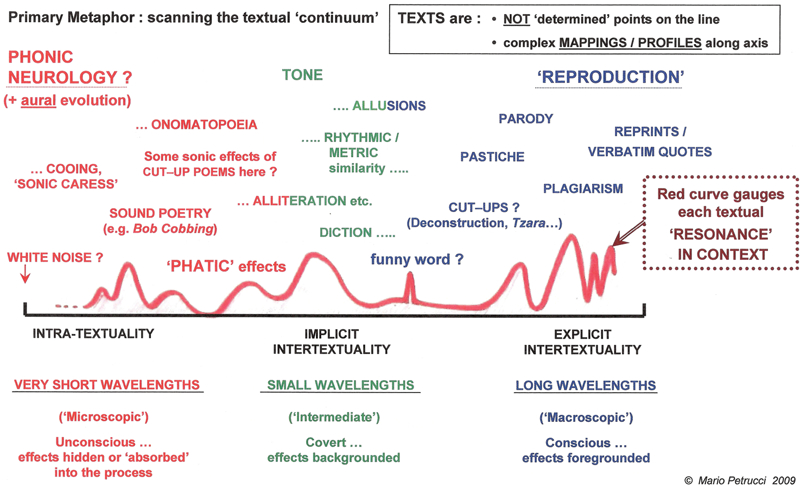
The spectrum analogy for intertextuality.
I find it best if students, having grasped the basics of the analogy, can (as far as possible) run with it themselves, allowing the Visualization to operate creatively (rather than prescriptively) as a hub for discussion involving the text(s) at hand. But, at some point, it has to be said, guidance is usually needed. Whenever drawing an analogy, one does well to ask such questions as ‘How strong is this analogy? Where does it break down?’ The value of analogies lies as much in probing their shortcomings as in the insights they afford. Where those deficiencies are less conspicuous, greater cautionary effort may be required. One must also be wary, having successfully applied a scientific analogy to (say) a literary-critical situation, that students do not thereby confer upon that target some vague notion of scientific truth. It is all too easy for an actual, or assumed, conclusiveness concerning the source (here, the electromagnetic spectrum) to be transferred across, by mere association, to the literary subject (intertextuality).
This case also serves to illustrate my reasons for insisting on the use of Visualizations as analogies rather than models. Even non-scientists will quickly realise that particular wavelengths along the continuum cannot be made to correspond in any rigorous, repeatable or complete way to the various attributes or effects of a text. The deficiencies of the spectrum as a model (or even as close analogy) are therefore immediately felt. We can either take this as crushing evidence of the pointlessness of the exercise, or turn that very insufficiency to advantage, using it to investigate how and why we might dissect a text for distinguishable qualities, or as an incentive to test and deepen the Visualizing process itself. This requires an open and inventive responsiveness that is often its own reward. It can also yield fascinating results. Indeed, my particular version of intra-textuality emerged, and was so labelled, partly because the spectrum needed something at its non-explicit end, but also (later) because many students who rapidly got to grips with explicit intertextuality were less sure about what was going on at the implicit limit. This uncovered an exciting area of discourse, eventually leading me to offer a means of approaching and negotiating (through gradations or fine structure) those regions of intertextuality they were finding less obvious. What is sought here — at least initially — is an illuminating variety of access and interpretation, rather than theoretical rigour or modelling capability at all costs. Too rigid an adherence to the details of the science would, I feel, have held this process back. In any case, scientific stringency is often misplaced among the plural purposes to which such a Visualization might be put. Figure 2was never intended to function, within literary studies, as some mimetic equivalent to the electromagnetic spectrum. It opens up productive questions more than it closes in on any final answer. In this kind of work, a Visualization and its target (for analogy) are best seen as siblings, not clones. (I shall say more about the limitations, and possibilities, of visual analogy in the section ‘Dangers; opportunities’ later.)
Further discussion on the spectral analogy is available elsewhere (Petrucci 2001a, 2001b). In spite of its dualistic assumptions and its speculative, provisional nature, this analogy has helped to kick-start seminar debates on intertextuality that have incorporated a variety of theories and approach, from Barthes to Pope (1995). Not only has it raised issues around how one maps out intertextuality in the first place, it has also focussed attention on what exactly is meant by any given (or mooted) intertextual quality. It has even been used — albeit at full stretch — to broach the difficult subject of authorship and originality, with (for example) the explicit extreme stressing text as derived object and the intra-textual regime suggesting a unique, willed writing-subject. Tutors may substitute preferred or alternative interpretations here; but, whatever the chosen slant, it does students no harm to visit, from this freshly analogic angle, the intra-textual dark matter of our linguistic universe.
Crosstalk, mutation, chaos
The following figures further illustrate my early attempts to establish analogies that qualify, to some degree, as Visualizations across disciplines: that is, they store, visually, some recognizable pattern of characteristics, some parallel set of relationships, however basic, which illuminates not only the sourced (scientific) situation but also the targeted aspect of (here) textual reception. The examples presented certainly function as visual analogies, and therefore represent possible overlaps between relevant bubbles in conceptual space, linking the two fields; the extent to which they operate, genuinely, as scientific Visualizations may be rather less clear (see the section ‘Three clarifications’).
Figure 3 offers an analogy for mistranslation in terms of crosstalk, where signals from one circuit bleed across to another. The nuances of electronic circuitry are unfamiliar to most of my students, so I discuss this via the scenario of crossed lines in phone calls. Taking each line, then, as a given language system, we might suppose that most signals (i.e. linguistic meanings) can be successfully translated between two phone circuits because those circuits have roughly similar properties (i.e. the semantic processes underlying each language are not too unalike). However, some distortion, fading in and out, hiss, buzz, etc. often occurs, since the original signal may be only imperfectly (and noisily) picked up (=the processes of translation), while the new line may not have identical characteristics to the first (=different rules of syntax, etc.). Also, the signal is shunted across to an addressee who may not immediately grasp the original call's context (=different culture, etc.). Although the second medium does allow most of the original information through, skews and misunderstandings thus come about (e.g. strange idiom, wrongly connoted phrases, misfiring puns, an unintentional insult or joke).
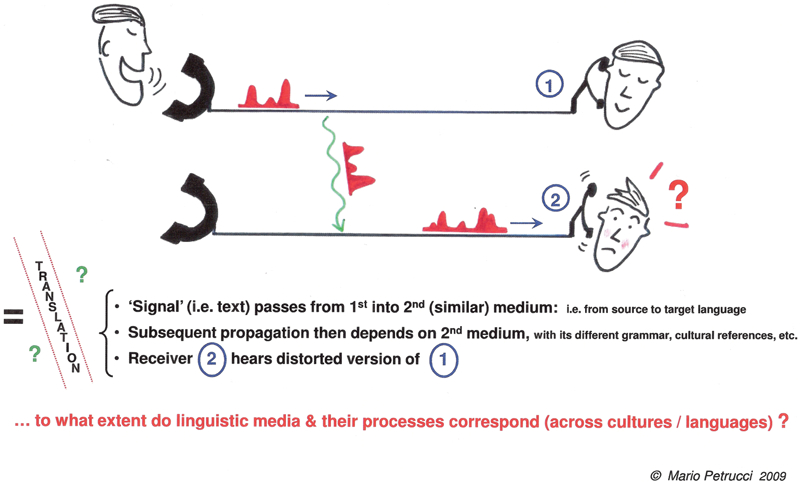
Crosstalk analogy for (mis-) translation.
Figure 4 presents evolution/DNA as a possible analogy for the changing reception of a given text (or author's canon) across time. This particular analogy leans towards an essentialist view, insofar that it suggests that certain textual qualities and meanings are captured in reproducible cultural-linguistic codes, passed on more or less intact to subsequent generations of reader. Examples of relatively stable code might include the use of a traditional form, some undisputed fact or unambiguous biographical reference, or a distinct style. As with DNA, though, the particular codes associated with a text do not determine exactly how that textual creature will look or perform (within a particular brain or culture), thus opening up that old debate: nature vs. nurture. The analogy also recognizes how textual codes can be intimately responsive to the complex, shifting environment of literary ideas and cultural signs. A type of Darwinism is implied here, with certain variations of code surviving because they are fit for the altered environment (e.g. they align with new thinking). These changes in meaning can be adaptive (i.e. slight and slow, as in much of natural selection), as when an author's style gradually accrues esteem across generations; or they can be rapid and substantial (a sudden mutation), e.g. if a discovered cache of letters forces deep and precipitous re-evaluation of a famous biography.
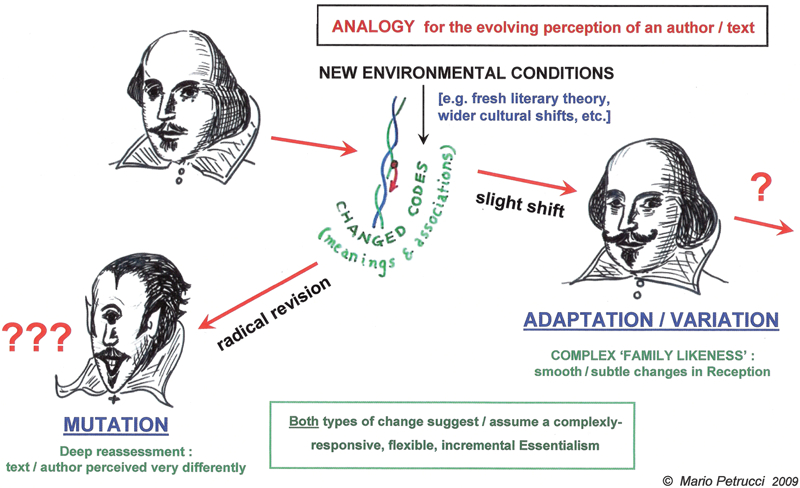
Adaptation/mutation. Analogy for the evolving perception of an author/text.
Naturally, the analogy has its flaws. Texts do not really behave — or propagate themselves, generation to generation — as do animals or DNA (though Dawkins’ (1976) self-replicating units of culture, memes, may bring some validity to the overall notion). Nor do I use the terms adaptation/mutation quite as technically defined in biology (my sense of mutation here is much closer to the populist idea of a severe alteration, or a mutant strain, as precipitated, say, by radiation). One might also challenge the very notion of codes preserved in the text, invoking instead reader-centred theories where the receiver (not the author, nor even the text itself) is the primary creator of the text's meaning. A fresh analogy there might be that of a textual quarry the reader excavates, seeking and constructing her own meanings from the raw materials of words and associations. This shows how analogies, once their inadequacies are acknowledged and incorporated, can be propped against one another to develop an evocative, extended mode of entry into a subject.
In Figure 5, chaos physics (often associated with weather systems) provides another engaging analogy for textual reception. Does a poem, say, arrive in the reader like a weather front of meaning, intricately modulated by all manner of inputs and accidents, with the complex environment corresponding to the reader's personality and socio-cultural context, her experiences of other poems and related texts, indeed all her involvements with intertext and context? To coin a phrase: ‘Is poetry like the weather?’ As with forecasts and outlooks, we can never quite predict the local detail of a particular text's reception within an individual reader; and yet, broad patterns may well emerge among readers in general, at least in the short term (it was fairly apparent, for instance, that the final instalment of Harry Potter would raise a storm of attention). The chaos analogy poses similar questions to other, more technical, models for communication; but every student has experience of weather and its forecasting — they may not be so nearly aware of possessing a code.
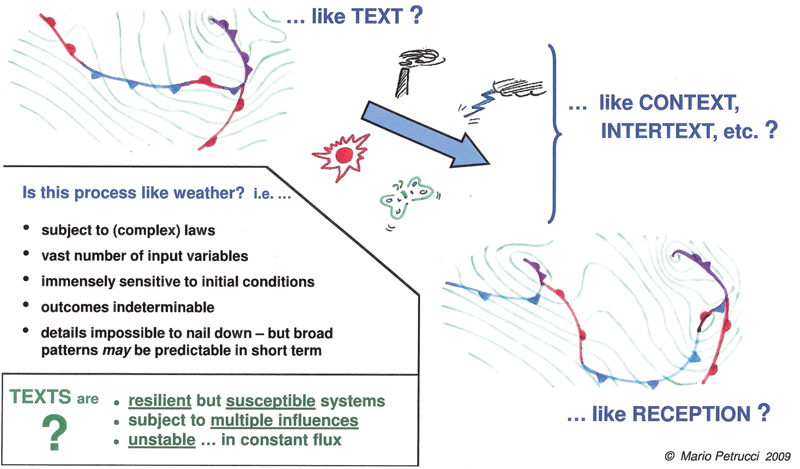
Chaos theory analogy for textual reception.
Advanced/hybrid analogies
None of the above analogies is presented as, in itself, a source of ground-breaking insight. If any of them seem a little obvious or simplistic, please bear in mind they are designed to be largely self-explanatory — which is, after all, a substantial part of their point. That said, they can be developed in far more depth, quickly becoming quite sophisticated. The continuum analogy, for example, may be expanded into a range of spectra, each representing a different aspect of the text's reception, thus generating a Fan of Reception (Figure 6). Here, the first fold of the Fan is just Figure 2 itself, perhaps simplified, or focusing on key features of the Explicit→Intra progression. Subsequent folds of the Fan highlight other traits of chosen interest. Even if a little too elaborate for some, the Fan should make it visually clear to most students that the apprehension of a given text is a complex process triggering many resonant functions between language and receiver. As an effective visual tool for introducing that idea, it can be used to initiate discussion on the possible nature and type of the spectra. Here, it is crucial to note the annotation stressing how the various functions are not isolated: they interact and overlap. This would seem to contradict the way in which the spectra are separated out within the figure; but this shortcoming can itself provide an opportunity for further debate. It reminds us that the Fan is not to be taken too literally, that there are shortfalls in every analogy — set, at least in part, by the skill of its designer (and the graphics software!). It also invites the observation that, in an attempt to handle material with clarity, literary criticism, too, can resort to a separation of thought, breaking texts down according to relevant characteristics. From there, one can then consider what forms the links and resonances between the Fan's functions might actually take, what their relative strengths may be, and even how these overlaps could be better represented visually. A final thought: some of the annotations (Golden Age, Pre-Lingual, etc.) may not be clear to readers. These have no special significance here and need not be decoded; they merely show how one particular discussion developed. In this case, Aesthetic Fascism was a way of labelling the attempt by a pressure group (or regime) to define society's authoritative works, while Nescience was (hypothetically) a total ignorance of the canon; ‘Intra-?’ marked a query regarding the validity of intra-textuality as a cogent concept; and so on. Naturally, participants should deploy their own detail — and, in any case, interpret the Fan itself — in ways they understand.
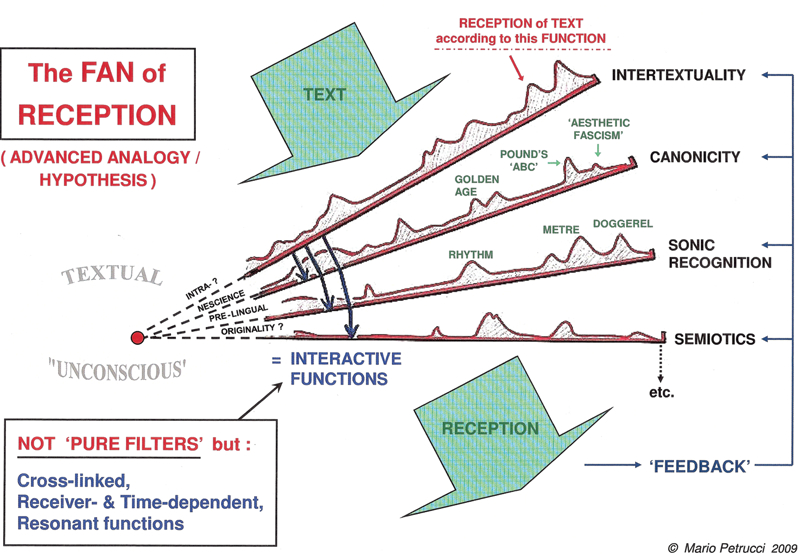
The Fan of reception (advanced analogy/hypothesis).
Figure 7 presents a second example of how the basic spectrum idea may be developed. It approaches the issue of what is lost (or preserved) in translation, through a filter analogy. Real filters (e.g. optical filters) allow certain portions of the input through (for light, the transmitted colours) whilst suppressing everything else (the absorbed colours). Figure 7b Visualizes the processes of translation in a similar way, as a kind of frequency response spectrum, i.e. as a series of annotated peaks and troughs which (respectively) enhance or inhibit various characteristics of the input text (the source text spectrum in Figure 7a). Set up loosely for a ‘free’ (or ‘Translator Response’) approach, the merely illustrative form of the curve presented in Figure 7b is easily embellished. Trough 1 could indicate, for instance, the translator's disregard for alliteration (which happens to be prominent in the source text). Other troughs might stand for, say, areas of lexical ignorance, or qualities in the original the translator deems untranslatable. The crests, on the other hand, represent specific strengths, sensitivities or tendencies in the translator, including obvious aptitudes, interests and intentions. The asterisked peaks, for example, could identify particular habits of textual rendering, such as elements of stylistic bias in the translator's own writing style. Meanwhile, Peak 2 might indicate an attempt to convey, precisely, some perceived flavour in the source, with Peak 3 a decision to use, come what may, footnoted equivalents of proper nouns (e.g. Coventry for Dresden). The sense in which these constitute genuine peaks — or some type of amplification — would, of course, be open to debate. It may become clear, too, that a simple light-filter analogy (where colours in the source merely do or do not get through) struggles with representing how a translator might improve or add something. Without getting too technical, one attempt to upgrade the analogy might involve (perhaps) a complex circuit or sound system that is able to sharpen up a signal or reduce noise, but which sometimes also adds blips to the output (to be followed up, in turn, with due evaluation of the new analogy).
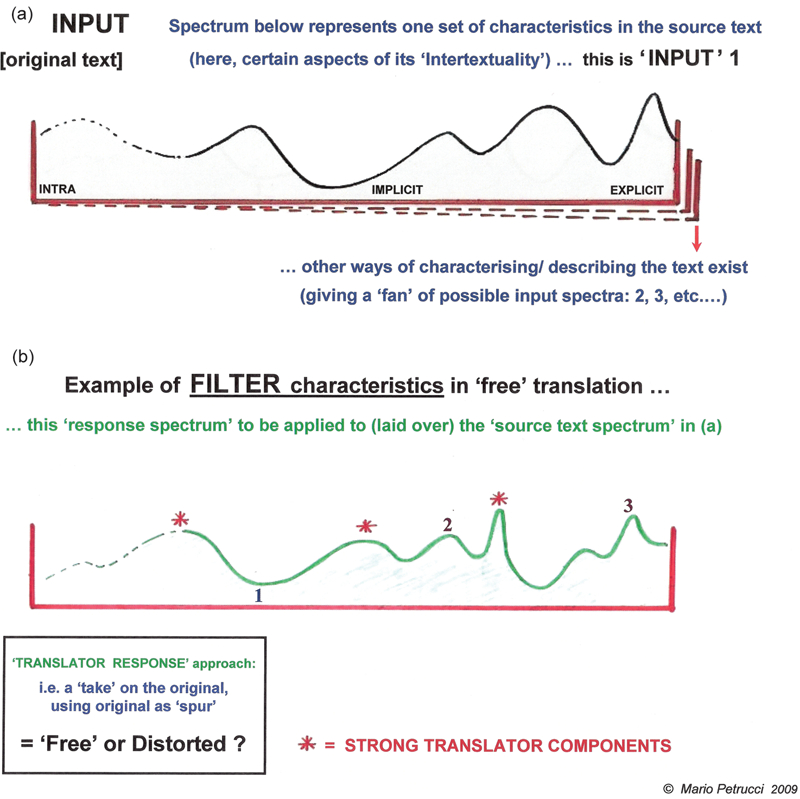
Translation as a Filter, F (analogy): Input→F→Output; a Input (original text); b Example of Filter characteristics in ‘free’ translation (this ‘response spectrum’ to be applied to (laid over) the ‘source text spectrum’ in a).
In a manner of speaking, then, the filter traces the shape of the translator's likely treatment of the source text. Different types of translation (literal, accurate, free, etc.) can now be discussed by suggesting what the broad characteristics of each filter might be. For instance, in poetry a literal translation might first be thought to entail a fairly flat or neutral, set of transmission characteristics, where words simply pass through the filter without obstruction or translator bias. There will, however, be at least some unintentional troughs, because a word-for-word approach always leads to losses in certain textual attributes such as rhythm, rhyme, cadence and irony. It is important, though, not to focus solely on Figure 7b. With real optical filters, a strong feature in the input can sometimes partly survive what the filter tries to do with it — so it is with translation. Thus a quality only weakly present in the original (a trough in Figure 7a) is unlikely to be picked up by a translator, while a prominent aspect (a large peak in Figure 7a) will probably not be missed, ignored or wilfully excluded (unless the filter of Figure 7b happens to have a strong trough at exactly that point). It should also be noted that Figure 7adisplays just one way of mapping the source text along a continuum: in this case, via intertextuality (interpreted in any way you wish). The annotation indicates that such mappings can be done according to other types of concern, each treated separately. This leads to a more sophisticated approach entailing a fan of possible inputs, each having its own specialized filter.
Given that the interaction between the two spectra is the output of this analogy (i.e. the source text translated into the target language), the process is easily enacted by placing a transparency of Figure 7b on top of Figure 7a(to the correct scale). This works wonderfully in teaching, bringing out the idea of the analogy crisply (whilst imitating the actual use of a filter), and providing a powerful, immediate visual grasp of the interplay between translator and source text. Again, as with Figure 2, the detail of the curves can be formulated quite differently from what is shown, and the specific nature and location of the proposed peaks and troughs is not to be agonized over. These curves are not reproducible fingerprints like the absorption spectra of gases or the emission spectra of stars; nor should the common perception of filters as purely mechanistic lead to any general conclusion that translation is merely a mechanical procedure (though computerized translations may indeed qualify). The deeper function of these analogies is to provide sites for initial understanding and study rather than any theoretical or experimental closure; once they have served their purpose, move on.
My final example (Figure 8) has more to do with study skills than literary studies, but I include it here for its aesthetic power and downright usefulness. This chart provides an accessible, productive framework in which to discuss possible structures for all manner of oral and written work. True, only some of the ‘Ways’ draw on genuine Visualizations taken from science and mathematics, while others may seem closer to cartoons, making it a kind of hybrid resource. Nevertheless, The 13 Ways — generated and refined in a 4-year study of student essays and presentations, initiated during a Royal Literary Fund Fellowship at Oxford Brookes University — became an invaluable and flexible tool for students and staff there, forming part of a thriving study skills module in the Department of English Studies. The chart can be downloaded (with supporting notes on its application in class) via the public section of the Royal Literary Fund's website (Petrucci 2005). What counts here, once more, is not any definitive or exhaustive quality in the chart, but what it achieves in practice. I am thinking, for example, of that precious clarity between tutor and overseas student when either of them can point to one of these images and make herself finally, completely, understood.
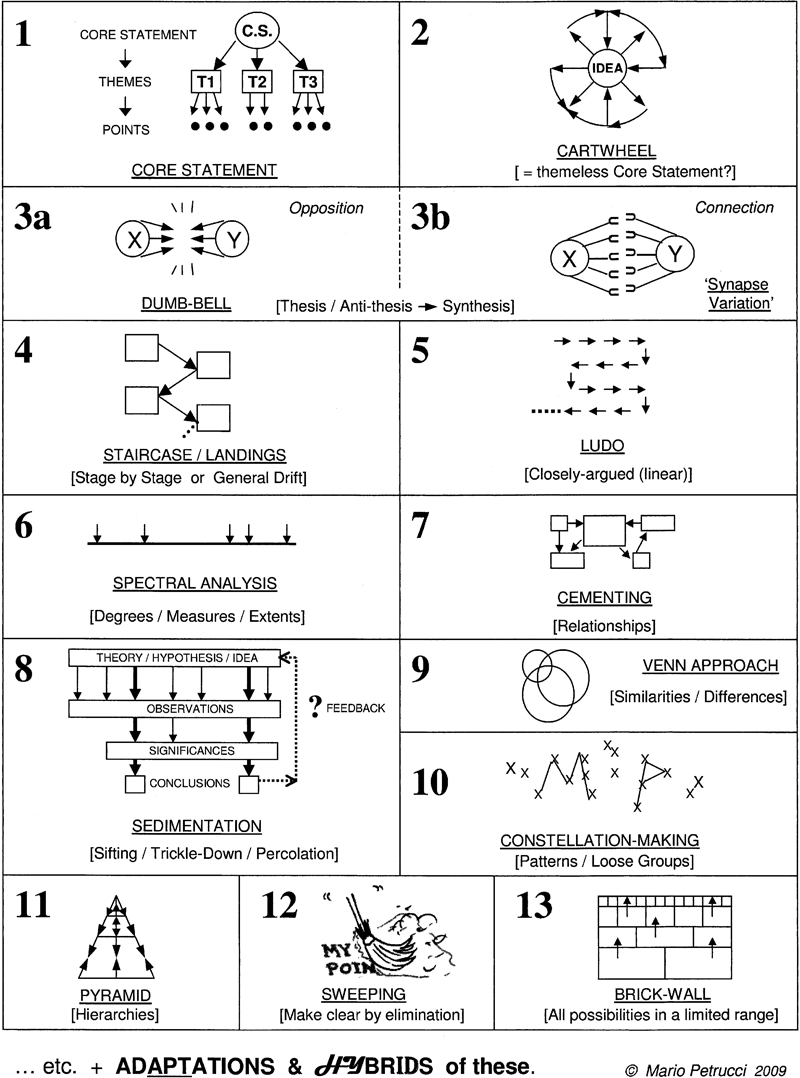
The ‘13 Ways’: Building an argument/logical structure.
Three clarifications
I must address three tricky issues somewhat skirted around in previous sections, deferred until now so that the reader could first broadly grasp the concept (and some trial examples) of Visualization.
The distinction between Visualization and visual analogy.
The distinction between diagram and Visualization.
The use of text (titles, annotations, captions, etc.) within Visualizations.
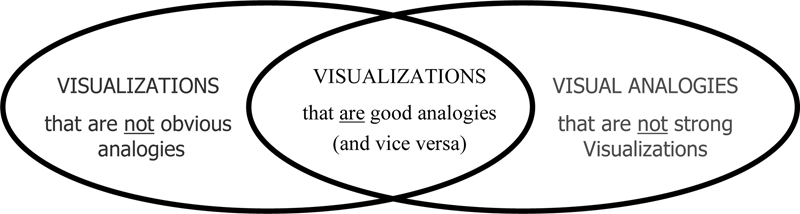
Taking these in order: to what extent are my terms ‘Visualization’ and ‘visual analogy’ analogous? To answer that, I must revisit my earlier observation that the pilot Visualizations in this paper have ‘the inbuilt character both of an analogy and of a scientific Visualization’. I somewhat circumvented there the subtlety that, strictly speaking, a Visualization is a representation of a situation, while a visual analogy is a representing object applied between situations (i.e. from source to target). Thus, a Visualization is not necessarily an analogy. A strange magnetic field pattern, for instance, does not automatically (or obviously) stand for anything else: it may be wielded elsewhere, as an analogy, but only if fit for that purpose. Likewise, some visual analogies are merely pictorial or whimsical, lacking the structural rigour of a good Visualization — I therefore tend to reserve the phrase ‘visual analogy’ for a more general analogic approach using images that might not always qualify as clear or strong Visualizations. It follows that the two terms really denote overlapping (rather than interchangeable) concepts, with my special sense of Visualization occupying the central portion of the following.1
Moving to the second point, I am entirely comfortable with the idea that a diagram in its original sense offers an abstract representation of the relation of its (often observable) elements: it is therefore — at least in that respect — a bona fide Visualization. But one cannot ignore the widespread use of ‘diagram’ to denote the merely illustrative (a near-photographic or pictorial likeness, a representational sketch or simplification). I bear that humble word no malice; but my more specific term ‘Visualization’ makes clear (as demonstrated in the iron filings example) that some essential correspondence must exist between the visual abstraction and the behaviours of the elements it represents, i.e. features of the subject's underlying, intrinsic properties should be stored in, or imitated by, a Visualization. This newer term thus sits comfortably with the analogic processes I seek to develop, whereas commandeering the portmanteau ‘diagram’ for the purpose might lead (given its plural use) to misunderstanding. For those needing to further distinguish between the two: a Visualization may be called (colloquially and loosely) a diagram; but a diagram or illustration is not perforce, or per se, a Visualization. A diagram or sketch of the benzene ring Kekulé saw in his dream reflects the relevant characteristics of carbon valency in its spatial structure; a pictorial diagram of some benzene sitting in a flask does not. Only the first of these operates as a Visualization. Actually, several of my own figures might be considered closer to embellished flow charts or diagrams than to scientific Visualizations: although all my analogies visually capture (or include) aspects of the scientific/literary process being considered, how far does each really encode, visually, the properties of that process?
Taking up the final issue in the list, the textual labels (in the main) merely name, clarify or extend the visual elements they accompany, usually to make them more intelligible to a wider range of readers, including non-specialists. Such notes and captions often become redundant when a Visualization is part of common visual currency, or when a tutor has previously introduced the Visualization or is talking it through, or where students are already au fait with its subject and frames of reference.
Science and literary studies: Two-way traffic?
The rich ancestry of visual analogy across culture shows that brains are not merely mechanisms that describe detectors of reality, but deep-pattern-deducing organs. This is certainly apparent in science, which abounds in metaphor/analogy relating to many other areas of human experience (black holes, quantum wells, electric current, electron avalanche, etc.). In recent decades, with the popularization of science, the activity has intensified (who is not now familiar with the analogy of billiard balls for molecular collisions in a gas?). The specific utilization of literature, though, by the sciences has been largely confined to quarrying (mostly classical) references for the purposes of naming — as with the elements of the Periodic Table, or the commandeering of ‘quark’ from Finnegans Wake. Analogies of a visual nature are not sought, as a rule, within literary discourse for explanatory use in science. I note a similar asymmetry in my own research, where a number of science-based Visualizations have been found with which to profitably explore literary themes, while the reverse has not yet come about. I propose below two main causes for this asymmetry, each consisting of factors of varying obstinacy:
there is a historical, perhaps inherent, lack of true Visualizations in literary studies;
most literary visual forms (where these do occur) are unsuited as analogies for scientific discourse.
The obvious response to the first point is to strive to nudge open a few more doors on Visualization within literary studies. Some readers might object that visual representations already exist, in force, within the humanities. Certain fields (such as media studies) are well stocked with visual elements, formats, tropes and types: graphs, flow charts, ‘Eye Q’, analogies linking film and drama with literature, 3D collages, and so on. True, some models in media studies and communication theory do indeed operate through visual analogy or possess some quality of Visualization; when it comes to literary discourse, this is far less evident. Naturally, I cannot argue the case instance by instance: my general claim is that many of the visual items deployed in literary studies — even highly-structured charts and images — are essentially diagrams in the pictorial sense described in the previous section, performing acts of visual list-making or description. The ubiquity of tools such as spider maps and the graphic organizer may be evidence of strong visual literacy in our educational culture, but does not represent a widespread use of Visualization. I maintain, then, that most areas of literary discourse specifically, if not the humanities more generally, employ true Visualizations (and visual analogies) relatively rarely. The arguments for the first bullet point ramify into the second. While it is clear that charts and diagrams — as commonly found across the sciences (e.g. for presenting data) — do occur in many other areas of discourse, those generic forms seldom possess the depth of visual structure that might usefully imitate actual scientific phenomena. They are therefore of little value in science as analogies.
There are further issues to consider. Whenever a visual analogy is bridging disciplines, some appropriate level of understanding and clarity has to be established at both ends of the bridge for it to carry any weight of traffic, or if serious backfiring of the analogy is to be avoided. Einstein remarked (quoted in Østergaard2006, 261): ‘After a certain high level of technical skill is achieved, science and art tend to coalesce in aesthetics, plasticity, and form. The greatest scientists are always artists as well.’ While such coalescence is terrific news in the context of this paper, I am nevertheless tempted to ask whether Einstein was equally convinced that the greatest artists are always scientists. Even if (in some sense) they are, we cannot ignore his caveat concerning the ‘high level of technical skill’ initially required before the merging can occur. It needs no Einstein to see the snag in relating science and the humanities for those whose science and mathematics are weak. In fact, non-scientists may experience problems when either end of a bridging analogy relates to the sciences. One can even venture that scientists might be stronger protagonists in any increased traffic with literary studies: while they can be expected to get the gist of most literary ideas, even experts in literary discourse could struggle with (what would be to a scientist) fairly basic science and mathematics if they do not possess the required cognitive codes. Science might also drive the enterprise more prominently or successfully, owing to the relative receptivity of literary discourse (its large cognitive bandwidth, if you will) for scientific Visualizations, as demonstrated by the figures earlier.
I frequently think of the above difficulties as akin to those of procurement and rejection in an organ transplant. It is premature, though, to conclude that such problems are fundamental or terminal. To begin with, not all literary discourse is text-based and discursive, while not all science is purely mathematical. Even where mathematics does reign supreme, there may be scope for transposition into clear visual representations (as with the Feynman diagrams of quantum mechanics) or some inventive paraphrase into words and images that provide a more suitable basis for analogy. As for attaining the abovementioned ‘appropriate level of understanding and clarity’ in the science, Cordle reminds us that scientific discourse is a powerful generator of narratives that do not always accurately represent professional science: ‘Those narratives are for many of us, as non-scientists, translations from a language we do not fully understand’ (Cordle 2005, 7). Given that so much of what the culture experiences as science consists of these simplified or incomplete translations, the non-scientist may be justified in exploiting their less rigorous (and less mathematical) forms to participate in cross-disciplinary dialogue. Thus, the need for specialist knowledge when formulating or applying scientific analogies may not be as crucial as one initially supposes, since scientific truth also resides in ‘the more culturally vital phenomena of Science and representation’ (ibid.). I retain deep reservations about allowing the science to become too flaccid in such analogies, but can see that interesting alignments might occur (whatever the degree of inaccuracy in the science) when popularized science engages with a non-scientific discipline itself concerned with cultural activity or representation.
I want to dispel any residual implication, either that Visualization can only give one-way nourishment at the science/literary studies membrane, or that any hierarchy, antagonism or adversarial state of affairs is intrinsic between these two fields. In referring (earlier) to ‘bridging disciplines’, I realise such images evoke a chasm; I hope the cost is acceptable, given how succinctly the metaphor reflects the subject separatism still encountered — perhaps too often — in schools, colleges and careers. That said, cross-disciplinary exploration should not seek to merge, utterly, its targeted areas of activity, nor try to discover some Shangri-La of a common language between them. The sciences and humanities [as Gould (2004, 6) puts it, for science and art] ‘cannot be morphed into one simple coherence … but the two enterprises can lead us onward together … toward the common goal of human wisdom, achieved through the union of natural knowledge and creative art’. The idea that cross-situational pattern recognition may form the very armature of thought itself, with the roots of words themselves tangled in visual metaphor, should be read as an encouraging initial sign for anyone wishing to contribute to this union through visual analogy.
Finally, if a Visualization is also an analogy, that means it relates to some aspect of Visualizability in the target as well as in the source (Figure 9). This double-ended quality to its Visualizing power is evidenced by the very fact that it works as an analogy. So, if a scientific (or any other kind of) Visualization operates successfully as an analogy for some aspect of literary studies, it must also be (to some extent) a literary Visualization. This project may therefore be helping to address the relative absence of Visualizations in the literary domain.
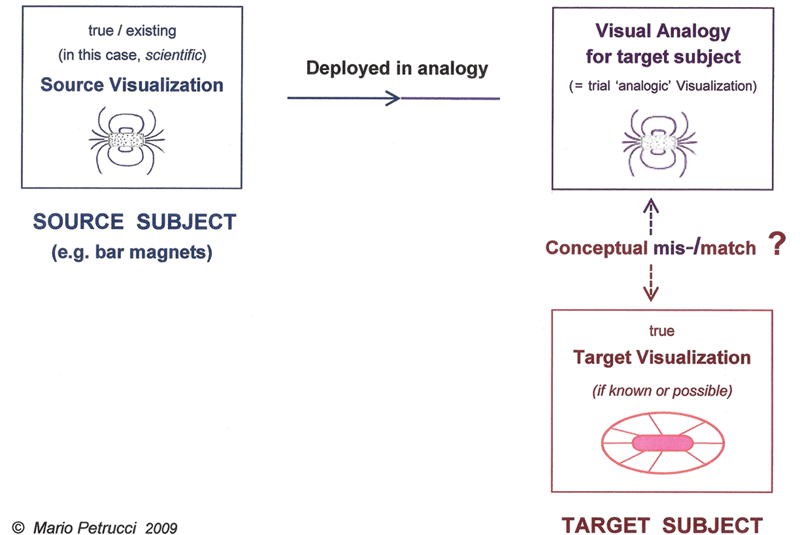
Visualizations and the analogy-making process (a hypothesis).
Dangers; opportunities
Visual analogies have potential pitfalls. For instance, how do we prevent student responses from unravelling into easy, arbitrary or gratuitous speculation? Without guidance, a study based purely on analogy (visual or otherwise) can quickly become all locus and no point, a bubble-bath of froth, lacking substance. Bad analogies spawn to outnumber the good: the former lead to confusion and false concepts; the latter are, at best, only ever partial (all analogies have an elastic limit). Like metaphors, analogies can be over-extended, inappropriately mixed, or poorly made. One sees, already, for certain difficult topics, explanations that are quagmires of half-glossed analogies and metaphors, recycled by users oblivious to the misunderstandings they propagate. In inexpert hands, then, visual analogy might actually serve to cloud or misrepresent any Visualizabilities present in the text. Besides, how does the Bohmian credo — here, that all aspects of analysis and Visualization connect at some deep level of Implicate Order — help us one jot in the Explicate world of the classroom? What happens, for example, if we cannot trace (or intuit) the connective paths, or verify them? How do we establish reliable theoretical centres against which to test results? Might the novelty of visual analogies tempt us into neglecting perfectly adequate conventional methods? Why not let texts, and their concepts, simply reveal themselves, unmediated, as they have always done?
Although none of these objections is in any way impertinent, one should recall that similar problems do occur in more established modes of theoretical and educational discourse. Just as an analogy can be taken too literally, so theories and models can be deployed with excess rigidity; they, too, are incomplete in their representations; and all theorization and modelling, like analogy, must acknowledge its bounds. So, given that existing modes of literary criticism are not about to be overturned by this paper, why not experiment (where suitable and possible) with a more thoroughgoing analogy-centred pedagogy? Students are becoming more visually adept in (what has been termed) ‘the visual turn’ (Jewitt 2008), making the educational advantages of visual analogy difficult to ignore (an observation, I must stress, that in no way implies we should thereby neglect books and reading). Naturally, not all visual analogies are of immediate value in any given context, and some steering of the exercise is essential. The ideal is to discover those that strike us as having about them a rightness which repays closer and repeated inspection, just as the best metaphors do in poetry. However, even where the proposed analogy seemingly plies an arid segment of conceptual space, or when the analogy-making activity falters at an early stage, we will still have involved the student in invention across the disciplines, in imaginative intellectual play. Moreover, testing those analogies for aptness and usefulness serves as more than a safeguard against arbitrariness: it fosters critical judgement and the ability to detect, define and assess conceptual patterns. There is no reason why this testing process cannot be extended (particularly with capable groups) so that several visual analogies are constellated around a single idea, with each helping to correct any errors or misunderstandings generated by the others. Other potential gains from implementing visual analogy (in the tertiary sector) include: the development of a novel tool to supplement more established modes of description, analysis and argument; a fresh supply of accessible introductions and explanations (even for tough terrain, if properly done); and a growing stock of enticing visual resources for undergraduate/postgraduate workshops and seminars, to spur participation and enrich discussion.
Of course, much of the activity I propose is unrealised or (as yet) somewhat invisible; but the importance of analogy-making in teaching has not gone unnoticed. Gilbert et al. (2008), for instance, note the role of analogies (in the context of visualization as they define it) in science education, while Nottis and McFarland (2002) register the essential part analogy plays in broaching scientific concepts in schools — and stress the need to acquire the skills involved in using it well. What is more, visual analogy seems to be especially advantageous when presenting highly abstract ideas, providing a cognitive stepping stone from which the final, clinching leap can then be made. It therefore makes good educational and pragmatic sense to further research how best the methods of visual analogy may be progressed and expanded, not least in subjects where its use is still uncommon.2 Meanwhile, the work has already been harvested by the British Council to introduce to overseas students (with scant training in science and, often, even less English) such concepts as intra-textuality and the filter analogy for translation (Petrucci2001a). When severe language (or subject) barriers are faced — in fact, wherever students need initial support with unfamiliar languages such as mathematics or arcane terminology — visual analogy sometimes has an edge over text-based explanations. The visual dimension of Visualizations can even function autonomously (i.e. beyond technical content), in that users regularly express excitement about them as aesthetic objects in their own right, an aspect that may be harnessed for less motivated students.
With due respect for difference, visual analogy may also help to dissolve the (often artificial) humanities-sciences split. I recall, here, Thomas Young, who devised the famous double-slit experiment to test the wave behaviour of light, but also had a hand in deciphering the Rosetta Stone. Kekulé, one of the founders of structural organic chemistry, trained as an architect. These, I suggest, could be more than isolated instances of excellent, polymath minds being able to make separate incursions into disparate domains: they may be profound evidence that the discursive, deep recognition of patterns is a transferable skill (across subject matter as well as language types) that can amplify the faculty of discovery across all the disciplines. The alternative is to accept — by implication, if not overtly — that disciplines and specializations (including the creative and critical) developed in response to some inherent structure in knowledge that resembles a sequence of separate, largely self-sufficient strands. Where literary discourse is concerned, I borrow an injunction from radical ecology: to challenge compartmentalization; to continually question any absolute priority given to measurability, to rational or mechanistic modes of analysis, particularly where the full range of human sensitivities and values is thereby excluded. With literary texts, too much rigour is rigor mortis. Not that those analytical modes are worthless, or that pure rigour is not, in its proper place, as insightful as it is essential; it is just that such processes, alone, fall short of the whole experience — the life experience — of a text. Visual analogies in general, and Visualizations in particular, by no means complete that experience; but, used with discrimination, and provided they do not get out of hand, they offer a vital new meeting place in education and thought, helping to span the creative-critical divide in crucial ways. Writers and speakers in all educational fields have always deployed analogic devices. The various types of analogy realised in this paper, and the interactivity between creativity, aesthetics and reason they tacitly endorse, merely extend that age-old undertaking in a multidisciplinary manner, guiding us away from any Procrustean dominion of models.
Notes
1 Having made (and, now, drawn) this distinction, I appreciate that in many teaching situations, the terms Visualization and visual analogy might be allowed to merge, at least initially. The visual forms presented in the figures are relatively new and their strength as Visualizations — to be frank — not yet fully established. The bulk of the science behind Figure 4, for instance, is not really present in Visualized form, meaning that the figure may be more akin to a diagram or flow chart. However, a weak degree of Visualization in an analogy is not necessarily detrimental to its worth or interest, and I do not wish to burden potential users with the feeling that any analogy they devise must also be a gilt-edged Visualization. That said, I invite fulsome challenge on the extent to which each of my examples actually does succeed as a Visualization.
2 In researching this paper, I did not systematically scour the annals of science hoping to find source Visualizations to apply to literary discourse. Often, the process entailed calling to mind — and attempting to Visualize — aspects of literary studies I sensed might possess correspondences with scientific subjects whose Visualizations I already knew. On other occasions, the process was one of sudden insight — a cognitive leap that is, perhaps, somehow stored in the analogy itself and subsequently received by its user. What lies behind such leaps is, I suspect, some kind of simultaneity of conceptual traffic involving the relevant disciplines or topics. In much of this, I stabbed in the dark. Further research might offer a better-lit background against which future efforts could be launched.
Notes on contributor
Mario Petrucci is a poet who holds a PhD in optoelectronics and degrees in physics and ecology. He lectures widely on educational and literary subjects for such organizations as the Wellcome Foundation, the Institute of Education (University of London) and the Imperial War Museum, where he became its first poet in residence (as he did in 2004 at BBC Radio 3). He has been a Royal Literary Fund Fellow at Oxford Brookes and Westminster Universities.
For more on the author and his work: www.mariopetrucci.com.
Footnotes
Acknowledgements
My thanks to the Royal Literary Fund for its generous support, to Howard Cattermole for his thoughtful comments, and to Rob Pope — the Venn mind without whom there would have been far fewer bubbles.
