







Abstract
On 11 November 1912, in Cambridge, England, Lawrence Bragg's discovery of Bragg's Law and his solution of the first crystal structure (ZnS) were announced. During 1913, he and his father, William Bragg, established the new science of X-ray crystallography. In 1914, their research was halted by the Great War. During 1915, Lawrence began to develop artillery sound-ranging on the Western Front, and in November 1915 father and son shared the Nobel Prize in Physics. In the same year Lawrence's younger brother and dearest friend were both mortally wounded. Through 1917, sound-ranging reached an extraordinary level of precision, and in 1918 it played a major role in the Allied victory. When war ceased six years later, on 11 November 1918, Lawrence Bragg had created a new field of science, won a Military Cross, been awarded a Nobel Prize and an OBE, and would soon be appointed to Rutherford's Chair at Manchester. He was just twenty-eight years old!
Keywords
Introduction
The story of Lawrence Bragg, the First World War, and his successful development of the sound-ranging technique to locate the massively-destructive and hidden German guns has been told infrequently in the last one hundred years, and its impact on his later life is largely unexplored in the numerous writings about him (for example, Hunter 2004, Phillips 1979, Jenkin 2008). In the years after the war, discussions of sound-ranging were mixed: its development was outlined, often amongst other issues, but assessment of its use and effectiveness in the major battles of the war was largely absent (Jack 1919, 1920, Innes 1935, Bragg 1920, Wood 1930, Bragg et al. 1971). Modern WWI literature often adopts a sweeping panorama, without coverage of sound-ranging, an exception being the varied work of Chasseaud (1990, 1997, 1999). A recent paper by Van der Kloot focuses on Lawrence Bragg and says less about the major battles on the Western Front and the role of sound-ranging therein (Van der Kloot 2005). The indices to Hew Strachan's major works on WWI contain no entries for sound-ranging or for Lawrence or William Bragg (Strachan 1998, 2001, 2004), although I did find one brief reference (Strachan 2004, 314). In contrast, the literature on WWI itself is massive. I have relied largely on the work of Trevor Wilson, Robin Prior, and particularly their student, Jackson Hughes (Wilson 1986, Prior and Wilson 1999, Hughes 1992), where the role of the opposing artillery forces is covered very extensively but the discussion of sound-ranging is muted.1, 2
This paper concerns the primary role played by survey and artillery in the battles on the Western Front and Lawrence Bragg's role in the Allies’ success in over-running the German army and its guns in 1918. As Terraine has said, the First World War was:
from first to last an artillery war … which manifested itself from the early days of 1914, when the Germans startled their enemies by producing 150-mm (5.9-inch) howitzers on the battlefield and massive 420-mm and 305-mm siege howitzers against the Belgium forts, to the moment the last gun fell silent on 11 November 1918. (Terraine 2000, 87, 187)
Chasseaud has described Lawrence Bragg's sound-ranging as ‘The Manhattan Project of the 1914–18 war’ (Chasseaud 1997, 120). This is an evident over-statement, but it is quoted here to highlight the primary thrust of this paper, that Bragg and British sound-ranging contributed substantially to the Allied victory and to the consequent ending of the First World War, as the Manhattan Project did in WWII.
Australia
Late in 1885, William Henry Bragg was walking along King's Parade towards the Cavendish Laboratory in Cambridge, where he was developing his experimental skills, having just completed a BA degree as Third Wrangler with first-class honours in the Mathematical Tripos. He was joined by his Trinity College colleague and Head of the Laboratory, J.J. Thomson, who suggested that he apply for the Elder Chair of Mathematics and Experimental Physics at the University of Adelaide in Australia. William was then surprised to find at interview in London that Thomson was Chairman of the selection committee! Despite never having devised a university course, taught in one, nor done any research, he was appointed at just twenty-three years of age.
On his first day in Adelaide, William was taken to meet the senior scientist in the colony, Charles Todd, his wife Alice, and their family. What particularly caught William's eye was their third daughter, Gwendoline, with whom he soon fell in love. They were married three years later and three children were subsequently born in Adelaide: William Lawrence in 1890, Robert Charles (‘Bob’), and later a daughter, Gwendolen (‘Gwendy’).
William's teaching blossomed, and when X-rays and radio were discovered his public lectures became the talk of Adelaide. In Britain on study leave in 1898, he studied the latest discoveries in science and on his return embarked on research, soon becoming a major authority on the alpha-particles from radioactive decay. He was made a Fellow of the Royal Society of London on his first nomination. This work was followed by an investigation of the fundamental nature of radiation, in which William suggested, in contrast to most European scientists, that it was composed of neutral particles rather than waves. Such particles, he pointed out, would have all the properties of X- and gamma-rays known at that time.
In 1899, William had a new family home built in Adelaide. At St Peter's College, Lawrence was promoted to higher and higher grades because of his outstanding academic ability; so that at age 14 and in the sixth form he was socially isolated from his peers, aged 17 and 18. He took to solitary pursuits such as shell collecting and had a new species of cuttlefish named for him, Sepia braggi. (Jenkin 2008, chs. 5–14).
This unhappy disjunction continued at the University of Adelaide, where Lawrence led his chosen subjects, many taught by his father. He graduated with first-class honours in mathematics late in 1908, a few weeks before the family sailed for England: William to the physics chair at Leeds and Lawrence to further mathematics at Cambridge. Lawrence later remembered these years sadly:
Although I was fifteen when I entered Adelaide University, I think my emotional age was about twelve or less, and my fellow students were mature young men and women. … Anyone handicapped in this way … develops a defence mechanism to hide his inexperience from those he meets … He is like a hermit crab, with a formidable array of whiskers and claws in front [his intellectual ability], but with a soft tail which he has to conceal in a protecting shell [his lack of social skills]. (Bragg n.d.)
Britain
A year later, persuaded by his father, Lawrence changed to physics and the Natural Sciences Tripos and again graduated with first-class honours. He entered the Cavendish Laboratory to undertake research but was dissatisfied with his project and left Cambridge to enjoy the summer of 1912 with his family on the Yorkshire coast. Here he and his father read a letter from Germany reporting the experiment of Friedrich, Knipping and Laue that showed that X-rays could be diffracted, seeming to prove that X-rays were waves.
The holiday over, father returned to Leeds to attempt to salvage his particle model while Lawrence went back to Cambridge, already aware of the deficiencies in Laue's analysis and determined to find a better solution (Figure 1). The Germans had assumed that the diffraction spots on the photographic plate were due to fluorescent radiation from the zincblende crystal itself, which had a simple cubic structure. Using insights provided by his lectures and advice on possible crystal structures, Lawrence envisaged a reflection of the incident radiation from planes of atoms in a face-centred-cubic array, leading to the observed elliptical diffraction spots, which were now all precisely reproduced. Lawrence's findings, including the first announcement of ‘Bragg's Law’ and the first crystal structure (ZnS), were presented to the Cambridge Philosophical Society on 11 November 1912 and were promptly published in its Proceedings.
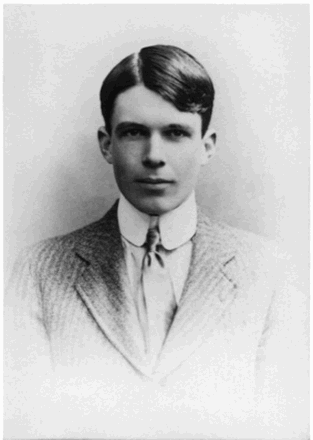
(William) Lawrence Bragg, Cambridge, circa 1913.
Father William quickly saw an opportunity to use Bragg's Law and the new technique to study X-rays, using a modified optical spectrometer, a crystal of known structure and an ionization chamber for detection as he had mastered in Adelaide. Harry Moseley and Charles Darwin junior were on the same track in Manchester (Heilbron 1974, ch. 5). Rutherford now intervened to ask William to delay publication until his ‘boys’ could do so simultaneously. William not only accepted this bullying from Rutherford but also withdrew from the field entirely, leaving it to Moseley. Instead, he offered his new X-ray spectrometer for crystallography, and together — for weeks at a time and less often separately — father and son now plundered the new field. Lawrence recalled, ‘we had a wonderful time … discovering a new goldfield where nuggets could be picked up on the ground … until the war stopped our work together’ (Bragg and Caroe 1962, 177). It was here, in an unsuccessful attempt to avoid confusion with his father, that W. L. Bragg now listed himself as ‘W. Lawrence Bragg’ and thus became universally known as Lawrence Bragg (Jenkin 2008, chs. 15–16, Hunter 2004, ch. 2).
The Great War
It was now 1914, and the First World War became real for the British Empire and the Bragg family on 4 August when Britain declared war on Germany. The outcome was disturbing: a devastating pre-emptive strike by German forces against France, delivered through the heartland of Belgium. In six weeks, following the Schlieffen Plan, Belgium was overrun, the Channel ports and Paris threatened, and the principal French armies ground down (Prior and Wilson 1999, Wilson 1986).
Second-son Bob had just completed second-year engineering studies at Cambridge. In 1912, he had joined his brother in the King Edward's Horse, a cavalry regiment formed in 1901 and composed of British colonial volunteers resident in England. Britain quickly sent troops to France (the British Expeditionary Force (BEF)), and Bob was embodied and went into camp. Lawrence was granted a commission as Second Lieutenant in the Leicestershire Royal Horse Artillery (Figure 2). He ate his last meal in Trinity College early in September and spent the next year training at Diss in Norfolk. He wrote regularly to his parents. He was not entirely happy or successful: ‘I don't know enough about horses’, and ‘I get moments of awful despondency’. His mother was already worried (Jenkin 2008, 352, 368).
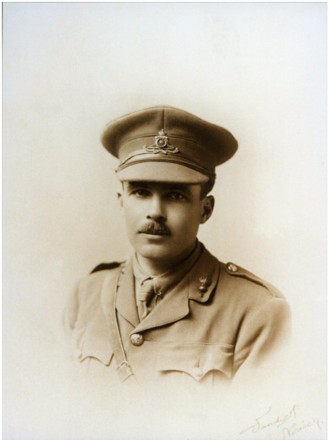
Lieut. Lawrence Bragg, Leicestershire Royal Horse Artillery, circa 1914.
Britain had prepared for a short, highly mobile, cavalry-led battle, in which it would simply support a much larger French army. The initial German attack was successful, but the Allies stopped the advance at the River Marne. The Germans fell back to the River Aisne and the high ground above, where they dug trenches, positioned machine-guns, set up barbed-wire entanglements, and brought up their awesome artillery. The Allies countered with their own defences, and attempts by each to outflank the other in the ‘Race to the Sea’ all failed. A ‘stalemate’ emerged on the Western Front, with earthworks stretching from the Belgium coast to the Swiss border.
The Germans again tried to reach Calais and Dunkirk. The BEF was outnumbered in men and weapons and suffered heavy casualties (dead and injured), driven back towards the Belgian town of Ypres; but German losses were unacceptably high and the Channel ports and Ypres remained in Allied hands. Indeed, despite numerous German attempts later, the Ypres Salient was held for the remainder of the war. Bob went up to London to apply for a commission and became a Second Lieutenant in the Royal Field Artillery, based in Leeds.
Early next year (1915), William Bragg returned from America, where he had been lecturing about his joint research with Lawrence, and the first edition of their book, X Rays and Crystal Structure, appeared (Bragg and Bragg 1915). William became a member of the consulting panel of the Board of Invention and Research, engaged in experiments to detect the destructive German submarines by listening underwater for the sound of their engines. News also arrived from America that father and son had jointly won the Barnard Gold Medal of Columbia University; they were joining illustrious company (Röntgen, Becquerel, Rutherford). But Lawrence felt disjointed and frustrated: explosive research beckoned but he was unable to follow, exciting fighting raged in Europe but he was locked in training, and an important medal awaited award but he was unable to attend (Jenkin 2008, ch. 17).
Gallipoli
Meanwhile, the British War Council had decided upon a major campaign in the Mediterranean. Prompted by the First Lord of the Admiralty, Winston Churchill, British ships tried unsuccessfully to force a passage through the Dardanelles to Istanbul; a Mediterranean Expeditionary Force would attempt it on land instead. Troops landed on the Gallipoli Peninsula in April 1915 and, after fierce fighting, also became bogged down in a stalemate. Incompetent leadership, inadequate artillery, desiccating heat, poor food and water, and disease all made success unlikely. Repeated attacks were unsuccessful and a final attempt — ‘The August Offensive’ — was planned for a ‘New Army’ of young men, including Robert Bragg (Figure 3).
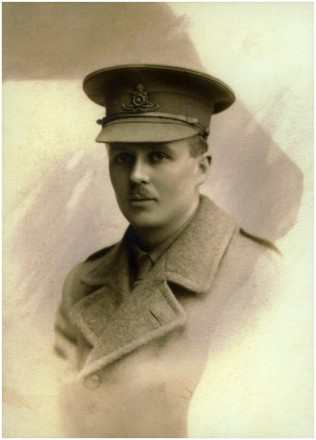
2nd Lieut. Robert Bragg, Royal Field Artillery, Leeds, circa 1915.
Bob's battery of four guns was landed just south of Suvla Bay, at the northern end of the Gallipoli Peninsula, to face newly arrived Turkish troops under Mustafa Kemal. The same conditions exhausted the new invaders, their guns were ineffective and their infantry attacks failed. Three senior commanders were replaced and the stalemate continued. Sitting in his dugout on 1 September 1915, Bob was hit by a Turkish shell that failed to explode but severed one leg and damaged the other beyond repair. He died on a hospital ship on the coast next morning and was buried at sea. His family was devastated. His father's internationalism was a casualty for some time and his mother sank into long-lasting mourning. It was soul-destroying but Lawrence would have to soldier on (Prior 2009, Fewster et al. 2003).
Sound-ranging
Nearly a year after receiving his commission Lawrence Bragg's prospects changed dramatically. In July 1915, he was seconded out of the Horse Artillery to unspecified duties with the Field Survey Company of the Royal Engineers. He had received a letter from the War Office in London, instructing him to report to Colonel Hedley of the Geographical Section of the General Staff, who put to him a proposition that he later described as follows:
The French had started experimenting with a method of getting the positions of enemy guns by measurements made on sound waves. Colonel Winterbotham … was convinced that this method might be useful, and he persuaded the Army authorities to set up an experimental section under the direction of an officer who had scientific training. Colonel Headley …asked me whether I would take on the assignment. I was thrilled … To have a job where my science was of use, after feeling so inefficient in the battery, seemed too good to be true. … The R.A. had clearly been very doubtful that the method would be of any use, but finally agreed. … Another young officer, Harold Robinson, was detailed to do the experimental work with me. Robinson was on Rutherford's staff at Manchester. (Bragg n.d.)
Britain had limited and poorly trained artillery, with a small number of small guns, inadequate and poorly-made ammunition, and poor technique. The Germans, by contrast, had modern machine guns and an array of monstrous heavy guns, produced in great secrecy in the Krupp workshops and hidden up to ten kilometres behind the front line. Perhaps sound-ranging could locate them.
The origins of sound-ranging are uncertain, but it was probably conceived independently several times. Captain Lowenstein took out a German State Patent on the method in October 1913 (No author 1929). More often mentioned is the French development in September 1914, when Professor Nordmann, an astronomer of the Paris Observatory and serving in the artillery, experimented with observers equipped with stopwatches measuring the time differences between the arrival of the sound of a gun at different points along a measured baseline. He then approached Lucien Bull of the Institut Marey in Paris, who was an expert in low-frequency sounds. Bull suggested the use of a three-string Einthoven galvanometer, in which each string was connected to a microphone and jumped in a strong magnetic field when the sound arrived and the current in the string changed (for Bull's own account, see Bragg et al. 1971, 33–4).
The strings were strongly illuminated and their shadows thrown into juxtaposition across a slit. A cine film ran behind the slit, and a toothed time wheel governed by a tuning fork interrupted the light 100 times a second, so ruling time markings across the film. The apparatus was switched on and off by a forward observer, who heard the sound before it reached the microphones. When the recording ceased, an operator cut off the portion of film which had run, developed and fixed it, and passed it to ‘the computer’, who measured the time intervals and deduced the position of the gun (see below). 3
For the British, Captains Winterbotham and Lefroy reported favourably to GHQ and recommended the Bull system, but higher authorities refused. Major Jack of ‘Maps, GHQ’ fought against the decision and was then permitted to order one set from Paris (Jack 1919, 19–27). Lawrence Bragg was asked to investigate its use for the British. He and Robinson sailed to Le Havre and then drove to Jack's headquarters at St Omer for further briefing. Lawrence then travelled to Paris to collect the promised Bull apparatus, installed in a ‘lorry’, and a small number of support staff. The delicate and complex equipment seemed to offer the best chance of locating the German guns accurately, and Lawrence installed it facing the enemy at La Clytte (now Klijte) in Belgium, south-west of Ypres. But it was a brave decision, for it seemed unlikely that the fragile equipment would work routinely in the war zone, and the rest of the army thought it was a total waste of time and resources!
The principle of sound-ranging is easily understood. Imagine just two microphones in known map positions behind the front line (Figure 4). The time difference for the arrival of the sound of a German gun at the microphones would be measured. Given the speed of sound, the distances still to be travelled to the second microphone when the sound reached the first could be calculated. A circle of this dimension could then be drawn around the microphone position on the map, and any great circle that passed through the first position and touched the small circle (there are infinitely many of them) represented a possible spherical sound wave from the gun, whose position was then determined at the centre of the great circle. Euclidean geometry, which Lawrence Bragg knew intimately, determined that the locus (positions) of all such points lay on a hyperbola, the microphone M1 at its focus, while the asymptote (infinite tangent) to the hyperbola passed through the midpoint between the two microphone positions, C, as shown. Given three microphones, the time differences then determined the position of the gun uniquely, at the centre of the only circle satisfying these conditions (Figure 5).
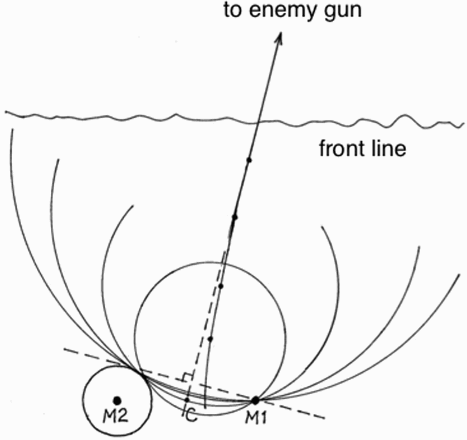
Basic principle of sound-ranging with two microphones, M1 and M2 (author). Four possible great circles are shown, their centres marked by black dots lying on a hyperbola. For a distant gun, all such centres lie close to the dashed asymptote (tangent), which passes through the mid-point, C, between M1 and M2.
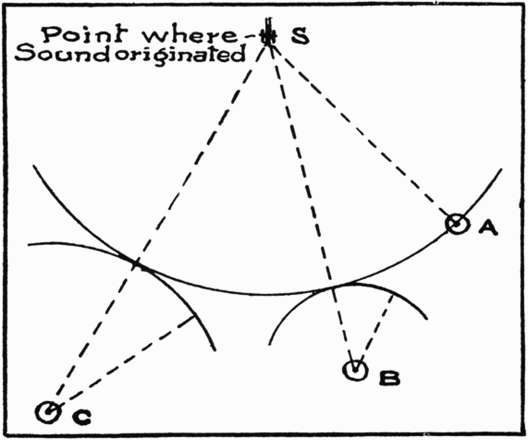
Basic principle of sound-ranging with three microphones (Bragg 1920, 186). Now there is only one great circle that passes through M! and touches the other two circles, revealing the gun position uniquely. Six microphones were used later, to enhance accuracy and reliability.
The technique proved extremely difficult in practice, however. The diaphragms of the carbon-granule microphones were hardly moved by the very-low-frequency sound waves of a gun, whereas the ejected shell produced a high-frequency shock-wave as it passed overhead, useless for gun location but clear to the microphones, as were the many other noises in the war zone. The wires connecting the microphones to the section's HQ (the lorry) behind the front line were strung between poles and were regularly broken; even armoured cables buried in the ground later were subject to theft and breakage. The absence of accurate maps for many months made the whole process unproductive. The effects of weather, especially adverse wind, and the lack of manpower also hampered progress.
As if these problems were not enough, two telegrams arrived later in 1915 that shattered Lawrence's already uncertain world. Brother Bob had died and Lawrence rushed to England to comfort his family. Bob had been the social centre of the family, widely popular and engaging. The family mourned and wondered what further, unexpected news the future would bring. They didn't have long to wait, for on 14 November Lawrence received word that he and his father had been awarded the 1915 Nobel Prize in Physics! The local Curé where he was billeted offered a bottle of wine and generals came to ask his opinion (Figure 6). What a psychological roller-coaster recent years had become for Lawrence and his family: Bragg's Law, X-ray crystallography, Bob's death, Nobel Prize, William's submarine detection struggling, Lawrence's sound-ranging improving but not yet satisfactory.
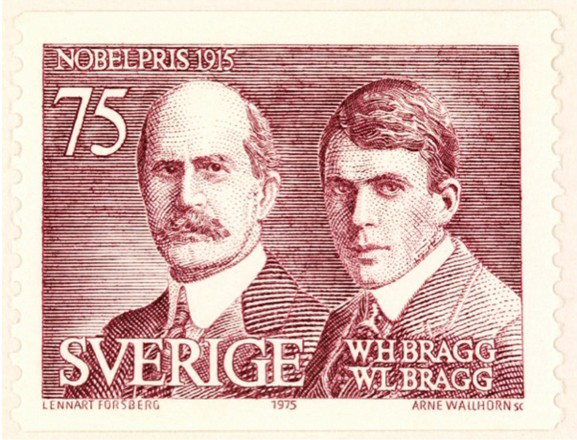
Swedish postage stamp commemorating sixtieth anniversary of Bragg Nobel Prize, showing them as in 1915.
While not in the trenches, Lawrence and his staff were very close to the front line, where it was extremely dangerous; even when it was ‘quiet’ shells came over irregularly and snipers watched night and day. His letters home gave very few hints, but he must have witnessed horrific scenes and experienced the agony. Robinson confided to Rutherford, ‘A week or two ago I had the first … opportunity of finding out whether I was really brave or not … Bragg kept very cheerful through it all — by the way, I don't think he has said anything to his people about it; they would be worried if they knew’ (Robinson 1915).
Late in the year, Lawrence was able to locate a German battery for the first time, although there were still major problems before the method could be judged a success. GHQ ordered seven more sets of apparatus so that each of its four armies could have two. In February of the new year (1916), the sound-ranging sections were transferred to army topographical sections, which later became Field Survey Companies (then Battalions), Royal Engineers. They included: map making, surveying, flash-spotting, sound-ranging, and the embryonic Royal Flying Corps. Lawrence's section at La Clytte was named ‘W-Section’, presumably because of his childhood name, Willie; and all other sections were given letter names. W-Section successfully selected and trained new personnel; as Lawrence said, ‘When I was seeking recruits for sound-ranging, I had only to … say “Bachelors of science one step forward” to get a generous response’ (Bragg et al. 1971, 31). Sound-ranging employed over 200 British scientists and engineers, many from Rutherford's team at Manchester (Chasseaud 1997, 120). 4
Attacking the stalemate, 1915
In May 1915, near Arras in northern France, heavy French guns and mortars were effective and infantry reached the summit of Vimy Ridge, only to be forced back by a German counter-attack. Other attacks also failed. In September, a British attack near the town of Loos was momentarily successful, but next day two British reserve divisions were thrown against the German defences and destroyed at a cost of 8,000 casualties and John French's job; Douglas Haig took over. Lawrence's dearest friend, Cecil Hopkinson, was a casualty in November and died later. So 1915 came to a close, with the Allies suffering many more losses than their enemy and with their offensives achieving very little.
The role of the artillery in attack was revised: instead of being primarily for infantry support it became the prime weapon of destruction. In an outstanding but unpublished PhD thesis, entitled The Monstrous Anger of the Guns, Jackson Hughes summarised as follows:
The protracted and bloody siege that was the Western Front was, after mid-1915, an ever-escalating gunnery duel. Both the attacking and defensive tactics adopted by the protagonists were based upon an increasing strength of the long-range heavy artillery with which the rival industrial complexes were able to provide their armies. … The mass production of the machine gun has often been blamed by historians as the cause of the bitter deadlock of the trenches … the reality is that it was the heavy guns which determined the shape and nature of the Western Front, and were its greatest killers. … Almost 60% of all the casualties suffered by the British forces in France and Flanders were inflicted by shell fire. (Hughes 1992, v)
Men were literally cut to pieces, and the injuries were often grotesque. Somehow the giant and invisible German guns had to be silenced, but it would take many months. Hughes goes on to point out that the war was won and then lost — and lost and then won — primarily by the guns, not primarily by the infantry, the cavalry, the machine guns, or the tanks; not by the British ‘wearing out’ the enemy and not by Field-Marshall Haig and his Staff Officers. The thesis contains strong writing and its analysis is persuasive.
The majority of British batteries were armed with 18-pound QF (quick-fire) guns, 4.5-inch howitzers, and a few 60-pounders. Their ammunition was poorly made and inadequate to damage the enemy trenches and guns. The German artillery, by contrast, had many more heavy weapons, a high number of which were 150-mm guns, regarded by many as the outstanding artillery piece of the war. Furthermore, the German batteries were dug into camouflaged pits, at great range and completely invisible to the Royal Artillery gunners; so that the British batteries fired ‘from the map’ or, as the artillery called it, ‘blind’. As a response to this dilemma, new methods to improve hostile-battery location were more widely introduced — sound-ranging and flash-spotting — the latter the location of German guns by hidden ‘spotters’ taking the bearing and range of the flashes of light when the guns fired.
The flash-spotting method was particularly useful when sound-ranging was difficult, but was less accurate and of limited range. However, when coupled with aerial observation and sound-ranging it made the location of German guns extraordinarily accurate. Counter-battery ‘unregistered’ or ‘predicted’ fire would then not require direct observation of the target. The German observers were better placed on ridges, hilltops and high ground and declined similar sound-ranging development.
The Somme, 1916
By July 1916, the earlier French losses at Verdun had so reduced them that the British Army now became ‘the offensive motor of the alliance’ (Hughes 1992, 82). Hughes continued:
The beginning of the Somme campaign could hardly have been less auspicious. It was a military calamity. … During the Spring of 1916, … the British Army trained hundreds of thousands of Kitchener's new army volunteers. The artillery meanwhile stockpiled hundreds of thousands of shells … and accepted the new guns the Ministry had managed to construct. These were used to fire the first sustained bombardment of the Royal Artillery for eight days, consuming over a million and a half shells. When this concluded … 120,000 troops advanced on the German positions. But by the end of the day, about 50% … were casualties, in return for no significant gains in territory. Indeed, most assaults got no further than the uncut German [barbed] wire, and the men were slaughtered there by German machine-gun and artillery fire.
The Somme campaign did not end with this carnage however; it continued for another five months, until winter rains finally brought it to a close. British casualties rose to 420,000. This long series of attacks did produce a significant advance, however, the ‘creeping barrage’, in which the gunners fired a tight, moving barrage just ahead of the infantry to shield it as it crossed no-man's-land and reached the German trenches largely unimpeded (Hughes 1992, Prior and Wilson 2005).
Breakthrough
In mid-1916 there was a breakthrough for sound-ranging. While Lawrence Bragg and his team had solved many of the problems, the serious inadequacy of the microphones remained. Bragg had noticed that, ‘although the gun report produced very little impression on the ear, it was associated with a large pressure change; it rattled windows’. Furthermore, he had noticed that he was lifted a little off the toilet seat when a six-inch gun fired, and others similarly felt a jet of cold air on their face through torn holes in the hut walls when they were lying on their camp beds. The arrival of Corporal William Tucker at Bragg's W-Section provided the key to unlock the impasse (Figure 7). Tucker had been working in the Physics Department of Imperial College London on the variation of the electrical resistance of fine wires as a function of their temperature, and he now saw how to detect the high-pressure, very-low-frequency gun wave in a new ‘Tucker Microphone’ (Tucker 1920, a drawing is in Wood 1930, 403).
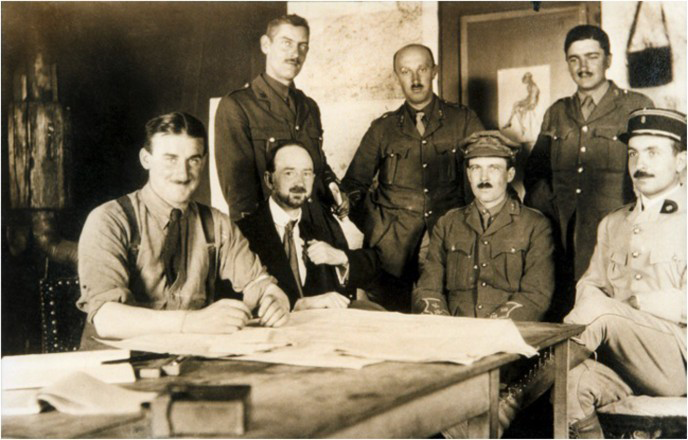
British WWI sound-ranging pioneers: William Tucker standing left, Lucien Bull and Lawrence Bragg seated centre, no date.
A fine platinum wire was strung across a hole drilled in a disused ammunition box or rum jar and was made one arm of a Wheatstone-Bridge circuit, balanced by a variable resistor and with a galvanometer string across the middle of the circuit in the usual way. It was hoped that the burst of air associated with a gun firing would cool the wire, unbalance the circuit, cause the galvanometer string to jump, and produce a clear blip on the film record. Bragg recalled the first occasion, in June 1916, when it worked: ‘It was a wonderful moment, the answer to a prayer. It converted sound-ranging from a very doubtful proposition to a powerful practical method’ (Bragg et al. 1971, 36). Figure 8 shows a clear record, where the start of each jump can be determined to better than one-hundredth of a second. It was also found in practice that six microphones were desirable, providing ample data for correcting any errors. 5 The number of sound-ranging sections along the front line was increased further, with the new recruits trained at Lawrence's W-Section, now at Kemmel village.
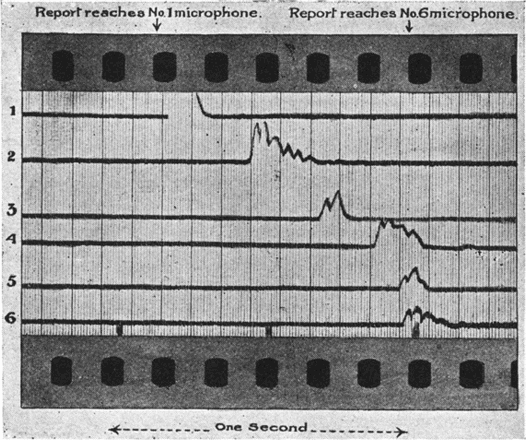
Sound-ranging film recording of German howitzer firing (Bragg 1920, 188).
The method had other advantages too. It recorded the burst position of an enemy shell and therefore its range, indicating the calibre of the gun; and it could locate the point of impact of British shells and therefore ‘range’ its own guns. In addition, in July Captain Owen suggested surveying the microphones at equal distances along a straight base line. The ‘breaks’ on the film for a given gun then fell on a smooth curve and could be easily identified, even on a very noisy record. This base was superseded in November by the arc of a circle, with its centre in the most interesting area behind enemy lines. Additional personnel were provided to W-Section for their ongoing research, and in September 1916 all sections were equipped with the Tucker Microphone and many more enemy gun emplacements were located. Tucker himself was sent to the Experimental Section of the Overseas Artillery School on Salisbury Plain to undertake experiments and to encourage even greater acceptance of the new technology.
Wind was a constant problem. Sheets of camouflage netting over the microphones shielded turbulence, but the effects of wind and temperature on the sound itself remained problematic. This was largely solved by J. A. Gray's suggestion of ‘wind sections’ behind the lines. Explosions were set off at regular intervals and the sound recorded by microphones in several locations. Errors in the deduced position of the explosion were due to wind and temperature, and so corrections could be circulated regularly to the sound-ranging sections (Lewis 1967). Nevertheless, in a strong westerly wind the sound was refracted upwards and sound-ranging became impossible. Otherwise, day and night, in easterly winds, in foggy, misty weather, and at ranges far beyond visible observation, the sound-ranging sections were brilliantly and uniquely successful.
Articles written after the war describe the mathematical and geometrical details of sound-ranging, in which Lawrence Bragg must have been involved, although no personal records of his wartime work seem to have survived (Trapp 1919, Hope-Jones 1928, Bateman 1918). But on the battlefield such calculations were impossible. Instead, ‘artillery boards’ of stout, zinc-covered plywood on a braced framework and with an accurate map pasted firmly on to it to avoid distortion due to changing atmospheric conditions, were used. Because the guns were very distant, a hyperbola and its asymptote were essentially coincident. Five coloured-gut strings (the asymptotes), fixed at the mid points between the six microphone positions, were then stretched to appropriate positions on time-difference scales marked around the edge of the board, and their intersection then gave the position of the gun (Hope-Jones 1928 and Trowbridge 1920 have diagrams of the method).
Passchendaele, 1917
Hughes again:
In 1917 the guns utterly dominated the battlefields of the Western Front. The preparatory bombardment used before the beginning of the Somme offensive would be dwarfed by the massive and repeated bombardments of 1917. In their preparations for the first three of the five major attacks launched by the British … the Royal Artillery fired over ten million shells, using over two thousand heavy weapons. The German artillery … used only marginally less. … Despite this … none of the many attacks launched by the British achieved the goal of … a decisive breakthrough of the German defensive line. When the last shot was fired in December 1917 the German armies were still ensconced. (Hughes 1992, 128)
In August 1916, the German defences changed to wide zones, eight miles (12 km) deep, which the British named collectively ‘The Hindenburg Line’. The Germans then withdrew to the new fortifications, surprising the Allies and devastating the countryside as they retreated. At the same time the British defects in guns and ammunition were addressed, so that the Royal Artillery now had destructive power and accuracy unimagined a year earlier. Improvements in communication allowed the information gathered by aerial observers, flash-spotters and sound-rangers to be co-ordinated by Corps Artillery HQ, thus locating enemy artillery precisely. New weapons enabled successful counter-battery (attack on enemy artillery) to become the foremost task of British artillery (Prior and Wilson 2003).
With more than twenty sound-ranging sections well established all along the battlefront, the first of ongoing monthly sound-ranging conference was held in January 1917, each section sending a representative. In addition to training, friendly competition and camaraderie developed. Furthermore, a new ‘Experimental Section’ led by Bragg was created at GHQ, with several functions: to improve apparatus and methods, to repair existing equipment and construct new, and to run a School of Instruction. There was a substantial workshop to facilitate the first two and the School ran four courses: for officers, for film-readers/computers, for forward observers, and for instrument repairers. Here, for example, sound-rangers learnt to move their equipment forward as fast as the artillery when British troops made an incursion into the frontline (Innes 1935, 150–3).
In April, British artillery faced the Battle of Arras much better prepared; it reduced the foremost German trenches to ruin and its infantry took Vimy Ridge with far fewer casualties than before. However, after a further six weeks of British attacks a breakthrough was not achieved. The German barbed-wire entanglements were not cut and the new tanks could not get forward because of dreadful weather. The result was calamitous, the slaughter reminiscent of the Somme. The concentration of heavy artillery on both sides made infantry movement impossible.
French attacks elsewhere also failed catastrophically and the French commander, Petain, allowed the British to assume control, freeing Haig to implement his favoured plan, a Flanders offensive. In May 1916, Haig had appointed Noel Birch Artillery Adviser at GHQ, making him the leading Allied gunner in France. In March 1917, Birch issued a confidential General Staff pamphlet entitled ‘Sound Ranging’ … ‘in order that Artillery Officers may know the possibilities of Sound Ranging’ (Birch 1917). Bragg's sound-ranging was now established and its acceptance had spread widely. Furthermore, it was clearly superior to the German form (Schirrmacher 2014) and, when British sections retreated, great care was taken to preserve all of the equipment and documents; they were precious.
The Flanders campaign, or Passchendaele, was launched in mid-summer 1917 with mixed results; sometimes success, capturing objectives and inflicting heavy casualties, at other times failure, repulsed with no gains and dreadful losses. Careful planning and accurate firing, crucial for counter-battery success, was achieved by close co-operation between the location techniques. In the counter-battery duel at Messines, ‘we had got over 90 per cent of the German guns absolutely accurately located’. A false barrage, the main attack itself, and subsequent detonation of mines below the Messines Ridge ‘knocked the German guns about so badly that that they gave us very little trouble during the battle’ (Chasseaud 1997, remarks by Major-Gen. Franks, quoted p. 123).
The next day, however, Haig replaced the successful Plumer with the Fifth Army led by Gough, who for the coming Battle of Pilckem Ridge attempted a grand strategy approach, which ended in dreadful failure. In appalling weather and clawing mud, the name Passchendaele became a byword for dreadful bungling and pointless slaughter. For a further Flanders offensive in September, Plumer was restored and again proposed to take the Gheluvelt Plateau by short steps on a narrow frontage. The German defences were destroyed by a creeping barrage and overrun. Yet Haig again intervened and, in ‘the most lamentable decision of his lengthy … command’, attempted to press on to the Passchendaele Ridge in three futile attempts. Over 250,000 British soldiers were casualties, until continuous rain stopped the slaughter (Wilson 1986, 477).
In November, one further attempt was made further south at Cambrai. With improvements in munitions, ranging techniques and meteorology, 80 per cent of hostile guns were identified by the sound-rangers before the attack and then shelled with calibrated and accurate guns. By mid-afternoon on day one, the Third Army completed the greatest British penetration of the war. However, a counter-attack soon followed, and in desperate fighting the Germans recaptured much of the surrendered ground. Both sides lost about 45,000 men.
Coup de Grâce, 1918
At the start of 1918, German leaders planned total victory through a vast offensive on the Western Front, while the British and French governments committed their generals to defence. The outcome was very different!
Late the previous year, Alexander Kerensky became Russian leader and mounted an unsuccessful offensive in the east. The Bolsheviks seized power, and in March 1918 a punitive truce was signed with Germany. Most of the German troops now moved to the Western Front: 192 divisions against 169 Allied, although American troops would soon arrive (Kevles 1978, 126–38). The Germans saw an opening and Ludendorff launched a series of offensives. At Verdun, German attacks were countered by heavier and longer French bombardments and there were huge casualties on both sides.
The Germans began to explore unregistered fire, but their sound-ranging involved observers with a pair of large ear trumpets and a stopwatch, clearly inferior to Bragg's sophisticated system. A German Group Order for their batteries to fire together to fool British sound-ranging was also futile; Lawrence's system could now untangle several batteries firing at once. However, because they had a large numerical superiority, the Germans broke through and by the end of March had advanced 40 miles (60 km) across the Somme battlefields.
Then, weakened by fatigue and inadequate supply, the German advance was halted by the British Third Army. Sound-ranging sections and flash-spotting groups were added to Rawlinson's Fourth Army, artillery boards were prepared and surveyed, and ‘bearing-pickets’ were hammered into the ground to guide aiming, The British government released 170,000 new troops for the Western Front and Churchill's Ministry of Munitions produced two thousand heavy guns and ten million well-made shells. The enemy turned north to Flanders, but again the attack petered out. Ludendorff turned to face the French, and his three attacks in May, June, and July had some success, until French reserves counter-attacked and recuperated British troops replied with a devastating push around Amiens (Prior and Wilson, 1992, Part VI).
It had become possible to fix the position of German guns to within 25 yards (23 metres), but this information was wasted unless the Allied guns could hit the located positions with similar precision. Lawrence's talented class-mate from his student days in Adelaide, Robert Chapman, had become a sound-ranger in 1917, and he developed ‘screen calibration’ of Allied batteries, determining the muzzle velocity and range of individual guns, whose performance changed regularly because of wear. Earlier, a gun was ‘registered’ before a battle by observing the error in the fall of its shots and making corrections. The Chapman method involved the measurement of the time of flight of shells between their penetration of two widely-spaced wire screens using the Bull apparatus. This could be done speedily and close to battery positions, before and during a battle, and the method proved extremely successful. In misty weather, the sound-rangers located ninety per cent of German batteries (Chasseaud 199, 455), and ‘the Amiens battle opened … with British shells falling with deadly precision upon the enemy's carefully concealed artillery pieces’ (Wilson 1986, 586). Chapman later wrote an Adelaide University Master of Engineering thesis giving the details, and Britain issued it as an official War Office document (Chapman 1922).
On 8 August 1918, the British surprised the unprepared German defences. Earlier, over 70 per cent of the hundreds of thousands of British casualties in Flanders were caused by German shellfire; in 1918, this reduced to 27 per cent of a total of less than ten thousand losses. In contrast, German casualties were devastating, as its Second Army collapsed, its artillery was destroyed or captured, and thousands of its troops were taken prisoner. The attack on 8 August was indeed, as Ludendorff described it, ‘der Schwarztag’, the black day (Hughes 1992, 274).
German divisions in the north now rushed south; British gunners and sound-rangers struggled to get forward, their attack halted and casualties rose. However, Haig at last recognised the central importance of artillery, closed the Amiens attack and released the Third Army to advance with well-prepared artillery. The First Army and the recovered Fourth Army joined in and the Germans undertook a general withdrawal. The Allied tactics of surprise attacks with limited objectives in different areas of the frontline forced Ludendorff to defend his entire frontage. On 18 September, the British captured almost 10,000 of the best German troops, 100 artillery pieces, 500 machine-guns, inflicted 20,000 casualties, and destroyed four elite divisions. Allied armies now launched attacks in the north and the south, and on 29 September broke through the centre and the strongest of the Hindenburg sections, the Siegfried Stellung.
The artillery and its supporters had triumphed. On the eleventh hour of the eleventh day of the eleventh month of 1918 the guns of the Western Front fell silent.
Major Lawrence Bragg had been promoted several times, been mentioned in dispatches three times, won a Military Cross (without citation for secrecy reasons), been awarded a Nobel Prize and an OBE, and would soon be appointed to Rutherford's chair at Manchester. He was just twenty-eight years old!
Conclusion
As a youth Lawrence Bragg was socially isolated, but at Cambridge he made friends and blossomed. He also grew personally during the war; it was a great adventure, with high excitement and times of fun. He made life-long friends and he succeeded when everyone predicted failure. But he was close to some of the worst areas of the war, and everyone who saw it up-close was traumatised (Winter 1978, ch. 8). Lawrence Bragg did not suffer long-term PTSD (post-traumatic stress disorder), but there was ongoing suffering and several other consequences, personal and professional (Jenkin 2008 passim, Hunter 2004 passim).
During his early years in Manchester, tensions were very high. Lecture-room desks were smashed, vicious anonymous letters circulated, and the inexperienced professor's research was unfashionable. Things recovered when Lawrence's research blossomed and he married the bubbly Alice Hopkinson. A number of physicists then greeted his appointment to the Cavendish chair in Cambridge with derision, unwilling to accept a crystallographer as a suitable replacement for Rutherford. But Lawrence again triumphed and the Laboratory achieved successes that equalled any of the previous era, notably the Nobel Prizes awarded to Perutz, Kendrew, Crick and Watson for their determinations of early structures in the emerging field of molecular biology.
Finally, at the Royal Institution of Great Britain (RIGB), Lawrence's war came back to haunt him. During WWI, a sound-ranging section leader, Edward Andrade, had been forced to leave, as described by Lawrence in a letter to his father, ‘Andrade got jolly well kicked out of the show here as he became absolutely the limit. He … has got a bad kink in him somewhere. … the officers in his section refused to work with him any longer and told the colonel so’. 6 Now Andrade was in charge of the Royal Institution and it was imploding, with staff, managers, members and visitors all involved. Lawrence wrote to its President suggesting Andrade's removal, and the letter became public. Andrade resigned, and Lawrence was then reluctantly persuaded to accept leadership of the Institution. A number of Fellows of the Royal Society were outraged and refused to lecture at, or even attend, the Royal Institution. But again, as he had done elsewhere, and as his father had done at the RIGB some time before, Lawrence substantially resurrected the Institution's role and reputation, in research and in the public sphere (James and Quirke 2002).
Sir David Phillips told me that Lawrence was diffident and insecure in personal relations and lacked social subtlety and skills, now recognised as a common outcome of traumatic war experience (Jenkin 2008, 443–4; Ekins and Stewart 2011, ch. 1; Raftery 2003, ch. 6). But at none of these institutions, or amongst his colleagues, have I found any indication that Lawrence was accorded understanding because of his wartime experience. The effects of war-trauma were very widely unrecognised. Throughout his life, Lawrence was also constantly confused with his father. He only rarely received the full recognition he deserved. However, in recent centenary celebrations of the achievements of father and son, great honour has finally come; at last.
Footnotes
1
The early parts of this paper are taken from my biography of William and Lawrence Bragg, which should be consulted for details and references (Jenkin 2008). The account of Lawrence's work in WWI carries its own references below. I thank Peter Buske, John Payne, Robin Prior, and two referees for helpful comments on early drafts of this paper.
2
It has not proved possible to include an account of William Henry Bragg's work in WWI; see Jenkin 2008, ch. 17.
3
A drawing of the electrical circuits involved is in ‘A treatise by Major R. H. Chapman on the calibration of guns and howitzers …’, UK War Office, 40WO8362, 1922, Plate 5, and a photo of the same is in Chasseaud 1999 plate XXII. Chasseaud 1990 has an account of the three French systems that were developed, including the TM or Telegraphic Militaire method that was widely adopted by the French army.
4
Eight from Rutherford's laboratory were Gray, Andrade, Darwin, Marsden, Nuttal, Robinson, Russell, and West.
5
The six microphones were placed 1.5km apart on a circular base of about 10km radius, facing the enemy, and about 3km behind the frontline. One or two observation posts were 1km in front of the microphones, which were all connected to the section's lorry/HQ/office further back.
6
W.L. Bragg to W.H. Bragg, 15 January 1917, Royal Institution MS WLB 37B/2/22.
Notes on contributor
John Jenkin was born, raised, and educated in Australia (BSc, PhD), held post-doctoral appointments in England and America, and then spent his career in physics and the history of science at La Trobe University in Melbourne, Australia. His research focussed on the electronic properties of materials (in physics), and on biography (in the history of the physical sciences). His major recent work is William and Lawrence Bragg, Father and Son (Oxford: OUP, 2008, 2011). He retired in 2000.