







Abstract
Kathleen Yardley started her career in X-ray crystallography under the directorship of Sir William Bragg first at University College London (UCL) and then at the Royal Institution (RI). She was part of a team of young researchers who were keen to discover this new world of molecular and atomic patterns. After her marriage, now Kathleen Lonsdale, she left the RI and moved to the University of Leeds. Whilst at Leeds Lonsdale sought Bragg's support and advice, evidence of which is provided by their correspondence during this period. After returning to London, Lonsdale, now the mother of two daughters, returned to Bragg's team. During the next fourteen years (1932–1946) she established herself as one of the prominent researchers within the rapidly expanding field of X-ray crystallography and was one of the first women to be elected a fellow of the Royal Society.
Introduction
This paper focuses on the early career of Kathleen Lonsdale covering the period 1922–1946. It attempts to show how Lonsdale progressed from student researcher to establishing her own research laboratory where she completed one of her most outstanding pieces of research on the structure of benzene. A key influence in her early career was Sir William Bragg, whom she worked with for fifteen years. This paper uses original correspondence and Lonsdale's own writings to show how his support and guidance helped Lonsdale to establish herself as one of the prominent X-ray crystallographers of the twentieth century.
On the 28 January 1903 Kathleen Yardley was born in Newbridge, County Kildare. She was the youngest of ten children in a family at times reduced to living in poverty. There were four girls and six boys, four of whom died in infancy. Yardley's father was Harry Frederick Yardley who was the postmaster at Newbridge Post Office following a career in the British Army. Her mother was Jessie Cameron who was of Scottish descent. In 1908 they separated and her mother, concerned about the stormy state of Ireland, decided to bring her children to England and they settled in Seven Kings, Essex. Yardley's father, who had moved to South Africa visited them occasionally but died when Yardley was twenty.
Yardley's formal education started at Downshall Elementary School (now Downshall Primary School) in Seven Kings from 1908 to 1914. As a result of her academic ability she won a scholarship to Ilford County High School for Girls. In order to study science Yardley had to attend classes in physics, mathematics, chemistry, and higher mathematics at the Boy's school as these were not available at the Girl's school. In 1918 Yardley applied to Bedford College for Women, a constituent college of the University of London for a place on the BSc Honours Mathematics course. She was academically extremely able having obtained first-class honours in the Senior Cambridge Examination with six distinctions but was only sixteen. Her age appeared to have caused concern with the Principal of Bedford College but after being interviewed Yardley was accepted as a non-resident student from October 1919.
During her first year Yardley's reports indicated excellent progress in all subjects which resulted in her being awarded a University Exhibition. However she had made the decision to change to the Physics Honours course. She explained later ‘I came to this decision because the only career open to me as a mathematician seemed to be that of teaching or lecturing and I felt very unwilling to undertake this’. 1 In 1922 Kathleen Yardley was awarded a first-class honours degree in physics, being one of eight students to achieve this award. The examiner for internal students for the final examination was Professor Sir William H. Bragg K.B.E, Quain Professor of Physics at University College London.
As a result of her success in the final examination Yardley was offered a position by Bragg which also provided her with the opportunity to complete a Master's degree. Yardley wrote to Miss Tuke, Principal of Bedford College informing her that:
I will be doing research in the Physics laboratory at UCL at Sir W.H. Bragg's request if a grant is forthcoming. He seems to think that this should be quite possible, so that my fond ambitions may now be realised.
2
The ‘fond ambitions’ suggests that research was really what Yardley wanted to do and was delighted that this had been realised. A grant had been forthcoming awarded by the Department of Science and Industrial Research (DSIR).
Joining the team of Sir William Bragg at University College London
William Henry Bragg had been appointed to the Quain Chair of Physics at UCL in June 1915 but he did not start assembling his team until 1922 as he was working for the Admiralty on anti-submarine devices. He had already appointed five research assistants during October and November — George Shearer, William Astbury, Reginald Gibbs, William Plummer, and Alexander Müller. In December they were joined by two students-in-training, Kathleen Yardley and Gladys E. Mocatta who, like Yardley, had also graduated in 1922 with first-class honours in physics from UCL.
On her arrival Yardley was instructed by Bragg that her first task was to assemble her apparatus and that:
I would take me perhaps three months to collect together everything I would need (ionization spectrometer to be constructed in his workshop by the formidable Mr Jenkinson, a huge lead-covered box to hold and shield the Coolidge tube, gold-leaf electroscope, induction coil with Hg interrupter, condenser, high tension battery, spark-gap and milliammeter) and then I would put it all together myself. (Lonsdale 1962, 596)
In the meantime Bragg advised her to read Hilton's ‘Mathematical Crystallography’ and to think about some problem she might tackle (Hilton 1903, 1–260). Although Hilton had been Yardley's mathematics lecturer at Bedford College she had no idea that geometrical crystallography had been his special subject. The problem would be the structural analysis of an organic compound since Bragg's team at UCL was focussed on analysing organic compounds. According to Jenkin ‘this was following an agreement with his son who was examining the structure of inorganic compounds’ (Jenkin 2008, 416). 3 Yardley had a limited knowledge of organic chemistry so asked the advice of William Astbury (referred to as Bill) who suggested she try succinic acid. She was immediately successful in obtaining a good crystal specimen of the acid with which to carry out her analysis.
At the beginning of 1923 Yardley had collected all her apparatus and set about the task of assembling it. She wrote later that ‘a fellow research student (now my husband) offered to do the soldering for me. I agreed that he should show me how to do it but said I would like to finish it myself’ (Lonsdale 1962, 596). Using this apparatus Yardley set about analysing the sample of succinic acid. The results she obtained enabled her to deduce a probable structure for the acid and two of its derivatives, succinic anhydride and succinimide. This work was to be the topic for Yardley's MSc awarded in December 1923 and also for her first paper communicated to the Royal Society by Bragg in January 1924 (Yardley 1924).
In May 1923 Bragg received a letter from Sir James Crichton-Browne, Treasurer of the RI inviting him to become the next Director. He decided to accept the offer and joined the RI in July 1923 bringing with him his five research assistants, two students, his instrument maker (Jenkinson) and his secretary (Winifred Deighton).
Transferring to the Davy Faraday Research Laboratory at the Royal Institution
The Davy Faraday Research Laboratory (DFRL) owed its existence to Ludwig Mond (1839–1909), who had been a substantial benefactor to the RI having purchased 20 Albermarle Street, paid for its merger with the RI and then given an endowment for the establishment of the Laboratory. The Laboratory admitted its first research workers in January 1897 each of whom was to be admitted for one term only and then had to apply for readmission. Each worker had to complete an application form giving personal details, education and qualifications, record of original work, title, and length of time for the proposed research, the need for unusual chemicals and apparatus, and whether the applicant would be bringing any exceptional apparatus to the laboratory or required the use of a personal assistant (Watson 2002, 207). Yardley's application stated that her projected title was ‘chemical and physical crystallography’ and that she would be bringing exceptional apparatus to the laboratory. She stated her proposed research was: ‘Investigation of the structure of organic crystals, with special reference to their chemical and physical properties: using the X-ray spectrometer’. 4 The exceptional apparatus was the X-ray spectrometer which had been designed by Bragg and which Lonsdale had been learning to use at UCL.
According to James and Peers, ‘Bragg changed the modus operandi of the Davy-Faraday Research Laboratory, believing in the value of directed collaborative research rather than letting individuals pursue their own particular interests as in the early years of the Davy- Faraday Research Laboratory’ (James and Peers 2007, 168–169). By the autumn of 1923 Bragg had increased his team to twelve by recruiting five more workers which included J. D. Bernal and Miss I. E. Knaggs all of whom were concentrated on studying the structure of organic molecules. However this number of workers provided Bragg with accommodation problems. An undated floor plan, assumed to be drawn by Bragg showed how he managed to accommodate his team over four floors with the ladies having their own room on the ground floor. 5 The plan showed that Yardley shared the room with Miss Allen and Miss Knaggs as she later recorded: ‘I was installed in a ground floor with two ionisation spectrometers and some early gas-tube equipment for the photographic technique’ (Lonsdale 1962, 597).
In July 1924 Yardley was appointed a temporary research assistant to Bragg which indicated that she was in receipt of an annually renewable salary.
6
She informed her former principal's secretary of her promotion stating ‘so I can continue with my work at the Royal Institution which will be very jolly’.
7
In the same year Yardley carried out her first major contribution to X-ray crystallography in conjunction with Astbury on the relationship between X-ray diffraction patterns and the space groups from which they arose (Astbury and Yardley, 1924). The problem had been to present the space groups in a form useful to X-ray crystallographers. Yardley wrote later:
…Astbury and I proceeded, independently but in parallel, to work out the 230 space group tables and we persuaded WHB, not without difficulty to send them for publication. The usefulness of the Astbury-Yardley Tables, which the Royal Society had to reprint — a very rare event for a Phil. Trans. Paper — perhaps lay in the fact that they were intended for immediate practical use. (Lonsdale 1962, 597)
Bragg had established a very successful research school at the DFRL attracting bright young research workers both male and female eager to be involved with the new area of crystallography. There were nine nationalities represented reflecting Bragg's international reputation and the growing importance of X-ray analysis. The workers had great respect for Bragg and enjoyed his style of leadership. Yardley conveyed her own thoughts when she wrote later:
Those of us who worked with W.H. Bragg in the Davy-Faraday Laboratory got the impression that we were allowed to choose and develop our research themes entirely independently. Sir William certainly never dictated; and he expected his team to have original ideas and to develop them independently. But looking back, it is possible to see that he in fact directed the research by means of silken reins that were hardly felt but were very effective… (Lonsdale 1962, 412)
Lonsdale appeared to enjoy the happy family atmosphere of the Laboratory with its lack of formality and emphasis on experimental work. She wrote later about the importance of the tea-break: ‘Tea at 4pm was something not to be missed. To begin with W.H. Bragg was nearly always there and there were generally Bourbon biscuits too. And all sorts of interesting visitors turned up…’ (Lonsdale 1962, 413).
Leaving the Royal Institution for the University of Leeds
In 1922 whilst working at UCL Yardley had met Thomas Jackson Lonsdale a PhD physics student. The following year they both left UCL, Yardley going with Bragg to the RI and Thomas Lonsdale to the British Silk Association located in the Textile Department of the University of Leeds. While apart they wrote to each other nearly every day and finally Thomas wrote to ask Kathleen to marry him. They were engaged for four years and planned to marry in 1927 and set up home in Leeds. Although Yardley planned to retire and become a wife and mother Thomas Lonsdale would not consider her giving up her scientific research.
Bragg had held the Cavendish Chair of Physics at the University of Leeds from 1909 to 1915 before moving to UCL. He would have been delighted to recommend Yardley to his successor, Professor Richard Whiddington (1885–1970) with a view to continuing her research work at Leeds. Evidence suggests that the priority was in securing funding as Yardley applied for several scholarships. She was successful in obtaining an Amy Lady Tate Scholarship from Bedford College which would provide her with £125 per year for two years. 8 Yardley was also successful in obtaining a grant of £150 from the Royal Society towards apparatus she would need for her research. Kathleen Yardley and Thomas Lonsdale were married at the Baptist Church in High Road, Ilford, Essex on 27 August 1927. The now Kathleen Lonsdale left the RI on the 15 September 1927. 9
Lonsdale started work in the physics department at Leeds in the autumn of 1927 and wrote to Bragg reflecting on her time as a member of his team:
Dear Sir William I should like to take this opportunity of thanking you again for all the help you have given me in so many ways. I feel sure that it will be difficult to find a place where I shall be as happy in my work as I was at the Davy Faraday…
10
In fact the situation that confronted her at Leeds was very different from that at the DFRL although there were similarities with regard to constructing her apparatus as she wrote later:
Professor Whiddington had welcomed me in the physics department at Leeds University where W. H. Bragg had formerly been professor and where he and W. L. Bragg had carried out their early and intensive studies of crystal structures. The advent of World War I had prevented the establishment of any research school here and Whiddington was interested in a different field, so I had once more to build up the X-ray diffraction equipment with the bits and pieces I could find and with the help of an apparatus grant of £150 from the Royal Society… (Lonsdale 1962, 600)
The physics department at Leeds was located with the much larger chemistry department and their laboratories were connected. The chemistry department was headed by Christopher Kelk Ingold (1893–1970), knighted in 1958 who had been appointed to the Chair of Organic Chemistry in 1924. It was during his time at Leeds that Ingold became interested in all aspects of organic chemistry and would go on to dominate theoretical organic chemistry with his reaction mechanisms derived by integrating physical and organic chemistry. Whilst at Leeds one area of his research focussed on aromatic substitution and as a result of this work various substituted benzene derivatives were prepared. One of these was hexamethybenzene, C6(CH3)6, crystals of which Ingold gave to Lonsdale for her X-ray analysis work. Since benzene was a liquid it was not suitable for study but the substitution of six methyl groups into the benzene ring had provided a solid derivative suitable for analysis.
In 1865, the structure of benzene had been proposed by August Kekulé (1829–1896) to be a six-membered ring of carbon atoms with alternating single and double bonds, subsequently drawn as a hexagon. However by 1925 there was still no confirmation of the ring structure of benzene which had been conjectured by Kekulé sixty years earlier and which remained a source of argument amongst chemists. Crystallographers were particularly interested in the benzene structure and hoped that the recently developed technique of X-ray analysis would provide the solution. In 1928 when Lonsdale started her work on hexamethybenzene the evidence for the structure was confused. The confusion arose as scientists debated whether the benzene ring was planar or had a puckered or zig-zag arrangement.
The first evidence of Lonsdale's progress was given by Bragg:
My dear Mrs Lonsdale I think your new result is perfectly delightful: many compliments upon it! I like to see the benzene ring ‘emerging’. Thank you for sending me a special account of your work. It is very welcome…
11
This letter appeared to be of particular importance to Lonsdale as she wrote later ‘I have a treasured letter from Sir William dated 30 October 1928’ (Lonsdale 1962, 599). In November Lonsdale sent a letter to Nature announcing her successful X-ray examination of hexa-methylbenzene which had led to certain definite and fundamental conclusions concerning the symmetry of the benzene ring (Lonsdale 1928).
Following this announcement Bragg wrote:
I would very much like to see a Laue photograph of your crystal…Would you mind letting me have a crystal to try, if you are not doing it yourself? I should be very glad to speak about your results at the first Friday Evening Discourse after Christmas but if you would rather I said no more about it than is in your letter to Nature I will refrain from going past that. It would be very nice however if I could show a photograph.
12
This brought an immediate reply from Lonsdale who had no X-ray photographic equipment at Leeds so was pleased that this could be done for her at the DFRL and was delighted that Bragg would be mentioning her work at his Evening Discourse.’ 13
The crystals were photographed by Alexander Müller now Assistant Director at the DFRL and Bragg reported that they possessed some unusual features but required further careful examination.
14
Lonsdale's reply indicated the value of the photograph:
I was very glad to receive from Dr Müller a photograph obtained by rotation of the crystal axis about its c axis. The photograph does not show quite as many reflections, at any rate in the equatorial zone, as I had observed on the spectrometer, but as far as it goes, it verifies my results…’
15
Early in 1929 Bragg wrote briefly to Lonsdale: ‘Very many thanks for your rough diagrams. I hope to say something of your beautiful work to-night’. 16 The beautiful work was Lonsdale's first experimental proof that the benzene ring was hexagonal and flat. Lonsdale herself considered this to be ‘my most fundamental and satisfying piece of research’ (Lonsdale 1962, 599). Her full detailed account of the investigation was communicated to the Royal Society by Professor Whiddington (Lonsdale 1929). From her experimental work Lonsdale deduced that the molecule existed in the crystal as a separate entity, the benzene carbon atoms are arranged in a ring formation and the ring is hexagonal or pseudo-hexagonal in shape. She concluded that this supplied a definite proof, from an X-ray point of view, that the chemist's conception of the benzene ring is a true representation of the facts (Lonsdale 1929, 502).
The next analysis undertaken by Lonsdale was on hexachlorobenzene a sample of which had also been given to her by Ingold. It can be assumed that she had completed all the experimental work before the birth of her first child, Jane on the 11 October 1929. While she was at home before and after the birth she worked on the complex calculations resulting from her analysis using logarithm tables. However as Lonsdale reported later:
I found it rather difficult to do everything in the home and also to find time for ‘arbeit’; so she wrote to WHB and he persuaded the Managers of the Royal Institution to give me a grant of £50 for one year with which to hire a daily domestic helper… (Lonsdale 1962, 599)
17
Unfortunately Thomas Lonsdale's position came to an end in 1930 but he obtained a new post at the DSIR in their Road Research laboratory, Harmondsworth. Lonsdale informed Bragg of her change of circumstances and also asked him if he would find room for her spectrometer and Coolidge tube at the Davy-Faraday. 18
Bragg's reply expressed his pleasure at the prospect of Lonsdale returning to the DFRL:
Any wind that blows you back to London is a favourable one; I am pleased to hear that we may possibly see you about the Davy Faraday once more. We will of course house your apparatus and I hope you may find some time to use it yourself…
19
Lonsdale moved to Harmondsworth in 1930 at which time she was in the final stages of completing her paper on hexachlorobenzene and expecting her second child. She had used two methods for the structure determination, the first by ‘trial and error’ using structure factors the approach she had taken in her analysis of hexamethylbenzene and secondly using the Fourier analysis which is a method of defining periodic waveforms in terms of trigonometric functions. The method is named after the French mathematician and physicist Jean Baptiste Joseph Fourier (1768–1830). It was Bragg in 1915 who had first proposed that the Fourier method should be applied to X-ray analysis.
The following letter from Bragg revealed that Lonsdale had some concerns about publishing her paper on hexachlorobenzene:
I do not see any reason why your paper should not be sent to the Royal Society. It is quite true that the Society is, very properly, loth to publish papers which could be carried further… Your position is quite different: you have done all you can for the moment and the conclusions that you have come to cannot be affected fundamentally by further observations. Moreover, your work has been beautifully done, it seems to me and is interesting both as a statement of observations and as a piece of reasoning. Shall I not therefore send it to the Royal Society?
20
Having been reassured by Bragg Lonsdale agreed to publish and the paper was received by the Royal Society on 26 June 1931 just under a month before Lonsdale gave birth to a second daughter Nancy born 23 July 1931. In the conclusion to her paper Lonsdale stated that:
…It is clear that the original intention of the research has not been adequately fulfilled. One projection of the molecule has been found with some certainty, but it is not possible to state whether the benzene ring in this compound is plane or not… (Lonsdale 1931, 552)
Despite not achieving confirmation of the structure Lonsdale had for the first time used the Fourier method in the structural analysis of an organic compound.
Returning to Bragg's team at the Royal Institution
From 1930 to 1932 Lonsdale stayed at home with her young children but used her time productively by continuing with her work on the preparation of tables of mathematical formulae needed in practical work on crystal structure. 21 For this work no laboratory was needed only the use of reference books and old X-ray photographs which Lonsdale used to undertake the demanding calculations by hand. This work would provide a significant contribution to crystallography and would be the basis for her future involvement with international developments within the field.
However Lonsdale was keen to resume her research and maintained contact with Bragg evidence of which is provided from a meeting of the DFRL Committee:
Sir W.H. Bragg reported to the DFRL Committee … that he had been unable to obtain grants of funds to assist Mrs Lonsdale (Miss Yardley) to return to work in the laboratory. Sir Robert Mond said that he would be glad to make a grant of £200 for this purpose.
22
Sir Robert Ludwig Mond (1867–1938) was the Honorary Secretary of the DFRL and the elder son of Ludwig Mond whose endowment had established the Laboratory. Bragg informed Lonsdale of Mond's generous offer: ‘A piece of good news: Sir Robert Mond is giving me £200 with which you are to get assistance at home to enable you to come and work here. Can you come and see me soon?’ (Lonsdale 1962, 600). Lonsdale hastily put together an ‘Estimated Annual Budget’ which included the expenses incurred in employing a nurse-housekeeper and her own personal expenses. 23 This did in fact total more than £200 as she wrote later: ‘I think he got me £300 but by now my careful keeping of weekly accounts was going to the dogs and I have no record of my exact salary’ (Lonsdale 1962, 601). Lonsdale returned to the RI in November 1932 to continue her work on the X-ray analysis of organic compounds.
In early 1934 she was expecting her third child and wrote to the DFRL Committee informing them that she would not continue her work after the Easter vacation but hoped to return to the Laboratory in the Summer of 1935. 24 Her son Stephen was born on the 30 June 1934 an occasion celebrated by Bragg: ‘My congratulations on your new arrival! I hope all goes well. Good luck to you: and I hope that your children will follow in their parents’ footsteps and in their turn lead others with equal success.’ 25
Lonsdale applied to the RI for a grant of £200 to enable her to resume her work in the laboratory but this was deferred and it was agreed to ‘recommend that a grant of £10 be made to Mrs Lonsdale for out-of-pocket expenses to enable her to work on one afternoon during the summer term’. 26 However Lonsdale was successful in obtaining a Leverhulme Fellowship awarded by the Leverhulme trust established in 1925 by William Hesketh Lever, First Viscount Leverhulme (1851–1925). This provided her with £400 paid in two annual instalments of £200. Lonsdale asked that her request to the RI for £200 now be reconsidered and this was agreed. 27
On her return to the RI in September 1935 Lonsdale found that there was no X-ray equipment available so decided to research a new field, the diamagnetic anisotropy of aromatic compounds using a large electromagnet. Previous work had shown that the diamagnetic susceptibility of aromatic compounds is numerically much greater in a direction normal to the plane of the molecule than in directions parallel to the molecular plane. In her paper Lonsdale extended this to aliphatic compounds and showed also that by applying the Larmor-Langevin equation the effective radii of σ (sigma) and π (pi) electronic orbits in aromatic compounds could be calculated and that the latter were of molecular dimensions (Lonsdale 1937). Early in 1940 Lonsdale observed some diffuse (or non-Bragg) spots on a Laue X-ray photograph of benzil (C6H5CO)2 and this led to a new area of investigation (Lonsdale 1940). This work then gave rise to two further research areas, thermal vibrations in crystals and the behaviour of diamond under different conditions both of which became lifelong interests.
During the period 1930–1936 Lonsdale became involved in the early development of what were to become the International Tables. By the late 1920s there were a number of books on crystal structure each containing different crystal data which led to confusion amongst crystallographers. This was particularly true of space groups with Astbury and Yardley for example using pictorial representations which were very different from other authors (Astbury and Yardley 1924). The problem was discussed initially at a meeting of international crystallographers held in 1929 at the RI organised by Bragg. The result of this and subsequent meetings was the production in 1935 of the first International Tables which were entitled Internationale Tabellen zur Bestimmung von Kristallstruckturen published by Gebrüder Borntraeger in Berlin. There were sixteen international authors which included Lonsdale. The Tables soon became the standard reference book for all those engaged in crystal structure analysis. However Lonsdale was keen to publish her own tables as she had been working on these since returning to London. The RI had agreed ‘that expenditure not exceeding £100 be incurred for duplication of tables of crystal calculations prepared by Mrs Lonsdale’. 28 The book which was a copy of Lonsdale's handwritten structure factor tables had been photo-litho printed from the original to avoid error (Lonsdale 1936, 1–181).
On the 12 March 1942 Sir William Henry Bragg died. For Lonsdale this was the end of a working relationship which had spanned twenty years, fifteen of which she had worked under Bragg's directorship at the RI. She was personally involved in preparing the bibliography of Bragg's published work which accompanied his obituary (Andrade and Lonsdale 1943).
For the next four years Lonsdale continued to work at the RI under the new Director Sir Henry Hallett Dale (1875–1968). Research activities during the period 1943–1946 were restricted owing to World War II. This was reflected in the small number of publications produced, the majority of which were by Lonsdale who effectively became the principal research worker in the Laboratory. Lonsdale had become involved in the new technique of divergent beam x- ray photography which she used for the examination of crystal texture and in particular for her ongoing research on diamonds (Lonsdale 1944).
By 1943 Lonsdale had become an established scientist but unlike her earlier colleagues at the RI had not been invited to Fellowship of the Royal Society. Dale was President of the Royal Society (1940–1945) and played a pivotal role in the election of women to the Society. Lonsdale was proposed for election by Sir Lawrence Bragg together with twelve other Fellows and her Certificate of Candidate for Election to the Fellowship was delivered to the Society in December 1943.
29
In March 1945 Lonsdale received the following letter from the Secretaries of the Royal Society:
Madam, We have the honour of acquainting you that you were on Thursday last elected a Fellow of the Royal Society…’
30
Kathleen Lonsdale and Marjorie Stephenson were the first women to be elected Fellows of the Royal Society, an honour which acknowledged their position as prominent scientists (Figure 1). In 1946 Lonsdale left the RI to start the next stage in her career as Reader in Crystallography at UCL.
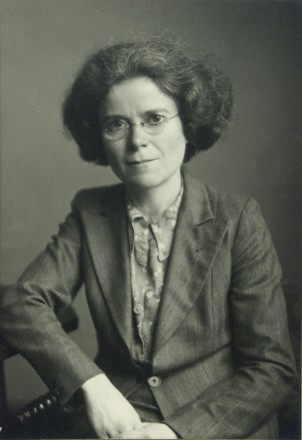
Photograph of Kathleen Lonsdale on her election to Fellowship of the Royal Society May 1945.
Conclusion
Lonsdale wrote later: ‘…I feel that I owe any qualities that I may have as a physicist and especially my love of research in pure science for its own sake mainly to the inspiration and encouragement of Sir William Bragg's great leadership…’. 31 This paper has provided evidence to confirm Lonsdale's statement. The correspondence included in the paper covers the period from 1927 to 1935 during which Lonsdale was away from the RI. Lonsdale had joined Bragg's team when she was only nineteen and it is clear that she wished to undertake research. It can be assumed that Bragg had selected Lonsdale for her academic ability and the evidence shows that her initial training was in the use of the ionization spectrometer which Bragg had devised with the assistance of his mechanic Jenkinson. It was this instrument which Lonsdale became skilled in using and with which she confirmed the structure of several organic molecules in particular the first experimental confirmation of the structure of benzene.
Clearly experimental work was important to Lonsdale and arguably justifies her move from Mathematics to Physics after her first year at Bedford College since it would involve more practical work. However Lonsdale's mathematical ability was evident in her work on space groups and in the development of the International Tables.
Lonsdale managed to combine both having a family and continuing with her scientific career and chose work that could be done at home without the need for laboratory facilities. However Lonsdale was keen to resume her experimental work and this paper has shown how Bragg instigated her return to the DFRL.
The working relationship between Bragg and Lonsdale spanned a period of twenty years until Bragg's death in 1942. It is clear from the letters that the relationship was based on mutual respect and a desire to carry out scientific research in order to further the importance of X-ray crystallography.
Footnotes
Acknowledgements
I would like to thank the staff from the various libraries and archives who have helped me with my research, namely Bodleian Libraries, Oxford; Royal Holloway, University of London (RHUL); University College London Library Special Collections, Dame Kathleen Lonsdale papers (UCL DKLP); Royal Institution (RI); Royal Society (RS).
1
Personal Records of Fellows of the Royal Society undated, section 7, The Dorothy Hodgkin papers, Bodleian MS Eng. c. 5647, D 71.
2
Lonsdale to Tuke, 24 November 1922, RHUL MS BC AR/200/2738.
3
W.H. Bragg's son, William Lawrence Bragg, was then at Manchester University.
4
RI MS DFRL/AA, 26 June 1923.
5
RI MS WHB/27A/92, undated plan shown in Hughes 2002, 224.
6
RI MS DFRL/LM, 2 July 1924, item 3, 52.
7
Yardley to Principal's Secretary, 16 July 1924, RHUL MS BC AR /200/2738.
8
RHUL MS BC AR/367/1 1919–1928.
9
RI MS DFRL/LM, Wednesday 2nd November 1927, Section 1.6, 97.
10
Lonsdale to Bragg, 16 November 1927, RI MS WHB/28B/27.
11
Bragg to Lonsdale, 30th October 1928, UCL DKLP, A.4.
12
Bragg to Lonsdale, 2 December 1928, UCL DKLP, H.157.
13
Lonsdale to Bragg, 3 December 1928, RI MS WHB/18F/2.
14
Bragg to Lonsdale, 13 December 1928, UCL DKLP, H.157.
15
Lonsdale to Bragg, 18 December 1928, RI MS WHB/18F/4.
16
Bragg to Lonsdale, 18 January 1929, UCL DKLP, H.158.
17
‘arbeit’ was her (German) word for scientific work.
18
Lonsdale to Bragg, 27 August 1930, UCL DKLP, A.4.
19
Bragg to Lonsdale, undated, UCL DKLP A.4.
20
Bragg to Lonsdale, 24 June 1931, UCL DKLP, C.17.
21
Personal Records of Fellows of the Royal Society undated, section 8, The Dorothy Hodgkin papers Bodleian MS Eng. c. 5647, D 71.
22
RI MS DFRL/LM, 2 November 1932, item 7, 183.
23
UCL DKLP, E.117.
24
RI MS DFRL/LM, 28 February 1934, item 5, 212.
25
Bragg to Lonsdale, 5 July 1934, UCL DKLP, C.36.
26
RI MS DFRL/LM, 27 February 1935, item 5, 232.
27
RI MS DFRL/LM, 29 May 1935, item 6, 240.
28
RI MS MM, 1 July 1935, 20, item 13, 233.
29
RS MS EC/1945/13.
30
Hill and Edgerton to Lonsdale, 23 March 1945, UCL DKLP A.29.
31
Lonsdale undated, Statement to the Press, The Dorothy Hodgkin papers, Bodleian MS Eng.c.5467, D71.
Notes on contributor
Jennifer Wilson formerly taught chemistry in both further and higher education institutions specialising in organic chemistry. She has also worked in marketing and development within the higher education sector. In 2010 she completed an MSc in the History of Science, Technology, and Medicine at Imperial College London and is currently a PhD student in the Science and Technology Department at University College London, UK.
Correspondence to: Jennifer Wilson, 4 Forest View, Brockenhurst, Hampshire, SO42 7YX, UK. E-mail: