







Abstract
Lawrence Bragg (1890–1971) was not only a world-class scientist, Nobel Prize winner, Director of the Cavendish Laboratory and later of the Royal Institution, he was also committed to many other areas of culture. Indeed he did not see the need for the sharp dichotomies that now dominate popular discourse on the social and cultural location of science. As this essay illustrates Bragg's interest in language and visualization was inspired by literature and the visual arts which, in turn, profoundly affected his approach to science. Finally, one should not forget the scientist's commitment to humanity and the sometime elusive role of personality in an individual's work.
Introduction
My father, William Lawrence Bragg, was born at the right time. The whole science of crystallography lay waiting to be discovered and my father had the talent and the training to capitalize on his opportunities. He had the intense excitement throughout his life of watching crystallography grow and flourish and be an integral part of the scene.
In his career he had the advantage that his father could protect him from any marauders who might have stolen Bragg's Law and used it for their own purposes. By adopting and expanding his son's research, W. H. Bragg kept it in the family. W. H. Bragg's appointment to a Professorship at Leeds in 1909 meant that the whole family moved to England just when my father was of an age to go to Trinity College, Cambridge, a hugely satisfactory move, where he found intellectual stimulation and firm friends for the future.
My father followed Lord Rutherford in two of the most rewarding and prestigious posts in science; Professor of Physics at Manchester and Cavendish Professor in Cambridge. This gave him many years in the prime of life to orchestrate some of the most thrilling developments in twentieth-century science.
I am not going to discuss any aspects of his contribution to science, notably to crystallography, but I would like to explore some of the non-scientific elements that ensured his success. These will centre round his expertise in communication and his powers of visual perception. Related factors will be his family background and upbringing, his education, his personality, his hobbies, and his philosophy of life. Again and again I ask myself how he managed to pursue his many interests, see his family, enjoy his hobbies and still have time for so much work? But then I knew him when he had passed the fifty mark and had his priorities sorted.
Language
There are four areas of language which are essential to effective communication and my father had them all. He could listen intently, speak cogently, read with discernment, and write with lucidity. These skills not only brought him success; they also afforded him great pleasure.
My father loved to play around with words and viewed communication skills with great seriousness and respect. He believed that they could be taught and acquired with practice, and that they were a basic essential in the smooth running of a successful career. My husband David and I spent part of our extended honeymoon with the Danish physicist who received the 1922 Nobel Prize Niels Bohr (1885–1962), both in Copenhagen and in his country cottage at Tisvildeleje. He and my father had been colleagues in Manchester and were old friends; by an odd coincidence my maternal grandfather had been their family doctor. Bohr took us for a long walk, during which he quizzed me about Goethe's theories of colour and of evolution. I had been reading German at Cambridge. This was quite a test, because he spoke very indistinctly. I sometimes thought he might be speaking Danish, when in fact he was speaking English. This led to some embarrassing moments. He went on to expound the idea that if you could not put a theory into words and then translate it into at least one other language, you might find that words can mislead badly. My father was very amused by this remark of Bohr's when I reported back to him. He stated very firmly that if you could not describe a concept with precision and lucidity, then you risked being the victim of ‘fuzzy thinking’.
My mother took a front row seat at the Royal Institution lectures every Friday evening when we were living in the official flat upstairs. I slipped into the gallery. Every Saturday morning, at breakfast, my father would carefully explain the talk of the evening before. ‘You should remember a minimum of three salient points’, he would say. He would expect us to recognise his own change of emphasis in explaining the lecture, so that when an important point was about to emerge, there was a preliminary pause. He did not confine his summaries to the lectures about science. I remember how well his dictum applied to the British art historian Sir Kenneth, later Lord, Clark (1903–1983) who lectured in 1961 and in 1959 to the American born violinist Yehudi Menuhin (1916–1999). At the time any fog in our minds lifted, and I felt convinced that I had really understood the thrust of each lecture, as did my mother. Unfortunately if it related to science, that understanding soon dwindled, but what Dad had communicated successfully was the excitement of new ideas, new discoveries and new research.
As a child I was never patronized. The language my father used with us was relatively simple but never simplistic. When we were children, he learnt several Grimm's Fairy Tales by heart and would half tell, half act them out for my sister and me to our great delight. He opened up for us a whole landscape of emotions — fear, laughter, and curiosity — with the vocabulary to describe them. He was enjoying himself as much as we were. His enthusiasm and energy were catching and he brought alive the scenes he was describing, sometimes adding considerable chunks in his own words when he felt a more vivid picture was required. He also told us stories about Australia, where he grew up, centred on the mythical character of Thomasina. When he wished to explain to me how, in a chemical reaction, the atoms changed partners, he drew me a picture of stick people in kilts dancing Scottish reels. Seventy years later the image is still in my mind.
In 1970, the year before his death, my father took part in the BBC Radio 4 programme called ‘With Great Pleasure’ (Reid 1986) which still runs. A number of famous names participated, rather as in ‘Desert Island Discs’. But in this case it was not music, but poetry and prose that were selected by the guest of the evening. I have his tape and also the book that was published to accompany this program. In the opening section by the editor, he quotes Dad as saying ‘It is very well known to our Arts colleagues, who never cease to remind us about it, that (a) scientists have hardly any human or artistic feelings at all and (b) that they are quite inarticulate, quite helpless at explaining even such feelings as they have’. He said this of course tongue in cheek, but he did feel that the stigma of inadequate language and communication skills was not justified with all scientists, and particularly not with his generation, who would have had a balanced education. My mother would wickedly have added her view that most scientists were socially incompetent too. My father began his radio contribution by saying, ‘The art of talking about science has always fascinated me’. Hence his happy involvement at the Royal Institution. On the radio programme my father was expected to choose a selection of eight pieces of poetry or prose that had given him particular pleasure. It is worthwhile to explore some of his choices, which reveal him as a scientist who was well versed in English literature. He was a man who found the time to read Homer's Iliad in the Greek original once every ten years, so he told me. He was of a cultured generation.
My father selected ‘Advice to a lecturer’, an anthology on the art of lecturing drawn from various sources written by the natural philosopher and chemist Michael Faraday (1791–1867), because he greatly admired the precepts it contained. Never read your lecture was one. The only point where he differed with Faraday was regarding the maxim ‘A lecturer falls deeply beneath the dignity of his character when he angles for claps’ to which my father's response was ‘I feel this last is a little too hard and I haven't got quite a clear conscience about it’. The other scientific piece of prose he chose was ‘How to make a scientific instrument’ by Geoffrey Chaucer.
My father was immensely proud that while he was Director of the Cavendish in Cambridge he had appointed a young man, Derek Price (1922–1983), to work on the laboratory's archives. Whilst researching the Scottish mathematical physicist James Clerk Maxwell (1831–1879) in Peterhouse College, Cambridge, Price happened upon an original Chaucer manuscript, a treatise on the Astrolabe, which had been misleadingly rebound. Dad's descriptive summary of the nature of the Astrolabe was masterly. ‘The author is explaining how to make a scientific instrument — a sort of large protractor, with scales around the edge and strings going from pins round the middle. And the purpose of it is to find the position of the planets and sun and moon in the sky at any given date’. To depict a visual picture and then briefly define its purpose was typical of my father.
His choice of ‘Home thoughts from abroad’ by Robert Browning seems surprising. ‘Oh to be in England, now that April's here’. As he was brought up in Adelaide, the English spring must have been a relatively vague concept during his early years! But he loved Browning and would read him aloud to me and my mother after supper in our Suffolk country cottage. He was much more doubtful about Tennyson and Wordsworth, but accepted them as part of British literary heritage.
‘Tirra Lirra’ by the river Sang Sir Lancelot
in the ‘Lady of Shalott’ — ‘What an absolute ass’, remarked my father. As for Wordsworth, he loved to quote the following poem by J.K. Stephen (1859–1892):
TWO voices are there: one is of the deep; It learns the storm-cloud's thunderous melody, Now roars, now murmurs with the changing sea, Now bird-like pipes, now closes soft in sleep: And one is of an old half-witted sheep Which bleats articulate monotony, And indicates that two and one are three, That grass is green, lakes damp, and mountains steep: And, Wordsworth, both are thine: at certain times, Forth from the heart of thy melodious rhymes The form and pressure of high thoughts will burst: At other times — good Lord! I'd rather be Quite unacquainted with the ABC Than write such hopeless rubbish as thy worst.
When my father got hold of this poem I am not sure. Stephen was Tutor to the Duke of Clarence (1864–1892), who was suspected of being Jack the Ripper.
Dad could resort to plain doggerel — to tease my mother. She, after all, had the money, which she had inherited from rich relatives.
I would like a girl with eyes of blue Eyes of blue, eyes of blue But as long as she has a quid or two Any old sort of eyes will do.
I am not going to discuss all his choices for ‘With Great Pleasure’. But Jane Austen's Emma and Tolstoy's Anna Karenina are worth a mention. He loved the passage in the former where Emma realises that she alone should marry Mr Knightley and the passage in Anna Karenina where Levin realises that Kitty returns his love. It was a reminder of my father's courtship of my mother. There were some surprise omissions from his list, notably the Old Testament (never the New). He was particularly fond of Ecclesiastes and the passage ‘To everything there is a season, and a time to every purpose under the heaven’. He read this to us as poetry. It accurately reflected his own philosophy.
Unusually for an academic scientist, my father had read a large number of classic novels, including Dickens, Trollope, and Tolstoy. One of his absolute favourite books, however, was a more modern American best seller novel of 1955, Good Morning Miss Dove by Frances Gray Patton. It is a simple but deeply moving tale of a schoolmistress in a small American town. In his retirement, my father read the same books again and again.
Dad had a huge collection of detective stories. The only time that he let his mind freewheel (it was always occupied) was with a thriller. His concentration was absolute; it was one of his effective forms of escape.
The controversy over the book The Double Helix by the American molecular biologist James Watson (1928–present) is well known (for example Quirke 2002, 269–270). Should my father back its publication? There were endless discussions at home. Should he consent to write the preface? Did my mother put pressure on him? I think the answer may be simpler than anyone suspected. My father backed the book. He didn't care that he was regarded by Watson as an old fuddy duddy. He thought it was a really good read which a wide range of people would enjoy. He was, of course, right. He predicted correctly that it would have booming sales. He enjoyed the fact that Watson was at times outrageous and maverick. Parts of the book he would certainly have described as quite ‘racy’, a favourite word. Most of all he commended Watson's mastery of the English language to commemorate one of the great scientific events of the twentieth century.
Often my father would return from the Cavendish in the evening muttering that Crick (1916–2004, English molecular biologist, biophysicist, and neuroscientist) was ‘rocking the boat again’. He disliked his methods. Their views on what was fair game in research were totally opposed. He liked Watson.
It was a family pastime to invent puns, which he inherited from his grandfather, the South Australian Post Master General and Astronomer Royal in Adelaide, Sir Charles Todd (1826–1910). He used to say ‘without my T I would be odd’. This play on words has been handed selectively down the family.
Why did the sole leave the plaice? Because the smelt smelt. Why did the barmaid whine and sham pain? Because the mild stout porter bit her.
He would have enjoyed his great grandchildren's atom joke.
Why should you never trust an atom? Because they make up everything and because they split on you.
He retold his own jokes but not those of others and he never used people's names in his puns, sensitive to his own, Bragg. He did, however, break his own rules occasionally as with ‘appalling Pauling’. In fact this was stretching a point for the sake of the pun. The American chemist and twice Nobel Laureate Pauling (1901–1994) was rather a friend, even though a rival.
Other aspects of his attitude to language were specific and detailed. On their honeymoon my mother compared the beautiful view in Valescure with some glowing Renaissance picture. My father chided her saying that in the case of similes and metaphors you should always go from the artificial to the natural, never, the other way round. He used such apposite metaphors to great effect and they were all strikingly original. Transferring the abstract to a tangible example was part of his skill with words and was a device he frequently used. He told us that ‘making a scientific breakthrough and getting a glimpse of the Creator was as exciting as it would be for a small boy who was mad about trains to be invited into the cab of the engine driver’. Of a friend of my mother's he remarked ‘she is like a poster rather than a watercolour or an Old Master’. He liked people to be exciting, rather than dull, however worthy.
Shortly before he died, my father wrote a book for a Longman entitled Ideas and Discoveries in Physics (1970). It was written for children but as a non-scientific adult I have found it most useful. The book summarizes the significant discoveries in physics in the nineteenth and twentieth centuries. It is liberally sprinkled with visual images and many of the passages create pictures in the mind. My father thought often in visual images. In his explanation of ‘the start of electricity’ he writes ‘it is an interesting pastime to imagine that one is entertaining an intelligent visitor from the past, and trying to explain to him the modern world. Suppose he was a Roman engineer…’ These images stick in the mind and are useful pegs for memory.
My father was a born teacher. Domestic help was always a problem at the Royal Institution and my parents employed a Swiss girl, unsurprisingly called Heidi, whom they sometimes took down to the country at weekends. My mother was plagued every morning by the chattering of the sparrows in the ivy above her window. My father used an airgun to scare them. He also drew a life size picture of himself with the airgun to prop up in the window at times when he could not be there himself. Heidi obviously classified him as a mad professor. This did not prevent her begging my father to teach her to use the gun. Finally he relented and was rewarded by the promise she showed of becoming an excellent shot. She was encouraged to progress from shooting at the target to real birds; carefully she took aim and at her first go shot dead the one and only nightingale in the garden, my father's pride and joy. Typically he blamed himself.
How else did my father use words? He used them daily to do the Times crossword. By the time he had finished it, he was ready to bicycle off to give his 9am lecture at the Cavendish Laboratory in Cambridge. He was skilled enough to detect who had devised each crossword. He enjoyed doing the word games from Picture Post with me. One editor, Tom Hopkinson, was a cousin and friend of my mother.
My father lectured in German, having learnt all the necessary scientific vocabulary, and spoke French with an appalling accent. He borrowed from the German some of the words that express mood or feeling such as ‘Weltschmerz’. This is a hard word to translate but roughly means ‘world weariness’ — or ‘disillusionment with the world’. At the other end of the scale he complained of ‘Bauchschmerz’, which is merely a grand word for tummy ache, after eating and drinking too much at a College Feast. This was the kind of irreverent joke that he loved. He would tell us how the Bible was translated into an African language, but the problem arose that there was no word for sheep, because there were none. The Lamb of God became ‘Little white woolly pig of God’ which Dad found hilarious. He also delighted in the following story. It had become plain that the students at the South African University which he was visiting had cheated. When they took their final examinations it soon became obvious that they had seen the papers in advance. Yet all of the papers had been counted carefully and closely guarded. It finally transpired that the man who had been charged with printing the examination papers had sat on the block and printed it off on his behind, from whence it had been transcribed.
Where did my father obtain his robust language skills and creative use of words to express his ideas with forceful accuracy and persuasion? At least part of the answer must lie in the remarkable education he received at St Peter's College in Adelaide, Australia, three of whose pupils have won Nobel Prizes: the pharmacologist Howard Walter Florey (1898–1968), in 1945; the pathologist J. Robin Warren (1937–present) in 2005; and of course Lawrence Bragg in 1915. The standard of teaching has always been uniformly high, the methods inspirational and the staff dedicated. The emphasis on the classics at that time gave pupils a sure grounding in language skills which would benefit them whatever their chosen career.
Ironically the only subject my father did not study at school was Physics. At St Peter's he always had the encouragement of every school master to make the most of his individual talents. My father expressed admiration and gratitude for what St Peter's gave him.
There were certain marked blanks in my father's repertoire. Music was one. He was tone deaf. It was revealing that he said that it was very odd that the language which music lovers used, particularly that of the critics, was so often borrowed from the Arts; ‘this colourful piece’ or ‘this dramatic finale’ meant little to him in the musical context.
Dad was also uninterested in politics. The Suez incident was the one notable exception. He felt our intervention had been bungled and was ashamed of the part Britain had played. He did not like political argument at any level, international, national or collegiate. His aversion to committee meetings was total. Innuendo and sarcasm were not his style. He mistrusted weasel words and ambivalence, the veiled attacks and the unreliable promises and particularly the in-fighting. This is why he disliked being on committees unless he was the chairman. So why did he take on a job at the Royal Institution, where administration was involved and warring factions had to be appeased?
In 1954 my father took up his post as the Director of the Davy Faraday Research Laboratory, Fullerian and Resident Professor of Chemistry and Superintendent of the House (what a mouthful) following the resignation of the English physicist Edward Andrade (1887–1971) from those positions. Bragg realised there was a huge challenge offered here and felt capable of taking it on and that it was a worthwhile and essential thing to do. His loyalty to the Royal Institution was intense and he often said that its continued existence was more important than the battle being waged amongst staff and members over Andrade's role. There were two groups, those who supported Andrade and those insisting that he resign. There was much bitterness and finally Andrade had to go. The pro-Andrade faction felt that my father had displayed unprofessional conduct in first criticising Andrade and then taking on the job (James and Quirke 2002).
He might have been expected at his age to retire from his full time work as Cavendish Professor in Cambridge and to take life rather more easily, so why did he sign on again? There are several reasons why he finally came to the conclusion that the Royal Institution should be rescued and that he was the man to do it. One of them surely was his passionate desire to close the cultural gap between Science and the Arts. This was a topic he loved to discuss, often on the Cambridge to London train, with novelist and former chemist C. P. Snow (1905–1980). Together they coined the phrase ‘The Two Cultures’. Snow was a good friend and did the original informal edit of my father's autobiography. His wife, the novelist and playwright Pamela Hansford-Johnson (1912–1981), did the original informal edit of my mother's autobiography (Glazer and Thomson 2015). Their small son managed to scribble over both. My father wanted to communicate to a wide audience of children and adults the excitement and inspiration of science, and I am always meeting scientists who say they were originally motivated to study science by going to the Christmas or the schools lectures.
Another quite unrelated reason was the strong desire to enable his wife Alice to perform on a wider stage, which could be arranged if they moved from Cambridge to London. She is quoted as saying ‘I like to be at the hub’.
Visualisation skills
My father thought in both words and images and used every part of his brain to communicate as appropriate. This flexibility offered great opportunities, both for lateral thinking and for the creative definition of ideas which he could then pass on to others. In my father's autobiography there is a passage which neatly illustrates Dad's lateral thinking and his ability to observe phenomena and draw unusual conclusions. He is describing how he came to invent his ‘bubble raft’ experiment, which he so loved to use in his demonstrations to the school children at the Royal Institution. ‘When adding the oil to the petrol for our lawnmower, I had noticed that the rafts of tiny bubbles formed by pouring in the oil showed interesting movements and adjustments’. According to my sister, Margaret, my father originally tried out his idea for the bubble model with her in the bathroom, using lentils and a basin. Back at the laboratory he designed an apparatus which blew small bubbles to form rafts. ‘Such rafts, when distorted, show “dislocations” running along the “slip-lines” in the most charming way’, he wrote. My father loved nothing better than a pretty experiment or model. He said of the lysozyme model ‘it must be right because it is so perfectly satisfying to the eye’.
My father's hobbies reflected his skills in close observation and in the translation of the 2D into the 3D. He had the ability to create models in his head. And he had an astonishingly good visual memory for detail.
Dad was an almost professional artist who could draw and paint beautifully in water colour. He had that power of visualisation that sees the whole picture before embarking on any of the parts. ‘Paint what you see, and not what you think you see’. His drawing of friends and family were always extraordinarily true to life and he took anyone who would sit for him gratefully as his model, from the Nobel Laureates Max Perutz (1914–2002) and John Kendrew (1917–1997) to my family's Swiss au pair girl at the time. His portrait of me ‘PMB finishing a thriller’ at the age of seventeen is Figure 1. His own self portrait is, amazingly, in profile rather than full face, which entailed using more than one mirror at various angles. He was equally competent with landscapes and his sketch ‘WLB aug 48’ of the river meadows at Grantchester, near Cambridge is Figure 2.
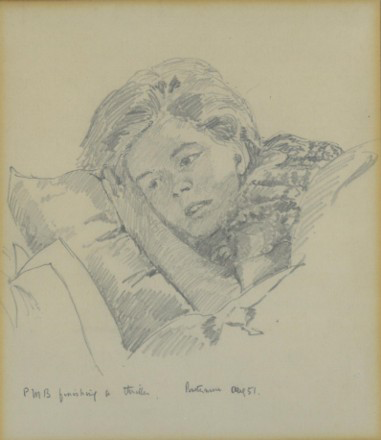
Lawrence Bragg portrait of ‘PMB finishing a thriller’ 1951.
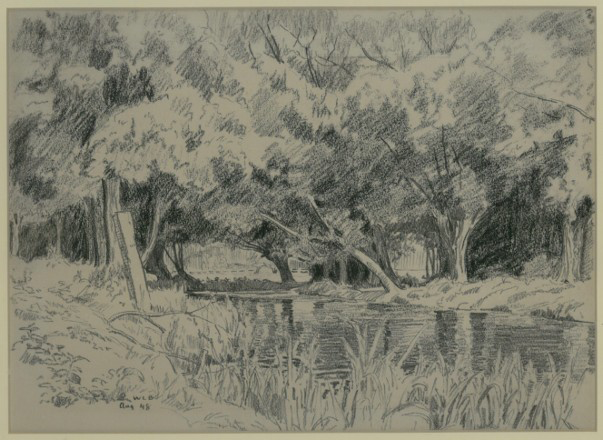
Lawrence Bragg landscape of the river meadows at Grantchester, near Cambridge, 1948.
Bird watching was another great love and he taught me how the colour, shape and size of a bird are important, but not all important. It is also essential to look at the ‘jizz’. How did it hop over the grass? How did it fly, how did it catch its prey? He was as happy watching the unusual behaviour of a common garden bird as he was discovering a new and rare species at home or abroad that he had not seen before.
As a teenager my father was an avid shell collector. He discovered a new one, previously unknown to science, which was actually named after him ‘Sepia braggi’. It is surely most remarkable for a teenage boy to have the dedication and perception to pick out this one slightly different shell from the myriad piled up on the beach and recognise it as special. The natural world was a constant source of enjoyment throughout my father's life. I remember vividly the excursions we made with him with our butterfly nets. He could recognise every specimen. We would, as was customary in those days, put them in jars of chloroform. When they were dead we would pin them down on setting boards, and then transfer them to the glass cabinets which would be their final home. We did not collect insects but my father identified them all for us and told us their story, I can still remember the individual habits of the cuckoo bee.
It was the same with wild flowers. We were taught to identify and categorise from a very early age. To do this properly it is necessary to observe closely not only the flowers themselves but the leaves, the stalks and even the root systems. ‘Go and find me ten different yellow flowers’, he would tell the children at the end of a picnic.
Dad was an enthusiastic gardener. He had the gift of being able to visualise the end result of what he was trying to achieve — what plants should be placed at the back, which at the front for maximum effect. He planned his colour schemes carefully, much more bright and jazzy than were normal in England at the time. I think he was harking back to his Australian childhood where the vibrant colours and strong light made a much more compelling and forceful statement. He loved his vegetable garden and was inordinately proud of his perfectly shaped potatoes, grown in sandy soil that encouraged a smooth and even exterior. There is one story that has been misquoted elsewhere. The following is the authentic one, vouched for by my friend Celia Hensman herself, who was there at the time. In his seventies, my father worked regularly in Celia's garden, which was not far from his London flat in the Boltons. A visitor looked out through the window and asked Celia who the gardener was and whether she would recommend him. ‘He's a wonderful gardener, but that's not all’, Celia replied. ‘He is just as good a locksmith and has fixed all my locks for me. Oh and he's a physicist too and actually he's won the Nobel Prize’.
My father once said that if he had not been a physicist he would have liked to have been a toy maker. With my brother Stephen, he created a train layout to die for in the old hayloft in Cambridge. It had a complicated signalling system and a detailed background landscape. They spent hours playing with it and improving it. He made us sailing boats, dolls house furniture and hobby horses. He also made us catapults, boomerangs, and even a lethal cross bow. He took a real interest in all our ploys but he met his Waterloo when it came to helping me with my dressmaking. Before going up to Cambridge I took a course in dressmaking. Dad liked to cut out the patterns for me. But when it came to a circular skirt, he balked. ‘How can I cut you out a circular skirt when your waist is elliptical?’ he asked.
Photography was another favourite. My mother presented him with a Leica camera. It took visualization to plan each photo in the days before digital cameras. Dad would concentrate fiercely on the image in the view finder. His black and white photographs were superb. They were stuck into albums and labelled, just as the butterflies had been classified inside the glass display cases.
‘There is a pattern to everything, if you can see it’, my father declared and this was part of his philosophy of life. He also said ‘there is a purpose to most things if you can find it’. Certainly he was always focussing on the matter in hand. He would not tolerate being bored. If someone or something was ‘interesting’ it was a private clue that he was trying to escape the conversation. My father saw the 2D X-ray photographs of the German physicist von Laue (1879–1960) and interpreted what they implied in terms of the 3D arrangements of atoms in the molecule. This is typical of his ability to see things in more than one light, to seek the simple solution and to interpret what he saw and not what he thought he saw.
Personality
There was a dark side to my father's character which was never exposed in public if he could help it. His periods of deep depression had become less disabling and less frequent by the time I was born but there were still times when he would bang his head with his clenched fist and groan.
I inherited the papers of my late brother David. He was schizophrenic. Among them I found the following letter that my father wrote to him in the 1950s, which is both touching and revealing:
Dear David, I was very pleased to get your letter and to know you had enjoyed your visit and our trip to Woodbridge together. I was particularly touched by your letter and you're talking about your difficulties. I do understand them quite a lot. There is quite a chance that these mental difficulties are caused by some simple physical defect such as an inability to assimilate some normal constituent of all food, or some hormone which is not being properly produced. There is a well-known mental defect which has been traced to an inability to digest one of the amino acids of protein and if the people are fed on a protein from which this amino acid has been artificially removed they have no trouble. But as yet the particular trouble that you have, and which I have had to labour under quite a lot, has not yet been found. This trouble makes me feel unable to cope with life [three words illegible], with reality, to feel it is very hard to make decisions and to go back on the ones that one has made. Also to be forgetful and so get in to trouble in one's job). Mettman [David's Psychiatrist], I am sure, has dealt with these difficulties much more than I can. It is interesting however to compare notes. I think the worst thing is the feeling of guilt. Perhaps this has affected me more than it has you; one must remember that one's inability to cope is due to a kind of illness, not to wickedness! There is one thing however to guard against, like the very devil, and that is, not to get angry at people. One's mental difficulties set up a state of frustration and mortification which tend to make one very irritable, and it is easy to fly into a rage. People get very fond of you, realise your difficulties and make allowances. You are fundamentally such a sound boy that they cannot help liking you. But they are only human, and are bound from time to time to be vexed with you for being untidy or making a mess or making a lot of extra work for them or for forgetting something or altering plans or being late. I have always so regretted times when I have lost my temper and I am worried when you have a flaming row with your foreman or land lady or whatnot, who has remonstrated with you. Besides such a row makes one very ill mentally. So [two words illegible]. Give yourself time to simmer down and especially don't’ have rows with people who have been kind and understanding.
The final part of the letter consisted of general remarks and chat, my father tells David he has drawn a portrait of the next door neighbour which he is rather proud of. David was also an artist.
David's mental problems affected both my parents and the rest of the family. For my father there was a certain element of threat, as he relived some of his own agony in some of David's mental struggles. My mother always stated that David's problems were the saddest part of her life. She herself was born with a cheerful nature. For us children it created uncertainty and helplessness.
My father faced some major problems in his life in the years that I knew him, from the turmoil of the RI when he took on the leadership role, to life-threatening cancer in his early seventies from which he recovered against all the odds. Most of the time my mother was a great support, although there were times, as for instance when he was shunned by the Royal Society over the Andrade affair, when my mother actually egged him on to respond with more positive anger and fire. My father was self-effacing and would have liked to have ignored where possible the hostility, however his vulnerability lay in his pain when my mother felt insulted or snubbed.
At a time when the word ‘mindfulness’ was not in the English vocabulary, my father represented a perfect example of a man who lived in the present and could, when necessary shut out the past or future. He could absorb himself in his work, his hobbies or family life, to the exclusion of all else and this was a great gift and advantage.
Good luck
It is important to mention, I feel, that in many respects there was a distinct element of good luck in my father's life. His parents were talented in different ways. W. H. Bragg, himself an eminent scientist, passed on his passion to his son. He inspired Dad to be a scientist, talking about the behaviour of atoms to him as a small boy instead of reading him a bedtime story. His mother inspired him with her artistic competence. She was a painter. In particular his maternal grandfather was a great influence. Sir Charles Todd, had laid the first telegraph wire across the centre of Australia. He was a pioneer of meteorology. Dad loved to study the stars with him, or record the rainfall. The home atmosphere was one where observation and investigation were a natural part of life.
Dad's upbringing in Australia gave him a different and objective perspective on life. His education at St Peter's and subsequently at Adelaide University confirmed his delight in research and discovery. It also gave him physical strength. He told me that in the war, the second generation Australian soldiers were far more healthy than their knock-kneed, pigeon breasted English counterparts.
My parents’ marriage was a huge success. Though very different, they complemented each other and worked as a team. Their four children, two boys and two girls, gave them much pleasure, an excuse for happy holidays and ten grandchildren to dote on.
A message from my father
My father wrote an article in the Listener magazine (10 February 1944) entitled ‘The spirit of science’. I quote:
To sum up, we scientists believe that our subject is not merely a matter for technical specialities. It is a new venture in human thought and achievement, a new advance in civilisation. The spirit of science, its methods of controlled experiment and the rewards which they bring, its glamour, its inspiration, must be widely understood and appreciated if we are to play our part in the difficult days which lie ahead.
The world was at a crossroads, my father told us, and science could be used for good or evil. He could only hope that what he had discovered would benefit mankind.
Footnotes
Acknowledgment
My sister Margaret (Lady Heath) has given me invaluable support in sharing her childhood memories with me and in her careful review of the text.
Notes on contributor
Patience Thomson's career has always been associated with dyslexia and includes eight years as Principal of Fairley House School in London.
She has lectured widely on special needs and study skills at home and abroad, she has participated in radio and TV programmes on dyslexia and written articles for the Daily Telegraph and for specialist journals.
Her book 101 Ways to get your Child to Read (2009) sold over 60,000 copies and won two literary prizes. She co-founded and was former Chairman of a successful children's publishing company, Barrington Stoke, producing books for less-able readers.