







Abstract
Gas tungsten arc welding (GTAW) repair process and GTAW+FSW (friction stir welding) hybrid repair process are studied to remove the large size groove defect formed during FSW. The experimental results indicate that the groove defect can be removed by both the repair processes. The tensile strength of the GTAW repair joint is only 55% of that of the base metal. The tensile fracture occurs at the transition zone between the weld zone and the heat affected zone, and the fracture surface of the repair joint is characterised by clear brittleness. In contrast, the GTAW+FSW hybrid repair joint has a high tensile strength equivalent to 70% of that of the base metal. The tensile fracture occurs at the overlap thermomechanically affected zone between the two FSW nuggets, and the fracture feature of the hybrid repair joint is partially plastic and partially brittle.
Introduction
Friction stir welding (FSW), invented by the Welding Institute,1 is a new solid state joining process with several advantages such as high welding quality, low production cost and low welding distortion, and thus can be utilised to weld some materials that are difficult to fusion weld. 2 2,3 However, in the fast development and application of the FSW process, it has been known that although high quality joints can be produced through FSW, welding defects can also be formed during FSW when improper welding parameters or technological conditions are used, and such defects as groove, cavity and kissing bond have a significant influence on the mechanical properties of the joints.4– 6 Therefore, the repair welding process of defect existent joints has attracted a great deal of attentions. Among the defects mentioned above, the groove defect exerts the largest negative effect on mechanical properties of the joints owing to its larger size and penetration.7 When the size of groove defect is small, FSW can be directly utilised to remove the defect and produce high quality repair joints.8– 10 However, when the groove defect has a large size, FSW repair process may not be applicable because the material is insufficient to fill the defect. As far as this case is concerned, gas tungsten arc welding (GTAW) repair welding and GTAW+FSW hybrid repair welding were proposed and conducted in the present paper. In order to provide guidance for engineering application, the quality of the repair joints was evaluated in terms of microstructures and mechanical properties.
Experimental procedure
Materials and equipments
The base metal (BM) used in the present study was a 2219-T6 aluminium alloy plate of 7·5 mm thickness, whose chemical compositions and mechanical properties are listed in Table 1. The plate was cut and machined into rectangular welding samples of 300 mm length by 100 mm width. All welding processes were conducted along the longitudinal direction of the samples. Before welding, the samples were cleared by a scratch wire brush to remove the oxide film and then cleaned by acetone.
Chemical compositions and mechanical properties of 2219-T6 aluminium alloy

The types of the welding machines used for GTAW and FSW are P 500 and FSW-3LM-003 respectively. The GTAW machine has a maximum current output of 500 A. For FSW, the welding tool pin is designated as a frustum contour and possesses right handed threads. The shoulder diameter, pin length and median diameter of the welding tool are 22·5, 7·4 and 7·4 mm respectively.
Welding parameters used for repair processes
For the convenience of statement, the joint directly formed from the BM is defined as initial joint, while the joint formed after repair welding of the initial joint is defined as repair joint. Based on the previous experimental results, the initial joint with groove defect can be produced by using the technological parameters listed in Table 2.
Technological parameters for FSW and hybrid repair process

In regard to GTAW repair process, a bevel was first produced on the initial joint to completely remove the groove defect (see Fig. 1), and then GTAW with filler wire was applied to the bevel to obtain sound repair joint. The basic idea of this approach is similar to that stated in the literature.11 The bevel surface was also cleared by the scratch wire brush and then cleaned by acetone, as above mentioned. The current flow and welding speed used for GTAW repair welding were 200 A and 120 mm min−1 respectively.
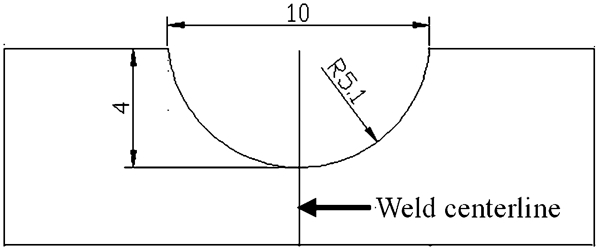
Bevel size for GTAW repair process
In the hybrid repair process, two-pass FSW joints were equidirectionally produced on the top surface of the GTAW joint with the centrelines located at the both bevel edges, and the length of the FSW joints was the same as that of the initial joint with groove defect. In this way, the weak regions of the GTAW joint can be sufficiently stirred, and thus the mechanical properties of the repair joint are expected to be improved. The welding parameters utilised for FSW in hybrid repair process are also shown in Table 2, which are the same as those of the good quality initial joint.
Tests and analysis
After welding, the joints were cross-sectioned perpendicular to the welding direction for metallographic analyses and Vicker's hardness test using an electrical discharge cutting machine (DK-7718B-CG). The cross-sections of the metallographic specimens were polished with a diamond paste, etched with Keller's reagent (150 mL water, 3 mL nitric acid, 6 mL hydrochloric acid and 6 mL hydrofluoric acid), and analysed by optical microscopy (Olympus-MPG3). Vicker's hardness test was carried out at the mid-thickness of the polished cross-sections with a spacing of 1 mm. The testing load was 4·9 N for 10 s.
The configuration and size of the transverse tensile specimens were prepared with reference to China National Standard (GB/T2651-2008). The room temperature tensile test was carried out at a crosshead speed of 1 mm min−1 using a computer controlled testing machine (Instron-1186), and the tensile properties of each joint were evaluated using three tensile specimens cut from the same joint. After tensile test, the fracture features of the joints were analysed by optical microscopy mentioned above and scanning electron microscopy (Hitachi-S4700).
Results and discussion
Cross-sections and hardness profiles of joints
Figure 2 shows the cross-sections of the initial joint with groove defect and the repair joints. The RS and the AS in Fig. 2a represent the retreating side and advancing side respectively. When unsuitable FSW parameters are used (see Table 2), the plasticised material cannot be refilled to the AS from the RS near the back surface of tool pin; therefore, a continuously distributing groove defect is formed on the AS (see Fig. 2a). After GTAW and hybrid repair welding, the groove defect disappears and sound repair joints are produced (see Fig. 2b and c). The middle part of the GTAW repair joint contains the weld zone (WZ) and the remained weld nugget zone (WNZ) of the initial joint. For the hybrid repair joint, the two FSW nuggets are symmetrically distributed on both sides of the GTAW repair joint. The middle part of the WZ, thermal mechanically affected by FSW tool, has been transformed to an overlap thermomechanically affected zone (TMAZ). Accordingly, the middle part of the hybrid joint consists of the overlap TMAZ and the remained WNZ.

Cross-sections of initial joint and its repair joints
Figure 3 shows the hardness profiles of the initial joint with groove defect and its repair joints. It can be seen that a softening region is created in all the joints due to coarsening or dissolution of strengthening precipitates. The weakest location of the GTAW repair joint is lying in the transition zone (TZ). After two-pass FSW, it has been transformed to the WNZ of the FSW joints, and thus the corresponding hardness value is significantly improved. The weakest location of the hybrid repair joint, located in the overlap TMAZ, has a higher hardness than that of the GTAW repair joint. Compared with the initial joint, the large heat input generated by GTAW leads to considerable decrease in the hardness of heat affected zone (HAZ). In contrast, further hardness decrease is limited in the HAZ of hybrid repair joint, reflecting the lower heat input during FSW.
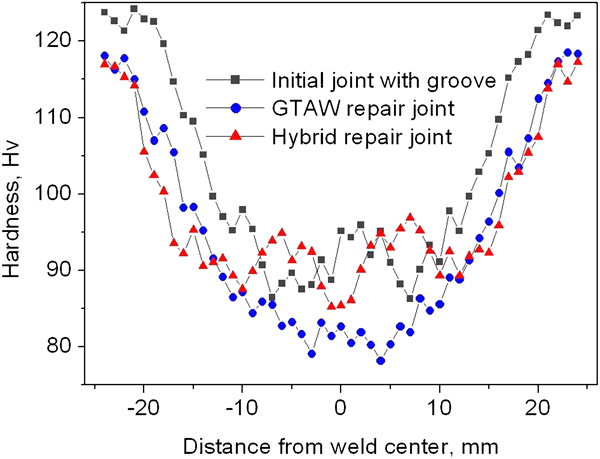
Hardness profiles of joints
Microstructures in different zones of repair joints
Figure 4 shows the microstructures in different zones of the GTAW repair joint. According to the microstructural characteristics, the GTAW repair joint is divided into three parts, i.e. the WZ, the HAZ and the TZ between the both zones. In the WZ, the crystalline growth velocity is large and nearly the same in all directions of the crystal nucleuses; therefore, the equiaxed grains are formed. The HAZ exhibits coarsened grain structures under the intense thermal action during GTAW. There is a distinct strain fusion line in the TZ. The non-spontaneous crystal nucleases are formed from the partial molten BM and grow towards the WZ perpendicular to the fusion line, resulting in the columnar grain structures in the TZ.
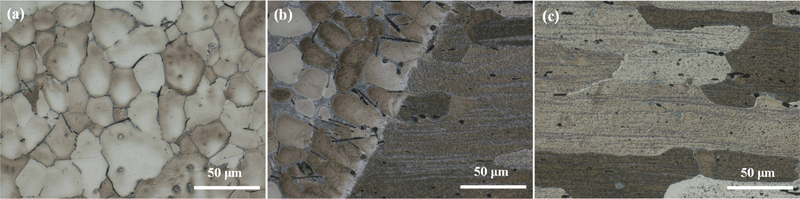
Microstructures of GTAW repair joint
The microstructures in different zones of the hybrid repair joint are shown in Fig. 5. Besides the remained WNZ of the initial joint, the hybrid repair joint is mainly composed of the WNZ, the TMAZ and the HAZ (see Fig. 2c). The grains in the TMAZ are bent and elongated under the thermal and mechanical effects of the welding tool, and the elongated direction presents a certain degree to the rolled direction of the BM. The material around the tool pin flows downwards on the AS and upwards on the RS,12 leading to an approximately symmetrical distribution of the elongated grains of the TMAZs outside the two FSW nuggets (see Fig. 5c and d). The grains in the overlap TMAZ between the two FSW nuggets experience twice elongated deformation, and the direction of the deformation presents a certain degree against each other. Finally, the long axils of the elongated grains are nearly perpendicular to the rolling direction of the BM (see Fig. 5e).
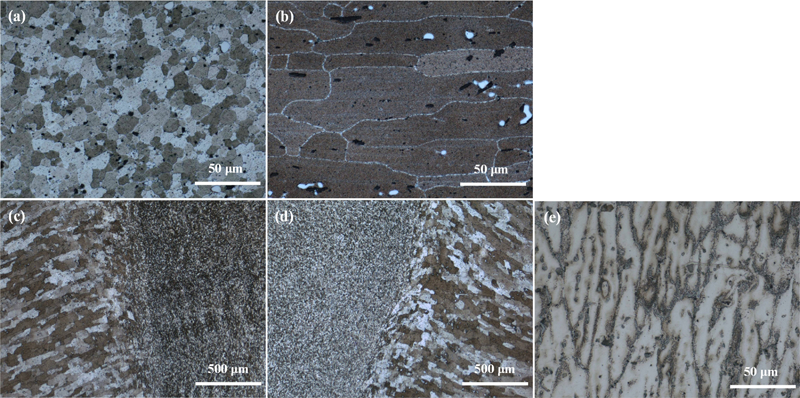
Microstructures of hybrid repair joint
Tensile properties and fracture features of joints
Figure 6 shows the tensile properties of the joints. The initial joint with groove defect has a considerably low tensile strength and elongation, implying that the groove defect has resulted in an enormous deterioration of the tensile properties of the joints. After the groove defect is removed by different repair welding processes, the tensile properties of the joints are improved to different extents.
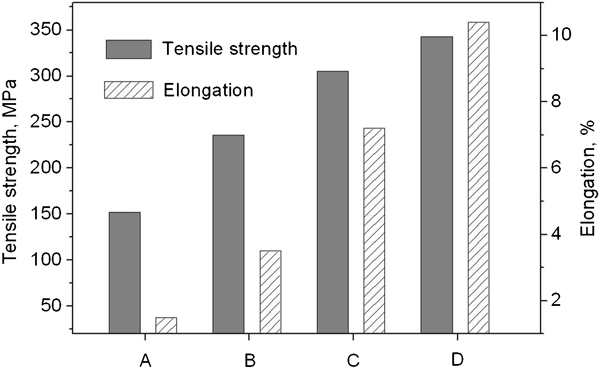
Mechanical properties of initial joints and corresponding repair joints (A: initial joint with groove defect; B: GTAW repair joint; C: hybrid repair joint; D: good quality initial joint)
When GTAW repair process is chosen, the tensile strength of the joint is improved from 152 to 236 MPa, equivalent to 55% of that of the BM. The elongation is also improved from 1·6 to 3·5%, comparable to 34% of that of the BM. Evidently, the tensile properties of the repair joint are still relative low in contrast to the good quality initial joint. After FSW of the GTAW repair joint, the tensile strength and elongation of the hybrid repair joint achieve 305 MPa and 7·2% respectively. In this way, the tensile properties of the GTAW repair joint are improved to a large extent.
Figure 7 Figures 7 and 8 display the fracture features of the repair joints. The fracture path of the GTAW repair joint is nearly along the TZ between WNZ and HAZ, inclined at a certain degree to the weld surface. There is no dimple on the fracture surface, suggesting the clear brittleness. This illustrates that the TZ is the weakest location of the GTAW repair joint, which corresponds to the microstructural characteristics in this zone.

Fracture locations of repair joints
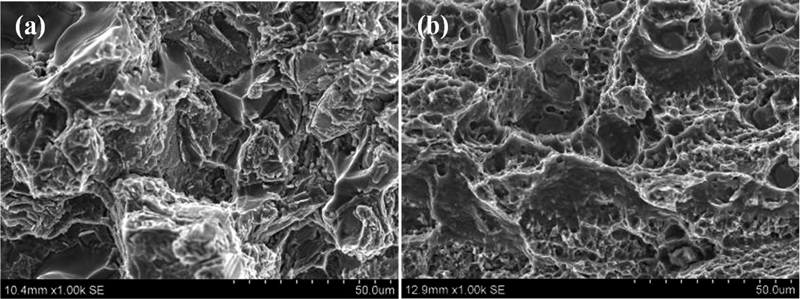
Fracture surfaces of repair joints
The hybrid repair joint is fractured in the overlap TMAZ during tensile test, which contains slender grains with the long axils nearly perpendicular to the rolling direction of the BM. Since the tensile direction is perpendicular to the long axils of the elongated grains, i.e. the tensile load is exerted on the coarse grain structures, the microcrack tends to be first formed in the overlap TMAZ due to the poor deformation ability of the coarse grains. However, it is noted that the grains in the overlap TMAZ of hybrid repair joint are still finer than those in the TZ of GTAW repair joint (see Figure 4 Figs. 4b and 5e); therefore, the hybrid repair joint exhibits higher hardness in the weakest location and superior tensile properties. The fewer shallow dimples distributed on the fracture surface suggest an insufficient plastic deformation of the joint during tensile test.
Conclusions
The groove defect that has a significant influence on the mechanical properties of the joints can be removed by GTAW repair process and GTAW+FSW hybrid repair process, but different repair processes exhibit different repair results. The tensile strength of the GTAW repair joint only reaches 55% of that of the BM, while that of the hybrid repair joint is relative high, equivalent to 70% of that of the BM.
GTAW repair joint exhibits equiaxed grains in the WZ and coarsened grains in the HAZ. The TZ contains columnar grains with the long axils perpendicular to the fusion line. The overlap TMAZ of the hybrid repair joint presents slender grains with the long axils nearly perpendicular to the rolling direction of the BM.
The GTAW repair joint is fractured at the TZ between WZ and HAZ. The fracture surface is characterised by clear brittleness. Regarding the hybrid repair joint, the fracture occurs at the overlap TMAZ, and the fracture feature is partially plastic and partially brittle.
Footnotes
Acknowledgements
The authors are grateful to be supported by the National Key Technology Research and Development Program of China (grant no. 2006BAF04B09).