






Abstract

This special issue is devoted to the 16th European Conference of Composite Materials (ECCM16), which was organised on behalf of the European Society for Composite Materials and held in Seville on 22–26 June 2014. The meeting was chaired by Professor Federico Paris of the University of Seville.
With an attendance of over 1000 delegates from 69 countries, the meeting was one of the most successful of recent years. There were 660 oral presentations, 180 poster presentations, 4 plenary sessions and 6 keynote lectures.
In addition, there was a round table discussion on the Future of Composites, an exhibition of developments in Composites in Spain and a visit to the Airbus A400M Final Assembly Line.
The weather was pleasantly temperate so delegates had the opportunity to enjoy several outdoor events, including a visit to Reales Alcazares and an al fresco Gala Dinner at Plaza de España with an authentic flamenco show.
The meeting organization was carried out very effectively by Professor Paris’ colleagues and researchers in the Elasticity and Strength of Materials Group at the School of Engineering of the University of Seville.
The seven papers that form this special idition cannot fully reflect the breadth of material reported at the conference but they do represent some of the key advances reported in some areas of growing importance relating in this case to natural fibre composites, wind turbines, aerospace and automotive applications.
A brief description of the papers in this special issue follows:
C. J. G. Plummer, S. Galland, F. Ansari, Y. Leterrier, P.-E. Bourban, L. A. Berglund and J.-A. E. Manson: ‘Influence of processing routes on morphology and low strain stiffness of polymer/nanofibrillated cellulose composites’.
This paper relates to natural fibres and describes the morphology and stiffness of composites with nanofibrillated cellulose produced via a range of techniques.
Y. Wang, C. Soutis, A. Hajdaei and P. J. Hogg: ‘Finite element analysis of composite T-joints used in wind turbine blades’.
The authors report an improved finite element analysis of the fracture behaviour of composite T-joints with various fibre reinforcement architectures, and through-thickness tufting, as applied to the design and construction of wind turbine blades.
C. Galleguillos, A. Zorrilla, A. Jimenez, L. Diaz, Á. L. Montiano, M. Barroso, A. Viguria and F. Lasagni: ‘Thermographic non-destructive inspection of wind turbine blades using unmanned aerial systems’.
The authors report an interesting feasibility study on the use of IR thermography for the in situ inspection of wind turbine blades. Such a system appears to be capable of use in conjunction with an unmanned rotorcraft.
P. Parlevliet and M. Geistbeck: ‘Investigations into lightweight solutions for epoxy composite fire property improvement’.
The paper describes methods to improve the fire properties of carbon fibre reinforced epoxy composites by means of debondable interlayers, which improve fire behaviour without compromising structural performance.
R. Staehr, S. Bluemel, P. Hansen, P. Jaeschke, O. Suttmann and L. Overmeyer: ‘The influence of moisture content on the heat affected zone and the resulting in-plane shear strength of laser cut thermoplastic CFRP’.
This paper relates to advanced manufacturing involving laser cutting of thermoplastic composites. It reports the effect of the moisture content on the heat affected zone (HAZ) and the resulting properties of carbon fiber reinforced polyetherimide (PEI) and polyphenylene sulphide (PPS)
G. Jung, P. Mitschang and C. Park: ‘New GMT material suitable for various polymers and high glass fibre content’.
This paper describes a new type of Glass Mat Thermoplastic (GMT)-like material, with a multi-layered structure suitable for various polymers, with increased glass fiber content, compared to conventional GMT.
P. Wagner, T. Bruder, W. van Papaegem and M. May: ‘Energy based method for numeric fatigue analysis of multidirectional carbon fibre reinforced plastics’.
This paper describes fatigue experiments on multi-axial laminates under constant amplitude and block loading, used to support an energy-based model designed to overcome some of the shortcomings of current models for predicting fatigue degradation in use.
Geoff Gibson
Associate Editor

The Conference Chairman, Professor Federico Paris
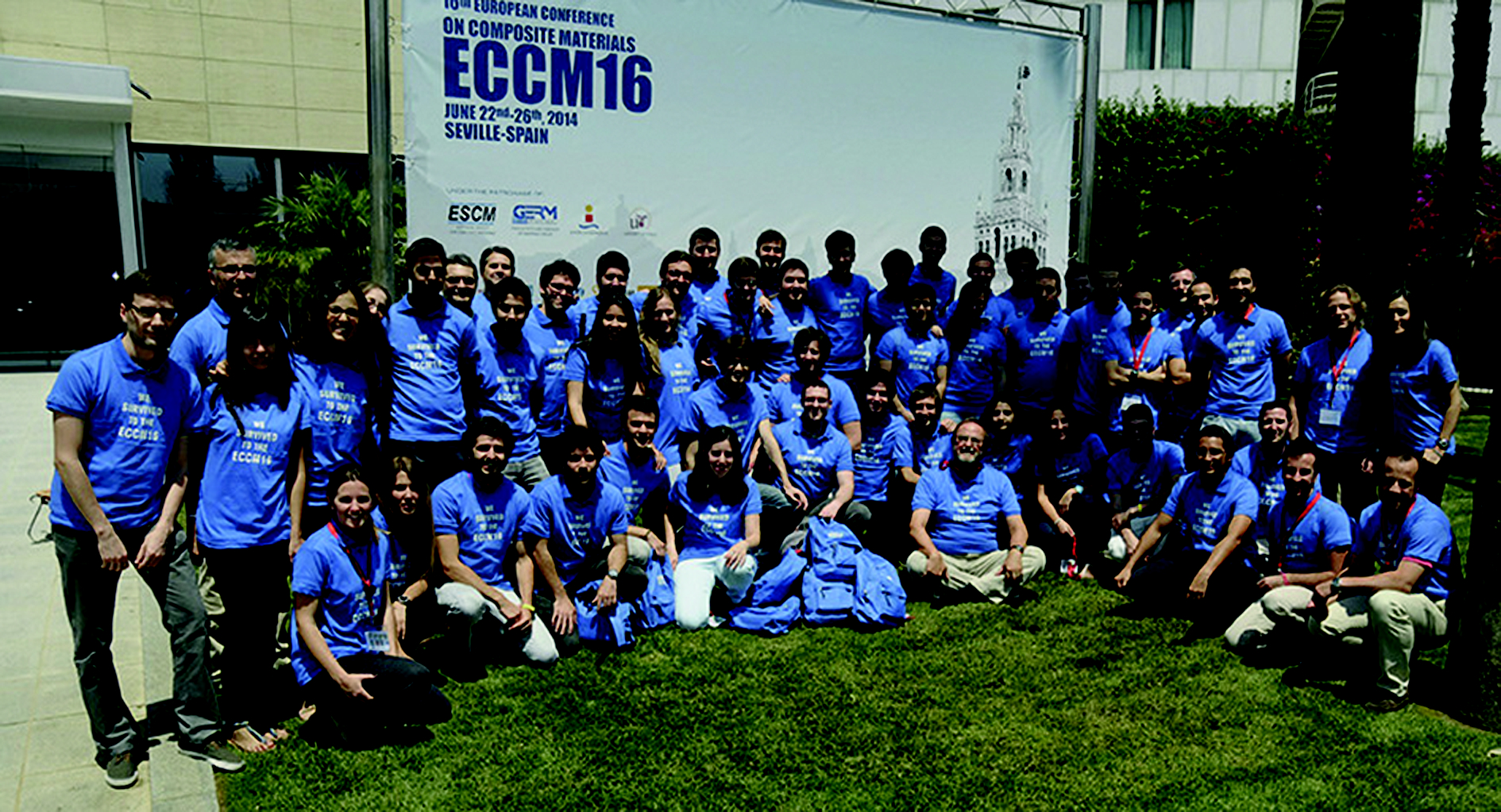
The conference support team, from University of Seville
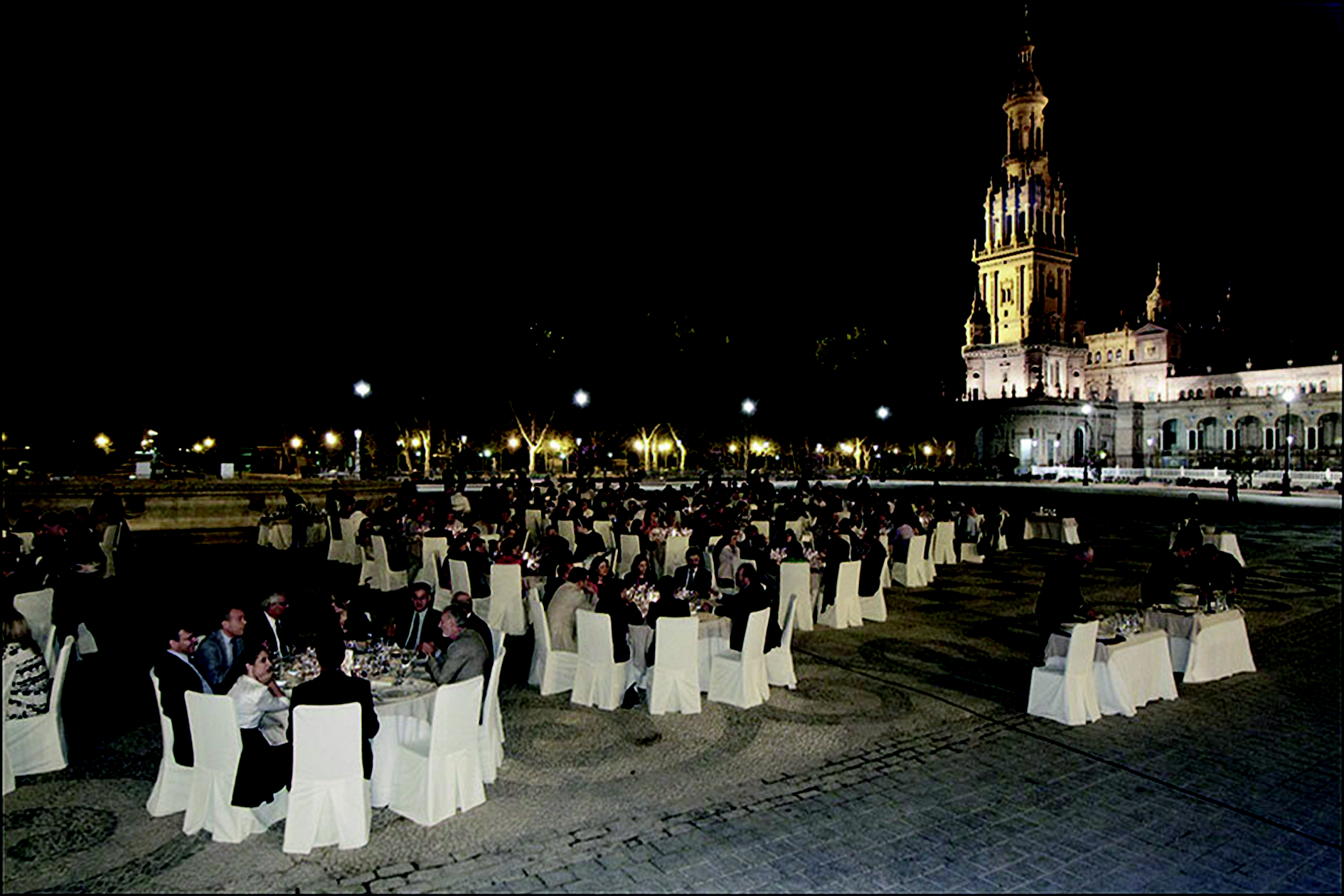
The conference dinner in La Plaza de España in the Parque de María Luisa, in Seville
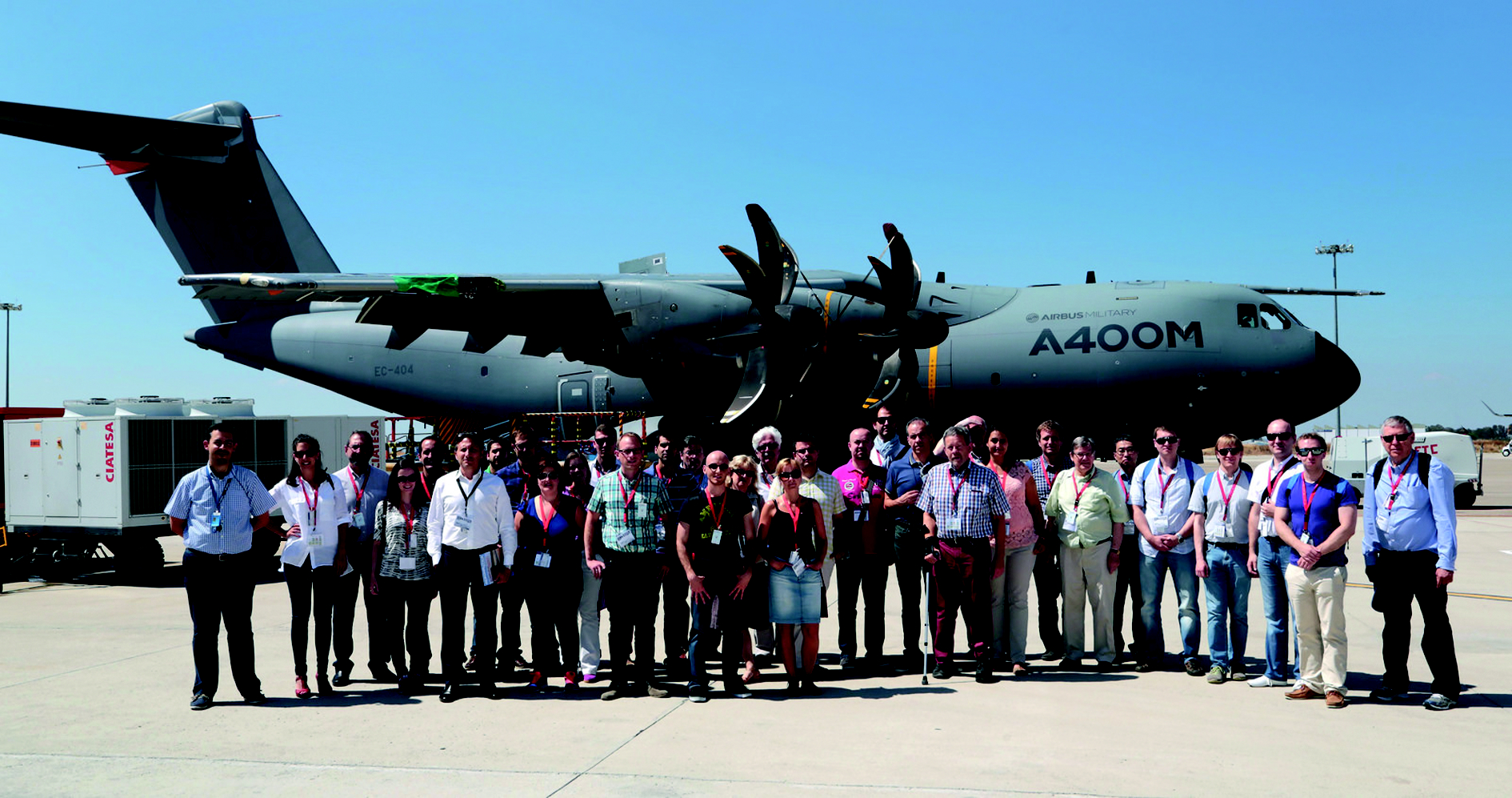
Delegates visit to the Airbus A400 Final Assembly Line