







Abstract
This study presents corrosion characterisation of CP-Ti after nitriding, anodising and duplex surface treatment. The structural properties and corrosion characteristics were investigated by using scanning electron microscopy, X-ray diffraction, Raman spectroscopy and electrochemical polarisation unit. After anodisation and duplex treatment, the porous oxide layer including anatase phase and unshaped or circular pores formed on CP-Ti surface. Size and shape of the pores were changed according to the anodising parameters. It was observed a double layered structure including porous layer on the top and a dense columnar layer beneath that section formed on duplex treated CP-Ti surface at low temperature of anodisation process. Pitting corrosion was observed on all of the samples after the electrochemical polarisation tests. Dense columnar microstructure provided good corrosion resistance via acting as a barrier. As a result, double oxide layer provided an important improvement in corrosion resistance in contrast with nitriding and anodisation processes.
Introduction
Titanium and its alloys has excellent corrosion resistant, favourable mechanical properties and good biocompatibility on account of titanium widely used orthopedic applications such as implants and prostheses, heat exchanger and aircraft engine parts.1 – 5 Pure Ti has a single phase, the α-phase which has a hexagonal close packed structure. Commonly, it is known that titanium metals form suddenly 1·5-10 nm thickness passive oxide film (consist mainly of TiO2) on their surface, if air at room temperature.1 Moreover, this oxide layer provides in an excellent corrosion resistance for a low level of electronic conductivity6 and low ion formation tendency in aqueous environments.7 However, Ti cannot always show a good corrosion resistance. Especially, there were obvious limits of fluoride concentration and the pH value at which the corrosion behaviour of Ti changed in environmental solution. If the fluoride concentration in the solution is high, the passive oxide film can breakdown and the corrosion resistance of titanium can decrease.8 To improve further corrosion resistant, different surface treatment methods are applied on the titanium such as nitriding, anodising,9 microarc coating,10 sol–gel coating,11 vacuum plasma spray coating,12 plasma spraying, chemical vapour deposition and sol–gel. 13 13,14 The electrolytic method to form oxide film is preferred, because of low cost and relatively easy of fabrication. Many works15 – 18 studied the effects of electrochemical oxidation condition on thickness of the titanium dioxide layer. Furthermore, Cheng et al.19 reported that the anodising treatment is superior to the sol–gel technique in improving corrosion resistance of titanium. Soung et al.20 showed that, when the porous oxide film are formed on titanium metals through anodising treatment, their crystalline structure, surface morphology and chemical composition can be changed according to the type of the titanium metals. Narayanan and Seshadri21 reported that high oxide thickness provided good corrosion resistance. However, the increase in the thickness of the oxide layer can cause kinds of adhesion problems. Corrosion behaviour of the anodised titanium samples was also related to oxide layer morphology. As a result, porous oxide layer formed after anodising cannot provide excellent improvement of corrosion resistance compared with untreated CP-Ti. With this aim, especially in the recent year, the duplex treatment and multilayers coating are suggested to improve the corrosion and the wear resistance of CP-Ti.22 – 24
The study investigates the changes of the oxide layer structure and corrosion resistance by applying single nitriding, single anodising and duplex treatment on CP-Ti. After the surface treatments, the structural properties and corrosion behaviour were investigated by X-ray diffraction (XRD), scanning electron microscopy (SEM), Raman spectroscopy and polarisation test.
Experimental
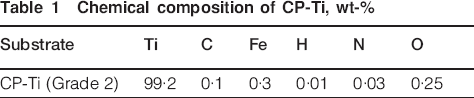
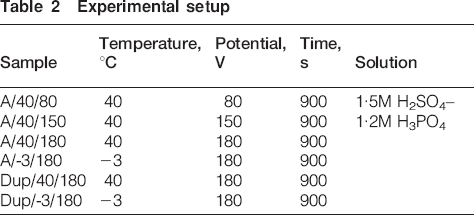
CP-Ti (Grade 2), whose chemical composition is given in Table 1, is used for nitriding, anodising and duplex treatment. At the beginning of nitriding and anodisation, the substrate with the dimensions of 25×25×2 mm was polished by using SiC emery paper with 600-1200 mesh grit and then the specimens were washed in distilled water and dried in air and etched with 3 vol.-%HF–30 vol.-%NH3 solution at 25°C for 60 s. The nitriding processes were carried out in plasma nitriding unit. After cleaning with alcohol, the specimens were placed into the plasma nitriding chamber and the chamber was evacuated to 2·5 Pa. Before plasma nitriding, the specimens were subjected to cleaning by hydrogen sputtering for 15 min at 500 V and a pressure of 5×10² Pa to remove any surface contaminates and then nitrided at 750°C for 4 h in a gas mixture of 75%N2+25%Ar under a constant pressure of 5×10² Pa. Afterwards, the nitrided specimens were anodised at different process parameters. The electrolyte anodisation was carried out in 1·5M H2SO4–1·2M H3PO4 under various voltages, which remain constant during the process. The experimental setup is given in Table 2.
Chemical composition of CP-Ti, wt-%
Experimental setup
Electrochemical polarisation experiments were performed using a potansiostat Potentioscan Wenking POS73. The specimen surfaces with an area of ∼0·25 cm2 were exposed to the 3·5 wt-% NaCl solution at 25°C. The specimens were immersed into the test solution, and a polarisation scan was carried out towards more noble values at a rate of 1 mV s−1, after allowing a steady state potential to develop. The surface morphologies of layers and corroded surfaces were observed by using a Jeol 6400 SEM (Japan). Identification of phase and crystalline structure of layers was evaluated by XRD analysis and Raman spectroscopy. X-ray diffraction (Rigaku) was performed at 30 kV and 30 mA with Cu Kα radiation. Surface roughness values were measured by a Mitutuyo SJ-301 (Japan) profilometer. In addition, the thicknesses of layers were measured by a cross-sectional view of SEM image and spectral reflection system.
Results and discussion
Structural analyses
Figure 1 shows the XRD patterns of the untreated, nitrided, anodised and duplex treated samples. The untreated and nitrided CP-Ti was mainly consisted of α-Ti and TiN phase respectively. It is well known that the TiO2 has three crystal structures as anatase, rutile and brookite.25 As can be seen in XRD peaks, the oxide layer formed on the surface after anodisation consisted of anatase and α-Ti phases. A peak related to the oxide layer was not observed up to anodisation potential of 150 V. Mixed crystalline structures consisting of anatase and rutile phases were observed at the duplex treated samples. This result indicated that the nitriding process affected the phase structure of the oxide layer formed during anodising. Rutile peak intensity of Dup/40/180 sample was relatively higher than Dup/-3/180 sample. Also, intensity of anatase phase increased with increasing anodisation potential. Onoda and Yoshikawa26 also obtained the intense anatase TiO2 on pre-nitrided titanium substrate after anodising. In conventional anodisation process, anatase TiO2 hardly forms on titanium surfaces, because the passive amorphous films produced in these processes act as a barrier to prevent further anodisation. Montero et al.27 reported that the titanium nitride films may increase the oxygen reactivity of the surface. Azumi et al.28 and Adjaottor et al.29 showed that an oxide layer could be grown readily on a TiN film, as compared to an anodic oxide film on titanium. The reason of this is that TiN is overstoichiometric with a weak bond existing between Ti and N atoms. It should be noted that easily oxidation of TiN is associated with its crystal structure. Titanium has a hexagonal close packed structure while TiN has a cubic structure. Oxygen atoms can easily migrate into TiN crystal structure due to low atomic packing factor.
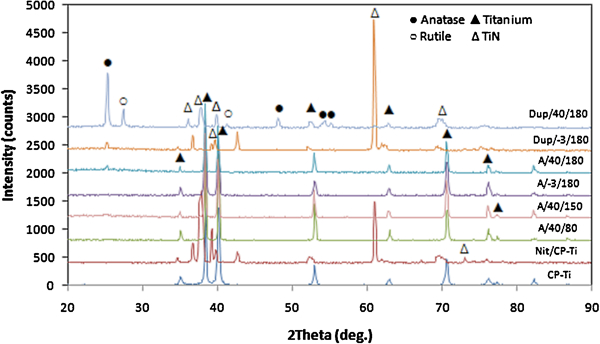
X-ray diffraction results of single nitrided, single anodised and duplex treated CP-Ti
Raman spectra of the single anodised and duplex treated samples are shown in Fig. 2. Raman spectroscopy was more clearly detected the crystalline structure of titanium oxide phases. Because, ordinary XRD techniques could not detect the TiO2 phases on the anodised samples due to low oxide thickness. The Jobin Yuon Raman standard peaks of anatase were 146, 198, 398, 518, 639 cm−1 and peaks of rutile were 224, 446, 610 cm−1. After anodising treatment, the peak width of anatase becomes broader and the peak intensity is low. The intensity of peak increased after duplex treatment.
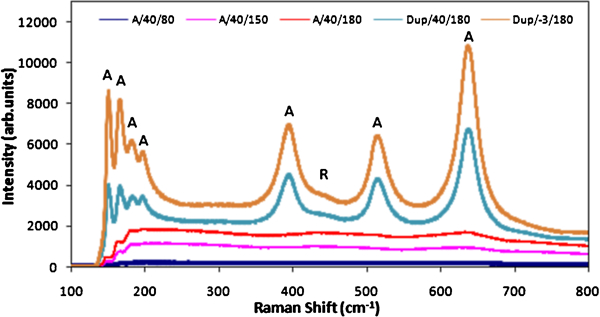
Raman spectra of single nitrided, single anodised and duplex treated CP-Ti
Figure 3 shows the SEM images of untreated, nitrided, anodised and duplex treated samples. Untreated samples with grey colour turned to golden colour after single nitriding. As shown in Fig. 3b, grain boundaries became evident after nitriding. According to the selected anodising parameters, the certain geometric shapes appeared on substrate surface. As shown in Fig. 3c, some colonies such as corals were formed. Unshaped pore and canals were distributed homogenously over the surface of anodised samples (Fig. 3d and e). After anodising at 150 V, stream shaped canals were formed on the surface and the length of these canals got shorter at 180 V. This result shows that the pores dissociate either with increasing anodising potential. Figure 3f shows the specimen anodised at −3°C. Diameters of pores on the surface of the specimen anodised at −3°C are smaller than those of pores on the surface of the specimen anodised at 40°C. Even not all pores have circular shape at 180 V. In addition, the pores with 500 nm were distributed homogenously over the surface of duplex treated sample (Fig. 3h). Dup/-3/180 sample surface was like a sponge and this spongy structure consisted of very small circular pores (Fig. 3h).
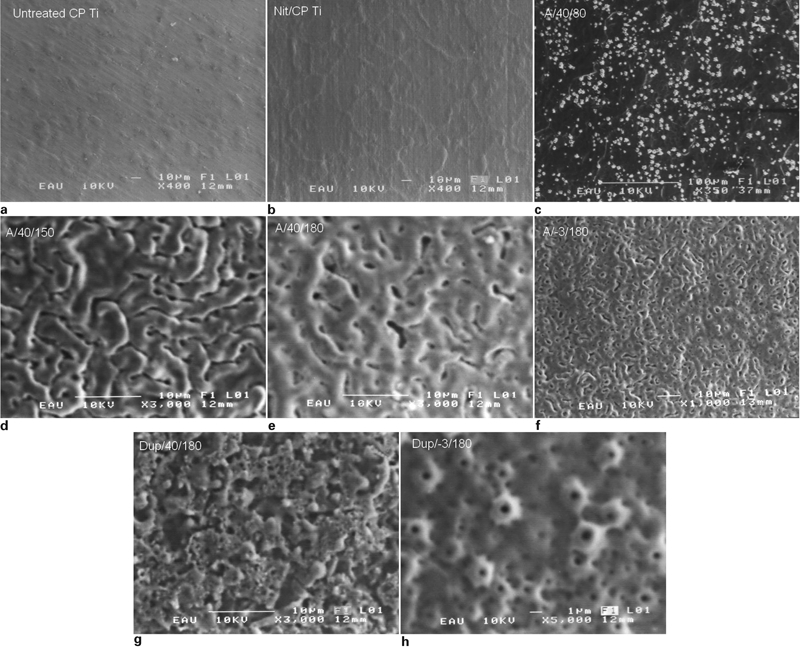
Surface images of untreated, single nitrided, single anodised and duplex treated CP-Ti
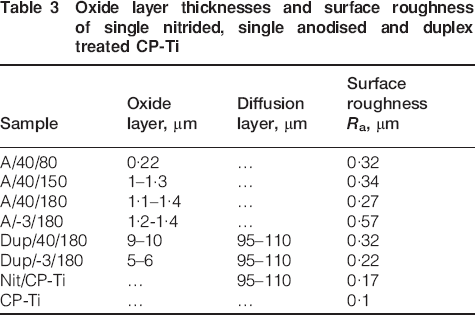
The oxide layer thickness, diffusion layer thickness and roughness are given in Table 3 for untreated, nitrided, anodised and duplex treated samples. For duplex treated samples, the diffusion layer thickness was slightly changed after anodising. The oxide layer thickness rose with the increasing anodising potential. The roughness of the surface also increased up to 150 V and then decreased at 40°C. In addition, the surface roughness decreased with decreasing anodising temperature. At low temperatures, the structure including deep channels occurred since the continuous oxide layer was not formed on the substrate surface. These results showed that it was necessary to increase anodising time to form uniform oxide layer on the surface.
Oxide layer thicknesses and surface roughness of single nitrided, single anodised and duplex treated CP-Ti
Corrosion properties
Polarisation curves of nitrided, anodised and duplex treated samples are given in Figure 4 Figs. 4 and 5. As shown in Figure 4 Figs. 4 and 5, the corrosion resistance of all surface treated CP-Ti increased, whereas that of the untreated sample did not. Specimens with thicker oxide layers exhibited a more noble behaviour. Even though the specimens anodised at potential of 80 V had thin and transient oxide layers, the anodising process had a positive effect on corrosion resistance of CP-Ti.
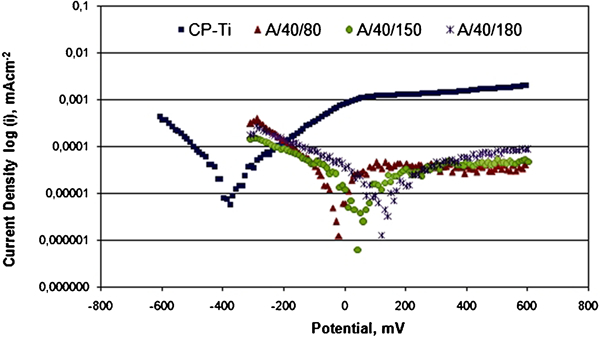
Polarisation curves of untreated and single anodised CP-Ti
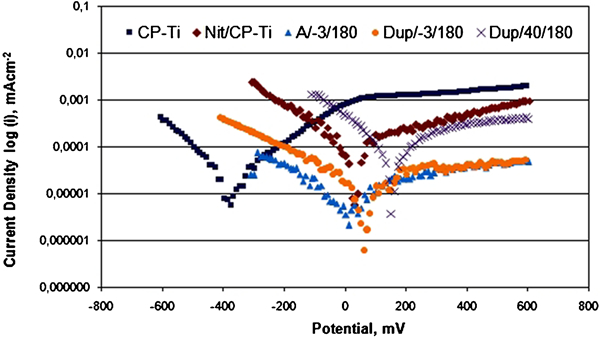
Polarisation curves of untreated, single nitrided, single anodised and duplex treated CP-Ti
The corrosion resistance of the nitrided sample increased while the untreated CP-Ti did not. The best corrosion resistance was found at duplex treated and single anodised specimens at −3 and 40°C. The duplex treated samples showed a more noble behaviour. The increase in corrosion resistance is related to the oxide layer structure. As shown in Fig. 6, the oxide layer has a structure with two different layers at a low anodising temperature. The upper layer is porous and the bottom layer has a dense structure. The oxide layer for sample anodised at 40°C is also completely porous. During corrosion tests, the corrosion resistance improved since the dense layer which is bottom layer had prevented the corrosion attacks. Corrosion resistance of samples formed oxide layer with porous structure also improved if the porous oxide layer structure had enough thickness. Although, E corr value of the anodised samples was 122 V, it increased to 154 V after the duplex treatment by showing a more noble behaviour (Fig. 5). The result of the corrosion experiments indicates that the effects of the formed anatase or rutile phases on the corrosion resistance of CP-Ti have been very similar and that the best results have been reported to be dependent on the porosity of the coating, the phase density and the number of the coating layers and single layer or a double layer.
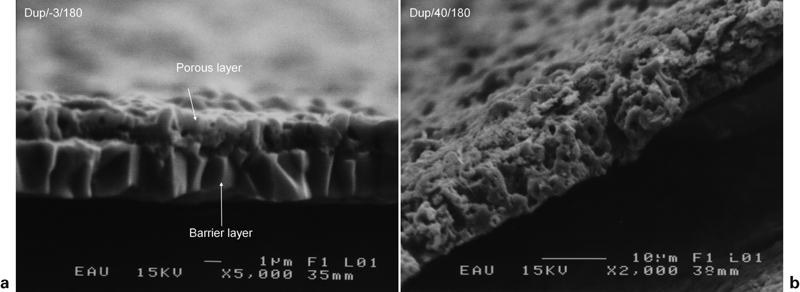
Cross-sections of duplex treated CP-Ti
Figure 7 shows the SEM images of the samples after the corrosion tests. As shown in figure, the main failure mechanism is the pitting corrosion. Many pits were seen on the untreated sample. The number of pits on the nitrided sample was less, but the sizes of pit were bigger than that of the untreated CP-Ti. At the sample single sample anodised at −3°C, no pits were observed. The reason of the results is the circular canals. Because, the corrosion occurred inside these canals. At Dup/40/180 samples, the number and size of pits are rather small and the A/-3/180 samples did not have any corrosion effect. The pore sizes of the Dup/40/180 sample were similar before and after the corrosion test.
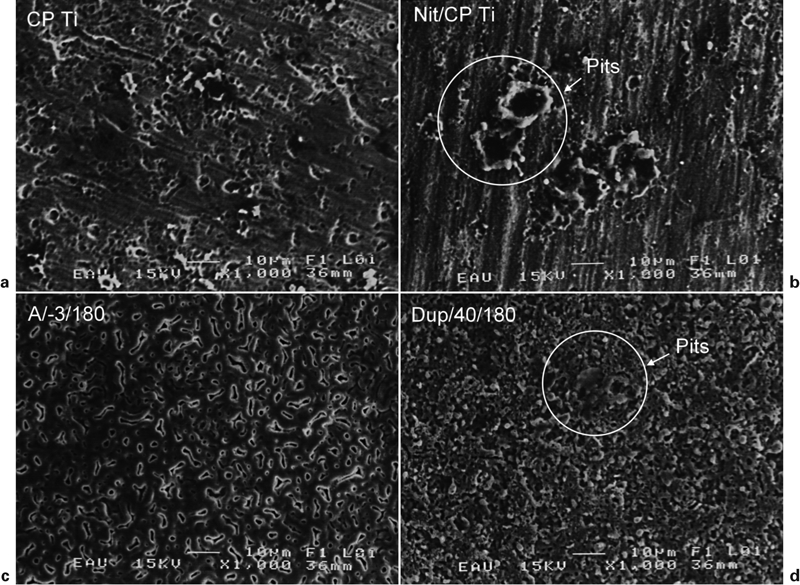
Images (SEM) of surface after corrosion test
Conclusions
The structural and corrosion properties of untreated, single nitrided, single anodised and duplex treated CP-Ti were investigated. The compound and oxide layers occurred after single nitriding and single anodising processes respectively. The duplex treatment caused the formation of the rutile phase by affecting the phase structure of oxide layer. The thickness of the oxide layer increased with increasing anodising potential. It can be seen that the duplex treated CP-Ti samples has a double layered structure including a porous layer on the top and a dense columnar layer beneath that section structure at low temperature anodising process. As a result, the double layered film improved the corrosion resistance and showed a more noble behaviour.