






Abstract
The 2012 Eurocorr meeting was held at the Sheraton Maslak hotel in Istanbul from 9-13th September 2012. The focus of the meeting was ‘Safer world through better corrosion control’. The meeting attracted over 650 delegates and over 360 papers and 125 posters were presented during the 27 sessions and workshops. Parts 1-5 will review the technical sessions over five issues with the opening and plenary lectures and technical sessions on corrosion and scale inhibition, corrosion by hot gases and combustion products and metallic, inorganic, and organic coatings covered in this report.
EUROCORR is an annual conference organised on behalf of the European Federation of Corrosion (EFC) and is generally regarded as the premier corrosion conference in Europe. The conference moves from country to country and this year took place at the Sheraton Maslak hotel in Istanbul, Turkey. The conference centre was located in the business district, several miles north of the city centre, and was readily accessible by the modern metro line. The organisation was split between an international scientific committee mainly composed of working party chairmen, a scientific committee, a local organising committee and Dechema. The international scientific committee was chaired by Ingegerd Annergren, Swerea KIMAB AB, Sweden and co-chaired by Damien Féron, STAC Chairman, Commissariat à l'Énergie Atomique (CEA)/Saclay, Gif-sur-Yvette, France and Philippe Marcus, EFC President, École Nationale Supérieure de Chimie de Paris, France. The local organising committee was chaired by Ali Fuat Cakir.
Istanbul
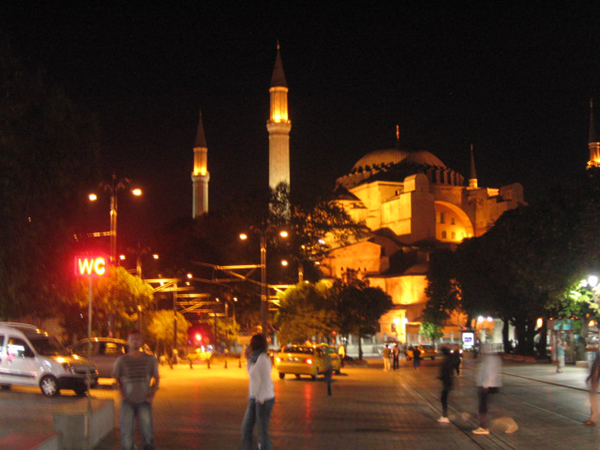
The number of delegates was around 650, which was excellent considering the location of the meeting (Asia is just across the Bosphorus). There were 27 sessions, 21 of which were run by working parties, plus 2 joint sessions and 2 workshops with over 360 oral and 125 poster presentations. The largest sessions were coatings, and mechanisms and methods although the automotive, microbial and archaeological sessions attracted more papers than usual. The conference venue was satisfactory with a moderate sized exhibition area where the Maney stand, with display copies of CEST, was located. The posters were displayed nearby and coffee was served in both the reception and exhibition areas. The lunches (included in the conference fee) provided on the first three days of the conference were excellent. All the active EFC working parties organised sessions as well as holding working party meetings throughout the four days of the conference.
The EFC General Assembly (GA) took place on Monday evening. This was run by the current EFC President, Philippe Marcus; the incoming EFC President will be Lorenzo Fedrizzi. Social events included a reception on Sunday evening, an enjoyable poster party on Tuesday evening and the conference dinner on Wednesday evening. The latter was held on a boat on the Bosphorus and, although your correspondent missed this event, was reputed to be very good. On a personal note, Istanbul was an absolutely fascinating place to visit with interesting people, history, food and atmosphere.
Opening session and plenary lectures
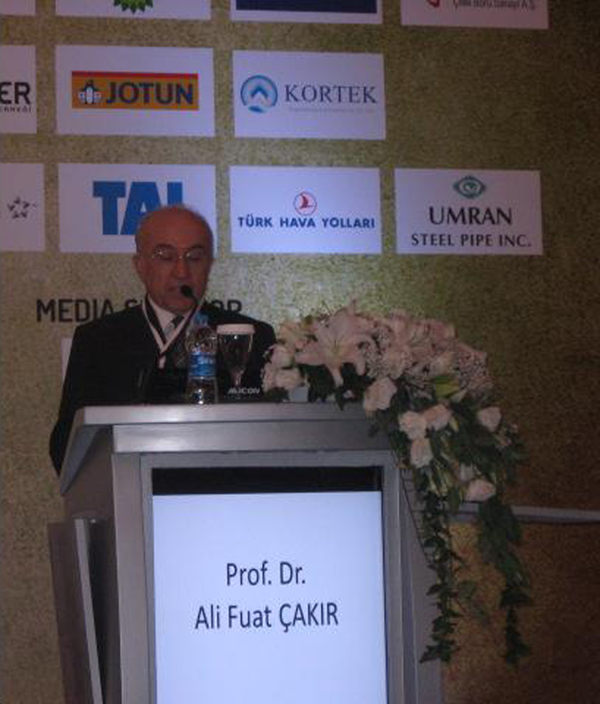
The conference was opened on Monday morning by A. F. Çakir who handed over to Philippe Marcus, EFC President. He gave a warm tribute to late Scientific Secretary, Dr Paul McIntyre, who sadly passed earlier that year (see Paul's obituary in CEST Vol. 47 No. 6, 2013, p. 395).
A. F. Çakir giving the opening address
Y. Kuznetzov – winner of the Cavallaro medal
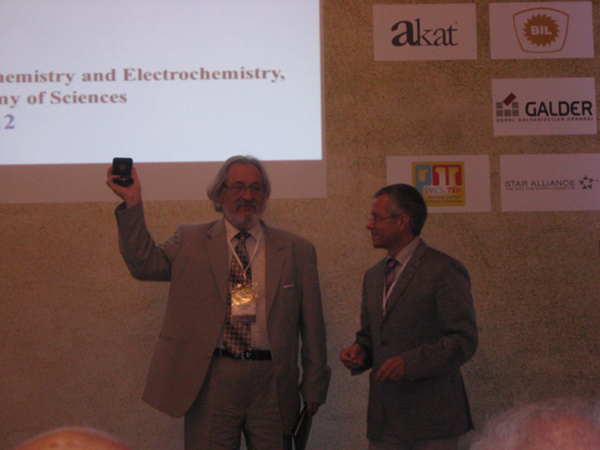
The Cavallaro medal was presented to Y. Kuznetzov from the A N Framkin Institute of Physical Chemistry, Russia. He gave short lecture entitled, ‘New possibilities of inhibition of metal corrosion by organic heterocyclic compounds’ that discussed the azoles, an important group of heterocyclic inhibitors. A short summary of this lecture can be found in the Inhibitors section.
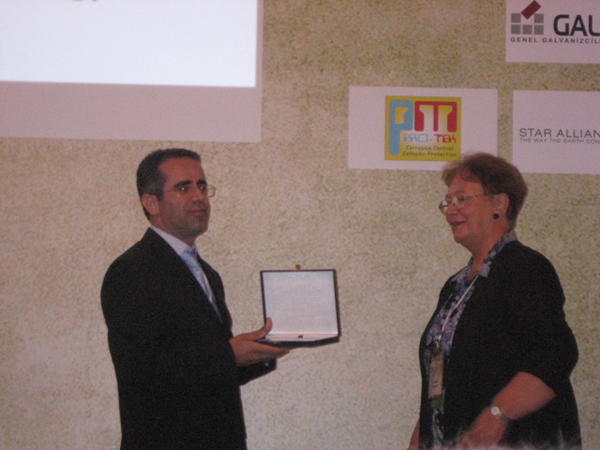
This was followed by the presentation of the Kurt Schwabe prize (best researcher under the age of 35) to R. Solmaz from Bingol University, Turkey. Dr. Solmaz summarised two talks that he was presenting during the conference. The first was, ‘Protection of copper surfaces against acid corrosion by modification of (1-Aminohexyl) phosphonic acid self-assembled monolayer’ and the second was, ‘Investigation of thiadiazole schiff bases as corrosion inhibitors for mild steel: electrochemical, spectroscopic and microscopic techniques’.
R. Solmaz – winner of the Kurt Schwabe prize with J Tegledi
An invited plenary lecture by K. Nisansioġlu from the Norwegian University of Science and Technology, Trondheim, Norway followed, on the topic of, ‘Nano-film segregations in localised corrosion of aluminium alloys’. He told us that the cause of sharp intergranular corrosion (IGC) in wrought aluminium alloys is related to the segregation of active or noble intermetallic films along grain boundaries at certain tempers of aluminium alloys, for instance, at the Mg-Zn compounds in 7000 series alloys and Cu-rich films in 5000, 6000 and 7000 type alloys. This type of IGC can often be mitigated by a simple heat treatment.
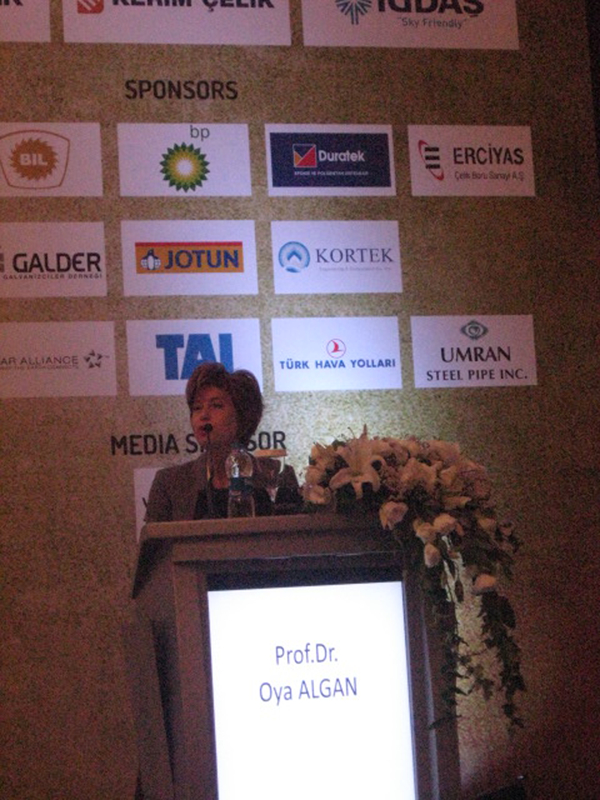
There were two other plenary talks during the conference. On Tuesday, O. Algan from the Institute of Marine Sciences and Management, Istanbul University gave a plenary lecture entitled, ‘Istanbul- How old is SHE – from a geo- archaeological point of view?’ There was not much mention of corrosion but the talk was interesting, nonetheless. During the preliminary construction of a large scale Marmaray Tube Tunnel Project, an ancient Byzantium Harbour (Theodosius H. 4th century) was discovered out at Yenikapý within the historical peninsula of Istanbul. Geological and archaeological evidence in the sedimentary sequence exposed to daylight at the excavation site revealed significant new data enabling for the first time correlation of the Holocene sea level change, paleo-environmental changes and the cultural sequence of the region. Based on these findings, a Neolithic settlement next to a small stream on a coastal plain were found to represent the oldest cultural age of the historical peninsula at ∼8000-9000 cal (calibrated) year BP (before present) was deduced to have existed. The harbour was probably abandoned after 12th century AD by filling up with the Lykos Stream detritus and continued seaward migration of the coastline.
O. Algan giving a plenary lecture
Plenary audience
On Thursday, the plenary lecture was given by H. Terryn from Vrije University, Brussels, Belgium on, ‘Interfacial bonding and de-adhesion of corrosion protective coatings on metals’. He noted that studying the bonding properties of the polymeric coating on the metal surface is experimentally difficult. The polymer/metal interface is hard to reach using analytical techniques due to the relatively high thickness of the polymer coatings. Consequently, the interfacial bonding has to be modelled through adsorption of functional groups -representative interfacial adhesive molecules - on differently pre-treated surfaces by means of bonding mechanism (FTIR) and affinity (XPS) studies. Furthermore, the buried interface and delamination mechanisms at this location can be studied by Scanning Kelvin Probe (SKP) measurements. These local measurements on a microscopic scale can be linked to macroscopic adhesion strength. The lecture presented recent important developments in the micro- and macroscopic studies of adhesion of corrosion protective coatings relating to a variety of metals.
Technical programme
Moving away from the plenary lectures and awards and looking at the technical side of the meeting, in addition to the usual technical sessions there was reports from a task force on C02 corrosion, two workshops, on aerospace and marine renewable energy, a course on tribocorrosion and two joint sessions, one on mechanisms of environmentally assisted cracking and another on coatings for high temperatures. The papers from these and all the technical sessions appear on the conference proceedings CD-ROM and selected presentations will be reported in subsequent conference reports.
As in previous years, the reports will review a selection of the full papers available on the proceedings CD-ROM and highlight interesting work (both presentations and posters). In some cases, working party Chairs have assisted in the selection of papers.
Corrosion and scale inhibition
The session ran throughout Monday and was chaired by G. Schmitt of IFINKOR, Iserlohn, Germany. 11 presentations were given during the session as well as 35 poster presentations. The first presentation was: ‘New possibilities of inhibition of metal corrosion’ by Y. I. Kuznetsov from the Russian Academy of Sciences, Moscow, Russia. Inhibition efficiency of azoles depends on their chemical structure which, in many cases, can be characterised by the principle of linear free-energy relationships (LFER). Bilayer nanocoatings were produced using mixtures of various azoles with carboxylate-type inhibitors. Particularly small additions of dimegin (disodium salt of deuteroporphyrin) were found to be effective at promoting passivation of iron in neutral solutions. Dimegin chemisorption offers a wide range of possibilities for further improvement of protection of metals by other heterocyclic compounds.
The next presentation selected for comment is, ‘Inhibition behaviour of benzonitriles on mild steel in HCl solution’ given by G. Sığırcık from Cukurova University, Adana, Turkey. Benzonitrile compounds are good inhibitors due to their molecular structure. 2-aminobenzonitrile (2-AB), 3-aminobenzonitrile (3-AB) (functional amine groups in different positions) were tested in 0·5 M HCl solution at 25°C at concentrations from 5×10⁻⁴ to 1×10⁻² M using Electrochemical impedance spectroscopy (EIS) and potentiodynamic measurements. Inhibition efficiency was calculated from the surface coverage factor (IE%a). Results show that all these inhibitors have a good inhibition effect on mild steel in 0·5 M HCl solution. This was followed by, ‘ECN study of pitting corrosion in pipelines in the water/hydrocarbon interface region – effect of corrosion inhibitors’ by G. Schmitt, INFIKOR, nfp Ltd, Iserlohn, Germany. In wet sweet or sour gas pipelines with inhibited two-phase bottom-of-the-line (BOL) liquids, pitting appears to be related to the wavy flow of the BOL by the gas stream. Using a specially developed ECN technique, this phenomenon was simulated with a two electrode system comprising two vertically-mounted X65 flat coupons with the water/HC interface in the middle of the coupons, one of which was oscillated vertically with defined amplitude and frequency; the other remaining stationary. It was proved that intermittent surface wetting with HC and brine can increase the likelihood of pitting in the HC/brine boundary region of the pipeline steel. In combination with a specially developed evaluation software the ECN method proved to be a sensitive tool to quantify parameter effects in short exposure times. The last paper in the first session addressed the question, ‘Does benztriazole deprotonate on copper surfaces?’ and was given by A. Kokalj, Jozef Stefan Institute, Ljubjana, Slovenia. Using density functional theory (DFT) calculations, the work showed that the deprotonated form of benzotriazole is the active species for inhibiting copper corrosion. The importance of deprotonated benzotriazole arises from the fact that it is able to form chemical bonds with copper surfaces that can rival the strength of, e.g., Cl-Cu bonds, whereas the bonding of neutral benzotriazole with copper surfaces is much weaker.
M. H. Moayed, Tarbiat Moallem University of Sabzevar, Iran, presented a paper on, ‘Inhibitive behaviour of pyridine-2-thiol on mild steel in HCl acidic media’. This was investigated using open circuit potential (OCP), potentiodynamic polarization and electrochemical impedance spectroscopy (EIS) techniques. A hydrodynamic state was accomplished by a rotating disc electrode at fixed rotation speeds. The inhibitive performance was concluded to comprise transfer of the inhibitor molecules from bulk aqueous media to double-layer and then their adsorption onto the corroding surface, resulting in creation of a protective layer, The OCP results showed that by increasing the rotation speed, the corrosion potential (Ecorr) shifts towards more positive values. An interesting paper in the poster session was, ‘Synthesis of 3-[(2-Hydroxy-benzylidene)-amino]-2-thioxo-thiazolidin-4-one Schiff base and its effect of corrosion on copper 0·5 M H2SO4 solution’ by E. A. Şahin, Çukurova University, Adana, Turkey. Electrochemical impedance spectroscopy (EIS) and linear polarization resistance (LPR) techniques indicated that the polarization resistances increase with increasing concentration of the inhibitor and at the highest inhibitor concentration of 1·0 mM, the inhibition efficiency reached 94·6%. This high inhibition efficiency was attributed to the blocking of active sites by adsorption of Schiff base molecules on the copper surface. This was confirmed using scanning electron microscopy (SEM) and atomic force microscopy (AFM) which showed that the inhibitor molecules form a good protective film on the copper surface.
Corrosion by hot gases and combustion products
There were a total of 13 lectures over 3 sessions on this subject, all of which were chaired by M. Schutze, DECHEMA eV, Frankfurt am Main, Germany. Additionally, there were 14 poster presentations on this topic. A notable lecture was, ‘Comparison of behaviour of low chromium steels in air and moist atmospheres at high temperature’ by A. Sultan, METU, Ankara, Turkey. P-5 steel (5%Cr), was subjected to isothermal oxidation tests. Two different environments; air and flue gas composition of natural gas combustion, CO2+2H2O+7·52N2 gas mixture- were used in thermogravimetric analysis (TGA) at 450 and 500°C. P-5 steel possessed better resistance in air than in water vapour containing environment. The presence of water vapour in the oxidising gases provides hydrogen that can dissolve in the alloy and affects its behaviour, and results in higher oxidation rate than in dry gases. The higher corrosion rates of Fe–Cr and Fe–Cr–Ni alloys at high temperatures in the presence of water vapour was attributed to: (i) higher corrosivity of water and (ii) and/or loss of the protective effect of chromium oxides of chromium in the steel.
Another paper of interest was, ‘Corrosion of stainless steels in condensing flue gases from waste-fired power plants’ by R. Pettersson, Avesta Research Centre, Sweden. Corrosion in condensing flue gases represents a complex situation, intermediate between high temperature- and aqueous-corrosion. Laboratory simulation of corrosive conditions was achieved by using a gas flow passing over cooled specimens. For tests on super-austenitic grades 254 SMO and 654 reasonable correlations were obtained between predicted and measured dew-points and condensate compositions. The best performance of all the stainless steel grades investigated was shown by the super-austenitic 654 SMO. This latter showed a performance on a par with the nickel-base alloy C-276 and may be a cost-effective solution for corrosion problems in flue gas cleaning systems.
One good example in the poster session was, ‘Nano-indentation determination of the mechanical properties of the oxide scale formed by high temperature oxidation of Ni-based superalloys’ by E. Fedorova, Polytechnic Institute of Siberian Federal University, Krasnoyarsk, Russia. Multiple nano-indentation tests at different loads were performed on polished cross-section of Ni-based superalloy AM1 after 100 h isothermal oxidation at 1100°C. It was found that the measured hardness and Young's modulus of the substrate and thermally grown oxide (TGO) oxide scale decreased with increasing indentation depth. For a load of 10 mN the average Young's modulus of the oxide scale is 320 ± 15 GPa. The corresponding average hardness values is 15·6±0·4 GPa. It was concluded that mechanical properties of oxide scale could be used to correct the values of the work of adhesion to quantify the adherence of oxide scales formed on Ni-based superalloys.
Coatings
The coatings session was a large one and ran from the start of the conference on Monday morning through until the end on Thursday lunchtime. The papers were divided into five smaller sessions: pre-treatments, metallic coatings, inorganic coatings, organic coatings and self healing coatings, all chaired by L. Fedrizzi, University of Udine, Italy and W. Fürbeth from Decehma E.v, Frankfurt-am-Main, Germany. These two gentlemen are the Chair and Vice-Chair of the Coatings working party.
Pre-treatment
Nine oral papers were given and there were five posters. There were seven full papers on the proceedings CD-ROM of which two have been chosen for summary here, both delivered on the Monday afternoon. The first was, ‘Combination of chemical conversion with water-based nanoparticle coatings for the corrosion protection of magnesium alloys’ by W. Fürbeth, from Dechema, Frankfurt, Germany. Salt spray tests (DIN ISO 9227) on coated AZ31 alloy were conducted and the results showed that combined coatings (6-8 wt-% SiO2 nanoparticles and Surtec 650 conversion) performed better than pure Surtec 650 coatings alone. This was further corroborated by impedance spectroscopy investigations in 3% NaCl solution where Rs values were found to be higher for the better performing coatings. Additionally it was found that annealing at 250°C is a promising way to further increase the coating resistance.
The second pre-treatment paper was, ‘Corrosion protection of AA1050 by a modified Ce conversion coating’ given by I. Costa, IPEN/CNEN-SP, São Paulo, Brazil. The corrosion performance of the surface treated samples was evaluated by electrochemical techniques and salt spray tests. The results showed better corrosion performance associated to the Ce conversion coating (CCCe) compared to hexavalent chromium, Cr (VI) type. This was related to the precipitation of Ce(OH)3 at the cathodic areas of the aluminium substrate during corrosion processes. The Ce conversion coating showed a self-healing effect associated with precipitation of solid products on the corroding areas.
Metallic coatings
The metallic coatings session ran through the remainder of Monday until Tuesday morning. Eleven papers were delivered and there were also thirty posters. Of the 12 full papers available on the proceedings CD-ROM, three have been chosen for discussion here.
The first was ‘Corrosion resistance in different environments of Ni matrix micro- and nano-composite electrodeposits’ given by M. Lekka, University of Udine, Italy. Pure Ni deposits, Ni containing SiC micro-particles and Ni containing SiC nanoparticles were deposited from a Ni sulphamate electroplating bath onto ASTM 387 gr.22 steel plates. The microstructure was observed by SEM, the SiC content evaluated by Glow Discharge Optical Emission Spectroscopy and the corrosion resistance by potentiodynamic polarisation curves. It was found that the co-deposition on SiC micro-particles decreased the protective properties of the coatings while the co-deposition of nano-particles did not penalise the high corrosion resistance of the nickel coatings. The microstructural modifications induced by the co-deposition of the particles and the use of pulse current influenced the degradation mechanisms.
The next presentation chosen for comment was. ‘Evaluation of Zn based composite coatings’ by M. Pazderová from VZLU (Aerospace Research and Test Establishment), Prague, Czech Republic. The aim of this new technology was to obtain lubricant composite coatings of zinc with PTFE or PE particles. A PTFE dispersion or PE micro-powder (size 0·05-0·5 μm) were deposited from an acidic bath. The particle distribution was examined by infrared spectroscopy (FTIR) and optical microscopy. The analytical methods confirmed a relatively homogenous incorporation of PTFE particles in the coatings. Compared with Zn coatings the Zn-PTFE coatings had lower friction coefficients, the self-lubricating properties of the coatings were improved, the wear resistance of coatings was reduced and the corrosion resistance were similar.
The last paper was, ‘Electrodeposition of Cu-Sn alloy with Cu-graphite anodes by pulsed electrodeposition’ delivered by S Xing from University of Trento, Italy. Mathanesulphonate electrolyte was used as an environmentally friendly (non-cyanide) alternative. EDX analyses showed that deposits had a maximum Sn content at approximately 1·3A dm−2. Films obtained using a Cu anode have increased Cu content in the deposit while using a graphite anode resulted in an increased Sn content. The physical characterisation of deposits showed dependence between surface morphology and applied current density. Cyclic voltammetry indicated that divalent tin salt in the bath tends to be changed into tetravalent resulting in a plated coating of inconsistent composition.
Inorganic coatings
This session ran from Tuesday afternoon and continued on Wednesday morning. Eleven oral papers were given and ten (out of twenty three) posters were presented. Only fourteen full papers appeared on the proceedings CD-ROM, of which three have been chosen for comment below. The first was, ‘Corrosion resistant coatings on AZ31 magnesium alloy’ delivered by M. Bestetti from Politecnico di Milano, Italy. Oxide films were grown on the alloy by micro-arc oxidation in an alkaline solution of phosphate salts with addition of different compounds (Na2SiO3,NaAlO2). Organo-functional silanes namely N-phenil-3-aminopropyltrimethoxysilane (AniSi) and Bis (trimethoxysilylethyl) benzene (BBE) were then applied to seal pores. The surface morphology, cross-section and elemental composition of the anodic films were analysed by scanning electron microscopy (SEM) coupled with energy dispersion spectrometry (EDS). Corrosion resistance was evaluated in dilute Harrison's solution by means of electrochemical polarisation tests. The results showed that the addition of different salts to the alkaline phosphate solution affected the surface morphology and the phase composition of the coatings and, as a consequence, the corrosion resistance behaviour. Both silane post-treatments provided significant corrosion protection to samples.
Two interesting posters were displayed in this session. The first was, ‘Protection of archaeological artefacts by deposition of parylene and SiOx thin films’ given by R. Balastikova from Brno University of Technology, Czech Republic. The first step involved in treating archaeological artefacts uses low pressure hydrogen plasma and after this the surface is highly reactive and prone to oxidation. To prevent oxidation, a barrier film preventing the penetration of oxygen can be temporarily applied. Hence thin films of SiOx and Parylene (poly-para-xylylene) were put down by PECVD and by CVD respectively on copper, iron, brass and bronze. Thickness (ellipsometry), chemical structure (FTIR) and elemental composition (XPS), surface morphology (LCSM, SEM) and barrier properties (OTR) were evaluated and standard corrosion tests carried out. The layers were shown to have a homogeneous structure and OTR measurements indicated that the thin film of Parylene C had a quarter of the permeability of the thin film of pp-HMDSO which correlated with the results of the corrosion test where Parylene C gave better protection.
The second poster was, ‘Case studies to illustrate the versatility and potential of Raman analyses of corrosion products on alloy surfaces’ by H. Potgieter-Vermaak, working at Manchester Metropolitan University, UK. The first case study showed that, for galvanised roof plate exposed to a marine environment, MRS distinguished unequivocally the visually similar white corrosion products into zinc salts and calcite. The second showed how when WC-Co-Ru alloys were placed in a sulphuric acid solution, MRS measurements found both W and Co oxides were formed on the passivated surfaces. The third looked at the corroded surfaces of austenitic (316) and ferritic (444) stainless steels after exposure in an acidic environment and in this case MRS scans indicated that different oxides form depending on the type of acid. Finally MRS showed that for mild steel rebar exposed to a simulated concrete environment neither the pH of the solution nor the presence of sulphate and chloride made a difference to the corrosion products that form on the surface of the rebar.
Organic coatings
The organic coating session was held on Wednesday afternoon. Only eight papers were delivered orally and there were forty six posters listed. The proceeding CD-ROM contains fifty-five abstracts but only sixteen full papers. A paper delivered early on in the session was ‘Preparation and investigation of ferrite doped TEOS sol-gel with and without alkyd top coating system in terms of corrosion resistance and physical properties’ given by D. Mills from the University of Northampton, UK in work done in conjunction with Gdansk University of Technology, Gdansk, Poland. Mg1-xCexFe2O4 and MgFe2O4 nano-ferrite pigments were prepared and incorporated into a Sol-gel TEOS (tetraethoxysilane) base which was then applied by dip coating onto mild steel Q panels. Coatings with and without both types of pigments were tested with linear polarization method, electrochemical noise method and electrochemical impedance spectroscopy. A pore plugging mechanism in sol-gel coating was identified and the cerium modified ferrite pigment was chosen as a more effective. Alkyd coatings were applied to the sol gel coatings and again tested using the above techniques in 3% NaCl aqueous solution. The electrochemical test results correlated and again a pore plugging mechanism was seen. This was followed by, ‘EIS and in-situ AFM study of barrier property and stability of waterborne and solvent-borne clear coats on mild steel’, given by L.G. Ecco, University of Trento, Trento, Italy in work done in collaboration with Royal Institute of Technology, Stockholm, Sweden. It was shown how Electrochemical impedance spectroscopy (EIS) and Atomic force microscopy (AFM) provide a powerful combination to study the initial interaction between the coating surface and electrolyte. EIS data presented initial high impedance values for both waterborne and solvent-borne (Z0·015 = 109–1011 ohm.cm2), Water uptake then caused swelling of the polymer and subsequently reduced the impedance. AFM images displayed that modifications of the coatings surface began shortly after the solution was in contact with the coatings. Moreover, some of the samples showed stable topography changes after a certain time of exposure and similar observations were detected by EIS. A good practical paper presented during the session was, ‘Protective coatings in arctic environments’ delivered by A. Bjørgum from SINTEF Materials and Chemistry, Trondheim, Norway (co-author O. Knudsen also being present). Ageing testing according to ISO 20340 with −60°C in the freezer instead of the specified −20°C generally showed less or comparable rust creep to the qualification limits. The low temperature however, resulted in cracking of the investigated polysiloxane topcoats. Internal stress of the coatings increased with decreasing temperature from 25 to −60°C. The calculated stress level for polysiloxane was in the order of 40 MPa which is significantly higher than the tensile strength of the coating. Vickers microhardness measurements showed increasing hardness with decreasing temperature.
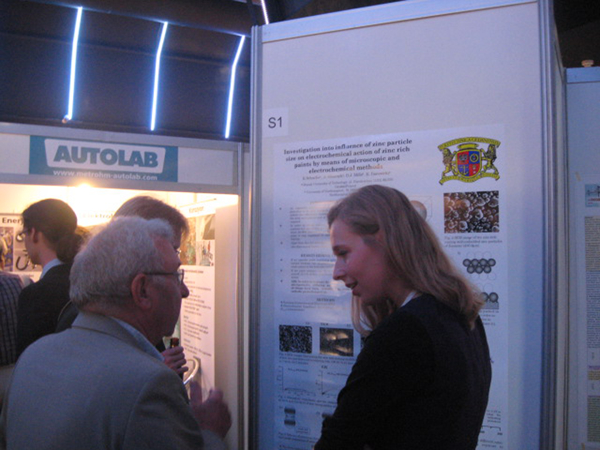
K. Schaefer from the Gdansk University of Technology, Poland won the Poster prize for the best poster written by a person under 35 for her work entitled, ‘Influence of zinc particle size on electrochemical action of zinc rich paints by means of microscopic and electrochemical methods’. The size and distribution of zinc pigment plays an important role in determining the degree to which a zinc rich (> 86% zinc dust in the dry film) provides protection. Hence the influence of nano- and micro-sized particles on electrochemical action of zinc rich paints was investigated by means of SEM as well as by potential measurements and by EIS. Potential measurements indicated that the incorporation of nano-particles extended the length of the first (galvanic) stage of protective action. An explanation based on the SEM observations involving the ability to create and maintain connectivity between particles and between the particle and the substrate was advanced.
Self healing coatings
The last coatings session took place on Thursday morning and is still a ‘hot’ topic (there have been workshops on self healing coatings at previous EuroCorr meetings). There were eight papers on proceedings v CD-ROM of which only two were full papers. Note that although their work is not represented in this report, two of the main groups in Europe doing working in this area are; F. Montemor from IST, Lisbon and H. Terryn (with I. D. Graeve) from Vrije Universiteit in Brussels.
K. Schaefer presenting poster
In the first session came, ‘Self-healing effect in epoxy clear coating provided by microcapsules loaded with corrosion inhibitor’ by F. Cotting, Polytechnic School of the University of São Paulo, Brazil. Polymeric microcapsules loaded with a silanol (octylsilanol) were encapsulated in a epoxy polymeric wall, and doped in a primer which was applied to a steel substrate. Some coatings were indented to create a defect. All samples were evaluated by EIS and in a salt spray chamber (SSC). It was found that, after 120 h immersion in 0·05 mol-L−1 NaCl solution, for samples without defect, the EIS values were better without capsules. This was attributed to some small pores in the coating layer created by large amount of capsules (30% w/w). For samples with indenter defect, the performance of coatings with inhibitor capsules was better than the non-formulated ones. Accelerated testing revealed less corrosion products and minor blistering around the scratch for the inhibitor capsules formulated coating after 144 h in the chamber. Overall the work showed that, by using EIS, it is possible to quantitatively assess the mechanism of self-healing of this type of coating.
The other paper (virtually the final paper of the conference) was ‘Self-healing coatings using Superabsorbent Polymers (SAP) for corrosion inhibition in carbon steel’ by A. Yabuki, Hiroshima University, Japan. A coating can be said to self-heal if the damaged surface is automatically repaired by a chemical component in the coating. Hence a 3-layer coating, consisting of a mixed polymer (containing SAP) as the middle layer and a vinyl-ester polymer as the base and top layers, was prepared with varying concentrations of SAP in the middle layer. A knife was used to create a defect in the coating and the self-healing property of the coatings was evaluated based on electrochemical impedance measurements. Results showed the resistance was generally increasing with time and that the concentration of SAP in the middle layer for optimal self-healing capability was 5-10 wt%. A film, which consisted of spherical particles, was found on the scratched surface of a substrate and it was suggested that this prevented the diffusion of oxygen to the scratched surface.