







Abstract
Discovery of a goldfield is a rare and difficult event, which contrasts with the normal outcome of exploration that is non-discovery. As there are many gold provinces globally and numerous discoveries annually, the recent and historical records of success are a great source of ideas to learn from and to enhance the rate of discovery.
Over the last two decades, important gold discoveries have been made in well-established gold provinces such as Australia, Canada and USA, regions with a long history of production like Ghana, and some further countries such as China, Mali, Tanzania and Peru that received lesser attention during the twentieth century. In contrast to the dominance of gold-only deposits throughout the last millennium of gold production, a significant proportion of recent discoveries are gold-plus, especially Cu–Au.
There have been some golden periods of exploration success in various parts of the world and as well as providing inspiration for exploration, they are sources of learning. Examples include the discoveries in Victoria (1850s), in the Witwatersrand (1886) including Carletonville (1930s) and Welkom (1940s), in the Carlin gold province of Nevada (1961 and 1980s), in the Yilgarn Craton (1980–1990s), and SW Pacific (1980s). Any area that is the focus of one of these golden periods attracts increased exploration activity and funding at the expense of less productive areas.
There is additional knowledge to glean from non-success. Despite being the world's major source of gold for the twentieth century, South Africa stands out for its lack of recent exploration success with no new goldfields discovered since Evander in 1951. This lack of exploration success has led to an 80% fall in gold production since the 1970 peak, and one significant consequence is a major decrease in revenue, and hence employment, in that industry.
Important ingredients in exploration success are area selection, appropriate exploration technologies and models, and skilled and motivated people. Some commentators have added luck to this list though this may be mis-guided. Instead, the thesis presented here is that doing exploration is like doing science; mineral discovery – like scientific breakthrough – is a rare event, and the way teams think and interact is a very important determinant of success in both mineral exploration and in science. If this thesis is valid, then teaching explorers to think and creating environments in which they can do so should favour discovery. It cannot be taken for granted that systematic thinking processes will be either taught or learned at all institutions, but rather there are places and people who enhance the development of thinking skills.
Exploration teams need to safe-guard against groupthink by the involvement of self- and external critical evaluation. Unorthodoxy will always have an important place in exploration while discovery remains a rare event well-removed from the norm; this is parallel to scientific revolutions which often owe their origin to unorthodox thinking and attention to minor anomalies. Introducing simple practices such as a fostering of a single-minded focus on discovery, maintaining a line-of sight from activities back to one's aims, encouraging unorthodoxy and avoiding the pernicious mentality of groupthink can be adopted at little cost.
Introduction
Making a giant gold discovery has been the dream of individuals and companies, but for many that dream still remains elusive. However, there are a few individuals who seem to have had more than their share of success. In searching for any clues to the formulas for exploration success, this essay examines some case histories of gold discovery, then analyses some of the important ingredients in these, before making suggestions how exploration success rates might be lifted. This is not a discussion on how to select the best area, best technologies, best exploration models or even best people; but more a discussion of some of the softer management issues that can make the difference between success, and just being close.
The initial investigation is an overview of some of the major discoveries of the last two decades, and especially the patterns that emerge (from what is a limited sampling population). There is no clear pattern in where discoveries are being made, though there is a marked shift towards the gold-plus deposit type (e.g. Cu–Au) and away from the main historical sources of gold, i.e. gold-only deposits (in which there are no economic base metals). Some of the great gold discovery periods over the last two centuries are reviewed, focusing on a few that revolutionised their district, their country, and even the global gold market. The importance of having exploration success, and the consequence of prolonged exploration non-success, is highlighted with an example from South Africa. Having overviewed some eras of exploration success, a summary follows of the importance of area selection and technologies though it would appear quite uncommon for a company to have sustained advantage in these two areas, and such sustained advantage is not a pre-requisite for discovery. Finally, the softer sides of exploration are investigated by drawing upon many observed and anecdotal traits of successful exploration teams, making some parallels between the activity of exploration and ways that successful scientific research is conducted, and learning from the field of philosophy of science. There is some focus on the environment in which these exploration teams work, and how individuals think and interact.
Gold discoveries: Exploration success
There is no single way to define or to measure a gold discovery. For most gold-only style deposits, the process of discovery and the final understanding of the full endowment can be decades apart; it is not uncommon for the all-time production to far exceed the initial resource estimate upon which the mine was developed. This uncertainty arises because major gold systems are geologically complex, may plunge steeply with a small surface area and do not lend themselves to complete definition before mining starts. This uncertainty contrasts with a shallow coal seam with a broad planar geometry that potentially can be drilled out and evaluated quite quickly. For gold, the incremental additions that take place during the life of a mine (brownfields exploration) can form a very important component of the final all-time production. As it may take many years to fully evaluate a gold-only discovery, the commentaries on recent discovery rates for gold are educated guesses at best. This limitation makes detailed calculations of gold discovery trends over periods of a few years interesting but imprecise and probably mis-leading.
Recent discovery trends
A different approach is taken here to portray gold discoveries over the last decade; no attempt is made to identify any changes within this short time span, and indeed the data source has a strong in-built bias over the decade (discussed below). The source of the discovery information is the New Generation Gold Conference (NewGenGold, Yates, 1995) series which has been held every two years since 1995 and involves two days of presentations on recent gold discoveries. Initially the conference focused on Australasian discoveries, and after 2003 it has taken a global perspective. The discoveries highlighted in NewGenGold since 2003 are considered to represent a reasonable selection of all discoveries that were made globally in that time. There are very few major discoveries that are completely omitted (possibly some in Russia), and only a small number of sponsored inclusions that appear out of place. The 14–16 discoveries highlighted at each NewGenGold Conference are presented in a series of global maps as time slices (Fig. 1).
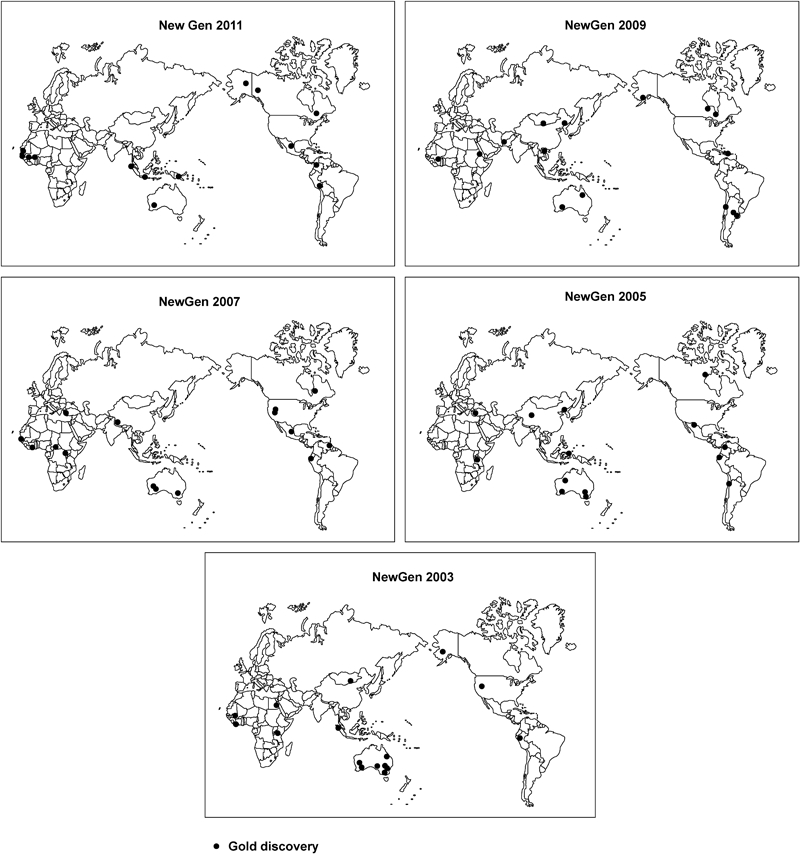
Two-yearly sets of gold discoveries selected for inclusion in the New Generation Gold Conference (Yates, 1995 and later conferences)
Several conclusions can be drawn from the series of discovery maps presented in Fig. 1. First, significant gold discoveries are being made in many different locations including well-established provinces that have been dismissed by some scientists as mature (in this usage, a somewhat emotive word without clear meaning); in provinces in which major goldfields have been known for decades, e.g. Ghana; and in less-well known areas (i.e. less-well known with respect to twentieth century mineral exploration) such as China, Mali, Peru and Tanzania. Second, there is a decreasing dominance of the gold-only deposits that have provided over 80% of all-time global gold production; and gold-plus deposits, especially copper-gold, are becoming important (Table 1). Third, there is no discovery example from the world's largest source of gold, the Witwatersrand of South Africa.
Major types of goldfields
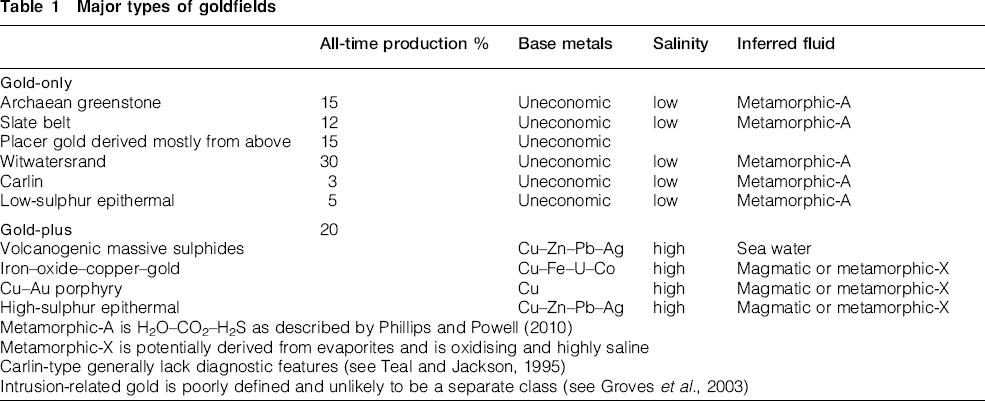
The first of these conclusions gives heart to those exploring in established areas of generally low sovereign risk as new deposits are still being found. The second conclusion arises because the lower grade of these gold-plus deposits has become less-detrimental and their large size and ease of evaluation makes them amenable to modern mine financing and development, e.g. porphyry-hosted copper-gold (see Holliday, 2009). The dual commodities are a bonus rather than the prime cause for the change in deposit emphasis. The final observation of no discovery from South Africa is investigated further and is an illustration of the economic consequences when exploration success declines significantly.
Some golden ages of exploration success
It is relatively easy to identify special periods of gold exploration success that transformed the industry of the country in which they occurred. A few are described here to illustrate their importance and to try to understand some of the components that led to these successes. Each such period represents repeated exploration success rather than a single discovery, and there are lessons in determining what went right in each case.
Victorian Gold Province – 1851
Within a decade Victoria went from being a non-producer of gold to the world's leading source. It became a separate colony at the start of 1851, gold was found at Clunes and Warrandyte in the middle of that year, and by the end of 1851 the initial discoveries of Bendigo (22 Moz), Ballarat (10 Moz), Castlemaine (5 Moz) and many more goldfields had been made (Victorian Historical Journal, 2001). The exploration method used was the already-established stream geochemistry method of panning, and initial successes led to greatly expanded exploration programs and more discoveries. Important was the use of the alluvial gold deposits as vectors toward underground primary mineralisation. This labour-intensive exploration was only possible because of large-scale immigration that led to the population of Victoria growing from 10 000 in 1840 to 500 000 in 1860. Not all the explorers shared equally in the successes and many Victorian miners eventually moved farther afield taking their skills and tenacity to Queensland, Western Australia, New Zealand, and the Rand of South Africa. The legacy of the Victorian gold period from 1851 to the early twentieth century is 2500 t of gold production, many fine buildings in Melbourne and regional cities, and a strong industrial and agriculture base for decades to follow.
Witwatersrand goldfields discovery in South Africa – 1886
The discovery of gold in conglomerate on the farm Langlaagte in South Africa in February 1886 was a turning point in world gold production. The discovery was made by George Harrison, a mason and digger who was working on the local farm when he detected gold in a conglomerate (Werdmüller, 1986). This host rock was very different from the auriferous rocks which he was familiar with back home in the goldfields of Australia. The auriferous conglomerate bands were followed east and west along strike for tens of kilometres through what became the Central Rand goldfield – all by May 1886. The horizons were then followed farther under cover into the East and the West Rand goldfields. These auriferous bands had great lateral persistence, high gold grades, and also great continuity to depth; and it was not long before the great city of Johannesburg was founded, then expanded to consume Langlaagte and beyond. The government recognised Harrison with the discoverer's reward though any benefit he received paled into insignificance against the profits made by individuals and companies in the years that followed; one of those individuals was Sir Julius Wernher (Perry, 2011), but many others benefited from the eventual 21 000 t of gold production from the Rand (i.e. 650 Moz Au from the West, Central and East Rand, out of a total exceeding 50 000 t Au from all Witwatersrand goldfields).
Carletonville goldfields discovery within Witwatersrand Basin – 1930s
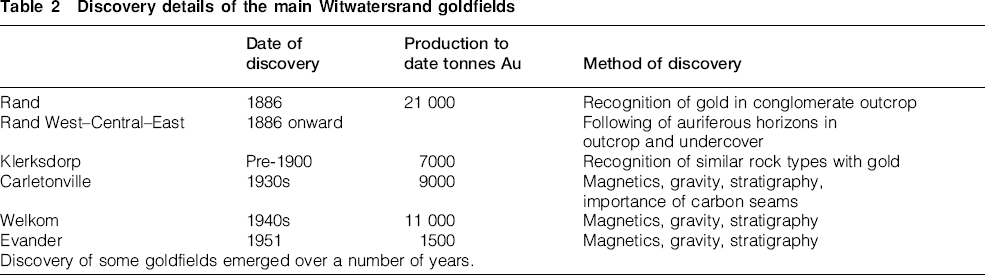
One of the great greenfield discoveries under cover was the Carletonville goldfield in the early 1930s, found well after the eastward and westward limits of the Rand goldfield had been reached. Whereas the 3 km-thick Upper Witwatersrand sequence that contained most of the gold was highly reducing throughout, it was recognised that the Lower Witwatersrand was oxidised and contained several highly magnetic units including banded iron formation and magnetite shale. With this knowledge of the rock units, Dr Rudolph Krahmann made extensive use of a newly developed magnetic field balance and led 143 traverses covering 530 km and 10 886 stations over eighteen months in 1931–1932. This ground magnetic work demonstrated that it was possible to predict the position of the Main Reef Conglomerate with precision even beneath thick younger cover (Engelbrecht, 1986, p. 204). Krahmann managed to track the auriferous stratigraphy despite the magnetic units being stratigraphically several kilometres deeper than the target conglomerate reef. With management backing including that of Dr Guy Carleton Jones, there was testing of the stratigraphic target which had been predicted by geophysics; and drilling confirmed that the auriferous units were present at 1–1·5 km depth. This led to discovery and development of some remarkable mines of the Carletonville goldfield including Blyvooruitzicht (>1000 t Au production from the Carbon Leader reef sheet which proved to be economic throughout virtually all of the 4 km by 5 km mine property); West Driefontein (>2000 t Au production at 15 g/t Au), and Western Deep Levels – Mponeng (4100 m depth below the surface today). In total, Carletonville goldfield has produced over 9000 t Au. The discoveries of the Welkom (11 000 t Au) and Evander goldfields (1500 t Au) followed in the years up to 1951. These discoveries were also based on predictions made from magnetic and stratigraphic models followed by drill testing (Table 2).
Discovery details of the main Witwatersrand goldfields
Carlin Gold Province discoveries in Nevada, USA – 1961 and 1986–1988
In north-central Nevada, the discovery of the Carlin gold deposit in 1961 encouraged increased exploration and more discoveries. These discoveries led to recognition of the Carlin Gold Province and dramatically increased gold production from the USA after 1970. Since then, USA has been one of the World's top three gold producers, and much of that production has come from Nevada. The initial successes from 1961 led to many shallow discoveries and mines that were described as epithermal deposits (e.g. Radkte et al., 1980; Ivosevic, 1984, p. 51). However, this phase of shallow targets was followed by an even more exciting period from 1986–1988 when deeper drilling opened up a whole new dimension to this deposit type that indicated that Carlin deposits could be of high grade and great depth extent. In this three year period, the discoveries of Deep Post (e.g. 119 m of 6·6 g/t Au from 355 m), Betze, Screamer, Rodeo, Griffin and Deep Star added an endowment of 1700 t Au mostly from below 200 m depth (Bettles, 2002). Meikle deposit followed shortly thereafter (e.g. 135 m at 16·1 g/t Au from 413 m in 1989). A change from the shallow (epithermal) thinking coincided with great success for some.
Yilgarn Gold Province discoveries, Western Australia – 1979–2004 quarter century
The Yilgarn gold province of Western Australia tells a slightly different story of discovery as it was already famed for the giant Kalgoorlie goldfield, and had been in significant decline since the 1930s. However, the quarter century after 1979 saw a dramatic shift with the discovery of 6265 t of gold resource in that period to add to the mere 128 t Au resource known in 1979. This is a classic example of a mature province being re-invented. Discovery of the Yandal gold province can be considered as a microcosm of the extensive Yilgarn activities (Phillips and Vearncombe, 2011). Yandal discoveries followed from a complete revision of the prospectivity of this greenstone belt; and the geological developments in the Yandal belt led to a number of new trends in the application of geology in regional gold exploration, e.g. Eshuys and Lewis (1995), Eshuys et al. (1995) and Wright et al. (2000).
There are further examples of multiple discoveries in provinces that could easily be in the list described above. Additions might include the Mother Lode of California, Abitibi of Canada, and gold-only and copper–gold discoveries of the Pacific Rim, e.g. Porgera, Grasberg, Lihir, Misima and OK Tedi (Sillitoe, 1995; Corbett and Leach, 1998). Today, there are likely to be additional provinces in the process of adding their names to this list, e.g. Tanzania, West Africa, Alaska, parts of South America, Russia, China, and potentially the Tropicana region of the eastern Yilgarn Craton.
New thinking at the time of discoveries
These golden periods of discovery coincided with changes of thinking (that may not have been fully-appreciated at the time). For Victoria, it was the concept that the State could host substantial gold, the application of some established exploration methods, and the link between alluvial gold and its primary source. For the Rand, it was the concept that a meta-sedimentary sequence could host sheet-like occurrences of high grade gold of great lateral and depth extent; much later there was the realisation that the magnetic rocks could be traced under deep cover. For Carlin, the 1960s stage of initial discovery revealed that ordinary-looking fine-grained sedimentary rocks could host high gold grades and yet the gold could be invisible; the second phase of deep Carlin success from the mid-1980s required abandonment of the epithermal model for these deposits and recognition that instead they could have great depth extent and adequate grade to support underground mining (Bettles, 2002, p. 278). For the Yilgarn goldfields, there was new thinking that these Archaean goldfields were not syngenetic (i.e. exhalative), but instead were orogenic in their timing. Research highlighted that the intensive weathering of the Yilgarn Craton could be used to the advantage of both exploration and mining, whereas previously it had been a barrier to much exploration. The Yandal story illustrated that field work still had an important role in assessing prospectivity of deeply weathered terrains; and here the regolith studies indicated extensive Cainozoic palaeochannels, long-lived weathering, and the need for different exploration methods for different regolith settings. The Yandal example showed that whole new belts could be discovered in well-explored cratons and close to well-studied goldfields.
Importantly, each golden period described here involved substantial addition to known gold resources, and these resources provided the platform for new industries and greatly increased gold production, often accompanied by development of new technologies needed for exploration, mining, and processing. It is tempting to look back and think how obvious some of these discoveries appear to have been; however, it is more useful to view the discoveries from a year before they were made to appreciate that none were easy and most involved significant technology and people challenges.
Does exploration success matter: Example of the Witwatersrand of South Africa
There is a great contrast of exploration success in the Witwatersrand Basin between the first and the second halves of the twentieth century. The period from the 1930 to 1951 witnessed some spectacular exploration successes with the discovery of the Carletonville, Welkom and Evander goldfields. Despite the continued use, and refinement, of geophysics, stratigraphy and drilling, and addition of detailed sedimentology, there has been no new goldfield discovered in the Witwatersrand Basin for the last 60 years; although there have been some very important additions made to existing goldfields (e.g. South Deeps, ∼30 Moz Au).
The successes of Carletonville and Welkom led to progressively increasing annual production from South Africa to a peak of 1000 t in 1970; the period of 1953 to 1965 illustrates the dramatic effect that Witwatersrand exploration success can have on national gold output. Since 1970, the annual gold production of the Witwatersrand goldfields has declined, falling in over 30 of the following 40 years and on no occasion rising significantly nor getting anywhere near the 1000 t pa again (Fig. 2).
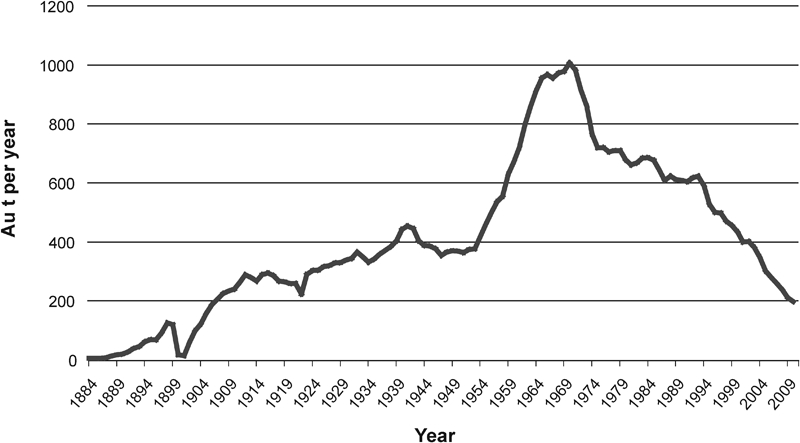
Annual South African gold production from 1884 to 2010. Virtually all this production has come from the Witwatersrand goldfields; Harrison's discovery of the Witwatersrand gold was in 1886 so pre-1886 production was from east of the country. The large slump around 1899 coincided with the Boer War
The underlying cause of this 40-year production decline is relatively easy to explain (though there are many smaller-scale effects within the 40 year decline). The consistent downward trend since 1970 cannot be explained by the long list of ephemeral issues used to explain annual variations, e.g. 1960 Sharpeville riots, 1976 Soweto riots, 1960s to 1990s apartheid-related sanctions, dismantling of apartheid from 1990, new government 1994, loss of skilled workers, labour costs, mechanisation, safety imperatives, energy shortages). The long term decline since 1970 is primarily caused by the lack of exploration success since 1951. One consequence of the low success rate was that as older mines became depleted they were not replaced; a parallel reason was that after much of the higher grades from the early years of the Welkom and Carletonville mines were consumed, there were only a few new large mines being brought into production with significant high grade ore. For example, the later mines of the Carletonville goldfield such as Deelkraal and Elandsrand did not match the rich hearts of Blyvooruitzicht, Driefontein and Western Deep Levels – which of course is why the mines like Deelkraal and Elandsrand were not developed until later (see Phillips and Law, 2000, their Fig. 1 or 2 for mine locations with alternative names in the inset). The net result of these trends is declining tonnage and gold grade, leading to falling rates of gold production. To replace production after 1970 would have required finding a major goldfield every decade (e.g. Welkom goldfield of ∼11 000 t Au), and this would always have been a challenge. However, it would have been expected that some success might occur in sixty years, especially as this period coincided with the Golden age of Sedimentology (e.g. Pretorius, 1976; Minter, 1978) and some intensive sedimentologically-based research programs. Within the 40 year decline three distinct phases can be recognised, a precipitous decline (1970–1975), a slow decline (1975–1993), and a steeper decline (1993 to present). The change around 1975 coincided with a significant rise in the price of gold, and 1994 marked the end of the era of apartheid government in South Africa.
The consequences of generic lack of exploration success are dramatically illustrated by this Witwatersrand example. Instead of producing 1000 t of gold per year, South African production is now below 200 t of gold per year; and consequently, instead of 500 000 employees, the current employment is nearer 150 000. This means that over 300 000 people do not have jobs today because of the lack of gold discoveries; and each of those individuals employed on these gold mines usually fed an extended family from the single wage (anecdotally this has been ten people supported by one mine wage). In different circumstances, exploration success might have helped to reduce the current unemployment in South Africa today which is about 25–30% and would have contributed to reduction of poverty. Obviously, some decline from 1000 t per year may have been inevitable, but the dire situation today was hardly predicted in either the 1970s nor even the 1990s.
Components of successful exploration
With the above examples of contrasting exploration successes and exploration non-success, it is useful to look more carefully at some of the components that contribute to mineral discovery. There is no attempt yet to dissect the case histories of success and non-success within this framework, though such an analysis is underway separately.
Discovery rate σ
Discovery rate σ is one measure of exploration success for gold, and it is based on exploration dollars spent and tonnes of gold resource identified (Phillips, 2004; see also the similar approach of Hogan, 2004).
For example, in the Yilgarn Craton from 1979–2004 there was ∼$7000M spent on gold exploration and 6265 t of gold identified giving σ = 0·9 t Au/$M (retaining 2004 AUD$ throughout); or approximately $35 per ounce. This figure covers one of the great periods of gold discovery and hence σ = 0·9 t Au/$M is probably a good figure for a province over a prolonged period of time.
Discovery rate (σ) has a compound effect on any gold industry. First, a low discovery rate means that less gold is found per dollar spent; second, a low σ means that the region becomes less attractive for gold exploration and hence exploration expenditure decreases. The amount of gold discovered (the product of σ and dollars spent) can decrease sharply if exploration becomes less successful. Once these factors of exploration spending and discovery rate decrease it can be very difficult to reverse the trend, and a whole region may become dismissed, i.e. considered to be well explored within the framework of existing exploration ideas.
Influencing σ for a company, a province, or a country is clearly of great commercial importance, and the case histories of the golden ages of exploration success (described above) reveal some of the ways that a low σ has been turned around to great economic advantage. In the Witwatersrand in the 1930s there was grave concern about decreasing viability of gold mining, and it took some enlightened thinking and application of a new geophysical approach to revive fortunes; in the Yilgarn Craton gold mining had almost ceased, and it was three breakthroughs in the understanding of primary gold and three breakthroughs in how to effectively explore in the regolith of deeply weathered terrains that changed the fortunes there (Hogan, 2004, p. 19–20; Phillips, 2004, p. 25–26). These six breakthroughs, and other advances including the gold price, revised the assessment of the Yilgarn Craton from being unattractive for exploration for gold in the mid 1970s to an exciting exploration frontier by the mid 1980s (Table 3). These breakthroughs help to explain the gold exploration successes in the Yilgarn Craton after 1979, but they do not explain the great differences in the success rate of various companies operating in that same terrain. The potential influences on the differential success rate for various companies are now investigated a little further.
Scientific breakthroughs impacting on exploration success in the Yilgarn Craton from 1979

Some people have all the luck! – or is it luck?
One helpful aspect of studying gold discoveries is that there are many large, medium and small deposits and a substantial number of discoveries from which to draw statistically meaningful conclusions. There are also dozens of exploration programs for every one that makes a major discovery. If discovery is simply a matter of luck, then one would go about exploration very differently than if discovery has some underlying ingredients for success.
If making a gold discovery is only a matter of luck and chance, then more activity and expenditure may be the main driver of success; there should be a predictable distribution of those companies and individuals making any discovery, and those making two or more discoveries. What is most surprising, at least looking at Australian experience, is that a small number of companies have had inordinate, repeated success (e.g. Western Mining Corporation 1967–1980; North Flinders Mines 1980s; Great Central Mines group late 1980s to 2000). It is interesting that there are a few individuals who have been part of discovery teams at two and three separate finds; more surprising is that those small teams may have broken up after the first discovery, then individuals have reformed different teams and the successes for some individuals have continued in those new groupings (see New Generation Gold Discoveries, 1995–2011).
Unfortunately, some major discoveries are denigrated and simply attributed to luck because the explorers did not find exactly what they were looking for: is this a failure, or is this a success resulting from keeping an open mind and all one's observational skills on alert? An example from science helps to place this so called luck in perspective. Five hundred years ago, Kepler used his mathematical skills and the observations of Tycho Brahe to suggest that the planets circled the Sun, not the Earth (Chalmers, 1980). Because he did not allow for one planet (Neptune had not been discovered at that time) his calculations appeared to be slightly in error. Did this small apparent error mean Kepler's hypothesis of a Sun-centred system was wrong – clearly not? Should Kepler have smoothed his data to absorb the error and thus present a more-comforting answer? Just as Kepler did not find exactly what he sought, it is niggardly and churlish to suggest that looking for copper, for example, and finding 8000 Mt of copper–gold–uranium ore (e.g. Olympic Dam) is either an accident or just luck: this well-documented story illustrates a protracted exploration program with its highs and lows, with a considerable amount of thought and perseverance, and built upon detailed research (e.g. Haynes, 2006).
In the rest of this paper, the premise is that gold discovery is rarely a matter of luck. Rather than dismissing individual discoveries as luck, the longer term analysis may provide a different perspective (Livio, 2010, p. 132) and it is valuable trying to learn from those who have inordinate, repeated exploration success. To quote from an organisational psychologist whose work extends to the mineral industry: ‘Luck is not a gift but a state of mind’ (McEwen, 2011, p. 37).
Contributing factors to exploration success
The contention here is that there are many contributing factors to exploration success and it is not sufficient just to get one factor right. Many of these factors can be deliberately enhanced in a small team.
Where to explore
Much has been made of exploring in the right place, and no one wants to spend forever searching in a fruitless location where there is no gold. However, the importance of being in the right place is only one part of success, the other is exploring properly once there. This point is well-illustrated by the history of many of the world's great discoveries which indicates that people were in the right place well before a big discovery was made and yet did not make the discovery themselves. Anecdotal evidence suggests that it can be five or even 10 exploration groups who look at a prospect before the main discovery is made. The interest in this paper is on effective exploring within an area, but this does not mean that choosing the right region to start with is any less important.
Exploration tools and ideas
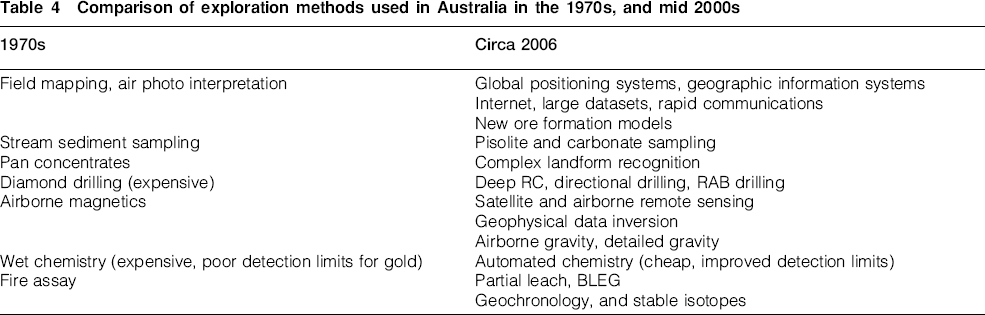
It is difficult to sustain the argument that having the best exploration model or even the best genetic model is essential for exploration success. There is a diversity of opinion in any part of the gold industry as to what might be the best exploration model and what might be the correct genetic model to explain the formation of a gold deposit. In reality, all models need to be considered as models, and not allowed to attain the status of truth or fact. There is a need for balance to design and hold multiple models without becoming over-committed to a single model when the rocks and data are not re-enforcing it. It is also clear from the documentation of many gold discoveries (e.g. New Generation Gold Discoveries, 1995–2011) that those groups making discoveries have quite differing opinions from one another regarding exploration and genetic models. There is no evidence of a one-to-one correlation between having one specific model and making discoveries. However, having some model is important, for otherwise looking for nothing might become self-fulfilling. Certainly having access to electromagnetic methods in Canada in the 1970s was very useful for finding volcanogenic massive sulphide deposits in the Archaean greenstone belts, but the method did not guaranteed success. There have been many advances in exploration methods and tools since the 1970s and these have clearly assisted in many discoveries (Table 4); there is no evidence however, that these have led to a much greater proportion of companies making discoveries and especially making multiple discoveries. In searching for further ingredients that might have facilitated a small number of companies greatly outperforming the norm, the next step is to investigate the intellectual environment of the exploration team.
Comparison of exploration methods used in Australia in the 1970s, and mid 2000s
An intellectual side to exploration success – less-tangible but real
Mineral exploration is a type of (geo)-science
Mineral exploration is a form of science and there are useful parallels to draw from a comparison with some classic forms of scientific research. Just as is done in chemistry or physics, exploration involves putting forward hypotheses (i.e. drill targets), then designing experiments (drilling program) to test these hypotheses. A further parallel is suggested here that links the normal science (Kuhn, 1970) with good exploration, and contrasts these two processes with the much less common scientific revolutions of Kuhn and mineral discovery. Kuhn based his separation of normal (incremental) science and scientific revolution (breakthrough) on his specialist knowledge of physics and many examples from the history of science; although he did not discuss exploration examples, he might easily have used some of these to provide additional support for his sub-division. Some of the barriers to scientific revolution, such as groupthink [group protection of their own ideas], are also barriers to mineral discovery. Just as unorthodoxy [new or unconventional ideas] can set the scene for scientific revolution, so unorthodoxy can facilitate mineral discovery. Groupthink and unorthodoxy can be either suppressed or enhanced (respectively) in the working environment by deliberate action.
One interesting similarity is the probability of success in discovering a major new scientific theory or discovering a major ore body. Both are very rare occurrences which suggests that the normal outcome of scientific research is an incremental (as opposed to revolutionary) advance (Kuhn, 1970), and the normal outcome of exploration is a program leading to non-discovery (but possibly some important new information). These two activities with low probability of major success contrast strongly with an activity such as landing an aircraft: here the probability of success (a successful landing) is very high and one should not be seeking any paradigm shift each time a landing is being made, nor is unorthodoxy encouraged regarding routine commercial landings (Phillips, 2006). In aviation, a median performance (landing safely) is admired without being particularly noteworthy; in mineral exploration a median performance (non-discovery) is not ideal, but hardly career-ending. Importantly, in seeking unusual performance (discovery) it is quite likely that many within a large team may not agree with the original target, and so any quest for consensus might kill the opportunity.
One common mistake in exploration (and mining geology, and scientific research) is to confuse data collection and data entry, with thinking. It is useful to have quality data properly input to a storage system but the real value comes next from applying an overlay of thinking to that data. This intellectual input is commonly what a company is buying when it employs a geologist and may be the differentiating component of the job that requires a professional qualification. This intellectual value might come from testing a hypothesis, explaining a result, or planning further tests. Some data might be outside the bounds of what was expected; dismissing such data as spurious or wrong might be bypassing a mineral discovery or a new scientific theory (note Kepler's retention of small discrepancies). The data by itself does not make a discovery; but detection of an anomaly in the data, and especially the decision to do something about that unusual data can be the catalyst for science breakthrough and for mineral discovery.
Where does one learn thinking?
‘Thinking is not natural. We need to treat thinking as a skill that must be developed.’ (De Bono, 1992a).
There are likely to be many ways to learn the scientific method and the art of thinking (Kuhn, 1970; Chalmers; 1980; Losee, 1980; Curd and Cover, 1998; Rossouw, 2003; Robinson and Groves, 2007; Vann and Stewart, 2011), but it is a talent that remains elusive for parts of the industry.
For geologists one way to learn thinking skills is through a well designed Honours research project. This provides opportunity to set up some testable hypotheses, collect appropriate data to test those hypotheses by looking for support or falsification, and use reasoning to come to some conclusions. This is the time to learn the important distinction between data that is compatible with one or more hypotheses, and data that is diagnostic or agreeing with one and no other (known) hypothesis. Some conclusions might be drawn in the project, but still with considerable caution so as not to conclude that the truth or fact have been found, and to avoid closing the mind with dogmatic assurances that limit speculation (Suri and Bal, 2007; Livio, 2010, p. 252). Exposure to a strong Honours research degree is particularly useful where it involves a supervisor who is an active high-level researcher and when the research is in an environment to learn from other postgraduates and postdoctoral fellows. It is a time to develop scepticism for supposed once-in-a-century events, for claims of absolute proof, and for opaque algorithms. This watching and learning of the thinking process may appear to be a very slow way to learn, and unfortunately for universities, is difficult to examine en masse; but in reality, it might be quite rapid and what is learned can be retained for life. It is difficult to see how this practical thinking and research learning can be completely replaced by lectures. Some modern university trends of large classes and funding determined by student numbers favour emphasis on content (minerals, geochemistry, earth processes, regional geology), rather than ways to think (De Bono, 1992a and 1992b; Paul, 1992).
An Honours research project, and especially higher level research, provides the opportunity to experience some of the special phases of research (and these have their parallels in exploration). One experience is the excitement when parts of a hypothesis seem to come together with much supporting observations, and the unreasonable effectiveness of a hypothesis with respect to its ability to predict additional and unexpected outcomes. A second is the experience of being on the wrong path, receiving negative feedback and learning how to recognise the real situation, and then how to avoid further losses and change to a different path. A third is the awareness and avoidance of upside-down reasoning; ‘… this is reasoning in which the end result precedes the supporting arguments. People make up their minds first, and tailor their arguments to support the position they want to take.’ (Suri and Bal, 2007, p. 154). The opportunities for these experiences may be limited in large centres or where projects are micro-managed.
University geoscience education can influence a graduate's approach to thinking for years to come. A less-optimal environment that includes lecturers who provide information, discourage probing questions, and do not engage in doubt when any information is challenged may appeal to some students but may be anathema to others. For their own intellectual development, the latter individuals may require rigorous steps of logic to reach conclusions and may not be very tolerant of short cuts in explanation or logic. These individuals may do poorly until they meet teachers who maintain an air of doubt and are prepared to engage in discussions challenging orthodoxy: watching these teachers acknowledge problems and then resolve them is a highly valuable learning experience (Suri and Bal, 2007, p. 97). The alternative of having challenges ignored can vary from de-motivating to depressing.
Learning to think also involves practice, and thinking time is important: exploration companies might consider time spent thinking as a way to enhance the value of their existing investments in people and data. In a mine or exploration office if the role is simply to collect data, enter data, collect more data, enter that data, then the company is gaining little intellectual input and added value, and the geologist is gaining little thinking experience. The quality of the data that has been meticulously stored in the database is not generating much value until it is overlain with that intellectual input.
Climate of thought within teams
Group think
One of the positive ways to influence exploration success is through awareness and avoidance of groupthink (Table 5). The term describes a mode of thinking that people engage in when they become a cohesive in-group striving for unanimity; it is a collective process of rationalisation and discounting of warnings in which desire to belong over-rides critical thinking and thoughtful analysis (Janis, 1982; de Waal, 1988; Garvin, 2002). The symptoms of groupthink can generally be described as a protective comfort of a group of co-workers (e.g. researchers, exploration team) where diversity and new ideas are not welcomed.
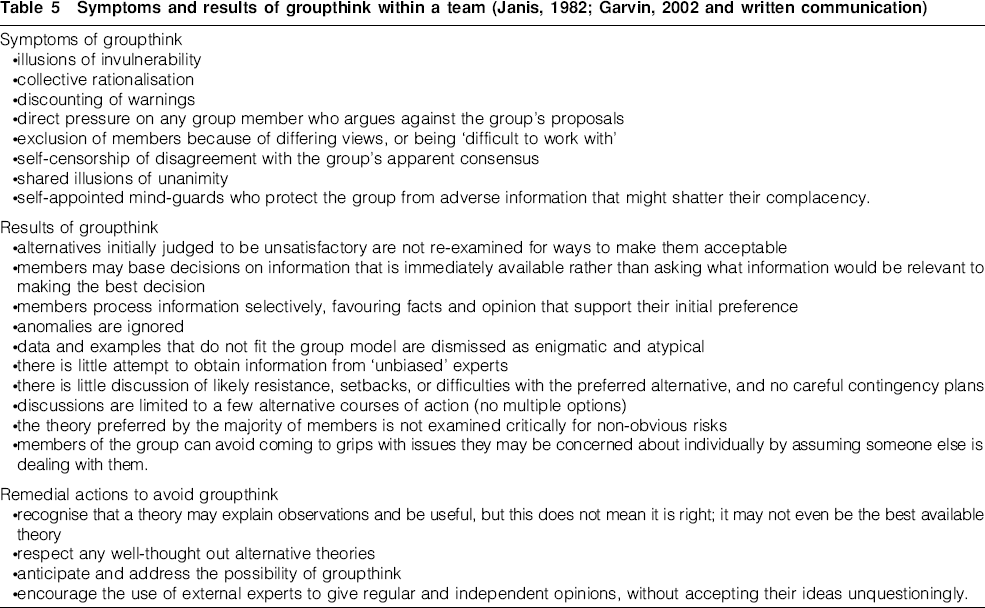
The undesirability of a groupthink environment in exploration is not a new revelation, and underpins the hunting pack size of a group of around 4–8 people and the need for diversity amongst that team (e.g. Snow and MacKenzie, 1981; Woodall, 1994; White, 1997). Sub-dividing a large exploration effort of a major company into several smaller autonomous teams achieves this end of reducing the chance of groupthink; but the need to seek approval of all drilling targets outside and senior to the small team could nullify some of the benefits of the hunting pack concept.
University and other research organisations may be even more susceptible to groupthink than the exploration group. Large collaborative research centres, for example, are prone to groupthink and it can be a very difficult trend to avoid. A large research team becomes large on the basis of specific successes of those who are appointed the technical leaders and maybe the administrators of the large collaborative centre. Such a centre may be very successful in disseminating and commercialising the earlier successes of the leaders. However, the large centre is likely to be less successful in making the next disruptive breakthrough for at least two reasons. The first is that a disruptive breakthrough is very likely to be a direct personal challenge to the earlier successes of the leaders who control the centre. Second, a disruptive breakthrough, although potentially a significant advance, may be seen as undermining the core activity of the centre itself, in other words, the whole science on which the centre is based; such undermining may risk reduced centre funding and job losses, or even centre closure. The culture of a large research centre with embedded groupthink is one that is unlikely to seriously challenge orthodoxy, or at least the group's own orthodoxy. The career opportunities for graduates of such research groups may be very good because of important references and contacts. However, the opportunity to learn thinking and real research skills may not be great. In many cases, the challenges to the research centre's ideas will come from unrelated disciplines; and because of these tangential challenges, the centre leaders may be poorly equipped to understand the threats of the new ideas or see their merits. Similarly, groupthink within an exploration team might close a team to opportunities that are outside their expectation of discovery types. This culture can be avoided by recognising the risk, designing a team of appropriate size and diversity, challenging oneself and each other, and routinely introducing external experts to challenge the team and its assumptions. An early warning sign of groupthink might be the exclusion of experts who do not fully agree.
One progression that might follow from an environment of groupthink is the stranded theory that no longer has foundations. In this scenario, a well thought out theory is put forward based on sensible reasons at the time (but much later these reasons are found to be incorrect). In the meantime a large amount of data is found to be compatible with the new theory and it gains such momentum that no one thinks to test all the new supporting data to see if the new data might also be explained by alternative ideas. Eventually, the original sensible reasons are realised to be incorrect, the original theory is stranded without its foundations, but the theory is retained because it is obvious that there is so much compatible evidence. Recognising a theory that is stranded from its original reasons and thus without real foundations is a means of recognising a topic ready for an unorthodox approach. Taking advantage of these opportunities may be dismissed by some as luck or being in the right place at the right time; but the opportunities would be open to all who take action when they see a theory is stranded from its foundations. A key question to ask is for the diagnostic evidence that is not explained by alternative models; and be less impressed by masses of supporting evidence that could have multiple explanations.
Role of unorthodoxy
Unorthodox views play a very important role in the advancement of science including being a catalyst for revolutions in scientific thinking and ideas (Kuhn, 1970). Paradigm shifts were developed as an idea by Kuhn in describing major steps in science, but the concept is used quite differently today. For example, the paradigm terminology is widely applied in expensive exploration research even where the aims are modest or the outcomes are negligible: many of today's new paradigms in mineral exploration would not be so described by Kuhn. Setting an environment to foster unorthodox ideas is important and a non-hierarchical university setting with irreverent postgraduates may be a more successful setting that the quiet peace of government research organisations (May, 1997, p. 796). The space and freedom to use one's imagination is an important contributor to successful science. It might be an independent and senior scientist making a casual comment that triggers a young scientist to successfully challenge an established idea, e.g. ‘that explanation has never matched what we see in those rocks’, ‘that theory seems too perfect to be true’.
The acceptance and uptake of unorthodox ideas is highly variable, and despite seemingly convincing evidence, some ideas are simply ignored. Typically new observations that might be framed as an extension to current knowledge are often more effective than new observations that provide a direct challenge to orthodoxy and require major revisions. Commonly, three stages of rejection of a new idea can be recognised before it becomes accepted. Initial ridicule of the idea may then be followed by anger at the idea, and finally dismissal that the idea was already known anyhow; recognising this pattern can be a strong motivation for persevering with a new idea and continuing to test it.
Single-minded focus on making a discovery
Given the difficulty of making even a single mineral discovery, carrying out average or normal business is not likely to lead to successful exploration. Success correlates with companies that have an expressed single-minded focus on making a discovery (which is not the same as a focus on exploring an area, or being a good explorer). For such a focus to have great meaning it needs to be re-enforced regularly by the Chairman, Managing Director, Board, Management and whole team, ‘the aim of our company is to make a discovery and do it safely’. The net effect of this single message is a completely unambiguous direction as to what is important; most smart intelligent people have little trouble translating this simple message to their own workplace, and it can be an invigorating environment. The remarkable success story of Fortescue Mining is an example of a single-minded focus where the messages appear to have been simple and direct, i.e. ‘The new force in iron ore’; and in ten years a new company has become a major iron ore exporter (Clout and Rowley, 2010).
Line-of-sight
A remarkably useful but simple tool is that of line-of-sight especially when combined with a single-minded focus on making a discovery. In a busy environment with many urgent and important tasks in front of an individual, some form of priority is required. Doing all tasks at once is likely to lead to poor decision making and poor quality of the tasks completed; tackling the easy ones first might be avoiding those that really help the company, and asking one's manager every few minutes for guidance may be career-limiting. Line-of-sight means asking what we are trying to achieve (‘the aim of our company is to make a discovery and do it safely’) and then prioritising tasks so that there is a direct connection between the immediate activity and the overall aim. The day-one-planning concept, planning from the start for final success and the stages leading to that success, has several similarities. Once adopted, these concepts become a very powerful motivating and prioritising method that can enhance discovery.
Setting up a team to make its own exploration success
The response to a new idea
Two scenarios are presented here to help illustrate a characteristic that is useful in a high performing exploration team, i.e. receptivity to a new idea. Exploration team A, an average team that has had many technical successes but not yet made a discovery reads about a new geological idea in a trade magazine that slightly upsets its current exploration strategy. At first, the team ignores the new idea on the basis that it might go away; but persistent questions from management require some form of reaction. This is not immediately possible with two members on FIFO break (i.e. fly-in, fly-out exploration or mining operation), two others logging drill holes from last month's drilling program, another verifying data from the previous week, one on a database course, and someone putting together the planned tenement relinquishment report. With an impending management visit to site and the certainty that they will be asked about the new idea, eventual rapid action is focused on any weaknesses in the new idea such as lack of supporting evidence or case histories, and these weaknesses in the new idea are used as re-enforcement of the team's existing program. Management is pleased that the new idea has been addressed, and the exploration team has promised to re-visit the new idea once it is proven. The team members return to their more urgent work of emails including checking the morning's assays that include 12 m at 1·1 g/t Au from 72 m; the drill-rig geologist is excited because this is the best result from the month's drilling, but someone else counters that the grade of 1·1 g/t Au is too low given the depth, and the morning ends on a high when the exploration team confidently recommends relinquishment of the tenement and ticks off that task.
The high performing, exploration group B has identified the same new idea but has done so well before it becomes widely known (others in the industry do not quite understand how group B knows of new ideas so early, but the answer is simple and it arises from their pool of research-active explorers who are in touch with, and speak the language of, other researchers). Immediately, the exploration group meets informally for an early morning tea to discuss the idea internally to ascertain whether it has any merit (having any merit is not the same as deciding whether the idea is right). Once it is decided that the idea has possible merit there is a rapid shift to brainstorming of ways that it might be used for exploration either in the current program or anywhere else. This unplanned brainstorming session cuts right across some planned morning activities, and when no one attends the exploration manager's meeting he goes to find out what is happening and immediately joins the brainstorming session. By lunch the group breaks and two geologists are assigned to cover all daily work, drilling, assays, supplies and contractors. The leader of an afternoon management workshop is asked to come back later. Someone has the task of taking the new idea a little further with some testing to either add strength to its case, or weaken it. All are alert to any signs of unreasonable effectiveness of the new idea. Two others draft a one-page proposal illustrated with sketches to test the idea on company ground, and maybe to peg further tenements. By the end of the day, the exploration manager has had the one-page plan with sketches approved, and drilling starts that evening after the current hole is completed. The first assays received that same week include 12 m at 1·1 g/t Au from 72 m, and whereas these were not exactly from where they were expected and are in rather weathered material, they become the forerunner of a new discovery that leads to a 3·6 Moz mine. The trade journal report focuses on the luck involved in this discovery.
The parallel between scientific research and geological exploration has already been noted. This parallel can be taken further with an illustration of continental drift – plate tectonics when this idea was suggested to a geological community in the 1960s. A first response to the idea may be ridicule (‘you do not seriously believe that the continents could move?’), and if the new idea does not go away, a second response may be anger (‘our collaborative research group has built its reputation and funding on stable continents and we do not need your crazy ideas about moving continents disturbing our good work, and jeopardising the future of our funding’). Once the new idea looks as if it is inevitably here to stay, a third response might be dismissal (‘the moving continents idea is an old one and you were not the first to suggest it. We have a book somewhere in our centre library dating back to the 1920s which mentions moving continents.’). Recognition that you are being subjected to the three-part ridicule, anger and dismissal process can be taken as encouragement that you may be pursuing a useful idea.
In a different environment, the same suggestion of continental drift – plate tectonics might be met with great excitement in a research group, though still some uncertainty. Discussion and speculation would then move to whether geology matches across oceans, how the new idea might be tested, and whether this might help with mineral exploration. This team goes on to publish widely on the new idea and seems to be in the right place at the right time. Additionally, they are involved with several mineral discoveries in unexpected countries. The trade journal and industry competitors focus on their luck.
Critical thinking and its value in exploration
An exploration group attuned to critical thinking rather than blind acceptance of ideas can save substantial wasted exploration efforts. Even more importantly, hundreds of millions (in some cases billions) of dollars are involved when one company makes the right, and another company makes the wrong, decision on a property that appears to have limited upside, but results in a major mine. For example, maybe one company wrongly inferred limited depth potential.
The name or classification given to a deposit can have considerable influence as to what management and explorers think about a new prospect. Exploration history is full of examples of the announcement of a possible-new deposit type followed by considerable effort in determining the characteristics of that type and development of exploration programs to look for those characteristics. It may be of great value to a company that any new classification be critically challenged early on: a positive outcome of the challenge would be that the new idea stands up to scrutiny and may (or may not) result in a discovery of a new deposit; if the idea is not challenged, however, an alternative outcome may be years of mis-guided acceptance and unsuccessful exploration followed finally by a review that shows that the original idea was flawed. The important stage here is to not settle with the statement that the observations fit the model for the suspected new deposit type, but to probe further, develop alternative models (multiple working hypotheses), and ask whether the observations fit any other model as well. Diagnostic observations that fit one model but not others are very useful; non-diagnostic observations matching many models are not especially useful. A mistake using non-diagnostic observations is to search for more observations and then become convinced because a large number of (non-diagnostic) data fit the preferred model (despite them probably fitting other models as well). Data quality is more important than data quantity.
The issue of classification of a new gold deposit can be described a little further. For almost a quarter of a century after its discovery Carlin-type deposits were referred to as being epithermal gold deposits. Along with this classification went some assumption that they may be shallow and mostly lack any great depth extension. The classification of these deposits in north-central Nevada as epithermal-like was based on many observations including clay assemblages, silica zones, metal abundance patterns and mineral textures; but all observations were non-diagnostic and they also matched other geological settings. For a further quarter of a century after the epithermal origin was discarded, patterns in clay minerals and calcareous rocks are still being interpreted as gold-related alteration (Christensen, 1993; Teal and Jackson, 1997), without consideration of alternative explanations (Table 6). The challenge is to find diagnostic characteristics of the Carlin-types, i.e. features of these deposits not found in other deposit types. If it is difficult to define diagnostic characteristics of a deposit type then it is likely the classification system has a significant weakness.
Non-diagnostic observations being used in Carlin Gold Province*
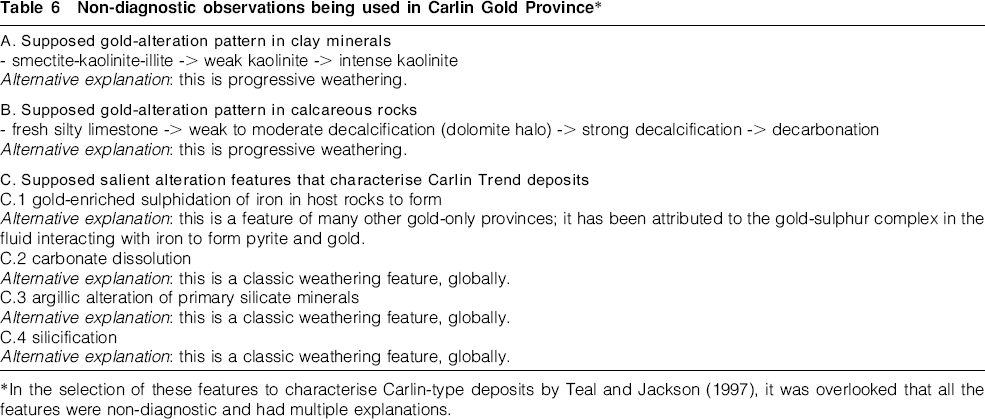
In the selection of these features to characterise Carlin-type deposits by Teal and Jackson (1997), it was overlooked that all the features were non-diagnostic and had multiple explanations.
The difficulty of identifying diagnostic criteria (defining features) for recognised gold deposit types today is not restricted to Carlin and epithermal gold. Intrusion-related gold is characterised by elements including As, Sb and Te, but these elements are found in slate-belt and greenstone gold deposits so are poor defining criteria. There can be great cost involved with a mis-identification such as years of fruitless exploration, or alternatively trading of a property that becomes a giant gold mine and company-maker for someone else. A company takes a high risk in dismissing this critical thinking about gold deposit types as just academic.
Summary
It would be trite to suggest that developing a highly successful exploration team is easy, or even to hint that this author knows what the complete formula for success in doing that might be. However, there are some factors that can be influenced relatively easily and at little cost. Thinking and a rigorous scientific approach can play an important part; these attributes can be developed in an enlightened university system or even school, through seniors and mentors in the industry and professional organisations, and through deliberate effort within a company. Generally these intellectual qualities are difficult to examine or rank in standard university tests, cannot be achieved by the award of a short course certificate of competence, but can be readily recognised.
Footnotes
Acknowledgements
Several people have contributed through their example and leadership in exploration and their willingness to discuss various ideas, including Ed Eshuys, Ken Hellsten, Ian Herbison, Jeff Ion, Martin Hughes, Jonathan Law, Julian Vearncombe, Roy Woodall and Jim Wright. Much has been learned about science and thinking from working with Mike Etheridge, David Groves, Bruce Hobbs, Doc and Rod Phillips, Roger Powell, Richard Smith and Vic Wall.
Discussions and correspondence with David Garvin and John Kotter of Harvard Business School, Chris Cordner of University of Melbourne, Sybrand De Waal of University of Pretoria, John Edwards of James Cook University, and various participants in the 5th International Conference on Thinking have been most useful and appreciated. Monika Sarder and the AusIMM Geoscience Society committee members are thanked for their comments particularly during preparation of a five-part series on exploration for the AusIMM Bulletin.
My appreciation to the many colleagues who have allowed me to experiment with philosophy of science in their classes – especially Honours, postgraduates and research assistants at the universities of Witwatersrand, Melbourne, James Cook, Monash and Stellenbosch.
The manuscript was improved by comments from Marat Abzalov, Jim Anderson, Arthur Day, Simon Dominy, Martin Hughes, Emma Leighton, Mike Stewart, Natasha van Leeuwen, John Vann, and Julian Vearncombe: to them, my sincere thanks.