







Abstract
Descriptions of the Witwatersrand goldfields have invoked superlatives around themes including great wealth, huge depths, giant mines and innovative engineering. After its discovery in 1886 and further discoveries in the 1930s and 1940s, the Witwatersrand dominated world gold peaking at 1000 t Au production in 1970. There has been a steady production decline since 1970, and, although the trend is clear in hindsight, few people predicted the seriousness of the fall in production or the grave situation of the industry today. The annual decline of Witwatersrand production has averaged 20 t of gold per year since 1994; at this rate, Witwatersrand gold mining will end in mid-2022. The forty-year production decline is attributed here to exploration failure as there has been no new goldfield discovered since Evander in 1951. A lesson from many of the world's great goldfields is that, where much gold has been discovered, there remains opportunity for repeats and additions by using new ideas and technologies. Future Witwatersrand exploration could adopt multiple working hypotheses rather than a single exploration model, introduce high-level geoscience training that is appropriate for a range of potential exploration models and strategies, and encourage a mindset in which discovery becomes both imperative for the whole community and an all-guiding passion. New exploration models open new opportunities not considered and tested over the last 60 years.
Introduction
The Witwatersrand Basin has been the greatest source of world gold, has powered the South African economy for much of the last century, and has led to some extraordinary mining innovations. It has produced over 50 000 t Au (or 1500 Moz), and dominated South African exports for many years. The distinguishing characteristics that make Witwatersrand gold ores so special have been their high gold grades, their large tonnages, and their extreme continuity (Phillips and Law, 2000).
Witwatersrand mines have been pioneers in underground mining practices. The mines have led the art of refrigeration at great depth as a way to keep the mines at a reasonable temperature for working and safety. Shafts were routinely sunk to 2 and 3 km depth at a rate approaching 5 m per day. The micro-seismic monitoring has been an innovative way to predict areas of likely failure and allow planning to reduce accidents. In the 1980s, the experience of seismic surveys in the oil industry was translated to the mineral industry and applied widely across the Witwatersrand Basin (Coward et al., 1995).
South Africa led world gold production from 1904, and by 1970 was producing 1000 t Au per year, or 30 Moz, and accounting for over half the western world production. However, in 2007, China overtook South Africa in global gold production; and by 2012 South Africa found itself ranked number five in world gold production. Its production of gold has declined around 20 tpa each year for the last two decades, and was 190 t in 2012. At this rate, the Witwatersrand goldfields will close in mid-2022 (Fig. 1). There is a small indication that the decline has been slowed in the last two years.
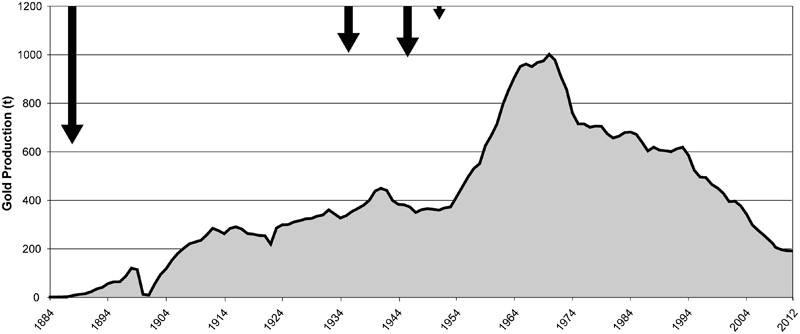
Graph showing Witwatersrand gold production and the date of major discovery events leading to new goldfields. For the purpose of this discussion, the quite minor South African gold production from outside the Witwatersrand is disregarded. The length of each discovery arrow is proportional to the gold produced from each goldfield; but some discoveries took place over a number of years. For example, Klerksdorp and the Rand were both discovered in 1886 and shown thus, but it might be equally valid to show the Klerksdorp ‘discovery’ much later when the Vaal Reef was identified in 1942. This graph shows the huge impact of the major discovery events on gold production, with a lag time of one to two decades as reserves are demonstrated and mines built
This contribution examines the current gold predicament in South Africa including the earlier discoveries, and the rise and fall of production. Possible causes of the production decline are considered, and, finally, some first steps are suggested that might reverse the precipitous fall.
Discoveries set the scene for production
The original discovery of Witwatersrand gold was by George Harrison in February 1886. From the discovery site on the farm Langlaagte, which is marked in present-day Johannesburg by George Harrison Park, auriferous rocks were traced east and west across the Rand goldfield for tens of kilometres before the end of 1886 (Fig. 2A and B). The first gold from the Witwatersrand was mined in early 1887. The discovery was followed by decades of prosperity and gold mine expansion, but, by the 1930s, gold production was steady and there was concern about the medium to long term future of the Witwatersrand goldfields. Figure 3
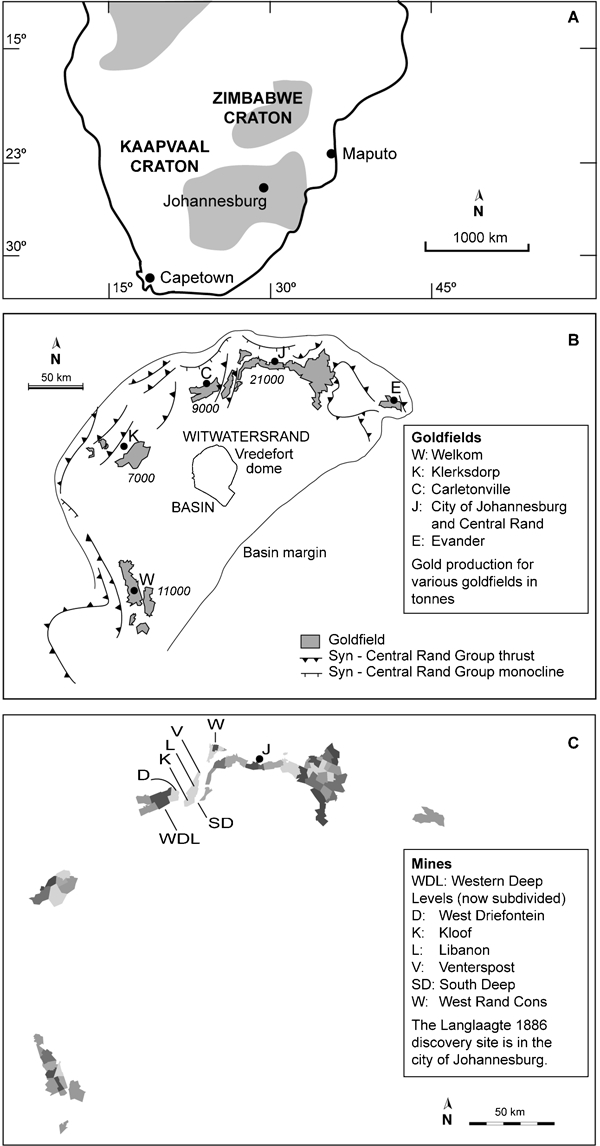
(A) Location map of the Archaean Kaapvaal craton in South Africa, and city of Johannesburg. (B) Map of the Witwatersrand goldfields with production from each goldfield. (C) Map of the gold mines immediately west of Johannesburg that are mentioned in the text
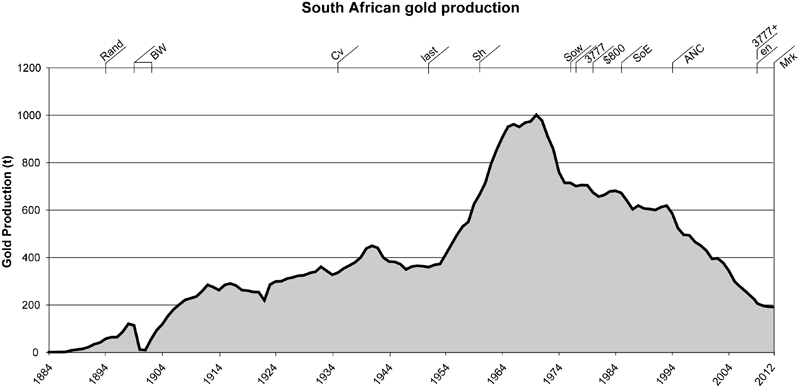
Annual production for the Witwatersrand goldfields shown with a timeline of the dates of major events that may have affected Witwatersrand gold production, namely Boer War (BW), Sharpeville massacre (Sh), Soweto riots (Sow), State of emergency (SoE), end of apartheid, and new ANC government (ANC), energy shortages (en), Marikana riots (Mrk), deepest shaft reaches 3777 m (3777), and deepest shaft exceeds 3777 m (3777+). Major discovery events are indicated (Rand; Cv: Carletonville; last: last discovery of a goldfield)
It was in this period of concern in the 1930s that one of the greatest discoveries under cover was made using stratigraphy, geophysics, and drilling to open up the Carletonville goldfield (Engelbrecht, 1986). At this stage, the lithologies of the Witwatersrand Basin were well understood from many years of geology on the mines of the Rand goldfield, and the base of the Witwatersrand Supergroup was known to be strongly magnetic because of magnetite-bearing mudstone and banded iron-formations (Smith et al., 2013). The stratigraphy was also well-understood and the richly auriferous horizons were some kilometres higher in the sequence above the magnetic units. By using an early hand-held magnetometer, Dr R. Krahmann was able to trace the magnetic units under cover of younger Archaean and Proterozoic rocks, estimate the offset likely from magnetite-bearing units to auriferous units, and then convince Gold Fields management that drilling was justified (Engelbrecht, 1986).
The Carletonville discovery paved the way for further use of geophysics and stratigraphy to reveal the giant Welkom goldfield in the south, and then during 1951 the smaller Evander goldfield in the east (Fig. 2B). Carletonville mines started producing in 1939 but grew rapidly through the 1940s and 1950s. Welkom mines started producing in 1951 and grew rapidly though the 1950s and 1960s. The Evander mines started producing in 1958. The period from 1954 to 1970 was one of unprecedented growth in gold production in South Africa due to the earlier discoveries of Carletonville and Welkom (and of the Vaal Reef at Klerksdorp).
There have been no Witwatersrand goldfields discovered since Evander in 1951, though there have been some important additions and extensions including South Deeps in the West Rand goldfield.
Growth of the Witwatersrand goldfields
There was some earlier gold production from South Africa, but discovery of the Rand goldfield in 1886 changed the gold industry forever. Gold production rose rapidly, except during the second Boer War, and in the early 1900s South Africa was the leading source of gold. Shallow mines on the Rand goldfield were amalgamated prior to 1920 as it became necessary to move down dip to follow the moderately south-dipping ore horizons, and this period generated the medium-depth mining operations. From 1920 to 1950, it became necessary to amalgamate the operations again to exploit ores at 2–3 km depth that were even farther down dip (Werdmüller, 1986; Phillips and Powell, 2011, Fig. 8).
At its peak, South Africa was producing almost three tonnes of gold per day and virtually all this was being exported. One of the benefits of a thriving gold industry was employment with the very largest mines sending 40 000 people underground each day, and the whole Witwatersrand employing over half a million workers every day at its peak. It is widely suggested that each mine wage was being used to feed whole families, possibly on the basis of 10 mouths fed from each mine wage. Additionally, revenue from Witwatersrand mining supported a significant number of supply and service enterprises, and tax revenue from the highly profitable mines funded many government projects.
This was a time of significant national innovation, partly due to the sanctions related to apartheid and also because of the overwhelming importance of gold to South Africa. There was innovation in mining engineering, in energy sourcing, and even in marketing of gold. For example, there were many years when 1–3 t of gold per day had to be transported to international markets without the South African national airline being allowed to fly over continental Africa because of the sanctions; this was addressed by the use of Ilha do Sal from 1967 to 2006 as a dedicated refuelling airport in the Cape Verde Islands off the western coast of Africa. Gold was such an important part of the South African economy, that the local currency (rand) moved in close relationship to the international gold price; higher gold price was paralleled by a higher rand relative to international currencies, and this tended to smooth out revenues and profits as virtually all costs were of domestic origin and in rand terms. This encouraged a strategic approach and the mining of orebodies for longevity rather than quick profit. Additionally, the tax scale was set to encourage longer life (and hence employment) for all the mines by having lower rates for some marginal mines.
Initial signs of trouble
Throughout the 1970s–1980s, and even into the 1990s, there was great confidence that the Witwatersrand gold would remain pre-eminent for decades to come. In one specific prediction, the Witwatersrand would continue producing until 2045, and South African annual gold production for the year 2010 would be 500 t (Pretorius, 1989); the reality was much lower, at 200 t Au (see Fig. 1). Other researchers were similarly positive, with Handley (1990, p. 29) stating ‘Thus at, roughly, 600 tonnes gold production per annum the South African industry can continue to survive for at least 36 years based on existing mine leases.’, and also when addressing the then current expectations of additional resources, Handley added, ‘The grand total of 41 800 tonnes of gold would see South Africa able to produce gold at the 600 tpa level for a total of nearly seventy years, namely to the year 2060.’ (p. 30–31); and ‘South Africa remains the world's largest producer of gold and, provided present political adjustments are achieved without serious disruption, is likely to remain so well into the 21st century.’ (Handley, 1990, p. 27).
Only six years later, it was becoming clear that these forecasts would not be met, with a prediction that South Africa would lose its number one ranking in gold production in the early 21st century (Phillips, 1996; the prediction was for this to happen in 2003 but it actually happened in 2007, and it was China that overtook South Africa, with Australia overtaking South Africa two years later).
A prescient study and analysis, adopting forecasting methods used for energy reserves, predicts Witwatersrand gold production will fall below 100 tpa within a decade (Hartnady, 2009). The study goes further to calculate the remaining reserves at the end of 2007 as 2948 t (noting that 1000 of those tonnes have now been produced, to the end of 2012). Hartnady's figure of Witwatersrand reserves is much lower than the official South African government figure of 36 000 t Au, or the US Geological Survey figure of 6000 t (Hartnady, 2009).
Some anecdotal explanations for the post-1970 production decline
Many reasons have been proposed to account for the decline of Witwatersrand gold production; and determining the correct cause(s) is a very important step to addressing the problem.
Specific issues of violence, such as Sharpeville, Soweto, the State-of-emergency and Marikana (Table 1, Fig. 3), helped shape external perceptions of South Africa but each was on the wrong time scale to explain an unrelenting forty-year decline. It is difficult to see these as direct contributors to production decline. However, together they contributed to lessening the attraction of South Africa as an investment and exploration destination. An interesting contrast is between these events of violence and the second Boer War (1899–1902): none of the former events are reflected in South African gold production (see Fig. 1), whereas the Boer War led to a sharp decline followed by resumption after fighting ceased.
Major political and community events in South African history leading up to and during the great gold decline that began in 1970
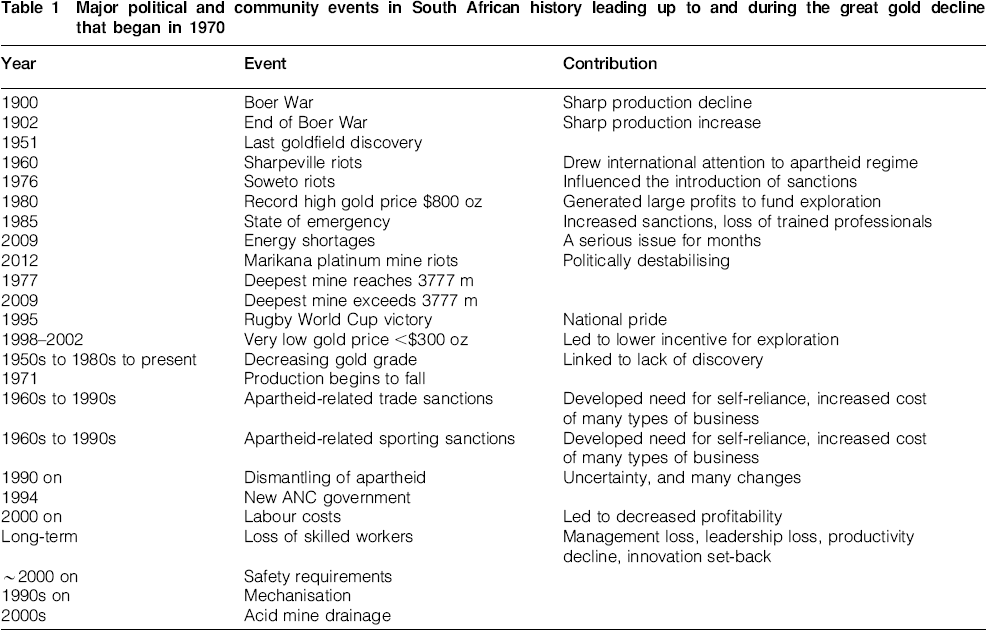
The apartheid era might be implicated in the decline after 1970, especially as tougher sanctions were introduced in the late 1960s. Whereas this explanation might agree with data until 1994, it does not explain why the removal of apartheid in 1994 led to faster decline in gold production (rather than no decline or an increase after 1994).
Gold price does not account for the decline overall, but might be a partial explanation for a change in slope around 1975 (Fig. 1). Gold prices increased in 1974 and again in 1979 during a period when the decline in Witwatersrand gold production was minimal. The period of low gold price from 1998 to 2002 is not well reflected on the production graph. The lack of sensitivity of production to gold price makes sense for these traditionally long life mines, though this situation is changing.
The change of government in 1994 coincides with a marked change in slope and is followed by an increasing rate of decline of 20 tpa per year. The exact and direct cause is unclear but is likely to include a shortage of skilled workforce and increased labour costs.
The explanation that production decreases are due to increased depth of mining is difficult to sustain; the depth of the deepest mine remained unchanged for three decades. Western Deep Levels mine reached 3777 m in 1977, and this was exceeded by a neighbouring shaft in 2009 (Fig. 2C).
The decreasing gold grade on virtually all Witwatersrand mines is a reality, and a consequence of focusing on the better grade areas first. By the mid-1980s, the grade at many mines had dropped significantly from a decade or two previous. For example in the mid-1980s, Libanon and Venterspost were producing at 5 and 4 g t–1 (respectively) compared to their ∼ 40 year life-of-mine average grades of 10 and 8 g t–1 (Fig. 2C). Although West Rand Consolidated was producing at 1–2 g t–1 in the 1980s, there were still super mines such as Kloof producing at 15 g t–1, and Driefontein maintaining 13 g t–1 though this was well below its life-of-mine figure of 1600 t Au at 24 g t–1 since opening in 1952 (Minerals Bureau of South Africa, 1986). Hence, decreasing grade is a logical consequence of how mining is prioritised on a mine lease, but need not affect the whole Witwatersrand Basin if there are new discoveries coming on stream each year. However, there have been no new mines of these high grades coming into operation since 1970.
Other suggestions such as safety requirements and mechanisation, whilst real, do not directly relate to production decline; and specific events like energy shortage, acid mine drainage, and sporting success are ephemeral in the forty-year context.
It is concluded that none of the explanations so far (Table 1) can adequately and directly account for the prolonged decline in Witwatersrand gold production. Some are consequences of other factors.
Lack of discovery of new Witwatersrand goldfields leads to production decline
It is postulated here that the forty-year decline in Witwatersrand gold production is a direct consequence of a failure of exploration to find any new goldfields. Other factors follow from lack of discovery such as decreased gold grade. For example, if just two goldfields had been discovered in the last 60 years (e.g. matching Welkom and Carletonville), it is likely there would have been another 10 large mines each producing 30–60 tpa Au at 10–30 g t–1 Au today. An important conclusion is that one solution to the forty-year decline lies in exploration success; although this statement might appear trivial, it is not one that is widely discussed. Discovery of a new goldfield would help to reverse the production decline, lift employment and increase gold grades. There may be other ways to achieve a similar end that should not be disregarded.
Of all the factors attributed anecdotally as causes for the decline of Witwatersrand gold, none (excepting that of discovery through exploration) has the ability to turn around the decline, if that factor was reversed. In fact, many factors have been reversed already with negligible effect on the production trend.
There has been pessimism regarding the Witwatersrand in the past; and one study identifies three periods when the end of the Witwatersrand goldfields was being pronounced (Pretorius, 1989). One was in 1890 when all the outcrops had been located; the introduction of diamond drilling changed that. A second was in the 1920s, and, as already described, the application of geophysical tracing of the magnetic Lower Witwatersrand rocks changed that. The third was in the late 1950s when exploration was failing to add to the Evander discovery; here Pretorius claims that ‘…The successful application of sedimentology brought back an air of optimism.’. It has to be noted however, that the air of optimism is not reflected by new goldfields or production upturns (see Fig. 1). Clearly, what is needed today to reverse the current production trend is a breakthrough on the scale of Krahmann's geophysical project, followed by the discovery of new goldfields.
First steps to a third era for Witwatersrand gold discovery
South Africa would benefit greatly from a third era of Witwatersrand exploration success to follow the two earlier eras of discovery initiated by Harrison (1886: Rand and Klerksdorp goldfields) and Krahmann (Carletonville, Welkom and Evander goldfields).
A successful and re-invigorated Witwatersrand gold mining industry should excite many stakeholders. It would benefit the South African government through taxes, exports, and employment contributing to national prosperity; it would benefit the whole South African community; and it would particularly benefit those who work in the gold mines and for companies supplying the mines. In considering possible stakeholders, it is important to recognise that the portfolios of several of the world's largest gold mining companies indicate that they do not see the future growth of their own production coming from the Witwatersrand region. Several actions can enhance the opportunity for discovery:
Recognise the need for discovery in the Witwatersrand Basin. Currently, the emphasis seems to be that the problems of Witwatersrand gold mining will be resolved through mining advances; the need for discovery is rarely mentioned.
Challenge the geological model that has guided exploration with an assumption that future exploration approaches will at least be different from the past. There is no scientifically correct model; they are all slices of reality (Vann and Stewart, 2011, p. 29). Recognise that a soft passage to publication does not strengthen a model, but tough testing will. An environment of challenge and enquiry will be beneficial, whereas corporate and academic groupthink will stifle new ideas. The focus needs to be on a discovery rather than model preservation (see also de Waal, 1988).
Foster a culture of co-operation between mining operations on the basis that discovery is a national priority: as favourable ground is tightly held there is little justification for operating in secrecy, and this culture is already changing.
Design Tertiary geoscience training so that Witwatersrand geologists have a first-class understanding of gold geology and especially Witwatersrand geology; this should include an appreciation for the variations possible in and between mines and goldfields. The aim of such training is not indoctrination, but rather to provide the skills to work out for oneself the best ways forward in an environment of conflicting data and ideas. To understand the placer model, graduates need a strong basis in sedimentology, stratigraphy, structure, and modern alluvial systems. To understand the hydrothermal model for Witwatersrand gold, students need a strong grounding in subjects including metamorphism, hydrothermal fluids, alteration and fluid flow in the Earth's crust. Foremost is a willingness and ability to analyse, to question, and, especially, to think scientifically.
Describe and reflect Witwatersrand ores properly in displays, descriptions, collections, photos, and terminology. If the main host association is that of gold and carbon, then classifying the Witwatersrand as a quartz-pebble conglomerate (e.g. Pretorius, 1981) is less than ideal. The classic quartz-pebble conglomerate (banket) is very important, very visual and easy to collect and display; however, many important Witwatersrand ores are not quartz-pebble conglomerate. Examples include lithic conglomerate, pyritiferous sandstone, auriferous shale, gold on unconformities, auriferous shear zones, arsenopyrite-bearing conglomerate, auriferous breccia zones, pyrrhotite-rich quartzite and gold-bearing banded iron-formation clasts.
Try other models when one model is not generating the expected results (i.e. discoveries). The placer model for Witwatersrand gold has not generated the anticipated exploration successes neither in the Witwatersrand Basin nor globally. The investigation of alternatives is part of a multiple working hypotheses approach. Considering alternative exploration models does not mean the placer model is wrong nor does it mean alternatives are right; it is simply sound risk management for the government, industry, and community. There are reasons to be quite concerned about the over-reliance on the placer model beyond its lack of exploration success: these reasons are scientific and would include its inability to explain any viable source for detrital gold, and the lack of a special sedimentary sorting process. These issues are discussed elsewhere, and an alternative quantitative genetic model proposed (Phillips and Powell, 2011).
Use new exploration models to provide impetus to revisit old targets, and to venture into new ones. Some of the major reef horizons are not fully tested on all goldfields. The well-known gaps between the Witwatersrand goldfields are no longer believed to be the areas between gold-rich alluvial fans (cf. Pretorius, 1989); however, they do contain significant mineralisation which will be geologically challenging (but not impossible) to put together as mining operations. The Lower Witwatersrand (West Rand Group) has been a major source of gold, and would be a prime target anywhere else in the world except that it is completely overshadowed by the highly auriferous Upper Witwatersrand. Structural geology will be useful in predicting gold distribution by identifying the location of folds and faults. Once the mindset moves beyond sedimentary sorting and conglomerate, and considers host rocks as chemical systems that might precipitate gold from solution, the opportunities in and near the Witwatersrand Basin increase considerably.
Conclusion
The Witwatersrand goldfields appear on a forty-year trend that will see the end of gold production in 2022. These enormous goldfields present a classic case for the importance of on-going exploration success in any gold-mining operation. If such an early end for the World's greatest gold province is to be averted then new goldfields need to be discovered. Given 60 years of non-discovery, there is ample justification for trying some different thinking.
Footnotes
Acknowledgements
The Geological Society of South Africa is thanked for the invitation to present these ideas at their Annual General Meeting in Johannesburg (2012) and Cape Town (2013). Similar ideas were promoted within a short course presented at Windhoek (2010), Stellenbosch (2011) and Carletonville (2012). Feedback from all these meetings has proved very useful in refining this contribution; and the various participants are thanked for sharing their observations, thoughts and opinions. Colleagues at Stellenbosch University are thanked for being willing to discuss their own ideas relating to South African geology and especially Witwatersrand gold. A lectureship at the University of Witwatersrand made this all possible by providing the environment for constructive scientific debate, and the opportunity to lead research projects on all the operating gold mines. Three AES reviewers are thanked for their constructive comments.