







Abstract
The Grasvally Norite–Pyroxenite–Anorthosite (GNPA) member is a 400 to 800 m thick cumulate package located in the northern limb of the Bushveld Complex, south of the town of Mokopane. On the farm Rooipoort it forms the lowermost unit of the magmatic stratigraphy, overlying Transvaal Supergroup sediments, whereas further south on the farm Grasvally it overlies Lower Zone rocks of the Bushveld Complex. The GNPA member is divided into three units; the Lower Mafic Unit (LMF), the Lower Gabbronorite Unit (LGN) and the Mottled Anorthosite Unit (MANO). Platinum-group element (PGE) mineralisation is closely associated with base metal sulphides (BMS) and is confined to the LMF and MANO where PGE grades range from 1 to 4 ppm (3PGE+Au). A number of distinct BMS assemblages are observed throughout the area and are interpreted to be the result of a combination of primary magmatic processes and low temperature alteration. In areas where the GNPA member is underlain by Lower Zone rocks, a pyrrhotite–chalcopyrite–pentlandite sulphide assemblage dominates, representing initial orthomagmatic sulphide mineralisation. Late-stage low temperature alteration has significantly altered much of the sulphide mineralogy, producing two secondary pyrite–chalcopyrite–pentlandite±pyrrhotite±millerite and pyrite–pentlandite±millerite sulphide assemblages. The primary assemblage was variably altered by crystallisation of pyrite and millerite from pyrrhotite and pentlandite at temperatures below 230°C. Sulphide replacement was associated with the precipitation of quartz and secondary silicates. This replacement of sulphides is more prevalent towards the base of the unit where the GNPA member is underlain by quartzites. These features suggest a strong footwall control over the low temperature alteration and thus the extent of the development of the secondary sulphide assemblages.
Keywords
Introduction
The 2·06 Ga Bushveld Complex in South Africa is the world's largest layered igneous intrusion covering an area of ∼65 000 km2 (Fig. 1). It represents the Earth's largest repository of magmatic ore deposits and currently accounts for 86 and 35% of the annual global production of Pt and Pd, respectively (Butler, 2011). These huge platinum-group element (PGE) reserves are hosted primarily in three deposits; the Merensky Reef, the UG2 chromitite and the Platreef. Within the northern limb of the Bushveld Complex, PGE mineralisation is developed in four distinct mafic/ultramafic bodies, (i) the Platreef, north of the town of Mokopane (previously known as Potgietersrus); (ii) within a sequence of layered cumulates referred to as the Grasvally Norite–Pyroxenite–Anorthosite (GNPA) member developed only to the south of Mokopane; (iii) within Lower Zone cumulates on the farm Volspruit, also south of Mokopane; and (iv) within Main Zone rocks on Moorddrift farm (Maier and Barnes, 2010), on the Aurora project to the far north of the limb (McDonald and Harmer, 2011) and on the Waterberg project which is north of the exposed northern limb (Kinnaird et al., 2012). At present, the Platreef is being mined by Anglo Platinum in four open-pit mines opened between 1992 and 2006, collectively referred to as the Mogalakwena Mine (McDonald and Holwell, 2011). The success of this low-cost, high-tonnage PGE mining has since led to increased exploration along the entire strike of the Platreef and facilitated an expanding number of geochemical and mineralogical studies, revealing the true complexity of the unit (e.g. Armitage et al., 2002; Hutchinson and Kinnaird, 2005; Kinnaird, 2005; Kinnaird et al., 2005; Sharman–Harris et al., 2005; Holwell and McDonald, 2006; Holwell et al., 2006; Hutchinson and McDonald, 2008). In contrast, south of Mokopane, exploration has been far less extensive with Caledonia Mining Corporation and Platinum Group Metals being the only companies at present prospecting the GNPA member mineralisation. Consequently, only limited mineralogical and geochemical studies have been undertaken on this ore body (e.g. van der Merwe, 1976; 1978; Hulbert, 1983; McDonald et al., 2005; Maier et al., 2008; van der Merwe, 2008), thus the GNPA member remains poorly constrained and understood in comparison to other PGE-bearing units of the Bushveld Complex.
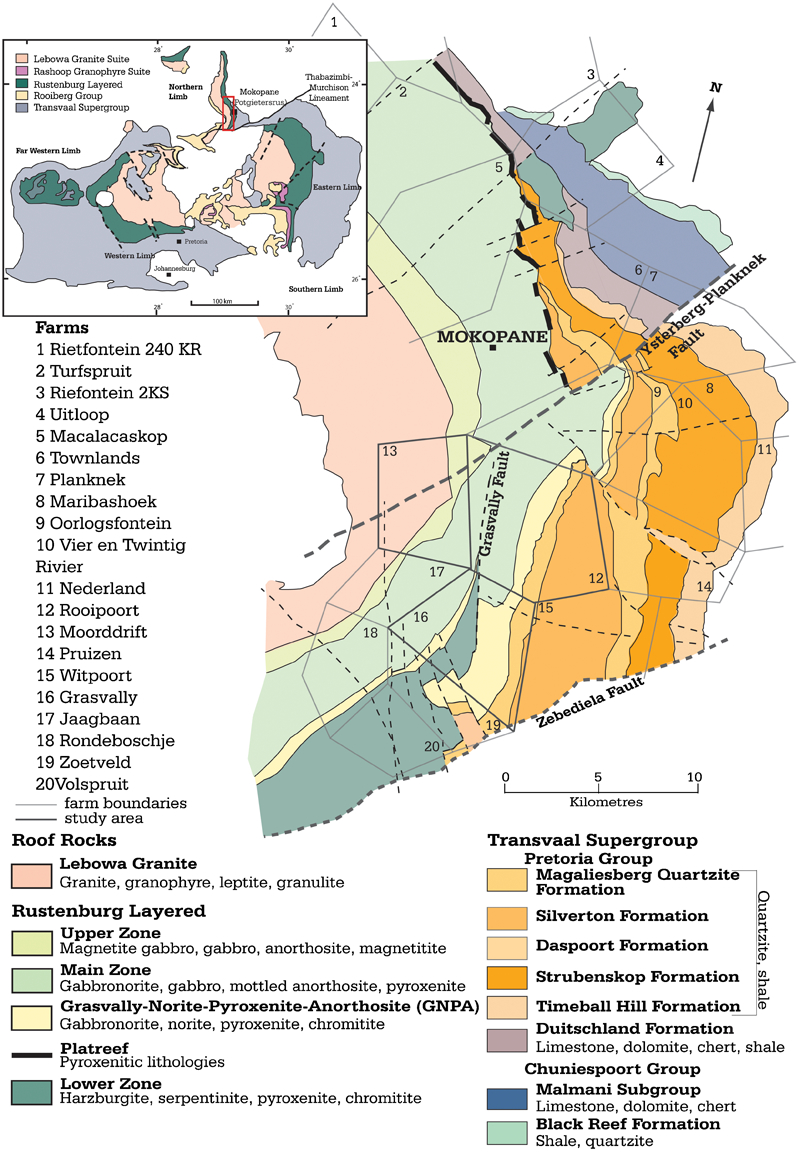
Geological map of the northern limb of the Bushveld Complex, highlighting the location of the GNPA member and the location of the study area on the farms Rooipoort, Grasvally and Moorddrift (thicker farm boundaries). Inset map adapted from Eales and Cawthorn (1996) and main map modified from van der Merwe (2008)
This study provides the first detailed account since the original work of Hulbert (1983). It focuses on the petrography and mineralogy of silicates, oxides and base metal sulphides (BMS) in the GNPA member, and the first that utilises the wealth of information provided by drilling since 2003. Thus this study covers a greater geographical area than Hulbert's (1983) previous work and also extends down dip and in doing so presents the most extensive description of PGE mineralisation-hosting GNPA member rocks to the south of the Platreef.
Regional geology
The ultramafic–mafic portion of the Bushveld Complex is referred to as the Rustenburg Layered Suite and has been spatially divided into five limbs (Fig. 1): the near symmetrical western and eastern limbs; a southern limb, partially hidden by younger sediments; a heavily eroded far western limb; and a northern limb (Eales and Cawthorn, 1996). The Rustenburg Layered Suite is also conventionally divided into five stratigraphic zones based on modal mineralogy: Marginal Zone norites, Lower Zone pyroxenites and harzburgites, Critical Zone chromitite-pyroxenite-norite cyclic units, Main Zone gabbronorites, and Upper Zone anorthosites, ferrogabbros and magnetites.
The northern limb is characterised by the local development of unusually thick (800–1600 m) sequences of Lower Zone lithologies; the apparent absence of the Critical Zone, which is so obviously developed in the eastern and western limbs; and the variation of the mafic succession along strike (McDonald et al., 2005; Fig. 1). To the north of the Ysterberg–Planknek Fault, the PGE- and BMS-bearing Platreef forms the base of the Rustenburg Layered Suite (Fig. 1) and is developed as a 10–400 m thick package comprising texturally heterogeneous and variably altered pyroxenitic lithologies (e.g. Hutchinson and Kinnaird, 2005; Kinnaird, 2005; Holwell and McDonald, 2006; Hutchinson and McDonald, 2008). Although Lower Zone cumulates have been identified beneath the Platreef (Yudovskaya et al., 2012) it remains unclear as to whether these represent isolated satellite bodies or a continual layer as in van der Merwe's (1976) original cross-sections. To the south of the Ysterberg–Planknek Fault the magmatic succession differs significantly (Fig. 1). This region contains locally developed Lower Zone harzburgites on and west of the farm Grasvally, a unique layered package termed the GNPA member, and overlying Main Zone gabbronorites and Upper Zone rocks. A characteristic feature of the northern limb is the pronounced transgression of the mafic succession northwards from the Thabazimbi–Murchison Lineament (Fig. 1) through the Palaeoproterozoic Transvaal Supergroup (van der Merwe, 2008). Northwards, the footwall consists of interbedded quartzites and shales of the Magaliesberg Quartzite Formation, quartzites and shales of the Timeball Hill Formation, shales of the Duitschland Formation, the Penge Banded Iron Formation, the Malmani Subgroup dolomites and Archean basement granites and gneisses (e.g. Sharman–Harris et al., 2005; Holwell and McDonald, 2006; van der Merwe, 2008).
The north-east striking GNPA member crops out over a distance of 30 km (Verbeek and Lomberg, 2005), reaching a maximum thickness of 800 m. The GNPA member was originally divided into two major sub-units by Hulbert (1983) but more recently has been divided into three by de Klerk (2005); the Lower Mafic Unit (LMF), the Lower Gabbronorite Unit (LGN) and the Mottled Anorthosite Unit (MANO). The LMF is distinguished from the unmineralised, homogeneous gabbronorites of the LGN by an increase in melanocratic lithologies, the development of two chromitites and elevated chromium values. The MANO is recognised by a substantial increase in plagioclase cumulates and the development of lithologies such as mottled and spotted anorthosites. It is suggested that the unmineralised LGN represents a sill of Main Zone rocks (de Klerk, 2005; Maier et al., 2008) however this is yet to be confirmed. The main structural control over the magmatic succession in the area is the N–S trending Grasvally Fault (Fig. 2a and b). East of this fault the GNPA member forms a plunging synform which directly overlies interbedded quartzites and shales of the Magaliesberg Formation (Fig. 2b). In contrast, west of the fault Lower Zone cumulates comprise the footwall to the GNPA member. Hulbert (1983) and de Klerk (2005) both identified nine PGE and BMS mineralised horizons, all of which are confined within the LMF and MANO on the farms Grasvally and Rooipoort. These reefs are highly discontinuous and sporadic in nature with the exception of the PGE- and BMS-bearing chromitites which are laterally persistent throughout Grasvally and Rooipoort (Verbeek and Lomberg, 2005). PGE grades associated with sulphide enriched regions reach up to 2 ppm (Pd+Pt+Au), with localised intersections of 5 ppm (2PGE+Au; Verbeek and Lomberg, 2005; Maier et al., 2008).
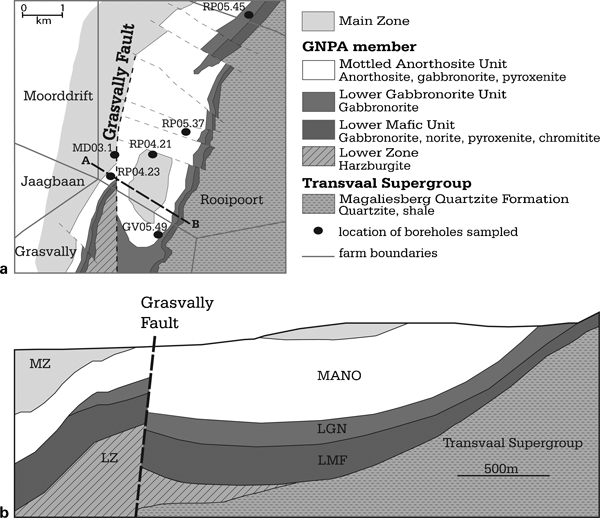
a map showing the geology of the GNPA member, on the farms Rooipoort, Grasvally, Moorddrift and Jaagbaan, b cross-section with the same horizontal and vertical scales through Rooipoort, showing the outcrop pattern of the Main Zone (MZ), Mottled Anorthosite Unit (MANO), Lower Gabbronorite Unit (LGN), Lower Mafic Unit (LMF) and the Lower Zone (LZ).
At present the relationship of the GNPA member with the rest of the Bushveld Complex remains poorly constrained and controversial (von Gruenewaldt et al., 1989; McDonald et al., 2005; Maier et al., 2008; van der Merwe, 2008; McDonald and Holwell, 2011). The GNPA member is assumed by numerous authors (Hulbert, 1983; Maier et al., 2008; van der Merwe, 2008) to correlate with the Upper Critical Zone of the eastern and western limbs with the two chromitites believed to directly correspond to the Merensky Reef and UG2 chromitite. In addition it has also been proposed that the GNPA member represents a lateral facies of the Platreef with the two bodies suggested to merge at the Ysterberg–Planknek Fault (van der Merwe, 2008). These correlations however are primarily based on the presence of PGE grade and vague lithological associations. In contrast, McDonald et al. (2005) suggested that the northern limb ore-bodies are distinct from the Upper Critical Zone and propose they resulted from the mixing of Lower and Main Zone magmas. The viability of this theory has been questioned as evidence exists to suggest that the Lower Zone cumulates were consolidated, significantly cooled and tilted prior to emplacement of a later magma (van der Merwe, 1978; Kinnaird et al., 2005). The relationship (if any) between the northern limb and the Upper Critical Zone or the GNPA member and the Platreef currently remains unclear.
Samples and methods
Samples have been obtained from six boreholes drilled by Caledonia Mining Corporation on the farms Rooipoort, Grasvally and Moorddrift (Fig. 1) where the GNPA member overlies Lower Zone and metasedimentary quartzites. The location of all these boreholes is shown in Fig. 2a. Stratigraphic logs of boreholes RP04·23 and RP05·45 are provided in Fig. 3 as representative sections from the eastern and western parts of the area. These logs also highlight mineralised zones identified by the presence of visible BMS. The depths in Fig. 3 reflect borehole depth in metres and not true thickness as boreholes were drilled vertically. Within the Rooipoort area dips vary from 5 to 30° with the variation largely due to the presence of a syncline directly adjacent to the Grasvally Fault. Steeper values correspond to the eastern limb of the syncline and to the west of the Grasvally Fault (Fig. 2b).
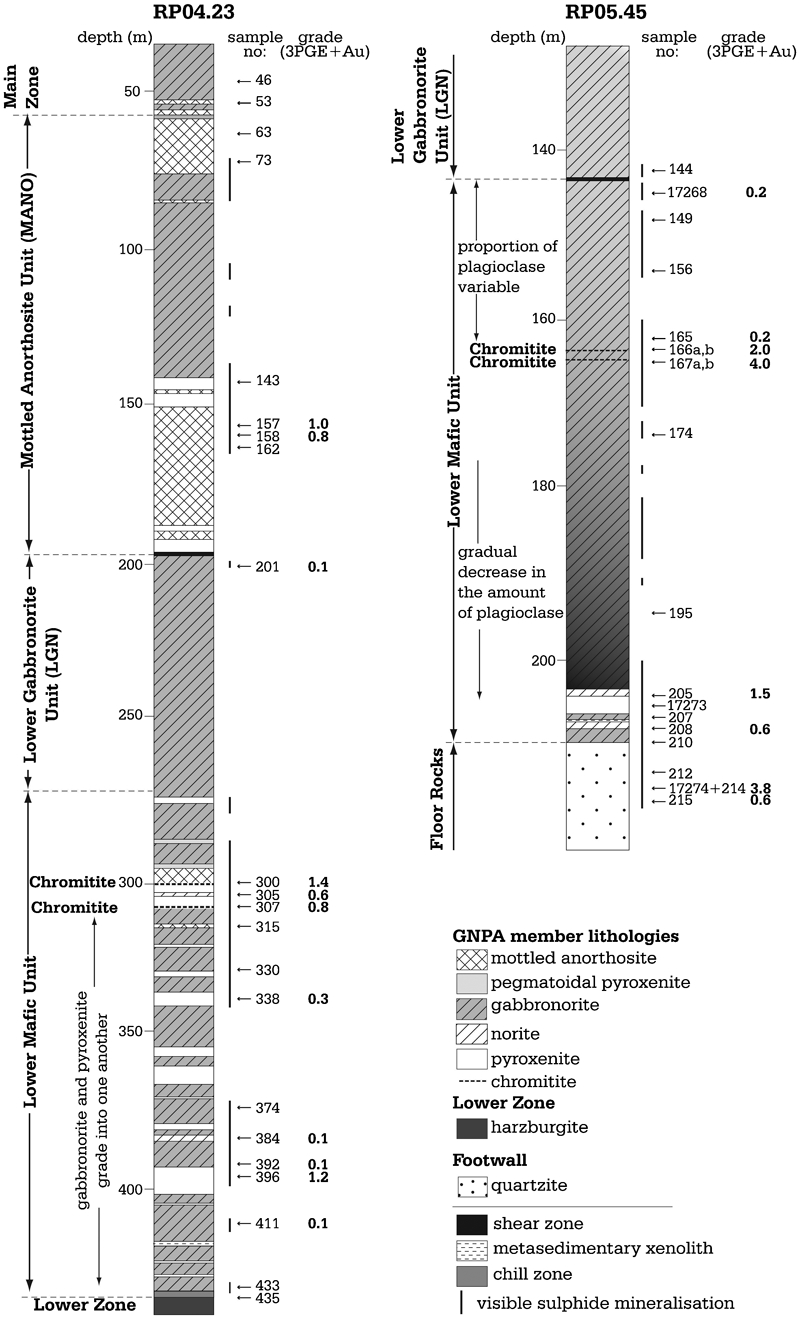
Stratigraphic logs of boreholes RP05·45 and RP04·23, showing the position of samples and zones of visible sulphide mineralisation and indication of PGE grades
In total, 52 polished thin sections were analysed under transmitted and reflected light microscopy. All the samples highlighted in Fig. 3 were examined in thin section. The additional nine samples analysed were obtained from a number of other boreholes (Fig. 2) and are representative of the MANO. Mineral identification of the sulphide occurrences was performed at the University of Leicester using a Hitachi S-3600N Environmental Scanning Electron Microscope, coupled to an Oxford Instruments INCA 350 energy dispersive X-ray analysis system. Overall 34 sections were examined on the scanning electron microscope.
Petrology
Rock names have mostly been assigned using the IUGS (Streckeisen) scheme and are distinguished typically by the modal percentage of plagioclase, orthopyroxene and clinopyroxene. Under the IUGS classification a rock containing >10 modal% plagioclase and <90 modal% orthopyroxene would be termed a norite. However, in keeping with Bushveld nomenclature, if the plagioclase is intercumulus to the orthopyroxene, the rock is classified as a feldspathic pyroxenite. Where plagioclase or pyroxenes total >90% of the modal mineralogy the rock is referred to as an anorthosite or pyroxenite, respectively. The term pegmatoidal is used when grains are interlocking and >2 cm in diameter.
Footwall lithologies
Transvaal supergroup
To the east of the Grasvally Fault quartzites from the Magaliesberg Quartzite Formation directly underlie the GNPA member. Calc-silicate xenoliths are also occasionally observed between the contact of the LMF with floor quartzites and Lower Zone harzburgites. The fine- to medium-grained quartzites consist of poorly sorted and poorly rounded grains which have a high sphericity (Fig. 4a). Individual quartz grains have irregular and embayed edges (Fig. 4a) and are generally separated by a very fine matrix. A coarser plagioclase-rich matrix containing secondary chlorite is also developed but appears to be confined to thin, inconsistent layers occurring in association with the sulphide bearing zones. Coarse-grained amphibole is found in association with interstitial sulphides.
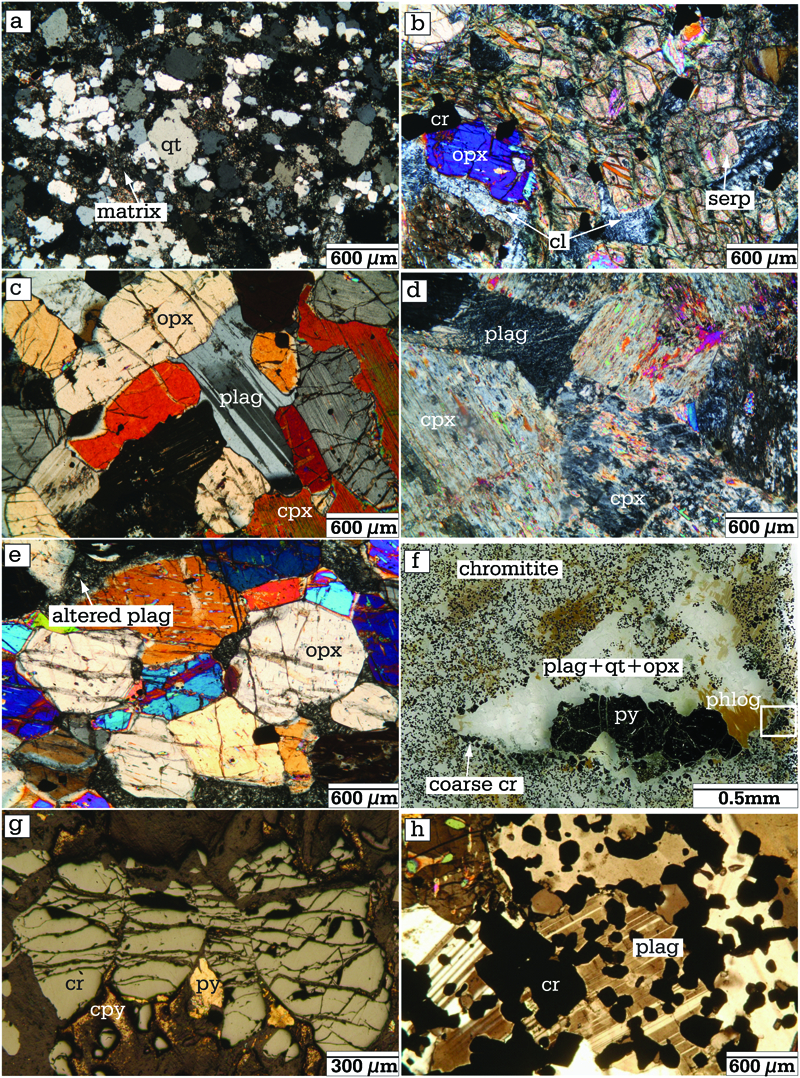
Thin section photographs of some of the petrographical relationships within the LMF and footwall lithologies; f represents a scan of a thin section, and g is taken in reflected light, all others are in cross-polarised light
Bushveld Complex Lower Zone
West of the Grasvally Fault, in the south-west of Rooipoort and in the north-west of Grasvally, Lower Zone harzburgites underlie the GNPA member. In this area, the Lower Zone reaches a minimum thickness of 1600 m, comprising 37 cyclic units (Hulbert, 1983) which range from <10 to 140 m in thickness. Detailed petrographical descriptions of the entire Lower Zone unit are provided in Hulbert and von Gruenewaldt (1982), Hulbert (1983), Hulbert and von Gruenewaldt (1985) and von Gruenewaldt et al. (1989). The Lower Zone cumulates in contact with the GNPA member consist of serpentinised, poikilitic harzburgites which contain olivine-chromite cumulates with minor orthopyroxene and secondary chlorite (Fig. 4b). The harzburgites are interlayered with orthopyroxenites (Verbeek and Lomberg, 2005). These rocks equate to Hulbert's (1983) uppermost Lower Zone division, the Moorddrift harzburgite-pyroxenite subzone.
GNPA member lithologies
Lower Mafic Unit (LMF)
The presence of a fine-grained chilled margin at the base of the LMF regardless of underlying lithology (Hulbert, 1983; de Klerk, 2005) indicates that the Lower Zone cumulates cooled significantly prior to the emplacement of the GNPA member. The chilled margins range in thickness from a few centimetres up to 20 m. Where the LMF is in contact with Lower Zone harzburgites, a granoblastic texture is developed within the orthopyroxenite chilled zone (Fig. 4e) which contains minor euhedral chromite. Although the cumulus orthopyroxene crystals are not altered they exhibit rounded and embayed margins. The chill zone developed over the quartzites is generally thicker, heavily altered and hosted typically by a gabbronorite.
The LMF is dominated by fine- to coarse-grained mafic lithologies such as gabbronorites (Fig. 4c) norites, pyroxenites (Fig. 4d) and feldspathic pyroxenites. Pegmatitic occurrences are relatively rare and are restricted to pyroxenites and feldspathic pyroxenites. The LMF is characterised by unusual orthopyroxene-clinopyroxene, orthopyroxene-clinopyroxene-chromite, clinopyroxene and orthopyroxene cumulates (Hulbert, 1983; McDonald et al., 2005). Plagioclase bearing cumulates are also present but are less common. Throughout the unit, clinopyroxene is ubiquitous forming >10–30 modal%. The association of cumulus clinopyroxene with chromite and the presence of orthopyroxene-clinopyroxene-chromite cumulates originally identified by Hulbert (1983) are features unique to the GNPA member.
Although mottled anorthosites are rare in the LMF, within borehole RP04·23 approximately 20 cm below the LMF–LGN contact the upper chromitite is overlain by an anorthosite (Fig. 3) that grades into the overlying pegmatitic feldspathic pyroxenite and the underlying chromite-bearing pyroxenite. Granitic dykes and <10 cm to >1 m thick calc-silicate xenoliths are common throughout the LMF. Minor chilled margins (1–2 cm thick) are frequently developed around calc-silicate xenoliths.
The LMF is characterised throughout Grasvally and Rooipoort by the development of two laterally continuous PGE- and BMS-bearing chromitites that are consistently present within the upper LMF and have been observed over 100 m from the basal contact on Rooipoort. In contrast, on Grasvally Hulbert (1983) found the lower chromitite to occur near to the base of the LMF. The chromitites developed east and west of the Grasvally Fault are texturally and mineralogically distinct and thus will be discussed in detail separately. The chromitites to the east of the fault are separated by up to 1 m of gabbronorites, are sulphide-bearing (5–10 modal% and up to 1 wt-%S), and range in thickness from 0·2 to 1 m. Chromite forms approximately 60 modal% with intercumulus plagioclase (30 modal%), clinopyroxene and orthopyroxene (<10 modal%). Chromite grains have not amalgamated to form large aggregations and are small (0·1 to 0·3 mm) and euhedral. The corners of the chromite grains are often seen to be slightly rounded. Phlogopite and quartz are relatively common within these chromitites (Fig. 4f). Sulphides are generally disseminated in nature and interstitial to the chromite, however polyphase blebs >1 cm in length are also common (Fig. 4f). No sulphides were found as inclusions within chromite grains.
The chromitites to the east of the Grasvally Fault contain irregular-shaped chromite free areas or pockets that also host the majority of the larger sulphide blebs (>1 cm; Fig. 4f). These pockets are coarser than the surrounding chromitite and contain heavily altered cumulus plagioclase, minor, less altered orthopyroxene and secondary silicates, primarily secondary chlorite, tremolite and actinolite. Accessory quartz and phlogopite are spatially related to sulphides and typically surround large sulphide blebs which are situated at the base of the chromite-poor regions, juxtaposed to cumulus chromite (Fig. 4f). It is currently unclear what these chromite-poor regions represent, with plausible possibilities including either micro-xenoliths or small pockets of trapped melt containing sulphide droplets. Contacts between chromitites and sulphide-rich, chromite-free regions are characterised by texturally distinct chromite grains that are relatively large, heavily fractured and anhedral (Fig. 4g). These unique shaped grains could be the result of the in situ reaction of cumulus chromite crystals with silicates and an interstitial liquid as described in Henderson and Suddaby (1971).
The two chromitites to the west of the Grasvally Fault are considerably thinner than those to the east of the fault. The chromitites range in thickness from 2 to 5 cm and are separated by norite, gabbronorite and pyroxenite ranging between 4 cm and 7 m in thickness. These chromitites appear patchy and disseminated in nature with chromite forming only 25–45 modal%, and are also significantly poorer in sulphide (<1 modal% and <0·3 wt-%S). The chromitites are characterised by chromite-clinopyroxene-plagioclase cumulates, with relatively coarse cumulus clinopyroxene constituting approximately 25–30 modal% of the rock. The clinopyroxene crystals are generally devoid of any chromite. Although the chromite is occasionally observed as small (0·3 to 0·4 mm), individual euhedral grains the majority exist as anhedral, polygonal aggregates (Fig. 4h). Both phlogopite and quartz are completely absent from these chromitites.
Lower Gabbronorite Unit (LGN)
The LGN consists predominantly of homogenous, fine- to medium-grained gabbronorites which contain variable proportions of cumulus plagioclase (Fig. 5a). Petrographically these rocks appear comparable to those typical of the Main Zone. Pyroxenitic xenoliths derived from the MANO and LMF with occasional sheared contacts are common. The upper and lower contacts of this unit vary considerably, with chilled zones up to 8 cm thick, gradational and sheared contacts all observed. On the basis of the uniform nature of this unit in conjunction with the presence of occasional chilled margins, de Klerk (2005) suggested that it represents a sill of Main Zone rocks which preferentially intruded along the original LMF-MANO contact. The LGN is generally sulphide-free, barring rare occurrences near the upper and lower contacts.
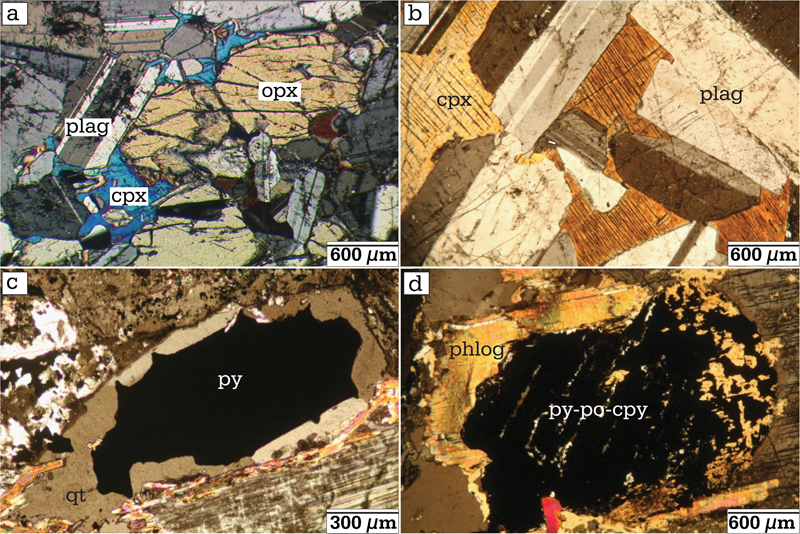
Cross-polarised light images showing petrographical relations within the LGN and MANO
Mottled Anorthosite Unit (MANO)
The MANO is most readily distinguished from the underlying LGN and LMF by the marked increase in the proportion of plagioclase cumulates present and the dominance of mottled and spotted anorthosites (Fig. 5b). Clinopyroxene typically forms less than 10 modal% in comparison to up to 30 modal% in the LMF. Cyclic units with gradational boundaries, on a scale of tens of metres, of orthopyroxenite, norite, gabbronorite and anorthosite are common within the MANO. Hulbert (1983) recognised that the basal layers of all these cyclic units consist of plagioclase-only cumulates. Within the prevailing rock type, mottles exist as large (2–10 cm in diameter) oikocrysts of orthopyroxene and occasionally clinopyroxene, whereas spots of orthopyroxene and clinopyroxene typically range from <1–2 cm. Where BMS and PGE mineralisation is developed, quartz is often present within the host litholiogies. Quartz occurs either as an interstitial phase that often surrounds and is closely associated with the sulphides (Fig. 5c) or veins through the larger sulphides. In addition, phlogopite also constitutes a minor phase which is also preferentially associated with sulphides (Fig. 5d). An anomalous feature of the MANO, which has only been observed within borehole MD03·1 (Fig. 2a) <5 m from the MANO–LGN contact, is the association of accessory chromite with rare occurrences of pegmatoidal orthopyroxenite. Shear zones and PGE-poor quartz veins contain zones of abundant sulphides (around 1 cm thick) comprising chalcopyrite, pentlandite and galena. Within the shear zones the original mineralogy has been completely replaced by very fine secondary silicates and quartz which constitutes >50 modal%.
Main Zone
The Main Zone south of Mokopane is characterised by an 1120 m sequence of gabbronorite and gabbro with three to four mottled anorthosite layers (Hulbert, 1983; van der Merwe, 2008). In summary, the Main Zone constitutes an alternating sequence of pigeonite-free and pigeonite-bearing gabbroic rock, with the crystallisation order plagioclase, orthopyroxene, clinopyroxene (Hulbert, 1983). The gabbronorites are comparable to those of the LGN shown in Fig. 5a. On Grasvally, Hulbert (1983) noted that the contact between the Main Zone and MANO is distinguished by a chilled margin. Where the Platreef is developed to the north of the Ysterberg–Planknek Fault, a chilled margin is developed at the base of the Main Zone rocks (Holwell et al., 2005; Weise et al., 2008). In contrast, on Rooipoort in borehole RP04·23 (Fig. 2) the contact with the GNPA member is characterised by a small shear zone approximately 12 cm in thickness which separates Main Zone gabbronorites from mottled anorthosites typical of the MANO. Furthermore, on Moorddrift although a sharp transition exists between leuconorites of the Main Zone and the MANO mottled anorthosites there is no evidence of a chilled contact.
Platinum-group element mineralisation
Initial results show that throughout the GNPA member, a strong correlation exists between PGE and Ni, Cu and S, thus high Ni and Cu values are generally indicative of high PGE grades. Throughout the Rooipoort area, a positive correlation between both Ni and Cu and S and Cu is evident which was also noted by Maier et al. (2008). Platinum-group element and BMS mineralisation, identified by visible sulphide, is typically confined to three to five zones that range in thickness from a few metres to ≥50 m (Fig. 3) and is hosted within all rock types, including chromitites. Mineralisation also extends for several metres into the footwall quartzites to the east of the Grasvally Fault. With the exception of the chromitite-hosted mineralisation, these BMS and PGE enriched zones cannot be correlated with confidence along strike. Although PGE concentrations are highly variable (Fig. 3) the highest grades of 4 ppm (Pd+Pd+Rh+Au) are associated with the chromitites developed east of the Grasvally Fault and the floor quartzites. The GNPA member, like the Platreef, is noticeably Pd-dominant with Pt/Pd ratios typically <1. Platinum-group mineral (PGM) assemblages are dominated by Pt arsenides, Pd bismuthotellurides, Pd tellurides, Pd antimonides and Au/Ag minerals (Smith et al., 2010; 2011). There is a noticeable lack of PGE sulphides and alloys. In agreement with the geochemical data, the PGM are associated with the sulphides, typically occurring included within or as satellite grains around the sulphides. The nature and distribution of PGE mineralisation within the GNPA member will be addressed in more detail in a companion paper.
Sulphide mineralogy
The sulphide content within the GNPA member is highly variable with sulphide minerals typically constituting 3 to 10 modal% of the rock. The highest sulphide contents are found in the dense chromitites developed to the east of the Grasvally Fault, within the MANO and within floor quartzites close to the contact with the mafic rocks. The sulphide minerals present within the GNPA member are pyrrhotite (po), pentlandite (pn), chalcopyrite (cpy), pyrite (py) and millerite (mil). Three principle sulphide assemblages were found to exist throughout the GNPA member which include (i) Po–Cpy–Pn, (ii) Py–Cpy–Pn±Po±Mil and (iii) Py–Pn±Mil. These three distinct assemblages, in conjunction with textural features, enabled the sulphide occurrences to be categorised into (i) primary textured sulphides, (ii) secondary textured sulphides and (iii) footwall sulphides. The latter two exhibit complex textural associations between individual sulphide phases and are characterised by the dominance of pyrite.
The sulphide textures are highly diverse and vary considerably in complexity (Fig. 6). Textures include irregular shaped, complexly intergrown sulphides >1 cm in length; spherical, centimetre sized blebs; and intergranular and disseminated assemblages. Cross-cutting PGE-poor quartz veins up to 4 cm in thickness containing cores of massive chalcopyrite with minor pyrrhotite were also observed within the MANO.
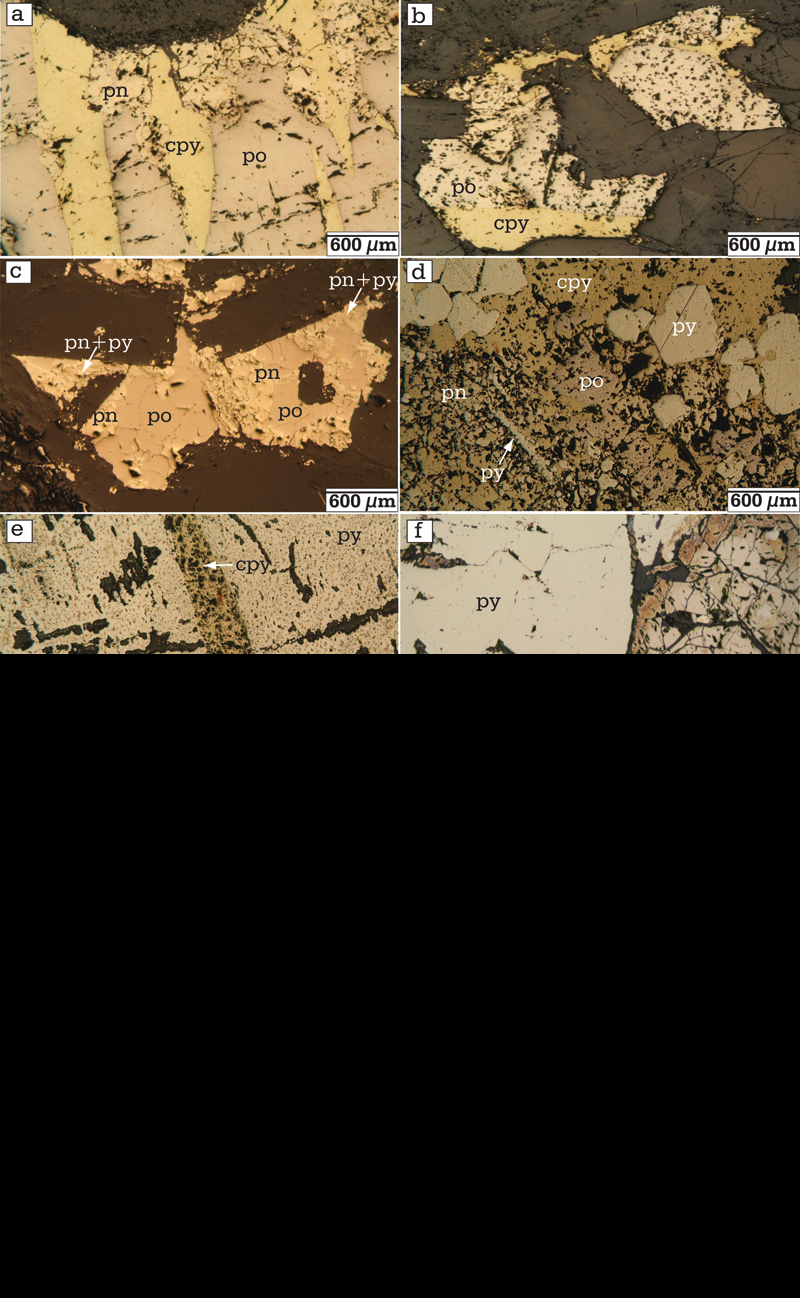
Reflected light images of primary, secondary and footwall sulphides
Primary textured sulphide assemblages
Primary textured sulphides are defined as those which exhibit magmatic textures and contain the assemblage Po–Cpy–Pn. Primary textures include fractionated blebs of sulphide comprising a core of pyrrhotite with pentlandite and chalcopyrite generally confined to the margins (Fig. 6a and b); flame exsolution of chalcopyrite within pyrrhotite (Fig. 6a) and, more rarely, pentlandite within pyrrhotite; and single-phase micrometre to millimetre sized, disseminated interstitial grains.
To the west of the Grasvally Fault, primary sulphide textures dominate throughout the LMF and are also present in restricted layers within the MANO (Table 1). Within the basal section of the GNPA member, specifically below the upper chromitite, BMS enrichment is generally restricted to coarse norites, gabbronorites and clinopyroxenites. The sulphides are characterised by intergranular polyphase blebs and large (≥1 cm in length), spherical, fractionated blebs, which are often surrounded by coarse cumulus plagioclase and clinopyroxene crystals. In contrast, where primary sulphide assemblages are developed in the MANO, sulphides are typically more intergranular and disseminated in nature (micrometre to millimetre scale) and are hosted by pyroxenite, mottled anorthosite, pegmatoidal pyroxenite and gabbronorite. Large primary sulphide blebs (≥1 cm) are rarer than within the LMF. Where present, alteration of these primary sulphides by secondary silicates such as tremolite, actinolite, talc, amphibole and chlorite is minimal and confined to thin halos around the margins of the sulphides (Fig. 7a, Table 1), typical of many magmatic sulphide assemblages (e.g. Li et al., 2004; Hutchinson and Kinnaird, 2005; Holwell et al., 2006; Li et al., 2008).
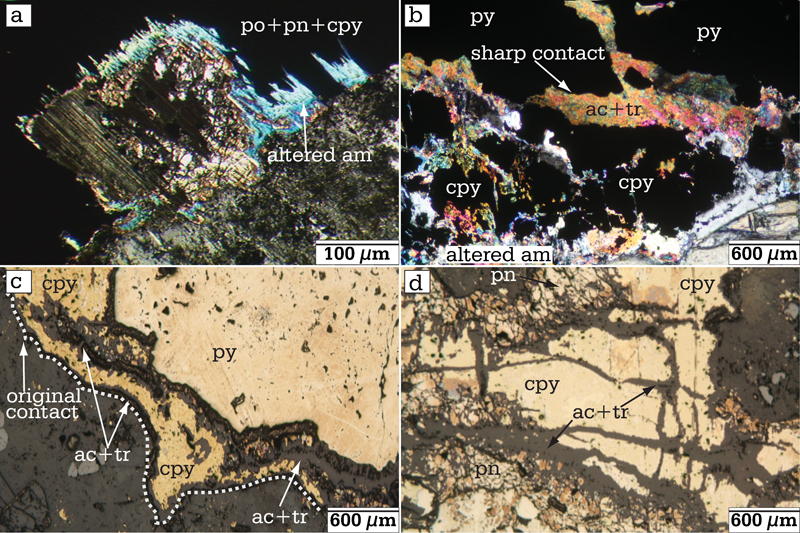
a, b cross-polarised light images, a primary sulphide comprised of pyrrhotite (po), pentlandite (pn) and chalcopyrite (cpy) being replaced around the margins by altered amphibole (am); b secondary sulphide with extensive replacement of chalcopyrite by actinolite (ac) and tremolite (tr). The pyrite (py) although in contact with secondary silicates is not being replaced by them. c, d reflected light images, c extensive replacement of chalcopyrite by actinolite and tremolite, with the original boundary highlighted. Primary pyrrhotite has been completely replaced by pyrite; d replacement of chalcopyrite and pentlandite by actinolite and tremolite within a secondary sulphide assemblage. Replacement of chalcopyrite focussed along cracks
List of samples from the Rooipoort area highlighting the type of sulphide assemblage present and the degree of secondary replacement by pyrite and millerite. Also indicates the extent of secondary silicate replacement of the sulphides*
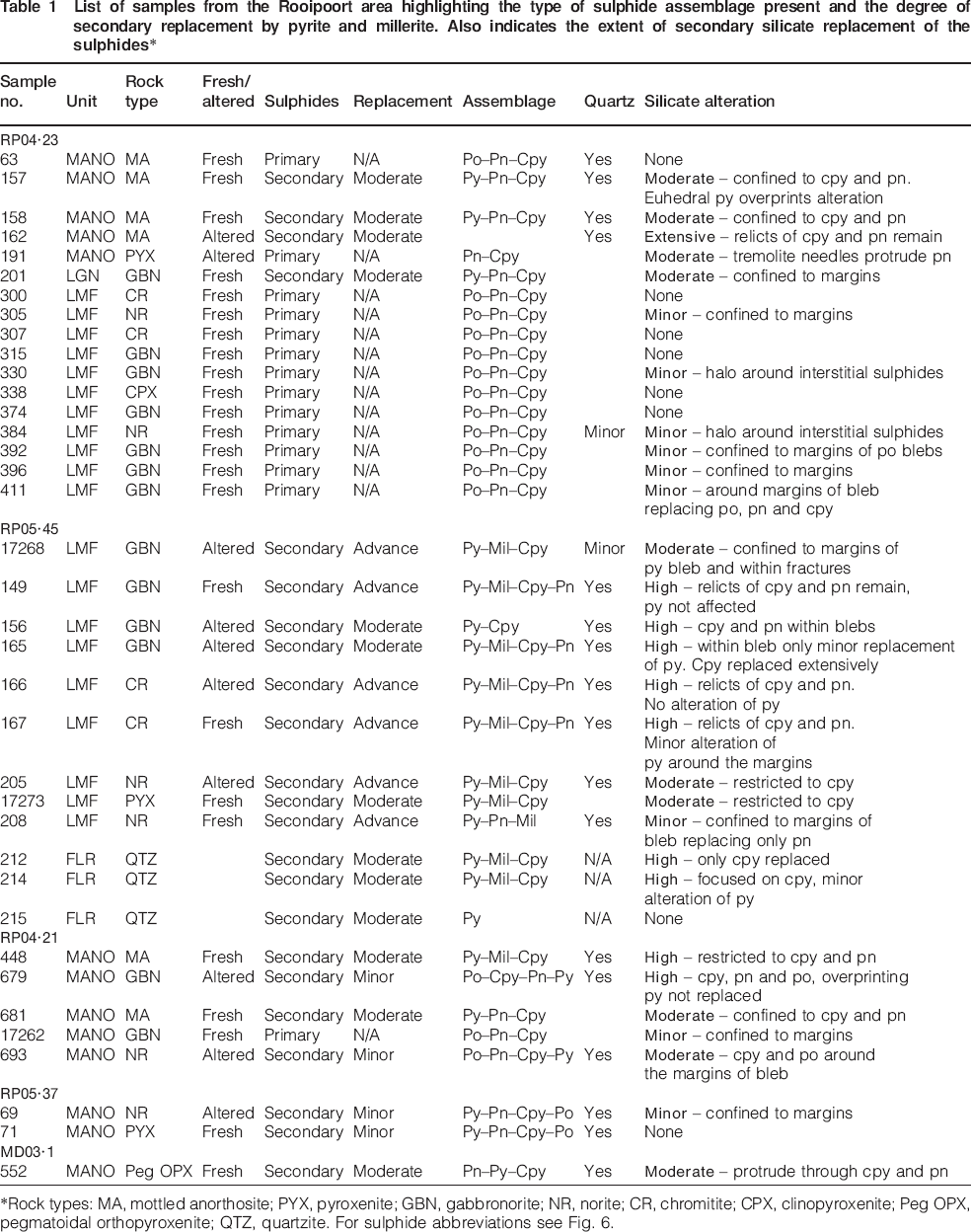
Rock types: MA, mottled anorthosite; PYX, pyroxenite; GBN, gabbronorite; NR, norite; CR, chromitite; CPX, clinopyroxenite; Peg OPX, pegmatoidal orthopyroxenite; QTZ, quartzite. For sulphide abbreviations see Fig. 6.
Secondary textured sulphide assemblages
Secondary textured sulphide assemblages are compositionally and texturally more complex and variable (Fig. 6c–h) and are dominated either by Py–Cpy–Pn±Po±Mil (Fig. 6c, d, e and h) or by Py–Pn±Mil (Fig. 6f and g) assemblages. The secondary textures evident are due to the replacement of the primary sulphide phases, chalcopyrite, pentlandite and pyrrhotite by later pyrite and millerite at low temperatures. The degree of replacement by pyrite and millerite is variable throughout the succession (Table 1; Fig. 6c–h) thus resulting in the diverse range of secondary textures observed in these sulphides. Secondary sulphides lack the well-defined phase zonation observed in the primary occurrences and although pyrrhotite, pentlandite and chalcopyrite remain abundant, they are joined by significant quantities of pyrite and millerite (Fig. 6c–j). Secondary assemblages are present as finely disseminated sulphides, intergranular polyphase sulphides and spherical to irregular shaped centimetre sized blebs. These sulphide assemblages dominate throughout the succession to the east of the Grasvally Fault and are also common west of the Grasvally Fault within much of the MANO. These sulphides are not stratiform and are hosted by a wide range of lithologies including gabbronorite, pyroxenites, mottled anorthosites and chromitites.
The degree of replacement of the original primary sulphides by pyrite and millerite varies considerably throughout the succession (Table 1) and can be considered to be a continuum from a purely magmatic assemblage such as those described in the section above to almost completely replaced sulphides. Figure 6 shows this progressive replacement style as preserved in various parts of the GNPA member. The sulphides which have experienced only minor replacement by low temperature pyrite retain the textures typical of primary assemblages and are still dominated by pyrrhotite (Fig. 6c and d). In these cases, pyrite forms only a minor phase and is seen to either replace chalcopyrite, pentlandite and pyrrhotite (Fig. 6c) or be confined to the margins where it overprints these primary phases (Fig. 6d). Millerite is not observed within these assemblages. Such textures are observed in both disseminated, interstitial assemblages and in large (≥1 cm), irregular shaped blebs; however, they are relatively uncommon and have only been observed within the MANO in boreholes RP04·21 and RP05·37 (Fig. 2; Table 1).
Sulphides which have experienced moderate replacement (Fig. 6e and f) are dominated by pyrite, with pyrrhotite completely replaced. Primary textures such as chalcopyrite exsolution flames and pentlandite around the margins however are preserved but to varying degrees (Fig. 6e). Pyrite appears to predominantly replace chalcopyrite and the surrounding plagioclase and clinopyroxene. From Fig. 6 it is evident that pyrite is not always seen to replace or overprint the paragenetically earlier pentlandite. Millerite is also present but forms only a minor phase and occurs as symplectic intergrowths within the pyrite. Where millerite is seen to replace pentlandite, it often retains the primary blocky texture of the latter. In addition, within moderately altered assemblages a close association is apparent between phlogopite and the sulphides. Quartz also commonly shows an affiliation to the sulphides which is observed throughout both the LMF and MANO. The quartz is typically developed around the margins of the sulphides (Fig. 5c) as coarse grains, and as fine grains within fractures which cross cut the sulphides. Both the quartz and phlogopite appear to coexist and do not appear to replace the pyrite. These textures are common throughout both the LMF and the MANO and are mostly observed in association with large (>1 cm in length) blebs.
Where sulphide replacement is the most advanced (Fig. 6g and h), pre-existing primary textures, such as the chalcopyrite exsolution flames, are completely overprinted. These sulphides are texturally the most complex and are overwhelmingly dominated by anhedral and euhedral pyrite that extensively replaced chalcopyrite, pyrrhotite and pentlandite (Fig. 6g and h). All these phases, including millerite, are observed throughout the pyrite as symplectic intergrowths. Quartz and phlogopite are spatially related to sulphide occurrences and often completely encase interstitial secondary sulphides (Fig. 5c). Magnetite and ilmenite are more common in areas where alteration has been extensive and typically exist along silicate-sulphide boundaries.
These textural observations are consistent with the replacement of pyrrhotite, chalcopyrite and pentlandite by pyrite and also pentlandite by millerite. Secondary silicate alteration is far more extensive than within primary sulphide assemblages and is not systematically related to the degree of sulphide replacement (Table 1). Within these secondary assemblages silicate alteration is generally restricted to the remnants of the primary chalcopyrite and pentlandite (Fig. 7b–d; Table 1). With increasing silicate alteration chalcopyrite and pentlandite become smaller and eventually only small relicts encased by actinolite, tremolite and chlorite exist. The original grain boundaries of these sulphide phases are often preserved as shown in Fig. 7c. Where alteration of the secondary pyrite and millerite is present it is limited to around the margins. Within most assemblages however, pyrite appears to be in textural equilibrium with the secondary silicates (Fig. 7b) suggesting silicate alteration occurred simultaneously with the crystallisation of pyrite. The close association of phlogopite and quartz with secondary sulphides suggests these phases also precipitated concurrently with pyrite and millerite.
In general, secondary textured sulphides are characterised by several key features, which include (i) the presence of pyrite and millerite; (ii) affiliation of phlogopite with disseminated and blebby sulphides most apparent in the chromitites; and (iii) also the association of intercumulus quartz with intergranular and blebby sulphides. In terms of PGE grade there is no notable difference between primary and secondary sulphides.
Footwall sulphide assemblages
Within the Magaliesberg Quartzite Formation directly underlying the GNPA member in the eastern part of Grasvally, two texturally distinct sulphide assemblages are present. Neither assemblage is confined to veins, or restricted to clear horizons, but instead the mineralisation appears disseminated in nature.
The most dominant assemblage is comprised only of pyrite. The pyrite is texturally distinct (Fig. 6i) and appears as polyphase aggregates or subhedral to irregular blebs which range in size from around 1 mm to >2 cm. The pyrite blebs are texturally unusual as they encompass resorbed quartz grains and are also characterised by straight boundaries (Fig. 6i). Small euhedral pyrite grains are observed disseminated within the quartzite where large blebs exist and the pyrite appears to be replacing/dissolving the quartz grains. Secondary silicates are not observed in association with this assemblage and the pyrite has not undergone any replacement. This assemblage also contains very minor chalcopyrite which is present either as tiny inclusions within the pyrite in association with very fine quartz or along fractures within the sulphide. The unusual texture of this pyrite is unique to the footwall rocks and has not been observed elsewhere in the GNPA member.
The second sulphide assemblage present in the footwall rocks is characterised by disseminated, intergranular sulphides which are comprised of either intergrown, anhedral pyrite with chalcopyrite and minor millerite or chalcopyrite which appears to be overprinted or surrounded by small, euhedral pyrite grains (Fig. 6i and j). Secondary chlorite appears to be developed in association with these sulphide assemblages. Within this assemblage the chalcopyrite is being replaced around the margins mostly by very small euhedral pyrite grains and minor millerite, with the original grain boundaries frequently preserved. The replacement textures imply that the pyrite formed after the chalcopyrite. Secondary silicates are also seen to replace chalcopyrite to varying degrees (Table 1). In contrast, the pyrite appears to have seen only minor replacement by secondary silicates.
The textural features potentially highlight three main sulphide phases developed in the footwall which include (i) polyphase aggregates of pyrite; (ii) relicts of primary intergranular chalcopyrite; and (iii) late-stage, low temperature pyrite and millerite.
Discussion
Regional context of the GNPA member
McDonald et al. (2005) were the first to challenge and question the viability of the long held notion that the GNPA member corresponds to the Upper Critical Zone of the eastern and western limbs (e.g. van der Merwe, 1976; 1978; Hulbert, 1983). This correlation is based on the assumption that the zones of mineralisation within the LMF and MANO correlate with the UG2 chromitite and the Merensky Reef, even though to date very few demonstrable similarities have been documented (Maier et al., 2008). McDonald et al. (2005) presented geochemical and mineralogical data highlighting the vast distinctions between the GNPA member and the Upper Critical Zone. Observations from this study reiterate some of these mineralogical differences and also demonstrate some fundamental differences in the style of PGE and BMS mineralisation between the GNPA member and the Critical Zone.
This study has highlighted that mineralisation in the GNPA member is not lithologically bounded and is distributed heterogeneously throughout the entire unit, unlike the Upper Critical Zone where mineralisation is confined to discrete layers usually associated with chromitites. Furthermore, in contrast to the sulphide poor (<0·1 wt-%) chromitites of the Upper Critical Zone where orthopyroxene prevails (Barnes and Maier, 2002), the sulphide rich (1 wt-%S) GNPA chromitites are characterised by unique chromite-clinopyroxene-plagioclase cumulates, which have not been documented elsewhere in the complex. For these reasons we do not believe the chromitites of the Upper Critical Zone in the eastern and western limbs of the Bushveld can be correlated with those observed in the LMF of the GNPA member. Furthermore, throughout the GNPA member clinopyroxene is ubiquitous at between <10 and <30 modal% even where chromite is present, whereas in the Critical Zone it forms <10 modal% (Cameron, 1982; Maier and Barnes, 1998). In terms of PGE mineralisation, the GNPA member contains notably lower PGE grades of <4 ppm (3PGE+Au) and Pt/Pd ratios (<1) than typical of the Upper Critical Zone where PGE grades range from 4 to 6 ppm (3PGE+Au; McDonald and Holwell, 2011). To fully constrain the context of the GNPA member with the rest of the Bushveld Complex a detailed comparison of the PGE geochemistry and mineralogy is required and will be addressed in a companion paper.
Sulphide mineralogy and distribution
The most significant finding of this study is the extensive and widespread replacement style of primary magmatic sulphides to varying extents by low temperature pyrite and millerite; a feature which has not been observed elsewhere in the Bushveld Complex PGE deposits. The sulphide assemblage Po–Cpy–Pn, and the textural relations between these three phases are considered typical of magmatic Ni–Cu–PGE deposits (Naldrett, 2004). The sulphides termed primary are thus considered to represent the direct cooling product of a fractionating sulphide liquid, with pyrrhotite and pentlandite exsolved from high temperature monosulphide solid solution (mss) which crystallises at around 1000°C, and chalcopyrite exsolved from intermediate solid solution (iss) which forms at 900°C (Holwell and McDonald, 2010). This sulphide assemblage is thus interpreted to be purely magmatic in origin and so represent an initial primary style of mineralisation within the GNPA member.
We propose that the secondary assemblages Py–Cpy–Pn±Po±Mil and Py–Pn±Mil formed by low temperature replacement of the primary sulphides, potentially related to late-stage magmatic fluids. The textural variability of these sulphides is resultant from the different degrees of alteration the primary assemblage experienced through the continuum illustrated in Fig. 6.
Experimental studies carried out by Craig (1983) have also shown that the assemblage Py–Pn–Mil, typical of the secondary sulphides throughout the GNPA member, is only stable at temperatures below 200°C. This therefore confirms that these texturally complex assemblages must be derived through low temperature alteration. This notion is further supported by the coexistence of pyrite and pentlandite which is commonly observed throughout the GNPA succession. Experimental work has shown that these two phases should not be able to co-exist above 212–230°C (Naldrett and Kullerud, 1968; Naldrett et al., 1968; Craig, 1983; Misra and Fleet, 1984), therefore one of the phases must have crystallised at higher temperatures. The dominance of pentlandite within the primary assemblages and its coarse nature suggests that it exsolved from mss at high temperatures (from 650 to 230°C). Therefore the pyrite must have only been capable of crystallising at temperatures below 230°C (cf. Dare et al., 2011). In addition the lack of zoning within the pyrite, which has been attributed as a primary texture (Dare et al., 2011), further supports that the pyrite present within the GNPA member is not of high temperature, magmatic origin.
Although not recorded within the Bushveld Complex, identical secondary sulphide assemblages have been documented within the PGE-bearing Lac des Iles Complex, Ontario (Djon and Barnes, 2012), where such assemblages were generated through interaction with late magmatic fluids and the loss of Fe to actinolite and chlorite at temperatures below 213°C. Thus, it is plausible to suggest that within the GNPA member precipitation of pyrite and millerite occurred at comparable temperatures of around 200°C, and that the replacement of the sulphides was most likely concurrent with alteration by actinolite and chlorite. Furthermore, the close association of the secondary silicates actinolite, talc, tremolite, chlorite and serpentine with the secondary sulphides throughout the GNPA member suggests that both silicate and sulphide replacement occurred in relation to the same low temperature alteration event. The presence of sharp contacts between the pyrite and altered amphiboles and the observed restriction of silicate replacement to the relicts of the primary chalcopyrite and pentlandite, further supports this notion. These observations also strongly suggest that the pyrite and secondary silicates crystallised concurrently.
An intriguing finding from this study is that although sulphide mineralisation is distributed throughout the GNPA member in a discontinuous manner, a pattern exists in the distribution of secondary sulphides. Spatially, these secondary sulphides are more abundant to the east of the Grasvally Fault, where quartzites directly underlie the GNPA member (Table 1). Furthermore, within this region there is an apparent decrease in the degree of alteration by pyrite upwards through the succession into the MANO (Table 1), with only partial replacement of pyrrhotite by pyrite observed. We have demonstrated throughout the discussion that these sulphides were derived through low temperature alteration. The greater abundance of these sulphides and the higher degree of pyrite replacement towards the base of the GNPA member (where underlain by quartzites) strongly suggests a footwall influence over the development of these secondary sulphides. If this alteration occurred in response to the circulation of fluids then the spatial distribution of these sulphides is consistent with either; (i) the fluid being derived from the floor rocks through metamorphism or (ii) the quartzite-LMF contact acting as a preferential fluid conduit.
It is important to highlight that although low temperature alteration within the northern limb of the Bushveld Complex is widespread, within the Platreef it has resulted only in the replacement of sulphides by secondary silicates (Armitage et al., 2002; Hutchinson and Kinnaird, 2005; Holwell et al., 2006; Holwell and McDonald, 2007; Yudovskaya et al., 2011). Within the GNPA member however it has also resulted in the extensive replacement of primary sulphides by pyrite and millerite. The reasons for this distinction between the Platreef and the GNPA member are currently unclear, although may include variations in fluid composition, floor rock composition and the amount of contamination. The effect of the significant thickness differences and thus cooling regimes needs to also be considered and explored.
Within magmatic sulphide systems the association of phlogopite with sulphides is common and in the Bushveld Complex has been noted in the Merensky Reef, the Platreef and the GNPA member. Ballhaus and Stumpfl (1986) concluded that within the Merensky Reef, phlogopite pre-dated sulphide solidification and proposed that this association resulted from the development of a Cl-rich fluid derived from the sulphide melt. In contrast to the Merenksy Reef, phlogopite does not occur as inclusions with the GNPA member sulphides and textural relations imply that its formation post-dates the crystallisation of primary sulphides. Within the Platreef the majority of quartz is found in association with felsic veins, whereas in the GNPA member it is closely associated with secondary sulphides. The restriction of quartz to the secondary sulphides (Table 1) where it encases the sulphide grains implies that it precipitated during low temperature alteration of the sulphides which was potentially initiated by the circulation of hydrothermal fluids. The timing of quartz precipitation relative to that of the secondary silicates has not been constrained, but their close association with secondary sulphides suggests they all developed at comparable times to the formation of secondary sulphides.
A paragenetic sequence for the development of sulphides and secondary silicates for the GNPA member is provided in Fig. 8. Between 650 and 250°C pyrrhotite and pentlandite exsolved from mss, whereas chalcopyrite exsolved at similar temperatures from iss. On further cooling to below 230°C, low temperature alteration in some areas resulted in the precipitation of pyrite and millerite, replacing the original primary assemblage to varying degrees. Textural relations imply that the precipitation of secondary silicates and quartz occurred at similar times and temperatures to the precipitation of pyrite and are thus associated with the late-stage low temperature alteration. It is thought that the sulphides present within the footwall quartzites were transported via the downward migration of an immiscible sulphide melt.
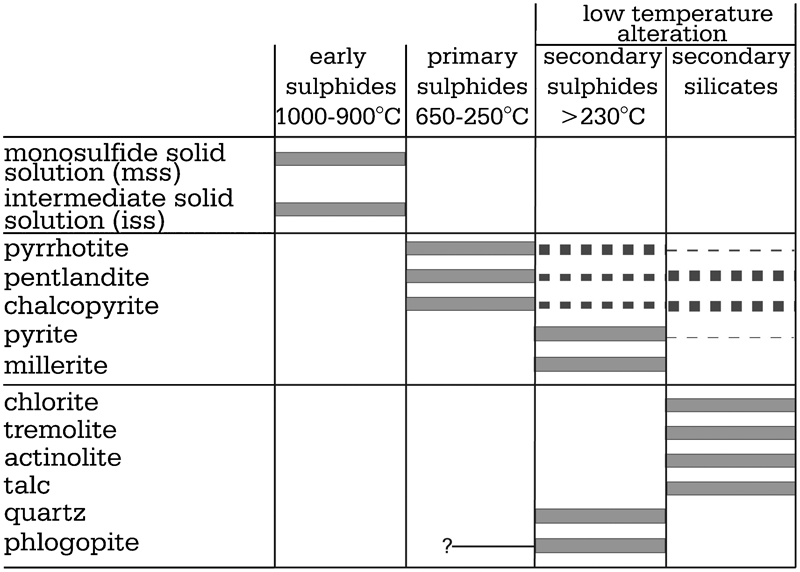
Paragenetic sequence for sulphide and secondary silicate generation within the GNPA member. Thick, grey boxes represent phases crystallising, whereas dashed line indicates phases being replaced. Thickness of lines indicates degree of replacement, increasing with extent of replacement. Temperatures for the crystallisation of mss, iss, pyrrhotite, pentlandite and chalcopyrite are taken from McDonald and Holwell (2011). Temperature estimations for the precipitation of pyrite and millerite are based on the experimental work by Naldrett and Kullerud (1968), Naldrett et al. (1968), Craig (1983) and Misra and Fleet (1984)
Implications for PGE mineralisation
Throughout the GNPA member low temperature alteration has had a profound control over the mineralogy of the sulphides and this study has highlighted the possibility that late-stage low temperature hydrothermal fluids have interacted significantly with the unit. Economically, it is important to constrain the effect of fluids on the mineralogy and distribution of PGE and on ore grades throughout the GNPA member. At Turfspruit, Macalacaskop and Sandsloot, where fluids have interacted with the Platreef and metsedimentary rocks form the footwall, PGE are locally decoupled from BMS on a scale of micrometres to centimetres (Hutchinson and Kinnaird, 2005; Kinnaird, 2005; Kinnaird et al., 2005; Holwell et al., 2006). In comparison, on Rooipoort Maier et al. (2008) showed that within the GNPA member a positive correlation exists between PGE and BMS. Thus, unlike parts of the Platreef, where both the PGE mineralogy and distribution can be controlled by syn- or post-magmatic fluid activity, the GNPA member may be more comparable to the Lac des Iles Complex where low temperature alteration has changed only the mineralogy of the PGM and sulphides but had no control over the distribution of PGE. A more comprehensive study of the PGE mineralogy and geochemistry will be presented in a subsequent paper which will build on the identification of low temperature alteration in this study.
Conclusions
Within the northern limb of the Bushveld Complex, late-stage low temperature alteration is widespread in both the Platreef and the GNPA member however the development of secondary sulphides is restricted to the later. The initial style of BMS mineralisation within the GNPA member is characterised by the primary sulphide assemblage Po–Pn–Cpy which is magmatic in origin and represents the direct cooling product of a fractionating sulphide liquid. These phases exsolved from the high temperature monosulphide solid solution (mss) and intermediate solid solution (iss) at temperatures between 650 and 250°C. Low temperature alteration has significantly altered much of the primary sulphide mineralogy, resulting in the development of the secondary assemblages Py–Cpy–Pn±Po±Mil and Py–Pn±Mil. Textural relations suggest pyrite and millerite crystallised at temperatures below 230°C. A close association is apparent between the secondary sulphides and the secondary silicates actinolite, tremolite and chlorite which crystallised at comparable times and thus temperatures. The greater abundance of secondary sulphides and the higher degree of pyrite and millerite replacement towards the base of the GNPA member, where underlain by quartzites strongly suggests a footwall control over the low temperature alteration and thus the extent of the development of these secondary sulphide assemblages.
Footnotes
Acknowledgements
The authors would like to thank Caledonia Mining Corporation and in particular Trevor Pearton, for allowing access to the drillcore on the farms Rooipoort, Grasvally and Moorddrift, and giving permission to publish this work. Jennifer Smith's PhD research is funded by the Natural Environment Research Council (NE/1528426/1). Constructive reviews by Judith Kinnaird and an anonymous referee helped improve the quality of the manuscript.
This paper is part of a special issue on Ni-PGE deposits