







Abstract
Two distinct platinum-group mineral (PGM) assemblages have been identified in the Fazenda Mirabela intrusion that hosts the Ni–Cu–platinum-group element (PGE) Santa Rita ore zone in Bahia State, north-eastern Brazil: (i) Pt–Pd–Ni tellurides accompanied by Ag–Te, with minor electrum and native Au, and (ii) Pd alloys accompanied by minor PGE arsenides and sulphides. Assemblage (i) is present in the Santa Rita ore zone and underlying S-poor footwall dunite whereas assemblage (ii) is observed in the dunite only. The assemblage (i) PGE tellurides crystallised from a late stage semimetal-rich PGE-bearing melt produced by sulphide fractionation and/or via exsolution from sulphides during subsolidus cooling. In assemblage (i) in the Santa Rita ore zone, PGM are also commonly found within base metal sulphide (BMS) veinlets which have either formed as a result of post-magmatic hydrothermal remobilisation or by the simultaneous crystallisation of PGM and BMS from a late stage volatile-rich melt. In the S-poor footwall dunite that hosts assemblage (ii), Pd alloys have formed through the interaction of sulphides with a late stage melt or high temperature hydrothermal fluid. This liquid had a high oxygen fugacity (
 ) that caused S loss evidenced by the formation of micro-scale textures that resemble symplectites or intergrowths of sulphides with olivine and occasionally orthopyroxene, and the formation of magnetite. During sulphur loss, semimetals (particularly Te) were also stripped from the dunite while PGE were expelled from the symplectite-like sulphides forming Pd alloys. PGE tellurides are present in the dunite where S and semimetals have not been completely stripped from the rock suggesting that this late stage melt or high temperature hydrothermal fluid was not pervasive throughout the dunite.
Introduction
The Fazenda Mirabela intrusion is an ultramafic–mafic layered igneous body situated in Bahia State, north-eastern Brazil (Fig. 1). The intrusion hosts the Santa Rita ore deposit (Barnes et al., 2011; Inwood et al., 2011), a Ni–Cu–sulphide ore zone that varies in thickness up to 200 m. This ore zone is also platinum-group element (PGE) bearing with Pt+Pd concentrations typically between 0·1 and 0·5 ppm. The ore body is hosted in the ultramafic sequence but lies close to the boundary with the overlying mafic sequence.
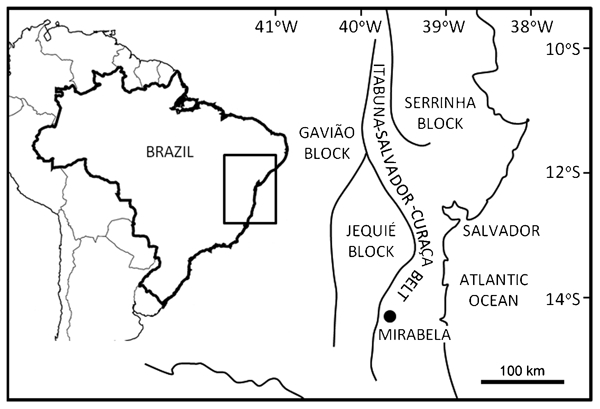
Map showing the location of the Fazenda Mirabela intrusion [modified after Barbosa and Sabaté (2004)]
This deposit is rather unusual for several reasons. The Santa Rita ore zone consists of disseminated sulphides and is thicker than other stratiform sulphide zones in layered intrusions (e.g. Great Dyke, Wilson et al., 1989; Munni Munni, Barnes et al., 1992; Luanga, Ferreira Filho et al., 2007). It is also much thicker than PGE reefs such as the Merensky Reef in the Bushveld Complex or the J–M Reef in the Stillwater Complex that are only a metre or so thick (Maier, 2005; Naldrett et al., 2009). Barnes et al. (2011) characterised the Santa Rita ore zone as having extremely high Ni tenors while being generally PGE-poor. They attributed the formation of the Santa Rita ore zone and the Ni-rich nature of the sulphide ore to the mixing of an initially S-undersaturated, moderately Ni enriched resident magma with a relatively low Ni, PGE-depleted, and significantly lower temperature replenishing magma charged with suspended sulphide liquid droplets. This study is the first to characterise the platinum-group minerals (PGM) present in order to improve the understanding of the PGE mineralisation within the intrusion.
The Mirabela Fazenda intrusion
The Mirabela Fazenda ultramafic–mafic body was intruded into the southern portion of the Archaean-Palaeoproterozoic Itabuna-Salvador-Curaça belt, close to the Archaean Jequié block in the west. This belt consists primarily of a low-K calc-alkaline plutonic suite and was formed during the collision of Archaean blocks during the Palaeoproterozoic Transamazonian orogeny (2·15–2·05 Ga; Barbosa and Sabaté, 2004). The country rocks to the intrusion consist of a previously deformed sequence of granulite facies charnockite and enderbite orthogneisses, as well as a supracrustal sequence consisting primarily of gneisses, meta-gabbronorite sills, banded iron formations and rare serpentinites (Barbosa and Sabaté, 2004). The Mirabela intrusion has been dated at 2·2 Ga using the Sm–Nd method by Silva et al. (1996); however, this is inconsistent with the observation that the intrusion postdates the peak granulite facies metamorphism at ∼2·1 Ga (Barnes et al., 2011).
The intrusion can be broadly divided into two northeast-dipping mega-sequences (Fig. 2): a lower sequence exposed in the western part of the intrusion comprised of ultramafic rocks (dunite, harzburgite, olivine orthopyroxenite, orthopyroxenite and websterite), and an upper sequence exposed in the eastern part of the intrusion comprised of mafic rocks (predominantly gabbronorite). The surface expression of the intrusion is approximately 2·5×4·2 km covering an area of ∼7 km2 (Barnes et al., 2011).
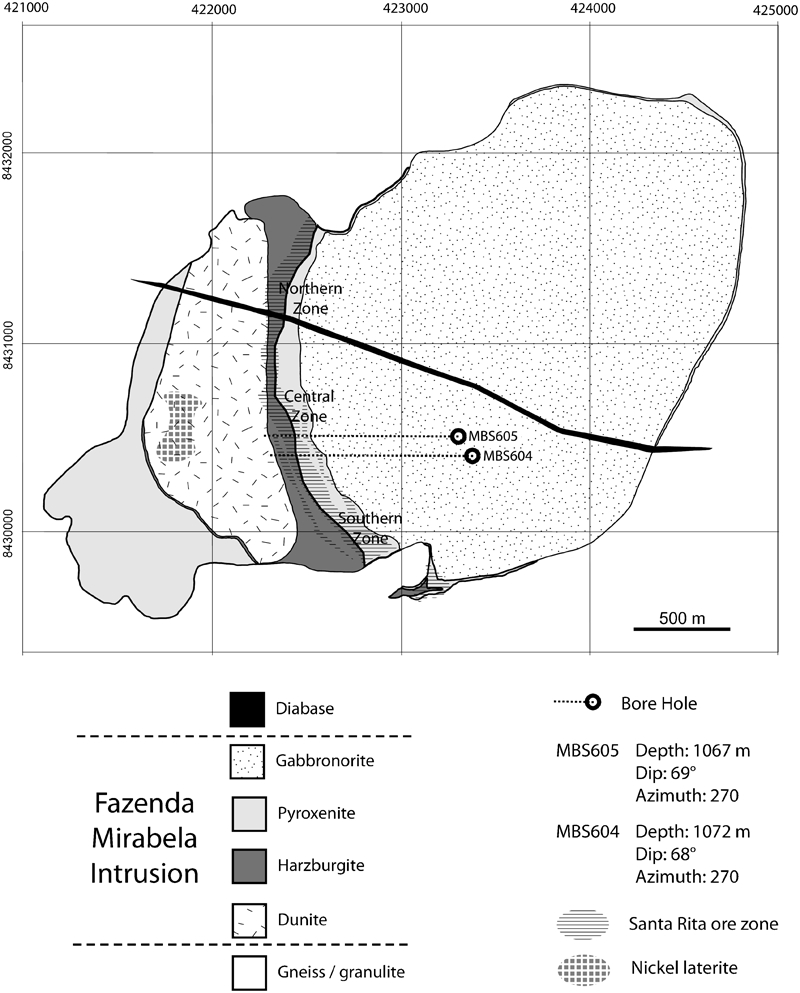
The stratigraphic base of the Mirabela intrusion is a reversely differentiated sequence comprising ∼90 m of gabbronorite overlain by ∼130 m of orthopyroxenite. These units are overlain by the ultramafic mega-sequence that is typically ∼730 m thick and consists of ∼600 m dunite, ∼50 m harzburgite, ∼25 m olivine orthopyroxenite and ∼50 m orthopyroxenite. The ultramafic mega-sequence is capped by a websterite unit only a few metres thick. This is overlain by the mafic mega-sequence (∼1000 m thick) comprised of gabbronorite, leuco-gabbronorite and augite norite (Barnes et al., 2011). The intrusion is cross cut by minor younger mafic dykes and granitic pegmatites.
The Santa Rita Ni–Cu–(PGE) sulphide deposit is a semi-continuous stratiform ore body hosted by the harzburgite, olivine orthopyroxenite and orthopyroxenite units in the upper ∼100 m of the ultramafic mega-sequence. The Santa Rita ore zone consists of 0·5–5 wt-% disseminated sulphides and is subject to lateral variation across the intrusion from north to south (Barnes et al., 2011). The ore zone varies in thickness from a single well defined ∼50 m layer at the northern margin to a thick (up to 200 m) discontinuous zone at the southern margin while transgressing upwards through the silicate stratigraphy (Barnes et al., 2011). Pentlandite is the dominant sulphide phase present in the Santa Rita ore zone accompanied by pyrrhotite, chalcopyrite and pyrite. The combined proven and probable reserves of the Santa Rita deposit as of January 2011 stood at 159 million metric tonnes at 0·52 wt-%Ni, 0·13 wt-%Cu, 0·015 wt-%Co, and 86 ppb Pt (Mirabela Nickel Ltd. Annual Report 31 December 2010).
Sampling and analytical methods
The Mirabela intrusion has been divided into three zones for mining purposes; southern, central and northern (Fig. 2). For this initial study, drill core from two boreholes 100 m apart in the central zone, MBS604 and MBS605 was sampled with the aid of mine assay data (Figs. 3 and 4) in order to select the samples with both the highest PGE contents (Pt+Pd about 0·2–1·5 ppm) from each lithology as well as variable Pd/Pt ratios. The sampling was also extended ∼100 m below the defined economic limits of the Santa Rita ore zone in order to capture all lithologies with anomalous Pt and Pd contents. The commercial mine assay data were determined from one metre composite intervals of diamond drill core by ALS Chemex Ltd, Vancouver, Canada. Fire assay was used to determine Au, Pt and Pd by inductively coupled plasma–mass spectrometry (ICP–MS) finish while multi-element ICP–MS was used to obtain data for the other elements reported here. Of the 25 samples collected, 11 from MBS604 (PTSR-01 through PTSR-11) and 10 from MBS605 (PTSR-16 through PTSR-25) had significant PGE concentrations and were selected for detailed mineralogical analysis.
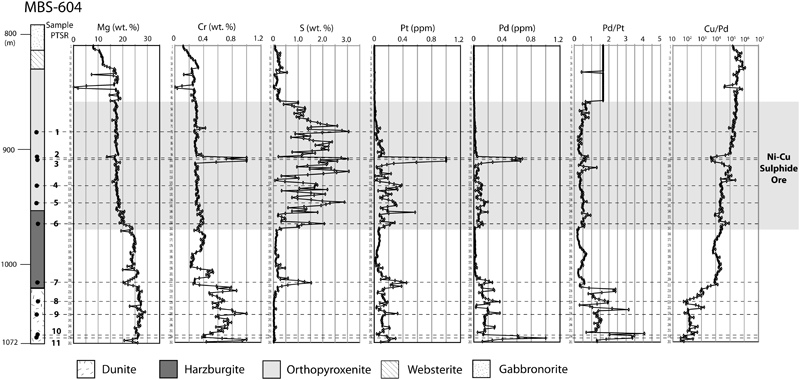
Geochemical profile of borehole MBS604 showing the location of the Santa Rita ore zone and metres where core was sampled. The Ni–Cu sulphide ore zone is defined by Ni cut-off grade
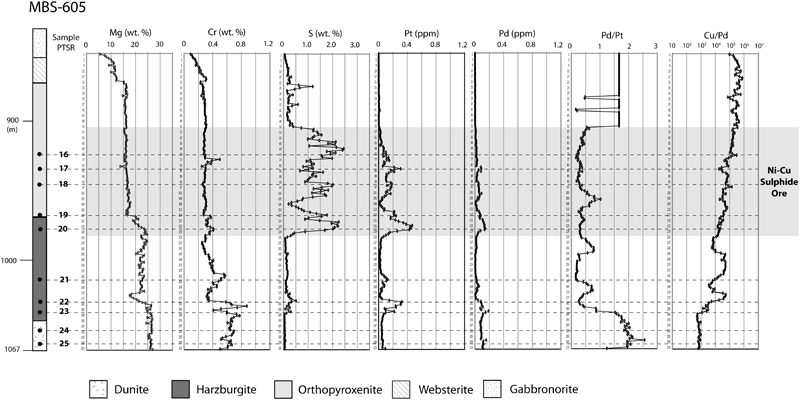
Geochemical profile of borehole MBS605 showing the location of the Santa Rita ore zone and metres where core was sampled. The Ni–Cu sulphide ore zone is defined by Ni cut-off grade
The silicate and sulphide mineralogy of the 25 samples were characterized using transmitted and reflected light microscopy of thin sections and polished blocks respectively. PGM and associated sulphide and silicate minerals were identified and analysed using a Cambridge Instruments (now Carl Zeiss NTS) S360 scanning electron microscope (SEM). Polished blocks were searched systematically for PGM using the SEM set at a magnification of ×100. Quantitative analyses of the larger PGM (>0·3×0·3 μm) were obtained using an Oxford Instruments INCA Energy EDX analyser attached to the SEM. Operating conditions for the quantitative analyses were 20 kV, with a specimen calibration current of ∼1 nA and a working distance of 25 mm. A cobalt reference standard was regularly analysed in order to check for any drift in the analytical conditions. A comprehensive set of standards obtained from MicroAnalysis Consultants Ltd (St Ives, Cambridgeshire) was used to calibrate the EDX analyser. Images were obtained using a four-quadrant back-scattered detector operating at 20 kV, a beam current of ∼500 pA, and a working distance of 13 mm, under which conditions magnifications of up to ×15 000 are possible.
Borehole profiles
The borehole profiles for MBS604 (Fig. 3) and MBS605 (Fig. 4) show Mg (wt-%), Cr (wt-%), S (wt-%), Pt (ppm), Pd (ppm) as well as Pd/Pt and Cu/Pd ratios from the top of the boreholes intersecting the lowermost gabbronorite to the termination of the boreholes which intersect the upper portion of the dunite. Pt and Pd contents above the Santa Rita ore zone are extremely low (close to or at the detection limit [Pd 0·5 ppb, Pt 0·3 ppb]); therefore Pd/Pt ratios were limited to 1·75 in samples where Pt+Pd was less than 10 ppb. Sample numbers are also located at their respective depths in Figs. 3 and 4, thus showing how the sampling was extended below the economic limits defining the Santa Rita ore zone into anomalous high PGE and low S zones.
Stratigraphy
A brief description of the textures observed in these two boreholes from the central zone (Figs. 3 and 4) is presented here for comparison with the extensive descriptions of these lithologies given in Barnes et al. (2011). The boreholes studied intersect all of the major lithologies present in the Mirabela intrusion. These are, from the bottom to the top of each borehole, dunite, harzburgite, orthopyroxenite, websterite and gabbronorite. Magnesium and Cr correlate well with the different lithologies both progressively decreasing in content upwards from the dunite to the gabbronorite. The igneous rocks are all adcumulates with a maximum of five modal percent intercumulus silicates (typically plagioclase, clinopyroxene and phlogopite). Only the upper part of the dunite is intersected in the two boreholes selected for study. Orthopyroxene oikocrysts are present in this dunite producing a bulk Mg content lower than that expected of a typical dunite. This unit is overlain by harzburgite where orthopyroxene and olivine are present in equal proportions. Gradational progression into olivine orthopyroxenite and orthopyroxenite then occurs as a product of fractional crystallisation. The orthopyroxenite layer is the thickest lithology encountered in both boreholes MBS604 and MBS605. The websterite above acts as a cap rock for the ultramafic mega-sequence and is a thin layer (approximately 10–15 m thick) comprised of orthopyroxene and clinopyroxene in equal proportions. The lower part of the overlying gabbronorite is intersected at the top of both boreholes; however, this lithology does not host any S or PGE mineralisation and therefore is not examined in this study.
Santa Rita ore zone
The Santa Rita sulphide ore zone occurs within the ultramafic units, predominantly in the orthopyroxenite layer (excluding the upper part of this lithology) as well as in the uppermost part of the underlying harzburgite which includes the upward gradational transition from harzburgite to olivine orthopyroxenite (Figs. 3 and 4). The Santa Rita ore zone is clearly observed in both boreholes shown by increased S characterising a thick layer of disseminated sulphides (pentlandite, chalcopyrite, pyrrhotite and pyrite). This zone is accompanied by an increase in predominantly Ni, but also Cu. The unusual Ni-rich nature of this deposit is also noted by Barnes et al. (2011) who calculated Ni tenors of 20% in this zone. Using microscopy, pyrite is observed to be intergrown with pentlandite. Pentlandite (±intergrown pyrite) tends to form the cores of interstitial sulphide blebs (typically 1 mm across) with chalcopyrite and pyrrhotite restricted to the edges. Much smaller chalcopyrite and pyrrhotite crystals do occur separately from these larger composite base metal sulphide (BMS) crystals.
This sulphide mineralisation is also accompanied by elevated PGE concentrations. Pt+Pd contents typically vary from 0·1 to 0·5 ppm and average 0·2 ppm for both of the boreholes studied. A unique chromite-rich seam (>10% chromite) is present midway through the Santa Rita ore zone in MBS604 (Fig. 3). This thin (∼2 m thick) seam is hosted within the orthopyroxenite layer. However, minerals associated with the chromite-rich seam include both orthopyroxene and olivine cumulates. Whole rock PGE contents associated with this chromite-rich seam are the highest identified in the investigated core with Pd>0·5 ppm and Pt particularly elevated at >1 ppm (capped at 1 ppm due to the accuracy of the mine assay data). Pd/Pt ratios are typically <1 over the entire Santa Rita ore zone even within the chromite-rich seam.
The intrusion is remarkably fresh with magmatic minerals and textures preserved. However, minor localised patches and veins of serpentinisation are observed in the Santa Rita ore zone. While most sulphides remain as unaltered interstitial blebs, some sulphides occur as small veinlets only a few micrometres wide. In some cases, these veinlets are enclosed by slightly larger serpentine veins (∼10 μm wide).
S-poor footwall dunite
PGE mineralisation also occurs in the S-poor dunite which acts as the footwall to the overlying Santa Rita ore zone and harzburgite. This dunite has low S concentrations (<0·1 wt-%) with no sulphides visible in hand specimen; however, sulphides are still observed using microscopy. Pentlandite is the dominant sulphide phase present accompanied by minor chalcopyrite. In contrast to the Santa Rita ore zone, pyrite and pyrrhotite are both absent from MBS604 whereas minor amounts of pyrite have been observed on two occasions in MBS605. These sulphides are extremely disseminated throughout the dunite forming very small (<150 μm across) interstitial crystals.
Sulphide-silicate mixtures with micro-scale textures that resemble symplectites are observed (Fig. 5A–D). These and other sulphides are often located adjacent to phlogopite (Fig. 5A and B). The BMS also exhibit micro-scale patches and veinlets of magnetite within them (Fig. 5C and D). On one occasion a magnetite rim was observed partially enclosing a patch of silicate material which also included a small bleb of pentlandite adjacent to a larger crystal of pentlandite (Fig. 5E). As in the Santa Rita ore zone, localised areas and veins of serpentinisation are observed. On one occasion magnetite is present with pentlandite in a vein of serpentine (Fig. 5F).
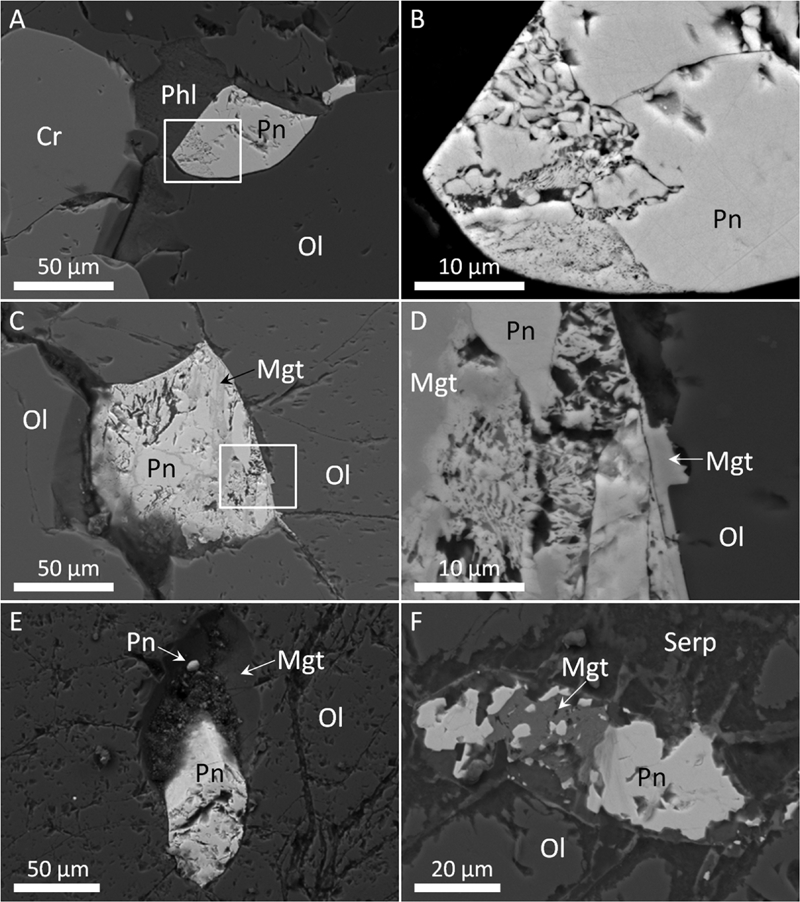
Back-scattered electron images of BMS in the S-poor footwall dunite. (A) and inset (B): Example of micro-scale symplectite-like textures (coarse and fine) in pentlandite (Pn) associated with phlogopite (Phl). (C) and inset (D): As above with patches and veins of magnetite (Mgt) identified in the Pn associated with olivine (Ol). (E): Example of possible sulphur loss marked by a preserved droplet of Pn in a patch of varying silicate chemistry partially rimmed by Mgt. (F): Formation of Mgt in Pn due to serpentinisation (Serp) of Ol
This dunite displays a decoupling of S and PGE (Figs. 3 and 4). Pt+Pd concentrations in MBS605 are typically between 0·1 and 0·2 ppm whereas in MBS604 they are commonly >0·3 ppm. Core with relatively high Pd concentrations of 0·6 ppm and on one occasion >1 ppm is restricted to MBS604 (includes sample PTSR-11; Fig. 3). This high PGE (Pd) interval was not intersected by MBS605.
In contrast to the Santa Rita ore zone, Pd/Pt ratios in the S-poor dunite are typically >1. In MBS605 Pd/Pt ratios are slightly higher (∼2; Fig. 4) than those in MBS604 (∼1·5; Fig. 3) where this ratio is also more variable. The transition from high Pd/Pt ratios in the dunite to low ratios in the Santa Rita ore zone is sharp and occurs at the upper boundary of the dunite in both boreholes. Thus the dunite is relatively more Pd enriched whereas the Santa Rita ore zone is more Pt enriched.
Platinum-group mineralogy
PGM assemblages
This initial study of PGM from the Fazenda Mirabela intrusion has revealed the presence of two distinct assemblages; (i) Pt–Pd–Ni tellurides with accessory Ag telluride, rare electrum and native Au grains, and (ii) Pd alloys with minor PGE-bearing arsenides and sulphides. PGM compositions and abundances are given in Table 1.
The distribution and number of different PGM in samples PTSR01-11 and PTSR16-25 from boreholes MBS604 and MBS605 respectively*
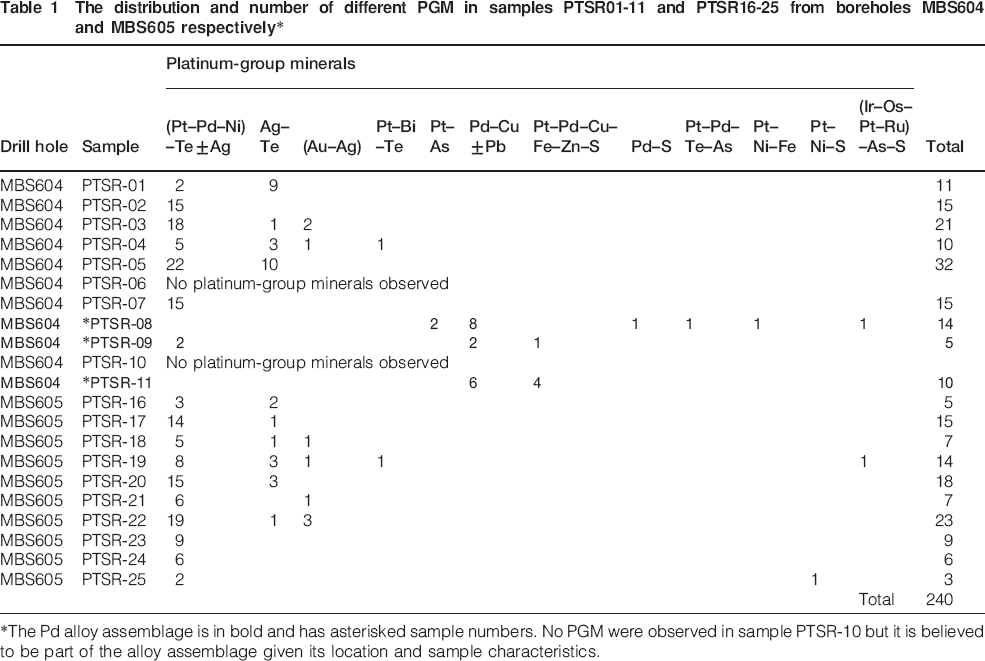
The Pd alloy assemblage is in bold and has asterisked sample numbers. No PGM were observed in sample PTSR-10 but it is believed to be part of the alloy assemblage given its location and sample characteristics.
Assemblages (i) and (ii) occupy different positions in the Mirabela intrusion (Fig. 6). The telluride assemblage (i) is found within the Santa Rita ore zone in both MBS604 and MBS605. Furthermore, this telluride assemblage is also identified in the S-poor footwall dunite in MBS605 where it is defined as assemblage (i*). Assemblage (ii) however, is only identified in the S-poor footwall dunite in MBS604.
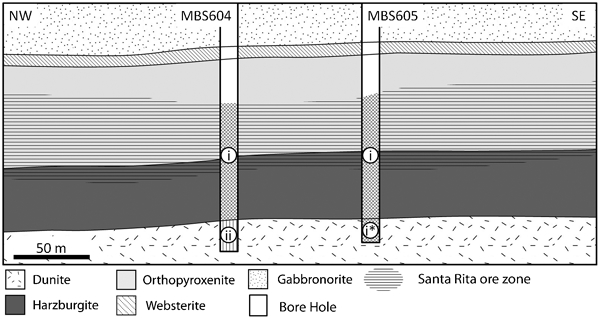
Schematic diagram showing the location of the two PGM assemblages identified. Positions of assemblages (i) and (ii) are marked: (i*) indicates where assemblage (i) is present in the S-poor footwall dunite
Assemblage (i) PGE tellurides
Assemblage (i), Pt–Pd–Ni tellurides with accessory Ag telluride, rare electrum and native Au grains, occurs in the Santa Rita ore zone. This assemblage is present in samples PTSR01 to PTSR07 (MBS604) and PTSR16 to PTSR23 (MBS605; Fig. 6).
Pt–Pd–Ni telluride grains are predominantly associated with sulphides either appearing to be fully enclosed by the sulphide or at the edge of the sulphide where also in contact with either a silicate, oxide or another sulphide phase (Fig. 7A and B). The PGM are associated with all of the sulphide phases present in the Santa Rita ore zone: pentlandite, chalcopyrite, pyrrhotite and pyrite. None of these PGM are spatially associated with chromite grains, even in samples from the chromite-rich seam located midway through the Santa Rita ore zone in MBS604 hosting the highest PGE contents in the investigated core (Pd>0·5 ppm, Pt>1 ppm; Fig. 3). These PGE tellurides display a variety of crystal forms including laths and tabular crystals (Fig. 7A and B) as well as rounded blebs (Fig. 7C).
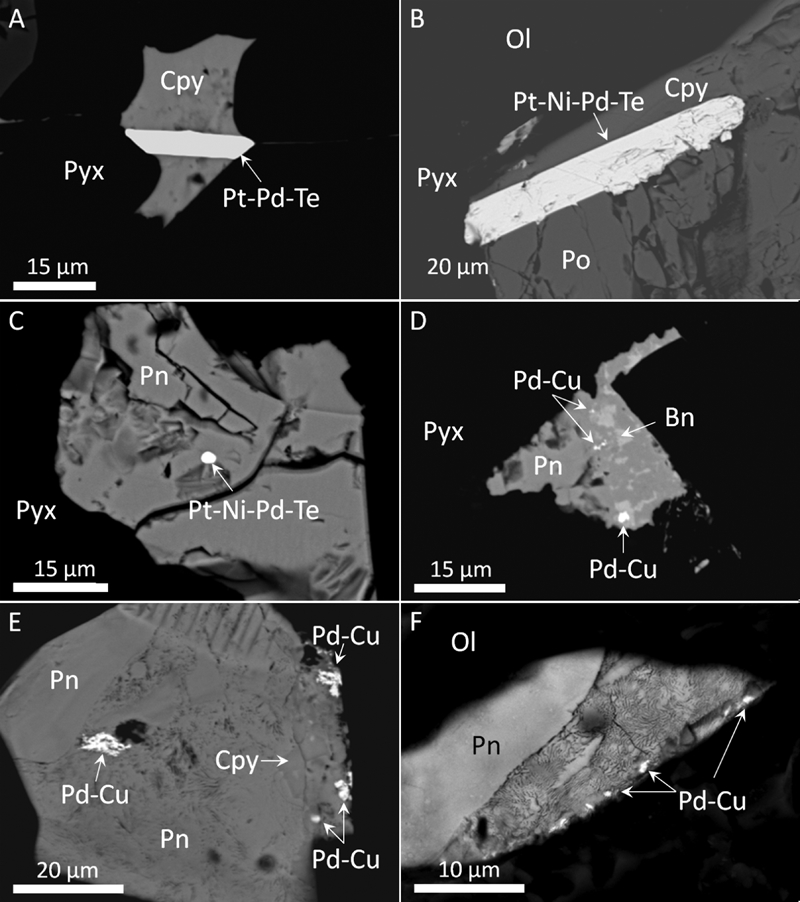
Back-scattered electron images representative of the PGM typically observed. (A)–(C): Examples of assemblage (i) with Pt–Pd–Ni telluride and their association with BMS chalcopyrite (Cpy) and pyrrhotite (Po). Both tabular, in contact with pyroxene (Pyx), and bleb crystal forms are demonstrated. (D)–(F): Typical examples of assemblage (ii) showing Pd–Cu alloys, all of which are associated with Pn and in one case bornite (Bn). (E) and (F): Examples of micro-scale symplectite-like textures demonstrating PGE expulsion and diffusion to the crystal edges
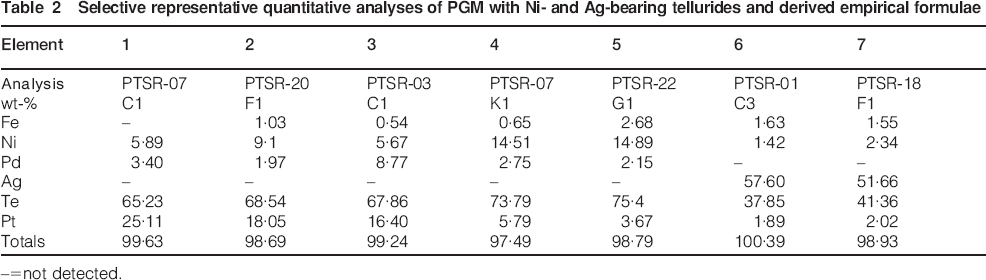
The chemistry of these Pt–Pd–Ni tellurides varies from grain to grain with Pt, Pd and Ni substituting for each other (Table 2). Where present, Fe comprises up to 5 wt-% of these PGM. Quantitative analyses of these PGE tellurides show that they have the empirical formula (PtxPdxNixFex)1·00Te2·00 (Table 2). Table 3
Selective representative quantitative analyses of PGM with Ni- and Ag-bearing tellurides and derived empirical formulae
– = not detected.

In the Santa Rita ore zone, the PGE tellurides associated with the BMS cover a wide range of sizes although the vast majority of grains have areas between 1 and 16 μm2. The largest telluride identified is 690 μm2 while the smallest is <0·1 μm2. In terms of volume, the larger PGE tellurides, although fewer in number, account for approximately 80% of all the PGE tellurides identified. The Santa Rita ore zone hosts a relatively large number of PGM in comparison with the underlying S-poor footwall dunite (Table 1).
Silver telluride grains are also identified with the PGE tellurides within the Santa Rita ore zone. These Ag tellurides are again associated with all of the types of BMS present. They tend to be more anhedral in shape than the PGE tellurides. A minority of the Ag tellurides observed form thin veneers partially enveloping the PGE tellurides. The Ag tellurides are similar in size to the PGE tellurides with the majority of grains having areas between 1 and 16 μm2. Quantitative analyses of these Ag tellurides show they have the empirical formula (AgxNixFexPtx) 2·00Te1·00 (Table 2).
Other phases in assemblage (i) include electrum. The majority of these electrum grains have some subhedral form and fall within the same 1–16 μm2 size range as the PGE and Ag tellurides. One electrum grain identified appears to be contained in olivine whereas the other six observed are associated with the BMS. One native Au grain and one Au–Cu alloy were also identified; both occurring within orthopyroxene.
PGM and Ag tellurides are also found within BMS veinlets associated with minor serpentinisation in the Santa Rita ore zone. Several different mineral associations in these veins are present. Some PGM are identified with BMS veinlets situated at the edges of interstitial sulphides where these veinlets are restricted in length (<20 μm; Fig. 8A and B). Other PGM are identified in relatively long (>50 μm) BMS veinlets that cannot be traced back to any interstitial sulphides when observed in two dimensions in polished blocks (Fig. 8C and D). In a small number of cases, these veinlets are strung out in such a way that small sections of sulphide veinlet can be observed in a boudinage type texture (Fig. 8E). This occasionally leaves short (∼5 μm) veinlet shaped PGM within the silicates with no physical association with BMS observed in two dimensions (Fig. 8F). PGM are also sometimes associated with BMS veinlets that are enclosed by larger serpentine veins.
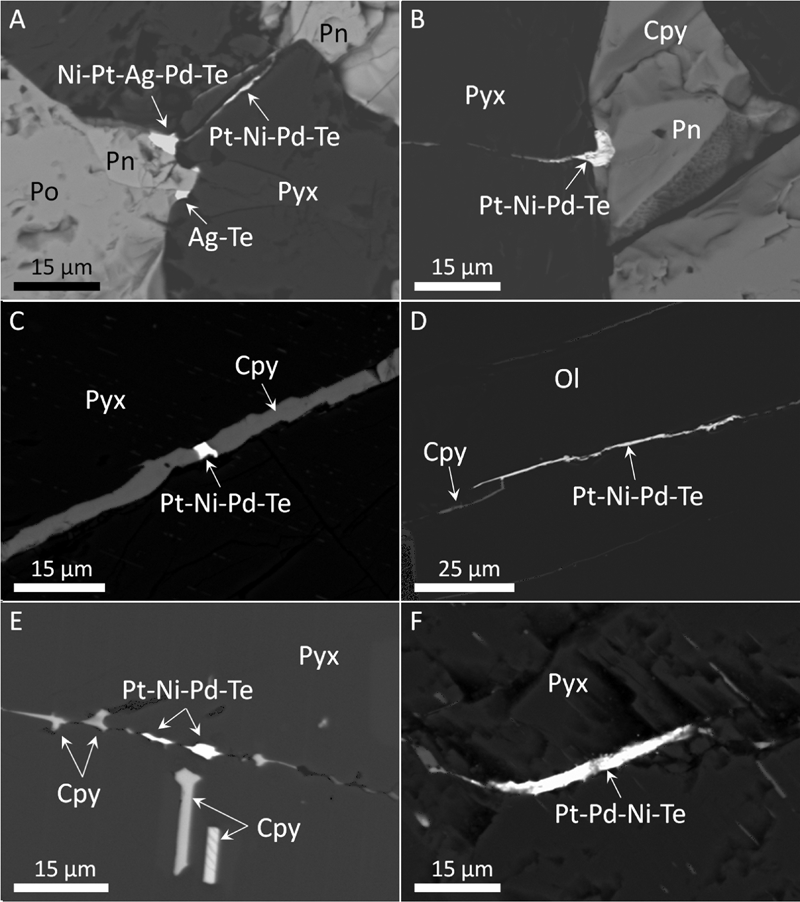
Back-scattered electron images showing the progressive redistribution of BMS and associated PGM in the Santa Rita ore zone. (A) and (B): Initial remobilisation of BMS and PGM at the edges of pentlandite (Pn), chalcopyrite (Cpy) and pyrrhotite (Po) associated with minor BMS veinlets branching into pyroxene (Pyx). (C) and (D): PGM hosted by Cpy veinlets in Pyx and olivine (Ol) with no association with magmatic interstitial sulphides. (E): Boudinage textured Cpy and PGM in Pyx. (F): PGM trapped in Pyx with no associated BMS present
Assemblage (i*) PGE tellurides
Assemblage (i*) is used to define where PGE tellurides, similar to those identified in the Santa Rita ore zone, are observed in the S-poor footwall dunite. This assemblage is present in samples PTSR24 and PTSR25 (MBS605; Fig. 6).
The PGE tellurides are very similar to those observed in the Santa Rita ore zone in terms of chemistry and crystal form. These PGE tellurides are also associated with the BMS; however, only pentlandite and chalcopyrite are present in the dunite. PGE tellurides in this zone are smaller in size than those observed in the Santa Rita ore zone. The majority of these PGM fall between 1 and 8·9 μm2. The largest PGM observed is only 11·5 μm2. Furthermore, the abundance of PGM in this dunite zone is less than that of the Santa Rita ore zone (Table 1).
Assemblage (ii) Pd alloys
Assemblage (ii), comprising Pd alloys with minor PGE-bearing arsenides and sulphides, occurs in the S-poor footwall dunite in only one borehole. This assemblage is present in samples PTSR08 to PTSR11 (MBS604; Fig. 6). In this assemblage, Pd alloys are the most common PGM identified and are predominantly Pd–Cu phases (Fig. 7D–F) that occasionally contain Pb. Other alloy phases include one Pd–Pb–Ag–Cu alloy and one Pt–Fe–Ni alloy.
Other minor PGE-bearing minerals observed include two Pt–As grains and one Pt–Pd–Te–As phase. PGE-bearing sulphides are also identified including several Pd–Cu–Zn–Fe sulphides and one Pd sulphide. One unusual (Ir–Os–Pt–Ru–Cu)–As–S grain is also observed. Where these Pd alloys are present, telluride minerals are rare (Table 1). Given the 29 PGM identified in these samples, only two are tellurides (a Pd–Ag and a Pt–Pd telluride).
These PGM are again associated with pentlandite and chalcopyrite, the only two sulphide phases present in this dunite zone. PGM are found both within what appear to be unaltered fresh magmatic sulphides (Fig. 7D) and sulphides with micro-scale symplectite-like textures intergrown with olivine and occasionally orthopyroxene (Fig. 7E and F). Where present in these symplectite-like intergrowths, the PGM are situated at the crystal edges and exhibit anhedral crystal forms. In contrast, PGM situated within unaltered sulphides usually have subhedral crystal forms.
These assemblage (ii) PGM are the smallest observed in the drill cores studied with the majority of the grains falling between 0 and 8·9 μm2. The number of PGM observed in this dunite zone is comparable to that of assemblage (i*) and therefore much less than the number of PGM observed in the Santa Rita ore zone (Table 1).
Discussion
Pt–Pd tellurides in layered complexes
The most abundant PGE observed in this study are Ni-bearing Pt–Pd tellurides, with Pd only comprising between 0 and 10 wt-% of each PGM. These types of PGM are commonly described from other layered intrusions. Michenerite (PdBiTe) is the most common Pd-bearing PGM in Sudbury and moncheite (PtTe2) is the most common Pt-bearing PGM in the As-poor North Range at Sudbury (Farrow and Lightfoot, 2002). Among the great variety and spatial variation of the PGM recorded from the Bushveld Complex, Pt–Pd tellurides are commonly recorded (e.g. Kinloch, 1982) comprising 6·5 to 33·5% of the PGM in the Merensky reef (Cawthorn et al., 2002). Analyses of Pt–Pd tellurides (moncheite) from Lac des Iles and Stillwater (Cabri, 2002) show that they have a low Ni content, generally less than 0·25 wt-% while Pd content is also very low (0·08 wt-% and not determined respectively). It is clear that Ni is a rare component of Pt–Pd tellurides in these other complexes confirming the rarity of these Ni-bearing PGM in the Santa Rita ore zone.
Formation of the Ni-bearing Pt–Pd tellurides
The Santa Rita ore zone Pt–Pd–Ni tellurides may have formed by two processes; via exsolution from BMS during subsolidus cooling and/or concentration of Pt and Pd (and Ag) into a late stage semimetal-rich melt consequently crystallising PGM. In both cases an immiscible sulphide melt would have initially collected the chalcophile elements; particularly the PGE, Ni and semimetals (especially Te). During fractional crystallisation of the sulphide liquid, monosulphide solid solution (MSS) crystallises leaving a Cu-rich sulphide liquid from which intermediate solid solution (ISS) crystallises (e.g. Holwell and McDonald, 2010). For exsolution to be a viable process of PGM formation, proportions of these chalcophiles based on their partition coefficients into MSS and ISS must be contained in solid solution in these phases. Pentlandite, pyrrhotite and chalcopyrite exsolve from MSS and ISS during subsolidus cooling. Further cooling then results in the exsolution of PGE and semimetals forming PGM as they become unstable in these sulphides at lower temperatures (Barnes et al., 2008). Barnes et al. (2008) also suggest that the rate of cooling affects the abundance of PGM formed. Slow cooling allows the PGE to exsolve forming PGM whereas rapid cooling does not allow the exsolution of PGE so they remain trapped in the sulphides in solid solution. If these PGM have formed via a process of exsolution, it appears that the intrusion has cooled sufficiently slowly to allow for the exsolution of PGE to form abundant PGM.
Alternatively, experimental studies are finding that Pt, Pd and semimetals are extremely incompatible with MSS (Fleet et al., 1993; Li et al., 1996; Ballhaus et al., 2001; Mungall et al., 2005; Helmy et al., 2007; 2010). The incompatibility of Pt, Pd and Au with ISS is also noted (Peregoedova, 1998). Studies of natural deposits support this experimental research suggesting that Pt and Pd remain in a late stage semimetal-rich liquid during the crystallisation of both MSS and ISS. This experimental research indicates that elevated semimetal contents (specifically Te in the case of Mirabela), can reduce the solubility of PGE in the BMS making the production of a late stage PGE-bearing semimetal-rich melt more likely in a semimetal- or Te-rich system (e.g. Helmy et al., 2007; Hutchinson and McDonald, 2008; Helmy et al., 2010; Holwell and McDonald, 2010). Several examples of the formation of a late stage PGE- and semimetal-rich melt are observed in natural studies of PGE mineralization. One such example is the identification of platinum tellurides in the central high-grade sector of the Platreef (Holwell et al., 2006; Holwell and McDonald, 2007) where the most ‘primary’ style of that mineralization is developed. These tellurides are thought to have crystallised from a late stage semimetal-rich melt. Experiments by Tomkins (2010) suggest that where an immiscible As-sulphosalt has formed, it may percolate through MSS particularly at triple points collecting semimetals and PGE that are incompatible with the MSS leaving a PGE- and semimetal-rich melt from which PGM may form. Cabri and Laflamme (1976) attributed the formation of discrete PGM in Cu–Ni deposits in Sudbury to the concentration of semimetals and PGE, first into a Cu-rich sulphide liquid during the crystallisation of MSS and then into a Pd–Pt–Te–Bi–Sb–(As?)-rich liquid during the crystallisation of ISS. PGM then formed from this late stage PGE- and semimetal-rich liquid as predicted by some experimental studies. Prichard et al. (2004a) also demonstrated that PGE collected in a late stage volatile-rich melt during the fractionation of an immiscible sulphide liquid in a dyke from Uruguay.
The only PGM observed within the chromite-rich seam intersected in MBS604 (Fig. 3) are Pt–Pd–Ni tellurides and these are not associated with the chromite grains themselves. Similar thin discontinuous chromite stringers are also present in the Merensky reef. These tend to host PGE-sulphides whereas the surrounding gabbronorite and the underlying anorthosite contain PGE-tellurides (Cawthorn et al., 2002; Prichard et al., 2004b). Perhaps the disseminated chromite grains in the Mirabela chromite-rich seam were insufficiently packed to allow the crystallisation of the PGE-sulphides observed in the Merensky reef. The presence of the chromite-rich seam indicates a reversal in the overall continuous fractionation path of the Mirabela intrusion and it is significant therefore that it contains the most anomalous PGE grades. Precipitation of PGE from a fresh input of magma, perhaps combined with magma mixing is likely to have resulted in elevated PGE concentrations.
BMS and PGM bearing veinlets
In the Santa Rita ore zone the remobilisation of PGM is clearly demonstrated by the presence of PGM associated with BMS in veinlets. It is well known that hydrothermal fluids can remobilise PGM. The remobilisation of Pd bismuthides with chalcopyrite within chlorite filled veins was observed by Prichard et al. (2001) in the Bacuri complex in Brazil. Furthermore, in the Jinbaoshan Pd–Pt deposit in Southwest China, sudburyite ([Pd, Ni]Sb) is found in late stage veins proximal to high temperature occurrences of BMS hosted PGM. This demonstrates small (mm) scale Pd mobility related to post-magmatic hydrothermal alteration (Wang et al., 2008). However, PGM-bearing veinlets have also been observed in the Stillwater Complex (Zientek, 2002) and in an immiscible sulphide bleb in a dyke in Uruguay (Prichard et al., 2004a). In both cases it was proposed that these BMS and PGM filled veinlets were the product of the last stages of crystallisation of an evolved volatile-rich melt. Whether of late magmatic or post-magmatic origin, it appears that both the BMS and PGM have been redistributed at the same time into these veinlets evidenced by their close association (Fig. 8C and D).
It is possible that these veinlets have lost BMS during subsequent alteration as some veinlets only host PGM. Those PGM associated with BMS veinlets emanating from magmatic interstitial sulphides show the onset of PGM and BMS redistribution or perhaps their original magmatic associations (Fig. 8A and B). However, continued alteration is evidenced by those PGM which are now isolated in silicates or associated with only traces of BMS (Fig. 8E and F). This suggests that in the Santa Rita ore zone, once the PGM and BMS have been redistributed into the veinlets, the BMS remain mobile after the PGM have become immobile thus forming the textures and associations observed.
Formation of the Pd alloy assemblage
In the S-poor footwall dunite it appears that a continuum of processes has occurred in order to produce the resulting sulphide and platinum-group mineralogy. There are several similarities between MBS604 and MBS605, relating to assemblage (ii) and (i*) respectively. The sulphide phases present which are typically <150 μm are predominantly pentlandite with chalcopyrite (ignoring very minor pyrite observed in MBS605). Many of these sulphides show symplectite-like textures on a micro-scale with olivine and occasionally orthopyroxene, particularly where the sulphide is in contact with phlogopite (Fig. 5A–D).
These sulphides may not however be true symplectites. There are only a few examples of sulphide-silicate symplectites in the literature. A troilite symplectite in orthopyroxene from the Acapulco meteorite is noted by El Goresy et al. (2005) which they ascribe to the simultaneous crystallisation of troilite and orthopyroxene from a silicate-sulphide melt. Marma (2002) also identifies a symplectite of chalcopyrite and orthopyroxene in the Birch Lake Cu–Ni–PGE deposit in the South Kawishiwi intrusion in the Duluth Complex although this texture is not explained. These examples are much coarser than the micro-scale textures observed in the Mirabela intrusion. In both of these cases it also appears that the sulphide is being incorporated into the silicate as stringers or as trapped sulphide liquid. However, in the Mirabela dunite it appears that silicate material is being drawn into the sulphide replacing it with silicate material.
There is also evidence in the literature for S loss from PGE-rich BMS ores. Kinloch (1982) suggests that in the Bushveld Complex, the interaction of volatiles related to feeder zones with sulphides results in the formation of Pt–Fe alloys. An analogy of converter matte produced from sulphide concentrates of Bushveld ore minerals suggests that volatiles with a high oxygen fugacity (
 ) may oxidise Fe to Fe3O4 while removing S as SO2 (Kinloch, 1982). In this Bushveld case, Pt does not readily form oxides so instead alloys with Fe to form isoferroplatinum (Pt3Fe). Anderson (2006) also states that oxidation would attack the sulphides mobilising the S as H2S or SO2 to account for S loss during the formation of the Platinova Reef in the Skaergaard intrusion. Pyrrhotite would consequently be converted to Fe-oxides while chalcopyrite would be converted to Fe-oxides as well as bornite, digenite, chalcocite, and under extreme circumstances native Cu. Another possible example of this process is documented in the Jinchuan intrusion, north-western China, where the BMS have been altered to magnetite during post-magmatic hydrothermal alteration (Ripley et al., 2005).
In the Mirabela intrusion, similar processes may have occurred in the dunite zone to produce the Pd–Cu alloys observed. Pd–Cu alloys are unusual PGM and have been observed most commonly in placer deposits or lateritic soils where S or semimetals have been lost from precursor PGM by oxidation (Salpéteur et al., 1995; McDonald et al., 1999). The micro-scale symplectite-like textures identified in many sulphides may be related to the partial dissolution or melting of the BMS by a late stage melt or high temperature hydrothermal fluid with a high
 . The presence of phlogopite commonly observed in contact with these sulphides (Fig. 5A and B) supports the presence of a volatile-water-rich melt or fluid. It is possible that this liquid was forced upwards through the olivine crystal mush as it was compacted. This process of S loss is evidenced by the presence of magnetite (Fig. 5C and D), the partial replacement of BMS forming the micro-scale symplectite-like textures observed (Fig. 5A–D and Fig. 7F) and the full replacement/removal of BMS, predominantly pyrite and pyrrhotite which are virtually absent in the Mirabela dunite. Furthermore, the partial loss of pentlandite rimmed by magnetite is also observed (Fig. 5E). Minor bornite is also observed (e.g. Fig. 7D); a product of S loss from chalcopyrite noted by Anderson (2006).
There are however differences between the two boreholes, MBS604 and MBS605, which need to be accounted for. MBS604 hosts assemblage (ii) consisting predominantly of Pd alloys whereas MBS605 hosts assemblage (i*), PGE tellurides much like those observed in the Santa Rita ore zone. The main difference between these two boreholes appears to be the semimetal content. Semimetals are present in MBS605 evidenced by the presence of tellurides whereas the paucity of semimetals in MBS604 is reflected by the distinct scarcity of Te- and As-bearing phases. It is highly likely that with the dissolution or melting of Fe-sulphides, semimetals were also lost. It appears that this process was more prevalent in the Pd alloy assemblage (ii) in MBS604 than in the Pt–Pd–Ni telluride assemblage (i*) in MBS605 suggesting the channelization of this melt or fluid.
MBS605 was affected to a lesser extent with Fe-sulphides only partially dissolved or melted evidenced by the presence of minor amounts pyrite observed on several occasions in this borehole. Therefore, semimetals were not completely removed, if at all, resulting in the occurrence of PGE tellurides similar to those observed in the Santa Rita ore zone. However, in MBS604, Fe-sulphides were completely removed along with the semimetals by this late stage melt or high temperature hydrothermal fluid. The subsequent exsolution of PGE during subsolidus cooling has formed PGE alloys, predominately Pd–Cu phases. In at least one example it is clear that sulphur loss has encouraged the formation of these Pd alloys. In Fig. 7F a pentlandite crystal can be observed, half of which exhibits a complex micro-scale symplectite-like texture. In this portion of the sulphide, it appears that sulphur loss has expelled the PGE to form the Pd–Cu alloys observed.
Core metres with relatively high Pd concentrations of 0·6 ppm and on one occasion >1 ppm are restricted to borehole MBS604 (includes sample PTSR-11; Fig. 3). This high PGE (Pd) interval was not intersected by MBS605, perhaps because MBS605 was interrupted before reaching this zone; alternatively this interval is thin and discontinuous, much like the chromite-rich seam observed in MBS604 in the Santa Rita ore zone. This PGE-rich interval is not specifically related to assemblage (ii) as Pd alloys are also identified in samples PTSR-08 and PTSR-09; samples which do not share the same PGE content as PTSR-11.
Post-magmatic serpentinisation similar to that observed in the Santa Rita ore zone is also present in the dunite. In some cases, this serpentinisation is related to minor magnetite formation where BMS are located in serpentine veins (Fig. 5F). Unlike in the Santa Rita ore zone however, BMS veinlets and remobilised PGM are not observed.
Conclusions
The Mirabela igneous complex is very fresh and preserves the distribution of the PGM formed during the transition from late magmatic crystallisation to early high temperature alteration. PGE tellurides dominate the PGM assemblage observed in the two boreholes studied from the central zone of the Mirabela complex. These Pt–Pd–Ni tellurides form assemblage (i) in the Santa Rita ore zone and assemblage (i*) in the underlying S-poor dunite footwall in one borehole only. A second assemblage (ii) consists predominantly of Pd alloys. The PGM in the Santa Rita ore zone have likely formed either via exsolution from the BMS and/or from a late stage PGE- and semimetal-rich melt to account for the association of PGM with BMS.
Despite only minor hydrothermal alteration identified in these igneous lithologies, PGM and BMS are commonly located in stringers and veinlets in the Santa Rita ore zone. It appears that the sulphides and PGM are either remobilised together from magmatic interstitial sulphides by post-magmatic hydrothermal fluids or precipitate from a late stage volatile-rich melt. The redistribution of BMS continues after the PGM have become immobile. This eventually leaves PGM trapped in silicates with no association with BMS.
The PGM and sulphide mineralogy in the Mirabela dunite suggests that a high fO2 liquid (silicate melt or high temperature hydrothermal fluid) has oxidised the Fe in the BMS to form magnetite while removing S as SO2 or H2S. It appears that this process has also stripped semimetals from the sulphides. During this interaction and S loss, sulphides with micro-scale symplectite-like textures are produced with silicates. This sulphur loss has caused the expulsion of PGE and formation of Pd alloys where semimetals have been completely stripped from the dunite. The diffusion of PGE to the edges of these symplectite-like textured sulphides forming PGM also may have occurred.
Additional sampling, geochemical and mineralogical analyses will be required to determine the significance of these two assemblages from genesis, mining and mineral processing perspectives. Whole rock geochemical analyses and laser ablation–inductively coupled plasma–mass spectrometry on a set of boreholes that cover more of the complex is required to gain a clearer understanding of the lithological and lateral variation of the two PGM assemblages documented in this study.
Footnotes
Acknowledgements
We would like to thank Mirabela Nickel Ltd. for allowing us to publish this data. We would also like to thank reviews from Dr. S. J. Barnes and Dr D. C. Peck whose comments have greatly improved this paper.
This paper is part of a special issue on Ni-PGE deposits