







Abstract
In order to separate the effects of a specific microbial species (Pseudomonas) in sea water on carbon steel, a comparative study of the corrosion and mechanical properties of AISI 1045 carbon steel in natural sea water, sterile sea water and Pseudomonas inoculated sea water was carried out using tensile testing, mass loss experiments and microscopy. The results of mass loss showed that the corrosion rate of the specimens in the single Pseudomonas system was faster than that in sterile sea water but slower than in natural sea water. Microscopy revealed that a loose corrosion product layer formed on the surface of carbon steel, and micropitting corrosion occurred underneath the corrosion product. Energy dispersive X-ray analysis of this deposit indicated that iron and oxygen were the main components, and a large amount of carbon, which most likely originated from the bacteria and its exopolymer, could also be detected. The tensile strength of carbon steel was reduced by the action of Pseudomonas, but hydrogen embrittlement was not found.
Introduction
Hainan Province, located in the southernmost tip of China, is surrounded by the South China Sea. The tropical maritime climate of Hainan leads to extremely rich microbial resources in the surrounding sea water and consequently severe microbially influenced corrosion (MIC).1 – 6 Microbes adhere to the surface of metals and consequently form biofilms and further produce an environment at the biofilm/metal interface that is radically different from that of the bulk medium in terms of pH, dissolved oxygen and organic and inorganic species. The MIC can produce pitting, crevice corrosion, selective dealloying and stress oriented hydrogen induced cracking, all of which can accelerate both localised and average corrosion rates of carbon steel. For example, Xiao et al.4 reported that over 1 year exposure, the average corrosion depth of carbon steel in natural sea water is between two to three times higher than in sterile sea water, with significant localised attack also observed.
Our preliminary work showed that Pseudomonas was the key microbial component in the corrosion products on carbon steel at the initial stages of corrosion in South China Sea.4 – 6 It was proposed, therefore, that the influence of Pseudomonas on the corrosion of carbon steel could not be ignored. Although there are some reports about the action of Pseudomonas on the corrosion of steel,7 – 14 there is still significant controversy about how exactly Pseudomonas affects the corrosion of steel. Some investigators insist that it accelerates corrosion, while others hold the opposite standpoint.7 – 15 The reasons for these different conclusions are possibly due to different experimental techniques, such as the usage of culture medium as the corrosive medium (instead of sea water), which may play a significant corrosion inhibition effect. Thus, the use of different culture media may lead to different conclusions. Therefore, only the cultivation of micro-organisms in sea water can reveal the effect of Pseudomonas corrosion on steel in its near natural state. Moreover, there are occasional reports about the effect of Pseudomonas corrosion on the mechanical properties of steel, resulting in a potential safety hazard in the use of marine facilities. In this work, a comparative study of the corrosion behaviour and mechanical properties of medium carbon steel in natural, sterile and Pseudomonas inoculated sea water was carried out using mass loss, microscopy and mechanical analysis.
Materials and methods
Preparation of coupons
Carbon steel (1045 grade) with a composition of 98·582Fe–0·499C–0·596Mn–0·230Si–0·028S–0·012P–0·006Ni–0·020Cr–0·001Mo–0·001Nb–0·014Cu–0·003W–0·003Al–0·004V–0·001Ti was purchased from QiQiHar HongShun Heavy Industry Group Co. Ltd (China). Sheet coupons of dimensions 50×25×3 and 15×10×3 mm were utilised in mass loss determination and surface analysis respectively. The coupons used in mechanical testing were prepared according to ISO 6892:1998. All the coupons were sequentially polished from 240, 400, 800 and 1200 grit SiC papers to a smooth surface, followed by degreasing with acetone, rinsing with deionised water repeatedly, immersing in absolute ethanol and drying in ambient air. Before the corrosion test, the samples were sterilised by immersion in 70% ethanol for 30 min and finally dried aseptically in a laminar flow cabinet. After these treatments, newly prepared specimens were immediately exposed to the test medium for all the corrosion experiments.
Preparation of medium and Pseudomonas culture
The organism used in this study was a marine Pseudomonas that was originally isolated from the corrosion products on 1045 steel immersed in nature sea water for 6 months. All cultures were grown in 2216E medium, i.e. 5·0 g peptone, 1 g yeast extract, 20 g agar, and 1000 mL nature sea water under aerobic conditions. The pH was adjusted to 7·8 using NaOH solution, and the solution was sterilised at 121°C for 20 min.
Three groups of experiment were conducted:
coupons were immersed in natural sea water, which was replaced with fresh natural sea water every 7 days; the sea water was obtained from Haikou Holiday Beach in Hainan Province, China
coupons were immersed in sterile sea water, which was replaced with fresh sterile sea water every 7 days; the sea water was obtained from the same place as group A
a 20 mL aliquot of the 2 day old Pseudomonas culture was introduced into 2000 mL of sterile sea water in the test box. The prepared specimens were aseptically introduced into the cell suspension, which was cultured at 26°C for 24 h before the metal was immersed. To maintain the bacterial density at the steady state growth phase throughout the studied period, the medium was drained and replaced with an equal amount of fresh cell suspension every 7 days.
All the test containers holding the metal specimens were kept in an incubator at 26°C. The plate count method was used to periodically evaluate the quantity of heterotrophic bacteria in suspension and the corrosion products on specimens during the experiments. The whole experiment was conducted for 60 days.
Mass loss determination
After removing adherent micro-organisms, the coupons were treated with passive Clarks solution (36%HCl, 1 L; Sb2O3, 20 g; SnCl2, 50 g) and washed with distilled water and absolute ethanol. The corrosion rate was calculated on the basis of obtaining the weight loss, and five replicate samples were used.
Surface analysis
The bacteria colonised specimens underwent fixation and dehydration according to the general procedure reported in the literature.16 Thus, the specimens were sputter coated with gold/palladium before analytical SEM in order to investigate their morphology and chemical compositions. To assess the corrosion features under the biofilms, the corrosion products and the biofilms were removed. The imaging sites were chosen at random on the specimen surface as representative of the entire surface of the specimens.
Mechanical property testing
To study the effect of surface flaws induced by MIC on the mechanical properties of steel, tensile testing was carried out without polishing. In order to compare the variations in mechanical properties before and after corrosion, coupons were tested by a universal testing machine according to ISO 6892:1998 after corrosion; an additional blank group (i.e. coupons without corrosion) was also tested in the same conditions.
Results
Changes in growth of Pseudomonas
Figure 1 shows the growth curves of Pseudomonas in the suspension of group C. As we can see from the figure, the Pseudomonas counts increase during 1-3 days, reaching a maximum value [9·5×109 colony formation unit (CFU) mL−1] on the third day. With the gradual consumption of nutrient in sea water, the Pseudomonas count appears to decrease after 3 days. The result indicated that the bacteria reproduced well in the sea water during corrosion.
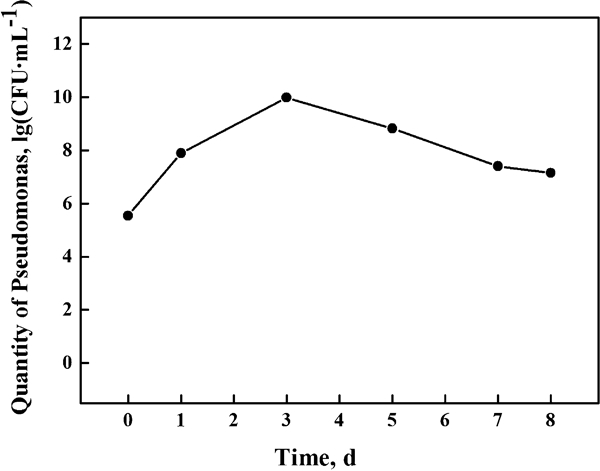
Growth curves of Pseudomonas in the suspension of group C
Figure 2 reveals the quantity of Pseudomonas attached to the surface of the carbon steel in group C as a function of exposure time. The quantity of cells is ∼6·3×1013 CFU g−1 on the seventh day, which increases until the thirtieth day, where the maximum quantity of Pseudomonas reached 9·1×1014 CFU g−1. With the gradual consumption of nutrient in corrosion products, the quantity of Pseudomonas appears to decline after 30 days.
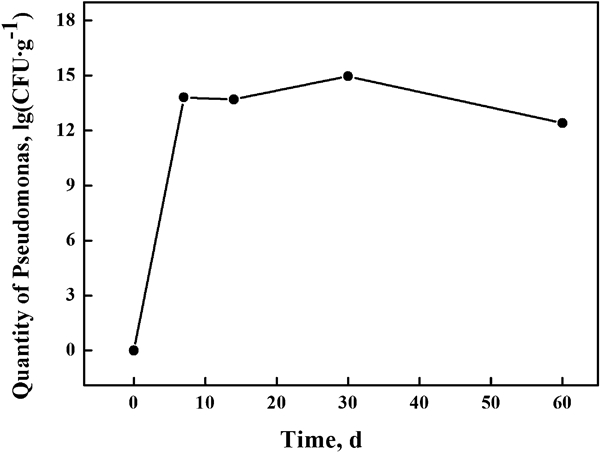
Quantity of cells attached to the metal surface in group C with immersed time
Corrosion rate
The corrosion rate of carbon steel obtained from the weight loss study is shown in Fig. 3. The metal coupons immersed in different media displayed different corrosion rates. Comparing with group B, the coupons immersed in groups A and C corroded at a faster rate, which suggests that the presence of micro-organisms significantly accelerated the corrosion rate. The corrosion rate in group A was 1·7 times as fast as that of group C, which meant that the synergy of various micro-organisms in natural sea water speeded up the corrosion rate of carbon steel significantly in comparison with the impact of the single Pseudomonas species.
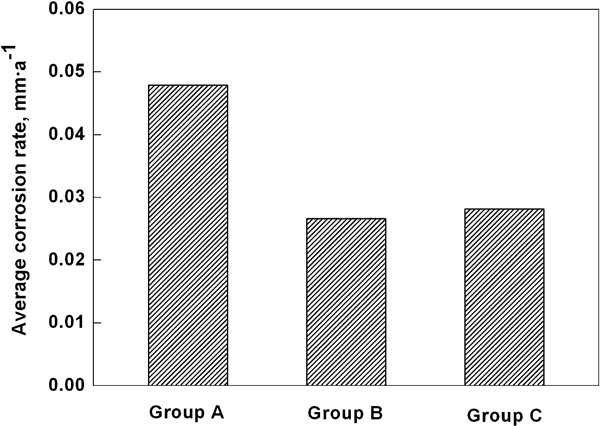
Corrosion rate of carbon steel exposed to different solutions (groups A–C) for 2 months
Surface analysis
The SEM image and EDS analysis of the specimen in the group C after 2 months exposure are illustrated in Fig. 4. A loose layer of corrosion product was clearly observed on the specimen surface (Fig. 4a). Analysis by EDS (Fig. 4b) of this deposit revealed that iron (66·23 wt-%) and oxygen (16·30 wt-%) were the main components, and a large amount of carbon with the value of 4·5 wt-%, most likely caused by the organic materials of bacteria and metabolism product, could also be detected.
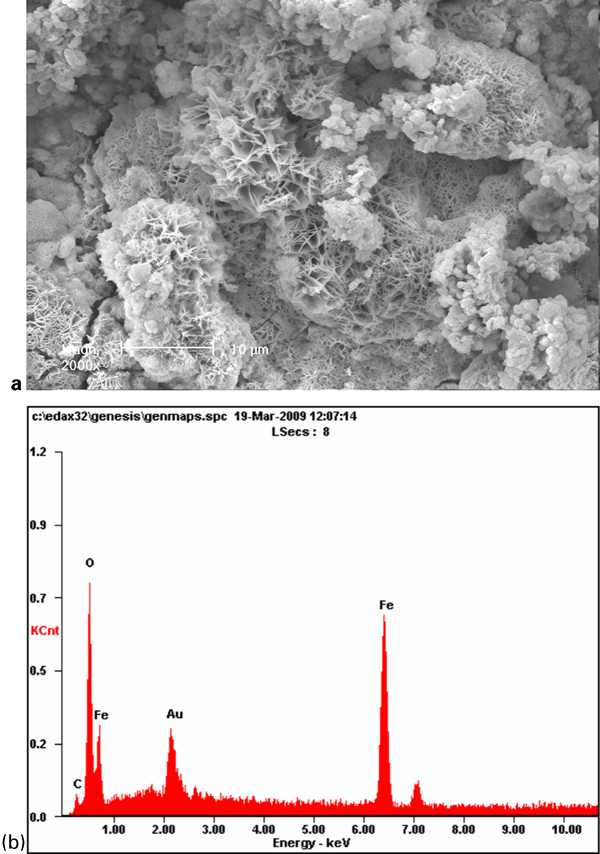
a surface morphology and b composition analysis of corrosion product layer of carbon steel exposed to group C for 2 months
After removing the biofilms and corrosion products and examining by SEM, it was found that the surface morphologies of the sample were similar in groups A and B, so only the surface morphology of the sample immersed in group B is illustrated in Fig. 5a. The surface of the groups A and B sample was smooth and exhibited little localised corrosion after 2 months of exposure. However, greater and larger pits are observed in Fig. 5b. The aggregation of Pseudomonas obviously aggravated the pitting corrosion of the exposed specimens. The pitting corrosion damage on the surface of carbon steel exposed to the Pseudomonas medium was worse than that under sterile and natural sea water conditions.
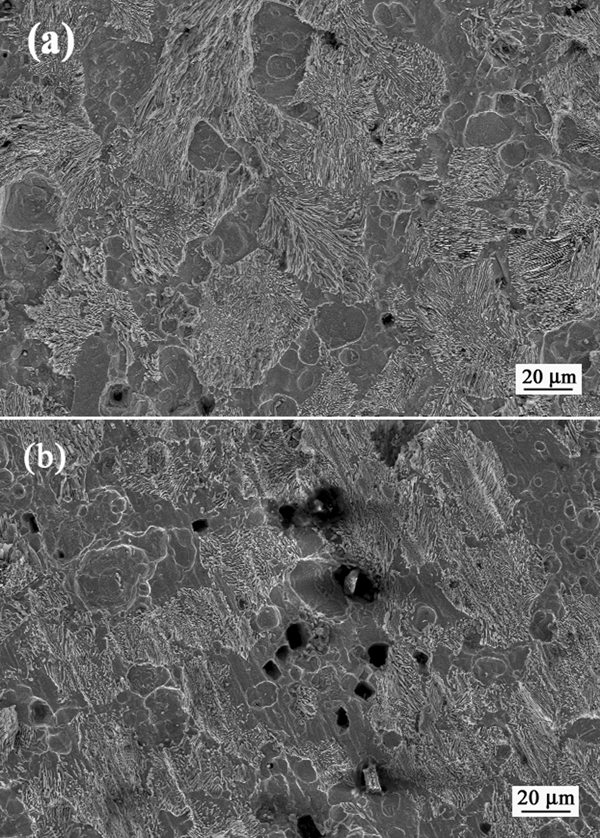
Images (SEM) of metal surfaces of carbon steel exposed to different solutions for 2 months after corrosion products removed
Mechanical properties
The mechanical properties of the specimens immersed in different media for 2 months are revealed in Fig. 6. The order of tensile strength was group C<group A<group B<blank sample; thus, the tensile strength of the metals was reduced after corrosion. Comparing with group B, the tensile strength of groups C and A decreased by 1·5 and 1·1% respectively, which indicates that the presence of micro-organisms could reduce the tensile strength. The elongation of samples, which had no obvious change compared to the blank sample, maintained >25% after exposing to the different media. Thus, hydrogen embrittlement induced by Pseudomonas was absent with no obvious impact on the plasticity of steel.
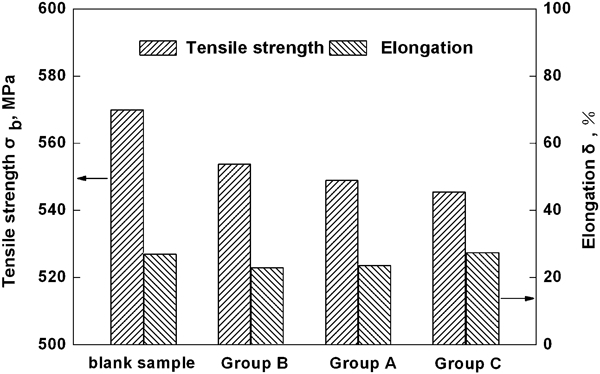
Mechanical properties of carbon steel exposed to different solutions for 2 months
Discussion
Although the overall experimental exposure conditions were similar, coupons immersed in group C had a faster corrosion rate than that in group B, which indicated that the presence of Pseudomonas increased the corrosion rate of carbon steel. In the presence of a Pseudomonas biofilm that is unevenly attached on the surface of coupons, the electrochemical corrosion processes are expected to be modified. On the one hand, the biofilm will limit the diffusion of oxygen, and since Pseudomonas is an aerobic bacteria,17 it is expected that oxygen might be significantly depleted due to respiration by Pseudomonas. Thus, it is would be expected that areas beneath respiring Pseudomonas colonies might become net anodes with surrounding area net cathodes. Accordingly, the average corrosion rate of carbon steel is increased, and localised corrosion might occur.18 In addition, the Pseudomonas biofilm may bind metal ions and other metallic compounds. Deposition of ferric hydroxide allows the transport of aggressive anions (chloride) to the metal surface but prevents the transport of metal ions away from the surface, thereby assisting the development of the concentrated local chemistry required for pit propagation.19 It is noted that exposure to natural sea water resulted in a faster corrosion rate than in Pseudomonas alone. This is assumed to be due to the various other micro-organisms that are present in natural sea water and that form synergistic communities. For example, the activity of aerobic bacteria on a surface biofilm provides growth conditions for anaerobic bacteria (such as sulphate reducing bacteria) underneath the biofilm, whereupon this interaction between bacteria might be expected to accelerate the corrosion process.19
The experimental results showed that the tensile strength of the material was declined by the action of micro-organisms. The tensile strength of specimens immersed in group C was lower than that in group A, while the corrosion rate was greater. It seemed that the tensile strength of the samples did not only associate with the corrosion rate. To further illustrate the effect of microbial effects on the tensile strength, we correct the cross-sectional area for the corrosion loss as follows

The tensile strengths corrected for corrosion loss are shown in Fig. 7, and it can be seen that the corrected strength of specimens immersed in group C was smaller than that in the others. This may be because local corrosion, in the presence of Pseudomonas, is higher than in its absence.
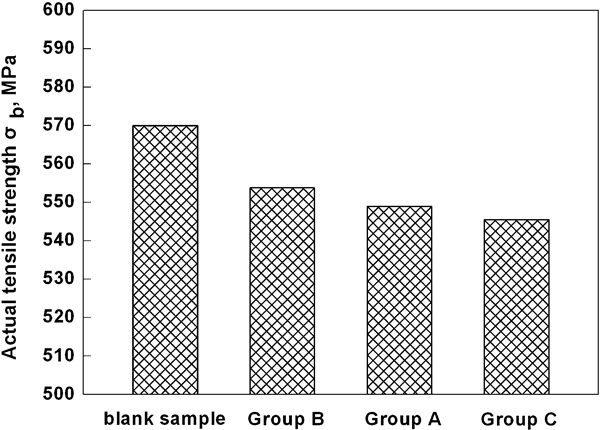
Actual tensile strength of carbon steel exposed to different solutions for 2 months
Conclusions
The influence of Pseudomonas on the corrosion and mechanical properties of carbon steel in sea water was studied. The following conclusions can be drawn.
The corrosion behaviour of steel is changed due to the aggregation of a marine biofilm of Pseudomonas. The corrosion rate of specimens in the presence of Pseudomonas only was greater than without any microbes. However, in natural sea water, an assumed synergy between the various micro-organisms resulted in the most rapid corrosion.
Owing to the effect of Pseudomonas, a loose layer of corrosion product was formed on the specimen surface after 2 months exposure. Analysis by EDS revealed that iron and oxygen were the main components, and a relatively large amount of carbon, which originated from the bacteria and bacterial exopolymer (i.e. its biofilm), could also be detected. Significant micropitting occurred underneath the biofilm deposits.
The local corrosion induced by Pseudomonas resulted in a stress concentration effect that caused a decrease in the tensile strength. However, no significant reduction in ductility was observed, and hence, hydrogen embrittlement was not found.
Footnotes
Acknowledgements
This work was supported by the National Natural Science Foundation of China (grant nos. 50761004 and 51161007), the International S&T Cooperation Program of China (no. 2009DFA92550), the Natural Science Foundation of Hainan Province (grant nos. 510204 and 511112) and the 2005 and 2009 Scientific Research Project of Hainan University (grant nos. Kyjj0536 and hd09xm77).