







Abstract
The present study explores an electrochemical surface modification process to improve the corrosion resistance of Fe–24Mn–4Al–5Cr alloy. The effects of transpassive aging potential and time on the corrosion resistance, composition and stability of the passive film formed on an Fe–24Mn–4Al–5Cr alloy in 1M Na2SO4 solution were studied using combined electrochemical measurements, Auger electron spectroscopic and X-ray photoelectron spectroscopic analysis. The passivation of Fe–24Mn–4Al–5Cr alloy in 1M Na2SO4 solution was performed under the optimal parameters of critical potential of 1100 mV and for a passivation time of 30 min. The corrosion resistance in 1M Na2SO4 solution of Fe–24Mn–4Al–5Cr alloy modified by this treatment is superior to that of Fe–13Cr–0·1C stainless steel. Auger electron spectroscopic and X-ray photoelectron spectroscopic depth profiles of the passive film formed on the alloy using this treatment show Al2O3 and Cr2O3 enrichment together with Fe and Mn depletion in the passive film. This compositional change provides the increase in stability and in corrosion resistance of the alloy.
Introduction
In our previous studies,1 – 4 we have developed a process to improve the corrosion resistance of a particular alloy by electrochemical modification of its surface composition. The main concept consists of reducing those elements that decrease corrosion resistance while enriching those elements that improve corrosion resistance in the alloy surface layer by means of electrochemical anodic polarisation. The electrochemical polarisation method includes anodic passivation aging,1 – 6,16 a critical transpassivation treatment and alternating voltage modulated passivation that enhances the preferential dissolution of Mn or Fe into solution and the enrichment of Al, Cr or Si in the passive film.8 – 13 Previous work has shown that the anodic polarisation aging treatment is effective in increasing the stability and resistance to corrosion of the passive film for Fe–Mn base alloys containing Al, Cr and Si.2,7
In general, electrochemical polarisation in the transpassive region induces the dissolution and breakdown of the passive film. However, Song et al.8 – 10 have reported that transpassive polarisation, combined with post-treatment aging, can enhance the stability of the surface film on 304L stainless steel. This was ascribed to an increase in film thickness and in the ratio of Fe3+/Fe2+ of passive film. Since the 1960s, the mechanical, physical and corrosion properties as well as the processing and production of austenitic Fe–Mn based alloys containing Al, Cr or Si have been studied systematically in China.14 Several alloys of optimal compositions have been used successfully as non-magnetic or cryogenic steels in the industry for >26 years.15 Our investigations on the anomalies in some physical properties at the Néel transition of Fe–Mn base alloys have led to the development of some new functional alloys with the Fe–Mn base containing Al and Cr or Si. However, systematic studies show that the nominal corrosion resistance of such alloys is generally inferior to that of conventional Fe–Cr–Ni stainless steels.
In this paper, we present the use of electrochemical polarisation at a critical transpassive potential to produce high quality Cr and Al enriched layers on Fe–Mn–Al–Cr alloy in 1M Na2SO4. Evaluation of the Cr and Al enriched films on the stability, constitution and corrosion resistance was carried out using Auger electron spectroscopy (AES), X-ray photoelectron spectroscopy (XPS) and electrochemical measurements.
Experimental
Experimental Fe–24Mn–4Al–5Cr alloy was prepared from low carbon Fe, electrolytic Mn and industrially pure Al and Cr by induction furnace melting and electroslag furnace remelting. A 500 kg ingot was hot rolled and then cold rolled into sheets of 2·4 and 7 mm thickness. The chemical composition of the alloy is Fe–0·315C–23·3Mn–3·44Al–5·05Cr (wt-%). X-ray diffraction and optical microscopy examination showed that the experimental alloy was single phase austenite and with no obvious carbide precipitation after solution treatment at 1323 K followed by water quenching. Samples of dimension 10×10×2 mm were machined from the 7 mm thickness stock materials, ground with 1000 grit silicon carbide (SiC) paper and then with diamond paste (2-3 μm), washed in distilled water and rinsed in acetone and alcohol before electrochemical treatment. All electrolytic solutions were made from analytical grade reagents and deionised water. A Princeton Applied Research 273 potentiostat/galvanostat and a conventional three-electrode cell were used to undertake the electrochemical measurements. The counter electrode was a platinum sheet of ∼4 cm2, and all recorded potentials were referred to a saturated calomel electrode (SCE). Figure 1 shows the polarisation curve recorded for Fe–24Mn–4Al–5Cr alloy in 1 mol L−1 Na2SO4 solution, and the selected critical transpassive potential range is marked by position (a). The working electrode (specimen) was pretreated by cathodic polarisation at −700 mV for 5 min and then maintained at constant anodic potentials from 260 to 1200 mV and for different aging times of 15-60 min in 1M Na2SO4 solution. The potentiostat was switched to open circuit, and the electrolyte solution in the cell was changed over to 1M Na2SO4+0·5M H2SO4 immediately after the anodic treatment was finished. Subsequently, the potential of the electrode was recorded as a function of time.
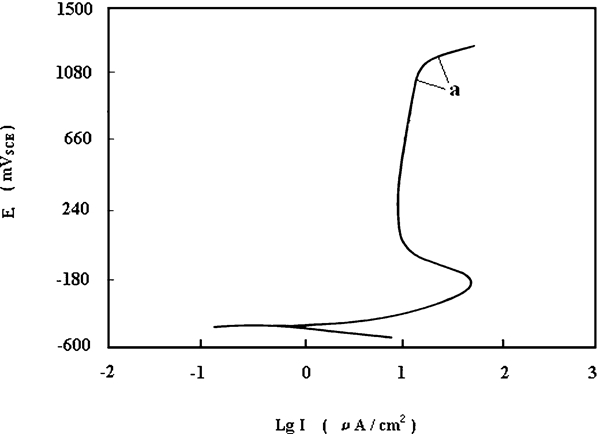
Potentiodynamic polarisation curve for Fe–24Mn–4Al–5Cr alloy in 1M Na2SO4; position (a) indicates region of critical transpassive potential
Both the compositions and the chemical valence states of the elements in the passive film were examined using a combined AES/XPS/secondary ion mass spectrometry surface analysis system. The background pressure in the sample chamber was ∼2×10⁻⁹ torr. The energy values of the primary electron beam and the Ar+ sputtering beam are 3 and 1·5 keV respectively. In the XPS spectrometer, Al Kα radiation (hυ = 1486·6 eV) was used with a power of 360 W and a beam diameter of 3 mm. The Auger peaks recorded were Fe (703 eV), Mn (542 eV), Cr (529 eV), Al (1396 eV), O (503 eV) and C (272 eV). A takeoff angle of ∼85° between the surface normal and the analyser axis was performed. The sputtering rate was determined to be ∼0·25 nm min−1 by ion etching of a Ta sample covered by a Ta2O5 layer of known thickness. However, the sputtering depths are reported without correction for possible differences in sputtering yield between the passive film and the Ta2O5 reference oxide. The binding energies E b of the elements of Fe 2p, Mn 2p, Al 2p and O 1s were referenced to the binding energy of C 1s at 284·6 eV, recorded from graphite. The obtained XPS spectra were fitted using a convoluted Gaussian–Lorentzian peak fitting routine after removing the Shirley background.16
Results and discussion
There are numerous factors that may affect the corrosion resistance of the passive film on the Fe–Mn–Al–Cr alloy substrate in this work. These factors include the aging potential, the aging periods and the composition of the film.1 – 4,7 The potentiostatic passivation technique is used as direct indicators for the successful formation of the protective thin film layer. The intermediate region passive film aged for 5 h at 620 mV on Fe–24Mn–4Al–5Cr alloy in 1M Na2SO4 solution was used as a baseline because this material has been shown in our previous work to have approximately the same corrosion resistance as Fe–13Cr–0·1C stainless steel in acidic media.4
Electrochemical investigations
The effect of aging time and aging potential on the stability of the passive film on the alloy is illustrated in Figs. 2 and 3 respectively. There are three clearly distinguished domains that can be observed from the decay curves. Initially, a steep potential drop occurs, followed by an almost linear potential decay with a lower slope. Finally, the potential sharply decreases towards the active corrosion value. The arrow in figure indicates the Flade potential E F and the decay time T d.
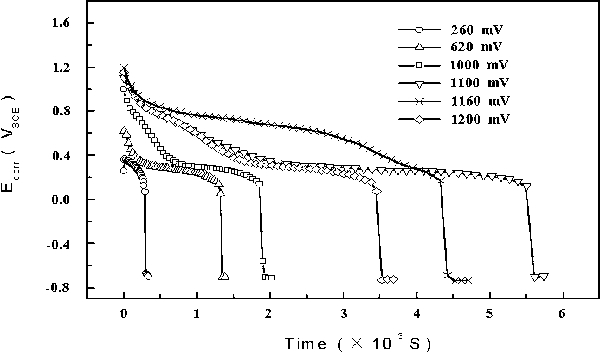
Effect of 30 min anodic prepassivation at various potentials in 1M Na2SO4 on potential decay time in 1M Na2SO4+0·5M H2SO4
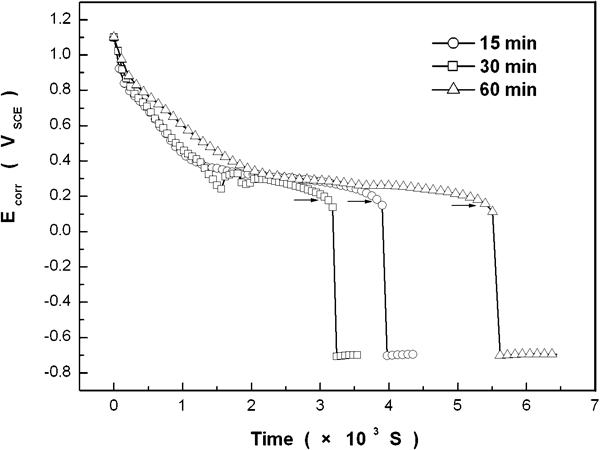
Effect of anodic passivation time in 1M Na2SO4 aqueous solution at 1100 mV on potential decay time in 1M Na2SO4+0·5M H2SO4 solution; arrow corresponds to Flade potentials
Figure 2 shows the effect on the potential decay curve of Fe–24Mn–4Al–5Cr alloy in 1M Na2SO4+0·5M H2SO4 after prepolarisation at the indicated potentials in 1M Na2SO4. It can be seen from Fig. 2 that the potential decay time to active behaviour increases as the prepolarisation potential increases from 620 mV (in the passive region, decay time of 1100 s) to 1100 mV (in the transpassive region, decay time of 5440 s), then decreases as the potential further increases to 1200 mV (3500 s). This latter effect is because as the potential increases significantly into the transpassive range, the stable passive oxide will turn into high valence state soluble metallic ions contributing to an activation of the film,17 which can be observed by the appearance of strongly coloured (purple; reminiscent of permanganate) species in the electrolyte solution beside the working electrode.
Figure 3 portrays the relation of aging time and film stability at a potential of 1100 mV. It can be seen that the time during which the E corr reaches the Flade potential increased initially with increase in aging time, achieving a maximum value within 30 min, however, finally decreasing with further extension of passivation time. One can notice from the curves that the time of achieving active state increases in the order transpassivation 30 min>transpassivation 15 min>transpassivation 60 min. This may be due to the results of competition of growing or dissolving of the film itself with the time. The stability of the film is defined not only by the applied potential but also by aging time.
In Figs. 2 and 3, the changes in stability with increase in applied potential and aging time were ascribed largely as the contribution of the two distinct effects beside transpassive region. On the one hand, migration of both Al3+/Cr3+ outwards from the film and O2−/OH− ions inwards in the solution is much faster under a relatively high positive potential. This behaviour may accelerate to form compact oxide films of Al (0·82) and Cr (0·74) due to their high passivity coefficient compared to Fe (0·18) and Mn (0·13), and hence, the stability of the passive film is increased. On the other hand, the further development of Al and Cr rich oxides is rapidly suppressed as little oxygen evolution [+1·23 V(normal hydrogen electrode (NHE)] occurred as well as a simultaneous manganese oxidation to a soluble  species [+1·22 V(NHE)], which results in the film protection degradation. As can be observed from the experiment, purple
  ions emerged when the potential is up to >1200 V(SCE). From the above experimental results, we may conclude that the optimal processed parameter is at a potential of 1100 mV and for a time of 30 min. This treatment results in substantially better performance compared with the previously recommended one of 620 mV for 5 h; the comparison between both conditions is shown in Fig. 4. This improved performance of the alloy when polarised slightly into the transpassive regime can be explained by the electrochemical dissolution reaction model of alloy surface film previously proposed by Song et al.10 This model states that the electrochemical dissolution rate is closely associated with the magnitude of the applied potential. Thus, since passivity of Cr and Al is higher than Mn,18 – 20 a greater quantity of Cr and Al enriched species is generated on the alloy surface layer under the higher potential condition at the critical transpassivating region than that in the stable intermediate potential range.
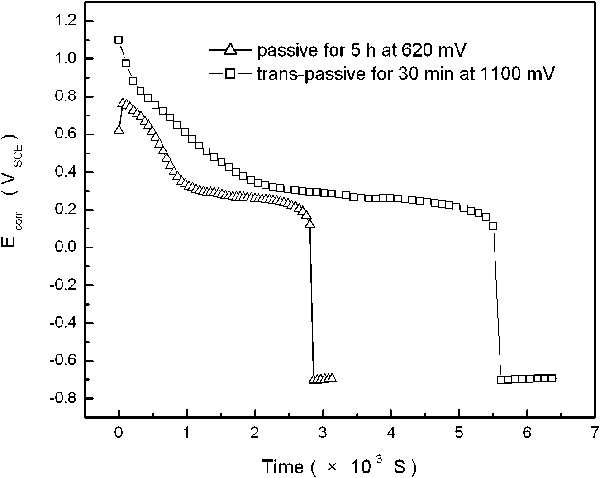
Potential decay time in 1M Na2SO4+0·5M H2SO4 solution for Fe–24Mn–4Al–5Cr alloy after prepolarisation for 5 h at 620 mV compared with 30 min at 1100 mV in 1M Na2SO4
In order to further confirm these results, potentiodynamic polarisation results for the alloy in three conditions (as received, aged at 620 mV for 5 h and aged at 1100 mV for 30 min) are compared with Fe–13Cr–0·1C in Fig. 5. It can be observed from the figure that the transpassivated alloy has a more noble open circuit potential with a corrosion rate very significantly smaller than the unaged alloy and Fe–13Cr–0·1C stainless steel. This result is consistent with depletion of Fe and Mn and enrichment of Al and Cr oxides within the passive film, which would be expected to make the passive film more stable and protective. 2 2,4
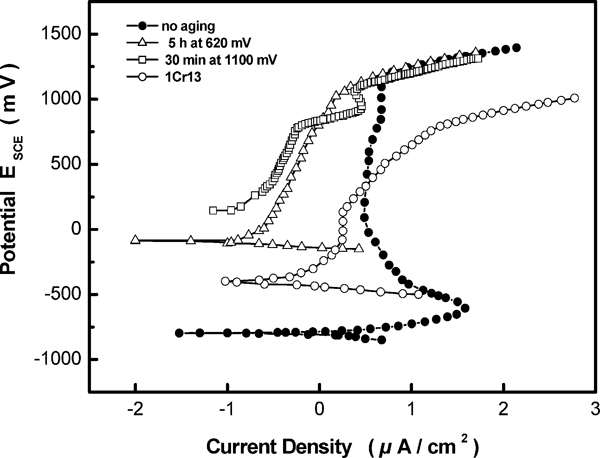
Anodic polarisation of Fe–24Mn–4Al–5Cr alloy (as received and at stated conditions) in 1M Na2SO4 aqueous solution; anodic polarisation behaviour for 1Cr13 is shown for reference
Auger electron spectroscopic and XPS analysis
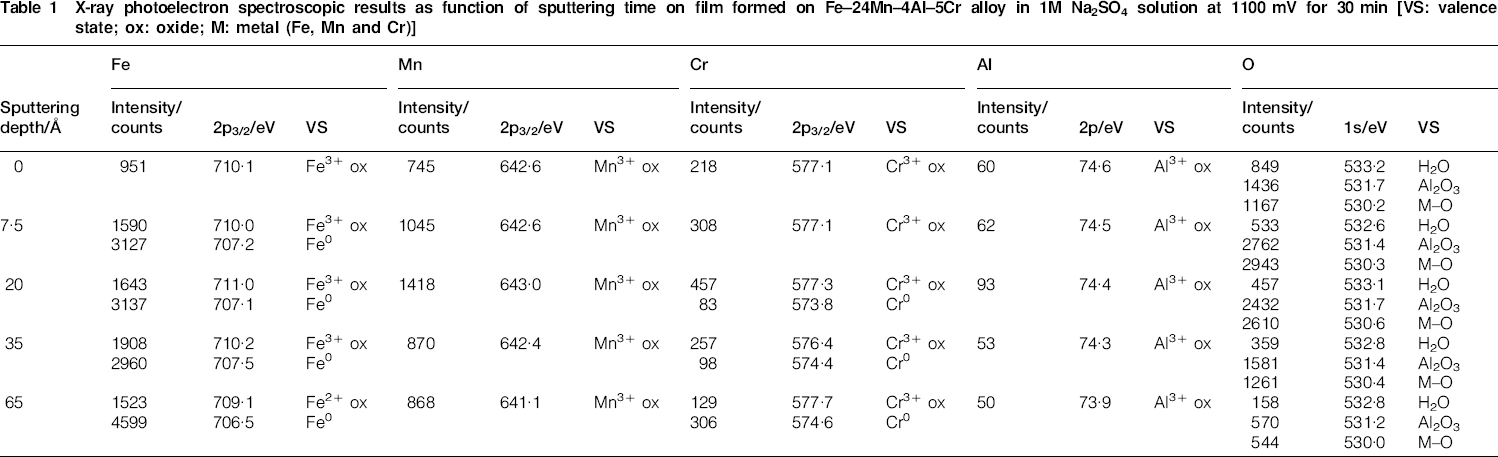
In order to explore the composition of the film formed on Fe–24Mn–4Al–5Cr alloy aged at 1100 mV in 1 mol L−1 Na2SO4 AES/XPS, results have been obtained as a function of sputtering time and are shown in Figs. 6 and 7 and Table 1 respectively. The carbon line in the AES spectrum originated from contamination and has been omitted to make the figures clearer. For comparison, values from similar analysis at 620 mV (cited from Ref. 4) are reported in Fig. 8 and Table 2. Figure 6 shows the Auger depth profile for the passivated layer formed in 1M Na2SO4 solution at 1100 mV for 30 min. The content of oxygen decreases continuously, and the amounts of Fe and Mn in the outer layer of the passive film are about 32-35 and 5-8 at-% respectively, which are much lower than in the matrix. This confirms the preferential dissolution of oxides of Fe and Mn into 1M Na2SO4 solution during the polarisation treatment. With increase in sputtering depth, broad peaks of Al and Cr at a depth of 10-22 and 30-40 Å and at a concentration of ∼8 and 7 at-% are noted.
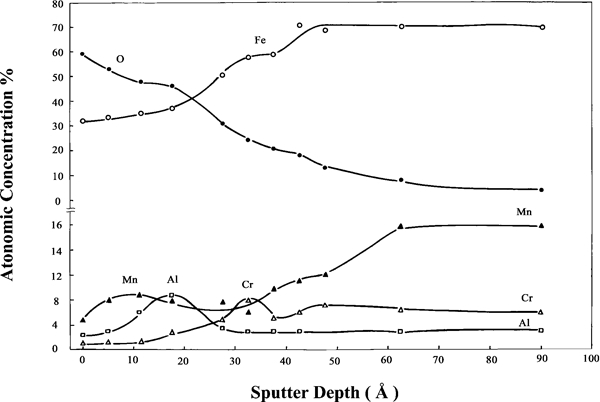
Auger electron spectroscopic depth profiles for film formed on Fe–24Mn–4Al–5Cr alloy in 1M Na2SO4 at 1100 mV for 30 min
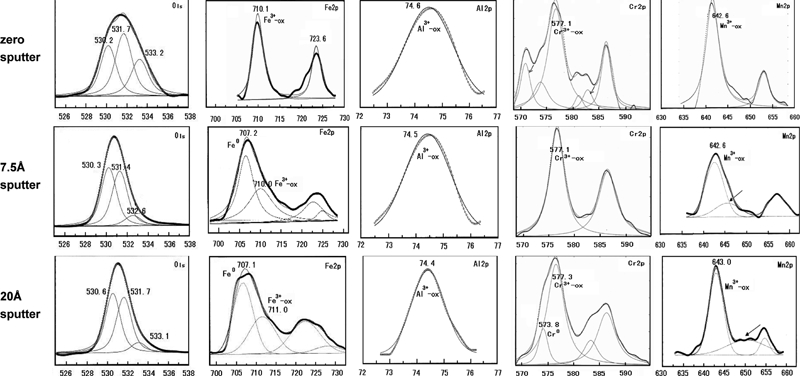
X-ray photoelectron spectroscopic depth profiles for film formed on Fe–24Mn–4Al–5Cr alloy in 1M Na2SO4 solution at 1100 mV(SCE) for 30 min; arrow indicates prominent satellite peak
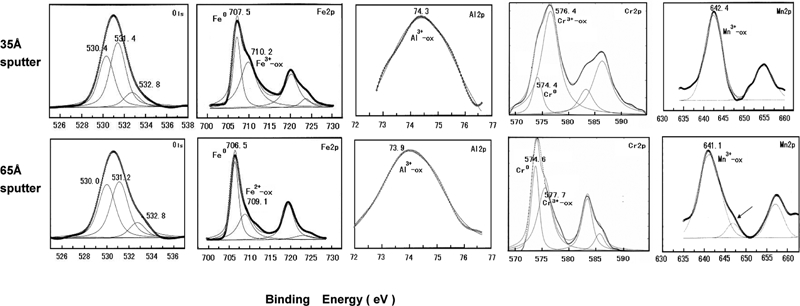
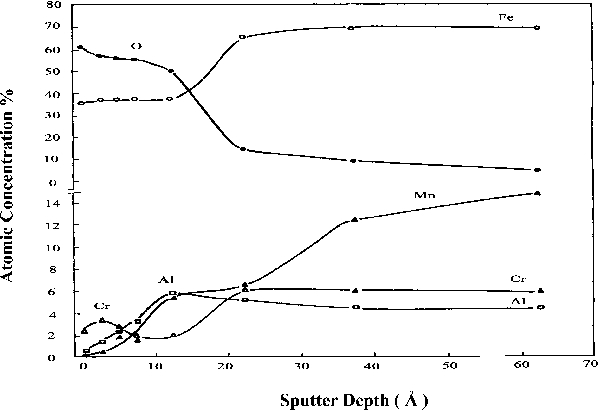
Auger electron spectroscopic depth profiles for film of Fe–24Mn–4Al–5Cr alloy formed in 1M at 620 mV for 5 h (from Ref. 4)
X-ray photoelectron spectroscopic results as function of sputtering time on film formed on Fe–24Mn–4Al–5Cr alloy in 1M Na2SO4 solution at 1100 mV for 30 min [VS: valence state; ox: oxide; M: metal (Fe, Mn and Cr)]
X-ray photoelectron spectroscopic results as function of the film formed on Fe–24Mn–4Al–5Cr alloy at 620 mV for 5 h in 1M Na2SO4 [VS: valence state; ox: oxide; M: metal (Fe, Mn and Cr)]*
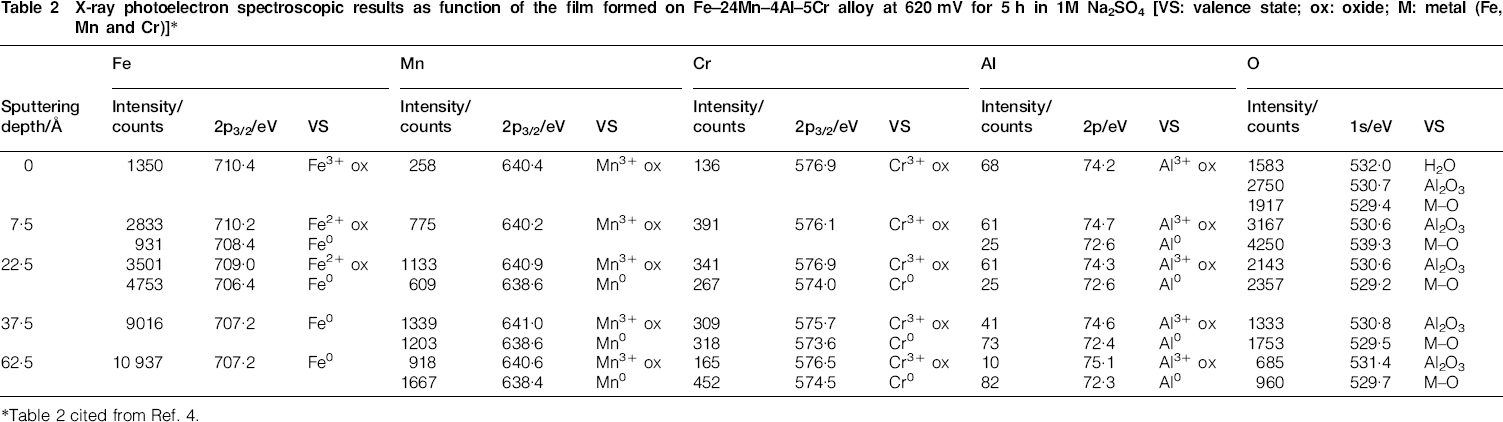
*Table 2 cited from Ref. 4.
The XPS spectra as a function of sputtering time for the film formed on the Fe–24Mn–4Al–5Cr alloy in 1M Na2SO4 solution at 1100 mV(SCE) for 30 min are shown in Fig. 7 and summarised in Table 1 respectively. As seen, the O 1s peaks at the sputtering depth from 0 to 65 Å in passive film are split into three components of 533·2-532·8 eV, 531·7-531·2 eV and 530·6-530 eV, representing the oxygen in the H2O (bound water), in Al2O3 or hydroxides (M–OH) and in oxides O2− (M–O) respectively. From the data listed in Table 1, the fitted binding energy E b of Fe 2p3/2, Mn 2p3/2, Cr 2p3/2 and Al 2p in the XPS spectra of passive film are 711·0-710·0, 709·1, 707·5-706·5, 643·0-641·1, 577·3-576·4, 574·6-573·8 and 74·6-73·9 eV, which correspond to the chemical valence states of Fe3+ ox (Fe2O3) and Fe0 (metallic Fe); Mn3+ ox (Mn2O3); Cr3+ ox(Cr2O3) and Cr0 (metallic Cr) and Al3+ ox (Al2O3) and Al0 (metallic Al) in the passive film. With increased sputtering depth, the binding energy of the Fe 2p3/2, Mn 2p3/2, Cr 2p3/2 and Al 2p peaks shift towards lower values, and the valences show transition from Fe3+ to Fe2+ and to Fe0, from Mn3+ to Mn0, from Cr3+ to Cr0 and from Al3+ to Al0, while the contribution from underlying Fe0, Mn0, Cr0 and Al0 increases. The AES/XPS analysis results of the film formed at 1100 mV in 1M Na2SO4 solution after 30 min were compared with those at 620 mV for 5 h (cited from Ref. 4). According to the Auger depth profile, the peak values of Al and Cr in the film after transpassive aging for 30 min are ∼2 and 4 at-% higher than those after anodic aging at 620 mV for 5 h respectively. On the basis of the XPS depth profile analysis, the film aged at 1100 mV for 30 min is thicker than that formed at 620 mV for 5 h. In addition, the higher valence species of Al3+ ox, Cr3+ ox and Fe3+ ox in passive film are greater in the film formed at a more positive potential.
These factors, particularly the increased thickness of the film formed at the higher potential, probably leads to the increase in T d, i.e., the stability of passive film. In addition, Al and Cr are enriched within the surface film in the Fe–24Mn–4Al–5Cr alloy during the prepolarisation treatment where preferential dissolution of Mn and Fe at the film/electrolyte interface and enrichment of Al and Cr within the passive film occur progressively to critical values.21,22 On the basis of the larger difference for the Gibbs free energy  of formation of Al2O3 (−1691 kJ mol−1), Cr2O3 (−1153 kJ mol−1),7 the initial preferential oxidation of Al, followed by Cr occurs, which induces an aluminium and chromium enriched zone in the bulk of the transpassive film. The corrosion resistance is mainly contributed by this thinner barrier layer of Al and Cr oxides.
Conclusions
The composition and electrochemical stability of the passive film on Fe–24Mn–4Al–5Cr alloy in 1M Na2SO4 solution were found to be a function of anodic potential and polarisation time. Specifically, transpassive surface modification on Fe–24Mn–4Al–5Cr alloy in 1M Na2SO4 solution was found to be optimal at a potential of 1100 mV(SCE) and an aging time of 30 min. Compared with passivation at 620 mV(SCE) for 5 h, the optimal transpassivation treatment shortens the overall time and significantly extends the potential decay time at pH 2. The corrosion resistance of the modified Fe–24Mn–4Al–5Cr alloy, characterised by polarisation in 1M Na2SO4, is superior to that of Fe–13Cr–0·1C stainless steel. The results of the AES/XPS analysis show that the critical transpassivation treatment enhances the amounts of Al2O3 and Cr2O3 present in the film while it causes the depletion of oxides of Fe and Mn resistance. This work reveals the potential for developing novel electrochemical methods for surface modification of passive alloys.
Footnotes
Acknowledgements
The financial support provided by the National Natural Science Foundation of China under grant no. 59901003 is greatly appreciated. The financial support given by the Educational Department Foundation of Liaoning Province, China, under grant no. 20131037 is also appreciated.