







Abstract
The sealing of porous anodic oxide film on aluminium 2024 involving immersion of the anodised aluminium in an aerated solution containing cerium salt under the application of pulse power at room temperature has been proposed as an alternative to dichromate sealing method. The sealing process shows some advantages. The corrosion behaviours of the anodised aluminium unsealed or sealed by dichromate and cerium salt respectively were investigated at different exposure times up to 30 days in 1M NaCl solution by means of electrochemical impedance spectroscopy, and the damage functions were calculated in this work. The results show that the damage functions of anodised aluminium sealed with cerium salt are lower than those unsealed or sealed with potassium dichromate. Cerium salt sealing provides a better corrosion resistance of anodised aluminium in NaCl solution for long exposure time than dichromate sealing.
Introduction
Sealing of anodised aluminium is a well established process to further improve the corrosion resistance of aluminium components.1 The traditional sealing methods include steam and hot water sealing, dichromate, nickel acetate and various cold sealing.2 The development of low energy consumption, environmentally friendly sealing methods, however, is still necessary. By recording electrochemical impedance spectra during exposure in NaCl solution for 14 days, Mansfeld et al.3,4 found that sealing of sulphuric acid anodised (SAA) aluminium alloys (Al 2024, 6061 and 7075) in cerium nitrate solution provided corrosion resistance comparable to that obtained in nickel acetate solution. In addition, they evaluated the corrosion resistance of boric–sulphuric acid anodised aluminium alloys sealed by boiling water, chromate, nickel fluoride, cerium nitrate and yttrium sulphate respectively. The results showed that the corrosion resistance of aluminium alloys sealed in hot solutions of cerium nitrate or yttrium sulphate was similar to that of chromate sealed Al alloys. Tian et al.5 studied the influences of sealing methods on the corrosion behaviour of Al 1070 anodic films in NaCl solutions. The results showed that anodic films sealed by Ce–Mo provided high corrosion resistance both in acidic and alkaline solutions. We have developed a new sealing process that involves the immersion of the anodised aluminium in an aerated solution containing cerium salts under the application of bidirectional pulse electric power.6,7 The results obtained by polarisation and EIS measurements show that the corrosion resistance of anodised aluminium sealed with this new method is better than that of anodised aluminium sealed with boiling water and potassium dichromate.7
As an effective testing method, electrochemical impedance spectroscopy (EIS) has been used for the investigation of properties of porous aluminium oxide films prepared under different conditions.8 – 11 In the present work, EIS measurements of the anodised aluminium unsealed or sealed by dichromate and cerium salt respectively were recorded at different exposure times in NaCl solution, and the damage functions were calculated.
Experimental
Sulphuric acid anodising process
Al 2024 samples with dimensions of 20×10×1 mm were polished using SiC abrasive paper up to no. 1000 and cleaned with water and acetone, followed by a degreasing treatment in 50 g L−1 NaOH solution for 3 min. After water cleaning, the samples were chemically polished in 200 g L−1 HNO3 solution for 3 min, and then, anodising was carried out in 200 g L−1 sulphuric acid solution at a current density of 2·0 A dm−2 for 60 min at room temperature (∼20°C). After that, the samples were cleaned with deionised water and dried. The thickness of the anodic film was ∼16 μm.
Sealing methods
Cerium salts sealing
The samples were immersed in cerium nitrate solution (the concentration of Ce3+ was 1·5 g L−1, pH 5-6) for 60 min under the application of a pulse power at room temperature (∼20°C). A Pb sheet was used as the auxiliary electrode. The pulse frequency was 50 Hz, the pulse voltage was 0·8 V, the pulse ratio was 1∶1, the negative duty cycle was 60% and the positive duty cycle was 35%. The wave of the bidirectional pulse voltage is shown in Fig. 1.
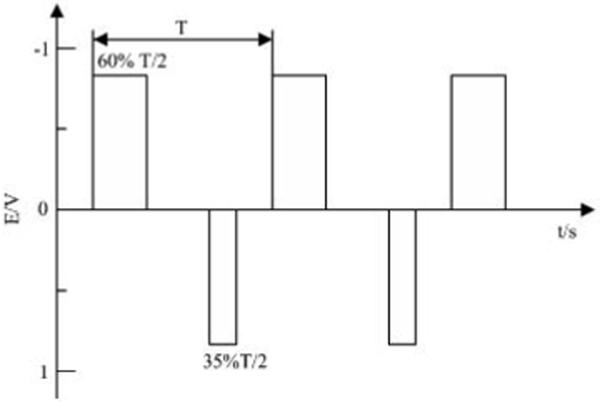
Wave of bidirectional pulse voltage with pulse period = 20 ms, negative pulse time = 6 ms and positive pulse time = 3·5 ms
Dichromate sealing
The samples were immersed in 50 g L−1 potassium dichromate solution (90-95°C, pH 6-7) for 30 min.
After sealing, the samples were rinsed with deionised water and dried in air. All the solutions were prepared by analytical reagents and deionised water.
Measurements of EIS
The sealed samples were immersed in 1M NaCl solution with a pH value of ∼6·5 at 25±1°C. Corrosion behaviours of the sealed samples exposed to 1 h, 7, 15 and 30 days respectively were studied using EIS. A saturated calomel electrode was used as the reference electrode, and the counter electrode was platinum. Measurements using EIS were performed with PARSTAT 2273 advanced electrochemical system at the open circuit potential with a 10 mV perturbation, and the frequency range was from 100 to 0·01 Hz. The test electrolyte was also 1M NaCl solution.
Results and discussion
Figure 2 gives the Bode plots for unsealed SAA Al 2024 as a function of exposure time t corr in 1M NaCl solution. The pronounced differences in the plots are observed over the entire frequency range at different exposure times, especial in the first 15 days. The impedance at high and medium frequency increases gradually with exposure time. However, the impedance at low frequency falls with exposure time. Previous studies have shown that the high and medium frequency portions of the impedance spectra reflect the porous layer properties of the anodic film, while the low frequency portion characterises the barrier layer properties.12 The impedance increment at high and medium frequency shows the occurrence of self-sealing of the porous layer of anodic film during the exposure time. The impedance decrease in the low frequency portion indicates that aggressive ions such as Cl− have penetrated to the barrier layer through the pores; as a result, the corrosion resistance of the barrier layer is decreased.
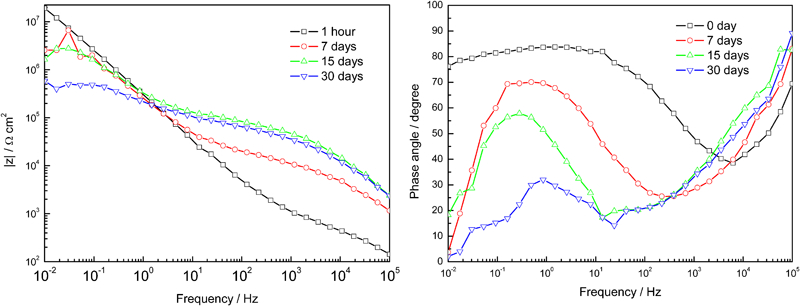
Bode plots of unsealed SAA Al 2024 as function of exposure time in 1M NaCl solution
The phase angle is a very sensitive indicator of these changes.13 It can be seen from Fig. 2 that the phase angle at high frequencies increases with exposure time, which probably means pit initiation. Moreover, it is noted that two time constants appear for unsealed SAA Al 2024 sample, which are related to porous film and barrier layer.
The above results show that EIS is a powerful tool able to provide detailed information on the anodised aluminium layer's electrochemical properties and how the solution exposure influences the anodised sample's properties.
Figures 3 and 4 show the Bode plots for the dichromate sealed and Ce sealed SAA Al 2024 at different exposure times in NaCl solution. For the dichromate sealed anodised aluminium sample, as shown in Fig. 3, only one time constant can be obviously observed in Bode plots. This result is quite consistent with some literatures reported.3 The impedance at high and medium frequency portions increases slightly with exposure time. It seems that for the dichromate sealed anodised aluminium sample, the self-sealing effect also exists, but it is very weak. The impedance at low frequency portions falls gradually with the exposure time, and one order of magnitude decrease is observed after 30 days of immersion, indicating that the protective properties of the barrier layer are weakened. The results obtained by Mansfeld et al. showed that the impedance of boric–sulphuric acid anodised Al 2024 sealed in dilute chromate solution decreased little during exposure in 0·5 N NaCl up to 6 days.3 However, the longer immersion test was not performed. The phase angle tends to go down at the whole frequency region, especially at the low frequency portions. For the cerium salt sealed anodised aluminium sample, as shown in Fig. 4, two time constants can be seen in Bode plots, showing an obvious characteristic of EIS for sealed anodic film on aluminium. However, the impedance at high and medium frequency portions increases also slightly with exposure time, similar to the dichromate sealed aluminium sample. This indicates that the self-sealing process of cerium salt sealed sample is also very weak. Similarly, the impedance at low frequency portions decreases gradually with the exposure time. However, it remains a relatively high value after immersion of 30 days. A comparison of the impedance in Fig. 4 and that in Ref. 4 reveals that better corrosion resistance is provided to the anodised aluminium sample by this new cerium salt sealing method than others.
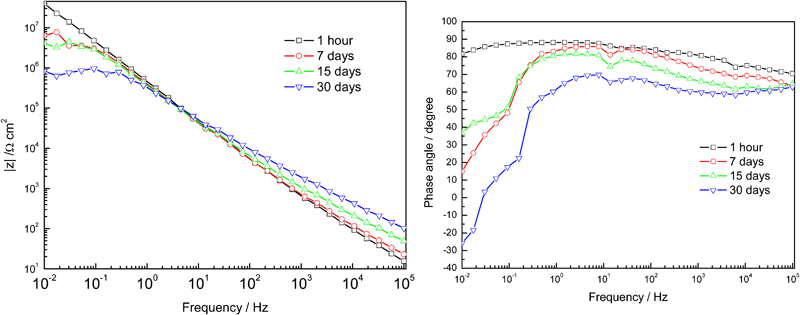
Bode plots of dichromate sealed SAA Al 2024 as function of exposure time in 1M NaCl solution
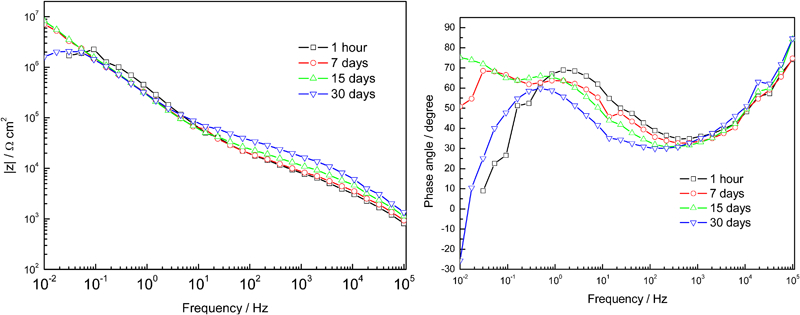
Bode plots of cerium salt sealed SAA Al 2024 as function of exposure time in 1M NaCl solution
Mansfeld et al.14 have used a damage function D to measure the changes in corrosion resistance of sealed or unsealed anodised aluminium with exposure time.
D is defined as

Damage functions for anodised Al alloys at different exposure times

Conclusions
Electrochemical impedance spectroscopy of anodised aluminium (unsealed, sealed with cerium salt and sealed with dichromate) were measured at different exposure times up to 30 days in NaCl solution at room temperature, and the damage functions were calculated according to the initial impedance value and the value at certain exposure time at 0·1 Hz. The results show that the damage functions of anodised aluminium sealed with cerium salt is lower than that of anodised aluminium unsealed or sealed with dichromate. Cerium salt sealing provides a better corrosion resistance of anodised aluminium in NaCl solution for long exposure time than dichromate sealing.
Footnotes
Acknowledgements
The authors are grateful to the National Natural Science Foundation of China (contract no. 50971014) for the support to this work.