







Abstract
The corrosion compatibility of zircaloy-2 was studied in strong oxidising permanganate based acidic (HMnO4) medium using impedance spectroscopy and potentiodynamic anodic polarisation methods at room temperature (28°C) and elevated temperatures (65 and 90°C). The average corrosion rate of zircaloy-2 in HMnO4 medium (0·417-8·33 mM) was found to be 1·32×10−4 μm h−1 at 28°C, 2·59×10−4 μm h−1 at 65°C and 3·53×10−4 μm h−1 at 90°C. At 28°C, the polarisation resistance R p values obtained from impedance spectrum were higher (in kΩ) when compared to R p values at 65 and 90°C, indicating a lower corrosion rate at lower temperature. Comparative studies with 2·5 mM H2SO4 and platinum (as a working electrode) showed the effects of oxidising nature and participation of additional redox reactions in HMnO4 medium. Cyclic polarisation studies showed the absence of pitting attack on zircaloy-2.
Introduction
A variety of metal alloys like zirconium alloys, high nickel alloys, stainless steel, hardfacing alloys (stellite) and carbon steel are used in reactors based on considerations of neutron economy, material strength, heat transfer efficiency and corrosion resistance, depending upon the zone where they are employed. The major structural materials of boiling water reactors (BWRs) are stainless steel (PHT) and zircaloy-2 (clad), and in case of pressurised heavy water reactors are carbon steel and zircaloy-4 (PHT), stainless steel and zircaloy-2 (moderator). The coolant chemistry environment in BWRs following the normal water chemistry regime is oxidative in nature. During the operation of water cooled nuclear reactors like BWRs, corrosion products are generated due to the interaction of high temperature coolant with the structural materials of the primary system. Some of these corrosion products are carried to the reactor core with coolant where they undergo neutron activation and thereby become activated corrosion products. Subsequently, they get redispersed to out of core locations where the oxide present over the surfaces acts as the host lattice for the incorporation of activated corrosion products and fission products, if any, originated from defective fuel cladding. Some of those nuclides are long lived and are of concern in the activity transport process. This results in the radiation field build-up in the reactor coolant circuit. Activated stellite particulates have also been observed to be deposited on the stainless steel vessels of moderator system.1 During moderator decontamination of hot spots, zircaloy-2 will also come in contact with the decontamination solution. Dilute chemical decontamination process is one of the methods adopted to remove the activity embedded in the oxide layers formed over these structural materials. Depending on the type of reactor, either an oxidising formulation followed by a reducing formulation or only the latter is used for the purpose.2 – 4 Permanganate based oxidising reagents such as alkaline permanganate,5 nitric acid permanganate5 and permanganic acid6 are generally used for the pretreatment in the decontamination process to dissolve chromium from the iron, chromium and nickel containing oxide films formed on stainless steel and other chromium containing alloys.7 During such process, the core material, which is zircaloy-2, will also come in contact with the decontamination solution. Various corrosion studies using zirconium alloys have been reported in different media such as sodium chloride,8 nitric acid,9 sodium hydroxide and sulphuric acid10 and water,10 – 12 but not in permanganate based formulations. This paper mainly concentrates on the corrosion mechanisms of zircaloy-2 in HMnO4 at three different temperatures using impedance13 and potentiodynamic anodic polarisation (PDAP) methods.14 Surface characterisation studies using X-ray photoelectron spectroscopic (XPS) are also presented supporting the corrosion data.
Experimental
Materials and solutions
The sample coupons of zircaloy-2 (Zr–1·5Sn–0·15Fe–0·1Cr–0·05Ni; size, 1×1 cm) were polished with different grades of silicon carbide papers ranging from 80 to 800 grit. Then, the coupons were washed with distilled water, degreased with acetone, dried in air and immediately exposed to the test solution. All the solutions were prepared using analytical grade chemicals.
The permanganic acid (HMnO4) was prepared by passing suitable amounts of potassium permanganate (KMnO4) solution through regenerated cation (H+) resin column with an optimised flowrate of 10 mL min−1 to avoid decomposition of the resin and to achieve complete conversion to HMnO4, and the final concentration of HMnO4 was estimated by a spectrophotometer.15 The concentration of HMnO4 prepared ranged from 0·417 to 8·33 mM. The pH of the above solutions thus prepared was in the range of 2·06-3·32. With increasing HMnO4 concentration, the acidity increases. In these experiments, higher temperatures, i.e. 65 and 90°C, were chosen to simulate the actual temperatures of chemical decontamination of moderator and coolant systems respectively. The room temperature 28°C was chosen for comparison purpose for laboratory studies. Dilute sulphuric acid (H2SO4) was prepared by suitably diluting concentrated H2SO4 to give the required pH of the solution.
Methods
X-ray photoelectron spectroscopic studies were carried out using VG ESCALAB MK 200X equipment. Spectrophotometric analysis was carried out using spectrophotometer Evolution 500 model (Thermo Electron Corporation). Electrochemical experiments were carried out with Eco Chemie Autolab PG STAT 30 system in a conventional three-electrode mode using a platinum foil as a counter electrode and a saturated calomel electrode as a reference electrode through a Luggin capillary. The temperature of the solution was maintained within ±1°C using a laboratory thermostat and suitably adjusting the set point to maintain the required temperature. Before starting the polarisation, the samples were stripped cathodically at a constant potential of −1·0 V for 3 min to remove any air formed film and were allowed to attain a stable open circuit potential (OCP). Impedance spectra were obtained at OCP by applying a sinusoidal voltage of amplitude ±10 mV in the frequency range of 104–0·005 Hz. The spectra were analysed using various equivalent circuit models, and the circuit given in Fig. 1 best describes the impedance data.16,17 Parameters like solution resistance R s, polarisation resistance R p, charge transfer resistance R ct, double layer capacitance C d and a constant phase element Q were computed.18 The PDAP scan was obtained by polarising the working electrode from −1·0 to +1·0 V with respect to OCP at a scan rate of 0·5 mV s−1. The corrosion rate was calculated from i corr.19 – 21
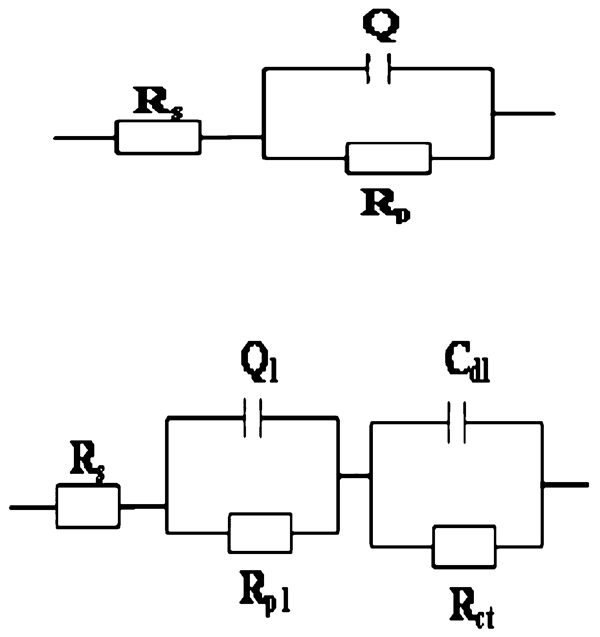
Randle's equivalent circuit model
Results and discussion
Potentiodynamic anodic polarisation studies
Corrosion parameters for zircaloy-2 in different concentrations of HMnO4 at different temperatures are tabulated in Table 1.
Corrosion parameters of zircaloy-2 in HMnO4 at 28, 65 and 90°C
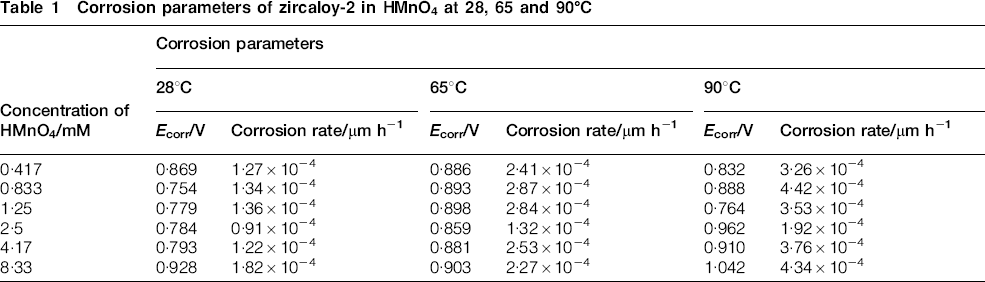
As shown in Table 1, the corrosion tendency, in general, at all the temperatures did not show any regular trend with increase in HMnO4 concentration. However, the corrosion rate calculated from the i corr value showed only a minor variation in corrosion rate at a particular temperature but significantly varied with increase in temperature. Thus, the corrosion rate of zircaloy-2 was found to be independent of HMnO4 concentration at a particular temperature but increased with increase in temperature. An average corrosion rate of 1·32×10−4 μm h−1 at 28°C, 2·59×10−4 μm h−1 at 65°C and 3·53×10−4 μm h−1 at 90°C was obtained for the above range of HMnO4 concentration. The oscillating shift in E corr values towards noble and active side could be attributed to the mixed effect of increase in hydrogen ion concentration and MnO4 − ions with increase in HMnO4 concentration in addition to the dissolved oxygen present in the solution. Owing to minor variation in the rates of these three reactions, the variation in corrosion currents/rates were observed.
The Tafel values indicate (not given) that the corrosion reaction was under mixed (anodic and cathodic) control. The anodic polarisation studies showed the formation of a surface passive film, and the anodic reaction was found to be more dominating.
Impedance studies
Different equivalent circuits were tested for interpretation of impedance data, and the appropriate one was chosen, keeping in mind that the corroding zircaloy-2 in HMnO4 medium was found to develop a surface film consisting of ZrO2 and manganese oxide. Constant phase element, denoted as Q, has been used for better fitting instead of true capacitance. The constant phase element is a special element whose impedance value is a function of the angular frequency ω and whose phase is independent of the frequency. Values of n are usually related to roughness or inhomogeneity of the electrode surface and Warburg diffusional effects at the interface, depending on its value. Its values close to 0·5 are considered to represent the diffusional effects, and those close to 1, the capacitance.22 – 24
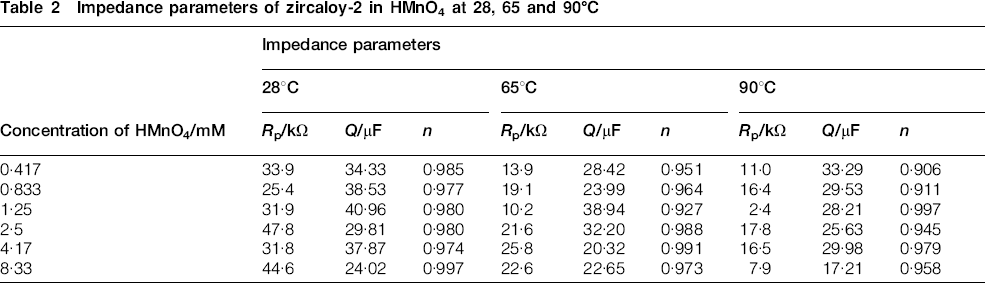
Table 2 gives the impedance parameters of zircaloy-2 in various concentrations of HMnO4 at 28, 65 and 90°C. The Nyquist plot showed a single capacitive loop indicating one time constant in all the formulations at 28, 65 and 90°C. The R p values were in the order of kilo-ohms, indicating a very low corrosion rate, which could be attributed to the instantaneous film formation on zircaloy-2. Further, the decreasing trend in the R p values for a fixed concentration showed an increasing trend in corrosion rate with increase in temperature. The Q values in μF did not vary significantly, showing that the ionic atmosphere around the double layer of the metal solution interface remained almost constant. The values of n associated with Q were >0·9, which indicated that the zircaloy-2/solution interface behaved like a pure capacitor.
Impedance parameters of zircaloy-2 in HMnO4 at 28, 65 and 90°C
Effect of permanganate ion and redox current contribution
In order to find the effect of permanganate ion, polarisation and impedance studies were carried out with zircaloy-2 in 2·5 mM H2SO4 (pH 2·39) and 2·5 mM HMnO4 (pH 2·84) media. Further, in order to understand the contribution of redox current to the measured i corr, the above polarisation and impedance curves were compared with the results obtained for platinum.
At 28°C
Figures 2 and 3 show the polarisation and impedance plots respectively for zircaloy-2 in the presence of 2·5 mM H2SO4 and 2·5 mM HMnO4 in non-deaerated and deaerated conditions at 28°C.
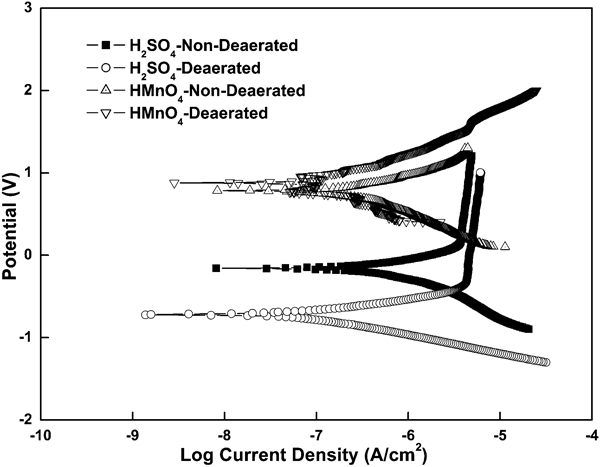
Potentiodynamic anodic polarisation curve of zircaloy-2 in 2·5 mM H2SO4 and 2·5 mM HMnO4 in non-deaerated and deaerated conditions at 28°C
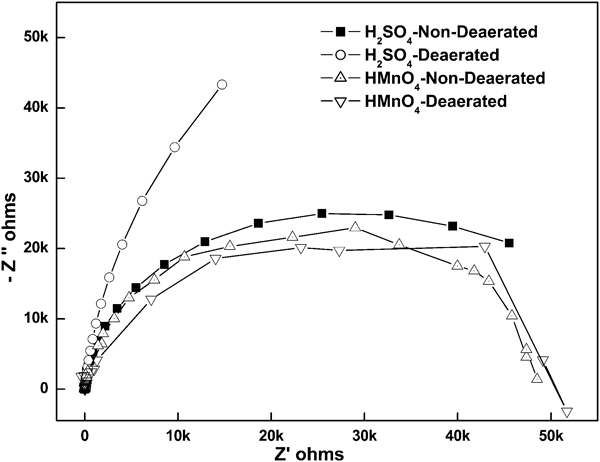
Nyquist plot of zircaloy-2 in 2·5 mM H2SO4 and 2·5 mM HMnO4 in non-deaerated and deaerated conditions at 28°C
E corr was very active, in the case of deaerated H2SO4 (−0·724 V) compared to non-deaerated condition (−0·158 V), whereas in HMnO4, the E corr values were moderately noble (+0·878 and +0·784 V respectively) under similar conditions, which showed the effect of the oxidising property of the latter. Thus, the oxidising powers of the mediums were found to increase in the following order: (sulphuric acid, deaerated)<(sulphuric acid, non-deaerated)<(permanganic acid, non-deaerated)≤(permanganic acid, deaerated). The current densities observed in H2SO4 in deaerated and non-deaerated conditions were slightly high when compared to those that were observed in HMnO4 under similar conditions, which could be attributed to surface films formed on zircaloy-2. It is seen from the electron spectroscopy for chemical analysis (ESCA) results presented later that a film of ZrO2 is formed in H2SO4 medium and a film containing ZrO2+MnO2/Mn–OH is formed in the presence of HMnO4. Both the films could then hinder the electron transfer reaction and lower the current density depending on the content of ZrO2, which is an insulator. The corrosion current densities observed in non-deaerated condition were higher compared to deaerated condition, both in H2SO4 and HMnO4 media, indicating that the dissolved oxygen present in the system leads to a high corrosion rate.
From Fig. 3, it was seen that the R p values followed a reverse trend, as expected, showing a correlation with the corrosion rates obtained from PDAP. The high R p values (in kΩ) suggested a very high corrosion resistance of the material, probably due to ZrO2 film, which is non-conducting in nature. In deaerated condition, in general, R p obtained (from equivalent circuit fitting) was higher compared to non-deaerated condition in both H2SO4 and HMnO4, indicating that the corrosion rate decreased in the absence of oxygen.
Figures 4 and 5 show the polarisation and impedance plots respectively for platinum in the presence of 2·5 mM H2SO4 and 2·5 mM HMnO4 in non-deaerated and deaerated conditions at 28°C.
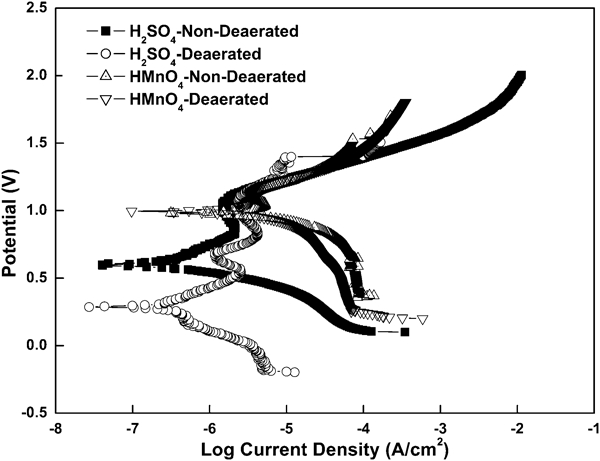
Potentiodynamic anodic polarisation of platinum in 2·5 mM H2SO4 and 2·5 mM HMnO4 in non-deaerated and deaerated conditions at 28°C
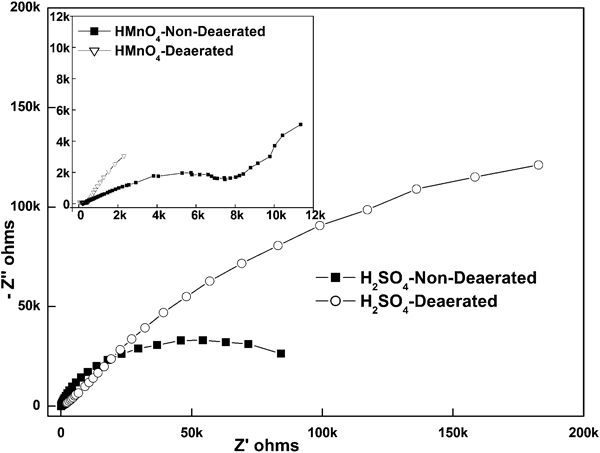
Nyquist plot of platinum in 2·5 mM H2SO4 and 2·5 mM HMnO4 in non-deaerated and deaerated conditions at 28°C
The experiment was carried out with platinum as a working electrode to see the redox effect of HMnO4. E corr showed a noble value in HMnO4 compared to H2SO4. In H2SO4, platinum showed a very small active to passive transition on the anodic portion of the curve. E corr was active in deaerated H2SO4 (+0·286 V) compared to deaerated HMnO4 (+0·996 V), which showed the effect of the oxidising property of HMnO4. E corr was active in case of deaerated H2SO4 compared to the non-deaerated condition, whereas in HMnO4, the E corr values were almost similar in both deaerated and non-deaerated conditions. The current densities observed were more in HMnO4 compared to H2SO4 due to the additional redox reactions of permanganate ion,  . The examination of the platinum electrode also showed a thin black film, probably MnO2, on the surface at the end of the experiment. Thus, in case of platinum, the experimentally observed corrosion current would be mostly representative of the redox current. The redox current from i corr calculation, in non-deaerated H2SO4, was slightly higher (not clearly obvious from graph) compared to deaerated condition due to dissolved oxygen present in the former case. In case of HMnO4, the difference in redox currents in non-deaerated and deaerated medium was not clearly significant since HMnO4 being an oxidant contributes more to the redox current. The comparison of cathodic and the anodic slopes under both deaerated and non-deaerated mediums showed that the reaction was under mixed control.
From the impedance plots (Fig. 5), the lower R p values (higher corrosion currents) in HMnO4 for platinum compared to R p obtained in HMnO4 for zircaloy-2 could be attributed mainly to the redox reactions of the solution species and to the absence of ZrO2 insulative film in the former case. A single semicircle was observed in H2SO4 medium in both non-deaerated and deaerated conditions, indicating the presence of a single time constant. The R p value was higher in the deaerated condition compared to non-deaerated condition in both the media due to a decrease in the corrosion rate in the absence of oxygen.
The equivalent circuit was best fitted to two semicircles (clearly not visible from impedance plots) for HMnO4 medium, indicating the presence of two time constants. The R p values obtained for platinum were significantly lower in HMnO4 compared to the H2SO4 medium due to the occurrence of HMnO4/MnO2 redox reaction at the platinum/solution interface.
At 65°C
Figures 6 and 7 show the polarisation and impedance plots respectively for zircaloy-2 in presence of 2·5 mM H2SO4 and 2·5 mM HMnO4 in non-deaerated and deaerated conditions at 65°C.
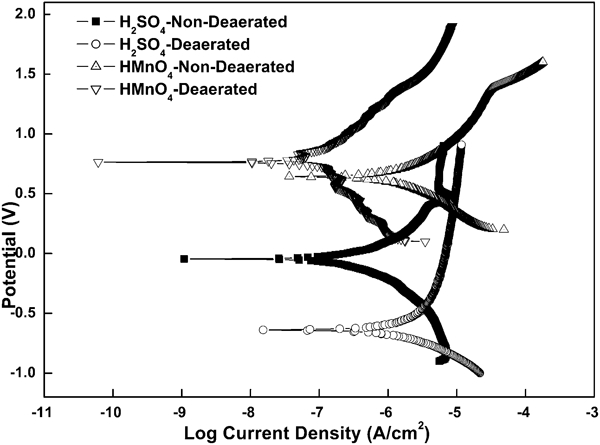
Potentiodynamic anodic polarisation curve of zircaloy-2 in 2·5 mM H2SO4 and 2·5 mM HMnO4 in non-deaerated and deaerated conditions at 65°C
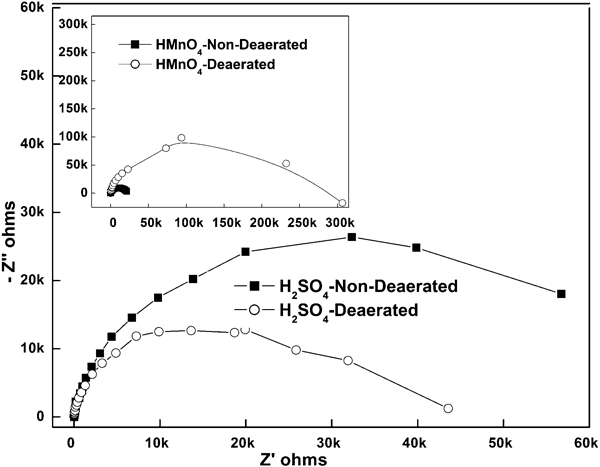
Nyquist plot of zircaloy-2 in 2·5 mM H2SO4 and 2·5 mM HMnO4 in non-deaerated and deaerated conditions at 65°C
At 65°C, almost similar behaviour was observed as in the case of 28°C. E corr was very active in the deaerated H2SO4 (−0·639 V) compared to the non-deaerated condition (−0·046 V), whereas E corr for non-deaerated HMnO4 was moderately active (+0·644 V versus +0·764 V for the deaerated condition) for the same reason as given for lower temperature. The oxidising powers of the media were found to increase in the following order: (sulphuric acid, deaerated)<(sulphuric acid, non-deaerated)<(permanganic acid, non-deaerated)≤(permanganic acid, deaerated) from the E corr values.
As in the case 28°C, the current density observed in deaerated H2SO4 was higher compared to that observed in deaerated HMnO4 due to efficient surface coverage in the latter case. However, the current density observed in non-deaerated HMnO4 was higher compared to that observed in non-deaerated H2SO4. This could be due to higher rate of film dissolution compared to film formation at 65°C. The corrosion current density observed in non-deaerated H2SO4 was lower compared to deaerated condition due to efficient film formation in the presence of oxygen. However, the corrosion current in non-deaerated HMnO4 was higher compared to deaerated condition due to higher film dissolution in the former case.
The R p values (Fig. 7) in kilo ohms represent the corrosion resistance of the material because the ZrO2 film formed on zircaloy-2 is non-conducting in nature. In deaerated HMnO4, R p observed was higher compared to non-deaerated condition, indicating that the corrosion rate decreased in absence of oxygen. In the case of H2SO4, deaeration decreases the R p value, indicating that at elevated temperature, the effect of deaeration was not observed.
Figures 8 and 9 show the polarisation and impedance plots respectively for platinum in presence of 2·5 mM H2SO4 and 2·5 mM HMnO4 in non-deaerated and deaerated conditions at 65°C.
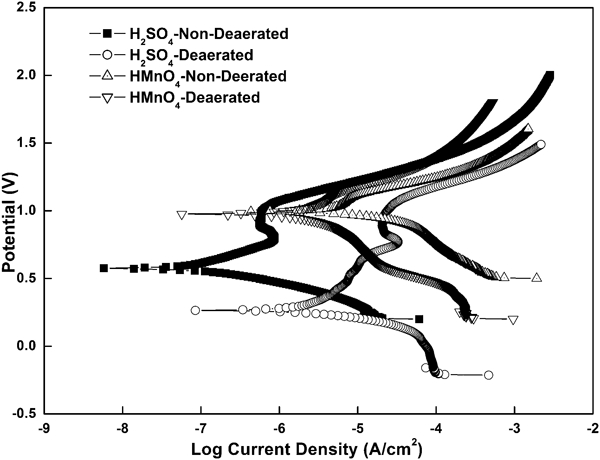
Potentiodynamic anodic polarisation of platinum in 2·5 mM H2SO4 and 2·5 mM HMnO4 in non-deaerated and deaerated conditions at 65°C
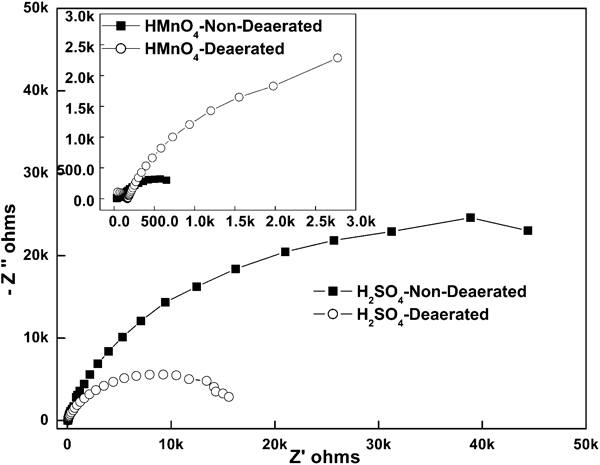
Nyquist plot of platinum in 2·5 mM H2SO4 and 2·5 mM HMnO4 in non-deaerated and deaerated conditions at 65°C
The experiment was carried out with platinum as a working electrode. In HMnO4, the PDAP curve shifted towards the higher current region, and E corr shifted to the noble side compared to H2SO4. In H2SO4, platinum showed a small active to passive transition on the anodic portion of the curve. E corr was active in deaerated H2SO4 (+0·576 V) compared to that in deaerated HMnO4 (+0·976 V), which showed the effect of the oxidising property of the HMnO4. E corr was slightly active in case of deaerated H2SO4 compared to non-deaerated condition, whereas in HMnO4, E corr was almost similar in both non-deaerated and deaerated conditions. The current density observed was more in non-deaerated HMnO4 compared to non-deaerated H2SO4 due to the additional redox reactions of permanganate ion,  . The examination of the platinum electrode also showed a thin black MnO2 film on the surface at the end of the experiment. Thus, in case of platinum, the experimentally observed corrosion current is representative of the redox current. HMnO4 being an oxidant leads to more redox current in non-deaerated condition compared to deaerated condition. The comparison of cathodic and the anodic slopes under both deaerated and non-deaerated media showed that the reaction was under mixed control.
In case of platinum (Fig. 9), the R p value obtained was less compared to that of zircaloy-2, indicating that the corrosion current was more, which can be attributed mainly to the redox reactions of the solution species. Moreover, there is no insulative film like ZrO2 (which was found on zircaloy-2) on the platinum surface. A single semicircle was observed in case of H2SO4 medium in both non-deaerated and deaerated conditions, indicating the presence of a single time constant. R p was less (current density high) in deaerated H2SO4 compared to non-deaerated H2SO4 due to higher dissolution rate of the film in the former case.
The equivalent circuit was best fitted to two semicircles (clearly not visible at high frequencies) for HMnO4 medium, indicating the presence of two time constants. The R p values obtained were significantly less in HMnO4 compared those in H2SO4 due to the occurrence of HMnO4/MnO2 redox reaction at the Pt/solution interface. R p was high (low redox current) in deaerated HMnO4 compared to non-deaerated condition due to absence of dissolved oxygen in the former case.
At 90°C
Figures 10 and 11 show the polarisation and impedance plots respectively for zircaloy-2 in 2·5 mM H2SO4 and 2·5 mM HMnO4 in non-deaerated and deaerated conditions at 90°C.
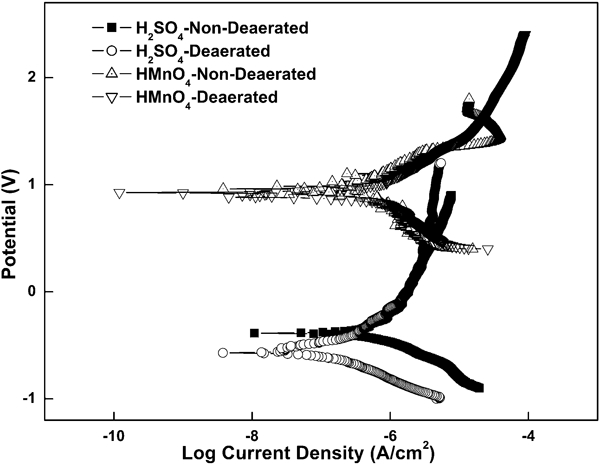
Potentiodynamic anodic polarisation of zircaloy-2 in 2·5 mM H2SO4 and 2·5 mM HMnO4 in non-deaerated and deaerated conditions at 90°C
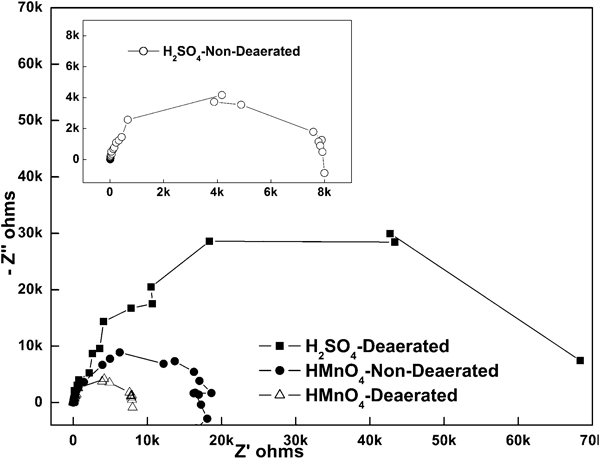
Nyquist plot of zircaloy-2 in 2·5 mM H2SO4 and 2·5 mM HMnO4 in non-deaerated and deaerated conditions at 90°C
At 90°C, E corr was active in case of deaerated H2SO4 (−0·570 V) compared to non-deaerated condition (−0·387 V), whereas in HMnO4, E corr was moderately noble (+0·927 and +0·962 V respectively) under similar conditions, which showed the effect of the oxidising property of the latter. The oxidising powers of the media were found to increase in the following order: (sulphuric acid, deaerated)<(sulphuric acid, non-deaerated)<(permanganic acid, deaerated)≤(permanganic acid, non-deaerated) from the E corr values. The corrosion behaviour was similar to those at lower temperatures. However, the corrosion current in non-deaerated H2SO4 was high when compared to that of deaerated condition. The polarisation curves did not show any active to passive transition. However, E corr, current density and tafel behaviours were similar to the other temperatures.
The impedance data showed a similar trend with zircaloy-2 as observed in lower temperatures (Fig. 11).
Figures 12 and 13 show the polarisation and impedance plots respectively for platinum in 2·5 mM H2SO4 and 2·5 mM HMnO4 in non-deaerated and deaerated conditions at 90°C.
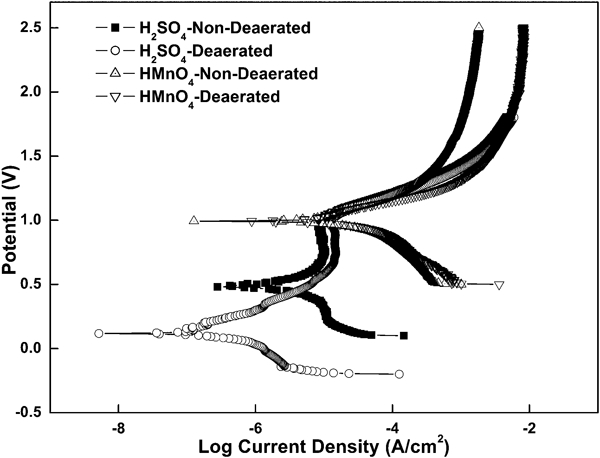
Potentiodynamic anodic polarisation of platinum in 2·5 mM H2SO4 and 2·5 mM HMnO4 in non-deaerated and deaerated conditions at 90°C
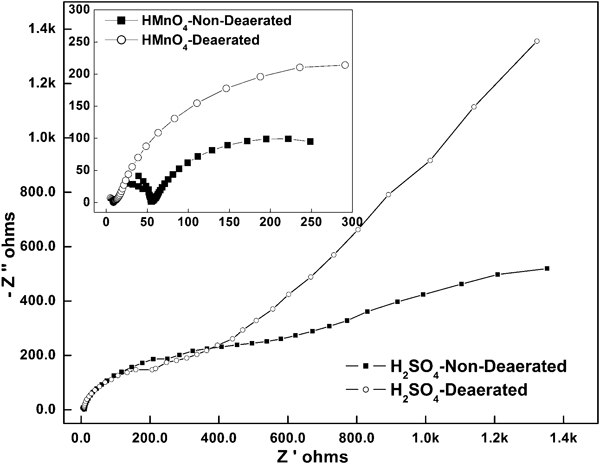
Nyquist plot of platinum in 2·5 mM H2SO4 and 2·5 mM HMnO4 in non-deaerated and deaerated conditions at 90°C
With platinum as a working electrode, E corr showed a noble value in HMnO4 compared to H2SO4. In H2SO4, platinum showed a very small active to passive transition on the anodic portion of the curve. E corr was active in deaerated H2SO4 (+0·117 V) compared to deaerated HMnO4 (+1·022 V), which showed the effect of the oxidising property of the HMnO4. E corr was active in case of deaerated H2SO4 compared to non-deaerated condition, whereas in HMnO4, E corr was almost similar in both deaerated and non-deaerated conditions. The current density observed was more in HMnO4 compared to H2SO4 due to the additional redox reactions of permanganate ion,  . The examination of the platinum electrode surface showed a thin black MnO2 film at the end of the experiment. Thus, in case of platinum, the experimentally observed corrosion current is representative of the redox current. The redox current in non-deaerated H2SO4 was higher compared to deaerated condition, indicating that dissolved oxygen present in the system leads to more redox current. The redox current was similar in both the conditions in HMnO4. The comparison of cathodic and the anodic slopes under both deaerated and non-deaerated media showed that the reaction was under mixed control.
The impedance data (Fig. 13) showed a similar trend with platinum as observed in lower temperatures. However, the R p values obtained with platinum was less than that of zircaloy-2 due to the response of the former to redox reactions as mentioned above.
The corrosion rates do not follow any regular trend with increasing temperature since the film formation and the film dissolution take place simultaneously at different rates at different temperatures. The film properties can also change with the dissolved oxygen concentration and the equilibrium concentration of HMnO4, which depend on the temperature. In general, it was observed that the corrosion rates were higher in the non-deaerated medium compared to the deaerated medium.
Cyclic polarisation studies
Figures 14 showed the cyclic polarisation curves for zircaloy-2 in 1·25, 2·5 and 4·17 mM of HMnO4 respectively at 65°C. In cyclic polarisation, if any hysteresis loop is observed with the reverse scan current more than the forward scan current, then pitting/localised attack is inferred. However, if the reverse scan current is smaller than the forward scan current, then it would mean formation of a good passive film during the forward scan. In this study, it was seen that at any given potential, the values of both anodic and cathodic currents were lower in the reverse scan as compared to the forward scan25 and hence the absence of any pitting attack. Further, the cyclic polarisation experiments showed that the passive region was broader in the reverse scan showing that the oxidising condition was just sufficient to form the film. These results show that a surface film was developed and thickened during the forward scan, which could have reduced the kinetics of both anodic and cathodic reactions in the reverse scan.
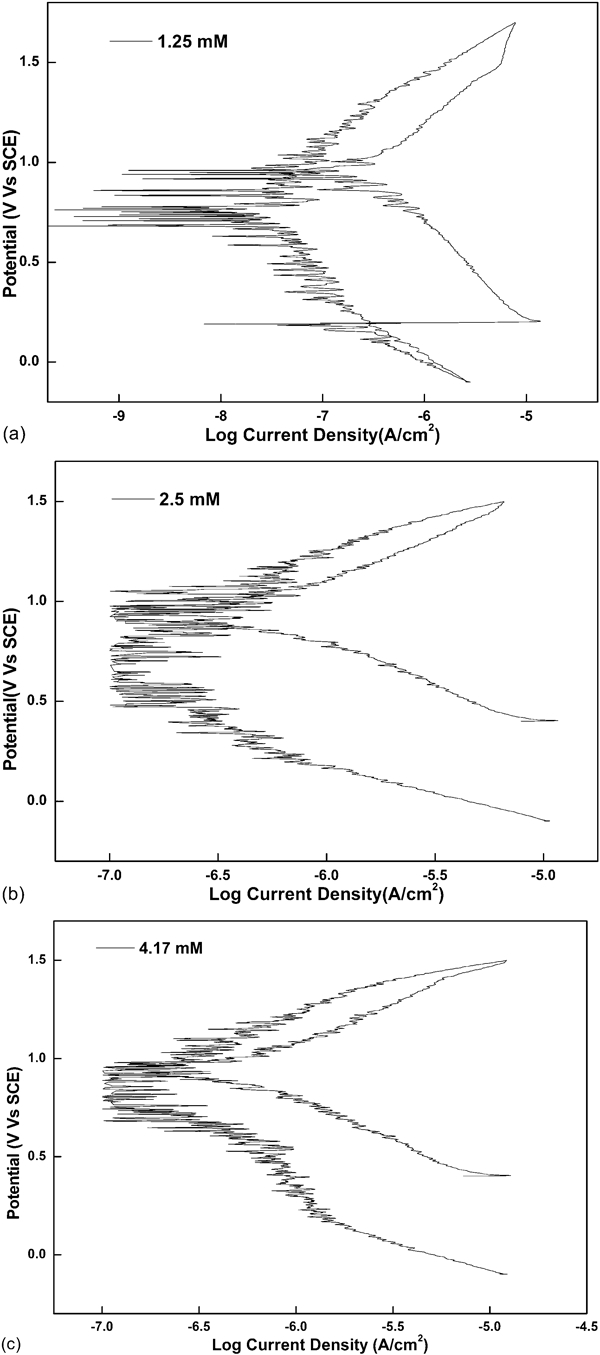
a–c cyclic polarisation curve of zircaloy-2 in 1·25, 2·5 and 4·17 mM HMnO4 respectively at 65°C
Electron spectroscopy for chemical analysis studies
Figures 15 and 16 gives the XPS spectra of the zircaloy-2 coupon exposed in 2·5 mM HMnO4 and 2·5 mM H2SO4 respectively at room temperature. In Fig. 15, the Mn 2p 3/2 and Zr 3d 5/2 peaks were observed at 642·1 and 183 eV respectively, which indicated the presence of MnO2 (Ref. 26) and ZrO2 (Ref. 27) on the surface. O 1s peak was found at 530 eV with a shoulder at ∼531·7 eV. The peak at 530 eV indicated the presence of oxide dominating phase, and at 531·7 eV, the presence of some OH species on the surface. Thus, it appears that the surface was covered dominantly with MnO2, ZrO2 and some Mn–OH containing species.
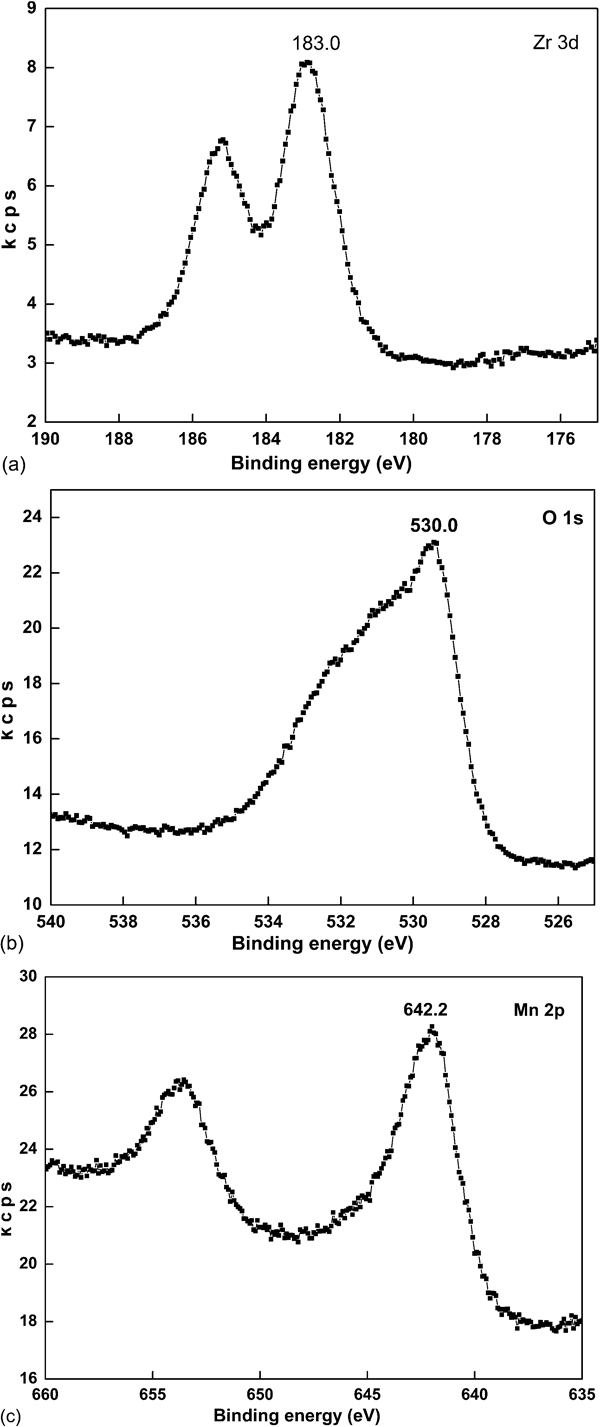
Photoelectron spectra of a Zr 3d, b O 1s and c Mn 2p obtained from zircaloy-2 exposed to permanganic acid solution at 28°C
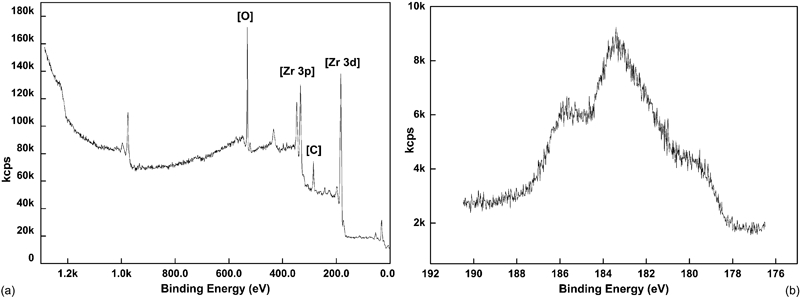
Photoelectron spectra of a wide scan and b Zr obtained from zircaloy-2 exposed to sulphuric acid solution at 28°C
The spectrum in Fig. 16a shows the wide scan of XPS taken for the oxide of zircaloy. It showed the presence of O, C and Zr. O 1s peak was found at 533 eV, indicating the presence of oxide dominating phase. The narrow scan for Zr 3d showed the presence of Zr in two different states as shown in Fig. 16b. Thus, it appears that the surface was covered dominantly with ZrO2.
Conclusions
The corrosion behaviour of zircaloy-2 in oxidising HMnO4 based decontamination medium could be understood using impedance and PDAP methods. The OCP and anodic polarisation measurements clearly showed that the alloy surface gets modified by formation of a surface film. The study also showed that the corrosion reaction was under mixed control, but the anodic reaction was more dominating. Comparative studies with 2·5 mM of H2SO4 and platinum (as a working electrode) showed the effects of oxidising nature and the participation of additional redox reactions in HMnO4 medium. The average corrosion rates of zircaloy-2 in HMnO4 medium were found to be 1·32×10−4 μm h−1 at 28°C, 2·59×10−4 μm h−1 at 65°C and 3·53×10−4 μm h−1 at 90°C. Based on these studies, it can be concluded that the use of HMnO4 in decontamination formulations does not cause any significant corrosion to zircaloy-2 material. For a given concentration of HMnO4, the corrosion rate was found to be lower at room temperature (28°C) compared to that at 65 and 90°C. Further, the cyclic polarisation studies revealed no pitting attack on zircaloy-2 in HMnO4 medium during its use as decontamination formulation.