






Abstract
The alternating current (AC) has a strong influence on the corrosion of carbon steel Q235 in soil. AC corrosion1-3 was investigated by morphology observation, weight loss analysis and electrochemical measurement. The results of morphology observation and weight loss analysis showed that AC increased the corrosion rate and the influence was weakened when a protective layer was built up. The electrochemical tests confirmed that in the presence of AC, the corrosion potential shifted toward the negative direction and the exchange current density increased.4-9
Keywords
Introduction
Corrosion of metallic structures buried in soil (pipelines and industrial structures) is a consequence of loss due to soil corrosion. When there are stray current sources nearby, the corrosion behaviour is much more complex than that in the usual medium. Alternating current can influence the anodic behaviour of steel and corrosion rate. Therefore, the research method has certain peculiarities and some difficulties.10
Literature dealing with AC corrosion is examined in a considerable quantity of laboratory tests and field tests. As more electrified equipments have been used, more and more pipes and ducts share utility tunnels with high voltage conductors.11
AC signals flowing through conductors induce currents in metallic structures such as pipes or towers which are in neighbourhoods of high voltage conductors. The magnitudes of the induced currents or voltages can be quite appreciable and depend upon the proximity of the conductor and structure, the geometry, the material of the structure, conductor signal levels, insulation dielectric strength, and other environmental factors.3,12,13
Numerous investigators have attempted to explain the mechanism of AC corrosion; however, there is at present no technical consensus. In addition, the testing procedures needed to address this issue appear to be relatively complex.14
This paper deals with the AC corrosion of Q235 carbon steel in soil. The mechanism of corrosion was investigated by potentiodynamic polarisation technique, immersion tests and scanning electron microscopy (SEM) observation. The effects of AC alternating voltage on corrosion of the steel were determined. The mechanism of AC corrosion of the pipeline steel was analysed.
Experimental
Materials
The material used in this paper was Carbon steel Q235, and the nominal composition was: 0·22 wt-%C, 0·48 wt-%Mn, 0·05 wt-%Si (max), 0·022 wt-%S, 0·012 wt-%P and Fe balance.
Carbon steel plate samples (100×50×2 mm) were first rubbed by 80-400 grit sandpapers progressively to obtain a smooth surface with uniform horizontal stripes, then degreased in acetone and alcohol. After being dried to a constant weight by a desiccator, the thickness and weight were measured.
Weight loss tests
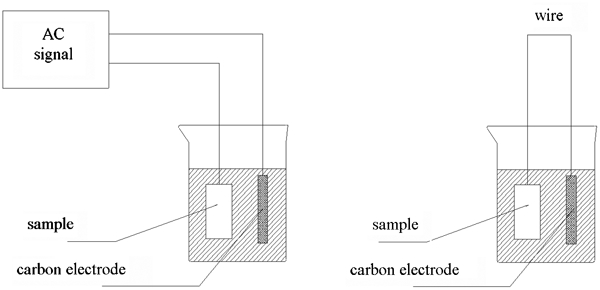
Samples were immersed in the original soil collected from Qingdao, China. The soil resistivity was 52·5 Ω m and soil pH was 7·5. At least three samples were exposed to the same AC conditions. An alternating voltage (AV) of 5, 10, 15, 20 and 36 V, was applied respectively between the samples and a carbon electrode for 100 h. Tests were performed in the absence of AC. After tests, all samples were inspected visually to investigate the morphology of AC corrosion.
After ultrasonic cleaning in rust removing solution (100 mL of hydrochloric acid +100 mL of distilled water +5 g of hexamet hylene tetramine) for 15-20 min, all the samples were rinsed, dried and weighed. A schematic representation of the test cell is shown in Fig. 1.
Schematic representation of AC corrosion test
Electrochemical tests
The AC corrosion of Q235 steel was studied by electrochemical polarisation curve and impedance test using electrochemical workstation PARSTAT 2273 with a three-electrode system under room temperature. Saturated calomel electrode (SCE), platinum electrode and Q235 steel sample were used as the reference electrode, the auxiliary electrode and the working electrode, respectively. Contact type voltage regulator TSGC2 was used to generate AC interference of different voltages. AC impedance spectroscopy was tested in soil simulating solution (1 wt-%NaCl+1 wt-%Na2CO3+1 wt-%Na2SO4). The frequency range is 105–10−2 Hz. The schematic representation of electrochemical test system was shown in Fig. 2.
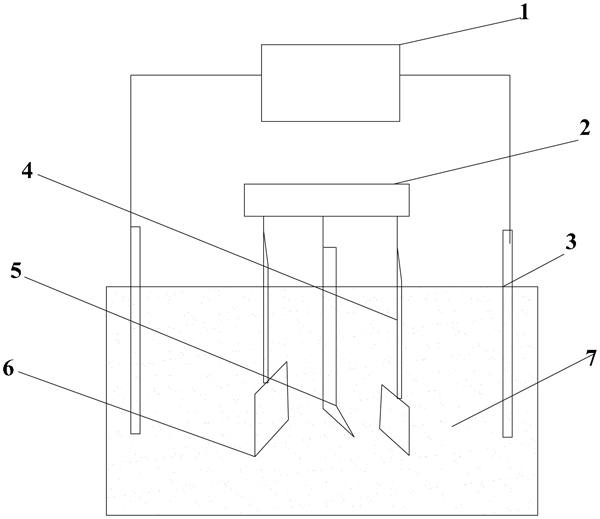
Schematic representation of electrochemical test system under AC interference: 1 interference source; 2 electrochemical test system; 3 carbon electrode; 4 working electrode; 5 reference electrode; 6 auxiliary electrode; 7 soil or soil simulating liquid
Results and discussion
Weight loss test
The weight loss of the samples was calculated using the equation:

The corrosion rate was calculated using the equation:

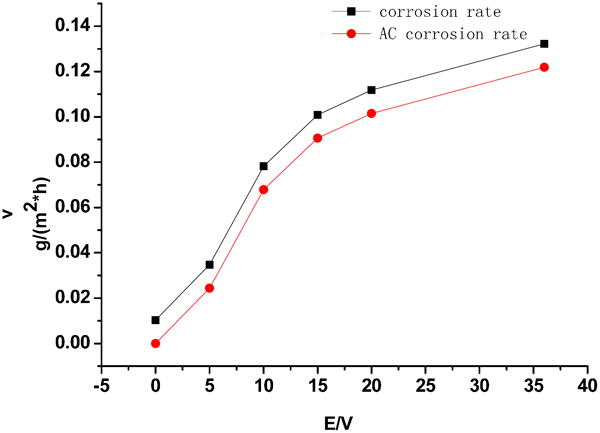
Corrosion rate and AC corrosion rate are shown in Fig. 3.

Relationship between weight loss rate and AC interference voltage
It can be noted that corrosion rate rapidly increased with the increase of AV. When AV of 36 V was applied, the corrosion rate was 10 times faster than that when there was an absence of AC.
The corrosion of carbon steel Q235 was oxygen depolarisation corrosion and the simplified electrode reactions are typical:
Andodic reaction

Cathodic reaction

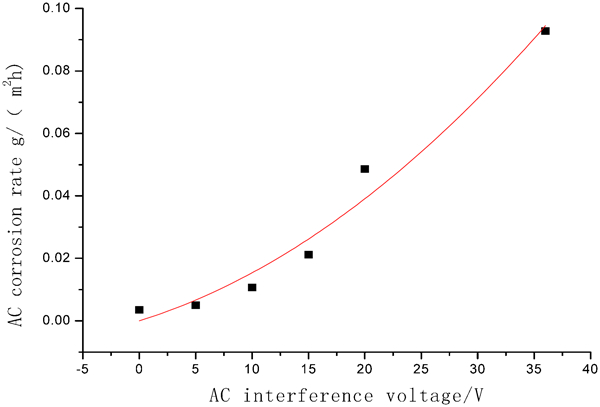
The fitting curve of weight loss rate and AC interference voltage is shown in Fig. 4. The curve displayed as an index form.
Fitting curve of weight loss rate and AC interference voltage
Microstructure analysis
The microcosmic morphology in Fig. 5 indicated the corrosion trend was small without AC.
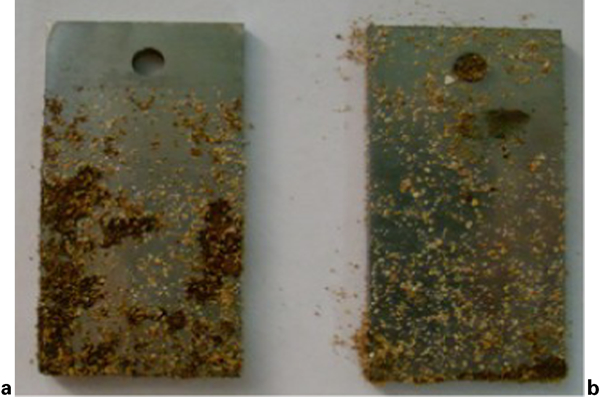
Macroscopic morphology at AC voltage of 5 V after 100 h
When AC was applied, the corrosion happened mainly on the middle and bottom of the surface where the stray current flowed out of the metal. The stray current worked as an anode current which accelerated the anodic dissolution of the metal.
The microcosmic morphology in Fig. 6 indicated that there was no soil adhesion on the surface of the samples without AC. When the applied AV was 5-15 V, mixture of microcosmic corrosion products and soil adhered to the sample. When the applied AV was greater than 20 V, the corrosion products presented black coating, and the mixture was hard to be stripped. With the increase of AV, the extent of the corrosion was greater. The corrosion morphology transformed from corrosion pit to etch moat.
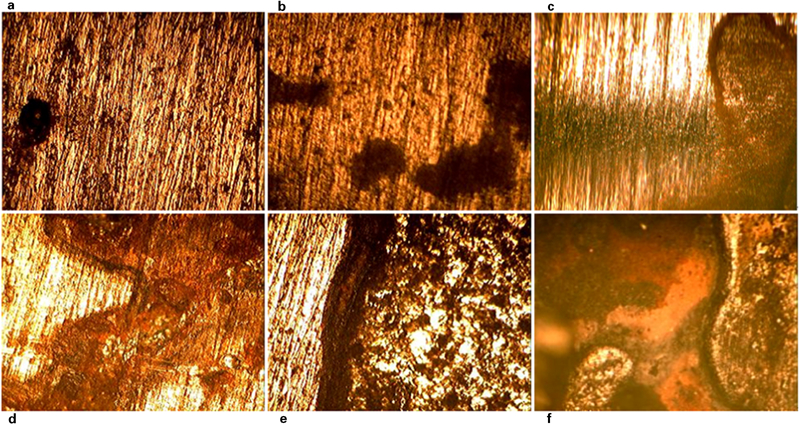
Microcosmic morphology (OM) of Q235 steel at different AV
In this work, sinusoidal AC interference was applied. In each cycle, the positive half-wave current promoted corrosion of the sample, while the negative half-wave current impeded that. The cyclically changed AC interference accelerated the peeling off of corrosion product and surface film. Applied with less AC interference, the media system was sensitive to the change in external environment, thus corrosion rate quickened. When the intensity of AC interference was increased, considering the surface film was thicker and compacter than before, the corrosion rate should have been slowed down. On the contrary, the corrosion rate increased because of the stronger metal dissolution. When the intensity of AC interference was strong enough, some of the protective film was broken, thus the anodic dissolution was enhanced. In such place corrosion pit or etch moat took place prior. In a work, with the increasing of AC interference, corrosion types changed from general corrosion to local corrosion.
Electrochemical test
The polarisation curves in Fig. 7 confirmed that AC has a strong influence on corrosion kinetics and corrosion and equilibrium potential. The electrochemical parameters of polarization curves of Q235 with different AC interference showed that corrosion potential was shifted toward the negative direction, and that the exchange current density increased with the increase of AC voltage. The Tafel curve deduced that the corrosion process had a trend of changing from cathode reaction control to mix control. The working electrode absorbed a large number of irons on its surface which restrained the diffusion of the charged particles. The rate of the charged particles lagged behind the rate of the anode reaction, thus slowing down the anodic dissolution. When applied with AC, the electric intensity of soil simulating solution was greater. The charged particles moved faster than before and trended to a more orderly way. Both the anodic and cathodic reactions were accelerated. The corrosion progress turned to the mix control.8,14,15
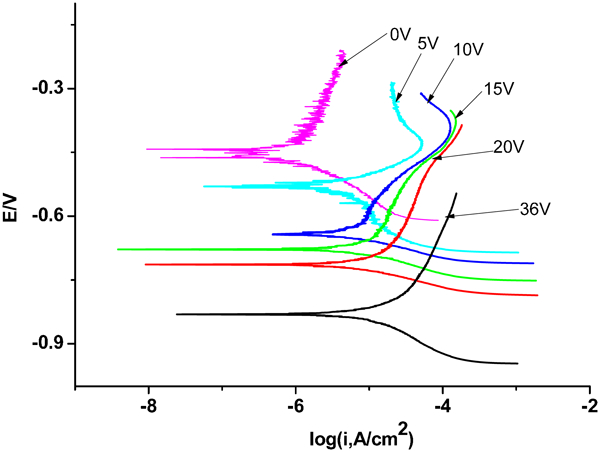
Polarization curves of Q235 with different AC interference for 4 h
Figure 8 demonstrates that in soil simulating solution, the shape of the impedance spectroscopy was approximately the same, but the radius had a great difference. It deduced that the corrosion mechanism was basically similar and the corrosion rate changed greatly.
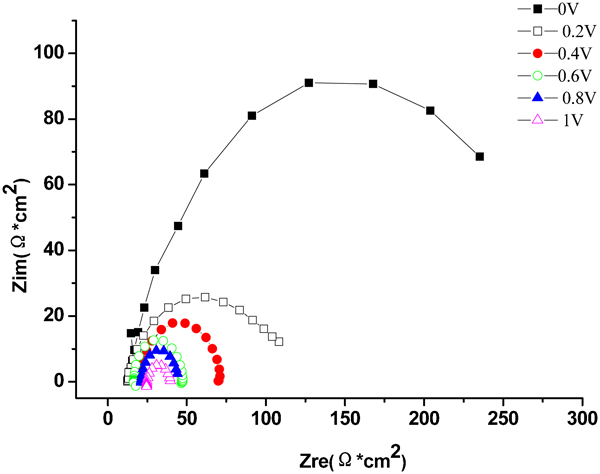
Impedance spectroscopy of Q235 steel at different AC interference voltages in soil simulating solution
The solution resistance and the electrode surface reaction resistance decreased with the increase of AC interference voltage which promoted the corrosion reaction.
In different voltages, the corrosion features (Fig. 9) were similar. There were some incomplete capacitive reactance arc in the high frequency region and small racial capacitive reactance arc in the low frequency region.
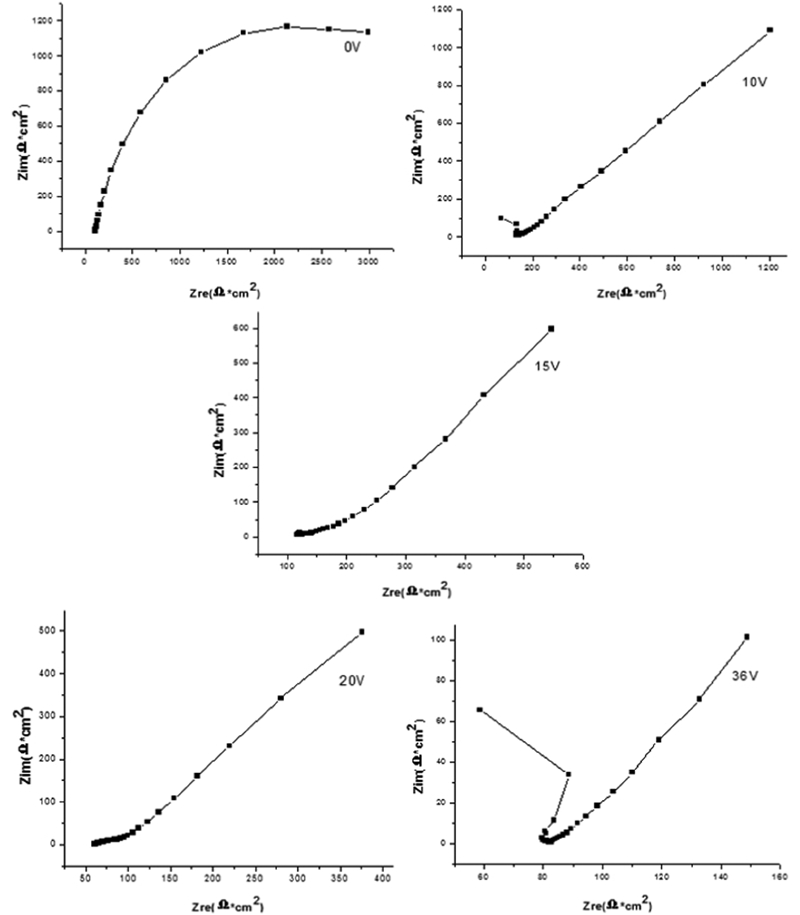
Impedance spectroscopy of Q235 steel at different AC interference voltages after immersed 4 h in soil
The low frequency region reflected the information of the interface reaction. As the progress of corrosion, the curve of the impedance spectroscopy was nearly changed into a straight line with an angle of 45°. It showed that the redox reactions in the oxide layers formation were diffusion controlled and it was proposed that the transport of OH− was the limiting step of growth.
The surface of the sample was covered with corrosion product which leaded to the increase of dielectric resistance, thus the capacitive reactance arc were incomplete. Insoluble corrosion products were continuously deposited and combined with the soil particles which hindered the corrosion.
From the features above, a schematic representation of an equivalent circuit model of soil corrosion was introduced. It is shown in Fig. 10.
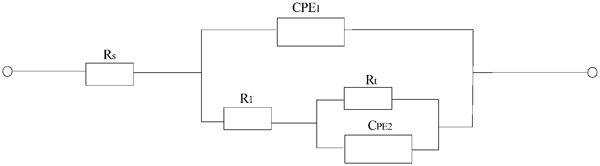
Schematic representation of equivalent circuit model of soil corrosion: R s, impedance of medium; R 1, impedance of bond layer of corrosion product and soil; R t, impedance of charge transfer; CPE 1, capacitance of bond layer of corrosion product and soil; CPE 2, capacitance of double layer
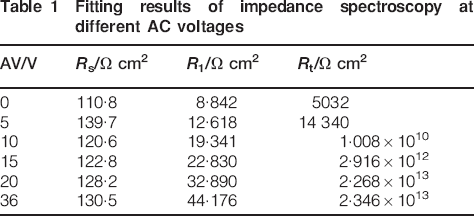
The fitting results of impedance spectroscopy (Table 1) at different AC voltages demonstrated that R s did not change much, while R 1 increased gradually and R t increased by a large margin at first, and then reached an equilibrium value. It proved that a protective layer was built up and the thickness of the corrosion product reached an equilibrium value.10,16
Fitting results of impedance spectroscopy at different AC voltages
Conclusions
Corrosion rate increased rapidly with the increase in AV.
With the increase in AV, the extent of the corrosion was greater. The corrosion morphology transformed from corrosion pit to etch moat.
The electrochemical test confirmed that corrosion potential was shifted toward the negative direction, and that the exchange current density increased with the increase of AV.
The EIS showed that as the AV increased, the corrosion mechanism was basically similar and the corrosion rate changed greatly.
Footnotes
Acknowledgements
The authors gratefully acknowledge the financial support of the National Natural Science Foundation of China (grant no. 41276074).