







Abstract
Investigation of corrosion rate under the simultaneous effect of parameters is a new and important approach that makes our experimental media closer to real condition and offers more realistic results. In this study, the effect of some important marine factors including temperature, pH, velocity and salinity on the corrosion rate of SS 316 is considered synergistically using two by two graphical curves. Experiments are performed in turbulence condition, and each parameter is applied at three levels. The results of this research are compared with the achievements of a former synergistic study of parameters, which had calculated the contribution percentage and qualitative influence of marine factors in laminar condition. This research presents the critical points in the change of corrosion rate under the synergistic effect of parameters and compares the capability of factors in changing the rate of corrosion and studies their qualitative effect.
Introduction
Sea water is recognised to be one of the most corrosive natural electrolytes under natural environment.1 The marine environment is a severe corrosion environment for unprotected steels, such as sheet and other piling used in sea water harbours.2 Hence, many protective methods have been performed to control corrosion of materials such as inhibitors, coatings and surface modification, but the exact influence of corrosion controlling parameters is still lacking.3 – 6
SS 316 is a kind of stainless steels and is the most widely used engineering material that is employed in tonnages in offshore engineering, coastal service environments, splash zone applications, intermittent submersion in sea water, deck components for boats and ships, deck eyes, brackets for anchor ropes, housings for equipment, shackles and handrails.7 It is always one of the priorities in marine application as it possesses good mechanical properties and also corrosion resistance.8 The effect of molybdenum in this alloy is found to be really beneficial for the localised corrosion resistance in the marine environment.9
Corrosion behaviour of stainless steels in marine media is strongly dependant on the formation and stability of passive layers on their surface. Each parameter that retards the formation of the protective layer or results in its deterioration increases the rate of corrosion in such alloys.10,11 As their corrosion behaviour is controlled by the surface oxide layer, the environmental parameters such as temperature or velocity that controls the amount of dissolved oxygen can affect their oxidation resistance.11 – 14
Ever since, people have established a series of investigations on corrosion of SS 316, and they have also considered the effect of marine parameters on the rate of corrosion.
In some studies, the effect of dissolved oxygen on corrosion resistance of SS 316 in artificial sea water was investigated.15,16 In other researches, the effects of temperature, velocity and salinity were examined.16 – 21 Researchers have also studied the importance of pH variation on the corrosion rate of SS 316.19
As mentioned, there have been many laboratories and on field studies of the corrosion of steels in sea waters under individual environmental parameters, but efforts to describe the synergistic effect of parameters on corrosion rates have been limited. Worldwide, there is increasing attention being given to deterioration of infrastructure exposed to actual hostile marine environments. For this purpose, the effective parameters have to be considered and applied simultaneously, which is really close to the actual marine condition where all the environmental factors come together. In this regard, in an attempt to evaluate the synergistic effect of environmental parameters, in 2007, Niu and Cheng studied the combined action of solid loading, flow velocity and fluid temperature on corrosion behaviour of AISI 316.22 Afterward, in another research by the authors, mathematical analysis was performed to measure the synergistic contribution percentage of marine parameters on the rate of corrosion in laminar condition.23
In this paper, the authors intend to illustrate the synergistic effect of most important sea water environmental factors including salinity, turbulence fluid velocity, temperature and pH through the 2×2 graphical curves. In each curve, two parameters are fixed, while the combined action of the other two factors on corrosion rate is examined. In each case, the synergistic results performed in turbulence conditions are justified and compared with a former study that investigated the synergistic effect of marine parameters on corrosion rate of SS 316 through qualitative and quantitative analysis in laminar fluid condition.23
Experimental
Artificial sea water was prepared according to ASTM D1145.24 Temperature and velocity were controlled by a heater–stirrer HP-8400, and pH was fixed by 1 N NaOH.25 Applying equation (1), salinity (dimensionless factor representing the total weight in grams of solid matter dissolved in 1000 g of water)26,27 was adjusted by the variation of chloride ion content through changing the amount of sodium chloride, while all the ingredients, except sodium chloride, were kept fixed according to the mentioned standard

Testing samples were 12 mm diameter commercial SS 316 rods with a chemical composition of Fe–18Cr–8Ni–2Mn–0·1N–0·03S–0·03C–0·75Si–0·045P–3Mo, polished up to 1200 grit. A three-electrode cell (μ Autolab type III/FRA2 electrochemical interface potentiostat/galvanostats) including SS 316 samples as working electrode, saturated calomel electrode as reference and Pt gauze as the auxiliary electrode was used to measure the rate of corrosion. Potentiodynamic polarisation experiments were performed from about −0·1 to +0·1 V around the corrosion potential with a scan rate of 0·05 mV s−1. GPES version 4.9 software programme was applied to measure the corrosion rates in millimetres per year using the Tafel extrapolation method.28 To be sure about the reproducibility of obtained data, each experiment was repeated three times and the error value was tested to be <5%.
Results and discussion
Polarisation curves related to conditions defined by pH, salinity, velocity and temperature are taken, and three curves are illustrated as the representatives from the total of 33 according to Fig. 1. The effect of solution electrical resistance (IR drop effect) is reported to be negligible in a sea water environment.29,30 To verify this issue, the IR drop compensated curve for one of the samples is presented as Fig. 2, which approves the negligibility of IR drop effect on polarisation curves of the samples. Corrosion rate values related to applied conditions have been presented in Tables 1–6. In each table, two parameters are considered to be fixed, while the other two factors are changing to show the synergistic effect of variable parameters on the rate of corrosion. Using corrosion rate data in Tables 1–6, corrosion rate variation has been investigated under the synergistic effect of two by two parameters and shown as Figs. 3–8. In each curve, corrosion rate variation under the combined effect of two factors is considered, while the other two parameters are fixed.
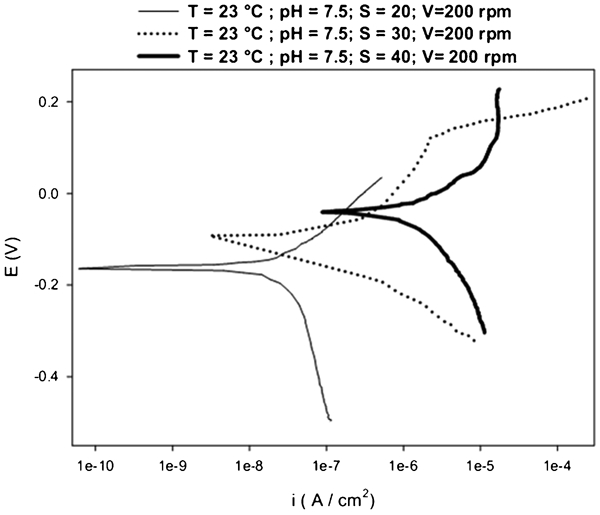
Examples of polarisation curves for SS 316 samples under different conditions
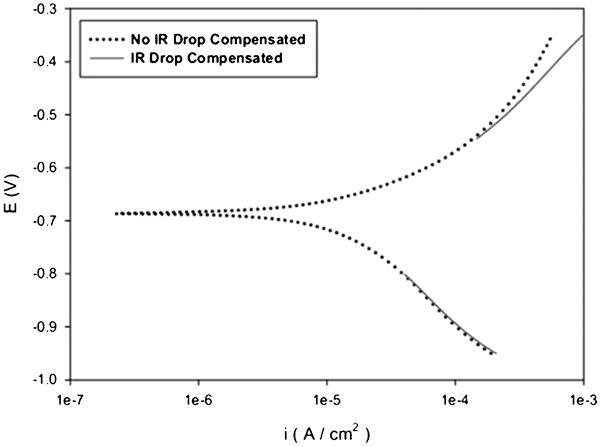
IR drop correction for polarisation curve (temperature = 23°C; V = 0 rev min−1; salinity = 30; pH 7·5)
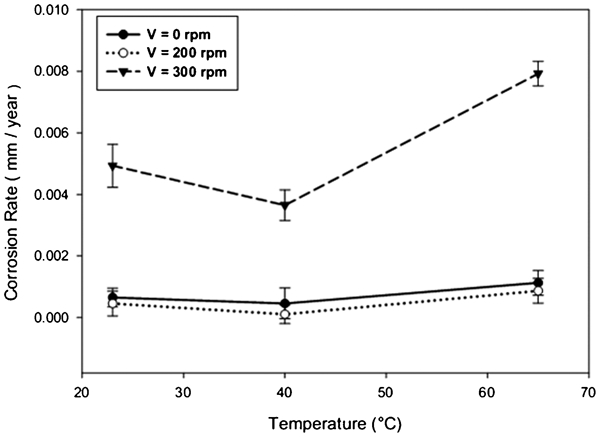
Synergistic effect of velocity and temperature on corrosion rate at pH 7·5 and S = 30
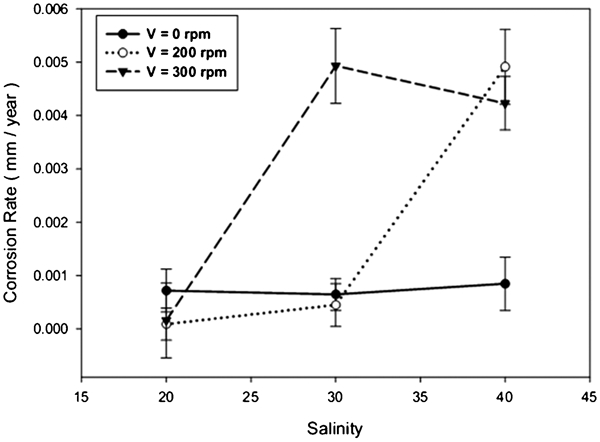
Synergistic effect of salinity and velocity on corrosion rate at T = 23°C and pH 7·5
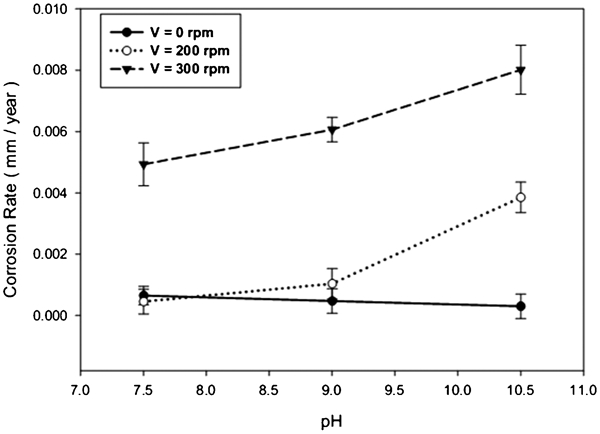
Synergistic effect of velocity and pH on corrosion rate at T = 23°C and S = 30
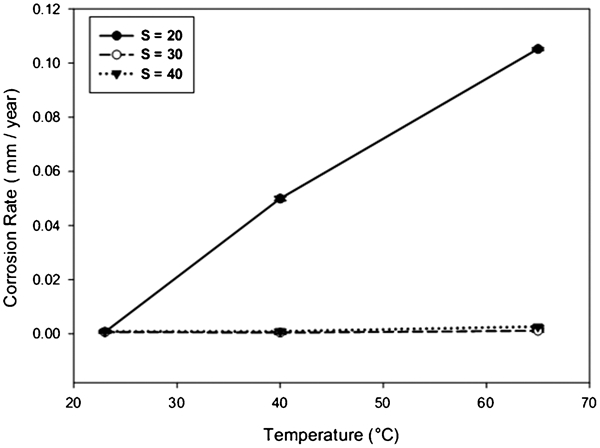
Synergistic effect of temperature and salinity on corrosion rate at pH 7·5 and V = 0 rev min−1
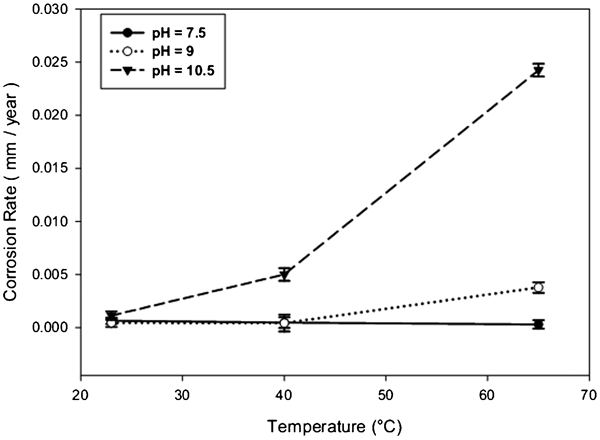
Synergistic effect of temperature and pH on corrosion rate at S = 30 and V = 0 rev min−1
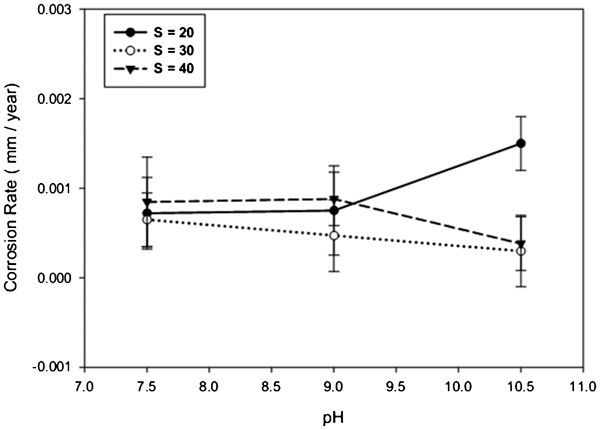
Synergistic effect of salinity and pH on corrosion rate at T = 23°C and V = 0 rev min−1
Synergistic effect of velocity and temperature at pH 7·5 and salinity = 30

Synergistic effect of velocity and salinity at pH 7·5 and temperature = 23°C

Synergistic effect of velocity and pH at salinity = 30 and temperature = 23°C

Synergistic effect of temperature and salinity at stagnant fluid and pH 7·5

Synergistic effect of temperature and pH at stagnant fluid and salinity = 30

Synergistic effect of salinity and pH at stagnant fluid and temperature = 23°C

Synergistic effect of temperature and velocity
Figure 3 illustrates the synergistic effect of temperature and velocity. According to Fig. 3, samples show a kind of similar trend in 0 and 200 rev min−1, and increasing velocity up to 200 rev min−1 has not applied a sharp effect on behaviour of metal under effect of temperature. In both conditions totally, temperature applies increasing and velocity applies decreasing effect on the rate of corrosion. Generally, by increasing temperature, the range of passive region decreases, which results in easier breakdown of the protective surface layer,31,32 but in the case of SS 316 alloy as a result of Mo existence, which assists the formation of passive layer by decreasing passive potential,33 increasing temperature cannot apply any sharp effect on the rate of corrosion under the velocities up to 200 rev min−1.
As mentioned, by increasing the fluid velocity up to 200 rev min−1, corrosion rate decreases. The reason for reduction in the rate of corrosion is the increment in oxygen availability by increasing velocity, which facilitates the formation of a protective layer. On the other hand, the possibility of localised corrosion reduces by the increase in fluid velocity because the velocity causes a type of agitation in the solution, which removes the stagnant condition that is one of the critical requirements for localised corrosion.17
When comparing our results at 0 and 200 rev min−1 with the results on synergistic effect of temperature and laminar fluid velocity,23 some interesting agreements can be observed. As is recorded at velocities up to 200 rev min−1, velocity has a decreasing effect on corrosion rate, while temperature has an increasing influence. These results are coherent with the results of qualitative analysis on the synergistic effect of temperature and velocity in laminar condition by Atashin and Pakshir who reported the same effects for velocity and temperature on the rate of corrosion at laminar condition.23
In this case, as was observed, although the experiments are performed under turbulant conditions, they present an acceptable coherency with the investigation under laminar condition,23 as long as fluid velocity does not exceed 200 rev min−1 and the point of sharp difference is obvious at high turbulence condition (300 rev min−1).
In the case of 300 rev min−1, which represents high turbulence, the situation is completely different from the laminar case because in such conditions a protective layer is affected by fluid impact. At 300 rev min−1, by increasing temperature up to 40°C, corrosion rate decreases, and after 40°C, it raises. In the range of 23-40°C, corrosion rate decreases as the amount of soluble oxygen decreases by temperature increment. While the high velocity of 300 rev min−1 tends to shift the metal from passive to transpassive region, increasing temperature controls the rate of corrosion by the reverse effect of shifting the metal from transpassive to passive. Increasing temperature can reduce soluble oxygen32,34 and causes a decrease in the corrosion rate by resisting the turbulence effect and keeping the metal in passive state.
After 40°C, corrosion rate increases by raising the temperature up to 65°C via the effect of temperature on the passive region.31,32 In this region, temperature increment decreases the stability region of the protective layer and causes the breakdown of the passive surface and increases the corrosion rate consequently. On the other hand, increasing temperature results in a reduction in the amount of dissolved oxygen, which is a critical component of protective layer formation.16
Synergistic effect of salinity and velocity
The synergistic effect of salinity and velocity is presented in Fig. 4. According to Fig. 4, generally, by increment of salinity, corrosion rate increases at velocities of 0 and 200 rev min−1. This result can be explained through the effect of salinity increase on decreasing the range of passive region, which results in the earlier breakdown of passive layer and a rise in the rate of corrosion.31,32
Thus, the qualitative variation of corrosion rate under the effect of salinity does not change a lot by increasing the fluid velocity up to 200 rev min−1. In other words, increasing velocity up to 200 rev min−1 does not change the qualitative effect of salinity on corrosion rate during the synergistic action of salinity and velocity. This effect of salinity on corrosion rate is the same as results in the qualitative investigation section of the study in laminar condition, which reports the increasing effect of salinity on the corrosion rate.23
In velocity of 300 rev min−1, the trend of corrosion rate variation under the effect of salinity changes completely. At velocity of 300 rev min−1, by increasing salinity up to 30, corrosion rate increases by the effect of salinity on passive region.31,32 Then, by salinity increment to 40, corrosion rate decreases because at this value of salinity, the amount of soluble oxygen decreases and causes a decrease in the rate of corrosion by shifting the metal from transpassive to passive region.32,34
As is obvious in Fig. 4, in salinities of 20 and 30, increasing velocity up to 200 rev min−1 does not cause a sharp increase in the rate of corrosion. While at salinity of 40, even raising the velocity up to 200 rev min−1 induces a noticeable effect on corrosion rate. The reason for this phenomenon is that, at high salinity (40), passive region is smaller,31,32 so the transpassive region starts more easily and even minor increase in the velocity can shift the metal toward the transpassive region by the breakdown of surface layer.
Synergistic effect of pH and velocity
The synergistic effect of pH and velocity is shown in Fig. 5. Referring to Fig. 5, in stagnant condition, corrosion rate reduces by increasing pH, which shows the decreasing effect of pH on corrosion rate as reported in the laminar study.23 Decreasing effect of pH on corrosion rate is because pH increment results in the reduction in passive potential of metal and easier formation of a protective layer, according to the Pourbaix diagram of SS 316 in a sea water environment.23
By increasing velocity up to 200 rev min−1, the effect of pH on corrosion rate changes from decreasing to increasing. At velocities of 200 and 300 rev min−1, by increasing pH, corrosion rate grows. This happens because by increment of pH, the stability region of MoO2 gets shorter according to the SS 316 Pourbaix diagram.23 Thus, MoO2 is more susceptible to breakdown, and every increase in the fluid velocity can detach the protective surface and increase the rate of corrosion.
At pH 7·5, fluid velocity up to 200 rev min−1 cannot apply a noticeable effect on corrosion rate, but at pH 9 and 10·5, increasing velocity to 200 rev min−1 results in a sharp increase in the rate of corrosion. To explain this behaviour, the effect of pH increase on providing the suitable media for localised corrosion should be considered. pH increment provides a favourable condition for localised attack and an increase in the rate of corrosion.23,32 On the other hand, by increasing pH, the stability region of MoO2 reduces according to the SS 316 Pourbaix diagram.23 Therefore, MoO2 is more susceptible to breakdown and every increase in the fluid velocity can detach the protective surface and increase the rate of corrosion. Thus, at high pHs, metal is more sensitive to localised corrosion and breakdown of passive layer. Hence, even a small change in the fluid velocity can cause the detachment of protective surface oxide and raise the rate of corrosion. That is why as pH increases more, the effect of velocity on corrosion rate is much more obvious.
Synergistic effect of salinity and temperature
Figure 6 illustrates the synergistic effect of salinity and temperature. In general, corrosion rate increases by temperature increment through the effect of temperature on the stability of passive region.31,32 Increasing effect of temperature on the corrosion rate of SS 316 is justified by the results of qualitative analysis on corrosion rate of SS 316 by Atashin and Pakshir.23
As Fig. 6 shows, by increasing salinity from 20 to 30, corrosion rate drops. Salinity growth causes the reduction in soluble oxygen and causes a drop in the corrosion rate by shifting the metal from transpassive region to passive state. On the other hand, by raising salinity, there is a possibility of concentration polarisation, which can reduce the rate of corrosion. In the former study,23 considering the salinity change from 30 to 40, the increasing effect of salinity on the rate of corrosion is reported. This phenomenon can occur because at high salinities, the range of passive region reduces.
If corrosion rate at salinity is equal to 20 and room temperature is considered as a reference point, it can be seen that corrosion rate increases more rapidly by raising temperature compared to a situation when both temperature and salinity are increased simultaneously. This result is also achieved in the previous study,23 which reported the combined effect of temperature and salinity to have lower influence on the rate of corrosion compared to temperature by itself.
Synergistic effect of pH and temperature
Figure 7 represents the synergistic effect of pH and temperature. As is presented in Fig. 7, by increasing temperature, corrosion rate grows via reducing the range of passive region.31,32 This increasing effect of temperature has been also reported before.23
At room temperature, pH growth up to 9 cannot induce a noticeable effect on corrosion rate, but at higher temperatures, increasing pH to 9 results in a sharp increase in the rate of corrosion. To explain this observation, the effect of temperature increase on the rate of corrosion must be discussed, which results in the metal transition from passive to transpassive region. Adding the effect of pH increase on providing the suitable media for localised corrosion23,32 to the effect of temperature, it can be concluded that at higher temperatures, increasing pH causes a growth in the rate of corrosion since, at one hand, increment of temperature facilitates metal's entrance to transpassive region31,32 and, on the other hand, increasing pH provides a suitable condition for localised corrosion23,32 and acts as a second motivator beside temperature to shift it to transpassive region. Thus, by increasing temperature, metal becomes more susceptible to localised corrosion, and a small raise in the pH (which enhances the increasing effect of temperature) shifts the metal to transpassive state and raises the rate of corrosion. That is the reason why at higher temperatures the effect of pH on corrosion rate is more obvious.
If corrosion rate at room temperature and pH equal to 7·5 be considered as a reference point and increases in corrosion rate by the individual effect of temperature be compared with the increase in corrosion rate under the combined action of temperature and pH, it can be concluded that the increasing effect of pH and temperature simultaneously is higher than the individual effect of temperature, as is reported via the qualitative analysis.23
Synergistic effect of pH and salinity
In Fig. 8, the synergistic effect of pH and salinity is presented. Considering the synergistic effect of salinity and pH, as shown in Fig. 8, by increasing pH, corrosion rate generally decreases at salinities of 30 and 40. This result was the same as in the results of qualitative analysis in laminar condition,23 which reported decreasing effect of salinity on corrosion rate.
At salinity of 20, corrosion rate rises by increasing pH, as pH increment facilitates the formation of localised corrosion32 and reduces the stability region of MoO2 in Pourbaix diagram.23
Conclusions
By comparing the results of synergistic effect of marine parameters in turbulence condition through this study with the results of these parameters in laminar condition through the former study, the following results are achieved.
The corrosion rate variation of SS 316 samples presents a similar trend in synergistic effect of temperature and velocity under the velocities up to 200 rev min−1, and increasing velocity up to 200 rev min−1 does not cause a noticeable effect on corrosion behaviour of metal. In addition, under the synergistic effect of temperature and velocity, velocity has a decreasing effect and temperature has an increasing effect on the rate of corrosion, and these effects do not vary in turbulant conditions up to 200 rev min−1.
Studying the simultaneous effect of salinity and velocity, the qualitative effect of salinity on corrosion rate does not change in turbulant conditions with a fluid velocity up to 200 rev min−1. In addition, salinity has an increasing effect on the rate of corrosion up to 200 rev min−1.
Considering the synergistic effect of velocity and pH, the decreasing effect of pH on corrosion rate changes to increasing effect at turbulant conditions with the velocities >200 rev min−1. Velocity increment causes more obvious increasing effect on corrosion rate at higher pHs.
Temperature shows a more dominant effect on increasing the rate of corrosion compared to the condition that both temperature and salinity increase. In other words, temperature has a larger effect than ‘temperature+salinity’. In contrast, the simultaneous effect of pH and temperature applies a greater effect than temperature by itself.
On the synergistic effect of temperature and pH, at higher temperatures, the increasing effect of pH on corrosion rate is more noticeable.