







Abstract
Pit dissolution rate on samples of an AISI 304 stainless steel (SS) in natural sea water was assessed using a scanning reference electrode technique (SRET) and compared with chronoamperometric measurements. Corrosion pits generated in AISI 304 SS samples under potentiostatic control at room temperature and smooth surface presented an empirical exponential growth rate law. The quantity of dissolved metal per pit as a function of polarisation time determined using SRET and chronoamperometric measurements presented acceptable agreement. Considering the capabilities and limitations of scanning techniques, this study presents an approach of the pit growth rate determination from SRET measurements demonstrating the possibility to perform real time quantitative determination of localised dissolution rate.
Introduction
Pitting corrosion is a localised electrochemical dissolution process that in some cases can induce catastrophic failure of diverse engineering components and structures. Pitting corrosion in engineering materials such as stainless steels (SSs) is due to the presence of localised defects, which debilitate the protective properties of the surface film created naturally on the surface of corrosion resistant metals. This degradation process has been a topic of research for many groups all over the world during the last five decades.1–6 As proposed by Williams et al., pitting corrosion can be analysed as a stochastic process which, under specific conditions, takes place randomly in space and time. 7 However, Cazeres-Ibáñes et al. found that in the case of copper, the pitting corrosion was associated to an electrochemical oscillating quasi-periodic signal at potentials much more positive than the ‘apparent pitting potential’. 8 These authors suggested that pitting corrosion can be associated to a lower degree of chaotic behaviour; the less the chaos the more the pitting, until the point where the behaviour of the dynamical system becomes quasi-periodic, where they found a more developed degree of pitting corrosion. Regardless of its nature, pitting corrosion is considered as a two-part process: nucleation and propagation, which are commonly studied separately. 5 The first stage is the development of a local instability as a consequence of some non-linear coupling between the rate of dissolution of the metal and passive film breakdown along with local electrolyte composition and electrode potential. Williams et al. reported that localized dissolution events at the sulphide inclusion–SS boundary could cause intense current spikes that precede nucleation of metastable pits. 9 These authors suggested that pits geometry determines the possibility of a favorable local environment for the development of a metastable pit through dissolution of both the inclusion and the steel. After nucleation, the propagation takes place, involving a coupled extreme local electrolyte composition and high local rate of dissolution through the effects of transport and electrical potential gradients within an occluded local zone. 10 During the propagation stage, a pit may grow for a short time and then repassivate (‘metastable pitting’), or it can enter to a stable pitting regime in which pits propagate for an indefinite period.2,5,10–13 Localized attack on passive metals has been studied intensively with special attention to the propagation steps, which are acceptably defined and modelled. 13
The pit growth kinetics has been measured by different methods, from electrochemical and optical microscopy to scanning electron microscopy (SEM) and transmission electron microscopy (TEM)10,11; some combination of methods is usually preferred, particularly if multiple pit initiation takes place. Several pit growth laws have been reported for specific alloy–electrolyte systems,14,15 providing empirical laws for both open circuit and potentiostatically generated pits.
The use of scanning electrochemical techniques to study localised electrochemical activity has been used in several distinct disciplines such as corrosion science and fuel cells.16–22 The scanning reference electrode technique (SRET) is based essentially upon fact that the electrochemical dissolution of metals during localised corrosion takes place at permanently separated sites from the cathodic areas, and the ionic flow induced by the localised dissolution produces ohmic potential gradients within the electrolyte owing to its low electric conductivity. These ohmic potential gradients generated in the electrolyte adjacent to the site undergoing localised attack can be measured using reference electrodes arrangement, one assessing the local and the other the bulk field respectively.19,20 This gives the possibility of real time direct measurements of the anodic reactions through in situ non-intrusive studies. The non-intrusive nature of this technique relies on the fact that the scanning probe assesses localised electrochemical activity in the absence of physical electronic connection with the electrified interface under study. The theoretical principles of the SRET indicate that there is a linear relationship between the SRET maximum detected signal E MAX and i (ionic current) when the conductivity of the electrolyte k and the current source to probe distance z are kept constant.16,17,19 This fact has been used to determine directly localised current and/or current density associated to the localised attack such as pitting corrosion.15–18,20 Real time SRET measurements of localised current can give at least a conservative quantitative value of the localised dissolution rate during pitting corrosion. The nature of the metal–electrolyte system in which localised corrosion takes place, as well as the sensitivity and resolution of the equipment, has great effect on the quantitative assessment of localised dissolution rate through SRET measurements.19,23 Once the effect of test conditions on the sensitivity and resolution of SRET signal response are established, 23 direct real time measurements of localized dissolution can be carried out from at least a semiquantitative approach.
The principal aim of this work was to determine quantitatively the pit growth rate on SSs (under potentiostatic control and at open circuit potential) in chloride containing electrolytes from SRET measurements. The reliability of SRET measurements for quantitative assessment of dissolution rate of pits was evaluated by comparing them with results of pit growth from optical microscopy analysis and chronoamperometric measurements.
Experimental
Materials
Samples of AISI 304 austenitic SS were used in this work. The steel was used in the as received condition (hot rolled, softened and descaled) with the chemical composition as follows: C 0.19 wt-%; Si 0.39 wt-%; Mn 1.40 wt-%; P 0.025 wt-%; S 0.001 wt-%; Cr 18.30 wt-%; Ni 9.07 wt-%; Co 0.12 wt-%; N 0.054 wt-%.
Cylindrical bars 1.58 cm in diameter and 10 cm in length were ground with 600 grit (P 1200) emery papers, rinsed with distilled water, degreased with acetone and air dried. The samples were coated with an epoxy primer leaving a 4 mm thick circumferential window of uncoated metal as the working electrode surface.
Determination of electrochemical parameters for potentiostatic generation of pits
Potentiodynamic polarisation of AISI 304 SS samples in natural sea water (κ = 50.6 mS cm− 1) was conducted in order to determine the corrosion potential E corr, the pitting potential E p and the pitting resistance potential E rp. These values were used to define the sequence for potentiostatic generation of pits. Potentiodynamic test were carried out at room temperature 25 ± 1°C by application of a cathodic overpotential of 200 mV followed by anodic polarisation at a scan rate of 10 mV min− 1 up to a potential of 600 mV more positive than the E corr using a Potentiostat/Galvanostat EG&G model 273A. A conventional three-electrode electrochemical cell was used for the tests with a saturated calomel electrode (SCE) as reference electrode, a graphite bar as auxiliary electrode and the 304 SS cylindrical bar as working electrode. During polarisation, the working electrode was subjected to rotation rate of 60 rev min− 1, equivalent to a linear rate of 5 cm s− 1 in order to maintain a hydrodynamic condition similar to that imposed in SRET measurements.16,19
Scanning reference electrode technique measurements during potentiodynamic polarisation in natural sea water
Scanning reference electrode technique measurements consisting of 20 linescans performed every 5 s were conducted simultaneously during the potentiodynamic polarisation of samples in order to follow the pit initiation and growth. Consecutive series of linescans were performed leaving a period of 1 min between each series starting at a potential of 150 mV versus SCE up to the end of the polarisation.
The SRET measurements were carried out in an area 4 mm high and with 49.6 mm circumferential length of uncoated surface of the working electrode. All SRET experiments were carried out with the scanning probe tip positioned at half the height of the study area, with a separation distance of 100 μm between the scanning probe tip and the working electrode surface. The scanning probe tip was positioned with the help of an optical microscope.
Potentiostatic generation of corrosion pits with simultaneous SRET measurements
The evaluation of the dissolution rate of active corrosion pits from SRET measurements was conducted on samples of AISI 30403 SS subjected to anodic potentiostatic polarisation under rotating conditions in natural sea water. During potentiostatic generation of pits, the anodic current was recorded to determine the quantity of charge associated with the metal dissolution. The methodology used for pits generation and determination of the pit depth as a function of polarisation time followed the work reported by Zhou and Turnbull. 14 The specific conditions were described in detail by González-Sánchez et al. 24 The SRET measurements, in form of linescans, were carried out under the same experimental parameters that used in the section on ‘Scanning reference electrode technique measurements during potentiodynamic polarisation in natural sea water’.
The profile of generated pits was established by a material removal method, which allowed determining the dissolved metal volume.14,15,24 This value was compared with calculations from chronoamperometric and SRET measurements. Empirical pit growth laws for the AISI 304 SS in natural sea water were determined based on the pit depth versus polarisation time obtained from the material removal method. The most reproducible sequence of potentiostatic generation of pits (nucleation plus stable pit growth) in samples of the S30403 SS used in this work in natural sea water is presented in Table 1.
Parameters for potentiostatic generation of pits on rotating working electrode of S30403 steel

Results and discussion
Electrochemical characterisation
Fig. 1 shows the polarisation curve for rotating S30403 steel sample tested in natural sea water. The polarisation curve presented severe anodic current fluctuations below the E p. Sato reported current transients at potential levels below the E p during potentiodynamic polarisation of SS and suggested that the transients were associated with unstable pits or pits embryos. 25 Frankel et al. associated the current transients with the passive film breakdown and suggested that these events were related to metastable pitting. 26
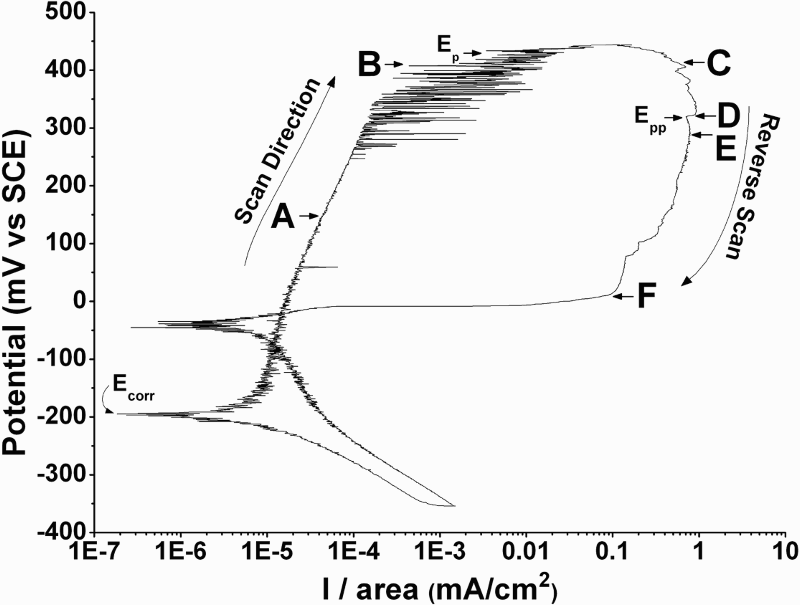
Polarisation curves for AISI 304 SS samples in natural sea water under rotating conditions. Letters A, B, C, D, E and F correspond to potential of beginning of linescans realized by SRET and presented in Fig. 2. Scan rate: 10 mV min− 1, rotation velocity: 5 cm s− 1, Pt probe to AISI 304 SS sample distance: 100 μm.
The average value of the E corr of AISI 304 SS in natural sea water under rotating conditions was − 121 mV versus SCE, and the average value of the E p was 374 mV versus SCE, with a standard deviation of 74 and 51 mV respectively. Value of ΔE (E p − E corr) was 495 mV. Dzib-Pérez 27 reported an average value of E corr of − 249 mV versus SCE with a standard deviation of 29 mV, an average value of E p of 328 mV versus SCE with a standard deviation of 25 mV and a value of ΔE (E p − E corr) of 577 mV using the same SS but in stationary conditions. This suggests that in rotating conditions at a constant velocity, this steel is less resistant to pitting corrosion in natural sea water, even with a higher E p compared with stationary conditions.
Scanning reference electrode technique measurements during potentiodynamic polarisation
Scanning reference electrode technique measurements, as series of 20 linescans, obtained at the potential values indicated in Fig. 1 by the letters A, B, C, D, E and F are presented in Fig. 2. Preliminary results from SRET measurements established that pitting involves sharp, narrow peaks in a linescan, whereas a flat, wide peak was associated to crevice. The pits generated in the AISI 304 SS used in this work presented a semicircular shape as reported previously. 24 All SRET measurements presented in this work correspond to pits formed exactly in front of scanning probe tip.
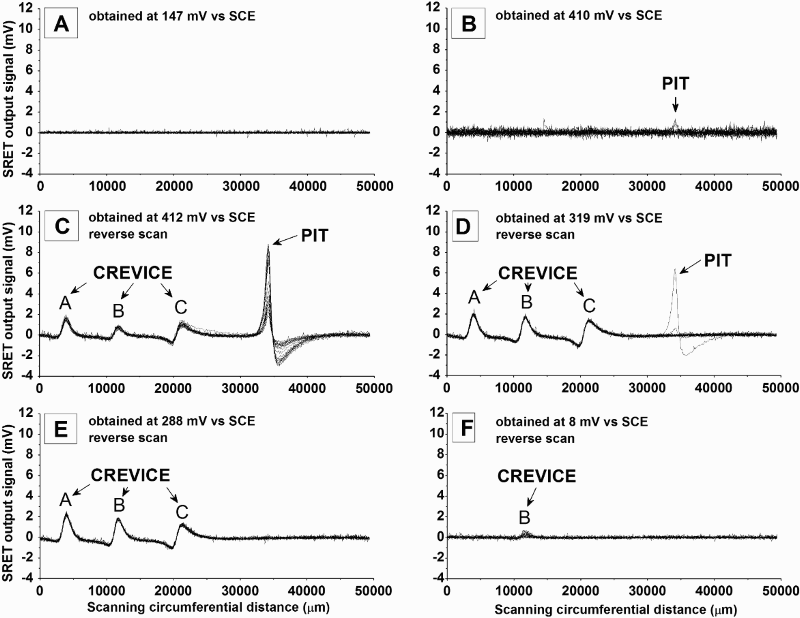
Scanning reference electrode technique measurements obtained during potentiodynamic polarisation of AISI 304 SS in natural sea water under rotating conditions. Graphs A, B, C, D, E and F were obtained in potentials indicated by respective letters on polarization curve from Fig. 1. Rotation velocity: 5 cm s− 1, Pt probe to AISI 304 SS sample distance: 100 μm.
Scanning reference electrode technique measurements obtained at 147 mV versus SCE (Fig. 2A) did not show peaks that should indicate the presence of localised activity. Scanning reference electrode technique linescans showed the presence of localised activity at a potential value of 427 mV (Fig. 2B), along with several current transients in the polarisation curve from a potential of 262 mV versus SCE. Current density fluctuations during anodic polarisation can be associated to passive film breakdown and repassivation, events that did not involve enough localised electrochemical activity to be detected by SRET. These results suggest that SRET is not able to detect changes in the dynamics of localised electrochemical activity related to metastable pits.
Several peaks were detected by SRET as shown in the linescans during the potentiodynamic polarisation at different positions along the circumference of the working electrode uncoated surface. In this study, it was observed that a flat and wide peak is associated with crevice corrosion and a sharp and narrow peak is associated pit corrosion. Although the crevice corrosion occurs at the boundary between the coating and the metal study, at 2 mm below or above the SRET scan line, the scanning probe detects such electrochemical activity. However, this information was not considered for the purposes of the present study as well as pits generated on the study surface but that are above or below the scan line of SRET.
Graph 2B shows the presence of a peak at 34 179 μm, with a magnitude of E max = 0.842 mV. This peak appeared at a potential of 427 mV versus SCE. Based on the peak form, it was associated to corrosion pit; therefore, this potential corresponds to the pitting potential E p. Figure 2C shows the peak observed at 34 179 μm, and peaks of lower intensity at 3873, 11 716 and 21 301 μm. Based on the peaks shape, these correspond to crevice corrosion (flat and wide peak), with low electrochemical activity because the crevice position was not directly in front of the scanning probe. The formation and position of crevices and pits were corroborated by optical microscopy.
Figure 3 is a magnification of the graph 2B and 2D, from which it is possible to appreciate in detail the initiation and passivation of a pit. For this pit, the localised activity disappeared during the reverse potentiodynamic polarisation at a potential of 318 mV versus SCE.
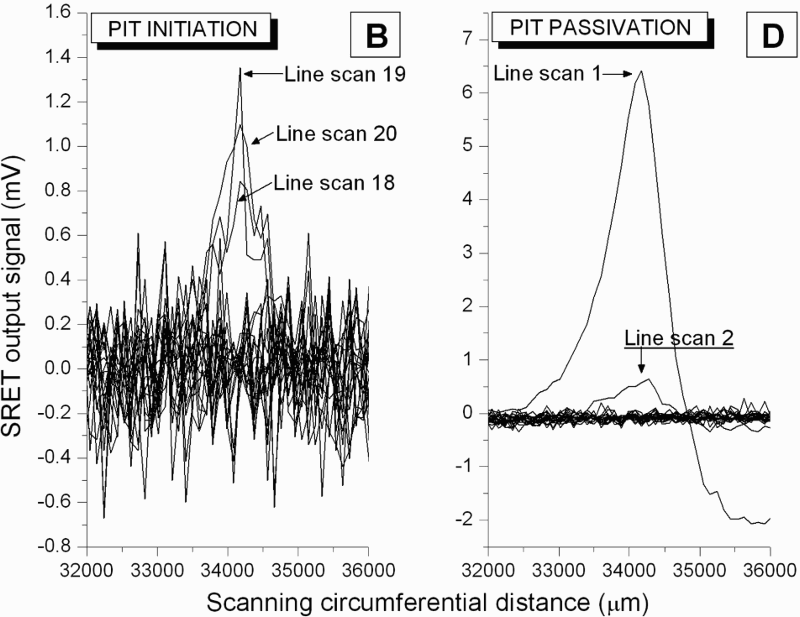
Magnification of graph B and D from Fig. 2.
A previous determination of the dissolution current of a pit from SRET measurements was carried out using equation (1), obtained from a calibration procedure.
23

Figure 4 shows the current associated to the cyclic polarisation from E p to pitting passivation potential E pp, continuous line and the current calculated from SRET measurements, dashed line. The anodic current from the potentiodynamic polarisation is greater than that obtained from SRET measurements. This result was expected since current calculated from SRET considered only the current generated by the pit under study, while the current obtained from cyclic polarisation took into account all anodic processes at the whole metallic surface (unstable pits, crevice corrosion and all active pits not detected by the SRET).
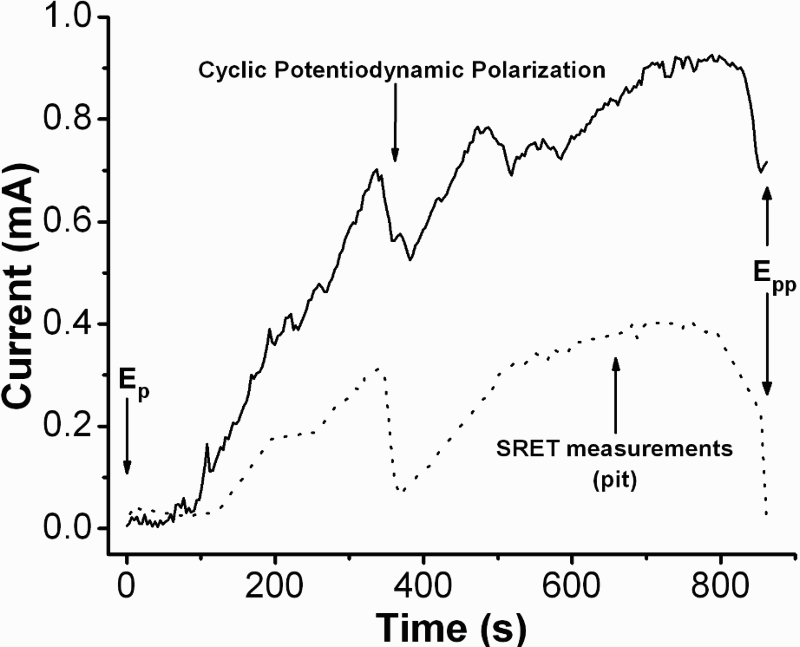
Current obtained from cyclic potentiodynamic polarisation and SRET measurements from E p to E pp.
Integration of the potentiodynamic polarisation curve gave a charge Q = 0.50102 C, equivalent to 128.714 μg of dissolved steel. In contrast, the integration of the curve obtained from SRET measurements gave a Q = 0.20894 C, equivalent to 53.677 μg of AISI 304 steel dissolved at the pit monitored by SRET measurements.
Scanning reference electrode technique measurements carried out during potentiodynamic polarisation allowed determining accurately the potential values at which stable active corrosion pits appeared E p, the growth stage and final passivation as a function of applied potential. Based in the form and intensity of the peaks in SRET linescans, it is possible to distinguish between pitting and crevice corrosion.
Trethewey et al. 19 conducted similar tests on martensitic SS in natural sea water reporting comparable anodic currents obtained from SRET and from potentiodynamic polarisation measurements using a calibration factor of 1 mV≌41.6 mA cm− 2. In the present study, the calibration factor was 1 mV≌110 mA cm− 2 also from tests with the gold point in space specimen of 200 μm of diameter. Differences on working electrode rotation rate, electrolyte conductivity, separation distance SRET probe to working electrode surface and Pt scanning probe tip diameter are the main features for the difference in the calibration factors.
Scanning reference electrode technique measurements during potentiostatic generation of pits in natural sea water
Figure 5 shows chronoamperometries obtained during potentiostatic generation of pits on AISI 304 SS samples in natural sea water under hydrodynamic conditions. The integration of current versus time curve provides the total charge of electrochemical processes that take place at the metal surface: pitting(s), crevice(s) and the dissolution of the metal in passive condition.
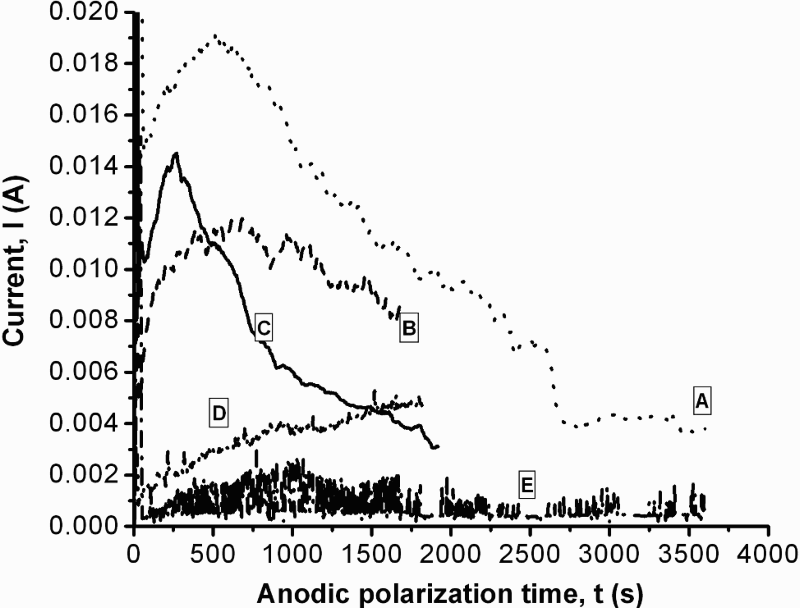
Chronoamperometry curves of AISI 304 SS in natural sea water obtained in rotatory conditions.
Scanning reference electrode technique linescans were obtained simultaneously during the potentiostatic polarisation for different time periods, which induced the generation of one to four pits in the working area. Scanning reference electrode technique measurements presented in this work correspond to experiments in which pits in front of scanning probe tip were generated. Figure 6 presents the SRET linescans obtained at different polarisation times for the potentiostatic polarisation presented in Fig. 5A. In the first series of SRET measurements (Fig. 6A), several peaks were detected. However, only two of these peaks correspond to pits located along the SRET linescan, indicated by the letters A and B.
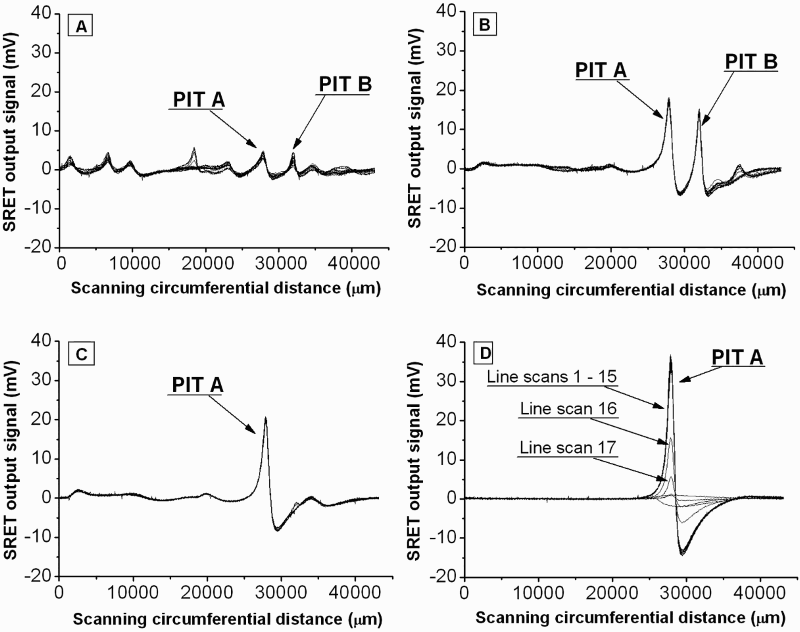
Scanning reference electrode technique measurements, in form of linescans, obtained at different times during potentiostatic generation of pits on AISI 304 SS in natural sea water under rotating conditions. Rotation velocity: 5 cm s− 1, Pt probe to AISI 304 SS sample distance: 100 μm.
The peak values E max for pit A were from 2.636 to 42.236 mV at the initiation and maximum growth of the pit respectively as shown by Fig. 6A. The vanishing of the electrochemical activity associated to pit A took place after 3663 s of anodic polarisation (Fig. 6D), indicating the pit repassivation. For pit B, the E max, in the first linescan, was 0.854 mV, which increased as a function of polarisation time up to a maximum value of 15.234 mV. The repassivation of pit B occurred after ∼1063 s at beginning of the seventh sequence of linescans measurements as can be seen in Fig. 6C. Scanning reference electrode technique measurements indicated that when a pit disappears, no localised electrochemical activity was observed again in the same position, which means that a repassivated pit did not reactivate.
Scanning reference electrode technique measurements in the form of linescans or map scans provide information of localised electrochemical processes such as pitting and crevice in terms of number of sites and intensity of localised activity; however, this information is qualitative. Scanning reference electrode technique measurements can be converted into quantitative data through specific relationships between the current generated by a site of localized activity and the magnitude of the potential gradient detected by the SRET (the calibration routine of the SRET system).17,19,23
Figure 7 presents the E max obtained from SRET measurements of some pits generated on samples of AISI 304 SS under potentiostatic control in natural sea water. These results correspond to pits generated exactly in front of the SRET scanning probe tip. Pits generated by this procedure presented a different life time as shown in the figure.
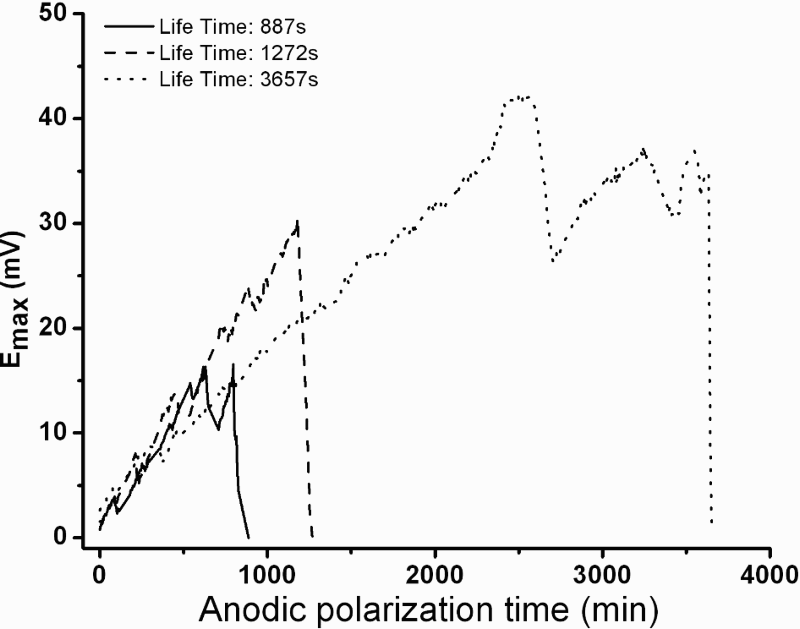
Peak maximum value E max as function of anodic polarisation time of AISI 304 SS in natural sea water.
The E max was converted into current emanating from the pit using equation (1). The integration of curve current versus polarisation time gave the electric charge per pit in Coulomb, which was converted into amount of dissolved material, via Faraday's law. Figure 8 shows the amount of dissolved material calculated from the method of material removal 14 and from SRET measurements together with fitting lines using a power equation.
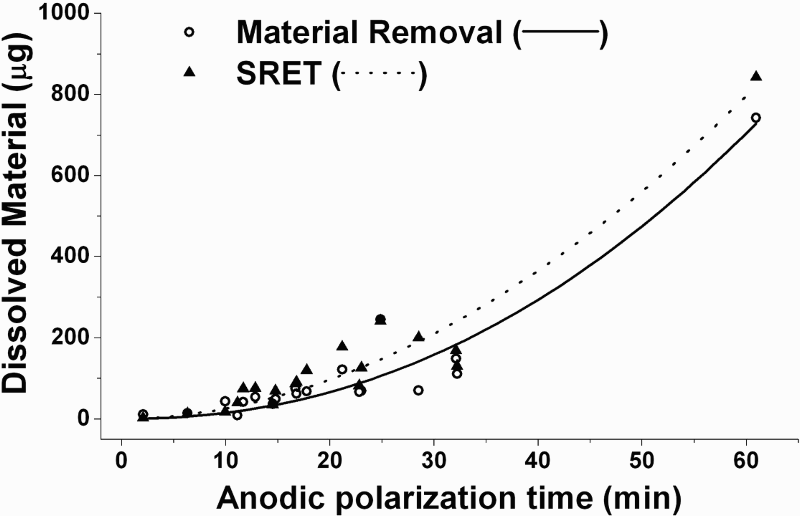
Amount of dissolved material obtained from material removal and SRET measurements on AISI 304 SS specimens in natural sea water.
The amount of dissolved metal obtained from material removal DMMR was fitted using the following equation


It can be seen that the results obtained from SRET are slightly above those obtained by the material removing method.
As stated in the electrochemical test results, the events of pit nucleation, formation of stable and metastable pits at E ocp could not be detected by SRET measurements. It is known that the nucleation of pits in SSs is a very quick process and involves transient current of the order of nA. 2 The spatial resolution and the minimum detected signal of the technique are factors that limit the detection of localised activity. The SRET equipment used in the present work, for localised corrosion of 304 SS in natural sea water, can only detect ohmic potential gradients generated by currents >9.08 μA.
At first glance, SRET measurements presented in Figs. 2 and 6 indicate roughly the intensity of localised activity and the location. However, a more detailed analysis of these results provides information about the history of the electrochemical behaviour of the pits such as that presented by Fig. 7. This figure shows the fluctuating nature of localised anodic activity of pits as a function of polarisation, as reported also by other authors.15,17,19,28,29
Using the equations obtained from the calibration procedure, the SRET measurements give the instantaneous current emanating from a pit. Measurements of the maximum pit depth, volume of pit and metal loss obtained from the material removal method indicate that the pits grew as a function of time involving variations of the anodic current emanating during polarisation as shown by Fig. 7. The evaluation of the amount of dissolved metal from an active pit through SRET measurements requires reliable calibration processes, which establish the relationship between E MAX and the ionic flux emanating from the pit. Integration of current as a function of time when the scanning probe is positioned in front of the active pit gave the total electric charge involved in the localised process.
Figure 8 shows acceptable fitting between the results obtained by the material removal method and from SRET measurements. The difference between SRET and material removal measurements can be attributed mainly to the proper nature of the microelectrode scanning technique.15,18,23 Scanning reference electrode technique measurements for the quantitative assessment of localised corrosion under the experimental conditions used in the present work can be considered an acceptable approach for real time results. In a study of hydrogen evolution during anodic polarisation of pure Mg and AZ31 Mg alloy in chloride containing electrolyte, Williams et al. applied numerical integration of local current distributions obtained from scanning vibrating electrode technique measurements providing quantitative results of localised electrochemical activity.30,31 The scanning vibrating electrode technique has better sensitivity and twice the resolution of the SRET. In the present case, a similar approach was used with the limitations of sensitivity of the SRET for the quantitative assessment of localised corrosion of an AISI 304 SS in natural sea water.
It is worth mentioning that even though it is possible to relate the pits electrochemical activity from SRET measurements with the volume of metal removed, there is not a direct relationship between the information of linescans and the pit size or geometry. The ionic current emanating from a stable growing pit presents fluctuations associated to the chemistry of the solution within the pit and hydrodynamic conditions in the electrolyte surrounding the pit.3,4,13
Conclusions
Results indicate that pitting corrosion and crevice corrosion originate to potential values close to each other. The initiation mechanism of both phenomena is very similar in terms of localised activity. However, the pitting corrosion process is much more sensitive to changes of local conditions such as electrolyte movement and polarisation level.
The generated pits under potentiostatic control presented hemispherical morphology.
The empiric pit growth law determined under hydrodynamic conditions corresponds to an exponential equation.
The results of pit growth rate obtained from SRET are slightly above those obtained by removing material method, which is a reliable form to determine the depth, morphology and quantity of dissolved metal per pit.
The most reliable way to evaluate the amount of dissolved metal from SRET measurements requires the integration of current versus time curves for each of the pits generated along the linescan.
Footnotes
Acknowledgements
The authors would like to thank PROMEP (Mexican government) for the financial support given to L. R. Dzib-Pérez to carry out his doctoral studies. Special thanks to the Centre for Corrosion Research, Universidad Autónoma de Campeche, for all facilities given to L. R. Dzib-Pérez to carry out his doctoral research work.