







Abstract
In this work, the inhibition behaviour of rare earth (RE) salts (Y(NO3)3.6H2O, CeCl3.7H2O) in conjunction with metasilicates (Na2SiO3.5H2O) for carbon steel A37 and in aerated 3%NaCl solutions has been investigated. Corrosion inhibition power evaluation and surface layer characterisation have been carried out by electrochemical measurements (potentiodynamic polarisation and impedance) followed by X-ray photoelectron spectroscopy. It was demonstrated that the binary RE/  improved the protective role of oxide/hydroxide films formed on the steel. Electrochemical tests showed that the cathodic and anodic reactions were both inhibited to some extent, leading to a decreased rate of the global corrosion process. The maximum protective inhibition against corrosion attack was evident when an RE/
  ion mixture was added. Surface analysis revealed the diverse nature of inhibitor coverage on the steel.
Introduction
It is well known that chromates are both toxic and highly carcinogenic.1,2 For many years, chromates have been used as economical and efficient products for the protection of many metals and alloys. Now, the situation is different because of the environmental toxicity and risks to human health associated with the use of the  ion, so that chromates have been replaced now by less toxic inhibitors.3,4 Among these, lanthanides or rare earth (RE) salts have a low toxicity, and their ingestion or inhalation has not been considered harmful to health, while the toxic effects of their oxides are similar to those produced by sodium chloride. Furthermore, lanthanides can be considered as economically competitive products because as elements, some of them are relatively abundant in nature.5,6 There are several papers in the literature dealing with the use of lanthanides as corrosion inhibitors for several metals and alloys. Hinton et al. 7–9 have shown that the soluble salts of RE metals such lanthanum cerium and yttrium are effective corrosion inhibitors for aluminium alloys and zinc in aqueous chloride solutions. These authors concluded that this oxide film reduces the rate of oxygen reduction at cathodic sites on the metal surface, which in turn reduces the rate of corrosion. Recent studies have shown that RE salts are effective not only for inhibiting corrosion of aluminium and zinc alloys in aqueous chloride solutions10–13 but also for suppressing corrosion of iron and steel in aerated chloride solutions.14–19 The presence of RE salts in solution leads to the formation of a protective film with complex hydrated oxides on the metal surface, and this can be confirmed by X-ray photoelectron spectroscopy (XPS).
20
ion, so that chromates have been replaced now by less toxic inhibitors.3,4 Among these, lanthanides or rare earth (RE) salts have a low toxicity, and their ingestion or inhalation has not been considered harmful to health, while the toxic effects of their oxides are similar to those produced by sodium chloride. Furthermore, lanthanides can be considered as economically competitive products because as elements, some of them are relatively abundant in nature.5,6 There are several papers in the literature dealing with the use of lanthanides as corrosion inhibitors for several metals and alloys. Hinton et al. 7–9 have shown that the soluble salts of RE metals such lanthanum cerium and yttrium are effective corrosion inhibitors for aluminium alloys and zinc in aqueous chloride solutions. These authors concluded that this oxide film reduces the rate of oxygen reduction at cathodic sites on the metal surface, which in turn reduces the rate of corrosion. Recent studies have shown that RE salts are effective not only for inhibiting corrosion of aluminium and zinc alloys in aqueous chloride solutions10–13 but also for suppressing corrosion of iron and steel in aerated chloride solutions.14–19 The presence of RE salts in solution leads to the formation of a protective film with complex hydrated oxides on the metal surface, and this can be confirmed by X-ray photoelectron spectroscopy (XPS).
20
Thus, various forms of sodium silicates have been employed to prevent corrosion of steel by water since the early 1920s. Many researchers have discussed the mechanism and the nature of the protective layers formed on metals in sodium silicate solutions. 21 Lehrman and Shuldener 22 have confirmed that silica forms an adsorbed compound with existing corrosion products in the water system (no protective film will form until some corrosion products are present) and prevents excessive film deposit. The film formed has been described as a two-layer deposit with the lower layer composed of corrosion products. The upper layer is a compound conglomerate of silica–metal and silica gel.22,23 We assume that silicate inhibition can occur through the formation of a protective film consisting of ferric hydroxide and silica gel. This is in accordance with the mechanism proposed by Wood et al. 21 The negatively charged silica species interact with the ferric hydroxide precipitates to form at the anodic sites silica gel and a protective film on steel. 24 The different approaches may be due to the variation of sodium silicate concentration, pH, temperature, Na2O/SiO2 ratio, the presence or absence of air, foreign ions and steady state conditions.
The inhibition efficiency of individual sodium silicate on the corrosion inhibition of carbon steel in aerated water solution has been investigated previously; no well defined current plateau was observed when only the metasilicate was added into the solution indicating that the cathodic process was mixed (controlled by mass transfer and by charge transfer); the presence of Ca2+ ion was necessary to observe a significant decrease in the cathodic current in the presence of metasilicate. 25
This work reports the behaviour of RE Y3+ and Ce3+ ions as inhibitors in conjunction with  that is easily soluble in water, with regard to other sodium silicates. The corrosion essays were performed in distilled water containing 3%NaCl. However, DC potentiodynamic techniques were first applied to the study of the corrosion of steel. Following this, AC electrochemical impedance spectroscopy (EIS) was used to provide further information on the inhibiting mechanism. The resulting films were also characterised by energy dispersive X-ray spectroscopy and XPS.
Experimental
A conventional three-electrode cell was used for electrochemical tests. Potentiodynamic measurements were carried out using an electrochemical apparatus consisting of a Tacussel model PGP 201 potentiostat, a scanning potentiometer and a log linear recorder. The system was connected in series with an electrochemical cell containing 200 mL of solution. The metal used in this investigation was carbon steel (98.33Fe–0.17C–1.40Mn–0.045P–0.045S–0.009N). The working electrode with a diameter of 1 cm and an exposed area to the solution of 0.8 cm2 was a disc of carbon. Specimens were polished in a standard sequence using emery paper up to grade 1000, rinsed in distilled water and cleaned in an ultrasonic bath with ethanol before drying. A saturated calomel electrode was used as the reference electrode, and a platinum grid of a much greater area was used as the counterelectrode. The solution pH was adjusted to 6 ± 0.2 in all cases by the addition of aqueous HCl or NaOH. The tests were performed in 3%NaCl (0.5 mol L− 1) solutions. Inhibitors were used at preselected concentrations corresponding to their optimal efficiency, determined in preliminary experiments on each of the additives: sodium silicate (Na2O/SiO2 = 1:1), 2.6 × 10− 3 M (500 ppm); yttrium( ). All experiments were performed at room temperature. Before initiating the polarisation experiments, the open circuit potential of the working electrode was monitored and allowed to achieve a constant value. Then, the working electrode potential was scanned cathodically from this open circuit potential up to − 1.4 V(SCE) and anodically from the same open circuit potential up to the oxygen evolution potential with a rate of 1 mV S− 1. The electrochemical impedance curves were plotted by means of a frequency response analyser Solartron 1250 connected to a potentiostat Solartron 1286. Impedance measurements were conducted by applying a small amplitude perturbation of 5 mV at the open circuit potential and by scanning the frequencies from 20 kHz to 10 mHz. Measurements were stopped at 10 mHz because they were not sufficiently stable at lower frequencies.
26
). All experiments were performed at room temperature. Before initiating the polarisation experiments, the open circuit potential of the working electrode was monitored and allowed to achieve a constant value. Then, the working electrode potential was scanned cathodically from this open circuit potential up to − 1.4 V(SCE) and anodically from the same open circuit potential up to the oxygen evolution potential with a rate of 1 mV S− 1. The electrochemical impedance curves were plotted by means of a frequency response analyser Solartron 1250 connected to a potentiostat Solartron 1286. Impedance measurements were conducted by applying a small amplitude perturbation of 5 mV at the open circuit potential and by scanning the frequencies from 20 kHz to 10 mHz. Measurements were stopped at 10 mHz because they were not sufficiently stable at lower frequencies.
26
The quantification of the inhibition protection IP was carried out by means of the corrosion rate using the following equation

Results and discussion
Electrochemical measurements
The evolution of the corrosion potential E corr according to time is presented in Fig. 1. The potential in open circuit is always performed to the negative values before being stabilised. This behaviour is clear in the absence of the inhibitor: a reorganisation of the surface layer with acceleration of the anodic process. However, it is less clear with the only reading of the open potential when the solution contains an inhibitor. A displacement of E corr towards the values more electronegative can be due to an acceleration of the anodic oxidation reaction and an inhibition of cathodic reaction.
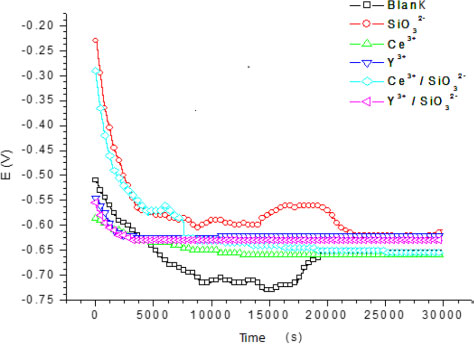
Potential evolution at open circuit of carbon steel A37 in presence of RE salts in 3%NaCl
The open potential variation is slow enough for the solutions containing the ions Y3+, Ce3+ and the mixture Y3+/  or Ce3+/
  . It can be observed that potentials take negative values and are stabilised quickly after 1 h of immersion. According to Arenas and de Damborenea,
27
the displacement of the corrosion potential towards the negative values with cerium salts in water containing NaCl corresponds to a layer formation containing cerium products blocking the cathodic sites where the reduction of dissolved oxygen occurs.
. It can be observed that potentials take negative values and are stabilised quickly after 1 h of immersion. According to Arenas and de Damborenea,
27
the displacement of the corrosion potential towards the negative values with cerium salts in water containing NaCl corresponds to a layer formation containing cerium products blocking the cathodic sites where the reduction of dissolved oxygen occurs.
Potentiodynamic curves
The electrochemical behaviour of steel samples treated with different salts was evaluated by potentiodynamic polarisation during 1 h immersion in 3%NaCl. Figures 2 and 3 contain polarisation curves corresponding to steel samples with RE ions Y3+, Ce3+ and  . The addition of inhibitors in the electrolyte at pH 6 changes the process controlling the corrosion. However, both cathodic and anodic current densities were decreased separately, which explain that the local anodic dissolution and cathodic reduction of oxygen were suppressed simultaneously. The polarisation curves look affected by IR drop at high over potential, especially above 10 mA/cm2. At high values of current, problems appear with diffusion of the reactants into the catalytic sites. The overpotential on metal will be even larger than the metal and will cause the reaction to be difficult; a slow system can be observed; it can be associated with the phenomenon of diffusion limitations, and it is due to chemical and electrochemical problems. The corrosion potential is slightly displaced towards positive values for all treated samples. This shift can be used as a criterion to classify inhibitors as anodic or cathodic. In this case, our results show that RE and RE/
  ions act as mixed inhibitors concordant to the authors’ works.15,28
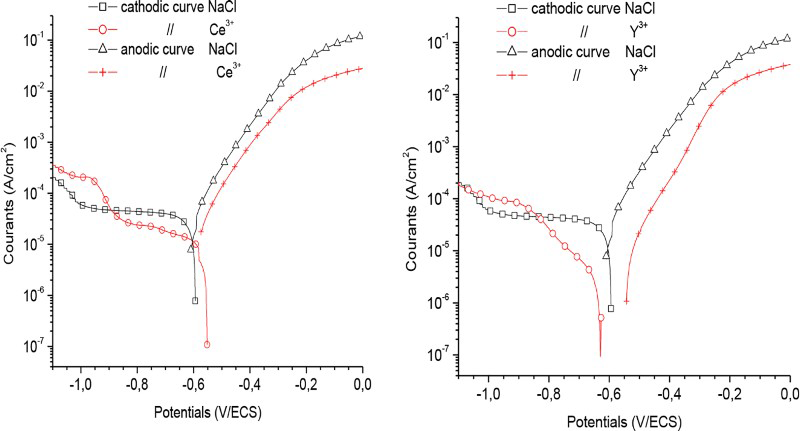
Cathodic and anodic curves of carbon steel A37 in presence of RE salts in 3%NaCl

Cathodic and anodic curves of carbon steel A37 in presence of RE/ salts in 3%NaCl
The decrease in the current is less pronounced in the presence of silicate ions under the same conditions, but the RE/  is a much more effective inhibitor than the separate species. The curves included in Figs. 2 and 3 allow to evaluate other parameters related to the behaviour of the treated samples.
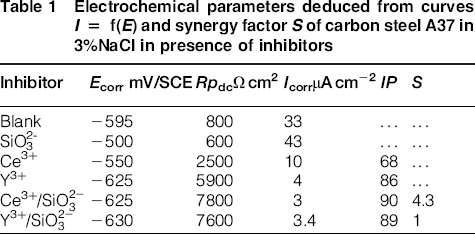
Corrosion current densities extrapolated from Tafel cathodic lines and the calculated efficiency of the inhibitors are listed in Table 1. As it can be observed, the greatest IP using 500 ppm is 89% for Y3+/  and 90% for Ce3+/
  . On the other hand, the IP using 1000 ppm is about 86% for Y3+ and 68% for Ce3+. The decrease in the cathodic current could be explained by a decrease in the active electrode area, which is a function of the film nature.
Electrochemical parameters deduced from curves I = f(E) and synergy factor S of carbon steel A37 in 3%NaCl in presence of inhibitors
 cm2
cm2 A cm− 2
Some authors29,30 have described two mechanisms of adsorption in order to explain the synergy effect observed when the two inhibitors were present in the solution simultaneously. They proposed that the synergy effect results from either competitive or cooperative adsorption between the compounds. In the first case, inhibitors are adsorbed on different electrode sites, whereas in the second case, one inhibitor is adsorbed chemically and the other one comes to adsorb on physically.
The mechanisms of adsorption are characterised by a synergy factor S evaluated according to the following relation
30

E 1,2 is expressed by


If Y3+ and  are considered, densities will be I 1, current density of corrosion in the presence of Y3+; I 2, current density in the presence of
  ; I 1,2, current density with Y3+/
  ; and I 0, current density without an inhibitor.
According to the criterion, if S < 1, there is competitive adsorption. On the other hand, if S>1, cooperative adsorption can occur.
While referring to Table 1, a synergy parameter S = 4.3 is obtained for Ce3+/  in the studied medium. In this case, there is cooperative adsorption.
Impedance measurements
Electrochemical impedance spectroscopy measurements were performed under potentiostatic control at the open circuit potential of steel, in the absence and presence of Y3+, Ce3+ and RE/  mixture. Figure 4 presents the Nyquist diagrams after 1 h immersion of the sample in the corrosive medium. The results in Table 2 show an important decrease in capacities in the presence of inhibitors, due either to the formation of an isolating surface layer of low dielectric constant or to the adsorption of some species replacing water molecules. In the low frequency range, the extrapolation of the medium frequency loop gives the polarisation resistance Rp ac. This point was clarified by determining the Rp dc value from the curves I = f(E) around E corr. The Rp dc (around E corr) value is less significant than the Rp ac value. This may indicate that one or several time constants exist in the low frequency range.
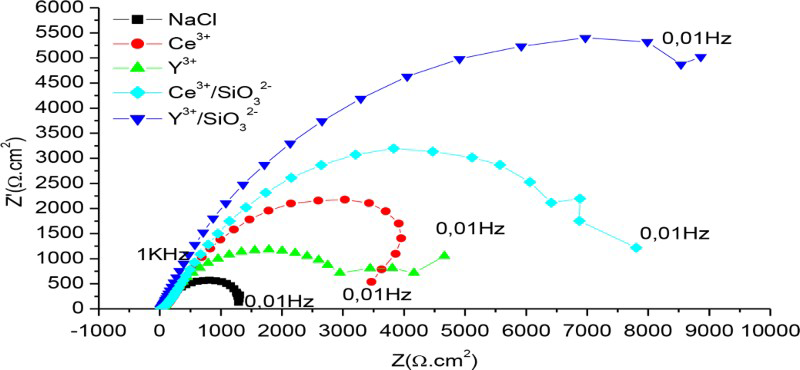
Impedance diagrams of carbon steel A37 after 1 h immersion in presence of inhibitors

General XPS spectra obtained from film formed on surface in presence of a Y3+, b Y3+/ , c Ce3+ and d Ce3+/ 
Electrochemical parameters measured from polarisation and impedance diagram experiments on carbon steel A37 in 3%NaCl solution after 1 h immersion
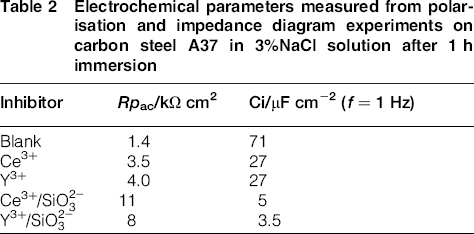
The spectra clearly show a marked influence of the inhibitor on polarisation resistance Rpac values. The value of Rp ac is maximum for the sample treated with Y3+/  and decreases with Ce3+/
  , Y3+ or Ce3+. Thus, the EIS measurements confirm the results obtained by potentiodynamic polarisation tests. Impedance measurements were also performed in the samples treated during 7 days with different components. All the Rp ac values are approximately in the same order as observed for 1 h of treatment.
Observation of corroded surfaces
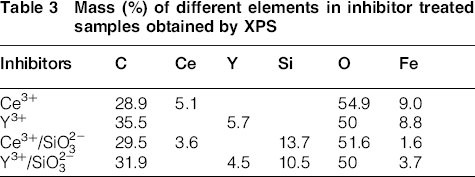
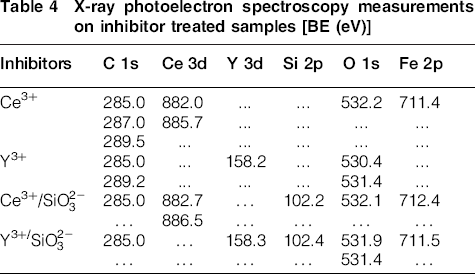
The chemical composition of the surface studied by XPS shows the presence of Y, Ce, Si, O, C and slight Fe in coatings (Fig. 5). The amount of Fe is an approximate measure of the inhibiting layer thickness. Less Fe signal equals thicker inhibitive layer. The ratio of RE to silicate might indicate the relative amount of each species in the film. The signal of C may be from surface adventitious contamination resulting from CO2 in the air. For the same reason, detailed analysis of the oxygen signal is also not sensible as much as from contamination including adsorbed CO2 from the air. In this case, XPS data (Table 3) show that Y, Ce and Si are the main components of the surface layer. The binding energy BE of the samples treated with Ce3+ is 885.7 eV (Table 4). This is in accordance with the results reported by Praline et al.:
31
for the Ce 3d5/2 of Ce2O3, BE ≈ 885.8 eV and Ce4+, BE ≈ 882.0 eV; for the Ce 3d3/2 of CeO2 species, BE ≈ 882.7 eV. An overlapped peak (O 1s), difficult to separate, was observed at ∼532.2 eV for O2 − , OH− and H2O. Thus, the BE of the oxygen peak suggests a contribution of hydroxide species. Cerium can also form Ce2(C2O4)3. The presence of carbonates was observed at 289.5 eV. For the samples treated with Y3+, the Y 3d5/2 peak was measured at BE ≈ 158.2 eV (Table 4) or BE ≈ 158.3 eV.
33
It suggested a contribution of yttrium oxide or yttrium hydroxide. An identical behaviour was observed with carbonates at 289.2 eV probably Y2(C2O4)3.9H2O (Ref. 32) for  .
32
The Y 3d is less clear due to the overlapping of the BE of Y3d5/2 and Y 3d3/2 at 158.2 eV. It was suggested that the film composition is in a suboxide form: Yox/Y.
34
The Si 2p peak was measured at BE ≈ 102.4 eV corresponding to SiO
x
with x < 2. For
.
32
The Y 3d is less clear due to the overlapping of the BE of Y3d5/2 and Y 3d3/2 at 158.2 eV. It was suggested that the film composition is in a suboxide form: Yox/Y.
34
The Si 2p peak was measured at BE ≈ 102.4 eV corresponding to SiO
x
with x < 2. For  , the spectrum of Ce 3d was similar to that of the Ce3+ alone: two peaks at 882.7 eV and 886.5 eV corresponding to Ce4+ and Ce3+ in oxide/hydroxide form. The Si 2p peak measured at BE ≈ 102.2 eV is attributed to siliceous oxide.
Mass (%) of different elements in inhibitor treated samples obtained by XPS
X-ray photoelectron spectroscopy measurements on inhibitor treated samples [BE (eV)]
Conclusions
The effect of RE (Y3+, Ce3+) and  ions on the corrosion of steel in 3% NaCl solution at pH 6 was investigated by electrochemical measurements (potentiodynamic polarisation and impedance spectroscopy) both with XPS.
The electrochemical polarisation showed that the treatment with RE salts and silicate ions affect both the anodic and cathodic arms. The formation of passive layer on the surface leads to a decrease in the local anodic dissolution and the cathodic reduction of oxygen. In the same way, the corrosion potential was shifted slightly towards positive values for all treated samples. From these results, it became evident that RE/  acted as a mixed inhibitor. The most intense decrease in the currents was observed with Y3+/
  ion binary. The treatment with Ce3+/
  ions revealed identical currents than that with Y3+ or Ce3+ separated species. The EIS spectra for different inhibitors show an increase in the polarisation resistance Rp ac and a decrease in the surface capacitance values C d, indicating the inhibiting effect of RE and
  . RE/
. RE/  seems to be more effective than Y3+, which is more effective than Ce3+.
The XPS analysis of the film deposited onto the surface of steel indicated the presence of RE oxides and/or hydroxides and SiO
x
with x < 2. For Y, the composition was attributed to Y2O3/Y(OH)3 and Y2(C2O4)3 probably (reacting with CO2 from the air). For Ce, the film was attributed to Ce2O3/Ce(OH)3 for short treatment times and CeO2 for long treatment times. The film deposited from RE/  would come to be formed by a mixture of RE oxide/hydroxide and silicium oxide. However, an effect seems to exist when RE and
  ions act simultaneously as inhibitors. Therefore, further studies are necessary for the complete understanding of this synergism origin.
Acknowledgement
The authors wish to express their sincere gratitude to the Thematic Agency of Science and Technology Research (ATRST) for financial support of this work.