







Abstract
The effect of molybdenum on the texture evolution of cold rolled and annealed steel sheets was examined in a series of 0·015C–1·5Mn–Mo steels. Orientation distribution function data were calculated from the (110), (200) and (211) pole figures determined on the rolled plane of cold rolled and annealed steel sheets. Increasing the Mo content markedly strengthened the intensities of γ fibre textures, but the {001}<110> and {110}<110> textures were not affected by the Mo content, which resulted in an increase in r m value. The desirable texture evolution for the deep drawability in 0·5%Mo steel may be mainly caused by the grain refining effect of Mo in the hot rolled steel sheet.
Introduction
Ultralow carbon interstitial free high strength cold rolled steels have been used for automotive panels to reduce vehicle weight. The highest tensile strength of the interstitial free high strength steels used for automotive panels is ∼400 MPa because of the lack of deep drawability above this strength.
Recently, dual phase steels with a tensile strength of 440 MPa or higher have been considered for automotive panels. Dual phase steel, whose microstructure consists of ferrite and martensite, has unique properties:1 – 2 high stretch formability, continuous yielding behaviour without temper rolling, low yield strength/tensile strength ratio, high total elongation, high rate of work hardening and large bake hardenability. The only drawback of dual phase steels is the low plastic strain ratio, r value, leading to poor deep drawability. Research3 – 5 has been conducted to improve the r value of dual phase steels, but there have still been difficulties in applying these to automotive panels because of the low average r value (r m<1·0). It has been reported that dual phase steels should have at least ∼5% of martensite in the microstructure for continuous yielding behaviour without temper rolling.6 – 8 The martensite content of >5% is responsible for the low r m value of dual phase steels.3 – 5
In this study, dual phase steels with a microstructure of ferrite and extremely small amount of martensite were considered to find the possibility to improve the r value even though the steel revealed discontinuous yielding behaviour. Of particular interest is a Mo bearing grade, with Mo being well known as an extremely effective hardenability element. It has been reported that Mo increased the slope of the A3 line, allowing for more flexibility in heat treatment, increased hardenability and produced carbide precipitation in ferrite.9 – 10
The effect of Mo on the texture evolution of cold rolled and annealed steel sheets was examined in a series of 0·015C–1·5Mn–Mo steels with molybdenum ranging from 0 to 0·5%. The 0·015% carbon was introduced to obtain a microstructure with ferrite and a very small amount of martensite. The chemical compositions of the steels are given in Table 1.
Chemical compositions of steels (wt-%)
The steels were vacuum melted using a high frequency induction heating furnace. The ingots were austenitised at 1200°C and hot rolled to 3·0 mm thick with finish hot rolling at ∼870°C. The hot rolled strips were air cooled to 660°C and then soaked an hour at this temperature, followed by furnace cooling to simulate the coiling process in hot rolling. The strip was cold rolled to 0·8 mm and annealed using a laboratory infrared heat treating furnace: heating at a rate of 3°C s−1 to 820°C, soaking 67 s at the temperature, cooling to 460°C at 6°C s−1, soaking 4 s at the temperature, heating to 530°C at 20°C s−1, slow cooling to 400°C at 7°C s−1, which is called overaging in the actual continuous galvanising line, followed by final cooling at 13°C s−1 to room temperature. The heat cycle was to simulate the typical heat treatment of continuous galvannealing line.
Optical micrographs showing the effect of Mo content on the microstructure of hot rolled steels are shown in Fig. 1. Regardless of the Mo content, the microstructure consists of ferrite and extremely small amounts of cementite, but there were some differences in the ferrite morphology. The ferrite grain size of the hot rolled steel sheet decreased with increasing Mo content. The average grain sizes in the ASTM scale of 0%Mo, 0·1%Mo and 0·5%Mo steels were 9·2, 9·6 and 10·4 respectively. The standard deviations were in the range of 0·08–0·12. The 0·5%Mo steel revealed a quasi-polygonal ferrite whose grain was the finest. The quasi-polygonal ferrite, which has a high density of dislocation and low angle grain boundaries with irregular changeful shape, has been observed in steels containing a substantial amount of alloying elements, such as Mn, Cr and Mo, which increase the hardenability.11
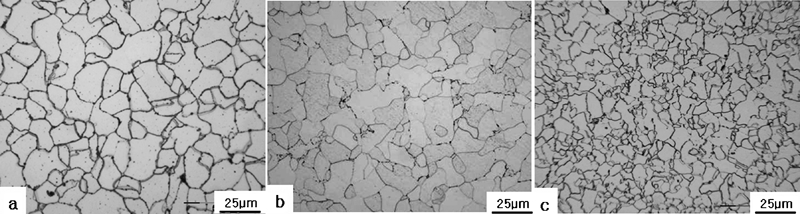
Optical micrographs showing effect of Mo content on microstructure of hot rolled steels: nital etched
Figure 2 shows the change in optical microstructure with Mo content in the steels cold rolled and annealed at 820°C. According to the Andrews equation,12 the calculated A c3 temperatures of M0, M1 and M5 steels were 887, 891 and 907°C respectively. Accordingly, 820°C is assumed to be the temperature in the intercritical region of ferrite and austenite. The annealed steels were etched in LePera’s etchant.13 With this treatment, martensite appears white. The small particles marked with M in Fig. 2c correspond to martensite.
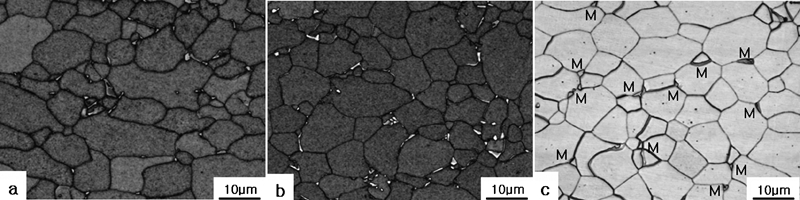
Optical micrographs showing change in microstructure with Mo content in steels annealed at 820°C: LePera’s etchant etched
Regardless of the Mo content, the grain size number in ASTM scale was 10·3 in three steels. Any change in ferrite grain size with Mo content has not been observed. The fine martensite particles in very small amounts were uniformly distributed in the microstructure. The uniform distribution of the fine martensite particles in very small amounts may be desirable for enhancing the r value. The martensite volume percentage increased with increasing Mo content. The martensite volume percentage, however, was <1·5% even in the 0·5%Mo steel, which contains the most martensite. This was much less than the martensite amount (∼5%) necessary for continuous yielding of dual phase steels. The presence of a small amount of martensite may be because the 0·015% carbon used in this study was less than the maximum solubility of carbon in ferrite.
Table 2 shows the tensile properties of as annealed steel sheets. As expected, increasing the Mo content increased the tensile strength but decreased the total elongation. The yield strength with Mo content, however, was affected by the yielding behaviour more than the strengthening effect of Mo. Discontinuous yielding appeared irrespective of the Mo content. The yield point elongations (YPEs) of 0%Mo, 0·1%Mo and 0·5%Mo steels were 4·0, 3·0 and 0·4% respectively. Increasing the Mo content decreased the YPE, and this is caused by the small increase in martensite amount with increasing Mo content.
Tensile properties of as annealed steel sheets
Orientation distribution function (ODF) data were calculated from the (110), (200) and (211) pole figures determined on the rolled plane of the annealed steel sheet. Figure 3 shows α fibre texture, <110>//RD, and γ fibre texture, <111>//ND, of the steels cold rolled and annealed at 820°C. The ODF sections showing the α and γ fibre textures of steels at PHI 2 = 45° are shown in Fig. 4. Increasing the Mo content markedly strengthened the intensities of the γ fibre textures, but the {001}<110> and {110}<110> textures among the α fibre texture, which are expected to decrease the r m value, were very weak irrespective of the Mo content. Consequently, it is expected that the combination of the strong γ fibre texture and the weak {001}<110> and {110}<110> textures is responsible for the increase in the r m value.
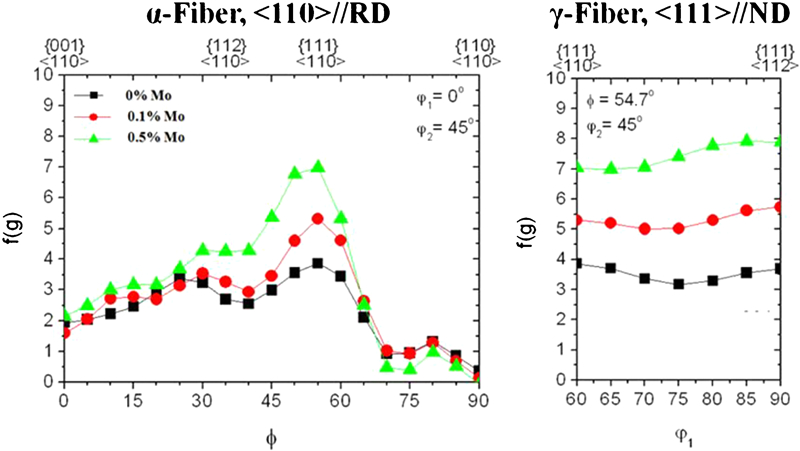
α and γ fibre textures of cold rolled and annealed steels
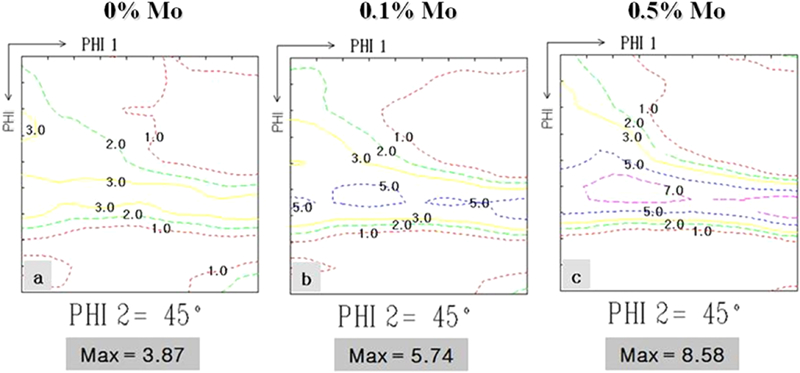
Orientation distribution function sections (PHI 2 = 45°) showing α and γ fibre textures of cold rolled and annealed steels
On the other hand, the r m values of M0, M1 and M5 steels were 1·23, 1·41 and 1·49. The r m value was calculated using the equation (r 0+2r 45+r 90)/4. Here, r 0, r 45 and r 90 correspond to the r value determined in the tensile test in the direction of 0, 45 and 90° to the rolling direction respectively. It is very interesting that the r m value increases with increasing Mo content, which is a strong hardening element. The ODF results were in good agreement with the change in r m value with Mo content.
It has been reported that finer ferrite grains of hot rolled steel sheets are required to strengthen the {111} texture and suppress the {110} and {100} textures of cold rolled and annealed steel sheets, allowing for a higher r m value.14 As shown in Fig. 1, increasing the Mo content markedly decreased the ferrite grain size of the hot rolled steel sheets. From the above results, consequently, it is concluded that the evolution of desirable texture evolution for the good deep drawability in the 0·5%Mo steel may be mainly caused by the grain refining effect of Mo in the hot rolled steel sheet. It is also important to note that the martensite content of <1·5%, which is not enough for a continuous yielding behaviour in dual phase steel, does not play a negative role in enhancing the r m value.
In summary, increasing the Mo content markedly strengthened the intensity of γ fibre textures, but the {001}<110> and {110}<110> textures were not affected by the Mo content, which resulted in the increase in r m value. The desirable texture evolution, strong γ fibre and weak {001} and {110} textures, for good deep drawability in 0·5%Mo steel, may be mainly caused by the grain refining effect of Mo in the hot rolled steel sheet.
Footnotes
Acknowledgements
This work was supported by research grants from the Catholic University of Daegu in 2010.