







Abstract
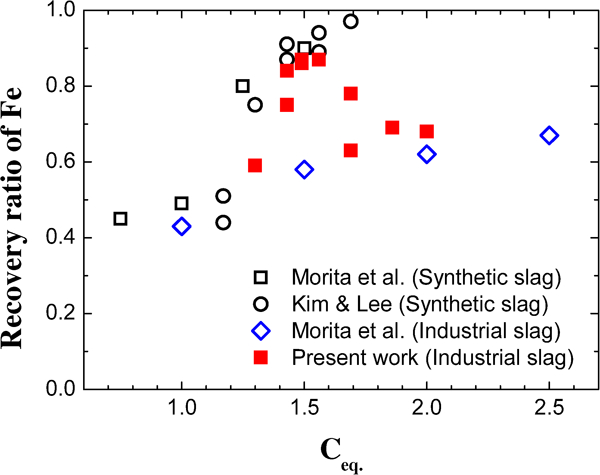
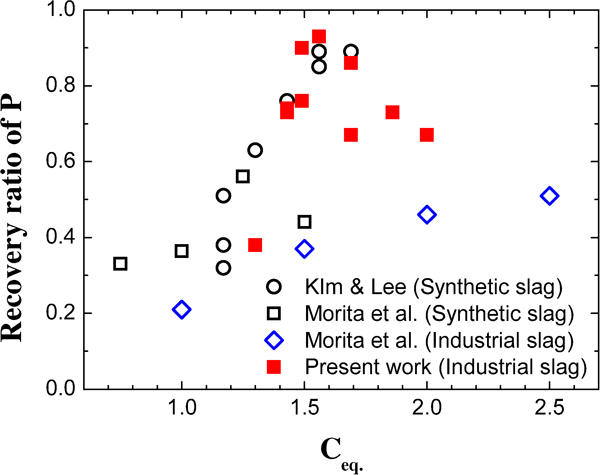
In order to optimise the recovery process of Fe and P from industrial steelmaking slag by microwave irradiation, the recovery ratios of Fe and P from slag–graphite mixtures were investigated. In the reduction of industrial slag by graphite at a fixed microwave processing time of 900 s using a microwave oven, the recovery ratio of Fe increased with increasing carbon equivalent (C eq.: the mole ratio of carbon/oxygen to reduce Fe2O3 and FeO, yielding CO gas) and reached 0·87 when C eq. = 1·56. The recovery ratio of P also increased with C eq. and showed 0·93 at the same condition. From the comparison between the present and previous studies by Kim and Lee employing a synthetic slag, it was found that almost similar results were obtained. From the chemical analysis of the slag and metal after experiments, it was found that the phosphorus distribution ratio (L p) strongly depended on the total Fe content in the slag, namely, as the FeO content decreased, the L p value decreased. Discrepancies observed between the present and previous studies are discussed in view of microwave power and thermodynamic analysis.
Introduction
Steelmaking slag is one of the major byproducts from the steelmaking industry, and the growth rate of slag generation is increasing as steel production increases. In 2009, 7831 kt of steelmaking slag was generated in Korea and utilised for land filling (43·2%) or as stabiliser in the lower part of road construction (27·2%). Only 21·7% was recycled in the steelmaking process. If phosphorus in the slag could be reduced, the slag could be recycled in the steelmaking process, and eventually, we could decrease the consumption of CaCO3, which is one of major sources of CO2 emissions. In addition, if the total Fe (T. Fe) content in the steelmaking slag is also reduced considerably, it could be utilised as a more value added material.
Recently, microwave processing has gained much attention in the last 2 decades as an alternative pyrometallurgical recycling process due to its nature of rapid and selective heating. Morita et al. utilised microwave heating in fly ash treatments.1 Ma et al. recovered metallic elements from sludge.2 Yoshikawa et al. recovered Ni from used Ni ion batteries.3 Cho and Lee recovered Fe, Cr and Ni from the stainless mill scales.4 Sun et al. 5 and Kim et al. 6 reduced the electric arc furnace dust to recover Zn as vapour and Fe as metal.
Morita et al. have found in their microwave treatment of steelmaking slag (1·6 kW, 2·45 GHz) that both Fe and P could be quickly recovered as a form of Fe–C–P alloy; thus, they suggested the use of microwave heating for steelmaking slag recycling.7, 8 Recently, Kim and Lee carried out similar experiments with a synthetic CaO–SiO2–FeO–P2O5 slag and found a way to increase the recovery ratio of P.9 They found that the heating of a carbon–slag mixture was dominated by carbon heating, and a maximum recovery rate was obtained by 900 s microwave treatment (1·7 kW, 2·45 GHz) when 15 g of the synthetic slag and 0·816 g of graphite mixture were used. They found that the T. Fe in the slag after microwave treatment showed a strong effect on the partition ratio of P between slag and metal (L p), namely, as T. Fe decreased, the L p value decreased considerably. Morita et al. reported that the recovery ratios of Fe and P were low when the industrial slag was microwave-treated, while those of Fe and P were relatively high when the synthetic slag was microwave-treated.8 However, no clear reasoning has been provided yet. General up to date information on microwave heating to recover metallic elements from industrial waste was discussed by Lee and Kim.10 Therefore, in this study, the recovery of Fe and P from an industrial steelmaking slag by microwave treatment was examined to find the optimised condition and clarify the relationship between T. Fe and L p. Moreover, a thermodynamic analysis was carried out in order to find factors affecting the recovery ratios of Fe and P.
Experimental
Materials
The industrial steelmaking slag used in the present study was provided by POSCO. The chemical composition was analysed with X-ray fluorescence (S4 Pioneer, Bruker, XRF) and inductively coupled plasma (ICP)–atomic emission spectrometry (138 Ultrace, Jobin Yvon). Analysis of Fe2+ and Fe3+ was performed by wet chemical analysis. The results are presented in Table 1. The average diameter of the slag powders was found to be 0·232 μm using a dynamic light scattering analyser (ELS-8000, Otsuka, Japan). Morita et al. reported that the microwave energy was most efficiently absorbed in the slag with the value of Fe3+/(Fe2++Fe3+) in the range of 0·15–0·18 with the largest dielectric loss of the slag.7 The industrial slag used in the present study showed the value of Fe3+/(Fe2++Fe3+) as 0·175. Therefore, the microwave energy absorption ability of the slag was considered maximised. As a reducing agent and a heating axillary, graphite powder was used, which was shown to be a very efficient heat generator under microwave treatment.9 The average diameter of the graphite powders was 2·260 μm.
Chemical composition of slags
Experimental procedure
The experimental procedure was the same as our previous studies.6, 9 Figure 1 shows a schematic diagram of the microwave furnace (MM-344 L, 2·45 GHz, 1·7 kW, LG). A well mixed slag–graphite powder mixture sample was charged in an alumina crucible (outer diameter, 39 mm; inner diameter, 36 mm; height, 29 mm). The amount of slag was 15 g, and that of graphite was varied from 0·91 to 1·40 g. Accordingly, the carbon equivalent (C eq, the mole ratio of carbon to oxygen to reduce FetO, yielding CO gas) varied from 1·3 to 2·0. The crucible was placed in a unit of refractory bricks which was then placed at the centre of the microwave furnace and irradiated for 15 min, which was optimised in the previous study.9 During the experiments, the temperature was monitored using a two-colour pyrometer (IR-HQH2, 873-2273K, CHINO) through a hole on the upper part of the refractory block. Temperature increased rapidly up to ∼1800 K in 6 min, keeping at this temperature for 9 min. Then microwave irradiation was stopped, and the sample was cooled down in air to room temperature at a cooling rate of −80 K min−1. After the experiments, the reduced metallic particles were separated from the remaining slag. The metal droplet was easily separated from the residual slag and the crucible mechanically. The size of the metal droplet was ∼10 mm. Then, the recovered metal was weighed and analysed with ICP and LECO-C/S analyser (C/S-300, LECO, USA).
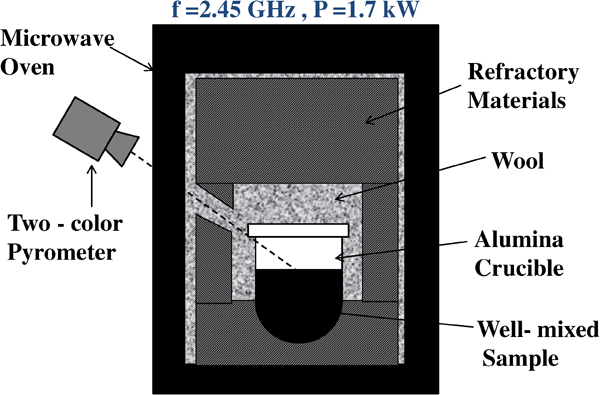
Schematic diagram of microwave furnace used in heating experiments
Results
Figure 2a shows the analysed T. Fe content, i.e. T. Fe in the industrial slag after microwave treatment with respect to C eq.. For comparison, T. Fe in our previous investigation employing a synthetic slag and T. Fe in the investigation by Morita et al. employing both synthetic and industrial slag were plotted together.8, 9 In the present study, T. Fe in the slag decreased with increasing C eq. and showed a minimum at around C eq. = 1·6 and slightly increased again as C eq. increased further. The T. Fe obtained in the present study shows reasonable accordance with the previous results of synthetic slags,9 but is lower than T. Fe reduced from the industrial slag reported by Morita et al. 8 Figure 2b shows the corresponding weight gain of metal (Fe–C–P alloy) with respect to C eq.. The reduced metal in the present study also has a maximum value at around C eq. = 1·6. Kim and Lee reported that the reduced metal in their investigation might be reoxidised when the microwave processing time became longer.9 Kim et al. reported that as the reduction was almost completed, the remaining graphite powder would be oxidised, and when all the graphite was consumed, the oxidation of the reduced iron could happen during cooling.6 It was considered that as C eq. increased, the reduction took place at a faster rate, and the reduced metal was exposed to an oxidising atmosphere for a longer time.
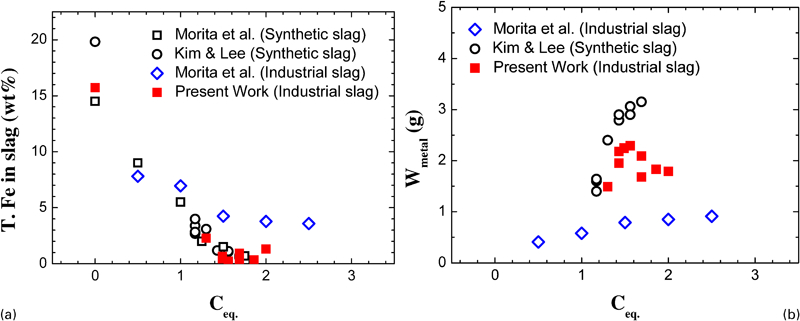
a total Fe content in slag and b mass of reduced metal phase after 15 min microwave processing with respect to C eq
Figure 3 shows the P content in slags and metals with respect to C eq. obtained in several investigations8, 9 as well as in the present study. It was found that the P content in the slag analysed in the present industrial slag gradually decreased with increasing C eq., showed a minimum at around C eq. = 1·6 and then slightly increased again as C eq. increased further like Fe. As the P content in the metal decreased (C eq. >1·6), the P2O5 content in the slag slightly increased. Therefore, it is considered that the reoxidised P was transferred to the slag. The P content in the metal phase reduced from the industrial slag of Morita et al. showed almost the same level as the present results, while the P2O5 content in the slag of Morita et al. was higher. Moreover, no maximum (for P content in the slag) or minimum (for P content in the metal) was observed in their investigation.
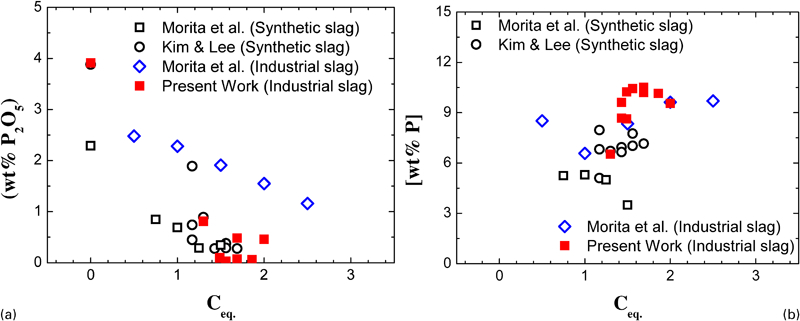
a P2O5 content in slag and b P content in metal after 15 min microwave processing with respect to C eq
Figure 4 shows the carbon content in the metal phase that ranged from 0·53 to 2·51 wt-%, being mostly close to 2·0 wt-%, which was slightly higher than that of Kim and Lee (synthetic slag)9 but lower than that of Morita et al. (both synthetic and industrial slags).8 Although there was a large scatter in the experimental results, general tendency showed that the carbon content in the metal slightly increased with increasing amount of carbon addition (C eq.). This behaviour qualitatively agrees with the previously reported results.
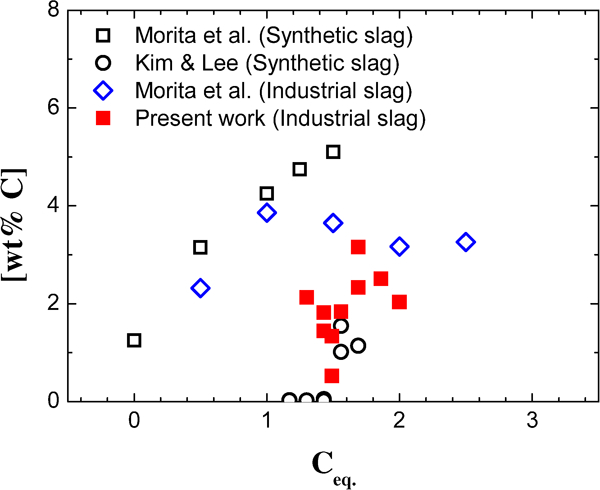
Carbon content in metal after 15 min microwave processing with respect to C eq
Figures 5 and 6 show the recovery ratios of Fe and P as a function of C
eq. respectively. The recovery ratios of Fe and P were defined by equation (1)9

Recovery ratio of Fe with respect to C eq
Recovery ratio of P with respect to C eq
Experimental condition and recovery ratios of Fe and P
Discussion
Comparison between present and previous investigations
The experimental results obtained by the earlier investigation of Morita et al.
8 differ from those in the present study and in our previous study9 in several ways: (1) microwave heating for longer than 420 s does not induce further recovery of Fe and P, while 900 s was found to be the optimum microwave heating time in our studies; (2) the recovery of Fe and P from the industrial slag used by Morita et al. was revealed to be inefficient (0·2–1·0 g of metal recovered out of 15 g of initial slag), while 1·5–2·3 g of metal was recovered from the same mass of industrial slag in the present study; (3) T. Fe, P2O5 and MnO in the industrial slag of Morita et al.
8 were not reduced as much as that in the present study; (iv) as mentioned in the previous section, the recovery ratios of Fe and P do not show the maximum with respect to the C
eq. in the work of Morita et al.,8 while there are clear maximums in the present study as well as in our previous study.9 With regard to reasons (1)–(3), it is likely that the differences stem from the power of the microwave furnace used in those investigations. Morita et al. employed a commercial microwave oven of 1·6 kW, while the present authors employed a microwave furnace of 1·7 kW (the average power absorbed by a material is the sum of electric loss and magnetic loss. 


Thermodynamic considerations on recovery of P from steelmaking waste slag
From the previous study with synthetic slags, it was found that when the partition ratio of P [L
p = (wt-% P in slag)/(wt-% P in metal)] was plotted with respect to T. Fe in the slag, as T. Fe decreased, L
p decreased simultaneously. In order to confirm the effect of T. Fe, the experimental results obtained in the present study as well as those from the previous investigations8,
9 are shown together in Fig. 7. It is clearly shown that when T. Fe decreases, L
p decreases slightly until T. Fe decreases to ∼4 wt-%, but when T. Fe further decreases below 4wt-%, L
p decreases very rapidly. From this observation, it might be said that at high T. Fe content in the slags, Fe is selectively reduced while P is reduced but not as much as Fe does. However, at low T. Fe content in the slags, due to the limited availability of Fe oxide, P in the form of 
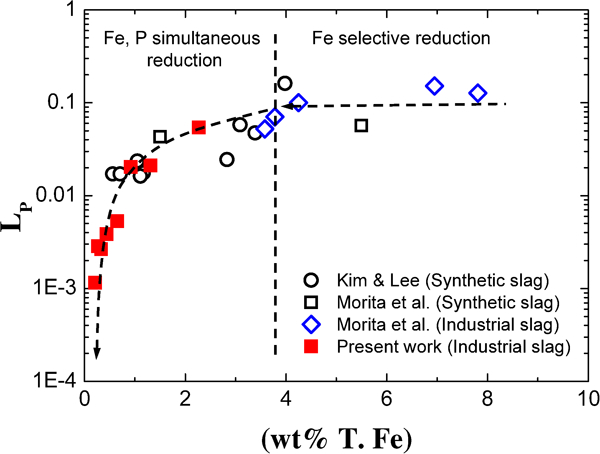
Partition ratio of phosphorus with respect to T versus Fe concentration in slag after microwave processing: dashed line and dashed arrows are inserted only for indication purpose
For better understanding, a number of thermodynamic calculations were carried out using FactSage thermodynamic software and thermodynamic database.11, 12 The validity of the thermodynamic model employed for the calculation of equilibrium P distribution ratio (L p) between molten slag and molten Fe and the procedure of the calculations are shown elsewhere.11, 13 The calculations were made by the stepwise consumption of carbon to reduce the slag, whose composition is the same as that used in the present study. The calculation was carried out at 1800 K. It should be noted that the calculations assume thermodynamic equilibrium at 1800 K, which is different from the thermal condition exerted on the samples. Therefore, only the tendency of the reduction reaction by changing conditions (slag type, compositions, etc.) is to be regarded.
The calculated results of equilibrium compositions of slag phase and metal phase are shown in Fig. 8a and b , and L p is shown in Fig. 9 as a full line. As shown in Fig. 8a , the first reduced oxide in the slag is Fe oxide (composed of FeO and Fe2O3). Until T. Fe decreases to ∼4 wt-%, the other elements in the slag are not significantly reduced. When T. Fe becomes lower than ∼4 wt-%, then P starts to decrease. Such tendency can also be observed in Fig. 8b , in which the equilibrium compositions of the reduced metal phase are shown. Accordingly, L p will decrease significantly when P oxide in the slag starts to be reduced.
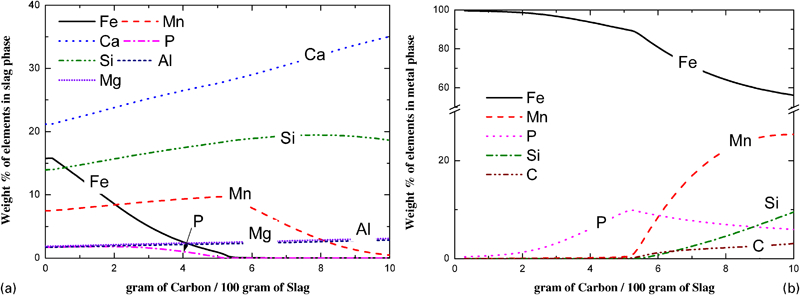
Changes of a slag and b metal compositions with consumption of carbon at 1800 K (calculated with FactSage)
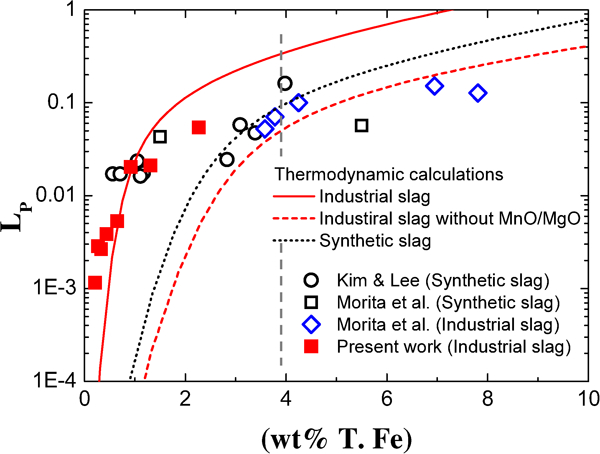
Partition ratio of phosphorus with respect to T versus Fe concentration in slag after microwave processing: lines are calculated partition ratio of phosphorus using FactSage
The full line in Fig. 9 is the calculated L p between the slag (the same composition used in the present study) and the reduced metal phase employed in the present study. As expected from the results shown in Fig. 8, the calculated L p decreases rapidly as T. Fe decreases. For comparison, the calculated L p at 1800 K between a slag (the same composition used in our previous study using synthetic slag) and the reduced metal phase is shown in dotted line. The calculation shows that in the case of synthetic slag, L p is lower than that of the industrial slag at a given T. Fe. In other words, the recovery ratio of P in the industrial slag should be lower in the thermodynamic point of view. This is attributed to the fact that the industrial slag contains MnO and MgO, which are not available in the synthetic slag. Since MnO and MgO have strong affinity to P oxide in molten slag, having MnO and MgO will increase the equilibrium P distribution ratio.
The dashed line in the figure is the calculated equilibrium L p for the industrial slag without MnO and MgO. The calculated L p without MnO and MgO is clearly lower than that of the industrial slag with MnO and MgO. The difference is significant. This suggests that industrial slag containing MnO and MgO will result in a lower recovery ratio of P than the synthetic slag. Unfortunately, the experimentally obtained L p values for two different types of slags (and also for the slags used by Morita et al.) are very similar. This implies that there should be some retarding factor for the recovery of P in the synthetic slag when the microwave treatment was employed. Such retarding factor might have affected both types of slags, thereby resulting in almost identical recovery ratio of P. At present, the factor is not clearly revealed. Further investigation to clarify such retarding factor is necessary.
Conclusions
At a fixed microwave processing time of 15 min, the recovery ratios of Fe and P showed maximum values of 0·87 and 0·93 respectively at C eq. = 1·56. The distribution ratio of P was strongly affected by T. Fe in the slag, namely, as the T. Fe content decreased, the L p value decreased significantly. In microwave processing, it is very difficult to control the temperature and reactions due to its selective and non-uniform heating mechanism. Therefore, monitoring T. Fe in the slag after a certain period of time of microwave irradiation may give the indication of the recovery ratio. The reduction of Fe and P from slags may be dependent on the power of the microwave furnace.
From the thermodynamic analysis, it was found that the industrial slag containing MnO and MgO would have a lower recovery ratio of P, although experimentally obtained results showed that recovery ratios of P in both types of slags are very similar. Therefore, further investigations are required in order to clarify the effects of microwave power and unrevealed retarding factor on the recovery ratios of Fe and P.
Footnotes
Acknowledgements
This paper was supported by the Ministry of Environment, Korea, as ‘The Eco-technopia 21 project’.
This article is part of a special issue on: Sustainable high temperature metallurgical processes and engineering materials recycling techniques