







Abstract
There has been an increasing interest in reduction of iron ore by hydrogen. This study deals with the reduction of haematite in a microwave assisted non-thermal hydrogen plasma. The plasma is composed of excited hydrogen molecules, hydrogen atoms, and ionic hydrogen among other gaseous species. The reduction in hydrogen plasma occurred even at temperatures as low as 573 K. In contrast, the same could not be achieved by merely introducing hydrogen gas to the reducing environment without creating the plasma. It is only ∼1073 K that the extent of reduction by gaseous means is comparable to that of reduction by hydrogen plasma. Based on the experiments, as well as the data available from literature, it was deduced that the reduction of haematite at a low temperature in hydrogen plasma could have been due to the contribution of vibrationally excited hydrogen molecules to the reduction process.
Introduction
The crude steel production in the world today is ∼1400 million tons per annum. The ore body used for this purpose is either haematite or magnetite and the reductant employed is of a carbon base. During reduction, CO2 which is produced as a pollutant is becoming a serious concern from the environmental standpoint. Therefore, hydrogen is considered as an alternate reductant. To our advantage, not only is it benign as the combustion product is H2O, but its consumption is less as compared to the carbonaceous reductant as shown in Table 1. It is expected that technologies will be developed in the future to produce H2 conveniently from water and hence the use of hydrogen for reduction purposes will also become realistic. Keeping this in view, the authors have made efforts to explore the possibilities of using hydrogen plasma to reduce iron ore.
Balance of reductant and product in case of reduction of haematite to iron*
*Data are in tons of species per 112 tons of Fe.
In 1970 Gilles and Clump1 carried out a detailed analysis of the reduction of iron ore with hydrogen in a direct current plasma jet and showed that the heat transfer to the particles is an important factor that determines the kinetics of the reduction process. Reduction of molten iron oxide and FeO bearing slags was reported by Kamiya et al. 2 in 1984, who showed that the rate of oxygen removal is very high in smelting reduction by H2–Ar plasma. In 2004, Uchikoshi et al. 3 demonstrated a process involving hydrogen reduction and plasma arc melting to produce high purity semiconductor grade Fe. Sohn and Choi4 also showed the feasibility of reduction of iron oxide in hydrogen atmosphere, where reduction took place in seconds within the temperature range of 1473–1773 K. The laboratory experiments carried out by Hiebler and Plaul5 in 2004 led to a large scale industrial plant concept, which suggests that hydrogen plasma smelting reduction can be an option for steel making with better product quality and flexibility.
There is no doubt that hydrogen can be used as a reducing gas in direct reduction processes, but from a design standpoint, it is necessary to establish the kinetics of reduction of iron ore into iron. A careful analysis of the literature shows that iron ores (haematite and magnetite) can be reduced by hydrogen gas and in this context, a series of relevant reactions are listed below6
–
12







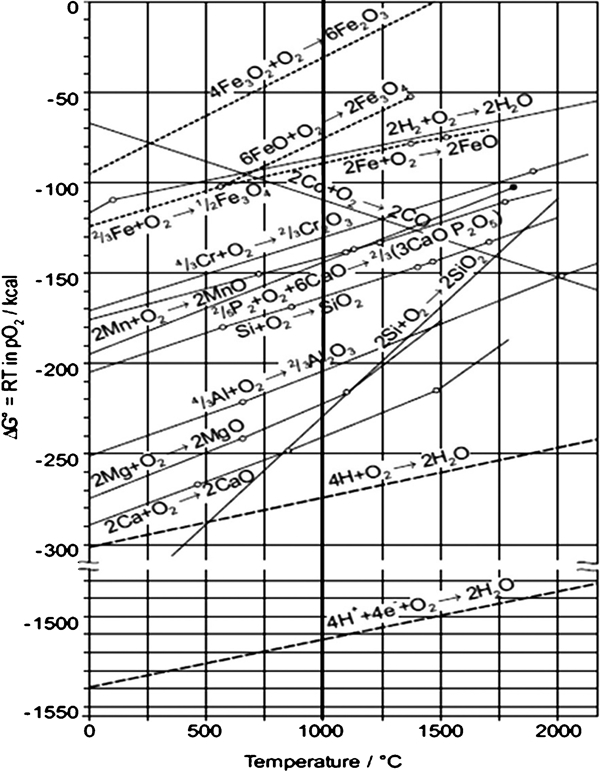
Figure 1 presents the Ellingham Richardson diagram showing the reducing potential of hydrogen (reaction (8)) in comparison to other reactions, e.g. transformation of FeO to Fe as shown in reaction (9).5, 15, 16 As seen from Fig. 1, molecular hydrogen reduces Fe2O3 and Fe3O4 quite easily, though ΔG° values for reactions (8) and (9) are very close. However, it is also seen from the figure that ΔG° values for reactions (10) and (11), involving atomic and ionic hydrogen species respectively, are very high and negative in comparison to reaction (8), which involves molecular hydrogen. The two species H and H+ are provided by the plasma. In other words, in the plasma state both H and H+ can coexist and for these reasons studies are underway to produce iron using hydrogen plasma in a manner similar to the hydrogen plasma smelting reduction process.2, 5, 17, 18
It is clear that there could be different possible routes for the reduction of iron ore in hydrogen plasma, as the plasma itself contain different species, namely, excited hydrogen molecules, hydrogen atoms, and ionic hydrogen and other gaseous species. Figure 2a presents equilibrium partial pressure of molecular hydrogen versus temperature for the reactions (4)–(7). It is seen that reaction (4) is feasible at all temperatures at a partial pressure of hydrogen as low as 10−5. However, the other reactions (5) –(7) require relatively higher partial pressure of hydrogen. Furthermore, as the temperature decreases, the equilibrium partial pressure of hydrogen increases. Figure 2b is similar to Fig. 2a with atomic hydrogen as a reductant and is drawn based on available data in the literature.5, 15, 16 This figure shows that unlike the case with molecular hydrogen, the equilibrium partial pressure of atomic hydrogen for these reactions decreases with a decrease in temperature. These conditions favour the production of direct reduced iron (DRI) using non-thermal hydrogen plasma at low temperatures. Fortunately, not only can the reduction be made feasible at low temperature in hydrogen plasma but also it can be stimulated by the vibrationally excited hydrogen molecules through their surface dissociation.19 The purpose of this paper is to examine production of DRI from haematite using a non-thermal plasma at low temperatures.
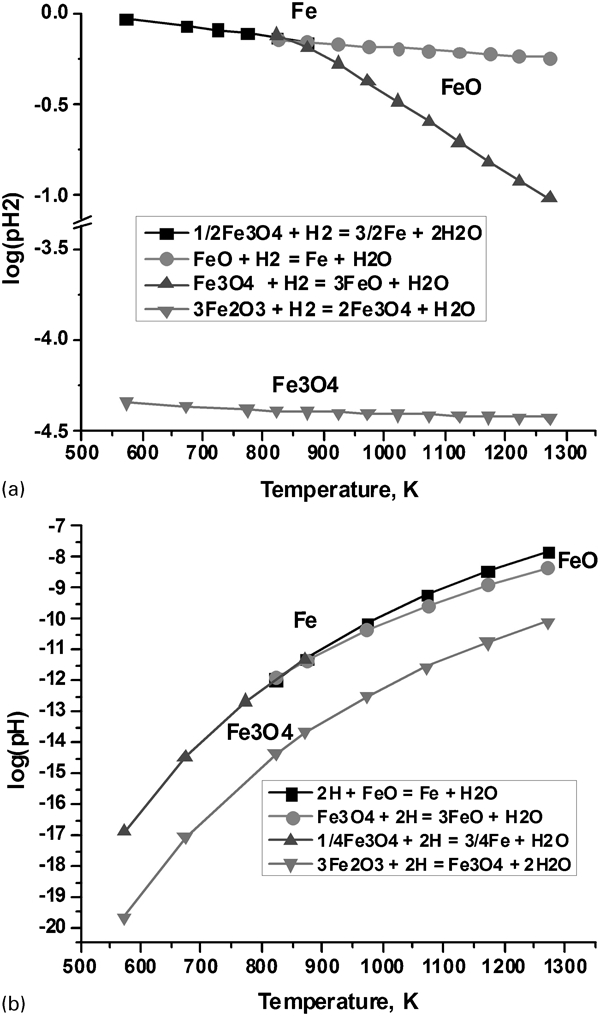
Temperature–partial pressure position with respect to reduction reactions
Experimental
Gaseous reduction by hydrogen in the presence and absence of plasma was carried out with haematite lumps of desired size as well as compacted pellets. The haematite lumps were sourced from a mine located at Joda, Odisha, India, which has the composition of 59·17Fe–84·52Fe2O3–12·11SiO2–1·62Al2O3. Several pieces of haematite of nearly the same weight (∼2·5×10−3 kg) were selected and were washed in acetone in order to remove dirt. The ore pieces were slightly scratched and polished to produce a flat surface, such that it can be rested properly over the sample holder. Simultaneously, pellets of the same ore were also prepared in order to have uniformity in shape and size. Iron ore fines (−500×10−6 m), prepared by grinding the ore using a pastel and mortar were taken to make pellets of 40×10−3 m diameter and 3×10⁻³ m height using a briquetting press. The reduction of pellets was carried out in a specially built plasma reactor to understand the reaction mechanism in the absence as well as presence of plasma.
A standard microwave plasma reactor supplied by M/s Seki Technotron Corporation, Tokyo, Japan was used to carry out the reduction tests. A schematic of the reactor is shown in Fig. 3. The features of this system provide an unprecedented control, as well as variation of the experimental parameters. The reaction chamber is cylindrical in shape, which is made out of steel, and the inside diameter of the chamber is 14·5×10−2 m. It is water cooled by circulating water through a double walled shell. The system has provision to inject hydrogen gas from the top into the chamber through a safety valve and the flow of the gas can be controlled by a mass flow controller. The temperature of the graphite susceptor, which carries the sample holder, is measured by means of a chromel–alumel thermocouple placed underneath. The microwave plasma reactor incorporates a 3000 W at 2·45×109 Hz microwave generator to produce plasma at high power densities. The microwave power can be varied to generate the plasma over a range of temperature. The high frequency waves interact with the hydrogen gas to produce the hydrogen plasma. The plasma produced in this manner covers a region up to about 6×10⁻² to 8×10⁻² m above the sample. The hydrogen molecules enter the plasma and become part of it, but the charged particles recombine immediately when they exit. According to the manufacturing details of the system, under plasma condition, the concentration of hydrogen atoms is 1 in 10 000 hydrogen molecules and the concentration of hydrogen ions is 1 in 10 000 hydrogen atoms. The pressure in the reactor chamber is controlled by a solenoid valve which works automatically and it controls the gas residence time.
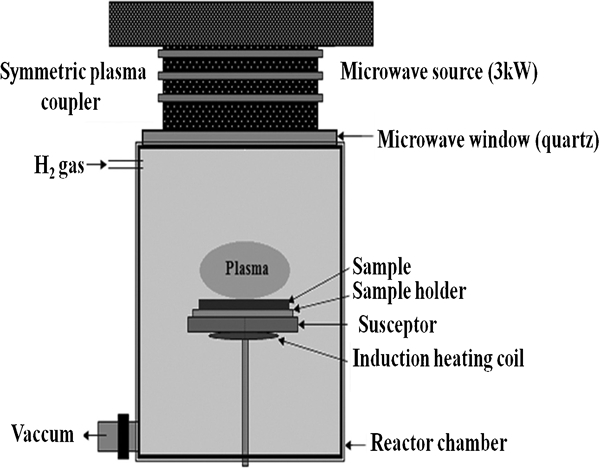
Schematic of reaction chamber
In all the experiments, samples were kept on a molybdenum sample holder, and the sample holder was in turn placed at the centre of the reaction chamber. The samples were either as prepared pellets or lumps. Since the reactor chamber is water cooled, the outer surface of the chamber remains at room temperature during the experiment. The extent of reduction with variation in process parameters, such as microwave power, hydrogen flowrate, pressure, temperature and time, was recorded by noting the loss in weight of the sample. After each experiment, the reduced sample was ground and mixed well, and then a representative sample was taken for analysis. An X’Pert PRO-PANalytical model no. 3040160 was used for X-ray diffraction (XRD) studies of the phases in the reduced samples. The quantitative estimation of the phases was done by using the wet chemical analysis procedure for the total iron, metallic iron, ferrous iron, silica and alumina.
Results and discussion
Reduction by hydrogen gas and hydrogen plasma
A series of experiments at four different conditions of microwave power, pressure, flowrate and temperature, were carried out to compare the reduction of haematite by hydrogen in the presence, as well as, absence of plasma using the same system. The results of experiments are presented in Table 2. The observed degree of reduction is interpreted according to the XRD data that are shown in Fig. 4. As seen from Table 2, at 1073 K more than 95% of the reduction is achieved. The d values of the XRD peaks in Fig. 4a correspond to the Fe peak (JCPDS file no. 00-006-0696). The intensity count (IC) of the principal peak is 5535 as shown in Table 3 (serial 1). However, the reduction achieved with hydrogen gas is slightly less (∼90%). The XRD peaks shown in Fig. 4b corresponding to the Fe and FeO are of relatively lower intensity of around 5200 and 120 respectively. For the experiments conducted at 873 K, the extent of reduction with plasma is >74%, whereas under similar experimental conditions in the absence of plasma the extent of reduction was only 30%. The decrease in the extent of reduction is evident from the XRD data. The XRD plots in Fig. 4c show prominent Fe peaks along with few FeO peaks. On the other hand, Fig. 4d shows composite peaks of Fe, FeO, Fe3O4 (JCPDS file no. 03-065-3107), Fe2O3 (JCPDS file no. 00-002-0919) and SiO2 peaks. At 723 K, the percentage reduction obtained in the presence of plasma was ∼90%. This level of reduction is more than that obtained for 873 K, and this could be due to the passage of 21×10−3 m3 of hydrogen gas in place of 18×10−3 m3. Here, the percentage reduction with hydrogen gas and in the absence of plasma was found to be only 10%, which is reflected in the Fig. 4f with more prominent peaks of Fe3O4 and Fe2O3. No FeO peak is observed, since FeO is not stable at 723 K. Serials 7 and 8 of Table 2 and Fig. 4g and h pertain to the results of the experiments at 573 K. More than 40% of reduction was observed at this temperature with plasma; the results in the absence of plasma indicated practically no reduction.
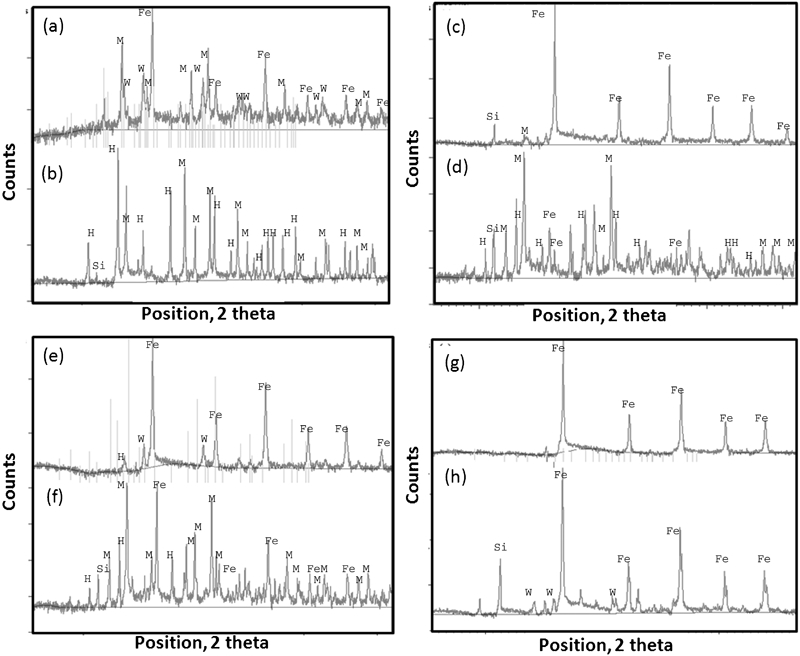
X-ray diffraction plots for haematite reduced by a hydrogen plasma, b hydrogen without plasma at 573 K, c hydrogen plasma, d hydrogen without plasma at 723 K, e hydrogen plasma, f hydrogen without plasma at 873 K, g hydrogen plasma and h hydrogen without plasma at 1073 K: Fe: iron; W: wüstite; M: magnetite; H: haematite; Si: silica
Reduction of haematite lumps by hydrogen plasma and hydrogen gas*
*Bracketed values represent reduction calculated from weight loss.
Intensity counts of principal peaks (in XRD) of various phases in product: reaction conditions are same as given in Table 2
*Total iron, FeM, is by wet chemical analysis.
Two more experiments were carried out: one with the passage of 42×10−3 m3 and the other with 14×10−3 m3 of hydrogen. In the first case, the experimental conditions were same as in serial no. 7 of Table 2 and in the second case the experimental conditions were that of serial no. 5 (Table 2). In these experiments, the reduction of haematite increased to 63 and 66% respectively. The XRD results in Fig. 5 support the observation as the peak heights of Fe3O4 and FeO reduced, and that of Fe peaks increased.
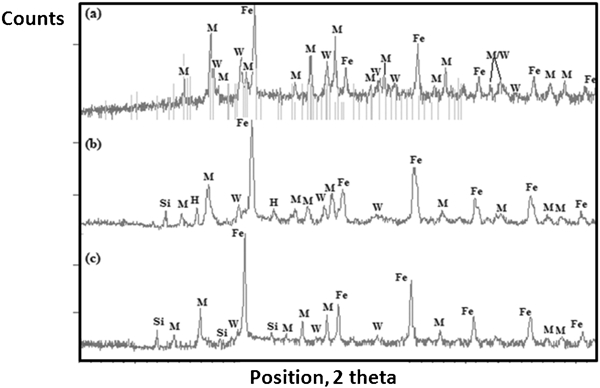
X-ray diffraction plots for haematite reduced by a hydrogen plasma with 6×10⁻³ m3 H2 flow at rate of 1·67×10−6 m3 s−1, b hydrogen plasma with 42×10−3 m3 H2 flow at rate of 1·67×10−6 m3 s−1 and c hydrogen plasma with 14×10−3 m3 H2 flow at rate of 3·33×10−6 m3 s−1, all at 573 K: Fe: iron; W: wüstite; M: magnetite; H: haematite; Si: silica
Effect of temperature
The temperature at which reduction takes place in the presence of hydrogen plasma is one of the major interests in this investigation. It may be noted that FeO phase is absent in the products obtained from the experiments conducted at 723 and 573 K in the absence of plasma (serials 6 and 8 in Table 3 and Fig. 4f and h ). In fact, FeO is unstable at these temperatures, i.e. <841 K (see Fig. 2). However, the reaction products obtained with plasma (serials 5 and 7 in Table 3 and Fig. 4e and g ) contain FeO phase. It should be noted that the stability of FeO is >841 K. Therefore, the effective temperature of hydrogen plasma, which is much higher compared to the surrounding temperature, must have been responsible for the formation of FeO. The temperature of the interface between hydrogen plasma and Fe2O3 is also expected to be higher than 841 K which favours the formation of FeO.
The following analysis shows the ineffectiveness of the interface temperature of the samples in the presence of plasma. Figure 6a presents the Arrhenius plot for the reduction process in the absence of plasma. Here, the percentage reductions reported in Table 2 have been used in place of reaction rate. Such an approach is reasonable, since the sample size of haematite lumps and the total hydrogen gas used in all the experiments fall in a close range. The activation energy of 45·78×103 J mol−1 is obtained from the Arrhenius plot. It is noted that the activation energy is the result of four possible reactions (4)–(7) that take place in sequence during the reduction process. For reduction of Fe2O3 to Fe, Piotrowski et al. 20 have reported activation energy of 23·9×103 J mol−1, whereas, Takahasi et al. 10 have reported values between 88×103 and 109×103 J mol−1. Valipour13 was more specific to record values of 92·09×103, 71·16×103 and 63·62×103 J mol−1 respectively, for the reactions (4)–(6). Pineau et al. 12 have recorded 76×103 J mol−1 for the reaction (4), whereas, two values of 88×103 and 39×103 J mol−1 have been observed for the reaction (7) for a temperature range, below and above 693 K respectively. The activation energy reported here may be considered closer to that reported by Piotrowski et al. 20 However, one important aspect about the reduction emerges when the data at these temperatures in the presence of plasma are plotted as shown in Fig. 6b . This plot flattens up to give a very small slope resulting in activation energy of 5·36×103 J mol−1. Therefore, it seems that the surrounding temperature has very little effect on the extent of reduction in the presence of plasma.
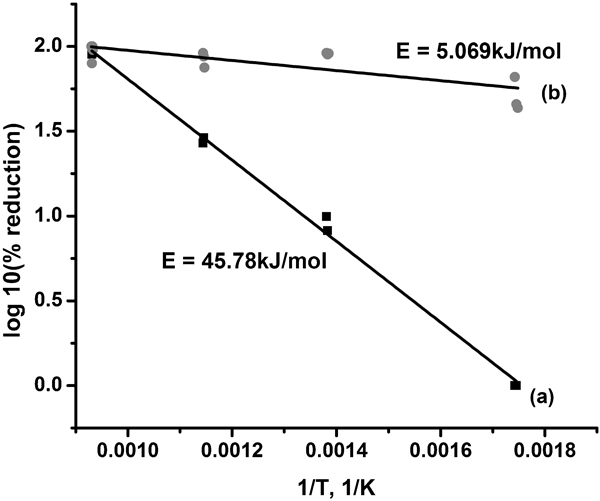
Arrhenius plot for reduction of haematite by H2 a without plasma and b with plasma
The experimental data reported in Table 2 at all temperatures are also linked to simultaneous variation of parameters such as microwave power, hydrogen flowrate and pressure. For this reason, four more experiments were conducted, varying the temperature while keeping these parameters constant. The results are presented in Table 4 and Fig. 7. As observed from these results, the extent of reduction improves substantially with the increase in temperature from 573 to 723 K, whereas, there is only marginal improvement in reduction with a further rise in temperature beyond 723 K. These data are also plotted in Fig. 4b which fit to the plot and does not make any significant change to the slope and hence to the activation energy. Therefore, it may be inferred that incorporation of plasma has probably reduced the effect of surrounding/interface temperature on the reduction process.
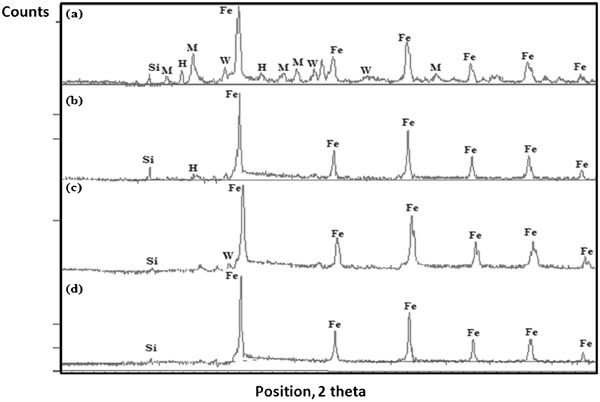
X-ray diffraction plots for haematite lumps reduced by hydrogen plasma at various temperatures: H2 flowrate: 3·33×10−6 m3 s−1; pressure: 6·67×103 Pa and microwave power: 750 W; Fe: iron; W: wüstite; M: magnetite; H: haematite; Si: silica
Effect of temperature on reduction of haematite lumps
*Pressure: 6·66×103 Pa, microwave power: 750 W. Bracketed values represent reduction calculated from weight loss.
Reduction kinetics
A series of experiments were conducted at 573 K for various time periods keeping all other parameters constant. This specific temperature was chosen because negligible reduction takes place (serial 8 in Table 2) with hydrogen in the absence of plasma at this temperature. The main purpose was to demonstrate the feasibility of reduction in the presence of plasma. In the experiment, the time was counted from the instant the glow discharge was visible. It is very likely that during the interim period some reaction might have taken place, so proper care was taken to record this data. In all the experiments for the kinetics study, compacted haematite pellets, as described in the experimental section, have been used in place of lumps. The results are presented in the form of mass balance in Table 5.
Reduction of compacted haematite pellets by hydrogen plasma at various time intervals
*Temperature: 573 K, microwave power: 750 W, pressure: 5·33×103 Pa, H2 flowrate: 3·33×10−6 m3 s−1. Bracketed values represent reduction calculated from weight loss.
The XRD data are presented in Fig. 8 as well as Table 6. The kinetic plot deduced from the experimental data is shown in Fig. 9. It may be noted that Table 7 can be placed over Fig. 9 so as to get a correlation of phases present at various stages of reduction. The following important observations have been made at 573 K:
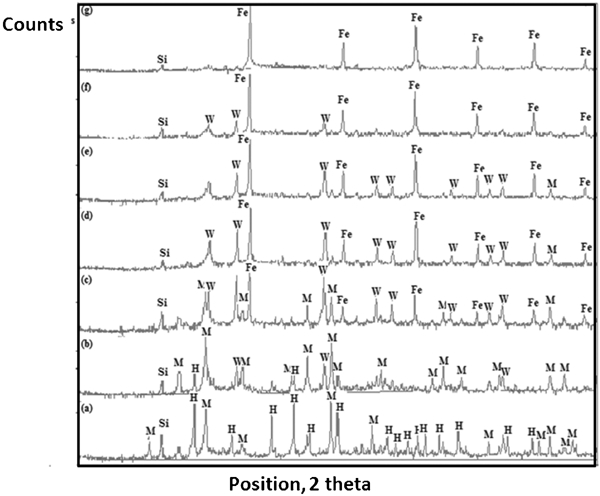
X-ray diffraction plots of haematite samples reduced by hydrogen plasma at various time: temperature: 573 K, H2 flowrate: 3·33×10−6 m3 s−1, microwave power: 750 W at 5·33×103 Pa; Fe: iron, W: wüstite, M: magnetite, H: haematite, Si: silica
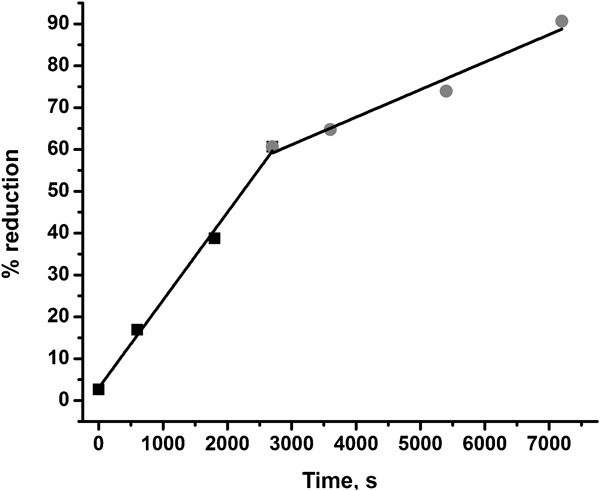
Kinetic plot for reduction of haematite with hydrogen plasma: temperature: 573 K, H2 flowrate: 3·33×10−6 m3 s−1, microwave power: 750 W at 5·33×103 Pa
Intensity counts of principal peaks (in XRD) of various phases in product
*Temperature: 573 K, microwave power: 750 W, pressure: 5·33×103 Pa, H2 flowrate: 3·33×10−6 m3 s−1. Metallic iron, FeM, is by wet chemical analysis.
Intensity count of various phases present after specific reaction time
*Temperature: 573 K, H2 flowrate: 3·33×10−6 m3 s−1, microwave power: 750 W at 5·33×103 Pa.
by the time the plasma struck, 2·64% reduction had taken place and at this instant the zero time was set. At this stage as observed from the XRD data, only Fe2O3 (IC of its principal peak is 1284) and Fe3O4 (IC of its principal peak is 925) were present. At 600 s, no metallic iron peak was seen, though all the three iron oxides dominated by magnetite were present
around 1800 s, Fe2O3 peaks were absent; only Fe and FeO peaks dominate the XRD spectra with some Fe3O4 peaks
after 2700 s, Fe2O3, Fe3O4 peaks were totally vanished, and only Fe peaks were present with few FeO peaks. Percentage reduction at this stage was 60·65%. With the passage of time amount of Fe increased with a decrease in FeO. The classical reduction sequence for haematite reduction is: Fe2O3→Fe3O4→FeO→Fe.
However, in the presence of plasma, two additional features with respect to the overall reduction can be noticed. First, even though FeO is not stable at 573 K, it prominently appears in the product as an intermediate stage. Second, the rate plot is linear up to 2700 s and then it deviates from linearity. During the later stage, only reaction (6) holds good for the reduction of FeO to Fe. Up to 2700 s, i.e. during the first linear region, the rate of reduction in terms of hydrogen consumed is calculated to be 2·97×1019 mol s−1. This rate is reduced to 0·938×1019 mol s−1 during the period 2700–7200 s. The rate of hydrogen supplied into the system is 8·963×1019 mol s−1, which is based on a total supply of 3·33×10−3 L s−1. It follows that the rate of hydrogen consumption in the reduction reaction during the first 2700 s is 33·13% of that supplied, which is reduced to 10·47% during the later period of 2700–7200 s. Interestingly, according to Fig. 2a it is not possible to produce metallic iron at 573 K with hydrogen partial pressure close to 1. This suggests molecular hydrogen alone is not responsible for the observed reduction of magnetite to metallic iron. In fact, in our experiments (serial 8 in Table 2) negligible reaction was observed at 573 K with hydrogen (without plasma) even after passage of 0·019 m3 of gas. Therefore, it is expected that the resultant reduction in presence of plasma at 573 K as reported above is due to some of the other hydrogen species generated during plasma processing.
It is already known that ionic hydrogen, atomic hydrogen, excited hydrogen molecules and other active species generated in hydrogen plasma can stimulate the reduction process.19 Since the formation of ionic hydrogen is known to be minimal at 573 K, could it be that atomic hydrogen is responsible for the observed reduction at 573 K? Sharda and Misra21 have estimated the rate of generation of atomic hydrogen in a similar microwave assisted plasma set-up. They have determined the characteristics of the microwave assisted hydrogen plasma such as the temperature T e and electron density n e. These values are 13·4×10−19 J and 7·2×1017 m−3 at 5·33×103 Pa respectively, which also pertain to the conditions of the present kinetic study. The rate of generation of atomic hydrogen from these data has also been estimated to be ∼1015 mol s−1. Therefore, atomic hydrogen generated in the system might have contributed to only ∼0·1% of the total reduction. Therefore, it is not the likely species to stimulate the reduction at a level of >1019 mol s−1. Ionic hydrogen generation rate is expected to be still lower than atomic hydrogen generation rate and hence is also ruled out to be the active species.
In addition to ionic and atomic species, the role of vibrationally excited H2 molecules has been also emphasised in the literature in the context of gas–solid reaction.19 ,22, 23 It has been reported that vibrationally excited hydrogen molecules stimulate the chemical processes through their surface dissociation and diffusion of hydrogen atoms into the crystal structure. Gabriel et al. 22 have highlighted that the excitation level of vibrationally as well as rotationally excited hydrogen molecules determine the rates of many gas phase processes. They have indicated that in a dc arc discharge torch, the vibrationally excited molecules inherit an internal energy up to 7·2×10−19 J, and the density of H2 with internal energies higher than 1·6×10−19 J can be of the order of 1019 mol. The recent communication by Mankelevich et al. 23 reports about microwave activation of H/C/Ar gas mixtures, which is relevant to the present investigation. They have listed the most important plasma assisted chemical reactions that determine the power density profiles, as well as the maximum electron density (n e≈3×10¹⁷ m−3) and gas temperature (T≈2930 K). According to the authors, nearly 66% of the power input is partitioned into vibrational excitation [H2 (v = 0) to H2 (v = 1)] with reaction rate of the order of 1026 mol m−3 s−1. The rotational excitation [H2 (J = 0) to H2 (J = 2)] which takes about 27% of the power input correspond to a reaction rate of the order of 1026 mol m−3 s−1. The experimental data of Mankelevich et al. 23 provide evidence to the presence of vibrationally excited H2 molecules, which matches with the observed reduction rate. Therefore, it is concluded that vibrationally excited H2 molecules are probably the species responsible for iron oxide reduction. Another alternate possibility may be the contribution of the atomic and ionic species of hydrogen plasma as a catalyst to drive iron ore reduction. Clearly more studies are required to obtain further insight with respect to reaction mechanism of the reduction process under H2 plasma at low temperatures.
Conclusions
Gaseous reduction of haematite ore in the presence and absence of plasma was studied. Hydrogen gas in the absence of plasma reduces haematite only at a relatively higher temperature. At ∼1073 K, the reduction is appreciable, whereas, it is negligible at 573 K. However, reduction of haematite in presence of microwave assisted non-thermal hydrogen plasma is highly effective at all temperatures. Experimental data coupled with the data available in the literature suggest that the vibrationally excited hydrogen molecules present in the plasma environment stimulates the reduction process at 573 K. The findings open up a new possibility to prepare DRI utilising H2 plasma.
Footnotes
Acknowledgements
The authors are thankful to Ministry of Steel, Government of India for the financial support.