







Abstract
A model is developed to estimate the viscosity of aluminosilicate melts containing CaF2, in which the influence of chemical composition is expressed by different types of oxygen ions and CaF2 clusters. In this study, CaF2 is assumed to have no effect on the relative amounts of different structures Q i (i = 0–4) (where the superscript refers to the number of bridging oxygen in a given structural unit), but only acts as a diluter. The viscosity model can be well applied to CaO–FeO–CaF2–SiO2, CaO–Al2O3–CaF2–SiO2, CaO–Na2O–CaF2–SiO2 and CaO–FeO–CaF2–Al2O3–SiO2 melts. From the isoviscosity curves of the CaO–CaF2–SiO2 system plotted by the present model, it can be concluded that the substitution of CaF2 for CaO makes the viscosity decrease in an acidic composition area but almost keeps constant in the basic composition area.
Introduction
CaF2 is utilised widely in the pyrometallurgy process for its strong ability of decreasing melting point, enhancing fluidity, controlling the crystallisation temperature of molten slag, etc. Therefore, research on the CaF2 slag is very important. The fluidity of molten slag evaluated by viscosity is considered to be a crucial physical property for controlling the metallurgical process operation. Therefore, accurate viscosity values are essential for the optimisation and improvement of smelting processes. However, obtaining data only by experimental measurements is time consuming and difficult because of the high volatilisation ability of CaF2 as well as the difficulties associated with high temperature operations. Consequently, there is an urgent need for a model to correlate the viscosity of CaF2 containing slag with temperature and chemical composition. Recently, the Riboud et al. model,1 optical basicity models,2, 3 the Iida et al. model4 and the Miyabayashi et al. model5 have been proposed to solve this problem. However, among these models:
the Riboud et al. model does not consider the non-linear behaviour of the activation energy of viscosity with chemical composition as well as the compensation effect between the logarithm of the pre-exponent factor and the activation energy in the Weymann expression6
the optical basicity models have narrow application ranges for the reason that many oxides are endowed with the same values of optical basicity
the Miyabayashi et al. model can only be applied to the system fulfilling the condition of mole fraction of CaO higher than that of CaF2.
Meanwhile, all these viscosity models cannot give a good estimation result for the slag system without SiO2.
In our previous papers,7 – 10 a structurally based viscosity model was derived, which considered the network structure of aluminosilicate melts based on definitions of different types of oxygen ions. The model has been applied to aluminosilicate melts involving Al2O3, SiO2, MgO, CaO, SrO, BaO, FeO, MnO, Li2O, Na2O and K2O components. In this study, the application range of the model is extended to aluminosilicate melts containing CaF2.
Influence of Caf2 on structure of aluminosilicate melts
In order to incorporate CaF2 into the viscosity model, its influence on the melt structure must be clear. The structure of aluminosilicate melts containing CaF2 has been studied using various types of spectroscopic measurements, such as infrared absorption spectroscopy,11 – 15 Raman spectroscopy,16 – 18 X-ray photoelectron spectroscopy15,19 – 21 and nuclear magnetic resonance spectroscopy,22 – 24 as well as molecular dynamic simulation.18, 25, 26 The conclusions derived from these literatures about the existence of CaF2 can be classified into three types:
F− ions mainly bond with Si4+ ions when the CaF2 content is low, but bonded with Ca2+ ions when the CaF2 content is high13, 14
in the case of low basicity, CaF2 participates into breaking bridging oxygen of silica and forming Si–F bonds, while in the case of high basicity, F− ions mainly coordinate with Ca2+ ions but do not contribute to the breakage of Si–O bridging oxygen15, 17
F− ions are mainly coordinated with Ca2+ ions in all the cases irrespective of the chemical composition of molten slags.
Recently, the third viewpoint has gained more and more evidences from spectroscopic data16, 19, 22, 23 and molecular dynamics simulation.18, 25, 26 However, even if only considering the Ca–F bond, there are still two structural models related to CaF2: the Baak–Bills model27, 28 and the Sasaki model.29 The schematic diagrams of these two models are given in Fig. 1.
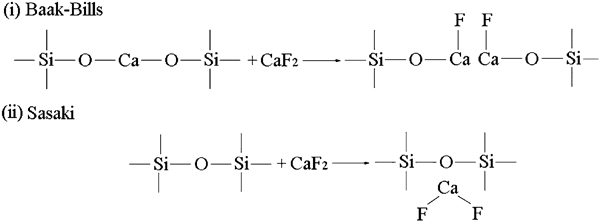
Schematic diagrams for Baak–Bills and Sasaki models
The Baak–Bill model may be effective only in the case of the mole fraction of CaO higher than that of CaF2 that also leads to the limitation of the model by Miyabayashi et al.,5 in which the Baak–Bill model is utilised to describe the influence of CaF2 on the melt structure. It is found by Hayakawa et al.
19 that Ca2+ and F− ions introduced as CaF2 are located favourably among the Si–O skeletons, forming Ca–F clusters, and cannot change the relative distribution of structural units Q
i, which have 4, 3, 2, 1 and 0 non-bridging oxygen per silicon, i.e. 


Model
The temperature dependence of viscosity is described by the Arrhenius law





In the denominator of equation (4), the first, second, third, fourth, fifth, sixth and seventh terms represent the contributions of bridging oxygen bonded with Si4+ ion, oxygen bonded with Al3+ ion not being charge compensated, bridging oxygen bonded with compensated Al3+ ion, non-bridging oxygen bonded with Si4+ion, non-bridging oxygen bonded with Al3+ ion, free oxygen bonded with cation of basic oxide and CaF2 respectively.
The parameters of the present model can be obtained as follows:
The values of parameters k
i, α
i and 
The values of parameters α
Al,i and 
parameter 
The parameters for SiO2, Al2O3, MgO, CaO, SrO, BaO, FeO, MnO, L2O, Na2O and K2O components have been optimised previously.7
–
10 In this study, only parameters 

Values of model parameters for different components


Value of model parameter


Results and discussion
CaO–FeO–CaF2–SiO2 system
The viscosity data of the CaO–CaF2–SiO2 system are taken from Yasukouchi et al.
30 and Shahbazian et al.
31 A small quantity of FeO present in the Shahbazian data is probably because of the use of iron spindle and iron crucible during viscosity measures. The viscosities of the CaO–FeO–CaF2–SiO2 system32,
33 with high content of FeO are also taken for the evaluation of the model. The comparisons between model estimated viscosities and those measured by experiments are shown in Fig. 2, with the mean deviation of 24·4% defined as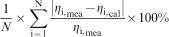
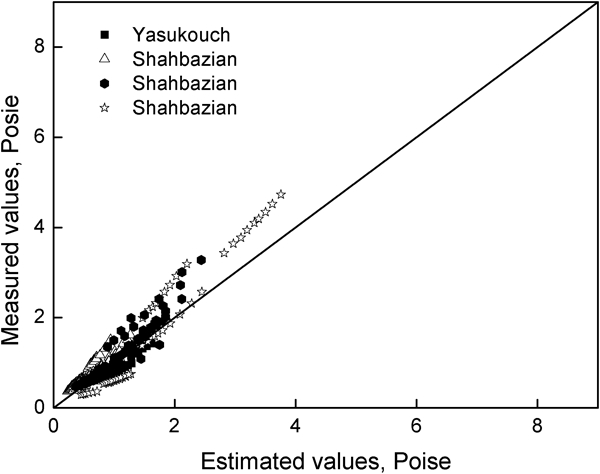
Comparisons between estimated and measured viscosity values for CaO–FeO–CaF2–SiO2 system
CaO–Al2O3–CaF2–SiO2 system
CaO, Al2O3, CaF2 and SiO2 are the main components of electroslag remelting slag, which possesses a quite high content of CaF2. The viscosity data of CaO–Al2O3–CaF2–SiO2 type electroslag remelting slag have been compiled by Mills.34 The calculated viscosities of this system using the present model with the parameters regressed in the CaO–FeO–Al2O3–SiO2 system and comparing with the measured values are shown in Fig. 3. The mean deviation for this system is 17·6%.
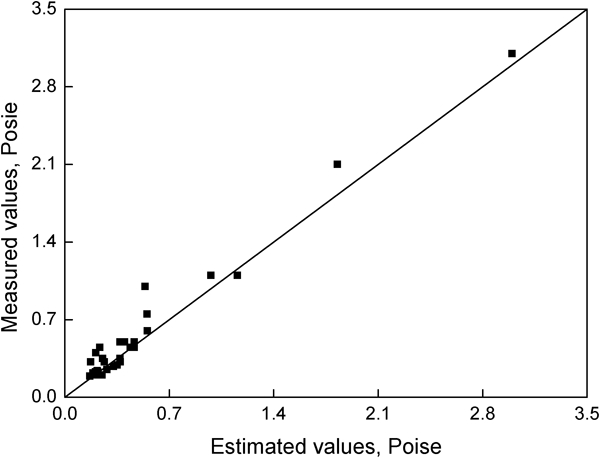
Comparisons between estimated and measured viscosity values for CaO–Al2O3–CaF2–SiO2 system
CaO–Na2O–CaF2–SiO2 system
The viscosities of four compositions in the CaO–Na2O–CaF2–SiO2 system were measured by Kim and Sohn.21 Although two basic oxides exist in this system, it has been pointed out that F− ions seem to be preferentially bonded to higher field strength modifier cations;22 thereby, Ca–F may still be considered as the main coordination type of F− ions. The assumptions that CaF2 acts as a diluter may not bring a large error in this system. Comparisons between the calculated and measured values are shown in Fig. 4, with the mean deviation of 24·3%.
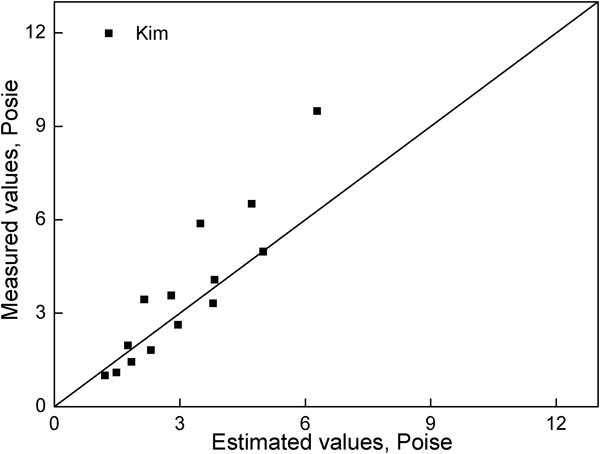
Comparisons between estimated and measured viscosity values for CaO–Na2O–CaF2–SiO2 system
CaO–FeO–CaF2–Al2O3–SiO2 system
The viscosity data of the CaO–FeO–CaF2–Al2O3–SiO2 system are taken from the experimental measurement of Shahbazian et al. 35 Comparisons between the estimated and measured values are shown in Fig. 5, with the mean deviation of 19·1%. In Fig. 5, both contents of FeO and SiO2 are equal to 0 for the points in the highlighted ellipse (or equivalent to the CaO–CaF2–Al2O3 ternary system). Thus, the present model can also obtain good results for the system without SiO2.
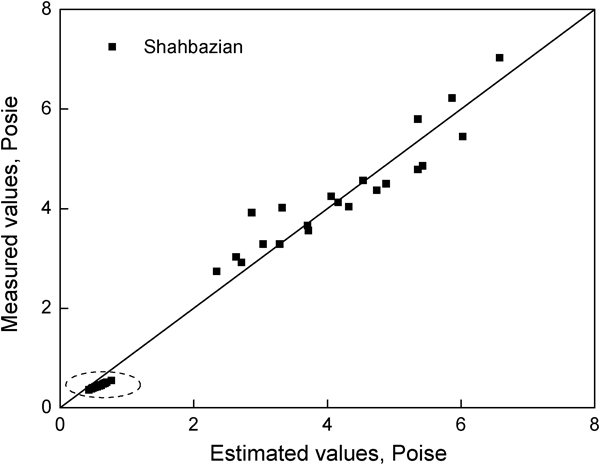
Comparisons between estimated and measured viscosity values for CaO–FeO–CaF2–Al2O3–SiO2 system
Discussion
In order to get a clear view of the influence of CaF2 on viscosity, the isoviscosity curves of the CaO–CaF2–SiO2 system at 1873 K obtained by the present model are given in Fig. 6. Two ways of CaF2 additions will be used to discuss its influence on viscosity: adding CaF2 to melts directly. When adding CaF2 to aluminosilicate melts, it can be seen from Fig. 6 that viscosity gradually decreases along the line from a particular point to the CaF2 vertex. Although Sasaki et al. 29 and Hayakawa et al. 19 assumed that the relative distribution of Q i (i = 0–4) units does not change, the addition of CaF2 decreases the absolute amounts of Q i units and provides lots of new cutoff points for the viscous flow. Thereby, a decreasing tendency may be anticipated when adding CaF2.
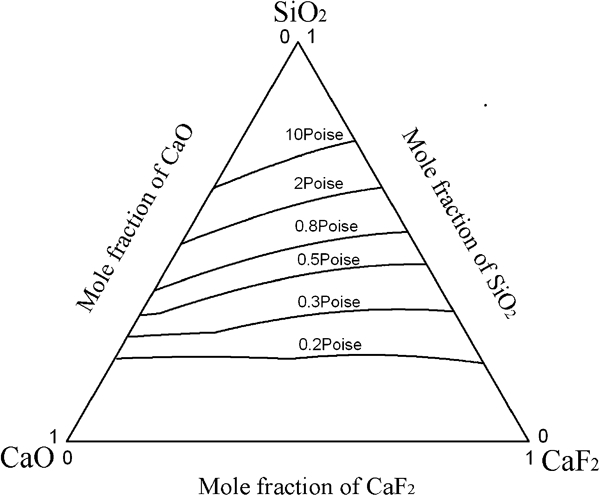
Isoviscosity curves of CaO–CaF2–SiO2 system at 1873 K
When substituting CaF2 for CaO, it can be seen from Fig. 6 that the viscosity decreases in an acidic composition area where the SiO2 content is high, but almost keeps constant in the basic composition area with high CaO content. The same conclusion was also obtained by Miyabayashi et al. 5 by using a neural network approach and Nakamoto et al.,36 who produced an isoviscosity map based on values from the literature. In the acidic composition area, Luth16 found that the substitution of CaF2 for CaO in a molten CaO–CaF2–SiO2 system enhanced the degree of polymerisation. Although this factor may increase viscosity, the introduction of new cutoff points due to the addition of CaF2 may be more important in the acidic range where the viscosity is very high, thereby a viscosity decrease occurs when replacing CaO by CaF2, whereas in the basic range, the aluminosilicate melt is mainly composed of polyanions with short chains, and the existence of lots of non-bridging oxygen and free oxygen leads to the small value and gent changing tendency of viscosity. Therefore, in this case, the viscosity will not be affected seriously. In general, viscosity is strongly dependent on the basicity in the acidic region, but not in the basic region.
Conclusions
A model to estimate the viscosity of aluminosilicate melts containing CaF2 is developed by considering different types of oxygen ions and CaF2 clusters as cutoff points during the viscous flow. In the model, two parameters are endowed to describe the influence of CaF2. The composition and temperature dependences of the viscosity for molten CaO–FeO–CaF2–SiO2, CaO–Al2O3–CaF2–SiO2, CaO–Na2O–CaF2–SiO2 and CaO–FeO–CaF2–Al2O3–SiO2 systems can be represented well by the present model.
Footnotes
Acknowledgements
The authors wish to thank the China Postdoctoral Science Foundation (2012M510318) and Chinese Natural Science Foundation (51174022) for their kind support.