







Abstract
The present paper focuses on the viscosity of high titanium containing slags in the process of titanomagnetite smelting by taking the TiO2–Al2O3–CaO–SiO2 quaternary system with TiO2 in the range from 23 to 43%, Al2O3 in the range from 3 to 12% and basicity (mass ratio of CaO/SiO2) in the range from 0·3 to 0·7 as the object. Experimental determinations of the viscosity were carried out in the temperature range from 1573 to 1873 K using the rotation cylinder method. The effects of TiO2, Al2O3, basicity and temperature on viscosity were studied. The experimental results indicated that the viscosity decreased with increasing TiO2 concentration and basicity, and increased with increasing Al2O3 concentration. Based on the experimental data of the TiO2–Al2O3–CaO–SiO2 quaternary system, a new viscosity model was proposed by modifying the Urbain model. The new model was applied successfully to predict the viscosity of TiO2–Al2O3–CaO–SiO2 and TiO2–Al2O3–CaO–SiO2–MgO systems in the fully liquid condition with high TiO2 concentration and low basicity over a wide range of composition and temperature using one set of model parameters.
Introduction
Titanium is the ninth most abundant element in the earth’s crust and the seventh most abundant metallic element. The titanium reserves in China accounts for one-third of the world total and mainly exists as titanomagnetite located in Panzhihua. 1,2 Currently, the titanomagnetite concentrates are smelted in the blast furnace, from which it is difficult to recover the titanium component. In order to make use of the titanomagnetite concentrates, a new process using a rotary hearth furnace–electric arc furnace process has been developed for recovering the iron, titanium and vanadium. 3 In comparison with blast furnace slag, the slag in the pellets used in the process is of low basicity (about 0·5) and high TiO2 concentration (35–40%). Over recent years, several researchers have reported the properties of the TiO2–Al2O3–CaO–SiO2 slag system, 4–9 most of whom investigated the slags with basicity 0·8–1·1 and the concentration of TiO2 <30%. However, the properties of high titanium concentration slag with low mass ratio of CaO to SiO2 have not been investigated to date. Viscosity is one of the key properties of industrial slags and is very sensitive to compositional and temperature changes. It is difficult to measure accurately, requires the use of sophisticated apparatus and is time consuming as well as expensive. In the last decades, various mathematical models have been developed by Urbain, 10 Riboud, 11 Zhang and Jahanshahi, 12 Iida et al., 13 Mills and Sridhar, 14 Ray and Pal, 15 Seetharaman and Du, 16 Nakamoto et al., 17 Shu 18 and Ghoshu et al. 19 to describe the viscosity of metallurgical, coal ash and geological silicate slags, but the accuracy to predict the slag with high TiO2 concentration and low basicity is not accessible.
In the present work, the viscosity of the TiO2–Al2O3–CaO–SiO2 system with TiO2 between 23 and 43%, Al2O3 between 3 and 12% and CaO/SiO2 between 0·3 and 0·7 is measured. Moreover, a new model based on these data is proposed. The new model has been applied successfully to predict viscosity of the TiO2–Al2O3–CaO–SiO2 and TiO2–Al2O3–CaO–SiO2–MgO systems in fully liquid with a wide range of temperature and slag composition using one set of model parameters.
Experimental
Apparatus for viscosity measurement
In the present work, viscosity was measured by the rotating cylinder method using a Brookfield digital viscometer. The experimental equipment for the viscosity measurement, which consists of a rotating system, a heating system and a measuring system, is shown in Fig. 1a . MoSi2 heating elements were used to ensure that the electric resistance furnace could be stabilised at 1873 K. The experimental temperature was controlled by two Pt–6%Rh&Pt–30%Rh thermocouples inserted into the furnace with an error less than ±1 K. The crucible and bob, both made of molybdenum, were employed for the viscosity measurement, and the dimensions of the crucible and the bob are shown in Fig. 1b . The viscometer was calibrated using standard silicone oil at 298±1 K.
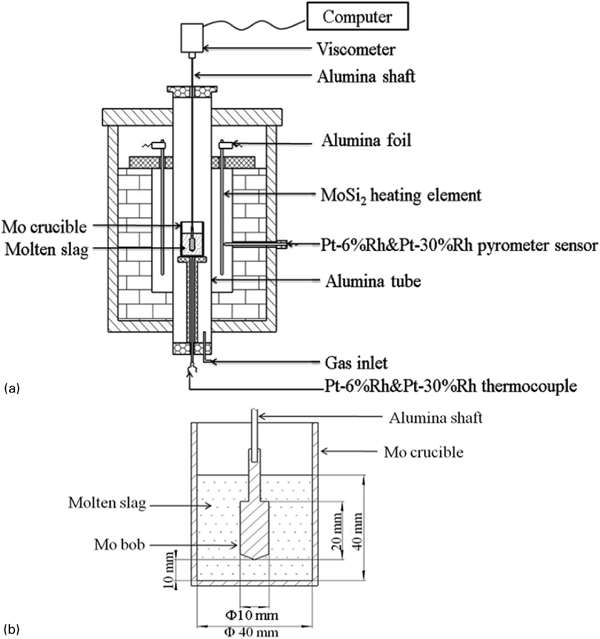
a viscometer; b dimension of crucible and bob
Sample preparation
The compositions of synthetic slags for viscosity measurement are listed in Table 1. The slags were prepared by mixing reagent grade oxides of SiO2, A12O3, TiO2 and CaO. The reagents were calcined at 1273 K in a muffle furnace under argon atmosphere to decompose any carbonate or hydroxide present, and then powders were mixed in an agate mortar with desired proportions. Then, the mixtures were packed in a molybdenum crucible and premelted in an induction furnace at 1873 K for 1 h. Once premelted, the slag was poured into a steel mould and cooled naturally under argon atmosphere. The obtained premelted slag was crushed into powder and used for viscosity measurement.
Slag composition for viscosity measurement/wt-%
Viscosity measurement
The molybdenum viscometer crucible, filled with 140 g of the prepared slag sample, was placed in the furnace and heated up to 1873 K under argon gas flowrate of 5 L min−1. After melting, the height of the slag is ∼40 mm. Then, the bob was lowered and kept at a distance of 10 mm above the crucible bottom. The crucible and bob were properly aligned along the axis of the viscometer. This is very important because a slight deviation from the axis can cause a big experimental error. The molten slag was held at 1873 K for 1 h, and then the viscosity value was measured.
The measurements were carried out at three different rates of rotation (100, 150 and 200 rev min−1) at each temperature, and the average of the measured values was adopted as the viscosity value at each temperature. At each rotational speed, the measurement time was 2 min. After each measurement, the temperature was lowered by 20 K and held for 10 min for the next measurement until the value of viscosity was beyond 4 Pa s. In order to estimate the reproducibility of the experimental results, selected slags, namely, Ti23, Al3 and R0·3, were chosen for repeat measurement, and the results shown in Fig. 2 illustrate good repeatability with an error <5%.
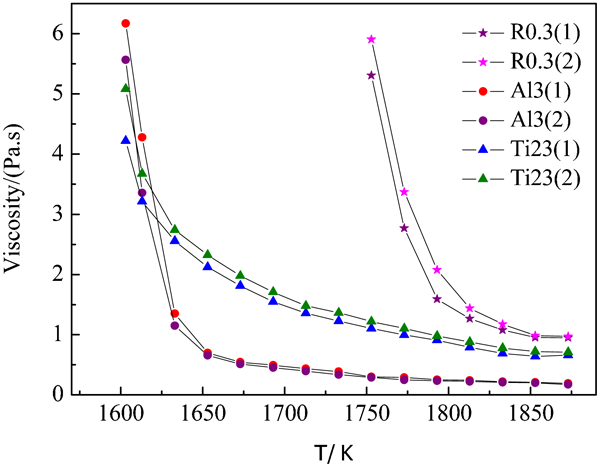
Repetitive experiments of Ti23, Al3 and R0·3
Results
The viscosity of 12 different slag compositions within the TiO2–Al2O3–CaO–SiO2 system were measured based on different levels of TiO2, Al2O3 and CaO/SiO2 ratio. The range of TiO2 was varied between 23 and 43%, Al2O3 was varied between 3 and 12% and the CaO/SiO2 between 0·3 and 0·7. The viscosity measurements were performed at a wide temperature range from 1873 K to the temperature at which viscosity was beyond 4 Pa s. The obtained viscosity values for each slag composition are shown in Table 2.
Measured viscosity
Effect of TiO2 on viscosity
Figure 3 shows the effect of TiO2 on the viscosity of the TiO2–Al2O3–CaO–SiO2 slags, and it shows that TiO2 decreased the slag viscosity at high temperature. According to the ionic theory of slag, the viscosity of slag depends on the complexity of Si–O ionic group. The more complex the Si–O structure, the greater the viscosity. The size of Si–O ionic group is determined by the oxygen/silicon ratio, and it is of the simplest structure with O/Si = 4. 20,21 The ionic radius of Ti4+ (0·68×10−10 m) is bigger than that of Si4+ (0·41×10−10 m), and the electrostatic potential of Ti4+(1·85 I) is smaller than that of Si4+(2·51 I), so the bond between Ti4+ and oxygen is weaker than that between Si4+ and oxygen. Therefore, the bond of oxygen will be weak with increasing concentration of Ti4+, leading to the depolymerisation of the oxygen ion. Moreover, Ti4+ is not the same as Si4+, which tends to form a complex anion group, contributing to the simpler structure with consequent decrease in the viscosity.
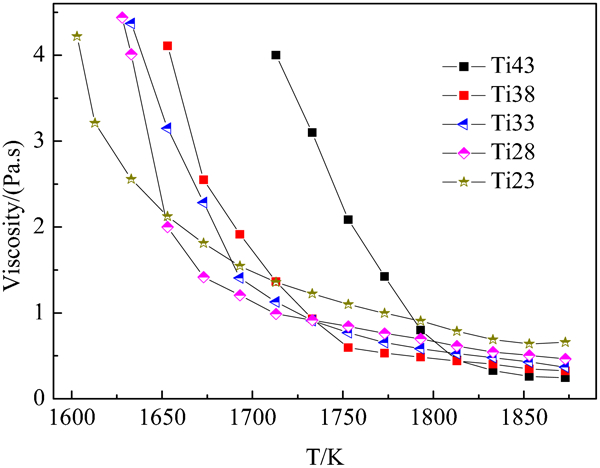
Effect of TiO2 on viscosity of TiO2–Al2O3–CaO–SiO2 slags
Effect of Al2O3 on viscosity
Figure 4 shows the effect of Al2O3 on the viscosity of the TiO2–Al2O3–CaO–SiO2 slags, and it shows that Al2O3 increased the slag viscosity. Generally, Al3+ is classified as intermediate in the (SiO4)4− network, because it either joins to the network or occupies the holes between the (SiO4)4− tetrahedron in the same way as Ca+ or Mg2+, which is according to the ratio of 



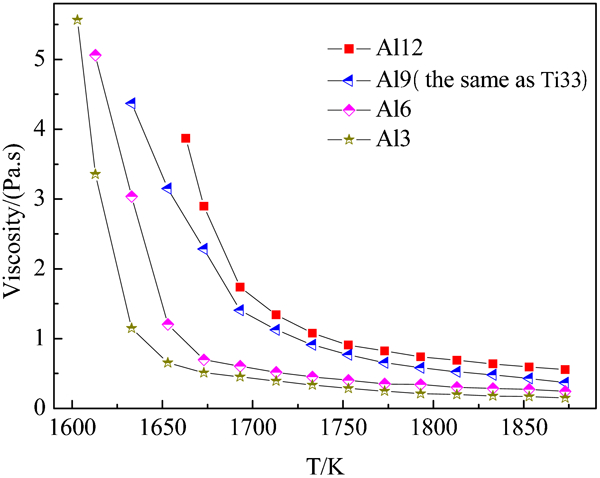
Effect of Al2O3 on viscosity of TiO2–Al2O3–CaO–SiO2 slags
Effect of basicity on viscosity
Figure 5 shows the effect of basicity (mass ratio of CaO/SiO2) on the viscosity of high titanium slag. It can be seen clearly from the figure that the viscosity decreased with increasing basicity. The viscosity of slag depends on the complexity of oxygen/silicon ratio. The increase in basicity can break oxygen bonds and improve the proportion of free oxygen O2− and the dissociated free oxygen O2−, leading to the increase in oxygen–silicon ratio. 24 Once the oxygen–silicon ratio increased, the connect type of the (SiO4)4− tetrahedral transforms from skeleton (O/Si = 2·16, R0·3) to layer, chain or ring (O/Si = 2·67, R0·7). The oxygen–silicon ion group shifting towards simpler structure leads to a decrease in the slag viscosity.
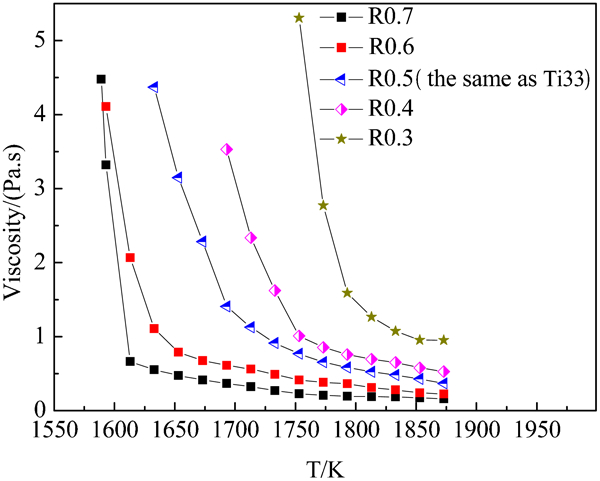
Effect of basicity on viscosity of TiO2–Al2O3–CaO–SiO2 slags
Effect of temperature on viscosities
It can be seen clearly that the viscosity of slags increases with temperature decreasing. Mills
23
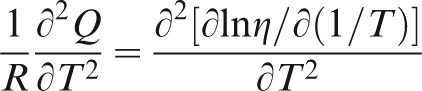
found that the activation energy Q would be expected to be constant at temperatures above the liquidus temperature, but Q will increase sharply in the vicinity of the liquidus temperature. This means that the first derivative of activation energy against temperature (∂Q/∂T) should show a corresponding change. Consequently, the second derivative ∂Q
2/∂T
2, as equation (1), should start from zero at high temperature and then decrease at the liquidus temperature. So, the temperature that the second derivative deviates sufficiently from zero is the liquidus temperature, T
L.
25
Considering viscosity measurement with the temperature interval 20 K, the error of the calculated liquidus temperature is ±10 K. R0·7 is taken as the example in Fig. 6
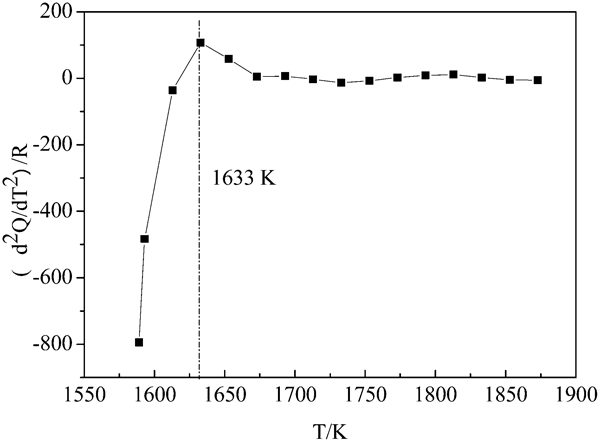
Second derivatives of activation energies for viscous flow with respect to temperature as functions of temperature for slag R0·7
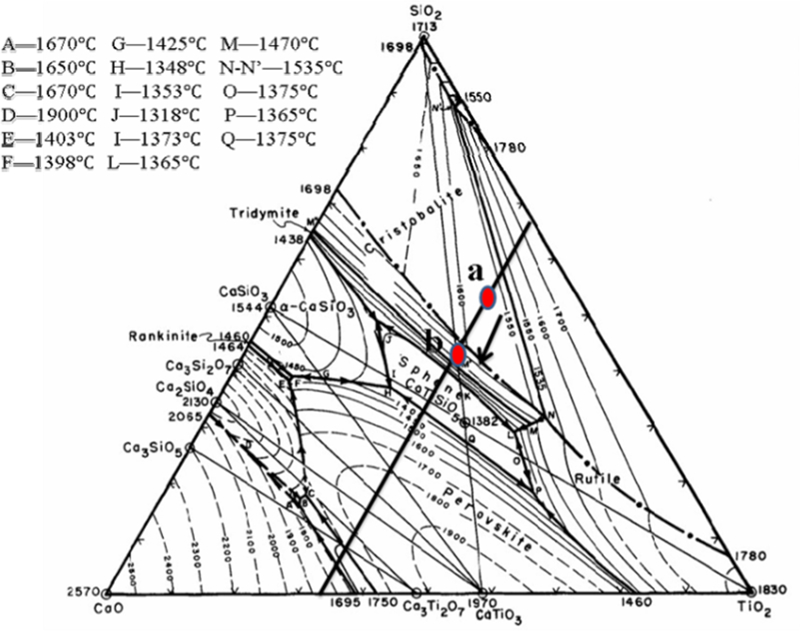
Liquidus surface and compatibility relations in CaO–SiO2–TiO2 system
Liquidus temperatures calculated from viscosity
Viscosity model
Classification of TiO2
Considering the complexity of TiO2, there is no unified view of classifying TiO2 to acid oxide or basic oxide. In this paper, the method 27 based on ion theory is used to classify the properties of TiO2 by calculating the sulphur partition coefficient of the slag in the electric furnace melting process (Table 4), providing a solid foundation for the model building.
High titanium slag composition in electric furnace melting process of vanadium–titanium magnetite (per 100 g)
TiO2 is classified as acid oxide
According to the phase diagram of TiO2–Al2O3–CaO–SiO2 system and subsystems, it is known that SiO2, Al2O3 and TiO2 exist in the form of 
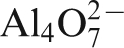
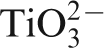




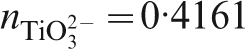






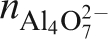

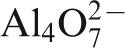
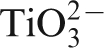


For slags in present paper, the following is obvious




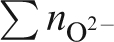
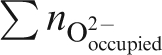


For the acid slag, the following equations exist based on the studies of desulphurising powers of the slag with high SiO2 concentration (SiO2 concentration >30%) and low basicity
28
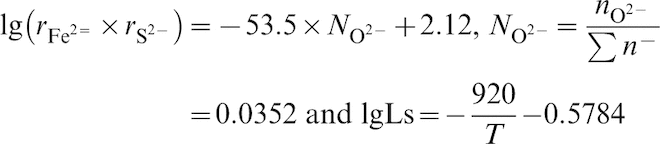


Considering that the concentration of impurity is very low, it can be ignored, except for carbon [%C] = 6. So the sulphur activity coefficient can be calculated as 


Based on the above, the sulphur partition coefficient
29
is calculated as
TiO2 is classified as basic oxide
If TiO2 is classified as basic oxide, 1 mol TiO2 will provide 1 mol Ti4+ and 2 mol O2−. The forms of SiO2 and Al2O3 act the same way as above. In this case, the following calculations exist.




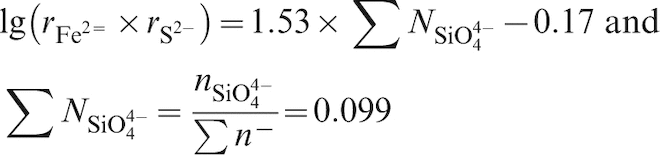
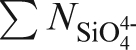

Based on the above, the sulphur partition coefficient is calculated as follows
Model building
The present paper uses a modified Urbain method.
10,31–33
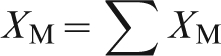
The new model further modifies the formalism developed by Urbain in order to describe viscosity behaviour of fully liquid slags over a wide range of composition with high TiO2 concentration and low basicity. Three classes of oxides, named glass formers, modifiers and amphoterics, are introduced in the Urbain model. Considering that there are no corresponding parameters for high TiO2 slag system, the new model extends the Urbain model, reclassifies the oxides and redefines viscous activation energy B, a function of composition calculated by the three classes of oxides




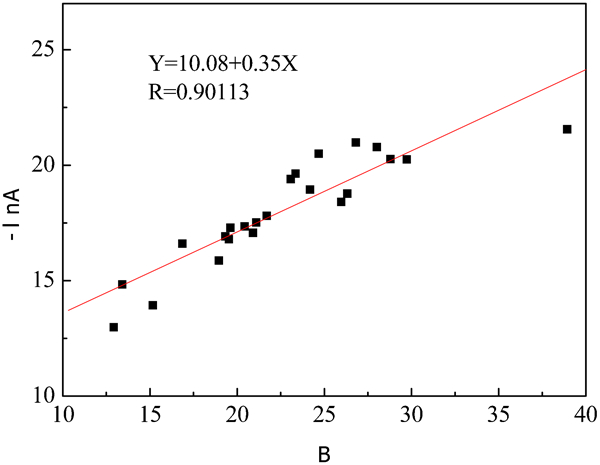
Relationship between –ln A and B
Model parameters
The differences between the experimental data and the estimation by the Urbain model, NPL model and the new model are compared in Fig. 9. It is obvious that the new model provides reasonable estimation of the viscosity for a wide range of slag composition. The uncertainties in estimation with the new model (the deviation being round 11%) are less than those in estimation obtained with the Urbain (the deviation being round 43%) and the NPL (the deviation being round 57%) models.
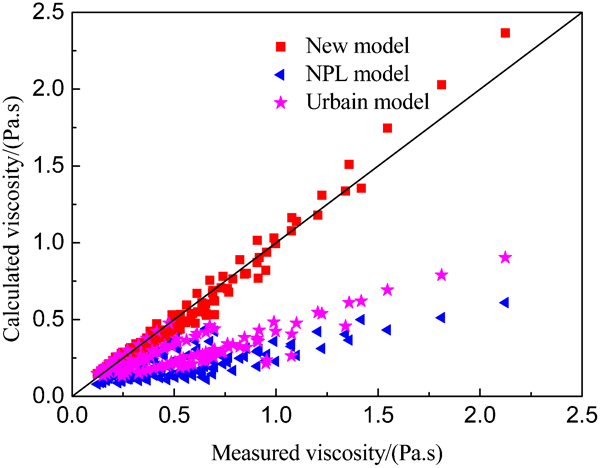
Comparison of experimental data and date predicted by new model, NPL model and Urbain model
Viscous activation energy of pure oxides
Owing to the high melting point of pure SiO2, Al2O3 and CaO, their viscous activation energies are not accessible to measurement, and the activation energy of pure SiO2, Al2O3 and CaO can be obtained from the new model by the extrapolation of B. The extrapolated values of B in Table 6 are in good agreement with the theoretical values given by the Urbain model through extrapolating the value of B obtained from binaries and by Bockris and Reddy 34 using the ‘hole’ method.
Viscous activation energy
Viscosity prediction
Good agreement was achieved between the new model and the experimental data of the TiO2–Al2O3–CaO–SiO2 quaternary system in fully liquid over wide composition ranges. To widen the use to a multisystem, the new model using one set of parameters was applied to the TiO2–Al2O3–CaO–SiO2–MgO quinary system with low basicity and high TiO2 concentration. Considering the locking of the data of TiO2–Al2O3–CaO–SiO2–MgO quinary system with high TiO2 concentration and low basicity, the chemical compositions of the slags in Table 7 were studied in the fully liquid condition. Figure 10 shows the effect of MgO on the viscosity of the TiO2–Al2O3–CaO–SiO2–MgO slags.
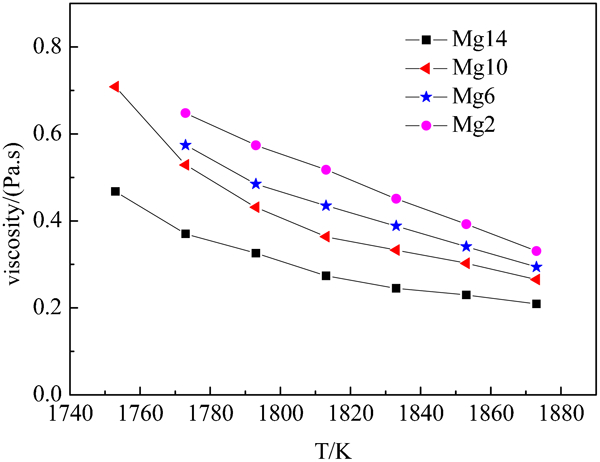
Viscosity experiments of TiO2–Al2O3–CaO–SiO2–MgO quinary system
Slag composition for viscosity experiments of TiO2–Al2O3–CaO–SiO2–MgO quinary system/wt-%
The calculated results are shown as a function of the experimental viscosity values in Fig. 11. It can be seen that the new model provides a reasonable prediction, the deviation being ∼20%. The values predicted by the Urbain (the deviation being ∼72%) and NPL (the deviation being ∼106%) models are also shown in Fig. 11. It can be seen that the results calculated by the new model are better than those by Urbain and NPL models. Thus, it is appropriate to apply the new model to predict the viscosity in the fully liquid of TiO2–Al2O3–CaO–SiO2–MgO quinary system with low basicity and high TiO2 concentration, and the concentration of MgO ranges from 0 to 14%.
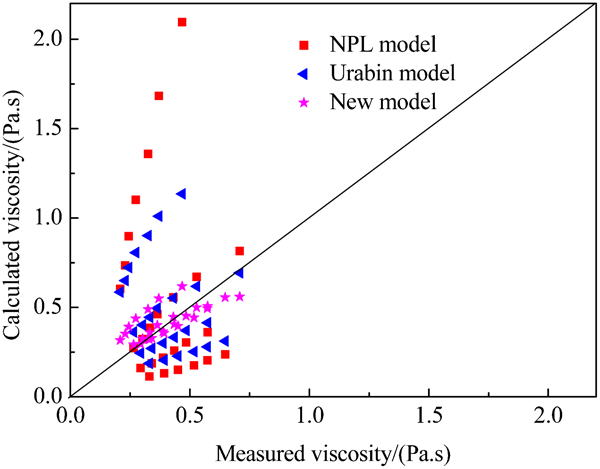
Comparison of experimental data about TiO2–Al2O3–CaO–SiO2–MgO quinary system and date predicted by new model, NPL model and Urbain model
Conclusions
The viscosity of the TiO2–Al2O3–CaO–SiO2 system with TiO2 between 23 and 43%, Al2O3 between 3 and 12%, and CaO/SiO2 between 0·3 and 0·7 was measured at temperatures ranging from 1573 to 1873 K. The viscosity decreased with increasing TiO2 concentration and basicity, and increased with increasing Al2O3 concentration.
The new model further modified the formalism developed by Urbain and was applied successfully to describe the viscosity behaviour of TiO2–Al2O3–CaO–SiO2 and TiO2–Al2O3–CaO–MgO–SiO2 systems in the fully liquid condition with the low basicity and high TiO2 concentration over a wide range of composition and temperature using one set of parameters.
The activation energies of pure SiO2, Al2O3 and CaO obtained from the new model by the extrapolation of B are 64·3, 10·67 and 9·57 kJ mol−1 respectively.
Footnotes
Acknowledgement
The authors gratefully acknowledge the support of the National Natural Science Foundation of China (grant no. 51090381).