







Abstract
Applying the fluxing method, hypercooling was achieved in Co80Pd20 alloys. After recalescence, the rapidly solidified microstructures of hypercooled Co80Pd20 alloys were subjected to rapid quenching. Applying transmission electron microscopy, high densities of substructures, e.g. dislocations and subgrains, and migration of high angle grain boundaries suggest the occurrence of partial recrystallisation in the hypercooled Co80Pd20 alloys.
Introduction
Grain refinement has been an interesting phenomenon extensively studied in undercooled metallic melts.1–6 Previous studies suggest two grain refinement events taking place at low and high undercoolings of undercooled metallic melts;2 it has been widely accepted that the grain refinement at low undercooling is induced by remelting of dendrites in post-recalescence.2–8 However, the mechanism of grain refinement at high undercooling is still a matter of debate. Several mechanisms have been proposed for explaining the grain refinement at high undercooling, such as dendrites breakup owing to remelting upon recalescence,7 stress induced recrystallisation,9–18 etc.
As is known, if hypercooling is achieved in solidification, the whole alloy melt will completely solidify during rapid recalescence,19 and the remelting effect will not work, since no remaining liquid exists.19–21 Consequently, it is proposed that the grain refinement at high undercooling should be ascribed to the recrystallisation mechanism.2–4 Upon rapid solidification, the rapid liquid–solid transformation leads to sharp volume shrinkage, thus giving solidification stress.2 The substantial stress originating from rapid solidification can surmount the yielding stress of the solidified skeleton and leads to plastic deformation in the as solidified structure.13 Subsequently, the stored energy due to plastic deformation provides driving force for the recrystallisation occurring after rapid recalescence. On this basis, the recrystallisation process after recalescence can be inhibited subjected to rapid quenching after rapid solidification, so that the stored energy accumulated in the as solidified structure can be preserved, e.g. in the form of lattice defects. Different stages of recrystallisation, i.e. nucleation and growth, can be expected to be observed in the rapidly solidified structures through quenching. This is the main topic of the present work.
Experimental
The completely miscible binary single phase Co–Pd alloy exhibits a rather low enthalpy of fusion and a narrow liquidus–solidus interval.16–19 Therefore, the hypercooling limit of this alloy system is relatively low and in the order of 300 K,18 which can be easily achieved at a reduced extent of undercooling ΔT.17 In the present work, the alloy Co80Pd20 was selected as the experimental alloy system.
Samples weighing ∼5 g were prepared by in situ melting pure Co pieces (99·9 purity) and pure Pd pieces (99·95 purity) under the protection of Ar. Afterwards, a high purity quartz crucible containing an alloy sample and 1·5 g dehydrated B2O3 was placed in the centre of an induction coil. The melting process was conducted in a vacuum chamber. The vacuum chamber was first evacuated to a pressure of 2×10⁻³ Pa, and then ultrapure Ar was back filled into the chamber until the pressure of the chamber reaches 0·05 Pa. The alloy was melted and cooled in the chamber cyclically until a desired undercooling was achieved. The temperature of the sample was monitored by an infrared pyrometer with an accuracy of ±5 K and response time of 10 ms. In order to investigate the recrystallisation mechanism of the grain refinement, hypercooled specimens were quenched rapidly into Ga–In liquid alloy after recalescence. The microstructures were observed by transmission electron microscopy (TEM). The TEM images were obtained using a cathode field emission high resolution TEM (Technai F30 G2 300 kV). The TEM specimens were prepared by the standard procedure of mechanical grinding and ion milling.
Results and discussion
The undercooling experiments of Co80Pd20 alloy show that if ΔT exceeds 265 K, the post-recalescence period vanishes in the measured temperature profile. This indicates that hypercooling has been achieved in the specimen with ΔT>265 K (see Fig. 1). In order to inhibit recrystallisation, quenching was carried out immediately after rapid recalescence (see Fig. 2). Owing to the rapid cooling, the recrystallisation in the specimen can be largely inhibited. Figure 3a and b particularly shows the equiaxed grain structure decorated with annealing twins for as solidified Co80Pd20 alloy with ΔT = 340 K without and with rapid quenching after recalescence respectively. Obviously, the grain size in the quenched specimen is coarser than that in the naturally cooled specimen, which is probably ascribed to the inhibited recrystallisation in the quenched specimen (see the section on ‘Introduction’).
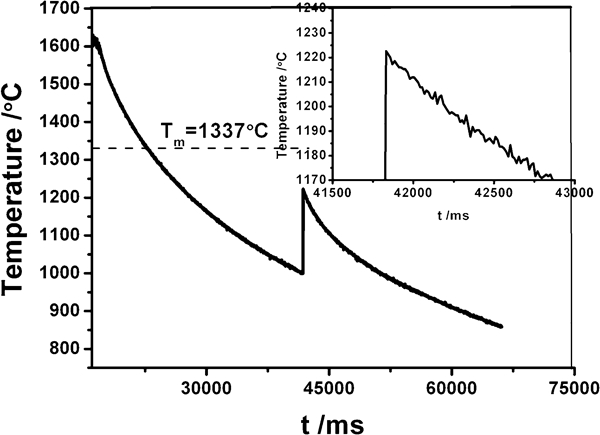
Cooling–recalescence curves of Co80Pd20 alloys undercooled by 340 K: inset shows magnified recalescence peaks
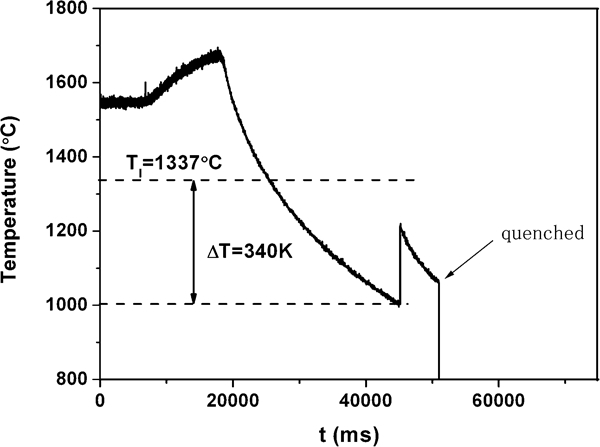
Cooling–recalescence curves of Co80Pd20 alloy undercooled by 340 K quenched after recalescence
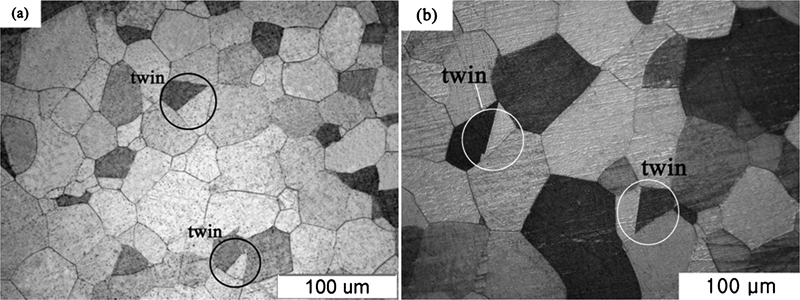
a, b optical metallograghs of microstructures of as solidified Co80Pd20 alloys naturally cooled and quenched respectively with same ΔT = 340 K
Recrystallisation is defined as the formation of a relatively defect free structure at the expense of the deformed matrix, whose driving force is the stored energy in the plastically deformed matrix, in the form of lattice defects, i.e. dislocations.22 Applying TEM, a partially recrystallised structure in the hypercooled specimens can be illuminated. Figure 4a shows the partially recrystallised structure in the quenched specimen, consisting of a highly defective grain (deformed matrix in the left side of Fig. 4a), a defect free grain [recrystallised grain circled by selected area electron diffraction (SAED) in the right side of Fig. 4a] and a grain boundary (GB) between the two adjacent grains. The electron diffraction pattern of the recrystallised region shows that the alloy has a fcc structure (see Fig. 4b). The above results suggest that the rapidly solidified structure of the quenched alloy partially recrystallises after recalescence; the partially recrystallised structure is preserved by rapid quenching.
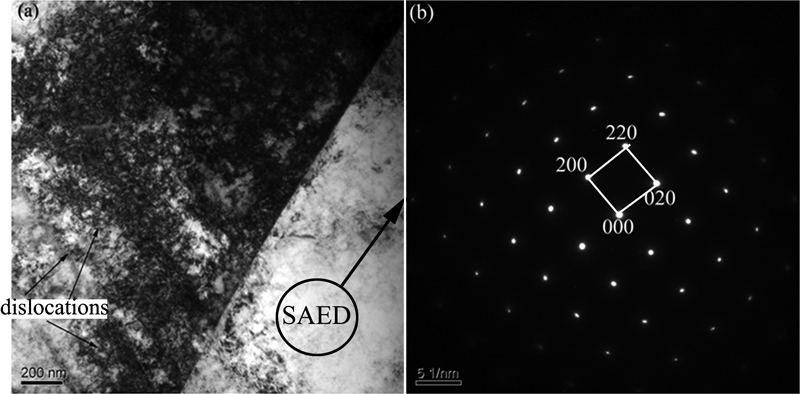
a bright field TEM image showing growth stage of recrystallisation in hypercooled Co80Pd20 alloys with ΔT = 300 K quenched 1 s after recalescence (grain boundaries with high densities of lattice defects in their vicinities) and b SAED pattern of circled area in a taken along specific zone axis orientation [0 0 1]
The nucleation stage of recrystallisation corresponds to the formation of sub-GB,23–24 where the misorientation of sub-GB increases until a high angle GB is formed.23–24 If the sub-GB/GB transition is frozen by rapid quenching, many lattice defects as well as low angle GBs should be preserved in the microstructure. On this basis, the rapidly solidified Co80Pd20 alloy just after recalescence undergoes the nucleation stage of recrystallisation, where the lattice defects in the alloy rearrange themselves to form low angle GBs. If rapid quenching is performed, this particular stage can be preserved (see Fig. 5). Owing to the low misorientation, the two adjoining subgrains in Fig. 5a separated by the low angle GB have the same diffraction spots (Fig. 5b), where the SAED pattern of the grain in the right side of the low angle GB is indexed by the lattice planes of (2 0 0), (1 1 1) and (3 1 1), whereas the grain in the left side of the low angle GB is indexed by the lattice planes of (2 0 0), (1 1 1) and (3 1 1) as well.

a bright field TEM image showing nucleation stage of recrystallisation in hypercooled Co80Pd20 alloy quenched 1 s after recalescence with ΔT = 300 K (low angle GB and two adjoining subgrains) and b SAED pattern of circled area in b taken along specific zone axis orientation [0 1
]
Different from the nucleation stage, the growth stage of recrystallisation corresponds to the migration of high angle GBs. If the growth stage of recrystallisation is frozen by rapid quenching, many lattice defects as well as high angle GBs should be preserved in the microstructure. Analogously, the rapidly solidified Co80Pd20 alloy after recalescence undergoes the growth stage of recrystallisation, where low angle GBs evolve to form high angle GBs (see Fig. 6a). Owing to the high angle misorientation, the two adjoining grains in Fig. 6a separated by the high angle GB have different diffraction spots (Fig. 6b), where the SAED pattern of the grain in the right side of the high angle GB is indexed by the lattice planes of (1  1), (2 2 0) and (3 1 1), whereas the grain in the left side of the high angle GB is indexed by the lattice planes of (2 0 0), (2 2 0) and (0 2 0). Furthermore, the densities of dislocation in the two grains separated by the migrating grain boundaries upon recrystallisation are remarkably different (see Figs. 4a and 6a and c). Once the recrystallisation is completed, the high angle GBs impinge, and meanwhile, the densities of dislocation in the two grains separated by high angle GBs will display almost no difference, where a fully recrystallised structure with low density of dislocation on both sides of the GBs will be formed.
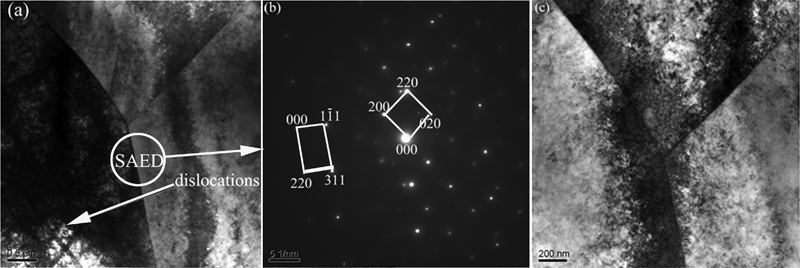
a bright field TEM image showing two adjoining grains and high angle GB between them in hypercooled Co80Pd20 alloy quenched 1 s after recalescence with ΔT = 300 K, b corresponding SAED pattern of circled region on GB in a taken along specific zone axis orientation [0 0 1] and c partially recrystallised structure consisting of three adjoining grains and grain boundaries among them
Partial recrystallisation in the hypercooled specimen is observed by TEM. The results reveal a partially recrystallised microstructure in the rapidly solidified structure of hypercooled Co80Pd20 alloys. These results confirm the recrystallisation occurring during the grain refinement process after rapid solidification of the hypercooled Co80P20 alloy.
Conclusions
In summary, hypercooling was achieved in Co80Pd20 alloys. After recalescence, the rapidly solidified microstructures of hypercooled Co80Pd20 alloys are subjected to rapid quenching. Owing to rapid cooling, partial recrystallisation structures in the rapidly solidified structure are observed; high densities of substructures, e.g. dislocations and subgrains, and migration of high angle GBs are also observed in the rapidly solidified structure. These results suggest the occurrence of partial recrystallisation in the hypercooled Co80Pd20 alloys. Therefore, it can be inferred that recrystallisation occurs during the grain refinement process happening after rapid solidification of the hypercooled Co80P20 alloy.
Footnotes
Acknowledgements
The authors are grateful to the financial support of the Free Research Fund of State Key Laboratory of Solidification Processing (09-QZ-2008 and 24-TZ-2009), the Natural Science Foundation of China (51071127 and 51134011), the Fundamental Research Fund of Northwestern Polytechnical University (JC200801), China National Funds for Distinguished Young Scientists (51125002) and National Basic Research Program of China (973 Program, 2011CB610403), and the 111 project B08040.