







Abstract
Applying fluxing method, Co80Pd20 alloy melts were undercooled up to 340 K. Evolution of the solidification microstructure of the undercooled alloys was investigated. Within the range of the achieved undercooling (ΔT), two grain refinement events were observed. The first event happens in the range of 50 K<ΔT<265 K, while the second event takes place at ΔT>280 K. Based on experimental investigations and theoretical calculations, the mechanisms of grain refinements were illuminated. The first grain refinement event is induced by the remelting effects involved in the post-recalescence period, resulting in the formation of a spherical grained microstructure. In the narrow transition range of 265 K<ΔT<280 K, the microstructure is occupied by a mixture of coarse dendrites with equiaxed grains. When ΔT is higher than 280 K, which is rather above the hypercooling limit, recrystallisation of the rapidly solidified solid happens and leads to the formation of an equiaxed grained microstructure.
Introduction
Evolution of the solidification microstructure of undercooled metals has been extensively investigated for many years.1,2 Grain refinement as an interesting phenomenon of undercooled metals has aroused much attention.3–7 A number of models were proposed to explain the grain refinement occurring when the initial undercooling of a melt (ΔT) exceeds a critical value, such as copious homogeneous nucleation induced by the pressure pulse generated from the collapse of shrinkage cavities,8 remelting of dendrite skeleton by chemical superheating,7 dendrite breakup driven by the instability of solid/liquid interface in post-recalescence period9 and stress induced recrystallisation.10–14 So far, it seems to be widely accepted that the grain refinement happening at a range of relatively low ΔT is caused by the remelting effect during a post-recalescence period, e.g. the effect of chemical superheating7 and the effect of dendrite breakup driven by the solid/liquid surface tension induced structural instability, as suggested by Karma;15 for the grain refinement occurring at a range of relatively high ΔT, the corresponding mechanism is still in controversy. For example, for Ni–Cu systems, some authors believed that both of the two grain refinement events can be ascribed to the remelting effect during a post-recalescence period on the dendrite skeleton formed during recalescence,16,17 while others suggested that a stress induced recrystallisation should be responsible for the grain refinement in the range of high ΔT.4,18 If an alloy is hypercooled, the whole alloy melt will solidify after recalescence, and the post-recalescence period will disappear. As a consequence, the remelting effect involved in the post-recalescence period will not influence the microstructure formation in the hypercooled alloy. Then, there will be an opportunity to testify whether the dendrite remelting or the stress induced recrystallisation can be responsible for the grain refinement at high ΔT.
Single phase Co–Pd alloy system has a low enthalpy of fusion and a narrow liquidus–solidus interval.19 The hypercooling limit of this alloy system is relatively low and in the order of 300 K,19 which can be easily reached at a reduced extent of ΔT.20 Therefore, this system can be a suitable model system to clarify the mechanisms of grain refinements in single phase alloy systems. Since when the alloy is hypercooled, the remelting effect involved in the post-recalescence period will be excluded. Previous investigations on the undercooled Co–Pd alloys focused mainly on the hypercooling behaviour and the paramagnetic–ferromagnetic transition at Curie temperature,21,22 but the microstructure evolution of these alloys as a function of ΔT has not been systematically reported yet.
In the present work, Co80Pd20 alloy was selected as a model alloy and was undercooled by fluxing method. The maximum undercooling up to 340 K was achieved. The evolution of solidification structures was systematically investigated. The formation mechanisms of the solidification structures were investigated in detail.
Experimental
Alloy specimens, each weighing ∼5 g, were prepared by in situ melting pure Co pieces (99·9 purity) and pure Pd pieces (99·95 purity) under the protection of Ar. Afterwards, a high purity quartz crucible containing an alloy specimen and ∼1·5 g dehydrated B2O3 was placed in the centre of an induction coil. The melting process was conducted in a vacuum chamber. The vacuum chamber was first evacuated to a pressure of 2×10⁻³ Pa, and then ultrapure Ar was backfilled into the chamber until the pressure of the chamber reached 0·05 Pa. The alloy was melted and cooled in the chamber cyclically until a desired undercooling was achieved. The temperature of the specimen was monitored by an infrared pyrometer with an accuracy of ± 5 K and a response time of 10 ms. In order to investigate the recrystallisation mechanism of grain refinement, some hypercooled specimens were quenched rapidly into Ga–In liquid alloy after recalescence. The as solidified microstructures were revealed by etching the polished specimens with a mixture of nitric acid water solution (30 mL HCl+10 mL HNO3+40 mL H2O). Then, the microstructures were observed by optical microscopy (Olympus GX71). The microstructures were further studied using transmission electron microscopy (TEM, Technai F30 G2, 300 kV) in order to show the morphologies of the substructures, e.g. dislocations. The TEM specimens were prepared by the standard procedures of mechanical grinding and ion milling.
Results and discussion
Recalescence characteristics and achievement of hypercooling in Co80Pd20 alloy melts
Three typical temperature profiles corresponding to the solidification of Co80Pd20 alloy melts in different undercooling regimes are shown in Fig. 1. It was found that when ΔT<265 K, the post-recalescence period presents in the temperature profiles, as seen in the plateau marked by the plateau duration time (Δtpl) in Fig. 1a. The plateau duration time Δtpl is the time required for the residual liquid to transform into solid after recalescence. Δtpl can be obtained by subtracting the time point of recalescence from the time point at which the first derivative of cooling curve after recalescence abruptly changes. When ΔT reaches 265 K, the post-recalescence period does not appear, and the maximum recalescence temperature is lower than the solidus temperature of this alloy (see Fig. 1b and c). Since the post-recalescence period will only vanish when the hypercooling limit of a metal is reached,1 the hypercooling limit of the Co80Pd20 alloy can be determined as 265 K.
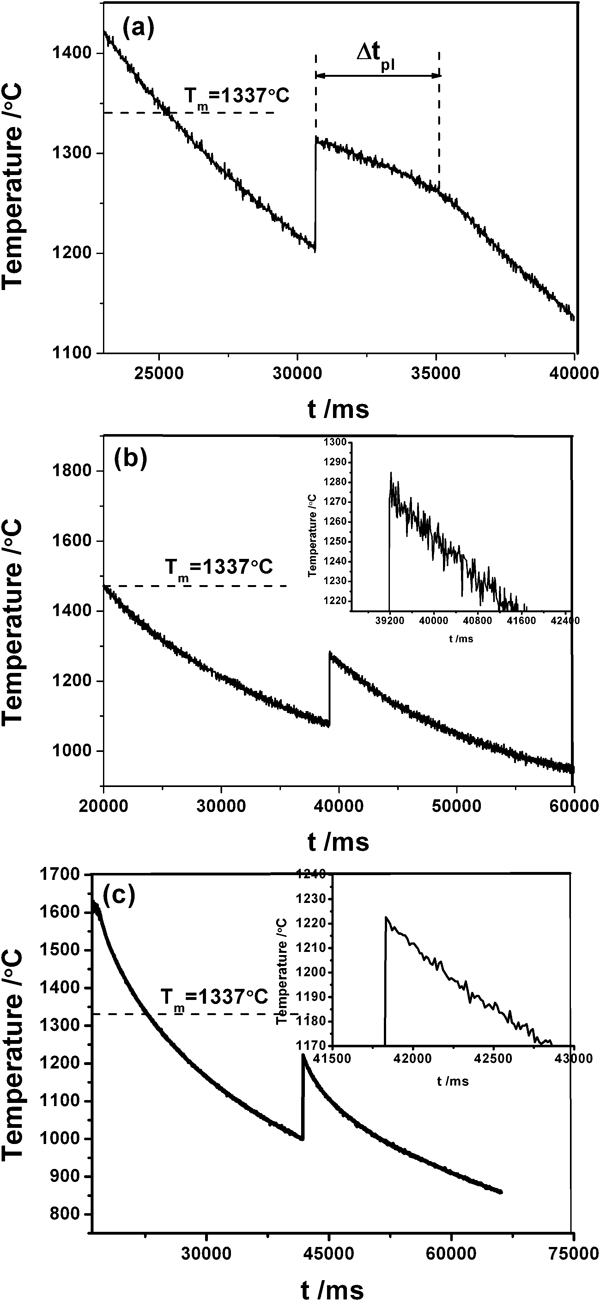
Measured temperature profiles of Co80Pd20 alloys undercooled by a 135 K, b 265 K and c 340 K: insets in b and c show magnified recalescence peaks
Evolution of solidification microstructures
Within the range of the achieved ΔT, the solidification microstructures show several morphological transitions, as seen in Fig. 2. When ΔT is smaller than 50 K, the microstructure consists of well developed dendritic skeleton, as seen in Fig. 2a. While ΔT falls into the range of 50 K<ΔT<265 K, a spherical grained microstructure forms, accompanying an abrupt reduction in grain size down to 20–30 μm (see Figs. 2b and c and 3). Further increasing ΔT into a narrow slit of 265 K<ΔT<280 K, an elongated grained microstructure appears, leading to a rise of grain size up to 120 μm, as seen in Figs. 2d and 3. Compared to the dendritic microstructure in the range of ΔT<50 K, the elongated grains observed in this range are not well developed and are mainly dendrite trunks. As ΔT exceeds ΔThyp, the second grain refinement occurs (see Fig. 3). The microstructures of the hypercooled alloys are characterised by equiaxed grains with rather straight grain boundaries, as seen in Fig. 2f. Except for the rather elongated grained microstructure observed in a narrow slit of 265 K<ΔT<280 K, these results are basically in agreement with Willnecker et al.'s results.21 The experimental methods in the present study and in Willnecker et al.'s study are the same, i.e. fluxing method. The elongated grained microstructure observed in the narrow slit of 265 K<ΔT<280 K is a new finding for the solidification structure evolution of Co80Pd20 alloys.
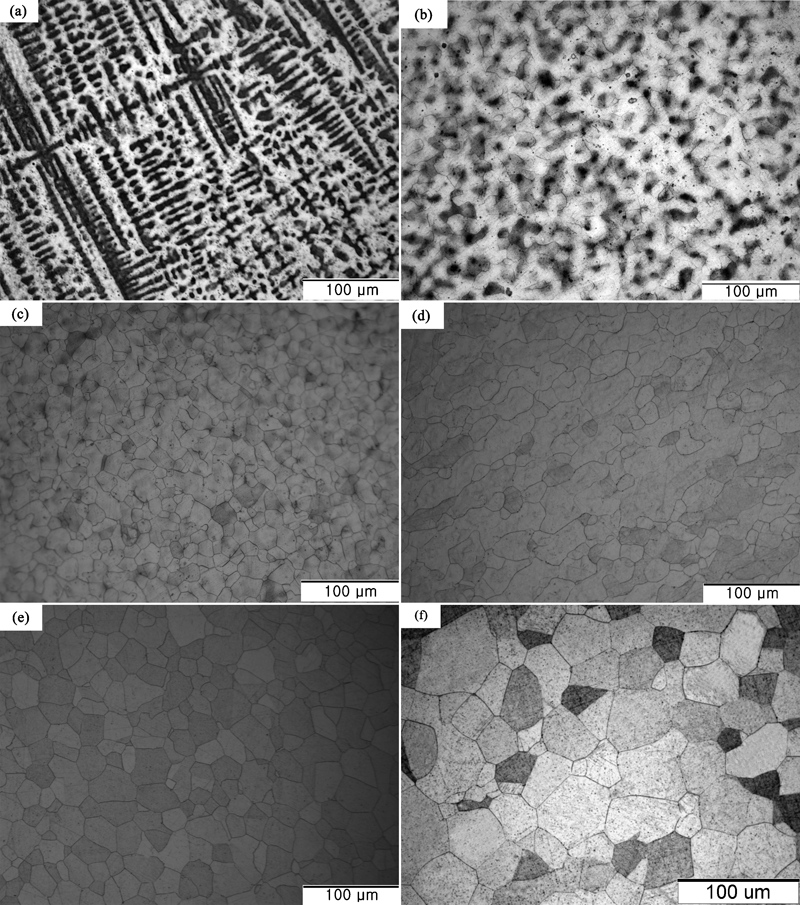
Optical micrographs of Co80Pd20 alloys undercooled by a 20 K, b 85 K, c 160 K, d 265 K, e 290 K and f 340 K
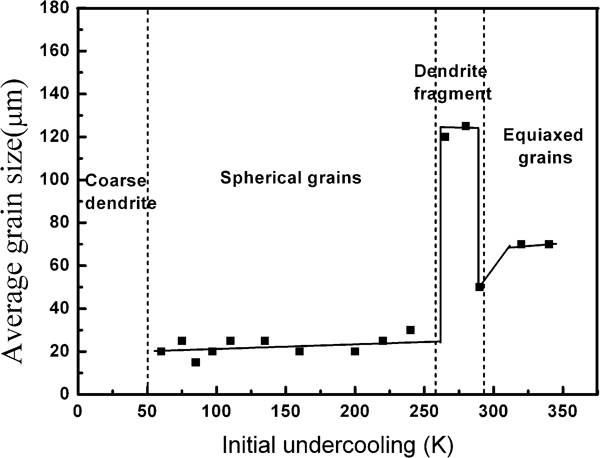
Measured average grain size as function of ΔT
Formation mechanisms of solidification microstructures
Microstructure formation of alloys with ΔT<ΔThyp
When an alloy melt solidifies at a small undercooling, e.g. ΔT <50 K in the case of undercooled Co80Pd20, the advancement of solid/liquid (S/L) interface is controlled by solute diffusion ahead of the S/L interface. Solidification of the melt proceeds rather slowly and results in the formation of well developed dendritic microstructures23 (see Fig. 2a). With increasing undercooling, a grain refinement event is observed in the undercooled Co80Pd20 alloy at 50–265 K. The first grain refinement in an undercooled single phase alloy is generally believed to be caused by the remelting effect during the post-recalescence period. In order to demonstrate the remelting effect during post-recalescence period, Karma15 proposed a model describing the relationship between the necessary breakup time (Δtbu) of dendrite and the duration time of post-recalescence period (Δtpl). According to Karma's model, when Δtbu<Δtpl, the dendrite skeleton formed on recalescence can be broken up completely and vice versa. Δtbu can be calculated according to the following equation15


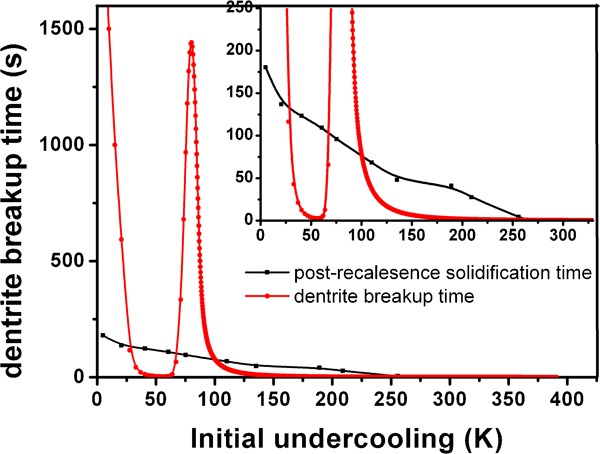
Δtbu (solid line) of Co80Pd20 calculated by Karma's model15 and Δtpl versus ΔT
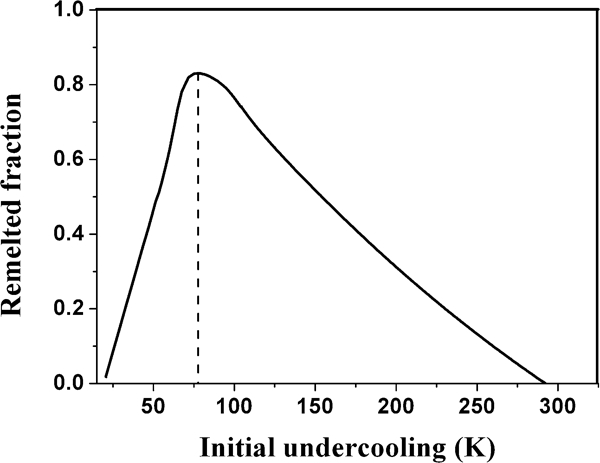
Calculated remelted fraction of primary dendrite at highest recalescence temperature for Co80Pd20 alloys
Microstructure formation of hypercooled alloys
When ΔT reaches the range of 265–280 K, which is above the hypercooling limit, due to a zero Δtpl and a zero fL, the dendrite trunks cannot be remelted and therefore can be preserved in the solidification microstructure, leading to the presence of the elongated grained structure. The appearance of elongated grained structure in the hypercooled Co80Pd20 alloy is apparently ascribed to the vanished remelting effect in the post-recalescence period. This is, in principle, in agreement with Herlach et al.'s explanation.16
As ΔT is higher than 280 K, the second grain refinement event occurs. The equiaxed grains with rather straight grain boundaries (see Fig. 2e and f) strongly suggest that the formation of the solidification microstructure is due to recrystallisation. The recrystallised microstructures in hypercooled alloys have been observed by Willnecker et al. in Co80Pd20 alloy21 and by Lu et al. in Ni75Pd25 alloy.14 In the present work, the occurrence of recrystallisation in the hypercooled Co80Pd20 alloy with ΔT>280 K was considered to be induced by the accumulation of internal strain/stress caused by the dramatic shrinkage stress resulting from rapid solidification. For rapid solidification taking place at a rather high undercooling, the advance of the solid/liquid interface proceeds extremely fast. As a consequence, a large volume contraction owing to rapid solidification will cause a high shrinkage stress developing in the system.13 Liu and Yang13 proposed a model to calculate the shrinkage stress developed during rapid solidification. According to this model, this shrinkage stress can be expressed by the following equation
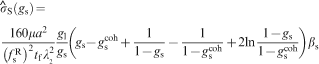
 . gs is the volume fraction of primary solid,
  is the solid fraction after the dendrite coherency point during recalescence, gl is the volume fraction of liquid, μ is the dynamic viscosity of the liquid, a is the size of the mushy zone in which primary growth or recalescence occurs, λ2 is the secondary dendrite arm spacing that can be measured experimentally and tf is the solidification time. βs is the solidification shrinkage of the primary dendrite, which can be calculated by the following equation
  , where
  and
and  are molar volumes of the liquid and solid respectively. Assuming the recalescence period is adiabatic and that the specific heats of the solid and liquid are constant and equal, the solid fraction formed in recalescence can be calculated by
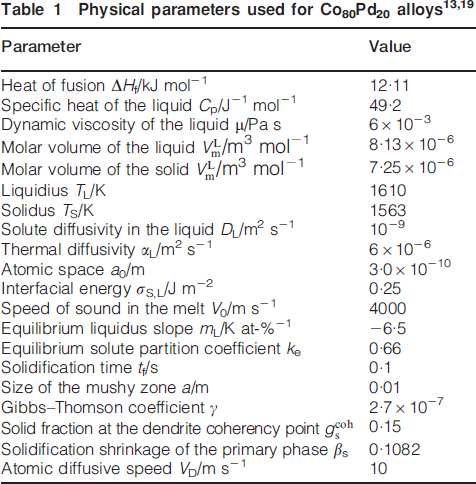
  ,26 and Tn is the nucleation temperature. Using the essential parameters listed in Table 1,
  as a function of ΔT can be calculated by equation (3) (see Fig. 6). It can be seen from Fig. 6 that, with increasing ΔT,
  continuously increases. The yielding strength of Co80Pd20 alloy at 1093°C is ∼83 MPa,27 which corresponds to the value marked by the dash line in Fig. 6. Once
  exceeds such a value, the dendrites formed will be plastically deformed, leading to a storage of microstrain in the microstructure. As is known, the stored microstrain will act as the driving force for recrystallisation.28 Further increasing ΔT causes a continuous increase in the stored microstrain, resulting in a continuous increase in driving force for recrystallisation. Once the driving force is high enough to initiate the nucleation, the recrystallisation will take place. As a consequence, a refined recrystallised microstructure can be resultant. Since the annealing twin is a typical characteristic of the recrystallised metal with fcc structure, the appearance of annealing twins in the microstructure (Fig. 7a) further evidences the occurrence of recrystallisation.28
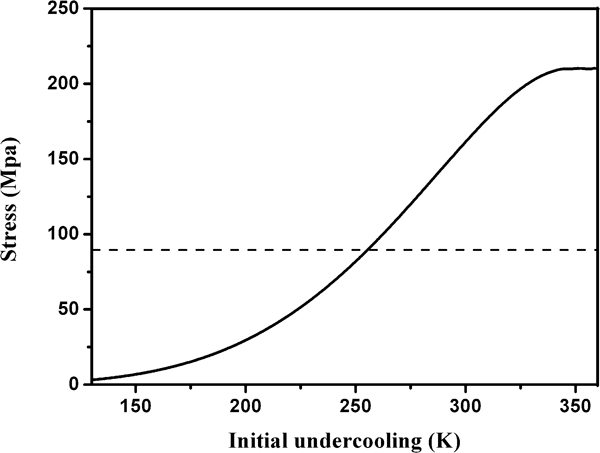
Calculated stress accumulated in dendrite skeleton upon rapid solidification as function of initial undercooling: dash line represents yielding strength of Co80Pd20 alloys
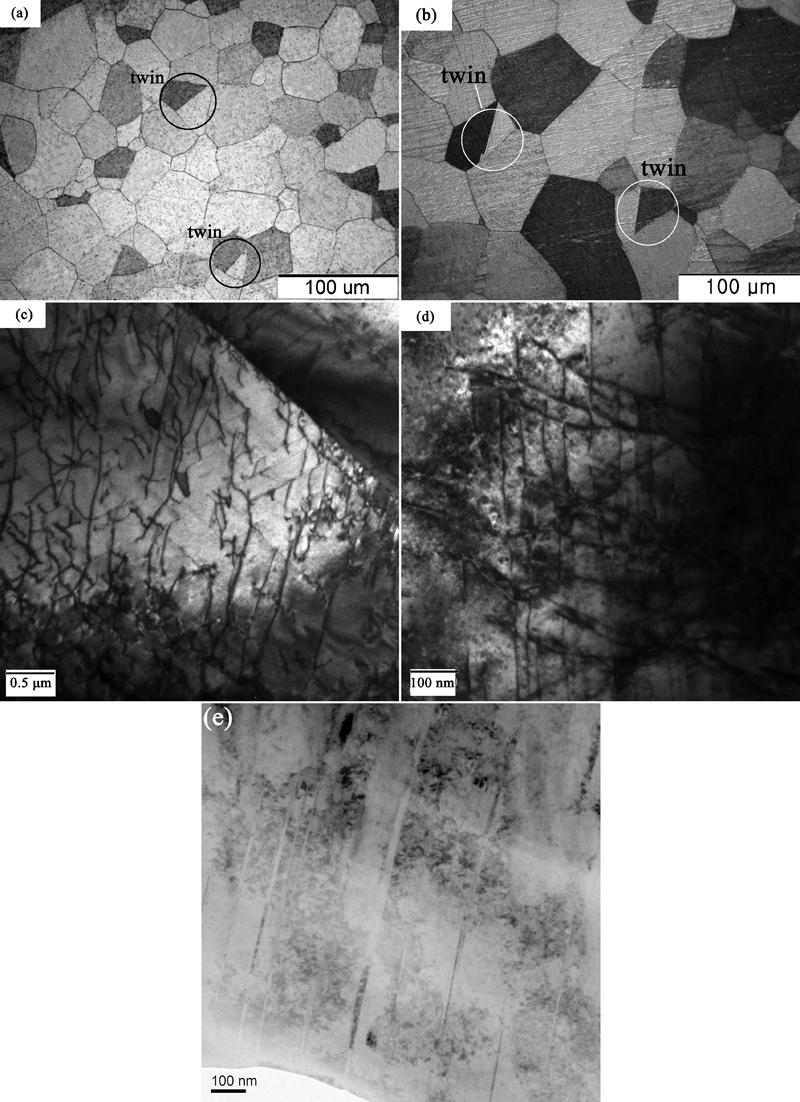
Optical images of microstructure of hypercooled 340 K Co80Pd20 alloys
The driving force for recovery and recrystallisation is an extra free energy of the cold worked state that is difficult to be measured. However, a major part of the stored energy will be attributed to the introduction of extra dislocations in the system.29 In order to provide more reliable evidence for the recrystallisation mechanism of grain refinement at high undercooling for the alloy, a hypercooled specimen with ΔT = 340 K was quenched into Ga–In liquid alloy immediately after recalescence. Interestingly, compared to the specimen with the same ΔT, which was cooled to room temperature naturally, the quenched specimen exhibits an even coarser solidification microstructure, as seen in Fig. 7a and b. Apparently, the quenched specimen is as well subjected to recrystallisation, since the solidification microstructure shows similar characteristics with the specimen subjected to natural cooling. For example, the solidification microstructure also consists of straight grain boundaries and twins; however, different from the naturally cooled specimen that shows very few dislocations (see Fig. 7e), rather dense dislocation networks were observed in the quenched specimen (see Fig. 7c and d). In the quenched specimen, a rather high cooling rate suppresses the completion of the recrystallisation. In this case, a large fraction of dislocations in the quenched specimen cannot be consumed by recrystallisation; therefore, the dense dislocation networks can be preserved in the microstructure. Owing to the partial recrystallisation, a coarser solidification microstructure compared to the specimen subjected to natural cooling can be resultant. This experiment provides additional evidence for the occurrence of recrystallisation in the specimen with ΔT>280 K and proves that the second grain refinement event at high undercooling in this alloy should be ascribed to the recrystallisation rather than dendrite remelting.
Conclusions
Co80Pd20 alloy was undercooled by means of fluxing method. The maximum undercooling of 340 K was achieved in the present work. Two grain refinement events of the solidification microstructures were observed in the ranges of 50–265 K and ΔT>280 K. The grain refinement in the range of 50–265 K is attributed to a combined effect of breakup of dendrite skeleton driven by solid–liquid surface tension induced structural instability and chemical superheating induced dendrite remelting. The second grain refinement at ΔT>280 K is ascribed to hypercooling and the recrystallisation of the rapidly solidified solid.
Footnotes
Acknowledgements
The authors are grateful to the financial support of the Free Research Fund of State Key Laboratory of Solidification Processing (09-QZ-2008 and 24-TZ-2009), the Natural Science Foundation of China (51071127 and 51134011), the Fundamental Research Fund of Northwestern Polytechnical University (JC200801), China National Funds for Distinguished Young Scientists (51125002) and National Basic Research Program of China (973 Program, 2011CB610403), and the 111 project B08040.