







Abstract
Soft magnetic alloy Fe81-xP9C7Si3Cux (x = 0, 0·5, 0·7, 1, 1·3) ribbons were produced by the single roller melt spinning method. The Cu content dependence of microstructure and magnetic properties was investigated. Appropriate addition of Cu is effective to the improvement of glass forming ability (GFA) and soft magnetic properties in this alloy system. The thermal stability, crystallisation process and soft magnetic properties of Fe80P9C7Si3Cu1 were also investigated. Excellent soft magnetic properties with low coercivity Hc (5·9 A m−1) and high magnetic flux density B8000 (1·68 T) can be obtained annealing this alloy at 653 K for 2 min. Low cost of raw materials and good soft magnetic properties make this alloy a promising candidate for future application.
Introduction
In 1988 the first Fe based nanocrystalline soft magnetic alloy Fe73·5Si13·5B9Nb3Cu1 was found by Yoshizawa. 1 In the later ten years Nanoperm alloys with high magnetic flux density and Hitperm alloys with high temperature stability were successfully developed.2,3 In recent years many kinds of Fe based nanocrystalline soft magnetic alloys based on the system of Fe–Si–B–P–Cu with excellent soft magnetic properties, especially high magnetic flux density, have been made.4–7 However, there are few reports about Fe based nanocrystalline soft magnetic alloys based on the system of Fe–P–C. The difficulty lies in the fact that the annealing temperature range to obtain soft magnetic α-Fe solid solution phase is very narrow. 8 Moreover, early transition metal elements such as Nb, V, Mo, etc. cannot play the role in suppressing grain growth effectively during annealing process in the Fe–P–C system owing to their strong reaction tendency with C at high annealing temperature and for long annealing time. But as one knows Si can widen the crystallisation temperature range to obtain mixed phases of α-Fe nanocrystallites and amorphous matrix effectively. 9 And also many researchers have demonstrated that uniformly dispersed nanocrystallites in the amorphous matrix can also be obtained at lower annealing temperature with shorter annealing time compared with those containing refractory early transition metal elements when simultaneously adding Cu and P to Fe based amorphous alloys. 10
In this paper we investigated microstructure and magnetic properties of melt spun Fe81-xP9C7Si3Cux (x = 0, 0·5, 0·7, 1, 1·3) ribbons. Alloy with the composition of Fe80P9C7Si3Cu1 exhibits good glass forming ability (GFA) and soft magnetic properties. Crystallisation process was further studied to improve the soft magnetic properties of this alloy.
Experimental details
Ingots with nominal composition of Fe81-xP9C7Si3Cux (x = 0, 0·5, 0·7, 1, 1·3) were prepared by arc melting industrial raw materials of Fe, Si–Fe, P–Fe, C–Fe and Cu under Ti gettered argon atmosphere. All the ingots were remelt four times and stirred by magnetic beater to ensure homogeneity. Ingots were then remelt in quartz tubes by induction heating followed by being rejected onto copper roller with peripheral velocity of 40 m s−1 under argon atmosphere. Ribbons with a thickness of 25 μm and a width of 1·5 mm were made. Thermal properties of melt spun ribbons were evaluated with a differential scanning calorimeter (DSC) at heating rates of 10, 20, 30 and 40 K min−1 respectively under argon flow. In the annealing process the specimens were heated at 20 K min−1 up to given temperatures and kept for 2 min and then cooled to room temperature in the furnace. The microstructure of melt spun and annealed ribbons was investigated by X-ray diffraction (XRD) with Cu Kα radiation and by transmission electron microscopy (TEM). The mean grain size D of the α-Fe phase was estimated by using Scherrer formula from the full width at half maximum of X-ray diffraction peak. B-H loop tracer with the maximum magnetising field of 8000 A m−1 was used to measure the coercivity Hc and magnetic flux density B8000 of alloys investigated.
Results and discussion
Figure 1 shows the XRD patterns of melt spun Fe81-xP9C7Si3Cux (x = 0, 0·5, 0·7, 1, 1·3) ribbons. Obvious crystallisation peaks corresponding to α-Fe at about 2θ = 45° and 2θ = 65° can be detected without Cu added to the alloy system. Only one crystallisation peak at about 2θ = 65° can be detected when 0·5 at-Cu is added. Further increasing the Cu content no obvious peaks in alloys (x = 0·7, 1, 1·3) can be detected, which shows these alloys are of amorphous structure. Nanoclusters of α-Fe may result in the very small peaks at 2θ = 45° and 65° in the XRD profiles of alloys with x = 0·7, 1, 1·3. However, very small weak peaks can be seen at 2θ = 32° at all the five XRD patterns, which may result from the high P content and the appearance of small amount of Fe2P phase. Figure 2a and b shows TEM images of Fe80P9C7Si3Cu1 and Fe81P9C7Si3 ribbons respectively. Figure 2a shows that the Fe80P9C7Si3Cu1 ribbon is amorphous, which is consistent with the XRD pattern shown in Fig. 1. No nanocrystalline grains can be seen from Fig. 2b and the selected area electron diffraction (SAED) pattern shows that the Fe81P9C7Si3 is mainly amorphous and that no clear evidence of crystallization exists, which seems to be inconsistent with the diffraction peaks in the XRD pattern in Fig. 1. The reason may be that the size of nanocrystalline grains is too small to be detected by TEM at ordinary magnification times.
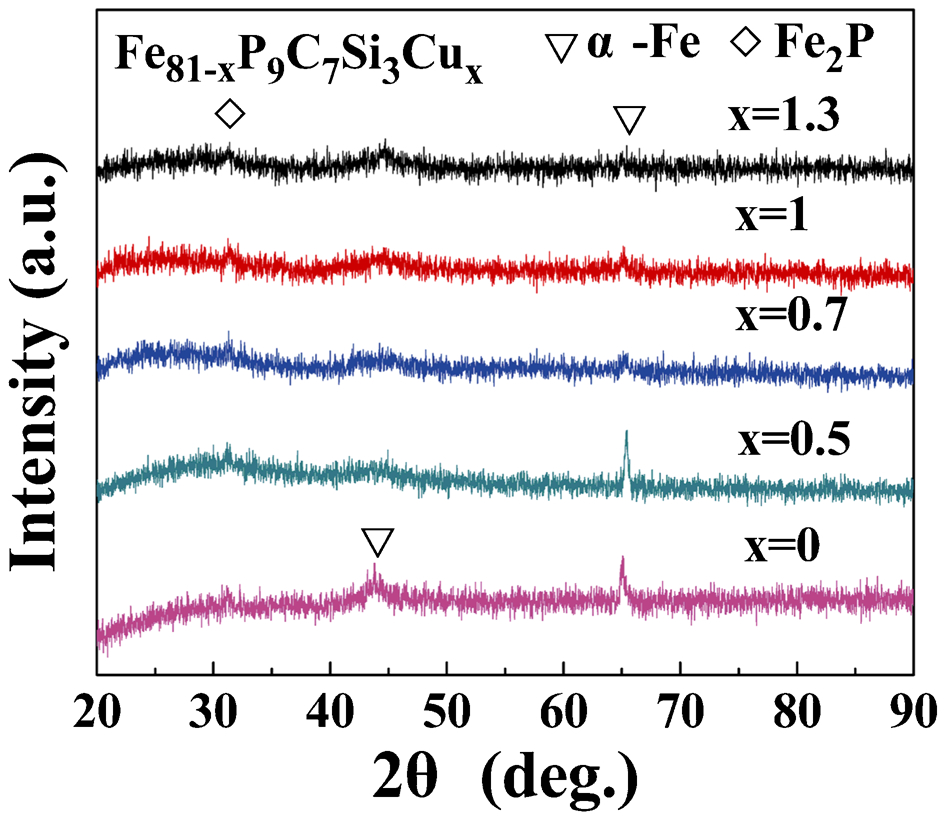
X-ray diffraction patterns of melt spun Fe81-xP9C7Si3Cux (x = 0, 0·5, 0·7, 1, 1·3) ribbons
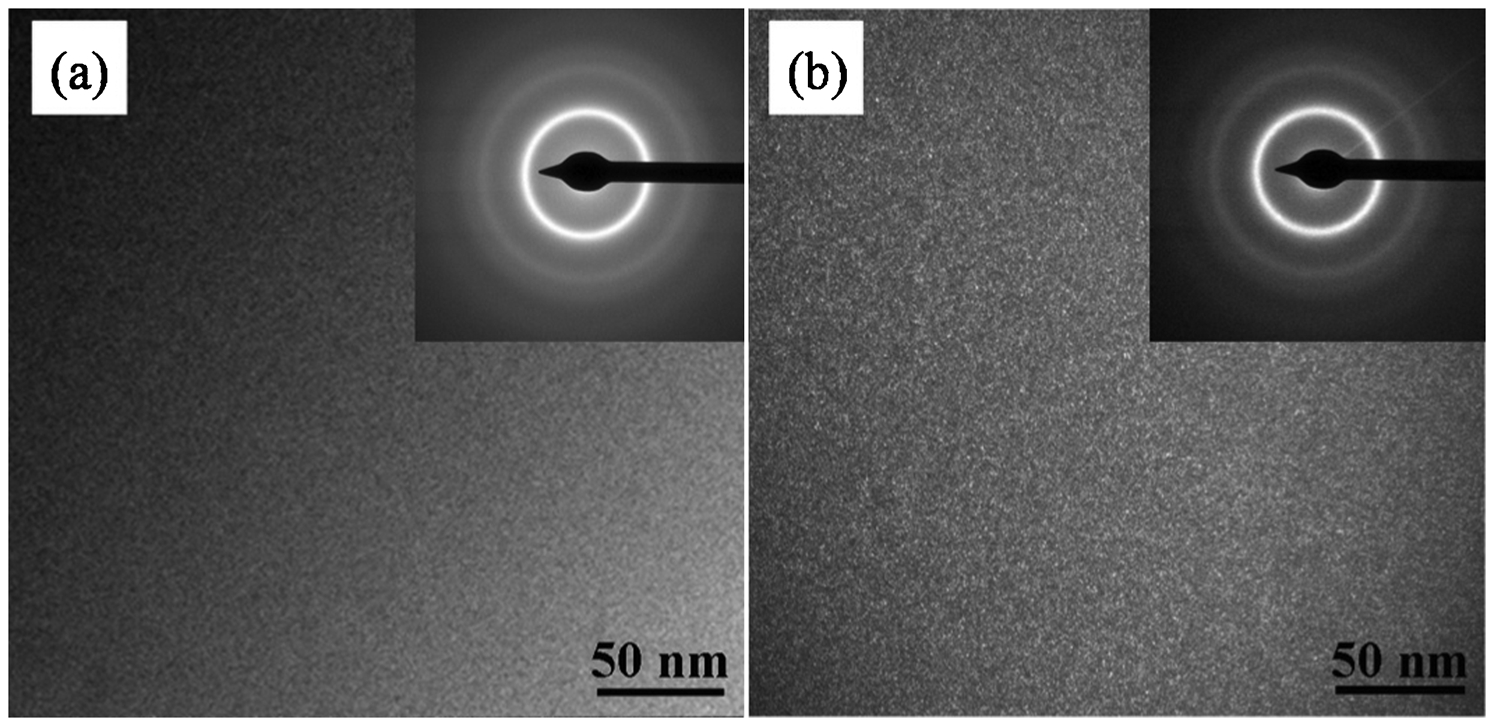
a melt spun Fe80P9C7Si3Cu1 alloy, b melt spun Fe81P9C7Si3 alloy: insets are corrosponding SAED patterns
Figure 3 shows the coercivity Hc and magnetic flux density B8000 of melt spun Fe81-xP9C7Si3Cux (x = 0, 0·5, 0·7, 1, 1·3) ribbons. There is no obvious change with B8000 in this alloy system. The minimum value of Hc is 14·2 A m−1 for the alloy with 1 at-Cu content. The Hc of melt spun ribbon without Cu addition is 26·7 A m−1 and it decreases to 17·6 A m−1 for the ribbon with 0·5 at-Cu. Amorphous ribbons with 0·7, 1 and 1·3 at-Cu show lower Hc than partially crystallised ribbons with no Cu or 0·5 at-Cu content. This magnetic hardening phenomenon may be attributed to the fact that the very small crystallites act as inclusions which give rise to domain wall pinning in the amorphous matrix. 11 We believe that to obtain nanocrystalline soft magnetic alloy ribbons directly without annealing is possible, but the microstructure characteristics such as phase composition, grain size and crystallinity are difficult to control in melt spinning process. Therefore, annealing amorphous precursors is still an indispensable process to produce nanocrystalline soft magnetic ribbons.
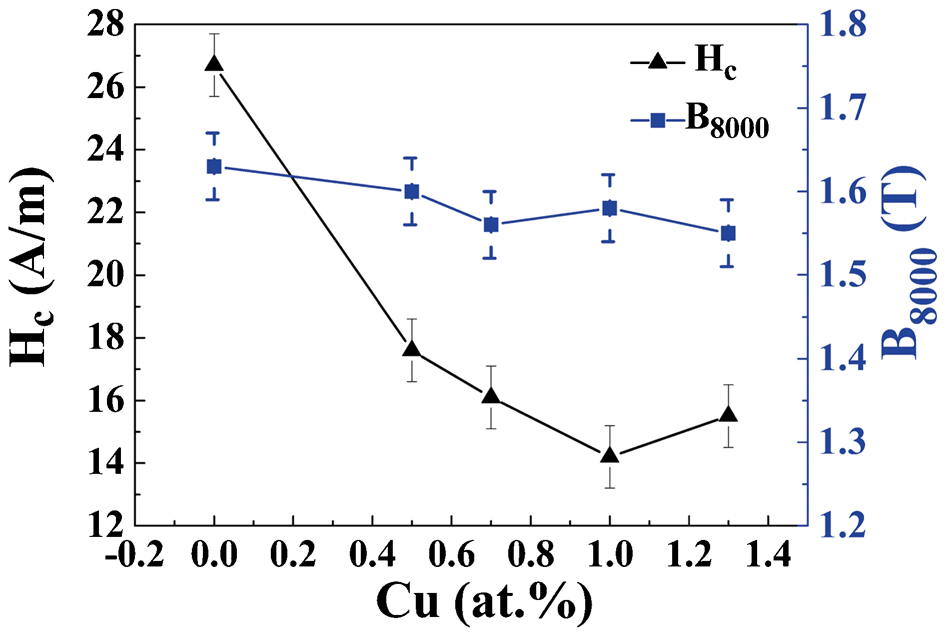
Magnetic properties for melt spun Fe81-xP9C7Si3Cux (x = 0, 0·5, 0·7, 1, 1·3) ribbons
The crystallisation process of melt spun amorphous ribbon Fe80P9C7Si3Cu1 was further investigated. Figure 4 shows the DSC curves of the as spun Fe80P9C7Si3Cu1 ribbon at different heating rates (10, 20, 30, 40 K min−1) in Ar atmosphere. From all the DSC curves three exothermic peaks can be observed. Exothermic peaks shift to higher temperatures with the increase of heating rate. The first exothermic peak is associated to the phase of α-Fe solid solution, and the second and third peaks with partial superposition are P–Fe and Fe–C phases respectively. 12 The temperature interval between the first and the second exothermic peak is above 100 K, which is larger than that of Fe–P–C ternary amorphous alloys. 8 This result demonstrates that combination addition of Si and Cu can effectively widen the annealing temperature range in which the single phase of α-Fe solid solution in amorphous matrix can be obtained.
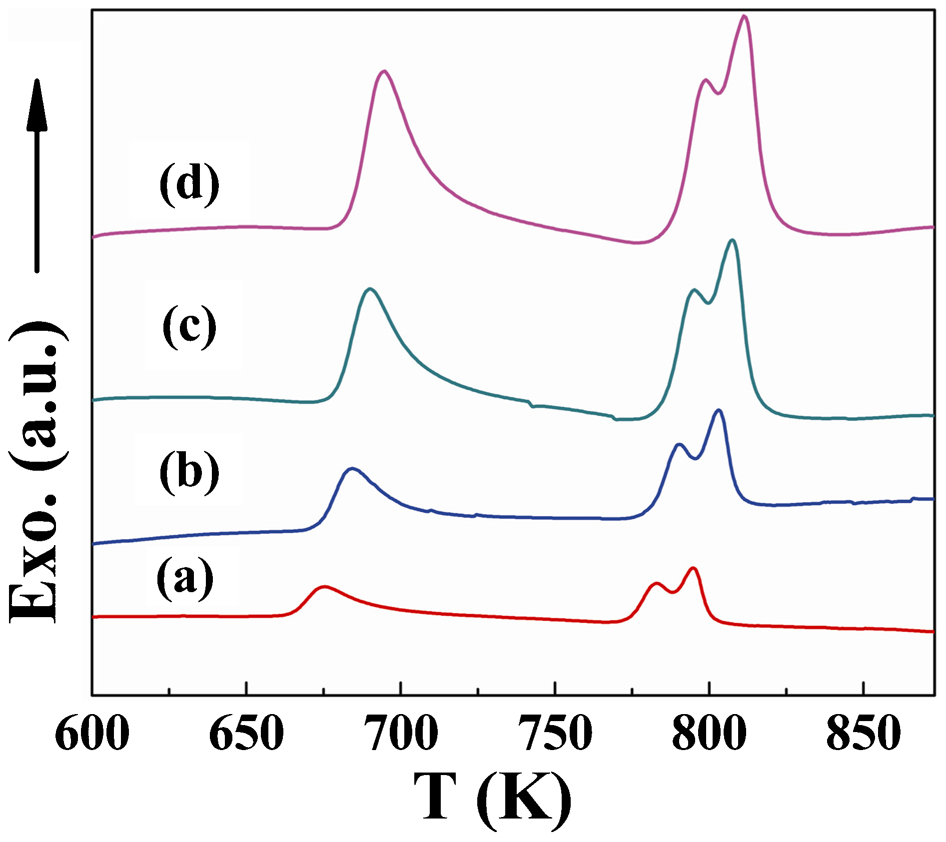
a 10 K min−1; b 20 K min−1; c 30 K min−1; d 40 K min−1
Activation energies of both nucleation and growth of the first crystallisation can be obtained based on the onset and peak temperatures at different heating rates by using Kissinger equation
13
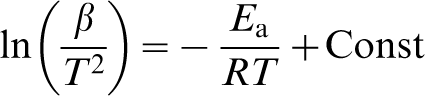
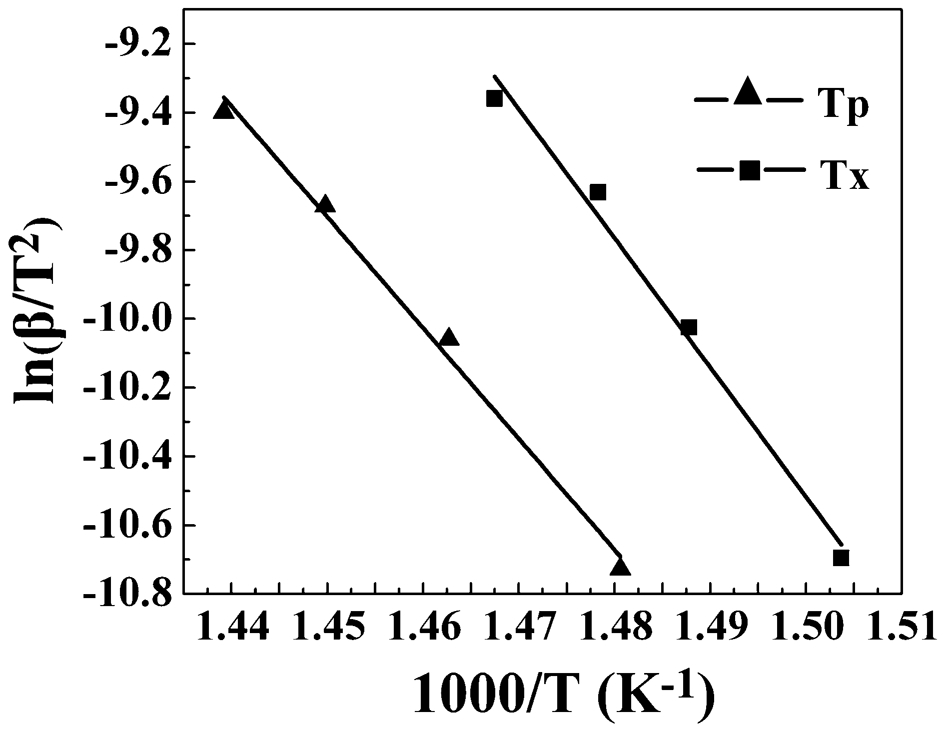
Kissinger plots of ln (β/T2) versus 1000/T obtained from linear heating DSC scans for Fe80P9C7Si3Cu1 ribbon
One knows that optimum isothermal annealing temperatures are often lower than those obtained from DSC curves for amorphous alloys without refractory early transition metals.17,18 In this work a series of annealing temperatures ranging from 573 to 723 K were selected and kept for 2 min to research the crystallisation and soft magnetic properties changing of the Fe80P9C7Si3Cu1 alloy. Figure 6 shows the XRD patterns of Fe80P9C7Si3Cu1 ribbon annealed at various temperatures. There is no apparent change in the XRD pattern for the ribbon annealed at 573 K compared with that in melt spun state. When the annealing temperature increases to 623 K small crystallisation peak corresponding to (110) of α-Fe at about 2θ = 45° can be observed clearly. Further increasing the annealing temperature, the intensity of the (110) peak increases, which indicates that the volume fraction of crystallized α-Fe increases with the increase in annealing temperature. 19 One can also see that the small peak corresponding to Fe2P almost disappears at 723 K, which may result from the fact that the content of the Fe2P phase is low and that it is unstable and decomposes when the crystallisation volume fraction of α-Fe increases with the increase of annealing temperature.
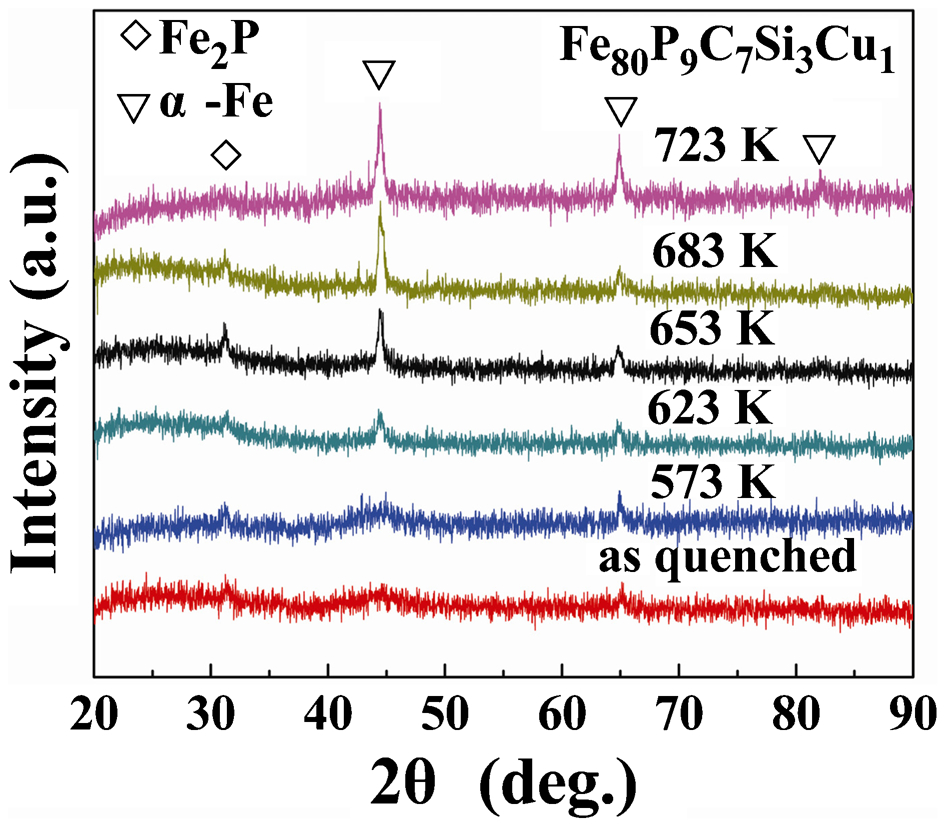
XRD patterns of melt spun and annealed Fe80P9C7Si3Cu1 ribbons
The annealing temperature dependence of Hc is shown in Fig. 7. Although no apparent crystallization takes place at 573 K, the Hc decreases to 11·5 A m−1 from the initial value of 14·2 A m−1 of the melt spun alloy. The improvement of soft magnetic properties can be attributed to the structure relaxation process, which can effectively decrease the magneto-elastic anisotropy through the relief of matrix stress.
20
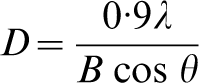
The minimum Hc 5·9 A m−1 can be obtained when the alloy is annealed at 653 K. Annealed ribbons are so fragile that the specimens for TEM observation can not be prepared successfully. The Scherrer equation
19
described as follows is used to estimate grain sizes
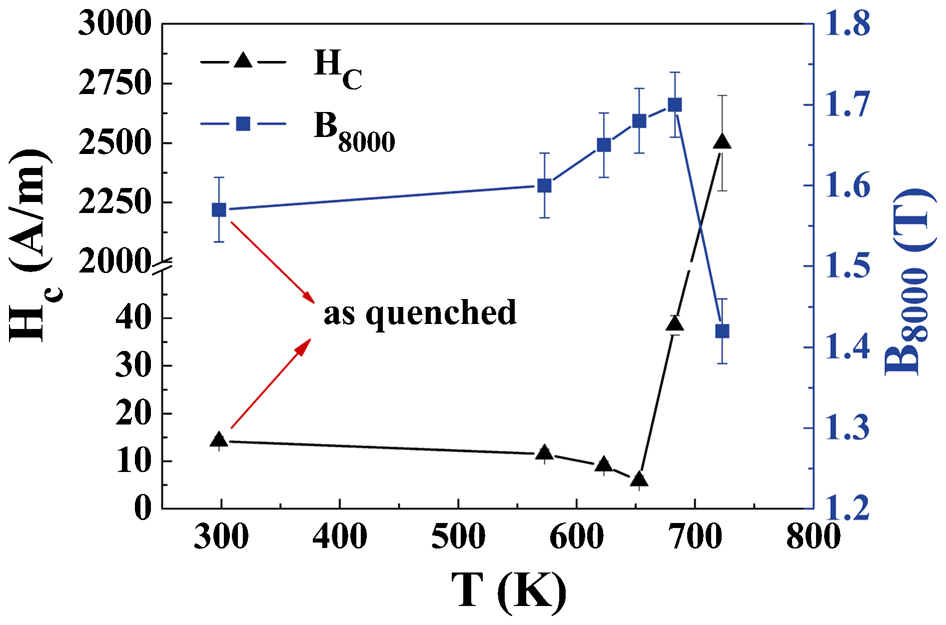
Annealing temperature dependence of coercivity Hc and magnetic flux density B8000 for Fe80P9C7Si3Cu1 ribbon
The annealing temperature dependence of the magnetic flux density at 8000 A m−1 (B8000) for the melt spun alloy is also shown in Fig. 7. With the increase in annealing temperature, B8000 increases to a maximum 1·7 T at 683 K. However, as the annealing temperature increases further, B8000 decreases abruptly. The increase in B8000 can be attributed to the increase of the volume fraction of the crystallised α-Fe phase. As the value of B8000 can be expressed by the following formula
25

In this formula R, BSC and BSA are the crystallinity, saturation magnetic flux densities of crystalline and amorphous phases respectively. Owing to the value of BSC of α-Fe is more than 2 T, while BSA is less than 1·6 T, thus B8000 increases with the increase in the crystallinity. The abrupt decrease of B8000 at 723 K can be attributed to the limited magnetic field of 8000 A m−1, at which the alloy can not be magnetised to saturation due to the large coercivity of this alloy annealed at 723 K.
Conclusions
Fe based soft magnetic alloy ribbons based on the composition of Fe81-xP9C7Si3Cux (x = 0, 0·5, 0·7, 1, 1·3) were fabricated by single roller melt spinning method. The addition of Cu can effectively enhance the GFA of this alloy system. The melt spun ribbon with the composition of Fe80P9C7Si3Cu1 exhibits the best soft magnetic properties. Activation energies of nucleation and growth of this alloy are 312 and 268 kJ mol−1 respectively. The temperature interval between the first exothermic peak corresponding to α-Fe solid solution and the second one corresponding to hard magnetic phase can be widened to above 100 K by the combination addition of Si and Cu. Good soft magnetic properties with Hc = 5·9 A m−1 and B8000 = 1·68 T can be obtained when the melt spun ribbon is annealed at 653 K for 2 min. The good soft magnetic properties with low cost raw materials and energy saving annealing process make this alloy a promising candidate for future application in magnetic cores of transformers, mutual inductors, sensors et al.
Footnotes
Acknowledgement
This work is supported by Joint Innovation Foundation of Industry and University of Jiangsu Province (no. BY2013003-01).