







Abstract
This paper summarises existing phase selection rules for cast high entropy alloys. Essentially, they are almost all based on the parametric approach, utilising various descriptors comprising mixing enthalpy, configuration entropy, mismatch entropy, melting points, atomic size mismatch, electronegativity and valence electron concentration. The overview starts from phase selection rules for solid solutions, intermetallic compounds and the amorphous phase in high entropy alloys. Further discussions are relevant to selection rules for solid solution phases in high entropy alloys, more specifically, for face centred cubic and body centred cubic type solid solutions. Finally, some challenges and future prospects of phase selection rules for high entropy alloys are addressed.
Introduction
High entropy alloys (HEAs), or multiprincipal element alloys with equiatomic or nearly equiatomic compositions,1,2 are becoming the new research frontier in the metallic material field. Conceptually, HEAs provide a brand new alloy design strategy to the conventional physical metallurgy that has mainly been working with alloys based on one and two principal elements, for example, Fe, Al, Cu and Ti based alloys and NiAl, TiAl and NiFe based alloys. The compositional space opened by HEAs is enormous, and as a matter of fact, many novel alloys with unique structural and functional properties have been developed in the family of HEAs.3–7 A very recent and decent example is CoCrFeMnNi, a single phase face centred cubic (fcc) solid solution structured HEA, which showed exceptional damage tolerance with tensile strengths >1 GPa and fracture toughness values exceeding 200 MPa m1/2, and simultaneously enhanced strength and ductility at cryogenic temperatures. 8 More excitements from HEAs await further alloy developments and continuous research efforts into this new class of metallic materials. Meanwhile, the rapid development of HEAs also raises opportunities to look into some scientifically intriguing questions on multicomponent alloys, particularly on concentrated multicomponent alloys. The phase selection in HEAs is an outstanding one among those questions and has indeed attracted much attention since the early stage of the development of HEAs. Quite a few works have been done on this topic, and it seems timely at this stage to summarise what are known and what remain to be unknown, a clear understanding of which can benefit further developments of HEAs.
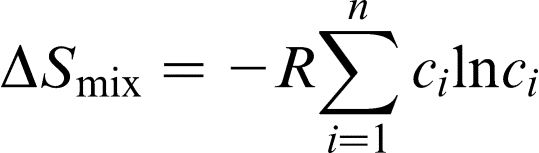
Before discussing the phase selection in HEAs, it is important to first clarify the definition of HEAs that is held in the present paper. The simple reason for this clarification is that even the definition of HEAs has been quite controversial. When the term HEAs was coined, HEAs were defined by their compositions in that they are composing of at least five principal metallic elements, each with a concentration between 5 and 35 at-.1 The configurational entropies of these compositionally complex alloys, in the liquid or fully random solid solution state, are much higher than those of conventional crystalline alloys and even bulk metallic glasses (BMGs),
9
and here comes the name of HEAs. The configuration entropies of alloys are calculated by the Boltzmann equation, on the premise that they are in the liquid or fully random solid solution state
10
:
Solid solutions, or intermetallic compounds, or even amorphous phase?
Essentially, if kinetic factors can be ignored, the phase selection is thermodynamically controlled by the Gibbs free energy, G. When considering the formation of alloys from mixing elemental components, G can be related to the enthalpy, H, and the entropy, S, via the following equation:

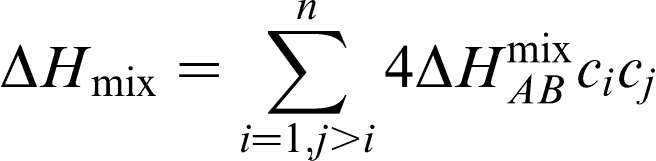
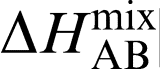 is the enthalpy of mixing for the binary equiatomic AB alloys; the atomic size mismatch, δ, is given by
15
:
is the enthalpy of mixing for the binary equiatomic AB alloys; the atomic size mismatch, δ, is given by
15
:
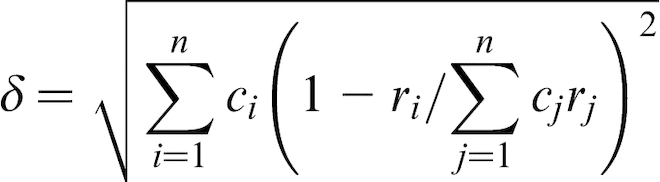
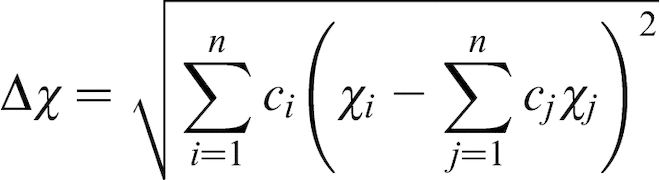
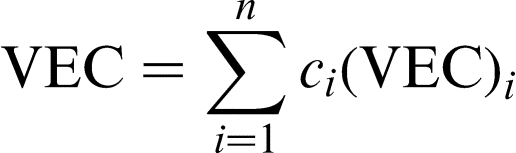
The evaluation of these parameters as phase selection criteria was done carefully by Guo and Liu. 18 It was found that neither Δχ nor VEC has a strong effect in determining the phase selection among solid solutions, intermetallic compounds and the amorphous phase. As will be discussed later, VEC, however, is a critical parameter determining the formation of fcc or bcc type solid solutions. 34 Δχ was found to relate to the elemental segregation, 35 and has recently been shown to be of some help for the formation of topologically close packed (TCP) phases. 36 ΔSmix does have an effect in that solid solution phases are formed when ΔSmix is high. However, in the context of HEAs that are defined here, ΔSmix for all HEAs are high and are quite comparable. Therefore, ΔSmix is not really an effective phase selection criterion for HEAs. δ and ΔHmix stand out from these parameters, and more importantly, it is the combination of these two parameters that gives a more reasonable phase selection rule for HEAs.
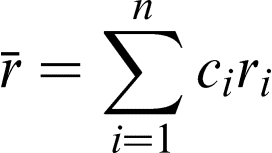
In the following part, four different phase selection rules mainly utilising δ and ΔHmix and some of their derivatives are introduced and compared based on statistical analyses of existing experimental data. The validity of these empirical rules has been verified from the process on how they are established (based on experimental facts) and also from a large amount of published work following the publication of these rules, particularly for ΔHmix − δ and Ω − δ, which are now widely used in the HEA field. Certainly, when more experimental data are available, they can be used to check whether there would be any exception to these established rules, or to establish modified and novel phase selection rules. On the reliability of the used experimental data to establish the following empirical rules, the current author did check very carefully his own data sources to make sure that only results from directly cast materials are used, but he also admitted that not all data sources from other researchers, which are included in this review, have been scrutinised. As a matter of fact, some caution is still suggested for taking the conclusions that are generated from these statistics.
ΔHmix−δ
An example of using the two-dimensional ΔHmix − δ plot to predict the phase selection in HEAs is given in Fig. 1. 16 Statistically, solid solutions can form when δ is small (δ < 0.066), and ΔHmix is either slightly positive or insignificantly negative ( − 11.6 < ΔHmix < 3.2 kJ mol− 1). This scenario can be taken as an extension of the Hume–Rothery rules from binary alloys to multicomponent alloys. Almost exactly contrary to these requirements, the amorphous phase can form when δ is large (δ>0.064), and ΔHmix is noticeably negative (ΔHmix < − 12.2 kJ mol− 1). The connection of this indication to Inoue's three empirical rules for the easy formation of BMGs can be recognised here. In addition, in agreement with both the Hume–Rothery rules and Inoue's empirical rules, the requirements on δ and ΔHmix to form solid solutions and the amorphous phase in HEAs are necessary, but not sufficient, conditions. Another condition that needs to be satisfied for forming either solid solutions or the amorphous phase is the avoidance of the formation of intermetallic compounds. 16 The tricky thing is that intermetallic compounds form in the intermediate conditions in terms of δ and ΔHmix, or in other words, the ΔHmix − δ for intermetallic compounds overlaps largely with those for solid solutions and the amorphous phase (Fig. 1). The intermetallic compounds forming region does not indicate that intermetallic compounds are the sole alloyed products there, but rather refer to the condition where the amount of intermetallic compounds is sufficient to be detected by the X-ray diffraction.
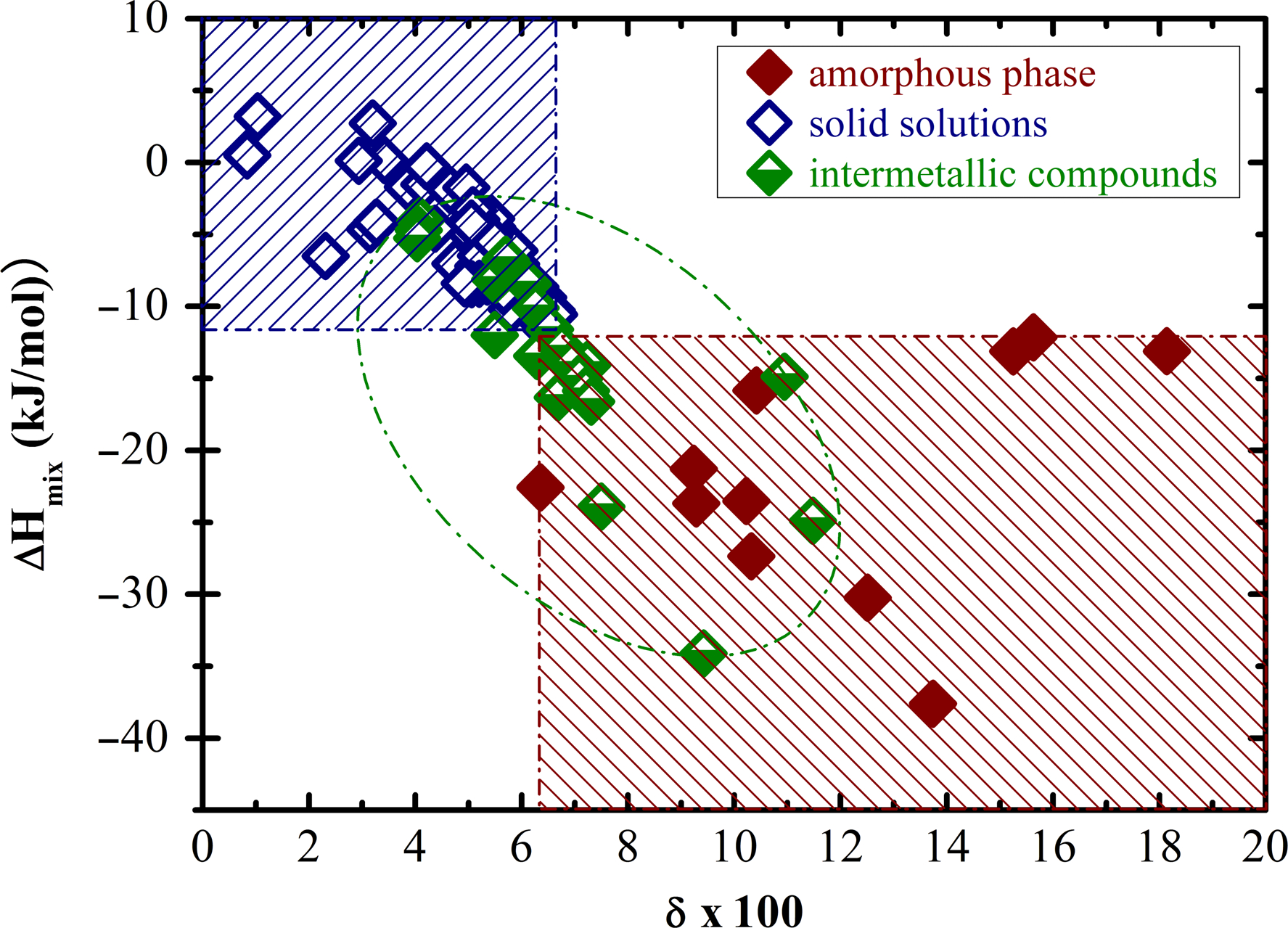
A ΔHmix − δ plot delineating phase selection in HEAs; dash dotted regions highlight individual region forming solid solutions, intermetallic compounds and amorphous phase 16
The ΔHmix − δ rule has been widely accepted and used in the HEA field as a useful empirical rule to predict the phase selection among solid solutions, intermetallic compounds and the amorphous phase. 37 Works from different research groups sometimes show different threshold values for δ and ΔHmix. This difference can be generated due to the use of different database from different researchers, or even when classifying one alloy composition into different genres. For the latter situation, a confused distinction between ordered solid solution (to avoid confusion, quite often this simply means that superlattice diffraction peaks are seen from the X-ray diffraction) and intermetallic compounds (particularly TCP phases and/or other complex intermetallics) is currently in the field. The classification of solid solutions in Fig. 1 takes in both disordered and ordered solid solutions, but ordered solid solution might be interpreted by some researchers as intermetallic compounds. In Ren et al.'s ΔHmix − δ plot, 38 they claimed that solid solutions are formed when δ ≤ 0.028 and ΔHmix ≥ − 8.8 kJ mol− 1, which largely narrows down the ΔHmix − δ space compared to that delineated in Fig. 1. Zhang et al.'s ΔHmix − δ plot gives almost the same threshold δ for forming solid solutions as that given in Fig. 1, δ < 0.066, but the range for ΔHmix is slightly different, − 15 < ΔHmix < 5 kJ mol− 1.15,39 They did also classify ordered solid solutions into solid solutions, rather than intermetallic compounds, and they noted that compared to disordered solid solutions, ordered solid solutions occur at larger δ (>0.046 40 ) and more negative ΔHmix. It has to be pointed out here that these different threshold values by no means indicate that these rules are in conflict with each other, if only one understands how these differences are generated. Meanwhile, the more important merit of these essentially empirical rules is that they give some direction and guidance (for example, not so negative ΔHmix and smaller δ favour the formation of solid solution phases) to researchers when designing HEAs, and the suggested threshold values for these parametric approaches are more for reference only. Nevertheless, these rules with different threshold values did cause some confusion in the field, and further work is required to critically assess them to see whether a consensus can be achieved. This note also applies to the following parameters that are covered in this present work.
ΔHmix−δ2
Recently, Takeuchi et al. used a ΔHmix − δ2 plot to describe the phase selection in both HEAs and BMGs, as shown in Fig. 2.
40
The motivation of using δ2 instead of δ started from the intention to use another parameter that can also characterise the atomic size mismatch, Sσ (often normalised by the Boltzmann constant kB, so Sσ/kB
31
), to replace δ. Then, they found out that a correlation between Sσ/kB and δ2:Sσ/kB∼δ2 actually exists. Comparing Figs. 1 and 2, it can be seen that they basically give very similar information in terms of the phase selection among different phases. It is noticed that one particular HEA with the composition of Al0.5CuNiPdTiZr appears in a region that is outside the supposed solid solution forming region, even though this alloy has a bcc solid solution structure. They thought that this might suggest new opportunities to find solid solution forming HEAs. On a different note, Singh et al. suggested an empirical parameter, Λ,
41
to predict the formation of disordered single phased solid solutions (DSS) in HEAs, i.e. no ordered solid solutions are formed. They claimed that DSS can form when Λ>0.96. Λ is defined as follows:

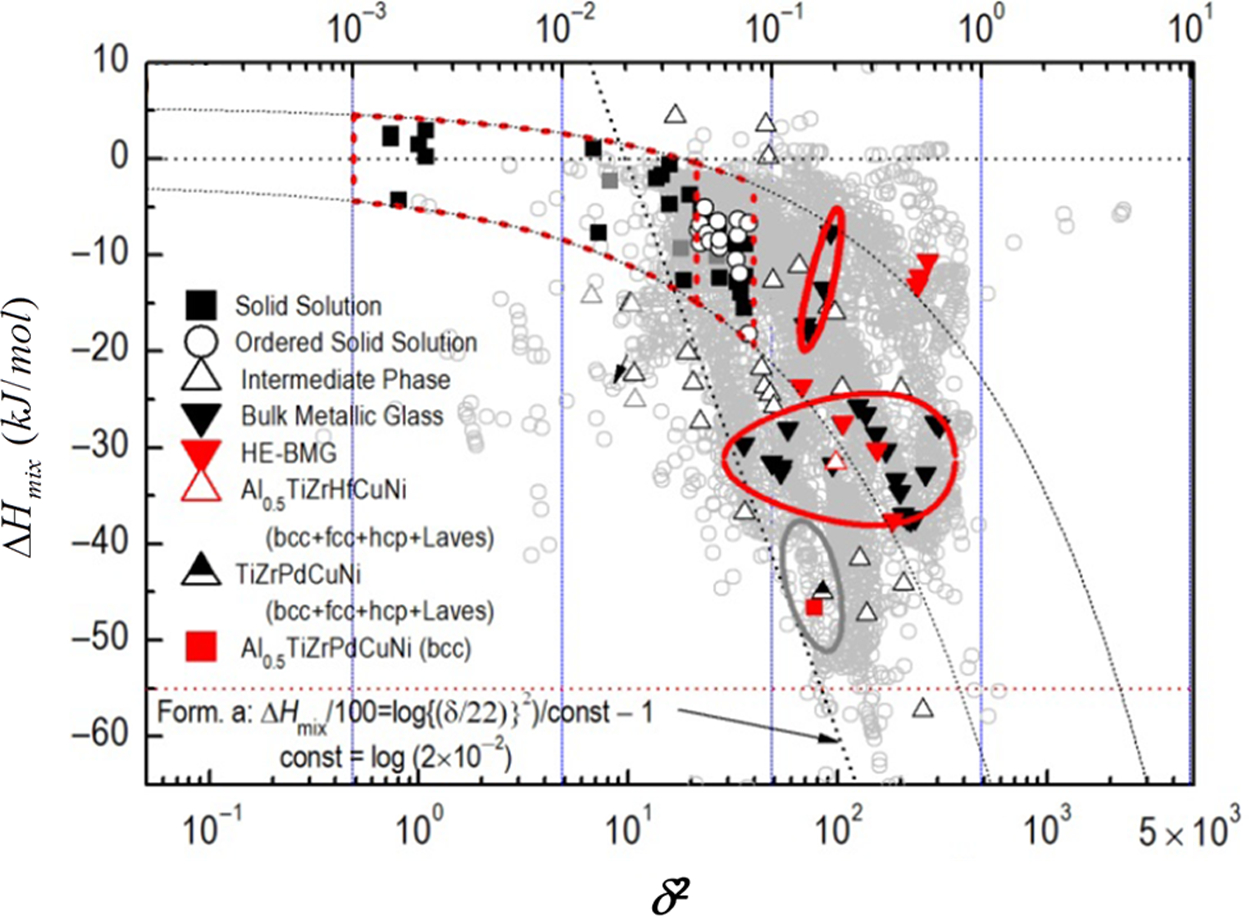
A ΔHmix − δ2 plot showing phase selection in HEAs and BMGs, including HE-BMGs 40
Interestingly, based on the correlation between Sσ/kB and δ2, Λ is actually a ratio between the configuration entropy and the mismatch entropy, ΔSmix/Sσ. This even reminds of another phase selection criterion suggested by Raghavan et al. 42 : ΔSmix/ΔSfusion, where ΔSfusion is the weight averaged entropy of fusion for all constituent alloying elements. They observed that most equiatomic solid solutions have ΔSmix/ΔSfusion>1, while non-equiatomic solid solutions have ΔSmix/ΔSfusion>1.2. Do these dimensionless criteria, the ratio of two types of entropies, indicate something that remains to be explored? Future work might give answers to this question.
Ω−δ
Yang and Zhang proposed a new parameter out of thermodynamics origin, Ω, to replace ΔHmix in the previous ΔHmix − δ scheme. The parameter Ω is defined by
39
:
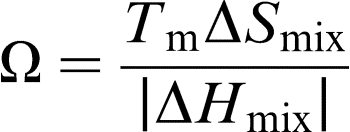
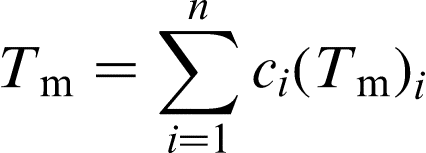
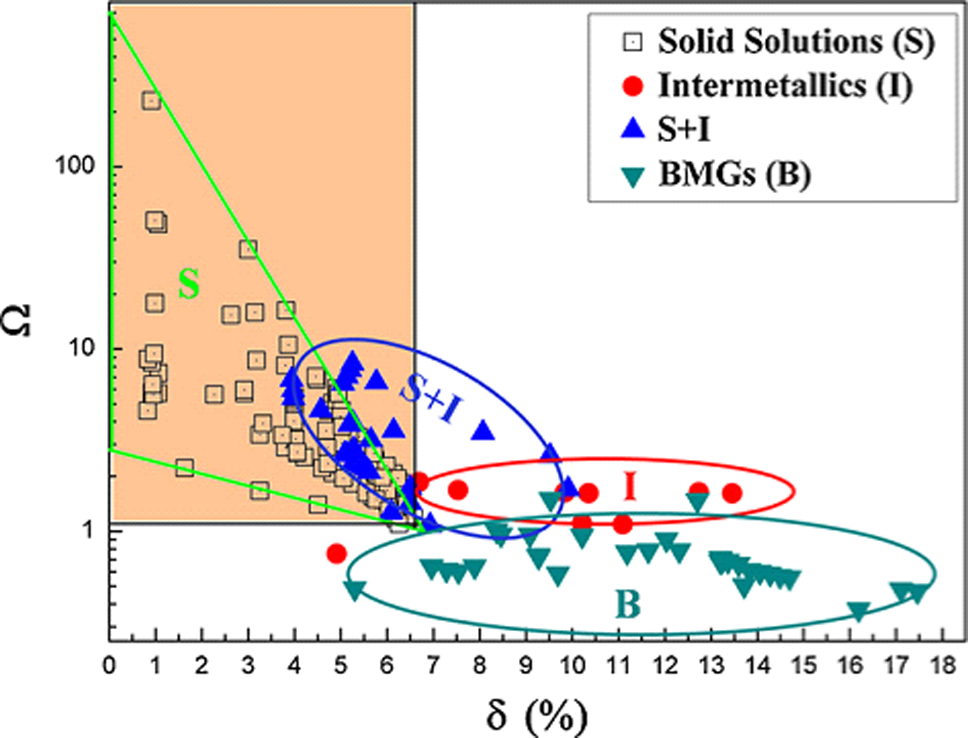
An Ω − δ plot showing phase selection in HEAs and BMGs 39
γ for δ?
Seen from the phase selection rules that have been proven effective, apparently, the atomic size mismatch, δ, is a very important parameter, as it appears in all the above mentioned empirical rules. However, there is a relatively wide range of δ over which both solid solutions and intermetallic compounds can form. Very recently, a new geometric parameter, γ, was suggested, which performs much better in distinguishing solid solutions from intermetallic compounds, as shown in Fig. 4.
43
γ is defined by:

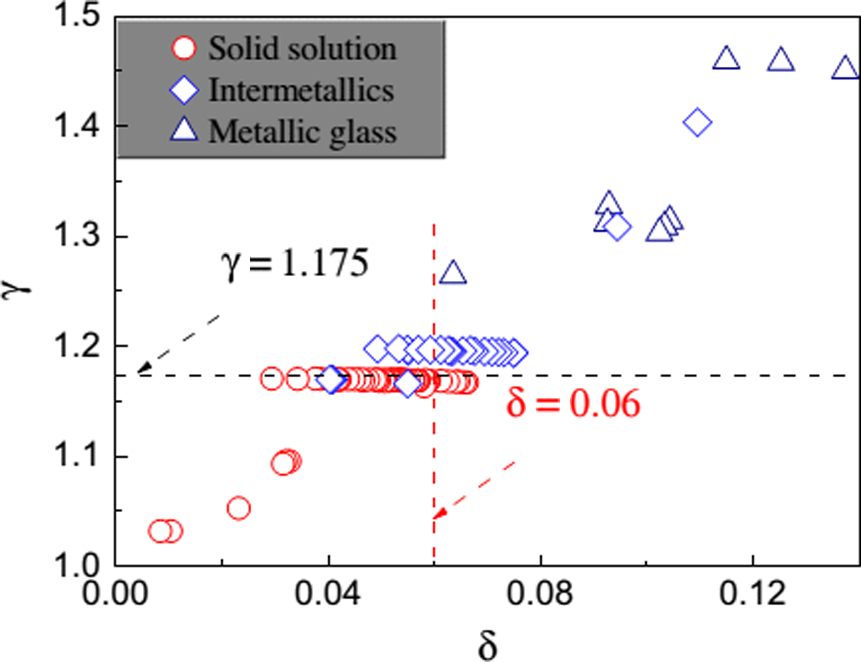
Comparsion of γ and δ in distinguishing solid solutions from intermetallic compounds and metallic glasses 43
What determines crystal structure of solid solutions?
So far, phase selection rules for solid solutions, intermetallic compounds and the amorphous phase in HEAs have been summarised. Knowing these rules gets one ready for the first step when designing HEAs, e.g. aiming for smaller δ and δ2, less negative ΔHmix, larger Ω and smaller γ, when designing solid solution forming alloys. However, these phase selection rules generally do not tell much information about the crystal structure of solid solutions that are formed. Solid solutions formed in HEAs are normally of fcc or bcc structure, or a mixture of both.15,16,18,34 Experimentally, it has been known that in HEAs, their crystal structures can significantly affect their mechanical behaviour.3 Basically, fcc structured HEAs are quite ductile, but their strengths are relatively low. 44 On the other hand, bcc structured HEAs are generally much harder, 45 but also quite often brittle, particularly under tension. 17 Therefore, it is crucial to design HEAs of the desired crystal structure. The ΔHmix − δ plot shown in Fig. 5 46 roughly says that fcc structured solid solutions form at smaller δ and less negative ΔHmix, while bcc structured solid solutions form at larger δ and more negative ΔHmix. Raghavan et al. 42 noted that the bcc type solid solution has a higher value of Sσ/kB, and argued that a higher mismatch entropy suggests a higher lattice strain, which can be better accommodated in a more open structure like the bcc structure. In contrast, the close packed fcc structure has a lower Sσ/kB. However, as exemplified in Fig. 5, the fcc type solid solution forming ranges, in terms of δ, ΔHmix or Sσ/kB, all largely overlap with those of bcc type solid solutions.42,46 As such, new criteria capable of clearly distinguishing fcc and bcc type solid solutions are needed.
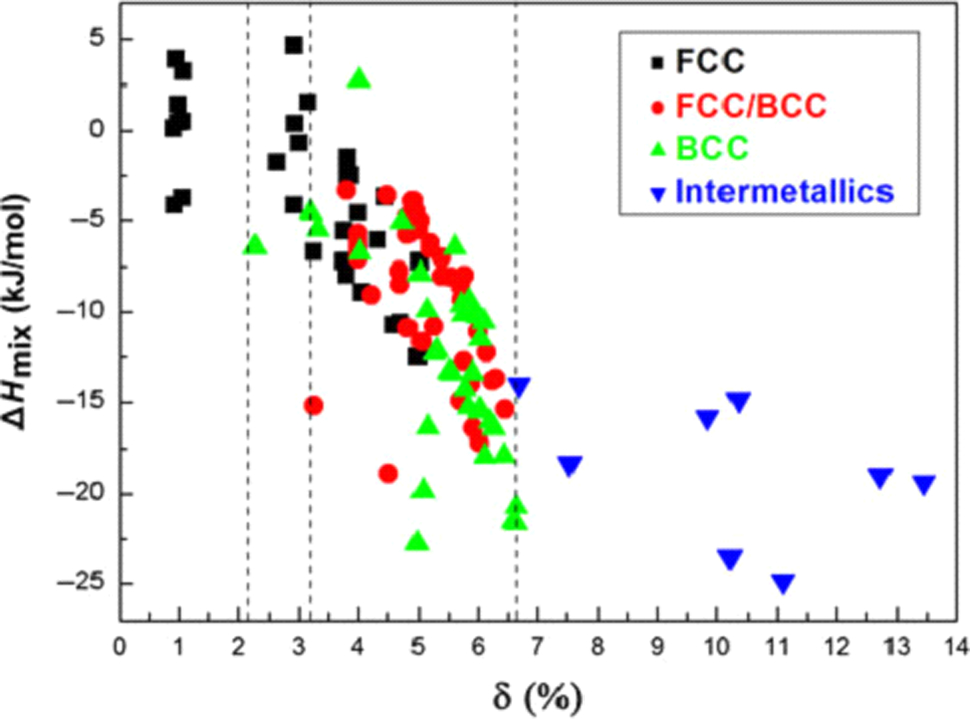
Dependence of solid solution types on ΔHmix and δ in HEAs 46
The equivalency of alloying elements in stabilising fcc or bcc type solid solutions gives some hint to solve this problem. Evidences from experiments have shown that elements like Al and Cr are bcc phase stabilisers, and Ni and Co are fcc phase stabilisers. 47 Furthermore, in an AlxCoyCrzCu0.5FevNiw HEA system, it was clearly shown that 1.11 portions of Co were equivalent to 1 portion of Ni as the fcc phase stabiliser, and 2.23 portions of Cr were equivalent to 1 portion of Al as the bcc phase stabiliser. When the equivalent Co was larger than 45 at-, the alloys had an fcc structure, and when the equivalent Cr was larger than 55 at-, the alloys had a bcc structure. 48 This equivalency of alloying elements in stabilising a particular crystal structure naturally reminds of the well known effect of electron concentration on the crystal structure in conventional alloys. 49 It has to point out that two different notions of electron concentration exist: one is e/a, the average number of itinerant electrons per atom, and the other is valence electron concentration (VEC), the number of total electrons, including d electrons involved in the valence band. Mizutani discussed different applications of e/a and VEC in depth in his monograph Hume–Rothery Rules for Structurally Complex Alloy Phases. 49 More detailed information on the difference between e/a and VEC can be found in this book. Simply put, e/a is connected with the Hume–Rothery electron concentration rule, and VEC is a key parameter in first principle band calculations.
HEAs generally contain many transition metals (TM). Considering that the determination of e/a values for TMs is known to be highly problematic, VEC seems to be a more straightforward electron concentration parameter, at least to start with. Meanwhile, the equivalency of Co and Ni shown in the AlxCoyCrzCu0.5FevNiw alloy system 48 further indicates that the VEC has an effect on the phase selection between fcc and bcc type solid solutions in HEAs. Inspired by this observation, Guo et al. scrutinised the VEC effect on the phase selection in various solid solution forming HEAs, and the result coming out of this statistical analysis is shown in Fig. 6. 34 Clearly, fcc type solid solutions form at VEC ≥ 8.0, bcc type solid solution phases at VEC < 6.87, and a mixture of fcc and bcc phases at 6.87 ≤ VEC < 8. Although some exceptions exist, particularly for Mn containing HEAs, the VEC rule provides a convenient way to design fcc or bcc solid solution structured HEAs. The threshold VEC values of 6.87 and 8.0 are mainly for reference, and they might vary slightly in different alloy systems, 34 and even vary for the same composition but prepared with different cooling rates. 28 However, so far, there are no exceptions against the trend that a higher VEC favours the fcc type solid solutions, and a lower VEC favours the bcc type solid solutions, in solid solution forming HEAs. Statistically, the threshold VEC values of 6.87 and 8.0 can still be regarded as a reasonable guidance to design fcc or bcc type solid solutions. The validity of VEC rule has now been widely verified in HEAs containing mainly TM elements, but additional efforts are still required to test whether it can still work effectively for HEAs containing mainly non-TM elements. Interestingly, Tsai et al. 50 found that the VEC rule can even be used to predict the formation of σ phase in cast Cr and V containing HEAs, and furthermore, the VEC range for the formation of σ phase is 6.88 < VEC < 7.84, almost overlapping with that for forming the mixed fcc and bcc solid solutions: 6.87 ≤ VEC < 8. It seems that the potential of using the VEC rule for the phase selection in HEAs remains to be explored.
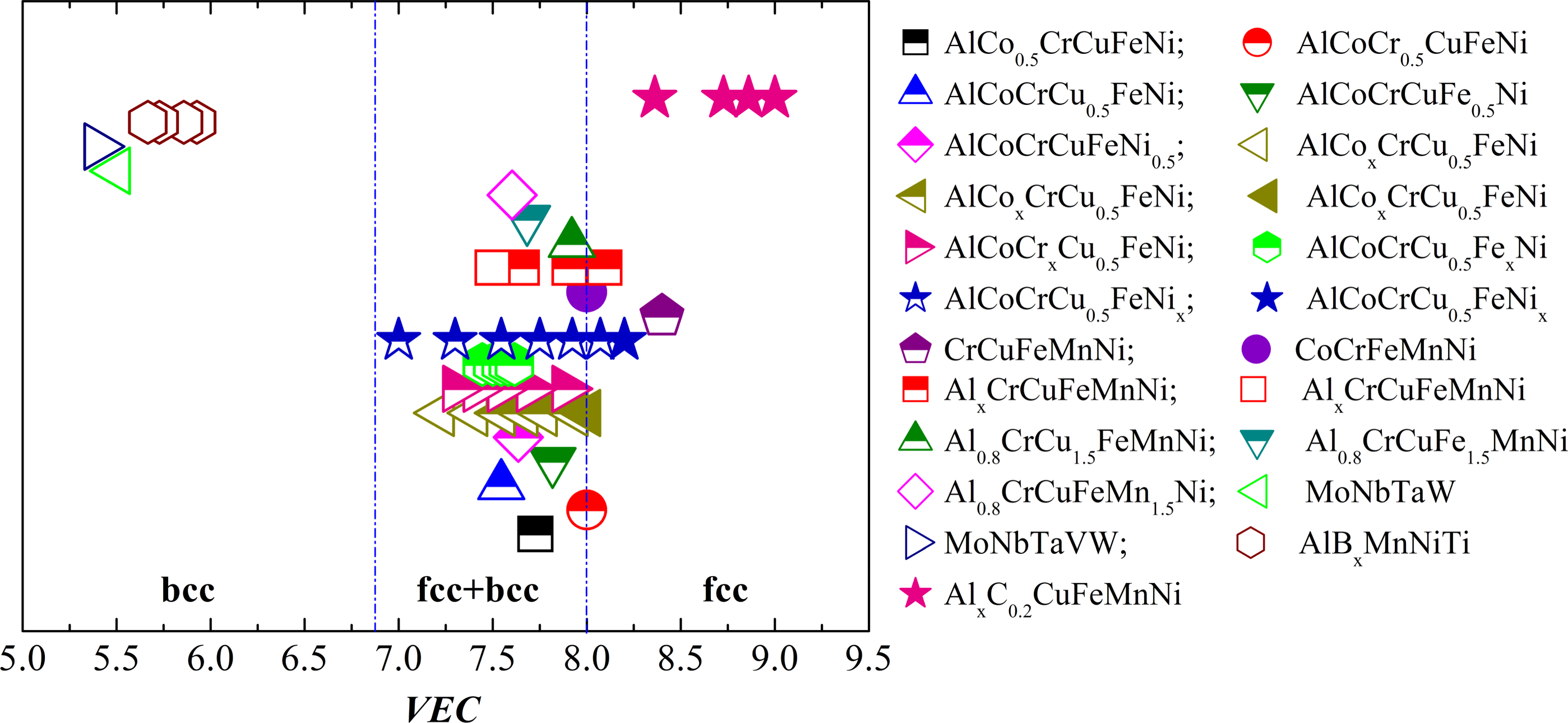
Role of VEC in phase selection between fcc and bcc type solid solutions in HEAs; fully closed symbols are for sole fcc phases, fully open symbols are for sole bcc phases, and top half closed symbols are for mixed fcc and bcc phases 34
Recently, Poletti and Battezzati evaluated the phase selection between fcc and bcc type solid solutions in HEAs, using both e/a and VEC. 51 They claimed that fcc solid solutions are stabilised at VEC>7.5 and 1.6 < e/a < 1.8, while bcc solid solutions are stabilised at VEC < 7.5 and 1.8 < e/a < 2.3. However, the way they determined the e/a values, and hence the soundness of the e/a dependence of the phase selection, needs to be better justified. Nevertheless, it is expected that future work along this line of thinking will help to achieve deeper insights into the effect of electron concentration, e/a and VEC, on the phase selection in HEAs.
Outstanding issues and future prospects
Single phase solid solution or multiphase solid solutions?
As mentioned in the Introduction section, there is an argument for strictly defining single phase solid solution forming multiprincipal element alloys as HEAs. However, up to now, a very limited number of so called genuine HEAs exist.2,11,12,45,52–54 They are fcc structured CoCrFeMnNi and bcc structured NbMoTaW, NbMoTaVW and HfNbTaTiZr, and fcc structured CoCrFeNi, CoCrMnNi and CoFeMnNi, if equiatomic quaternary alloys can also be counted. Some suggested that single phase solid solution forming HEA systems, based on binary and ternary phase diagrams, include fcc structured CuNiPdPt and CuNiPdPtRh, even hcp structured CoOsReRu, 13 but they remain to be experimentally verified. Naturally, there is not much work discussing the phase selection rules for single phase solid solution and multiphase solid solutions. Guo et al. 55 suggested that the solid solutioning induced lattice distortion might lead to the decomposition of the single phase solution and, hence, the formation of multiphase solid solutions. The proposed critical lattice strain of ∼0.018 could be correlated to the solid solutioning limit in HEAs and the design of single phase solid solution. However, more experimental supports need to be provided to verify its validity. Meanwhile, efforts are needed from both theoretical and experimental perspectives to pinpoint the controlling factors for the formation of the single phase solid solution in HEAs.
Other types of solid solutions?
In most available experimental results, if solid solutions are formed in HEAs, they are of fcc or bcc type, or a mixture of both. However, hcp type solid solutions have been experimentally seen or theoretically predicted in HEA systems like DyGdHoTbY, DyGdLuTbY, DyGbLuTbTm, CoFeMnTixVyZrz, CrFeNiTiVZr, CoFeNiTi, HfTiYZr and CoOsReRu.13,56–61 The existence of hcp type solid solutions poses challenges to the VEC rule that was initially established to guide the phase selection between fcc and bcc type solid solutions. Future alloy developments in the HEA field might lead to the discovery of other types of solid solutions. For example, Lilensten recently reported an orthorhombic structure in the Ti35Zr27.5Hf27.5Ta5Nb5 alloy, 62 although whether an alloy of such a composition can be classified as HEAs is certainly debatable. New phase selection rules are required to cover different types of solid solutions beyond fcc and bcc types.
HE-BMGs?
The development of HEAs also leads to new types of BMGs, which are now called HE-BMGs. Currently, the known HE-BMGs include PdPtCuNiP, SrCaYbMgZn, SrCaYbMgZnCu, SrCaYb(Li0.55Mg0.45)Zn, ErTbDyNiAl, ZrHfTiCuNi and ZrTiNiCuBe.19–23,25 It has already been shown in section 2 that the large δ and very negative ΔHmix are two necessary conditions for the formation of HE-BMGs, and in most cases, the competition phases to the amorphous phase during solidification are intermetallic compounds, rather than solid solutions. It is expected that the high entropy alloying design strategy, i.e. employing equiatomic or close to equiatomic constituent elements, can possibly bring new perspectives to understand the glass forming ability, and also open new opportunities to develop BMGs.
Summary
Phase selection rules for cast HEAs, among solid solutions, intermetallic compounds and the amorphous phase, have been formulated using a parametric approach, utilising parameters based on two considerations, i.e. thermodynamics and geometry effect. A couple of empirical rules have been proved useful in the design of HEAs, and they are summarised here. Notably, the mixing enthalpy, the atomic size mismatch and some of their derivatives play crucial rules. Inspired by the equivalency of stabilising elements, the valence electron concentration rule has been applied successfully to control the phase selection between fcc and bcc type solid solutions, two most commonly seen types of solid solutions in HEAs. In the meantime, new developments in phase selection rules for HEAs are expected to tackle challenges like the formation of single phase solid solutions, solid solution types other than fcc and bcc structures, and also further development of high entropy BMGs.
Acknowledgements
S.G. thanks the Area of Advance Materials Science from Chalmers University of Technology for the startup funding.