







Abstract
The article discusses the concept of high entropy alloys, introduced over the last decade and offering a methodology for development of new materials with enhanced properties, as well as the classification of such materials into a special category of multicomponent solutions. It is argued that the efficiency of this approach and applicability of the theory of regular solutions, on which the concept of high entropy alloys is based to materials science of multicomponent systems, are strongly exaggerated. The idea of random distribution of atoms in high entropy alloy structure is appropriate in fact only for ideal solid solutions, and there is no advantage in using it to understand the regularities of formation of complex alloys with special properties.
Ten years ago, an article entitled ‘Nanostructured high entropy alloys with multiple principal elements: novel alloy design concepts and outcomes’ was published. 1 The subsequent publication developed the idea proposed by Yeh et al. 1 into a concept of ‘a new era’ in the science of alloys. 2 To date, in the literature, a large number of articles and reviews on study of ‘high entropy alloys’ (HEAs) have appeared.3–5
Despite the seemingly obvious main statements of the presented concept, it is interesting to discuss these statements in depth in order to understand the need for a certain group of materials to be distinguished as a special category of HEAs.
The essence of the HEA concept is stated most completely by Zhang et al. 6 According to the proposed concept,1–3,6 HEAs are multicomponent alloys of five or more basic components, each with a concentration of 5–35 at.-. At the same time, such complex multicomponent metallic alloys should not form complex multiphase compositions but should consist of one or very few solid solutions phases. It is assumed that the liquid or disordered solid solutions with simple structures, mainly body centred cubic and face centred cubic, in such multicomponent systems are formed due to a high value of the entropy of mixing that stabilises solid solutions. 1 Such solutions are characterised by sluggish diffusion of its components, severe lattice distortions of lattice structures and the appearance of the so called cocktail effect, namely, a sharp change of properties, such as lattice parameter or hardness, over relatively small changes in concentration ratio of components, leading to a change of the alloy phase composition. 6
The configurational term the entropy of mixing for multicomponent systems can be calculated from the well known equation for ideal mixtures

It is noted by Zhang et al. 6 that the alloy with the configurational entropy of mixing more than 1.61R possesses unique structure due to the possibility that different atoms randomly occupy any available positions in a structure, and high lattice distortions because of different atomic sizes result in very high strength of solid solution.
Increase in entropy of mixing facilitates the solution formation as it corresponds to decrease in the Gibbs energy:

Assuming a random distribution of atoms of components in a solid solution when mixing entropy is derived from equation (1), it is proposed to calculate the enthalpy of mixing from the model of regular solutions according to Zhang et al.
6
:
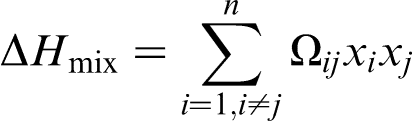
Thus, the concept of HEA, in fact, is a model of multicomponent regular solutions that assumes random distribution of atoms at low enthalpy of formation. It should be noted that this model does not take into account other contributions to the entropy ΔSmix except the configurational term ΔSconf, like vibrational entropy. In practice, such multicomponent systems, satisfying the conditions of regular solutions, are very few, and the role of such category of alloys is much more modest than a ‘new era’ of metal science.
Numerous studies on the thermodynamics of alloys, which are not possible to consider here in detail, showed that the model of regular solutions very rarely gives satisfactory results for real alloys. This was already noted by Chipman in one of the first detailed reviews on thermodynamic properties of alloys, 10 where an empirical correction to the regular solutions model was offered and the term ‘semi-regular’ solutions was introduced. In the discussion of Chipman's suggestion, Guggengeym and Kleppa 11 noted that there is an internal contradiction of regular solution model in the assumption of a combination of complete randomness in the distribution of component atoms with simultaneous energy disparities of various combinations of atomic interactions. Guggenheym 11 suggested that such solutions should be called ‘semi-impossible’ rather than ‘semi-regular’.
Hence, researchers long ago realised strong limitations of the applicability of the regular solutions model to real solutions.
The main weaknesses of the regular solutions model when applied to real alloys are the following:
The regular solution model is applicable to systems where the component atoms have very similar sizes and result in small changes in volume on the formation of the solution. This is not consistent with the concept that HEA may have large lattice distortions,
6
as strong deformation field will inevitably lead to ordering of atoms in the lattice and the decrease in configurational entropy derived from equation (1) valid for the random arrangement of atoms. Only the energy of pair atomic interactions is taken into account by the regular solution model. This leads to a symmetry of thermodynamic properties of the regular solutions with respect to component concentrations, whereas for most systems the variation is asymmetric. The interactions of ternary and more complex combinations of the atomic arrangements are possible. The main problem of the regular solutions model is that it does not take into account the short range ordering in alloys resulting from the difference of interaction energies between the atoms of different components. The assumption of the model about absolute random distribution of atoms of all components within structure is practically impossible. The short range ordering takes place already at rather small enthalpies of the solutions formation.
This may be demonstrated by the example of Fe–Ni system. There is an ordered phase in this system Ni3Fe that decomposes at a moderate temperature of 517°C. The enthalpy of formation of the solid solution for this composition is not high, equal to ∼4 kJ mol− 1.12,13 In spite of the loss of long range order by heating up to 517°C, the short range order in Fe–Ni alloy of this composition extends on two coordination spheres at 1000°C and remains in the first coordination sphere even at the melting point.
14
This means that even for the systems with low deviations of enthalpy from ideal solutions, the short range ordering leads to considerable decrease in the entropy of mixing compared to that calculated by Yeh et al.
1
for ideal systems. Meanwhile, the quasi-chemical model of regular solutions gives essentially smaller value of the configuration entropy of mixing
15
that corresponds to the significantly reduced contribution of the entropy to the Gibbs energy of solution, which according to Zhukhovitsky and Schwarzman
16
is half of the energy of ordering.
Let us consider some recent publications devoted to the HEA research. It was clearly demonstrated that for Al–Co–Cr–Cu–Fe–Ni system, a single solid solution phase forms only by rapid quenching from the melt. 17 Annealing at elevated temperatures results in the formation of multiphase structure. Five phases were found in the as cast alloy including the phases with long range order of B2 and L12 structural types. It should be noted that calculation of formation entropy by equation (1) is possible only for the single phase alloy with completely disordered structure. Appearance of several phases, as well as their ordering, results in a significant decrease in the alloy formation entropy.
A detailed study of the same Al–Co–Cr–Fe–Ni–Cu system also confirmed the presence of several phases at ambient temperature. 18 Four phases, including the ordered ones of B2 and L21 types, were found after quenching. The same ordered phases based on Ni–Al–Co and Cu–Ni–Al solutions were observed in the as cast and in the annealed alloy. In spite of coexistence of several phases in the alloy structure, including the ordered ones, that means inapplicability of equation (1) to them, Singh et al. 17 and Ivchenko et al. 18 still consider such systems as HEA.
It seems easy to produce HEA by mechanical alloying (MA) method, which allows mixing of components at the atomic level. However, this was not confirmed experimentally. In Ref. 19, Be–Co–Mg–Ti and Be–Co–Mg–Ti–Zn equimolar alloys, which are composed of HCP elements, were prepared by the MA technique. No crystalline solid solutions or compounds formed before complete amorphisation. In Ref. 20, the structure of six-component alloy Al–Co–Cr–Fe–Ni–Ti obtained by MA was studied. It was found that even at early stages of MA treatment, the B2 ordered phase was formed, which gradually transformed into amorphous phase by further MA processing. Under consequent annealing, the amorphous phase started to decompose, and even when heated up to 1200°C, the alloy did not demonstrate single phase solid solution structure, as would be expected according to the concept of HEA, but the two-phase structure with a predominance of the ordered phase L21.
To understand the probability of formation of multicomponent solutions, it is worth estimating their Gibbs energies. This is possible to do by the CALPHAD method based on the available experimental thermodynamic data for binary and ternary phases.21,22 The phase diagram for the Al–Co–Cr–Fe–Ni system was calculated by this method by Zhang et al. 23 It was found that the ordered B2 phase always appears in this system, and even slight variation of composition results in the formation of two-phase structure. Unfortunately, Zhang et al. 23 had not calculated the entropies of formation for the studied alloys and had not compared them with the values estimated using equation (1).
At a first glance, the HEA concept seems reasonable for justification of easy amorphisation of multicomponent systems. It is expected that the increase in the number of components in liquid phase promotes glass forming ability (GFA) of metallic systems, which could be explained by an increase in mixing entropy. However, the model of regular solutions for this case also contradicts experimental data. For example, Fig. 1a shows direct calorimetric data for the enthalpies of formation of liquid, amorphous and crystalline phases in the Ni–Zr system. 24 This system is known as the basis for bulk amorphous alloys with very good GFA. The values of enthalpies of formation of amorphous phase as well as all crystalline ones are strongly negative. Amorphous phase and corresponding intermetallic compounds have rather similar enthalpies, which indicate similar character of interactions in these phases. This fact is explained by the existence in disordered amorphous structure of some complex associates with compositions similar to intermetallic phases. The formation of the associates facilitates GFA of melts because this is accompanied by an increase in viscosity of the melt and simultaneously retards rearrangement of atoms by crystallisation. So, the GFA range in Ni–Zr system corresponds to the most stable compounds (Fig. 1). Based on the data of Turchanin et al., 24 and using the theory of associated solutions, it was calculated 26 that the total fraction of NiZr, Ni2Zr and Ni3Zr associates in Ni–Zr amorphous phase corresponding to GFA range is ∼40 (Fig. 1b). Similar correlation of good GFA with existence of strong intermetallic compounds was observed for Cu–Zr system,27,28 as well as for ternary systems Zr–Ni–Al, 29 Zr–Cu–Al30,31 and Al–Y–Ni. 32
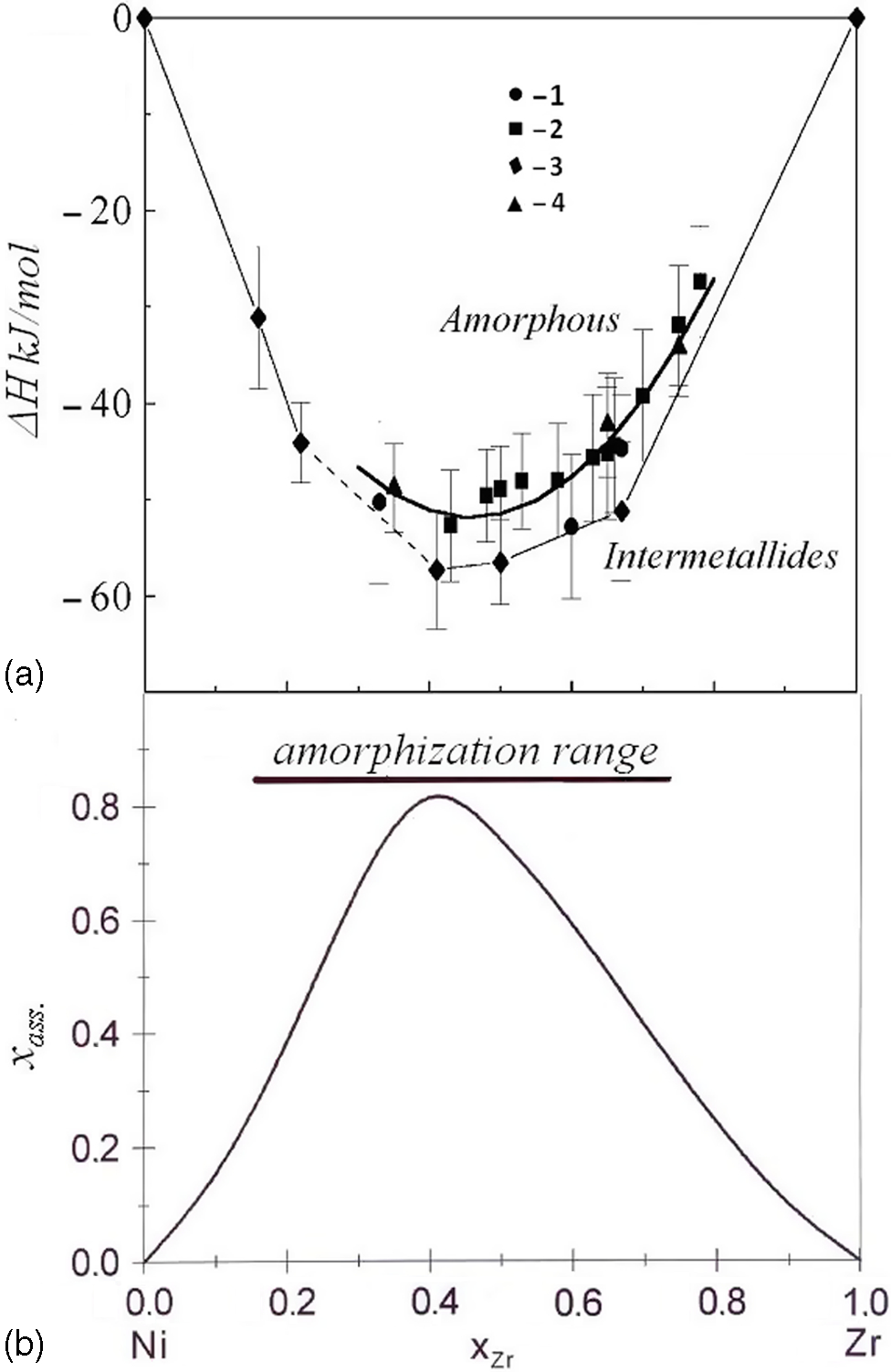
a enthalpy of formation of amorphous alloys: (1) from direct calorimetric experiments 24 ; (2) calculated from data of Henaff et al. 25 for enthalpies of crystallisation and enthalpies of formation of intermetallic phases; (3) enthalpies of formation of intermetallic phases recalculated from Turchanin et al. 24 from data of Henaff et al. 25 ; (4) experimental data of Henaff et al. 25 ; b total molar fraction of associates calculated from association solution theory 26
Likewise, high stability of the amorphous phase may not be a consequence of its high entropy. Decomposition of the amorphous phases occurs, as a rule, with the formation of multicomponent crystalline phases, which eliminates the change of configurational entropy calculated from the model of regular solutions. Indirectly, the existence of associates in the amorphous alloys is confirmed by the fact of increase in activation energy of crystallisation by formation of more complex crystalline phases. 33
In nature, there are very stable systems with really high entropy. Good examples can be the natural mixtures of isotopes of chemical elements. Cadmium, for example, has eight isotopes, six of which are present in approximately equal amounts. Tin has 10 isotopes; the presence of 7 of them also corresponds to the formation of high entropy mixture. However, although such mixtures have high stability, they do not possess any outstanding properties compared to the single isotopes. At the same time, a considerable energy is required to separate elements into isotopes. Another example of high entropy system is natural oil, which is a solution of vast number of organic substances with similar chemical properties. The oil, at least at the initial stages of its distillation, can be considered as a regular or ideal solution, which in fact is not so easy to separate into individual components or even fractions. However, in the physicochemical calculations of petroleum refining processes, the term ‘high entropy system’ is not used. Stability of high entropy systems is reflected not in some special properties but in the fact that their separation into constituent components requires significant energy costs.
A question arises at this point: what stands behind the special terminology like ‘high entropy alloys’, and are these alloys really very specific physical substances that open ‘a new era’ in materials science? Multicomponent metallic alloys are indeed promising in search of new materials having unexpected properties, but it is unlikely to connect these properties with configurational entropy calculated for ideal solutions according to equation (1). In this context, the term ‘high entropy alloys’ seems rather declarative than reflecting physical nature of multicomponent systems.
In conclusion, we would like to note that the thermodynamic approach to multicomponent systems is very useful. We also recognise that the term ‘high entropy alloys’ is already widely known. We only want to acknowledge that the contribution of the HEA concept into thermodynamics of multicomponent alloys is quite modest. To say the least, in real practically important metallic systems, strong interactions between components always win the battle with chaos, decreasing entropy. At the same time, in multicomponent systems where the interactions between components are weak and entropy wins, advanced properties can hardly be expected. So, from a practical point of view, such systems are simply not attractive.