







Abstract
Alloys involving multiple solutes where the concentrations are such that it becomes difficult to identify a “solvent”, such as the so called “high entropy alloys”, have the potential for interesting combinations of properties. A key question relates to the fundamental mechanisms of plastic deformation in these alloys. A simple lattice strain framework is proposed for complex concentrated alloys to address the energetics and kinetics of dislocations and twins. It is argued that the lattice strain in highly concentrated alloys raises the base energy of the crystal and thereby reduces the additional energy required to nucleate dislocations and twins. However, the kinetics of dislocation motion are dampened by the lattice strain and local energy variations. This is reflected in lower values of activation volume. This framework can be used to design non-equiatomic high entropy alloy matrixes that enhance the properties achieved thus far.
Keywords
Introduction
The fundamental alloying principles have attracted metallurgists from more than a century. Structural materials have progressively become more complex, both compositionally and microstructurally, based on a detailed understanding of alloying principles. For example, if one considers common structural alloy families such as steels, aluminium alloys, nickel based superalloys and titanium alloys, the wide range of alloying principles can easily be appreciated. These alloys will be referred to below as “conventional alloys”. The focus of the present article is on the plastic deformation of high entropy alloys (HEAs).1,2 However, to provide a proper perspective, a broader approach is taken under the nomenclature of “complex concentrated alloys” (CCAs); a cogent case for this approach has recently been argued by Miracle. 3
Ashby's 4 materials selection criteria in the context of plastic deformation based goals are strength, fatigue, toughness and creep limiting designs. The basic mechanisms involved in all these deformation based approaches relate to dislocations and twinning. Kumar et al. 5 have recently highlighted the excellent strength, fatigue limit, toughness and high temperature strength that can be achieved in the best HEAs.6–9 Hemphill et al. 7 noted an exceptionally high value of fatigue endurance limit. Typically, the ratio of fatigue strength to ultimate tensile strength is in the range of 0.3–0.55, whereas the value noted for HEAs was < 0.7. A conventional low stacking fault energy alloy such as stainless steel is known to undergo planar slip, which reduces the fatigue life, but that is not the case for the initial results on an HEA alloy. 7 The toughness value of < 200 MPa m1/2 reported by Gludovatz et al. 8 is again among the highest achieved for metallic materials. With respect to high temperature behaviour, HEAs show remarkable resistance to elevated temperature softening9–12 and higher activation energy values.13,14 What, then, are the unique characteristics of the deformation mechanisms that make these properties possible? Can this framework be used to design CCAs that expand the current range of HEAs?
Brief survey of highly concentrated conventional alloys
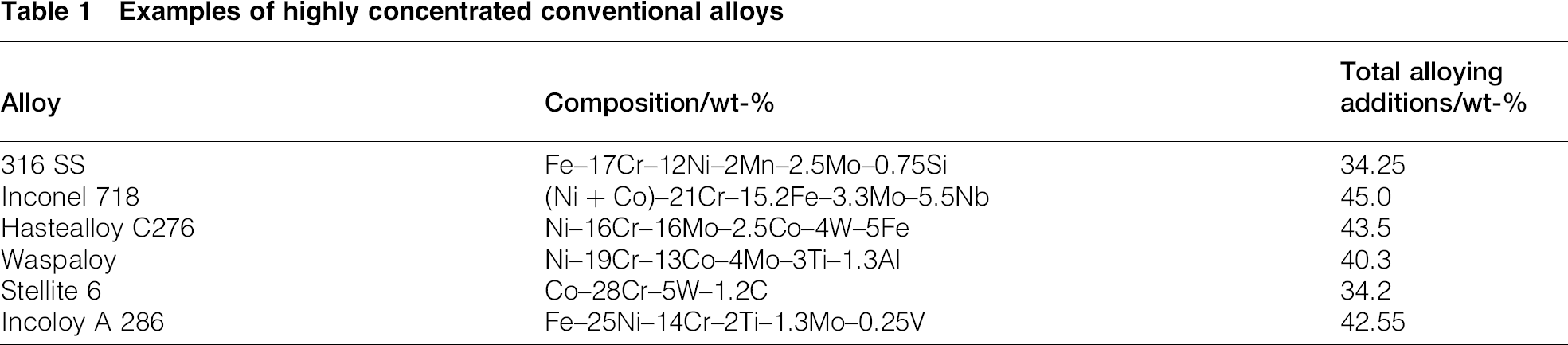
A brief survey of highly concentrated conventional alloys sets the scene for the current discussion. Consideration of solid solution strengthening in isomorphous alloy systems goes back to the early days of dislocation studies. A classic example is the Ag–Au system where maximum strength is achieved at an equiatomic composition, i.e. with 50 solute. It is notable that the experimental variation of lattice parameter in this system does not follow the linear average given by the lever rule. The lattice strain caused by the solute is calculated on the basis of the parent lattice constant (although this definition breaks down for equiatomic composition, i.e. 50:50). Other examples of highly concentrated alloys span the spectrum from steels to nickel based superalloys, which use a variety of strengthening mechanisms and are usually multiphase alloys. Representative examples are given in Table 1. The Fe–Ni–Cr–Ti precipitation strengthened austenitic steel (A286 steel) has almost 40 solute content and Ni3Ti strengthening precipitates. In this case, the addition of Ni stabilises the austenitic phase, but the lattice does represent Fe and solutes occupy substitutional sites. In addition, the stacking fault energy of such alloys is quite low, which directly influences the dislocation plasticity, including planar slip. This discussion is intended to illustrate that some conventional alloys had very high alloying content before the development of HEAs and that their microstructural complexity was also high. It is argued in the following section that a similar approach can be used to develop HEA complex alloys.
Examples of highly concentrated conventional alloys
Alloying principles used to design HEAs and future possibilities
As highlighted in early reports, the alloying principle used for HEAs is distinct from that for conventional alloys. The conventional approach is to add alloying elements to a host matrix (Fig. 1). Even for highly concentrated alloys, the host crystal structure is the basis for microstructure development (see discussion below on plastic deformation). In contrast, synthesis of the initial HEAs was based on an equiatomic approach (Fig. 1), which remains the focus of most investigations. The objective is to form a solid solution with a facecentred cubic (fcc),1 body centred cubic1 or hexagonal close packed 15 crystal structure. Murty et al. 16 have produced a comprehensive list of such alloys in a review that summarises the current state of understanding. The nomenclature “high entropy alloy” derives from the concept of maximising the configurational entropy. While this is an important aspect of these highly concentrated alloys, we focus on two other aspects that underpin mechanical behaviour: the crystal structure and the modulus.
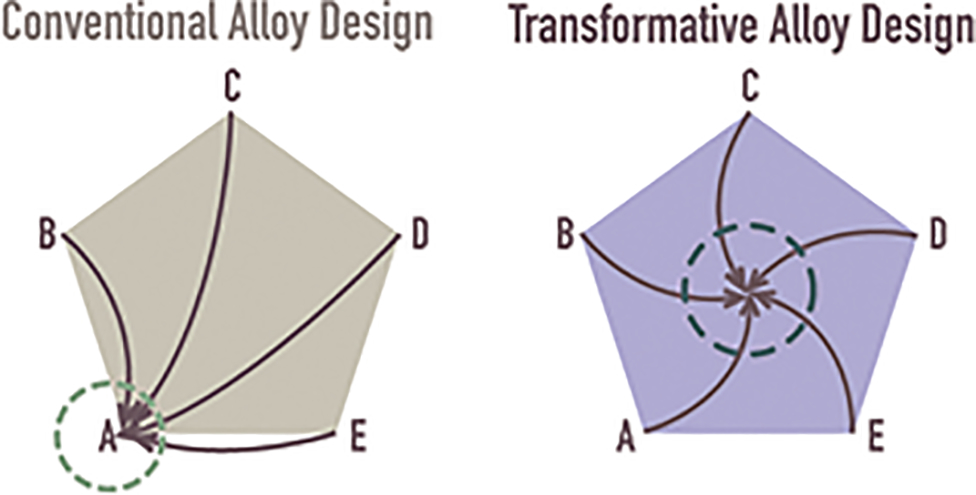
Schematic illustration of conventional alloying approach and HEA concept: HEA design is of interest because of its multicomponent approach to produce stable extended solid solutions
Consider the crystal structure of an HEA, which impacts the nature of dislocation plasticity directly. CoCrFeMnNi HEAs form an fcc solid solution, but only Ni has an fcc crystal structure at all temperatures; Fe has an fcc structure over a certain temperature range. This raises the question of whether the HEA fcc crystal structure “belongs” to any single element in this alloy, as would be the case for a conventional fcc alloy. An answer requires further research in terms of the relationship between the native crystal structure of the alloying elements and the resultant HEA crystal structure. Similar argument can be extended to the discussion of shear modulus. The shear modulus of a CoCrFeMnNi HEA, for example, is based on the lattice structure and reflects the average bond strength. 17 As discussed below, this will have a direct bearing on the properties of dislocations, since the line energy is directly related to the shear modulus. Murty et al. 16 have summarised various possibilities for the formation of these extended solid solutions. Even if a binary intermetallic is considered as the starting point to create a lattice structure that progressively turns into a concentrated solid solution by substitution, the final shear modulus would be dictated by the atomic bonds in the solid solution. The emerging information about atomic structure will shed light on whether short range preferences exist between specific alloying elements that will affect the average bond strength.
Additionally, non-equiatomic compositions open up the compositional and microstructural space by orders of magnitude. While it is not possible to deal with this broader discussion on multiphase concentrated alloys here, it suffices to say that that dispersion strengthening effects can be potent. The current discussion could provide the basis for creating matrixes for multiphase complex concentrated alloys. Just a few examples of non-equiatomic compositions are put forward in Fig. 2, and it can be inferred that a vast array is possible. Types 2 and 3 are solid solutions and represent possibilities that have been pursued, involving small additions of elements with different properties. This concept will be important for the discussion of lattice strain below. Type 4 is a composition purposefully designed to promote dispersion strengthening; in an approach akin to A286 stainless steel, ∼2Ti is added to an Al–Cr–Ni solid solution matrix to form Ni3Ti precipitates. Such approaches make the possibilities for engineering alloy design very rich. Borrowing from aluminium alloy metallurgy, one can adopt a 2xxx alloy approach where the intermetallic precipitate forms with the matrix element (Al with Cu) or a 7xxx alloy approach where two alloying elements (Zn with Mg) form an intermetallic independent of the matrix element. In the microstructural design of quinary HEAs, ABCDE can be treated as base and second phase can be incorporated for dispersion strengthening. This broader approach can be classified as CCAs, which derive the matrix crystal structure from a combination of elements and not from the conventional individual element.
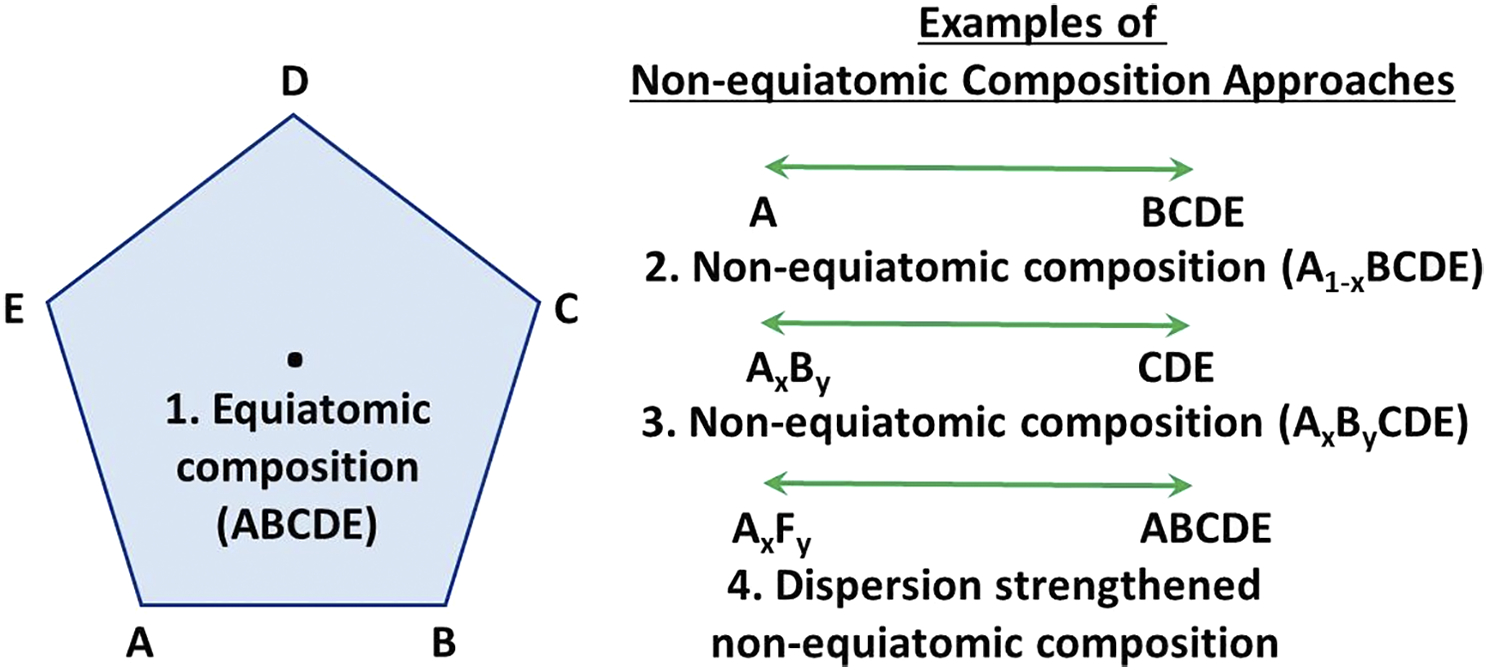
Non-equiatomic possibilities for complex concentrated alloy compositions: types 2 and 3 are solid solutions, and type 4 is dispersion strengthened; these are simple examples of very large number of possibilities to design non-equiatomic alloys and HEA matrixes for dispersion strengthened alloys
Implications of lattice strain for dislocations and twins: Framework for plastic deformation?
Several researchers have highlighted the concept of lattice distortion in the design of HEAs, even if the connection to mechanical behaviour is not explicitly framed.18–20 The creation of a framework for plastic deformation is the focus of the present discussion (Fig. 3) (Kumar et al., unpublished work). From the literature, it is clear that the origin of the exceptional mechanical properties of HEAs, particularly the high fatigue endurance limit and very high toughness, are related to the competing behaviour of dislocations and twins (see Refs. 5 and 6 for overview plots). For simplicity, only the fcc crystal structure is considered here, although the applicability of this framework to other crystal structures will be obvious.
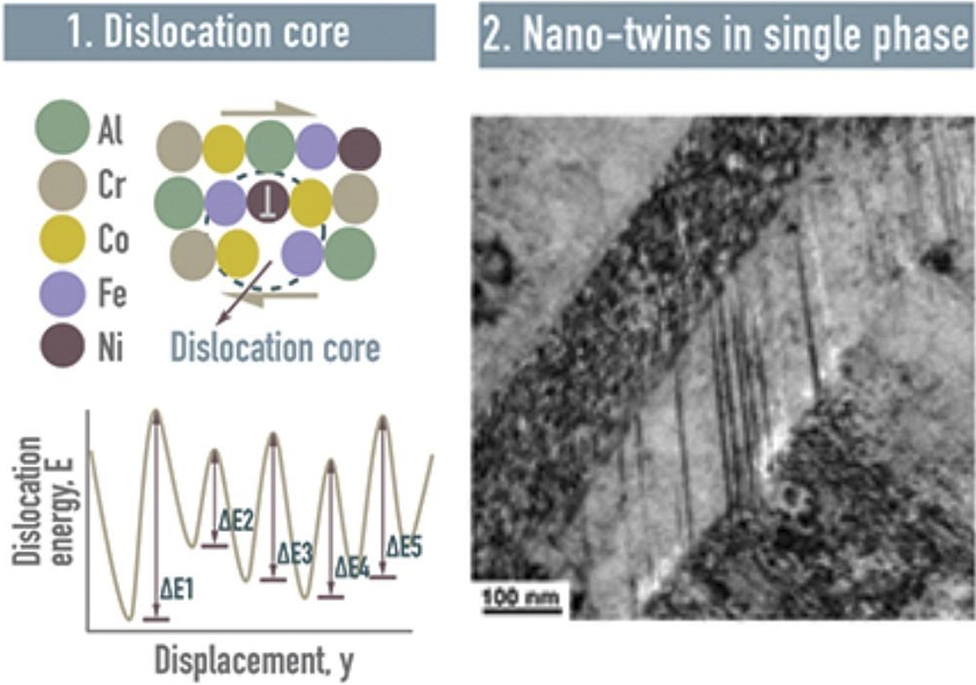
a illustration of likely dislocation core energy fluctuation in highly concentrated alloys along dislocation core and b observation of nanotwins and secondary nanotwins in HEA (Kumar et al., unpublished work): this can be used to develop framework involving energy and kinetics of dislocations and twins
The atomic misfit strain in representative single phase fcc HEAs alloys and conventional binary alloys is compared in Fig. 4. To calculate the atomic misfit strain, an average atomic radius was calculated for each alloy considered in Fig. 4, using Vegard's law
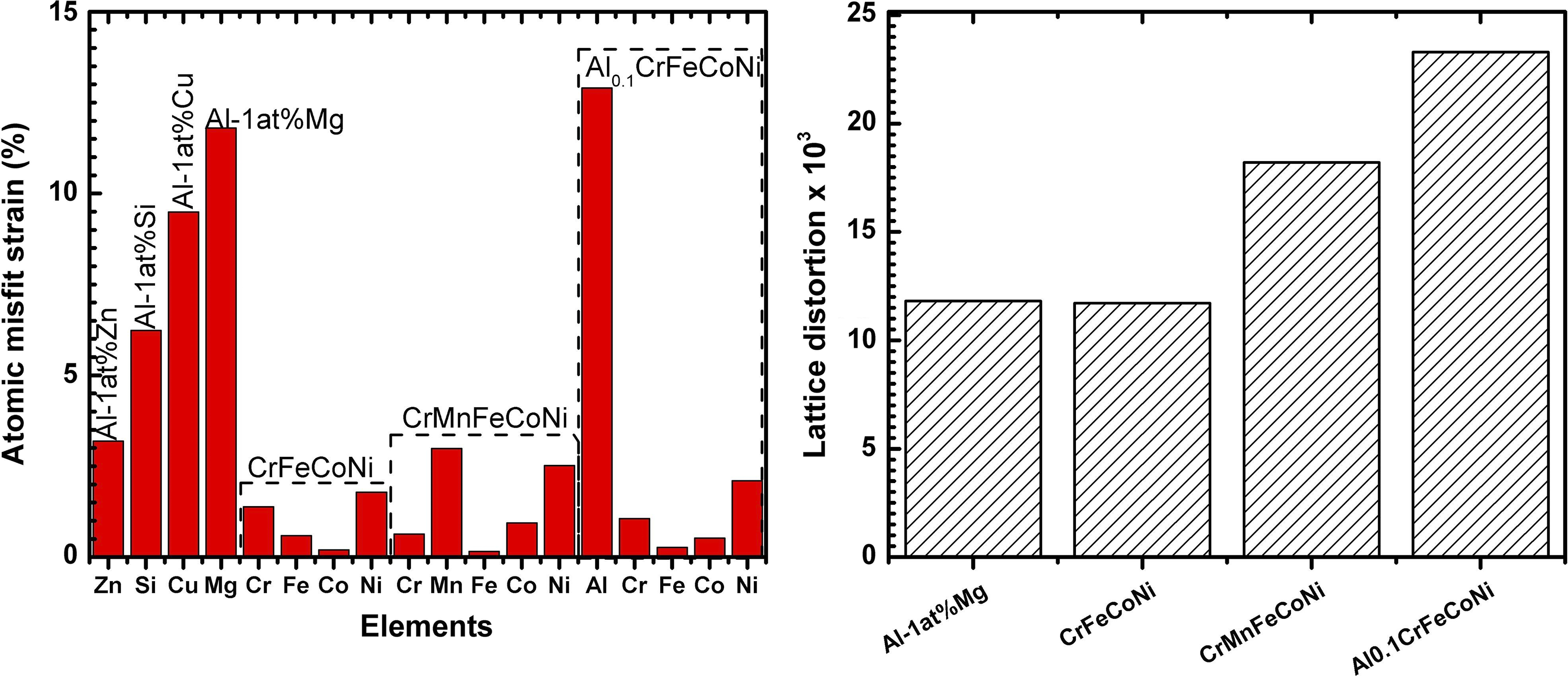
Comparison of a lattice misfit strain of single phase fcc HEAs and binary alloys and b lattice distortion of HEA and binary Al–1at-Mg alloy
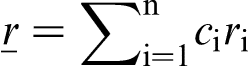
Although the magnitudes of misfit strain present in HEAs such as CrFeCoNi and CrMnFeCoNi are relatively small, their high concentrations would be expected to cause a correspondingly large distortion of the lattice. Lattice distortions for the alloy groups in Fig. 4a were calculated as
18

Consider a perfect, defect free fcc crystal with all atoms at their saddle points; the strain energy is defined here to be zero. With respect to this state, the core energy of a dislocation can be estimated from the displacement of atoms from their perfect positions. The difference in energy between a perfect crystal and one containing dislocations is large (Fig. 5a). In this conceptual argument, it is assumed that the cutoff radius for dislocation energy remains the same; a typical range for the cutoff radius is 50–100 times the magnitude of the Burgers vector. On the other hand, the lattice in very concentrated alloys such as HEAs is highly distorted and lattice strain is high. The nature of lattice strain caused by dislocations, which leads to contrast in a diffracted beam, differs from the local lattice strain discussed here in the context of HEAs. To differentiate between the two, the local, atomic displacement related strain is termed “lattice strain” and strain based on systematic lattice displacement around the dislocation core is termed “dislocation strain”. The lattice strain can again be visualised with reference to the perfect lattice position. In HEAs, all the atoms are likely to be displaced from the idealised saddle point of the fcc crystal lattice, to an extent governed by their local neighbours. These factors suggest that the energy for dislocation nucleation is likely to be lower in highly concentrated alloys than in conventional alloys and also that stacking fault energy and twin energy values will be lower. It is well established that solid solution alloys tend to have lower stacking fault energy. 21 On a simplistic view, this lowering of stacking fault energy can be attributed to the higher lattice strain energy. Very low stacking fault energy values have been reported for HEAs, 22 and a proportionality between the twin boundary energy and the stacking fault energy has been reported in some instances. 23
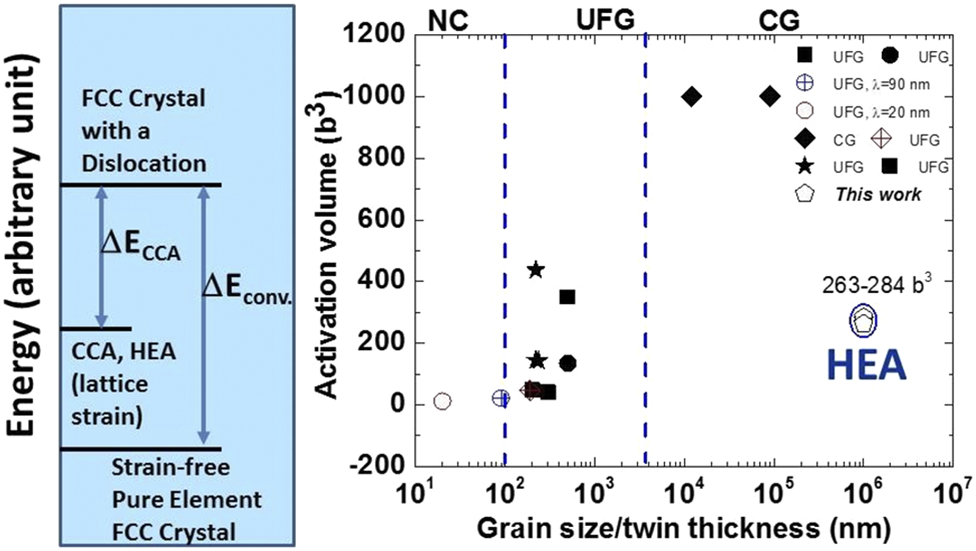
a schematic illustration of energy difference for dislocation in fcc crystal of pure element and concentrated alloy, in relation to role of lattice strain on dislocation energy: ΔEconv, and ΔECCA are activation energy for dislocation nucleation in conventional alloy and in complex concentrated alloys respectively. b measured activation volume in coarse grained HEA shows much lower value than in conventional alloy (Komarasamy et al., unpublished work): x-axis (grain size or twin thickness) represents interfacial barrier spacing
The second aspect of dislocations in HEAs is the kinetics. The influence of solutes on dislocation mobility can be measured by estimating activation volume, and the variation of activation volume with the grain size or twin thickness is shown in Fig. 5b. As the interfacial barrier spacing decreases, it limits the area available for dislocation sweep during stress change, and consequently, the activation volume goes down. A comparison of activation energy values for conventional coarse grained material and a coarse grained Al0.1CoCrFeNi HEA shows a difference of four times. The implication is that, during a stress change, the area swept by a dislocation in the HEA is considerably smaller. In the context of the current lattice strain discussion, the solutes in CCAs or HEAs can be visualised as damping dislocation motion. It is like moving a vehicle on a pebbled pathway (CCA) as opposed to a smooth road (conventional lattice). This argument would also apply to thickening of twins. At present, few observations of twinning have been made, but the mechanism is worth considering. Otto et al. 24 and Gludovatz et al. 8 observed no twinning at ambient temperature in CoCrFeMnNi HEA, whereas Komarasamy et al. (unpublished work) observed twinning in Al0.1CoCrFeNi HEA at ambient temperature as well as at 773K during tensile tests. As shown in Fig. 4a, the lattice strain values are different for these alloys. The causes require further investigation, but it appears that the lattice strain framework may explain the differences in the observation of twinning.
In conventional alloys, low stacking fault energy results in planar slip. Austenitic stainless steels are good examples of this. However, the early evidence in HEAs is that the workhardening rate is very high. 25 In particular, the onset of twinning in Al0.1CoCrFeNi alloy was observed to lead to exceptional workhardening.
Conclusions
The discussion here on the use of lattice strain to design complex concentrated alloys might be used to advantage provided the concepts can be expressed quantitatively and supported by detailed observations. For example, a multicomponent alloy ABCDE could have several minor alloying elements to promote high lattice strain. Taking ABCDEF0.1G0.1H0.1, there are five major and three minor elements. Such an approach of tailoring lattice strain and twin energy will give an alloy in which plastic deformation starts with dislocation glide, then uses twin nucleation as a mechanism to enhance workhardening.
It can be speculated that the coupling of twin boundaries or coherent boundaries with dislocation plasticity will lead to a new level of structural performance. Addition of further elements to precipitate a second phase without losing the high lattice strain could take advantage of the possibility of precipitation strengthening.