







Abstract
Effects of boron and lanthanum on the impurity iron in aluminium melt with 0·12 wt-% and 0·78 wt-% Fe were studied. The Al melts were held for enough time at 720°C with the addition of La, B, or both of La and B. La or B had no effects on the iron phases in purity aluminium when they were added solely. Only AlB2 phases formed after the addition of boron in the Al melts at 720°C, and precipitated to the bottom. AlB2 and Al–Fe phases were found after solidification. No phases formed with the addition of lanthanum in Al melt at 720°C, only α-Al11La3 and Al–Fe phases formed in aluminium samples after solidification. LaB6 formed in the Al melt at 720°C and settled down to the bottom of melt with the addition of La and B. LaB6 showed 3–5 at-% solubility for Fe when the initial Fe content was 0·78 wt-%, which caused iron content slightly decreased to 0·76 wt-%. However, LaB6 did not dissolve Fe atoms when the Fe content was as low as 0·15 wt-%.
Introduction
Iron is the most pervasive impurity element in aluminium alloys. Fe rich phases are reported to be brittle and have a relatively weak coherence with the Al matrix, which leads to serious mechanical property degradation, especially the ductility (Khalifa et al., 2003; Crepeau, 1995; Samuel et al., 1996). Thus, it is important to reduce the deleterious effect of iron. So far, Manganese can be used to successfully remove iron through the formation of primary α-Al(FeMn)Si in Al–Si alloys (Flores et al., 1998; Shabestari and Gruzleski, 1995; van der Donk et al., 1995; Nijhof et al., 1996; Cao et al., 2004; de Moraes et al., 2006). However, manganese addition leads to a lot of disadvantages (Gao et al., 2009a) and manganese has been severely restricted in Al alloys. In our previous studies, boron compound Na2B4O7 was found to be able to remove iron from Al melt, and the reason is the formation of iron borides (Gao et al., 2007; 2009a). In this study, we still studied the effect of boron on the iron in Al melts. Furthermore, lanthanum was also added in the Al melt to investigate its effect on iron.
Experimental
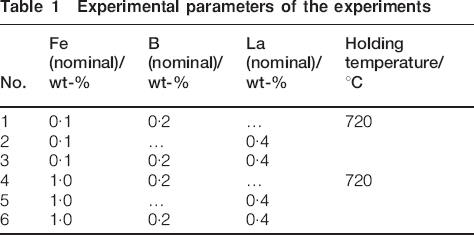
Purity aluminium ingots used in the experiments were prepared by melting high purity aluminium (99·999 wt-%) and high purity iron powder (99·9 wt%) in a medium frequency induction furnace. The iron compositions were adjusted to nominal 0·1 and 1·0 wt-%. Boron was added with Al–B master alloy, of which the chemical composition is Al–2·78B–0·074 Si–0·20Fe (wt-%). Purity lanthanum (>99 wt-%) was used. Lanthanum and boron were added into the purity aluminium melt to study their effect on the iron phase. The related experimental parameters are shown in Table 1. First, purity aluminium was melted in a corundum crucible (Φ80×100 mm) in an electric resistance furnace (3 kW), then the temperature was increased to 780°C. Second, lanthanum and Al–B master alloy were added. The mixed melt was thoroughly homogenised and kept at 780°C for ∼1 h in order to make lanthanum or Al–B alloy completely melt. Some melt samples were taken and the rest was poured into a corundum crucible (Φ35×70 mm), and then the melt was held for 2 h at 720°C. Finally, the melt was left to solidify in the furnace. The top and bottom parts of the aluminium ingots were cut off for analysis. Moreover, the bottom samples were dissolved in diluted hydrochloric acid in order to extract the phases during the holding process.
Experimental parameters of the experiments
The chemical compositions of the aluminium samples were studied by an inductively coupled plasma–atomic emission spectrometry machine (Thermo Jarrell Ash Company). The metallographic specimens were polished mechanically. Analysis of the intermetallic phases was carried out by scanning electron microscopy (SEM)/energy dispersive X-ray spectroscopy (EDX) (Jeol JSM-6460 Jap, EDAX AMETEK USA). Extracted phases of the bottom aluminium were detected with an X-ray diffractometer (D8 Discover with GADDS, BRUKER AXS, Germany).
Results and Discussion
In experiment no. 1 and no. 4, only boron was added into the Al melt. Platelet phases were found in the bottom part of the ingots as shown in Fig. 1, and the EDX analysis indicated that they were AlB2. As reported by Wang (2005), the morphology of AlB2 was platelet or bulk. No iron borides were found, which was consistent with our previous study (Gao et al., 2009b). Only AlB2 and Al–Fe binary phases were found in the samples of experiment no. 1 and no. 4. Therefore, the addition of boron had no effect on the iron phases. When only lanthanum was added into the Al melt in experiment no. 2 and no. 5, no phases were found at the bottom of the melt at 720°C. La and Al formed Al—La binary phases together and precipitated at the border of Al–matrix as shown in Fig. 2. Only Al–La phases and Al–Fe phases were found in the samples of experiment no. 2 and no. 5, no La–Fe or Al–La–Fe phases formed. According to Al–La phase diagram shown in Fig. 3, the precipitated Al–La phase should be α-Al11La3.
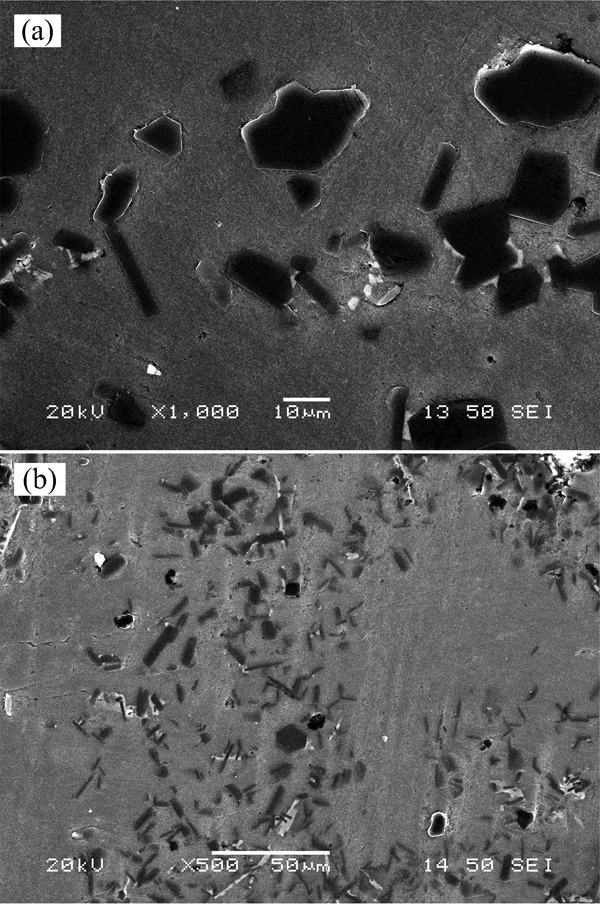
Image (SEM) of bottom sample in a experiment no. 1 with 0·1 wt-%Fe, 0·2 wt-%B and b experiment no. 4 with 1·0 wt-% Fe, 0·2 wt-%B
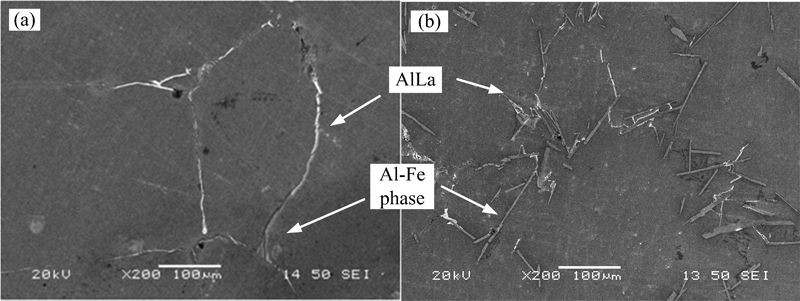
Image (SEM) of bottom sample in a experiment no. 2 with 0·1 wt-%Fe, 0·4 wt-%La and b experiment no. 5 with 1·0 wt-%Fe, 0·4 wt-%La
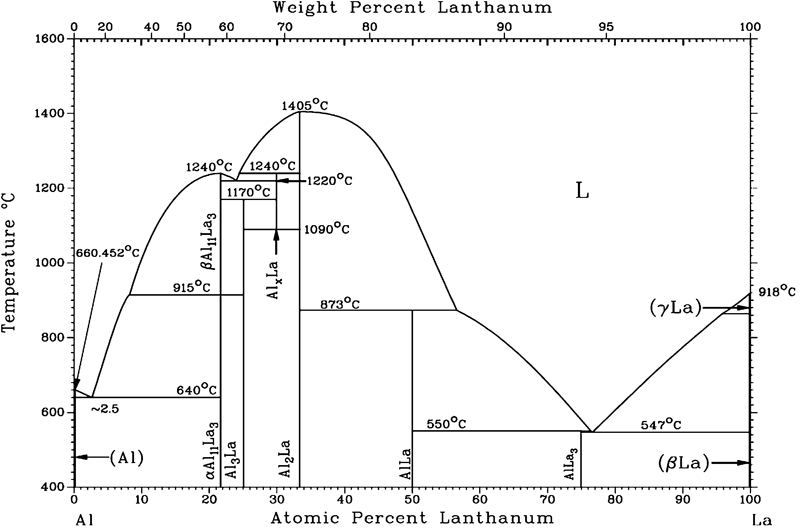
Al–La binary phase diagram (Okamoto et al., 1990)
When both lanthanum and boron were added into the Al melt with 0·1 wt-%Fe in experiment no. 3, un-known bulk phases settled down at the bottom of the melt as shown in Fig. 4. Unlike AlB2, the bulk phases were much brighter than other phases in the second electron scene. The morphology of the bright bulk phases was round or polyhedral. Energy dispersive X-ray analysis indicated that the bright bulk phases were rich in La and B. Because the atomic number of La is much higher than Al, the bulk phase was brighter than the Al matrix or AlB2 in the second electron scene. There were also a few AlB2 phases at the bottom, but the number of them was much less than that in the experiment no. 1. No Al–La binary phases were found precipitated at the border of Al matrix. Almost all the added lanthanum was found in the bright bulk phases. Thus, La and B were supposed to react in the Al melt and formed the bulk phases. However, no iron was found in these bright bulk phases by EDX analysis and the Al–Fe binary phase was the only place where we can find the element Fe.
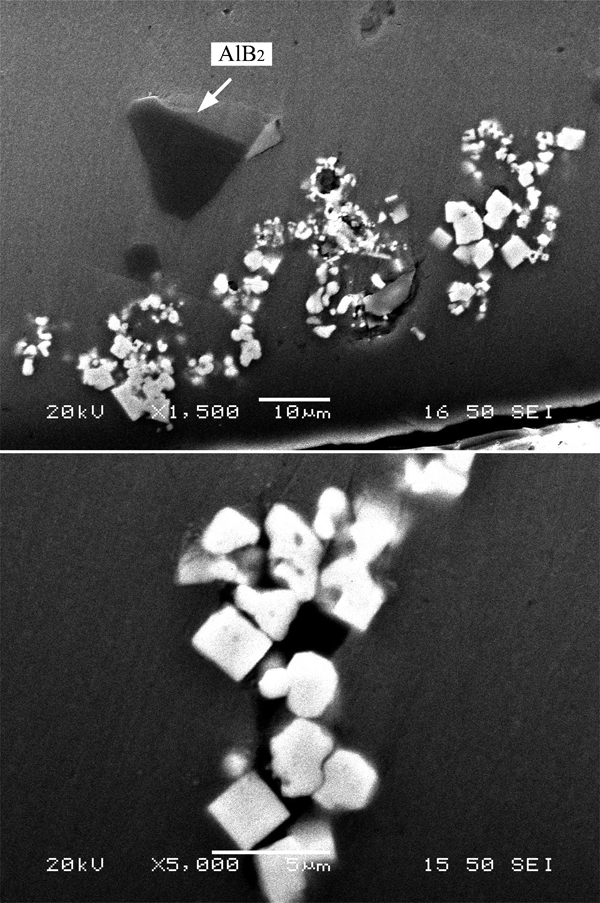
Image (SEM) of bottom sample in experiment no. 3 with 0·1 wt%Fe, 0·2 wt-%B, 0·4 wt-%La
In experiment no. 6, the bright bulk phases were also found in the bottom samples, as shown in Fig. 5. The iron concentration (1·0 wt-%) was higher than that in experiment no. 3 while the lanthanum and boron addition was the same. However, different from experiment no. 3, the bulk phase showed 3–5 at-% solubility for Fe in the bottom samples according to the EDX analysis. Figure 6 is the section EDX results of the bulk phases in experiment no. 6, which shows the distribution of element Al, Fe, La. It is obvious from Fig. 6 that La and Fe is much richer in the bulk phases than that in the Al matrix. The precipitated bulk phases in experiment no. 3 and no. 6 were extracted and analysed by X-ray diffraction as shown in Fig. 7. From Fig. 7, it can be seen obviously that the bulk phases are LaB6.
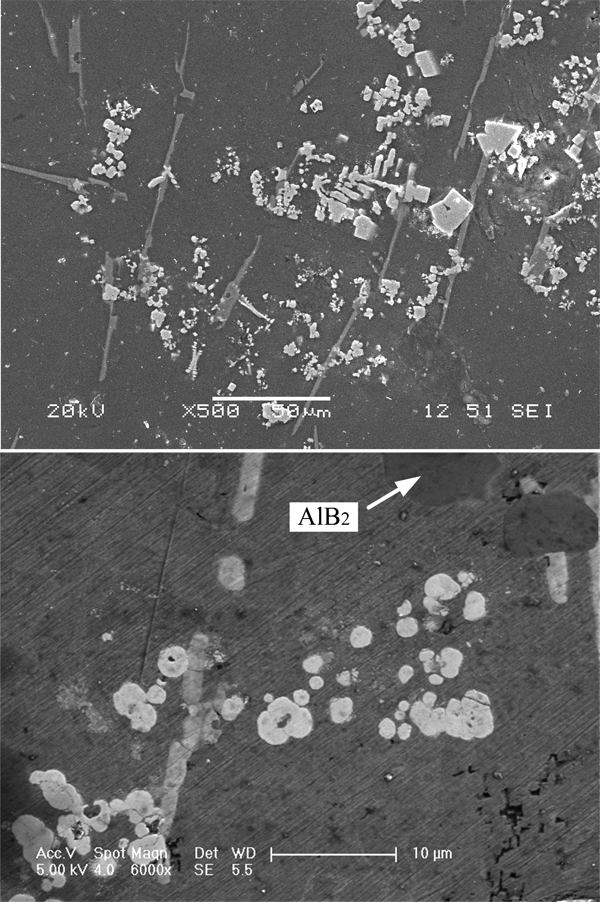
Image (SEM) of bottom sample in experiment no. 6 with 1·0 wt-%Fe, 0·2 wt-%B, 0·4 wt-%La
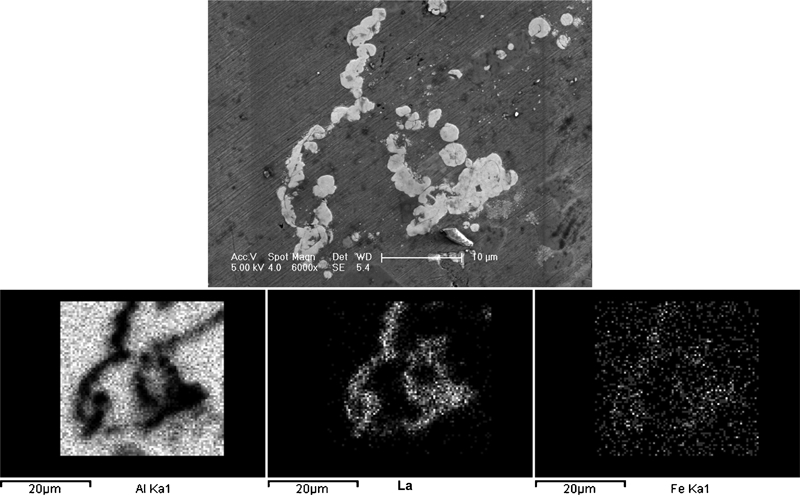
Energy dispersive X-ray analysis of bulk phase formed in experiment no. 6
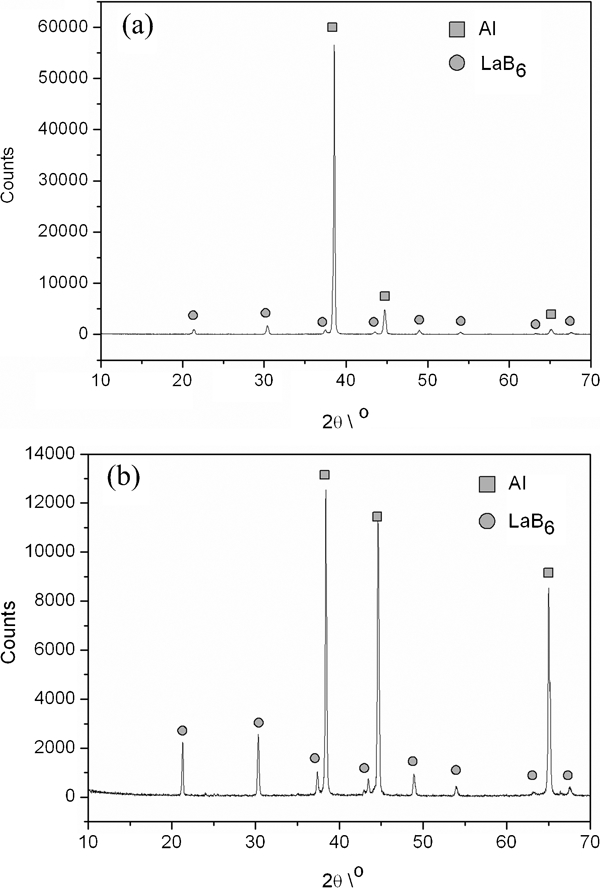
X-ray diffraction pattern of extracted bulk phases in a no. 3 and b no. 6
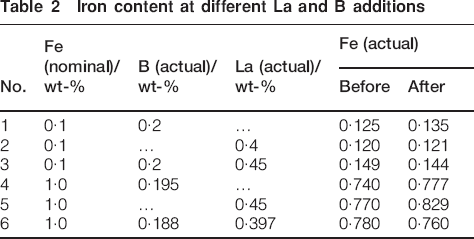
Table 2 shows the iron content before and after the treatment, and it can be seen that the iron content does not decrease in experiment nos. 1–5. While in experiment no. 6, the iron content is slightly reduced. The reason is that LaB6 shows solubility for iron when the iron content is high (0·78 wt-%), and iron is removed with LaB6 by settling down to the bottom. However, iron cannot be dissolved in the LaB6 when iron content is as low as 0·1 wt-% in experiment no. 3.
Iron content at different La and B additions
LaB6 is a stable compound which forms at ∼2000°C according to the B–La binary system thermodynamic evaluation reported by Schlesinger et al. (1999). However, there are no reports about the thermodynamics of the Al–La–B ternary system. No related data are available to evaluate the solubility of Fe in LaB6 in the current study.
Conclusion
Addition of La or B had no effects on the iron phases in purity aluminium in which the iron content is ∼0·12 and ∼0·78 wt-%. With the addition of boron, only AlB2 phases formed in Al melt at a holding temperature of 720°C and settled down to the bottom. AlB2 and Al–Fe binary phases were all the phases could be found in the related samples. No phases formed after the addition of lanthanum at 720°C in the Al melt. La can only be along with Al to form α-Al11La3 and precipitated at the borders of Al matrix during the solidification of Al melt.
LaB6 formed in the Al melt at 720°C with the addition of La and B both, and settled down to the bottom of melt. LaB6 showed 3–5 at-% solubility for Fe when the initial Fe content is 0·78 wt-%, and the iron content slightly decreased to 0·76 wt-%. Iron was removed with LaB6. However, when the Fe content was as low as 0·15 wt-%, LaB6 cannot dissolve any Fe and the Fe content would not be reduced.