







Abstract
The phase equilibria in the ZnO–‘FeO’–Al2O3–CaO–SiO2–Na2O (K2O) system have been determined experimentally in equilibrium with metallic iron. Pseudoternary sections ZnO–‘FeO’–(Al2O3+CaO+SiO2) for CaO/SiO2 = 0·71 (weight), (CaO+SiO2)/Al2O3 = 5·0 (weight) and fixed Na2O or K2O content have been constructed. It has been found that the addition of 1·0 wt-%Na2O or K2O does not introduce any new primary phases in the composition range investigated. The presence of 1·0 wt-%Na2O or K2O in the liquid phase extends the wustite primary phase field and reduces the size of the spinel primary phase field. Liquidus temperatures are slightly increased in the wustite primary phase field and decreased in the spinel primary phase field by addition of 1·0 wt-%Na2O or K2O. Neither Na2O nor K2O is detected in the wustite or spinel solid solutions. The presence of 1·0 wt-%Na2O or K2O in the slag does not affect the partitioning of the ZnO between the solid (wustite or spinel) and liquid phases.
Introduction
ZnO, ‘FeO’, SiO2, CaO and Al2O3 are major components of zinc and lead smelting slags. Phase equilibria studies in the ZnO–‘FeO’–CaO–SiO2 (Jak et al., 2002a, b) and ZnO–‘FeO’–Al2O3–CaO–SiO2 (Zhao et al., 2010a, b; Zhao et al., 2011a, b, c) systems in equilibrium with metallic iron have previously been carried out over a wide range of compositions relevant to zinc and lead blast furnace slags. Historically, alkali concentrations in zinc and lead blast furnace slags have been low since the feed to these primary smelting processes has been almost exclusively from mineral concentrates. The use of material feed stocks from the recycling of waste dusts, leach products and other secondary materials is increasing as lead and zinc smelting processes offer a cost effective and environmentally acceptable method of processing these materials (Hayes et al., 2010). Inevitably, these secondary materials contain components, such as Na and K at relatively higher levels compared with the concentrates. Given also the potential to enrich the alkali concentrations in the tapping slag by vaporisation and recondensation processes, similar to the recirculation reported in the iron blast furnace (El-Geassy et al., 1986; Bergman, 1989), it is clear that further data on these systems are needed.
There is no information available in the literature on the phase equilibria studies in the ZnO–‘FeO’–Al2O3–CaO–SiO2–Na2O–K2O system under reducing conditions. The present investigation, which forms part of a series of studies examining the range of slag compositions relevant to zinc blast furnace and lead blast furnace processes, has therefore been undertaken to characterise the effect of alkalis on the liquidus temperatures of these slags.
The experimental techniques used in this study have been described in detail in a previous paper (Zhao et al., 2010a). Essentially, the approach involves high temperature equilibration, quenching and electron probe X-ray microanalysis (EPMA) of the resulting phases. The master slags were prepared from high purity ZnO, SiO2, Al2O3 and CaCO3 powders and melted in air at temperatures between 1573 and 1773 K for several hours. The quenched master slags were ground and mixed with metallic iron (excess 15 wt-%) and K2CO3 or Na2CO3 (99·9 wt-%) powders to obtain the final mixtures. Approximately 0·3 g mixture was then pelletised and wrapped into envelopes of platinum (0·025 mm thick) or iron foil (0·1 mm thick) for high temperature equilibration under an ultra high purity N2 gas (O2<1 ppm; H2O<1 ppm) atmosphere. After equilibration, the samples were rapidly quenched into water.
The compositions of the equilibrium liquid (glass) and crystallised phases were measured using a JEOL 8800L electron probe X-ray microanalyser with wavelength dispersive spectrometers. An accelerating voltage of 15 kV and a probe current of 15 nA were used. The Duncumb–Philibert ZAF correction procedure supplied with JEOL 8800L was applied. The standards used for analysis were from Charles M. Taylor Co. (Stanford, CA, USA): Al2O3 for Al, Fe2O3 for Fe, CaSiO3 for Ca and Si, NaAlSi3O8 for Na, KAlSi3O8 for K and from Micro-Analysis Consultants Ltd (Cambridge, UK): ZnO for Zn. The average accuracy of the EPMA measurements is within 1 wt-% for major components ZnO, ‘FeO’, SiO2, CaO and Al2O3, which is verified by comparison with standards as unknowns during the analysis. Particular attention was paid to the reliability of compositional measurements of Na2O and K2O. Measurements of standards as unknowns were always undertaken to evaluate the reliability of the EPMA measurements. It was shown that the accuracy of the EPMA measurements for Na2O or K2O was <10% of their concentrations, i.e. ±0·1 wt-% for 1·0 wt-%. Six to twenty measurements were usually carried out at different areas of the quenched liquid phase. The composition of the liquid (glass) was calculated on an average.
Only metal element concentrations are measured by EPMA; the oxygen content is calculated according to the assumed oxidation states of the elements. Since the experiments were carried out under reducing conditions, i.e. metallic iron saturation, all iron in the slag was recalculated to FeO for presentation purposes.
Results and Discussion
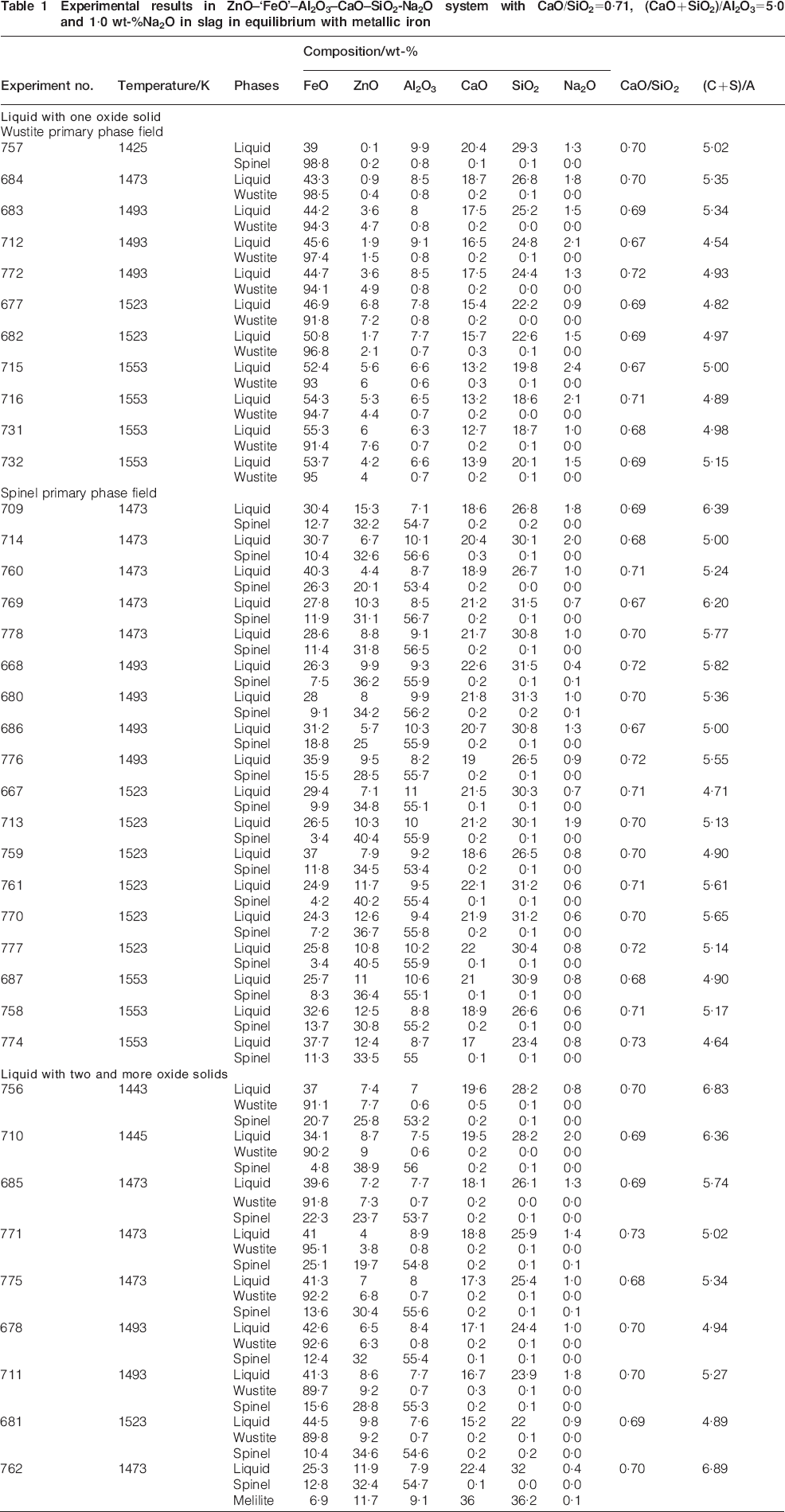
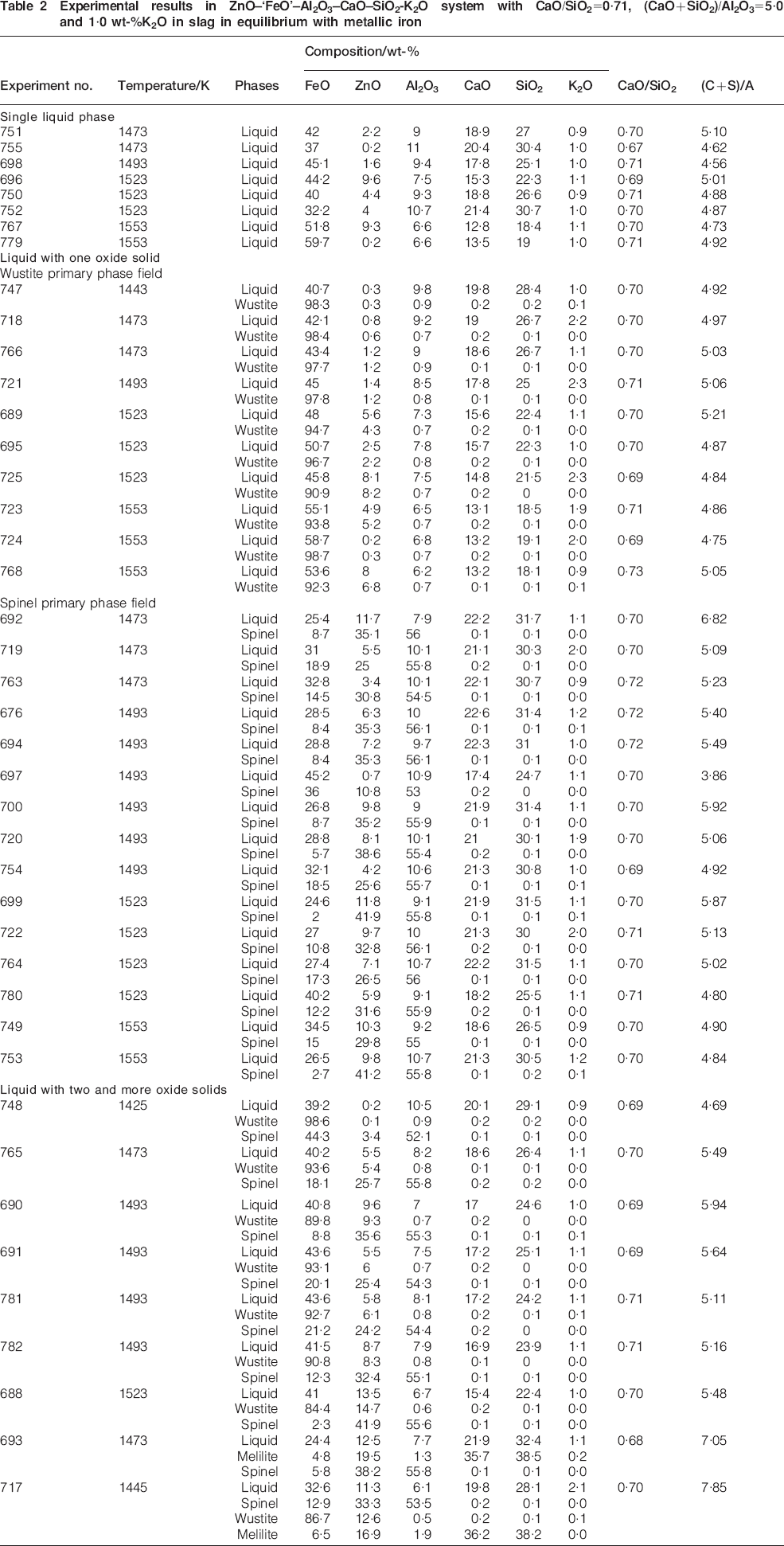
This paper presents the experimental results in the ZnO–‘FeO’–Al2O3–CaO–SiO2–Na2O and ZnO–‘FeO’–Al2O3–CaO–SiO2–K2O systems with CaO/SiO2 weight ratio of 0·71 and (CaO+SiO2)/Al2O3 weight ratio of 5·0 at nominally 1·0 wt-%Na2O or K2O in the liquid in equilibrium with metallic iron. These slag compositions were selected for study because of their direct relevance to lead and zinc blast furnace and smelting practice. The phase equilibria in the multicomponent systems can be conveniently represented on the pseudoternary as shown in Fig. 1. The end members of the section have been selected to be ZnO, ‘FeO’ and (Al2O3+CaO+SiO2), with CaO/SiO2 = 0·71 and (CaO+SiO2)/Al2O3 = 5·0 at fixed Na2O or K2O concentration of 1·0 wt-% in the liquid phase. The compositions of the phases obtained from these experiments are given in Tables 1 and 2 for Na2O- and K2O-containing systems respectively. Metallic iron is present in all samples. Less than 0·5 wt-%Zn was detected in the iron phase so that the composition of iron is not given in the tables.
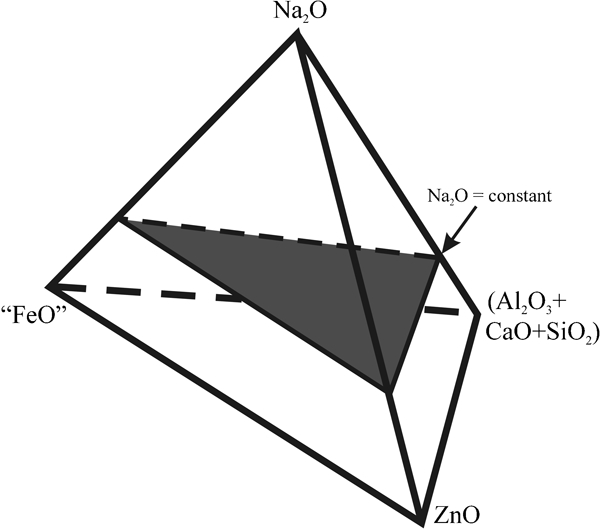
Pseudoternary section of ZnO–‘FeO’–(Al2O3+CaO+SiO2) system at constant Na2O in equilibrium with metallic iron
Experimental results in ZnO–‘FeO’–Al2O3–CaO–SiO2-Na2O system with CaO/SiO2 = 0·71, (CaO+SiO2)/Al2O3 = 5·0 and 1·0 wt-%Na2O in slag in equilibrium with metallic iron
Experimental results in ZnO–‘FeO’–Al2O3–CaO–SiO2-K2O system with CaO/SiO2 = 0·71, (CaO+SiO2)/Al2O3 = 5·0 and 1·0 wt-%K2O in slag in equilibrium with metallic iron
The liquidus surfaces of the pseudoternary sections constructed from the experimental data are presented in Figs. 2 and 3 for Na2O- and K2O-containing systems respectively. In the figures, the symbols represent the measured liquid compositions close to the desired section. Not all of the data available in Tables 1 and 2 have been included in the figures. The solid thin lines represent experimentally determined isotherms and solid thick lines represent the boundary between the primary phase fields of wustite and spinel. The isotherms shown on the figures have been deduced from interpolation of all available data and self-consistency within the respective primary phase fields. It can be seen that wustite (Fe, Zn)O and spinel (Fe2+, Zn)O.(Al, Fe3+)2O3 are the primary phases in the composition range investigated, which is the same as reported in the Na2O- and K2O-free slag systems (Zhao et al., 2010a, b; Zhao et al., 2011a, b, c).
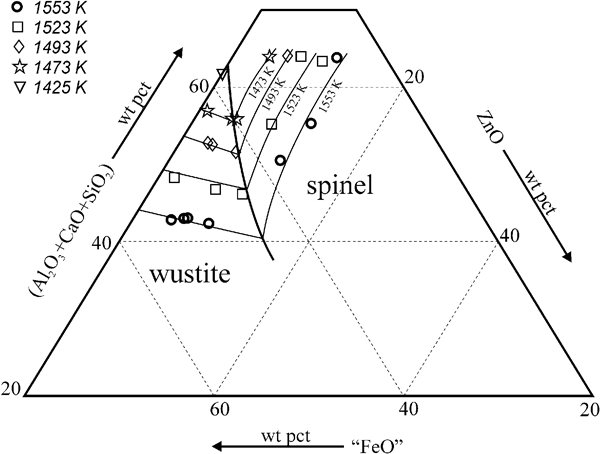
Experimental results in ZnO–‘FeO’–Al2O3–CaO–SiO2–Na2O system with CaO/SiO2 of 0·71, (CaO+SiO2)/Al2O3 of 5·0 and 1·0 wt-%Na2O in slag in equilibrium with metallic iron
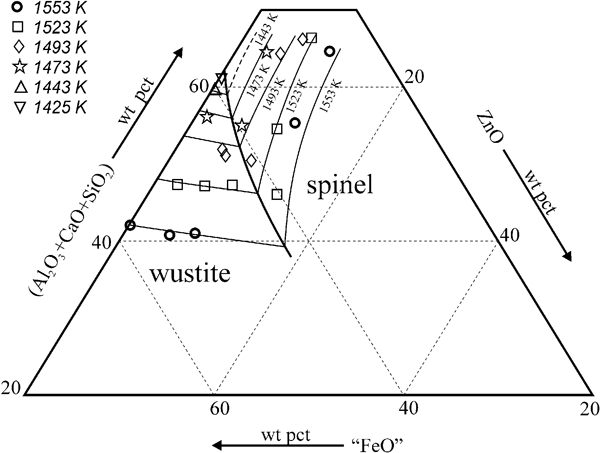
Experimental results in ZnO–‘FeO’–Al2O3–CaO–SiO2–K2O system with CaO/SiO2 of 0·71, (CaO+SiO2)/Al2O3 of 5·0 and 1·0 wt-%K2O in slag in equilibrium with metallic iron
It can be seen from Figs. 2 and 3 that the liquidus temperatures in the spinel primary phase field progressively increase with increasing ZnO concentration. The liquidus temperatures in the wustite primary phase field increase with increasing (‘FeO’+ZnO) concentration.
Effects of Na2O and K2O on primary phase fields and liquidus temperatures
The effects of Na2O and K2O on the extent of the primary phase fields and the liquidus temperatures are evaluated using the experimental data obtained in the present study. Experimentally determined phase boundaries between primary phase fields of wustite and spinel and 1523 K isotherms are compared in Fig. 4 for the alkali free (Zhao et al., 2011a), Na2O- and K2O-containing slags. It can be seen that Na2O and K2O have similar effects on the liquidus temperatures. An increase in Na2O and K2O concentration from 0 to 1wt-% in the liquid extends the wustite primary phase field and reduces the size of the spinel primary phase field.
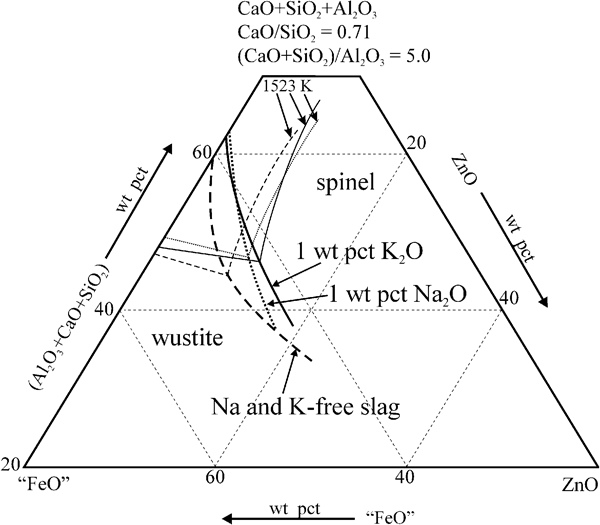
Effects of Na2O and K2O on primary phase field in equilibrium with metallic iron at CaO/SiO2 of 0·71 and (CaO+SiO2)/Al2O3 of 5·0
The liquidus temperatures in the wustite primary phase field are plotted against ‘FeO’/(Al2O3+CaO+SiO2) weight ratio (see Fig. 5) for the zinc free ‘FeO’–Al2O3–CaO–SiO2, Na2O- and K2O-containing slags at fixed CaO/SiO2 weight ratio of 0·71, (CaO+SiO2)/Al2O3 weight ratio of 5·0 and fixed Na2O or K2O concentration of 1·0 wt-% in equilibrium with metallic iron. It can be seen that the wustite liquidus temperatures increase with increasing ‘FeO’/(Al2O3+CaO+SiO2) weight ratio, and the addition of 1·0 wt-%Na2O or K2O into the liquid slag increases the liquidus temperature by ∼10 K.
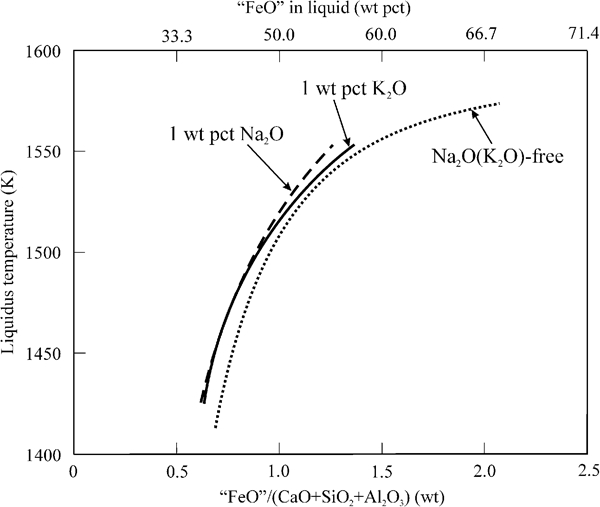
Effects of Na2O and K2O on wustite liquidus temperature in ‘FeO’–Al2O3–CaO–SiO2–Na2O–K2O system in equilibrium with metallic iron at CaO/SiO2 of 0·71 and (CaO+SiO2)/Al2O3 of 5·0
The effect of Na2O or K2O on wustite liquidus temperatures on the above zinc free, iron saturated slags is compared with predictions of FactSage 6·1 (Bale et al., 2002) for 50·0 wt-%‘FeO’ (see Fig. 6). Experimental and predicted data both indicate that the addition of alkali increases the liquidus temperatures at low alkali concentrations. Na2O appears to have a more significant effect than K2O on the increase in the wustite liquidus temperatures. The FactSage 6·1 database, however, appears to overpredict the increase in liquidus temperature with the presence of Na2O. The same trends were observed in the phase diagrams in the ‘FeO’–SiO2–Na2O (Schairer et al., 1954) and ‘FeO’–SiO2–K2O (Roedder, 1952) systems both in equilibrium with metallic iron. FactSage calculations show that the oxygen partial pressures at liquidus conditions given in Fig. 6 are in the range of 10−12–10−11 atm.
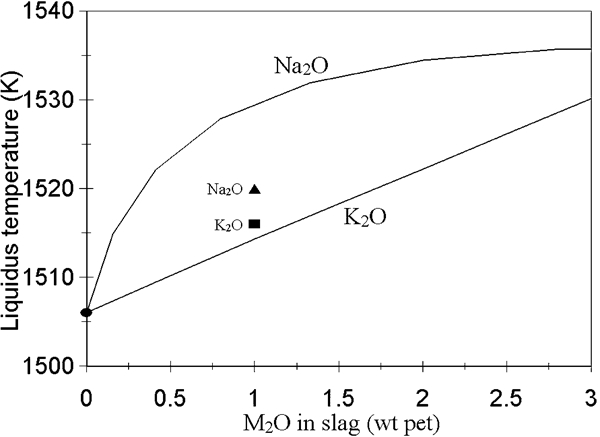
Effects of Na2O and K2O concentrations on liquidus temperatures in wustite primary phase field at iron saturation at CaO/SiO2 of 0·71, (CaO+SiO2)/Al2O3 of 5·0 and ‘FeO’/(Al2O3+CaO+SiO2) of 1·0: lines: FactSage 6·1 prediction; symbols: experimental results
Figure 7 shows the liquidus temperatures in the spinel primary phase field as a function of ZnO concentration at fixed CaO/SiO2 ratio of 0·71, (CaO+SiO2)/Al2O3 ratio of 5·0 and ‘FeO’/(Al2O3+CaO+SiO2) ratio of 0·52. It can be seen that the liquidus temperatures in the spinel primary phase field increase significantly with increasing ZnO concentrations. The presence of 1·0 wt-%Na2O or K2O in the liquid decreases the liquidus temperatures in the spinel primary phase field by up to 20 K.
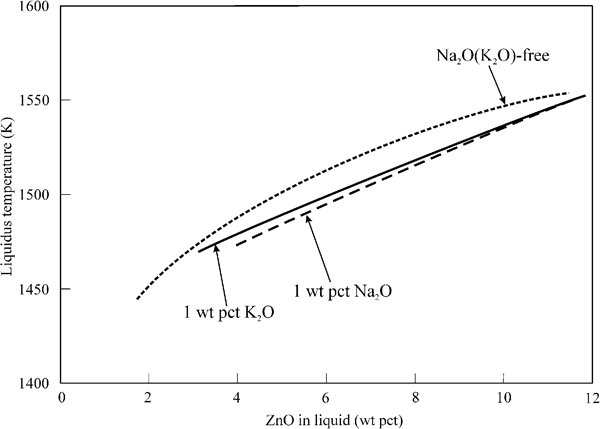
Effects of Na2O and K2O on spinel liquidus temperature of ZnO–‘FeO’–Al2O3–CaO–SiO2 slags in equilibrium with metallic iron at CaO/SiO2 of 0·71, (CaO+SiO2)/Al2O3 of 5·0 and ‘FeO’/(Al2O3+CaO+SiO2) of 0·52
The present study confirms that the effect of the presence of Na2O and K2O on the slag liquidus temperature is complex. The data presented in Figs. 4–7 for CaO/SiO2 ratio of 0·71 and (CaO+SiO2)/Al2O3 ratio of 5·0 show that in general the liquidus temperatures of slags in the wustite primary phase field are increased and the liquidus temperatures in the spinel primary phase field are decreased, by the presence of Na2O and K2O. Inspection of Fig. 4 shows that for zinc-containing slag doubly saturated with wustite and spinel, if 1 wt-%Na2O is present in the slag at 1523 K, the ‘FeO’ concentration should be lowered by ∼5 wt-% in order to maintain a fully liquid slag. If this adjustment is not made, then ∼7 wt-% solid wustite will be formed in the slag, and this can be deduced through the use of the lever rule on the appropriate pseudoternary section (see Fig. 4).
If, on the other hand, the slag contains a lower (CaO+SiO2)/Al2O3 ratio, it has been shown (Zhao et al., 2011a) that the spinel primary phase field is favoured for typical ISF smelter conditions. The present study indicates that the presence of Na2O or K2O will decrease the liquidus temperatures of these spinel slags.
The presence of Na2O and K2O in the ISF slag may have other effects on the operation. For example, it is to be expected that increasing the concentrations of these components would increase the extent of their vaporisation from the lower furnace zone and condensation in the upper shaft, potentially leading to increased fuel requirements. The life of furnace refractories may also be affected by the presence of alkali elements. On the other hand, from the point of view of process economics, these factors may be offset by the significantly lower costs of secondary zinc source materials.
Solid/liquid equilibria
One of the advantages using the quenching and EPMA techniques is that the compositions of all phases present at equilibrium including liquid and solid compositions are determined (see Tables 1 and 2).
It was found that ‘FeO’ and ZnO are the major components in the wustite solid solution. The solubility of alumina in wustite is found to be <1 wt-% in the composition and temperature range investigated. Na2O and K2O do not dissolve in the wustite phase.
The partitioning of ZnO between liquid and wustite is presented in Fig. 8. The data on alkali-free slags (Zhao et al., 2011a) are also presented in the figure for comparison. It can be seen that the presence of Na2O and K2O in the slag does not have a significant effect on ZnO partitioning between liquid and wustite phases. All data given in Fig. 8 including alkali-free and alkali-containing slags can be represented with the following equation

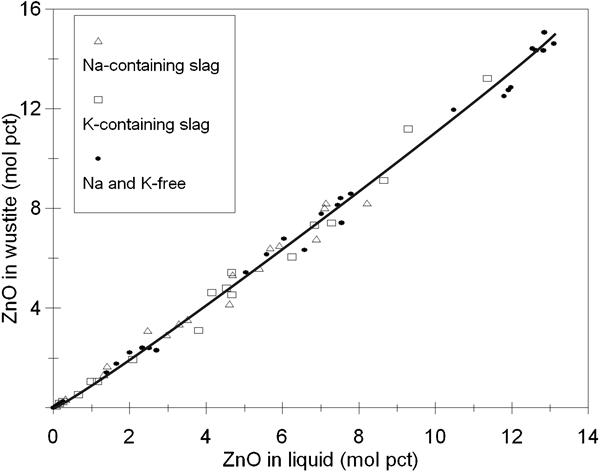
Partitioning of ZnO between liquid and wustite for temperatures between 1425 and 1553 K in equilibrium with metallic iron at CaO/SiO2 of 0·68–0·73 and (CaO+SiO2)/Al2O3 of 4·4–6·4
The spinel phase can exist over a range of compositions, and in the system under study, these may be represented by the formula (Fe2+, Zn)O.(Al, Fe3+)2O3. The Al2O3 concentration in the spinel is found to be in the range of 45–50 mol.-%, which indicates that Fe2O3 in the spinel is in the range of 0–5 mol.-% in the composition and temperature range investigated. No significant concentrations of Na2O and K2O were detected in the spinel phase. The partitioning of ZnO between liquid and spinel is presented in Fig. 9 for Na2O- and K2O-containing slags. It can be seen that as ZnO concentrations in the spinel phase increase with increasing ZnO in the liquid, ZnO partitions preferentially to the spinel phase.
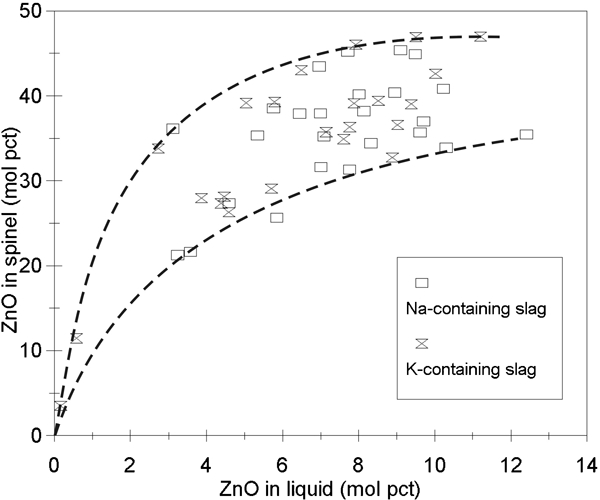
Partitioning of ZnO between liquid and spinel for temperatures between 1445 and 1553 K in equilibrium with metallic iron at CaO/SiO2 of 0·67–0·73 and (CaO+SiO2)/Al2O3 of 3·9–6·9
Summary
The phase equilibria in the ZnO–‘FeO’–Al2O3–CaO–SiO2–Na2O–K2O system have been determined experimentally in equilibrium with metallic iron. Pseudoternary sections of the form ZnO–‘FeO’–(Al2O3+CaO+SiO2) for CaO/SiO2 ratio of 0·71, (CaO+SiO2)/Al2O3 ratio of 5·0 and fixed Na2O or K2O concentration have been constructed. It has been found that the presence of 1·0 wt-%Na2O or 1·0 wt-%K2O does not introduce any new primary phases in the composition range investigated. The addition of 1·0 wt-%Na2O or 1·0 wt-%K2O extends the wustite primary phase field and reduces the size of the spinel primary phase field. Addition of 1·0 wt-%Na2O or 1·0 wt-%K2O slightly increases liquidus temperatures in the wustite primary phase field and decreases liquidus temperatures in the spinel primary phase field. ZnO is found to partition approximately equally between liquid and wustite phases, and preferentially to the spinel phase than to the liquid phase.
Footnotes
Acknowledgements
The authors wish to thank the Australian Research Council (ARC-SPIRT scheme), ISP Ltd, Britannia Zinc Ltd, Enirisorse SA, Pasminco Sulphide, Rio Tinto Technical Services, MHD GmbH, Metaleurop and Hachinohe Smelting Co. Ltd for providing the financial support to enable this research to be carried out.