







Abstract
The kinetic analysis for non-isothermal solid state reduction of nickel laterite ore by carbon monoxide was investigated at four different heating rates (5, 10, 15 and 20 K min−1). The mechanism function f(α) and kinetic parameters of the reduction process of nickel laterite ore were determined by the thermogravimetric curves using Coats–Redfern method, and the reduction mechanism of nickel laterite ore was analysed. The results indicated that the degree of conversion α could be considered as a function of the temperature, and heating rates had less effect. There was clear relationship between calculated values and measured values of the degree of conversion by mathematic model verification. The kinetic analysis for non-isothermal reduction of nickel laterite ore was divided into three stages for 200–600°C, 600–800°C and 800–950°C; activation energies were 32·16 kJ mol−1 for 200–380°C, 33·13 kJ mol−1 for 380–600°C respectively, for the initial stage, which was characterised by a very slowrate; activation energy was 60·78 kJ mol−1 for the middle stage, which was characterised by a very fast rate; the reduction of nickel laterite ore remained a sluggish process at the decaying stage, and the reaction was governed by the diffusion of oxygen. The mechanism function belonged to G–B equation with differential forms f(α) = 3/2[(1−α)−1/3−1] at the initial stage, and that belonged to Avrami–Erofeer equation (n = 4) with differential form f(α) = 1/4(1−α)[−ln(1−α)]−3 at the middle stage.
Keywords
Introduction
Nickel laterite ore is formed by nickel olivine owing to the long periods of weathering and leaching. As oxidation of ferric after the deposit weathered, the ore showed red colour (Wang et al., 2008). In recent years, there has been an increased focus on the utilisation of nickel laterite ore, along with a growing demand for stainless steel and a declining supply of sulphide ores (Chang et al., 2008). Among these sulphide ores, nickel laterite ore comprises 73% of the world's nickel resources and will be the dominant source of nickel in the future. With the continuous depletion of high grade nickel ores such as millerite and niccolite, nickel laterite ore has became the major source for the production of nickel metal. However, currently, only 42% of the world's production of nickel comes from nickel laterite ore because the concentration of nickel in the ore is low (Jungah et al., 2010). Therefore, in the long term, it will be necessary to optimise nickel extraction from nickel laterite ore.
Solid state reduction of nickel laterite ore at low temperatures (⩽1000°C) is pretreatment process of nickel laterite ore using pyrometallurgy, improving the reduction rate of valuable metals from nickel laterite ore, so it is necessary to study the reduction kinetics of nickel laterite ore. Few investigations of reduction kinetics of nickel laterite ore have been performed for solid state deoxidisation, but several investigations mainly focused on the reduction kinetics of nickel oxide, analysing reduction mechanism and establishing kinetics model. For example, Utigard et al. (2005) investigated that the reduction kinetics of Goro nickel oxide using hydrogen, these authors measured the rate of reduction increased with increasing temperature and increasing hydrogen pressure in the temperature range from 400 to 600°C; when the temperature was increased above 600°C, the reduction rate decreased noticeably before suddenly becoming extremely fast above 950°C. The kinetic analysis of non-isothermal nickel oxide reduction in hydrogen atmosphere using the invariant kinetic parameters method was studied by Jankovic et al. (2007). The kinetics parameters (Ea, ln A) were determined using Friedman isoconversional method and the invariant kinetic parameters method. The values of invariant kinetic parameters were used for numerical evaluation of conversion function. Thereafter, Jankovic et al. (2008) conducted that the kinetic study of temperature programmed reduction of nickel oxide in hydrogen atmosphere at four different heating rates. The Malek's kinetic procedure was used for the determination of the most suitable kinetic model and calculation of a complete set of kinetic parameters. The kinetic model of the investigated reduction process was determined, and this model corresponded to the empirical two-parameter Sestak–Berggren equation which gave a more quantitative description. The kinetic triplet obtained for the investigated process was E0 = 90·8 kJ mol−1; ln A = 19·50 and f(α) = α0·63(1−α)1·39.
Based on the facts given above, in this paper, the kinetics and mechanism of solid state reduction of nickel laterite ore, which were obtained by the thermal analysis method, were investigated by non-isothermal reduction with carbon monoxide at the atmospheric pressure.
Experimental
Materials and Methods
Nickel laterite ore contains a large amount of water, with a moisture content on a dry basis of up to 20%, in the form of adsorbed and crystallised water. Drying was performed at 650°C in a corundum crucible within a muffle furnace for 1 h. Dried nickel laterite ores were ground to 20–40 mesh size using a laboratory scale ball mill. The chemical composition of the raw nickel laterite ore is 1·09Ni–0·023Co–9·12Fe–0·34Cr2O3–29·08MgO–2·47Al2O3–0·030CaO– 36·48SiO2 (mass-%). The ore contained approximately 1·09 mass-%Ni, 9·12 mass-%Fe, 2·47 mass-%Al2O3, 36·48 mass-%SiO2 and 29·08 mass-%MgO, which was typical of low grade nickel laterite ore combined with lizardite. Figure 1 shows the X-ray diffraction pattern of the nickel laterite ore. Nickel laterite ore is a complex mineral. X-ray diffraction analysis indicated that lizardite [(Mg, Al)3[(Si, Fe)2O5](OH)4], quartz [SiO2], magnetite [Fe3O4] and hematite [Fe2O3] are the primary crystalline phases (Li et al., 2011).
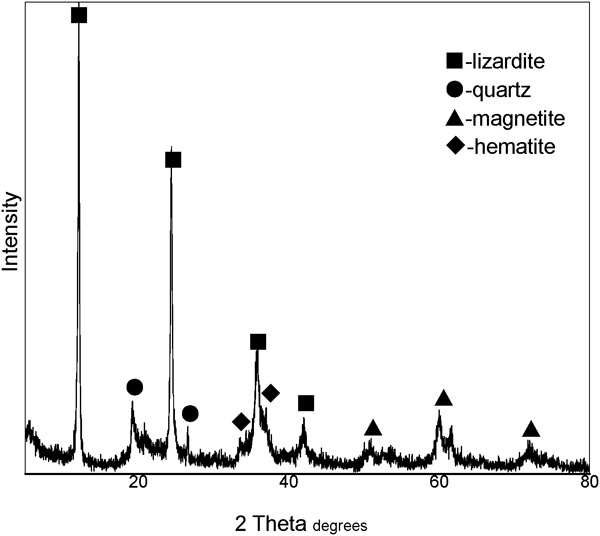
X-ray diffraction patterns of nickel laterite ore
Thermogravimetric (TG) measurements
The experiments were carried out in a NETZSCH STA 449F3 unit, capable of simultaneous TG differential scanning calorimetry analysis in the temperature range from 25 to 1600°C. The nickel oxide samples were reduced directly within the thermobalance, in korund pans, under (99·95 vol.-%) carbon monoxide flowing at a rate of 20 mL min−1, and using various heating rates: 5, 10, 15 and 20 K min−1, in the temperature range from an ambient one up to 950°C. The sample mass used for TG investigations was about 10±0·5 mg.
The total mass change of nickel laterite ore samples at all considered heating rates is ∼4·5%. The degree of conversion α of the reduction process is expressed as

Kinetic analysis
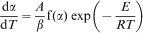
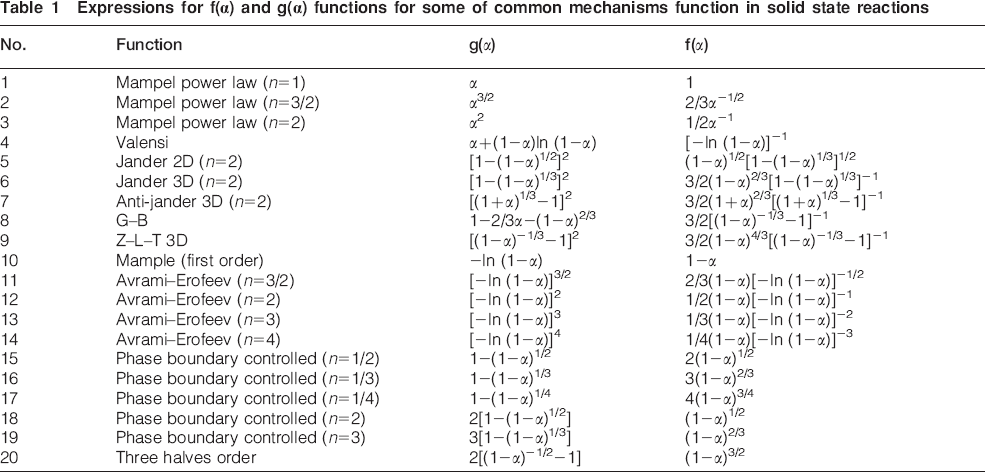
Experimental data for the kinetic analysis of heterogeneous gas–solid reactions can be obtained under different conditions. The authors analyse the data obtained under non-isothermal conditions, with a linear regime of temperature increase in time. Under such conditions, for a heterogeneous gas–solid reaction, occurring in a single step, the reaction rate is expressed by the well known general equation (Jankovic et al., 2007, 2008). The differential and integral functions of conversion f(α) used in this work are listed in Table 1
Expressions for f(α) and g(α) functions for some of common mechanisms function in solid state reactions
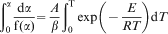
For each heating rate β, using an integral or differential method, the pairs (A, E), characteristic for each mechanism function, are determined. The equation (3) is obtained to integrate equation (2). It leads to the following relation








Results and Discussion
Experimental data analysis
The TG curves of the reduction process of nickel laterite ore by carbon monoxide obtained at different heating rates (5, 10, 15 and 20 K min−1) are shown in Fig. 2. Four different curves of mass loss were basically in coincidence. Although the heating rates were different, mass loss of nickel laterite ore were almost same in the gas–solid reduction process, as long as heating to the same temperature. Therefore, mass loss of nickel laterite ore was related to the heating temperature, and the heating rate had little effect on mass loss.
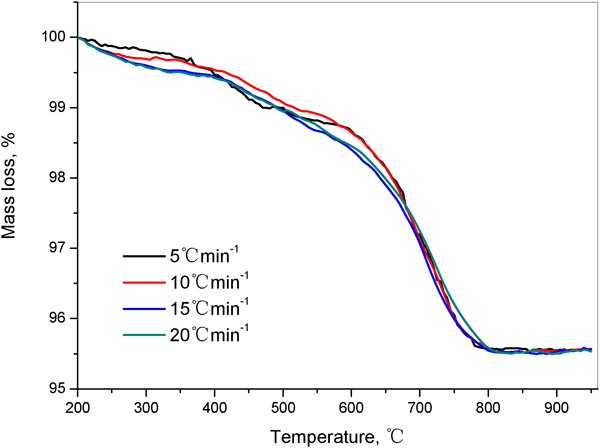
Thermogravimetric curves for reduction process of nickel laterite ore in carbon monoxide atmosphere at different heating rates
The α–t curves for the reduction process of nickel laterite ore in carbon monoxide atmosphere at different heating rates are shown in Fig. 3. The degree of conversion of nickel laterite ore was calculated using equation (1). The rate of reduction process of nickel laterite ore by carbon monoxide increased with increasing heating time, and the rate reached a certain value at last. With increasing heating rate, the rate of reduction process of nickel laterite ore by carbon monoxide increased.
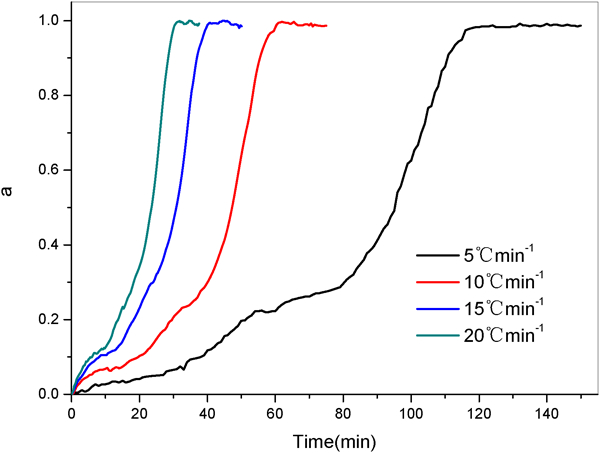
Curves of degree of conversion α and time for reduction process of nickel laterite ore in carbon monoxide atmosphere at different heating rates
The α–T curves for the reduction process of nickel laterite ore in carbon monoxide atmosphere at different heating rates are shown in Fig. 4. Four different α–T curves were basically in coincidence. Although the heating rates were different, the degrees of conversion were almost same in the gas–solid reduction process with heating to the same temperature. Therefore, the degree of conversion for the reduction process of nickel laterite ore was related to the heating temperature, and the heating rate had little effect on the degree of conversion.
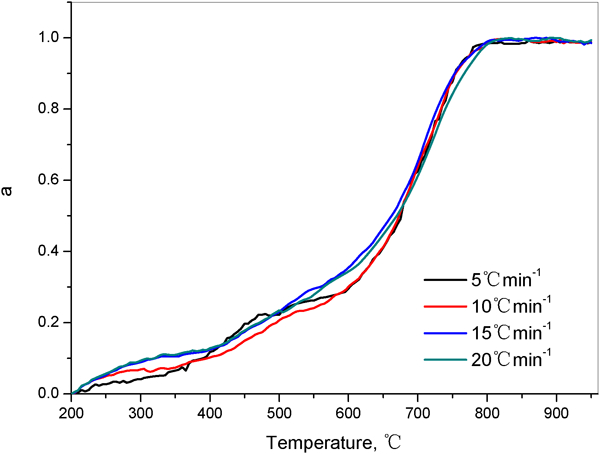
Degree of conversion α as function of temperature T for reduction process of nickel laterite ore in carbon monoxide atmosphere at different heating rates
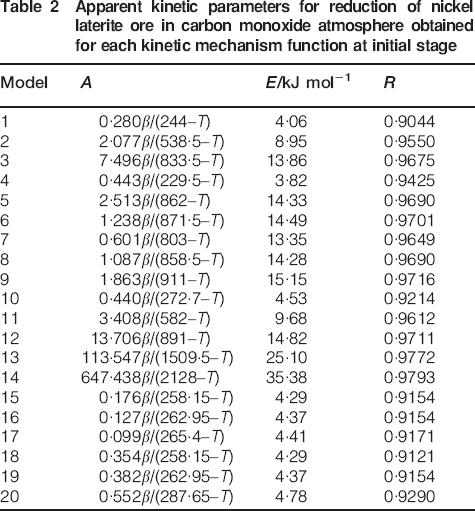
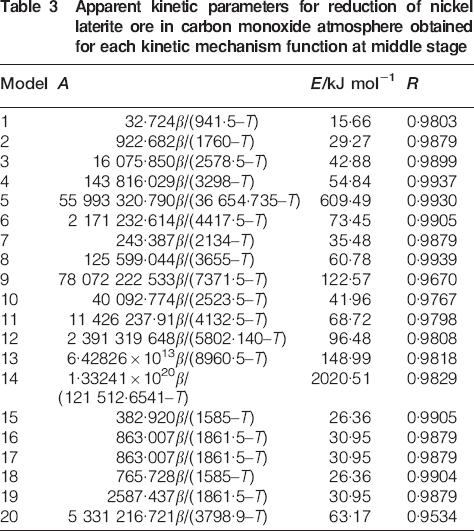
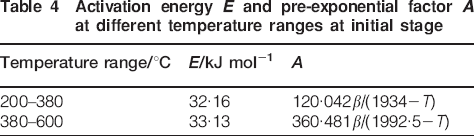
According to TG curves for the reduction process of nickel laterite ore, the kinetic analysis for non-isothermal solid state reduction of nickel laterite ore was divided into three stages, which included the initial stage for 200–600°C, the middle stage for 600–800°C, the decaying stage for 800–950°C based on the different temperature ranges. Mass loss of nickel laterite ore was caused by water evaporation below 200°C. Mass loss of nickel laterite ore had no obvious change at the decaying stage for temperature range of 800–950°C; therefore, the decaying stage was not analysed. For the initial stage and the middle stage, the kinetic mechanism function was determined by the calculation and verification of 20 types of kinetic mechanism functions. Apparent kinetic parameters for the reduction process of nickel laterite ore in carbon monoxide atmosphere, which were obtained for each kinetic mechanism function of the initial stage and middle stage, are shown in Tables 2 and 3. Based on the maximum correlation coefficient, G–B equation was determined to be mechanism function of the initial stage, which belongs to the type of random nucleation and growth, and its differential form is




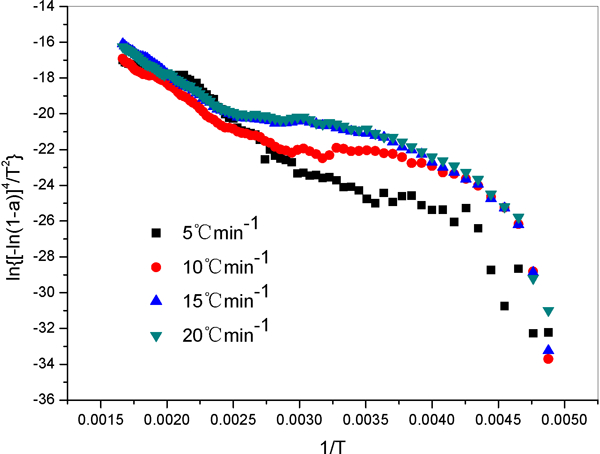
Relationship curves of ln{[−ln(1−α)]4/T2} and 1/T for different heating rates at initial stage
Apparent kinetic parameters for reduction of nickel laterite ore in carbon monoxide atmosphere obtained for each kinetic mechanism function at initial stage
Apparent kinetic parameters for reduction of nickel laterite ore in carbon monoxide atmosphere obtained for each kinetic mechanism function at middle stage
Activation energy E and pre-exponential factor A at different temperature ranges at initial stage
The relationship curves of
 and 1/T for different heating rates at the middle stage are shown in Fig. 6. Four different curves were basically in coincidence, and activation energy and pre-exponential factor can be calculated using slope and intercept. For the middle stage, the following kinetic parameters were obtained E = 60·78 kJ mol−1


Relationship curves of
and 1/T for different heating rates at middle stage
Mathematic model verification
Activation energies and pre-exponential factors for the initial stage and the middle stage were obtained by the calculation of kinetic equations, the results of which were substituted into equations (10) and (11) (Ma et al., 2002), and the mathematic model was established. The degree of conversion is a function of the temperature, and the calculated values of the degree of conversion are shown in Fig. 7. Except for some small deviations of individual stage, which was related to nickel catalyst, the calculated and measured values of the degree of conversion had well correlation (Hua, 2004).
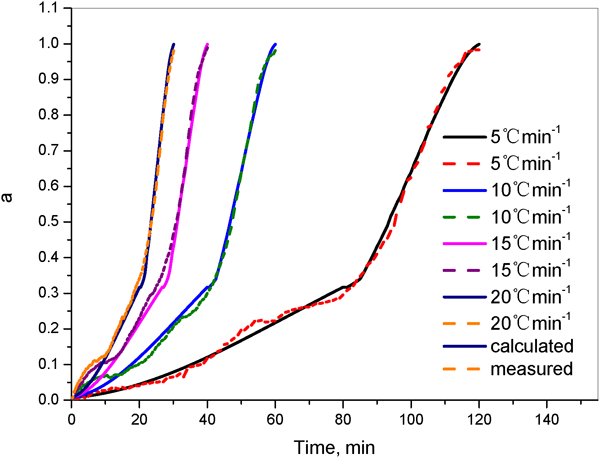
Degree of conversion α calculated and measured at different heating rates
Reduction mechanism analysis
For the reduction process of nickel laterite ore in carbon monoxide atmosphere, the reduction reactions can be expressed through the following equations






In the solid state reduction process of nickel laterite ore, the composition variation of CO and CO2 in gas products was investigated to analyse the reduction mechanism of nickel laterite ore (Abdel-Halim et al., 2008). Relationship of gas composition (CO and CO2) and temperature is shown in Fig. 8. The concentration of CO in gas products first decreased and then increased with increasing temperature, and that of CO2 in gas products first increased and then decreased with increasing temperature. At 700°C, the concentration of CO was minimum; the concentration of CO2 was maximum. The production rate of CO and reaction rate of CO reached the maximum at 700°C, so it was shown that reduction rate of nickel laterite ore was the fastest at 700°C.
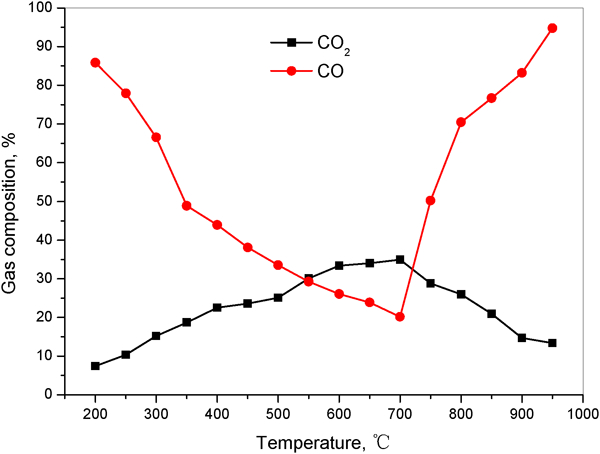
Relationship of gas composition (CO and CO2) and temperature
The kinetic analysis method reveals that the solid state reduction of nickel laterite ore does not follow a single mechanism because the determined activation energies and pre-exponential factors are not constant during the course of the reaction. The mechanism analysis for the non-isothermal reduction process of nickel laterite ore was divided into three stages: the initial stage for the temperature range of 200–600°C, characterised by a very slow rate; the first stage for the temperature range of 200–380°C, indicated that external diffusion for mass transfer of gas reactants and resultants between carbon monoxide flow and mineral surface, and internal diffusion of gas reactants and resultants through solid layer; the second stage for the temperature range of 380–600°C, represented the adsorption of carbon monoxide on nickel laterite ore surface and the slow formation of nuclei of nickel and low valence iron oxide (Wen et al., 2011); the middle stage for the temperature range of 600–800°C, characterised by a fast rate, was preceded by a short transition period during which the reaction accelerated rapidly, probably due to the autocatalytic effect of the nickel nuclei formed during the initial stage; furthermore, carbon monoxide adsorption on reduced nickel and low valence iron oxide was much faster as compared to that on nickel laterite ore. Once the reduction rate reached a maximum, it stabilised and became virtually unchanging; the decaying stage for the temperature range of 800–950°C, characterised by a gradually decreasing reduction rate, for the decaying stage, that was, in the proximity of complete reduction, even at high temperatures, the reduction remained a sluggish process which may be attributed to the entrapment of the unreduced nickel laterite ore grains by the growing metallic nickel and iron thereby rendering the residual oxygen virtually inaccessible to the carbon monoxide, and it was likely that in the final stage, the reaction was governed by the diffusion of oxygen (Rashed and Rao, 1996; Lopez et al., 2008).
Bahgat studied the behaviour of wustite prepared from Baharia iron ore sinter during reduction with CO–CO2–N2 gas mixture. These results showed the reduction rate of pure wustite samples that was most likely controlled by the combined effect of chemical reaction and gaseous diffusion mechanisms while the reduction rate of wustite from iron ore sinter was most likely controlled by interfacial chemical reaction mechanism (Bahgat et al., 2011). Therefore, the gas–solid reaction of nickel laterite ore was controlled by interfacial chemical reaction, and the reaction rate was determined by the chemical reaction rate. Pre-exponential factor was a function of heating rate and temperature, which increased with increasing heating rate and temperature of mineral particles in the non-isothermal reduction process of nickel laterite ore. This result was attributed to the fact that physicochemical properties of grainy minerals were transformed, and the changes of heat and mass transfer process were caused by the outward diffusion of gas products (Wang et al., 1998).
Conclusion
The kinetic analysis for non-isothermal solid state reduction of nickel laterite ore by carbon monoxide has been studied. Mass loss of nickel laterite ore were almost same in the gas–solid reduction process at the different heating rates, as long as heating to the same temperature, so mass loss of nickel laterite ore was related to the heating temperature. The degree of conversion was a function of the temperature, and the calculated and measured values of the degree of conversion had well correlation by mathematic model verification. The composition variation of CO and CO2 in gas products was used to analyse the reduction mechanism of nickel laterite ore. The production rate of CO and reaction rate of CO reached the maximum at 700°C, so the reduction rate of nickel laterite ore was the fastest at 700°C.
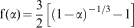
The Coats–Redfern method was used to the calculation of the activation energy and pre-exponential factor of reduction process on the degree of conversion. The kinetic analysis for non-isothermal solid state reduction of nickel laterite ore was divided into three stages, which included the initial stage for 200–600°C, the middle stage for 600–800°C and the decaying stage for 800–950°C based on the different temperature ranges. G–B equation was determined to be mechanism function of the initial stage, which belonged to three dimensional diffusion equation, and its differential form was

Footnotes
Acknowledgements
The project was sponsored by the National Natural Science Foundation of China (grant no. 50906035).