







Abstract
The Fosterville Gold mine is located approximately 20 km to the East of Bendigo in central Victoria. The gold at Fosterville occurs as solid solution within disseminated arsenopyrite and pyrite. The Fosterville ore bodies contain various amounts of native carbon in the form of bituminous coal. This carbon (non-carbonate carbon or NCC) has been the predominant mechanism for gold loss from the processing facility through ‘preg-robbing’. Processing of the Fosterville ore is achieved initially through crushing, grinding and flotation to extract the sulphides. The sulphide concentrate is oxidised using bacterial oxidation, before being leached in a conventional CIL circuit. A high portion of the native carbon (NCC) in the mine ore is naturally hydrophobic in nature, and subsequently reports to the flotation concentrate stream, and ultimately onto the CIL circuit. This NCC has a notable preg-robbing ability. Treatment of black shale ores, which have elevated NCC levels, has historically resulted in CIL recoveries as low as 35%, with around 60–80% of the gold loss from the leach circuit attributed to preg-robbing. Standard technologies for the dealing with a carbonaceous leach feed have been trialled with limited success. The discovery of the significance of heat on leach recoveries, triggered extensive testwork on a range of leach feed and tails samples. Pilot plant testing demonstrated that ‘heated leaching’ of the CIL tails was the best process with an average recovery increase of 7·5% being achieved. Following a successful pilot study, an engineering feasibility study was completed by Minerva Engineering, and the project economics determined. With strong recovery gains evident and a predicted project payback of 1–1·5 years, approval for the installation of the full scale plant was granted. Detailed design commenced in September 2008 with installation commencing in January 2009. The circuit was successfully commissioned in April 2009. Following commissioning, the heated leach circuit has achieved recovery gains of 4–14%, and has proven itself to be a significant contributor to the overall plant performance.
Introduction
At the time of the development of the heated leach process, Fosterville Gold Mine was wholly owned by Northgate Minerals, a Canadian company. This company has since been acquired by Aurico Gold and then its Australian operations at Fosterville and Stawell sold to Canadian Crocodile Gold.
Mining at Fosterville has taken place intermittently since 1894. Contemporary exploration and heap leach operations commenced in the 1980s and up to 2001 produced a total of 240 000 troy ounces (oz) of gold from these operations. Following the completion of a successful deeper drilling program in 2001/02, a detailed feasibility study was undertaken based on mining and processing refractory ore at a nominal rate of 800 000 metric tonnes per annum. Engineering for the ore processing plant commenced in November 2003 with plant construction commencing in March 2004. Installation was completed and the first gold bar produced from sulphide ore was poured in May 2005.
The Fosterville mineralisation occurs within Lower Ordovician sediments comprising of interbedded sandstones, siltstones and shales. The predominant feature in the area is the Fosterville Fault System, a north–south striking, steep westerly dipping reverse fault comprising of numerous subparallel faults. Gold is typically located in disseminated arsenopyrite and pyrite forming a halo to veins in a quartz: carbonate veinlet stockwork, which is in turn controlled by late brittle faults. The arsenopyrite occurs as fine grained acicular needles with no preferred orientation. The disseminated pyrite associated with gold mineralisation occurs as crystalline pyritohedrons (Hitchman et al., 2008).
The Fosterville ore bodies contain various amounts of native carbon in the form of bituminous coal. This carbon (referred to as non-carbonate carbon or NCC) occurs through hydrothermal alteration and as a significant sedimentary structure along the Fosterville fault line. The carbonaceous minerals in the ore are the predominant cause of gold loss from the processing facility through ‘preg-robbing’.
Processing of the Fosterville ore is achieved through a simple single stage jaw crushing circuit followed by a SAG mill. The sulphides are separated using a three-stage flotation circuit. The sulphide concentrate is oxidised using bacterial oxidation, with the residue washed through a counter current decant circuit, before being leached in a conventional CIL circuit. The tails from the CIL circuit are heated to recover a portion of the preg-robbed gold (heated leach), before being pumped to a CIL residue storage dam. The flotation residue and the neutralised liquor from the counter current decant circuit are combined and pumped to an in-pit residue storage facility.
A high portion of the native carbon in the mine ore is naturally hydrophobic in nature, and subsequently reports to the flotation concentrate stream, and ultimately into the CIL circuit. This NCC has been shown to have a high a preg-robbing ability, with gold loss of 6–7% from even the cleanest of ores. Treatment of black shale ores, which have elevated NCC levels, has historically resulted in CIL recoveries as low as 35%, with around 70–80% of the gold loss from the leach circuit attributed to preg-robbing (Wemyss, 2007).
Defining Fosterville ‘preg-robbing’
Both plant and laboratory leaching demonstrate that the leach rate of the gold in oxidised Fosterville ores is extremely fast. However, kinetic leach testing demonstrates a continued drop in solid grades over a 48 h period and indicates a steady release (desorption) of gold, which has been weakly adsorbed on NCC by preg-robbing, back into solution for adsorption onto activated carbon. The rate of gold desorption from the preg-robbing NCC is dependent on solution grade and time.
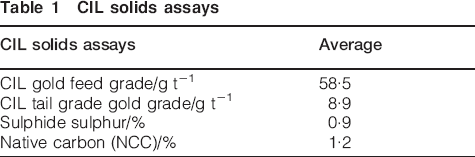
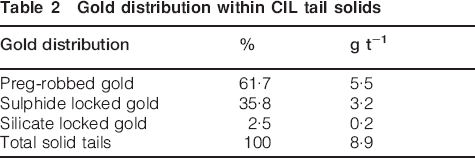
Table 1 identifies the typical gold, sulphur and NCC assays for the solids within the CIL circuit. Although average assays are shown, periods of black shale ore treatment have resulted in CIL feed assays above 2·5%NCC, with a corresponding gold loss in the order of 28–30 g t−1. The historical average level of preg-robbed gold in CIL tails is approximately 62%, with 36% locked in sulphides and the balance in silicates or precipitates (Table 2).
CIL solids assays
Gold distribution within CIL tail solids
Size by size assays (Table 3) provides an indication which size fraction the gold reports to and the mechanism by which it is reporting. The data show that on average 70% of the gold and 90% of the native carbon are below 9 μm in size. The fine nature of the gold and native carbon limits the ability to study the surface of the mineral particles to determine the gold/NCC association more firmly. The gold/NCC association was subsequently indirectly determined through diagnostic testwork.
Average elemental and weight distributions within CIL tails stream
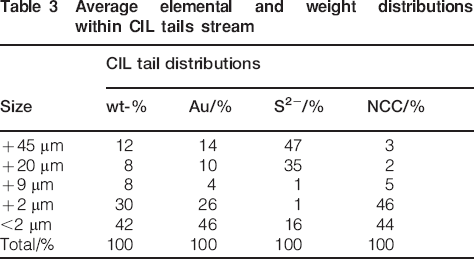
Figure 1 is a plot of the gold and NCC levels obtained from composite samples taken over a 2 year period. It can be clearly seen that a reasonably strong correlation exists between the level of native carbon and gold in the CIL residue stream.
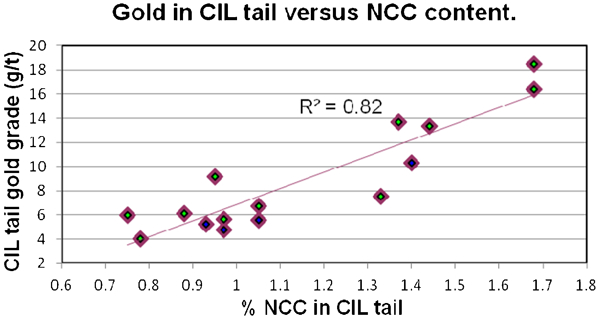
CIL tail gold grade versus %NCC
Combating ‘preg-robbing’
During the prefeasibility study for the Fosterville project, the presence of native carbon and losses through preg-robbing were identified, but the degree to which the ore bodies contained native carbon was underestimated. During the prefeasibility, initial tests on the carbonaceous samples used the standard method of kerosene blanking in a bid to address the prerobbing loss. However, this proved relatively unsuccessful.
Following commissioning of the Fosterville processing facility, CIL gold recoveries struggled to achieve the levels predicted in the prefeasibility study. Although leach gold losses were initially exacerbated by low oxidation levels, the loss of gold by preg-robbing was identified as the key factor adversely affecting recovery.
A myriad of testwork was conducted in a bid to establish a treatment method, including but not limited to:
(i) elevated carbon concentrations; (ii) low density leaching; (iii) kerosene blanking; (iv)synthetic blanking; (v) pressure oxidation; (vi) thiosulphate leaching; (vii) chlorination; (viii) thiourea leaching.
Outside of the treatment of the leach feed to combat preg-robbing, other tests focused on the flotation circuit and the rejection of native carbon at this stage of the process. Chemical suppression was unsuccessfully trialled several times in the plant. Through the trials, however, the use of Guardisperse (naphthalene sulphonate) was found to assist in the management of tenacious carbonaceous froth experienced when black shale ore was part of the feed blend. Guardisperse continues to be used periodically to assist in managing tenacious froth and not specifically for NCC rejection.
Owing to the fine nature of the native carbon and its low density relative to the sulphide minerals, physical separation from the secondary circuit flotation concentrate was assessed. The use of 1 in. Mozley cyclones was evaluated (Binks, 2006) and ultimately applied to remove fine native carbon from the stream. This process proved successful in its own right with 60% carbon rejection achieved with an associated 5% gold loss from the flotation circuit. The clean cyclone underflow produced vastly improved leach recoveries. However, this circuit has been in most cases superseded with the introduction of the heated leach process. In some cases, both the Mozley cyclones and the heated leach have been operated in unison to deal with extremely high NCC ore feeds.
Of the various alternatives roasting was seen as technically the best method for the treatment of Fosterville flotation concentrates. However, the location of the site in a highly populated area, coupled with the local weather conditions meant that the process was considered environmentally unsound and therefore not a viable proposition.
An unconventional approach
Standard technologies and known methods for dealing with the Fosterville carbonaceous leach feed were trialled with limited success. The lack of success from laboratory tests provided evidence that a portion of the gold must already be associated with the native carbon before entering the leach circuit. Mozley cyclone classification testwork on flotation concentrate (Binks, 2006) demonstrated that a gold/carbon association is not present within the flotation concentrate and subsequently indicates that the ‘preg-robbing’ is initiated in the bacterial oxidation circuit.
This understanding moved the focus of testwork to reversing or breaking the gold/NCC association developed within the bacterial oxidation circuit. The application of heat to the pulp was tested as a method to break the gold/NCC bond. Initial leach temperatures of 40°C were adopted with the view to use waste heat from the bacterial oxidation circuit which operates at a similar temperature. ‘Heated leach’ tests conducted on CIL feed at 40°C immediately showed benefits with a step increase in CIL recoveries over both plant and previous testwork results and provided the foundation for further work.
Heated leach pilot plant studies
To fully evaluate the heated leach process, establish a potential processing circuit flowsheet and enable identification of any idiosyncrasies of operating such a circuit, a pilot plant was constructed. Como Engineering of Perth Western Australia was engaged to construct the plant, based on site design. The pilot plant (Fig. 2) consisted of two trains of six tanks. Each train was different in volume to enable a comparison of residence time and to conduct two tests simultaneously.
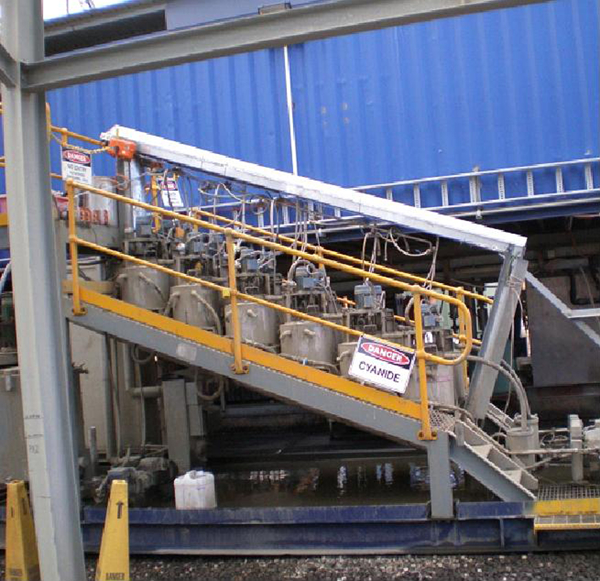
Heated leach pilot plant
Heating of the pulp was achieved by circulating hot water through jackets around the tanks. Each tank was fitted with a basket to retain the carbon and allow for easy carbon transfer. The circuit was also set up with chemical, oxygen and air dosing to the tanks.
Standard carbon management in the pilot plant was designed around having 20 g L−1 carbon concentration in each tank, with basket movements in each train timed to approximate carbon movement rates and dwell times achieved in the existing CIL plant. Free cyanide levels were kept at historical plant levels and pH was kept in line with the plant. Any variation from the above was performed specifically to test different treatment scenarios.
Sampling of streams was performed every 6 or 12 h in order to give good variation around the 9 and 18 h basket movement regime. This way assay results were available from the start, middle and end of basket dwell duration in order to determine variation effects.
The heated leach pilot plant was operated for a period of 4 months on a continuous roster to evaluate the effects of:
heated leach process on CIL feed
heated leach process on CIL tails
various temperature profiles
carbon addition to the circuit including location, activity and rate
cyanide addition
caustic addition.
Pilot plant testing clearly demonstrated that heated leaching of the tailings from the CIL plant was the best method for increasing overall gold recovery from the ore, with an average recovery increase of 7·5% being achieved. The pilot work also identified that the recovery increase through heated leaching is possible without any further additions of cyanide, and can be performed in the absence of air or oxygen injection into the pulp (Wemyss, 2007).
Pilot studies were later extended to evaluate the ability of the process to recover gold from historic leach tails which had an average gold grade of 10 g t−1. The testwork indicated that 35–50% of the gold within the tail residue could be recovered, further supporting the implementation of the process. Additional capacity was factored into the design to allow for reclaimed tails to be processed concurrently.
Board approval for the project was received in October 2008. Minerva Engineering of Melbourne were engaged to complete the detailed design. Site construction commenced in January 2009 with commissioning underway by April of that year.
Full scale operation
The six stages used during the pilot plant studies on the CIL tail were ultimately applied to the full scale plant. The initial three stages of the heated leach circuit are operated up to 70°C with the remaining three stages cooled to aid the adsorption of gold from solution.
Heating of the CIL tails stream is achieved through inline injection of steam which is provided by a 4 MW LPG fired boiler. Tanks on the first three stages are rubber lined and insulated to reduce radiant heat loss. Stainless steel lids are fitted to four of the six stages to retain heat and reduce steam entering the operator working zone on the top of the tanks.
The detailed design assumed that the necessary cooling of the secondary stages (tanks 4–6) could be achieved through simple aeration of the tanks. This cooling method, however, proved unsuccessful during the commissioning phase and ultimately, the introduction of cold recycled water from the CIL residue dam was adopted to achieve the temperature adjustment with the sacrifice of density and tank residence time.
In early 2011, simple tube heat exchangers were installed into the circuit to preheat the new feed with slurry leaving stage 3 of the process. The heat exchanges reduced the steam demand for the process and also reduced the amount of cooling water required to achieve effective adsorption.
In stages 1–3, recessed impeller pumps are used for carbon transfer to prevent unnecessary cooling of the pulp that would occur if using air lifts. Air lifts are used for carbon transfer in stages 4–6 where lower operating temperatures are required. In all cases, the carbon advance slurry is screened to allow the carbon only to progress forward and the slurry to return to the tank from which it came.
Barren carbon is continuously added to both stages 1 and 6 in the circuit. The loaded carbon from the heated leach circuit is recovered to a carbon column, regenerated and then returned to the CIL circuit. Figure 3 depicts the carbon movement at nominal rates and grades. The carbon flowsheet adopted in the design was centred around the reuse of the existing regeneration kiln and avoiding the capital cost of a second kiln. It was fully anticipated that some benefit would be available through regenerating barren carbon before returning to the heated leach circuit; however, the pilot plant studies indicated only a marginal benefit and not substantial enough to justify the installation of an additional kiln.
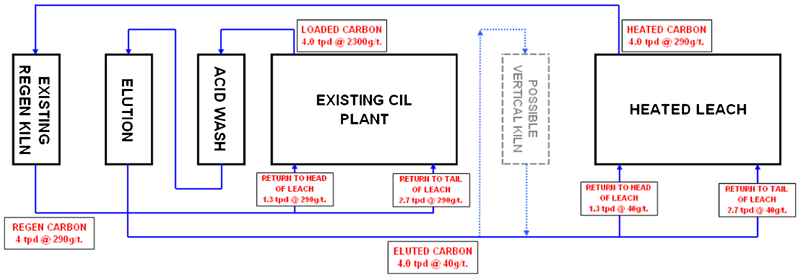
Carbon movement through heated leach and CIL circuits
The circuit operates continuously with an availability of 95–98%. In 2010, the heated leach process (Fig 4) provided an average recovery gain of 7·4%. This is deemed an excellent result particularly given the level of circuit downtime and reduced efficiency associated with poor availability of the steam boiler. During the year, a peak monthly gold recovery gain of 14% was achieved during the processing of a blend containing high NCC levels.
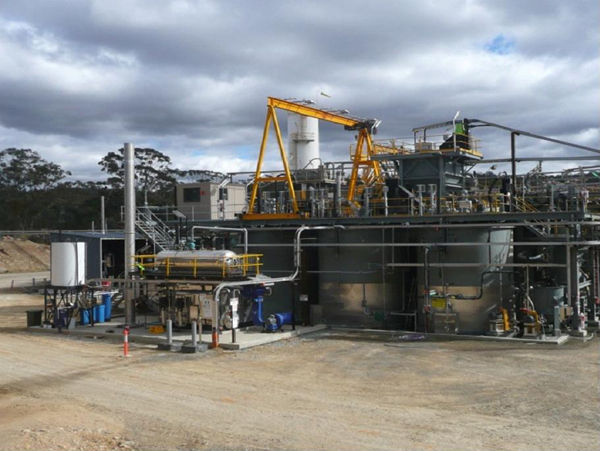
Fosterville gold mine heated leach circuit
Conclusion
The heated leach circuit is the most notable addition to the Fosterville processing facility that has been made since the operation of the plant commenced. The heated leach circuit contributes significantly to improved process economics and the long term future of the site. Continued work on the optimisation of the process and improvement of the equipment availability will further enhance the benefits obtained.
Footnotes
Acknowledgements
The authors would like to acknowledge Northgate Minerals for the support and confidence in firstly piloting the process and then establishing a full scale operation.
This paper was originally presented at MetPlant 2011 and has been subsequently peer reviewed and revised for publication in Mineral Processing and Extractive Metallurgy with the kind permission of the Australasian Institute for Mining and Metallurgy.
This paper is part of a special issue on Australian gold processing