







Abstract
The weight of the load is one of the main parameters in reductive melting process in electrical furnace which depends on the roasting of ores in a furnace located in Drenas. Roasting of the load is done at ∼950°C, which is composed of ores from Drenas and Albania. Also, the article has the experimental analyses that modify some parameters of the production which are the reduction in quantity of limestone in the load and the increase in quantity of quartz used in the load. The paper emphasises the possibility of mixing the ore from Kosovo with the lateritic ore from Albania with the aim of reducing the acidity of weight which is loaded in the electrical furnace. The optimisation of the above mentioned parameters enhances the production process and provides better practical results. The composition of the load must satisfy the ratio 1∶10 of ore from Kosovo and Albania to optimise the melting process.
Introduction
In order to achieve better results in quality and quantity of the products of ferro-nickel, the article has an experimental and scientific analysis of parameters which deal with the rotational roasting furnace. Also, the paper deals with the melting process of the electrical furnace. The implications are based on the several months of experimental work on the possibility of merging the ore from Kosova with the lateritic ore from Albania. In order to have a better look of the roasting process and to direct the process towards acquisition of qualitative load with positive technical and economical effects of the process, we should comprehend the behaviour of each component during the process.
Calcium carbonate (CaCo3) is one of the important components for roasting which has an important role during the process development, it absorbs the heat which is released from the oxidation of the load and by heating itself it lowers the temperature of the load and keeps it in porous-friable condition. Quartz (SiO2) has the role of thermal regulator in the process of oxidation of the load, and it impacts the composition and viscosity of scoria. The paper has the analytic, graphical and experimental analysis of the production of load aiming to increase the quality and production in the electrical furnace. The paper has the positive findings in the increase in the quality and production with economical and environmental stability in the smelter of Drenas.
Literature review
The smelter of iron–nickel in Drenas is projected for processing 1 374 000 t of ore per year and the production of 52 000 t of metals iron–nickel with 23−25%Ni+CO composition. The main projector of technology is Gipronickel Institute of Former Soviet Union. The producers of the technological equipment are: Smidth Denmark Company for rotational furnaces and Elken Norway Company for electrical furnaces. The granular–metric composition of the ore of Kosovo which is processed is 70% with 5 mm diameter and 20% humidity composition. The chemical composition is 1·32Ni–0·07Co–24Fe2O3–46SiO2–8MgO–2·2Al2O3–1·2Cr2O3–0·2CaO (%) (Agolli, 1985).
The calcium carbonate is used as a smelter with 50%CaO, and the coke or anthracite is used as a reductive component with 35 mm granular–metric composition of sulphur <1%. The combustible matter that is used by the generator has the composition of 61·4H2–17·3%CO–16·6CH4–1·5H2S–2·8N2–1·2CO2–0·1O2 (%) with caloric value of 15·1 MJ m−3. The rotational furnace combustible matter could be used, and the gas of electrical furnace is composed of 60%CO, 4%H2 and 10–12%CO2 with caloric value of 10·9MJ m−3. The oxide ores of Kosovo belong to the type of iron-silicate ores with relatively low content of iron around 18–20%Fe. The complete reduction of them in rotational furnace is not possible or is hardly done. The high scale of reduction of these oxides is reached if the roasting process of ores is done in the temperature range of 900–1000°C with the use of tiny reduction matter and by providing strong reductive atmosphere, specifically of minimal oxygen content atmosphere in gases’ processes. The optimal parameters of the reductive roasting in rotational furnace are:
the maximum temperature of roasting is 900–950°C. The minimum time of material staying in furnace is 60 min. The optimal parameters of particles in the load are 20–28 mm
the maximum content of oxygen in gases of furnace is 5%, and then the process builds up according to reactions



reduction of 70–80% of the quantity of Fe2O3 in FeO
reduction of 2–5% of the quantity of FeO in Fe
reduction of 30–50% of the quantity of NiO in Ni
thermal dispersion of 50–60% of the quantity of CaCO3.
The composition of gases on exiting the rotational furnace is 9%CO2, 0·1%CO, 30%N2, 5%O2, 0·1%SO2 and dusts of 50 g m−3. The removal of dusts from rotational furnace gases is done with cyclones (rooms for precipitation), and the load is sent directly in electrical furnace or is kept in special blockhouses which are sealed from inside with fire-resisting material in order to keep the load temperature at 800 or 850°C.
Melting process of electrical furnace
The melting process of electrical furnace is sufficiently sensitive and at well seen parameters depends on the physical–chemical characteristics of the load and the materials which are put into the furnace. The condition of the full dispersion of electrical energy is thermal energy. The load dosing in electrical furnace in the temperature 700�–800°C is done with the help of blockhouses and pipes placed on ceiling of the furnace. The furnace is heated with electrodes sank in melted scoria. The heating of the load and gases close to electrode enable the melting of load, and reactions in the process. The liquid products of melting precipitate in the floor of the furnace respective to their specific weight. The gases are withdrawn with filter and sent to cooling and the removal of dusts. The process of electrical furnace develops with the slipping of the load in distance ∼400 mm beyond the limit of liquid stage in temperature around 850–1050°C. The concentration of CO in gases is about 80–90% and then we have intensive development of silicate reduction and metals of oxides according to these reactions (Murati, 1995)




Main technical–technological indices of electrical furnaces
The furnace is sealed with magnesium bricks. In the middle of the wall of magnesium bricks and metallic body of the furnace, there is a layer of compressed graphite which is cooled with water. The floor of the furnace is built up with magnesium bricks over which a layer of dolomite of ∼1500 mm width is placed. The specific power of the furnace is 167·5 kW m−3, the capacity expressed in dry ore is 1476 t(24 h)−1, the specific consumption of electrical power is
 (Pan et al., 2011).
Methodology
Process in rotational furnace
After the comminuting and the homogenisation of the ore, we should do the roasting in the rotational furnace. During the roasting of the furnace, it is necessary to lower the acidity of the load which is done by loading the calcium carbonate in the load. In some cases, the percentage of the calcium carbonate is 12–15% to normalise the acidity of scoria. In this case, the specific consumption of electrical power increases, the cost of production increases and the productivity of rotational furnace decreases. In the case when we minimise the quantity of calcium carbonate in the load for roasting, we see some problems in the roasting process; the temperature increases in the pod of the furnace, and the acidity of the scoria increases which causes different problems in the roasting process. The normalisation and the minimisation of these problems in the rotational furnaces in Drenas are worked out by mixing the ore from Kosova with the ore from Albania of lateritic type which has a chemical composition of 28·50Fe–23·32Si–5·97Mg–2·83Al–0·89Ni–8·06Co–1·83Cr (%). In a timeline of >3 months of experimental work and the calculations of the process and the quality of the load acquired from the rotational furnace, we conclude that the ore from Kosova should be mixed with the ore from Albania at 1∶10 ratio respectively (Haxhiaj and Drelich, 2011).
Alternative I
The average monthly chemical composition of the load which is produced on the rotational furnace with the load of 7% of the ore from Albania.
Fe0 totl: 15·84%, CaO0 2·54%, CO 0·04%, Cr2O3 1·07%, Al2O3 2·17%, MgO0 15·36%, MnO0 0·36%, SiO2 49·78%, Ni 1·230%, C fix0 3·50%.
Alternative II
The average monthly chemical composition of the load which is produced on the rotational furnace with 10% of the load from the ore of Albania.
Fe0 totl: 019·85%, CaO0 5·080%, CO0 0·050%, Cr2O3 1·76%, Al2O30 4·08%, MgO0 12·62%, MnO 0·390%, SiO2 41·25%, Ni0 1·110%, C fix0 3·00%.
Products of electrical furnace
As mentioned above, the standard products of electrical furnace are metaline (iron–nickel) and scoria and the composition of gases depends on the chemical composition of the load and the technological melting process in electrical furnace. We have done some statistical (quantitative) and chemical analyses of industrial products of the electrical furnace which directly depends on the ratio of the mix of ores from Kosova and Albania (Dimidovski et al., 1983).
Alternative I
The chemical composition of metaline Fe–Ni of the electrical furnace is produced from the load with 7% of the ore of Albania.
The average daily chemical composition of metaline Fe–Ni is 13·41Ni–0·37S–3·00Si–0·59Ca (%).
The average monthly chemical composition of metaline Fe–Ni is 0·74Al–3·34Si–0·35Cr–0·53Co–13·75Ni–0·04Cu–73·47Fe–0·35S–0·44Ca (%).
The average monthly chemical composition of scoria is 0·09Ni–18·57Fe–5·25CaO–57·82SiO2–12·73MgO–20·09FeO–2·23Al2O3 (%).
Alternative II
The chemical composition of metaline Fe–Ni of electrical furnace is produced from the load of 10% ore from Albania.
The average daily composition of metaline Fe–Ni is 13·32Ni–0·36S–2·50Si–0·64C (%).
The average monthly chemical composition Fe–Ni is 0·74Al–2·50Si–0·35Cr–0·53Co–13·32Ni–0·04Cu–73·47Fe–0·36S–0·64C (%).
The average daily chemical composition of scoria is 0·07Ni–13·67Fe–2·85CaO–57·38SiO2–16·59MgO–17·6FeO (%).
The average monthly chemical composition of scoria is 0·07Ni–13·6Fe–2·85CaO–57·98SiO2–16·59MgO–17·6FeO–2·23Al2O3 (%).
Experimental results
Industrial management of quantity of electrical furnace products in Drenas
The management of the load and the products of the electrical furnace with the load is complex and like that treated with a 3 months timeline in 1∶10 ratio of the mix from Kosovo ore and Albania ore respectively (Haxhiaj and Drelich, 2011).
Alternative I
The load of electrical furnace with 7% of ore from Albania used in the plant is




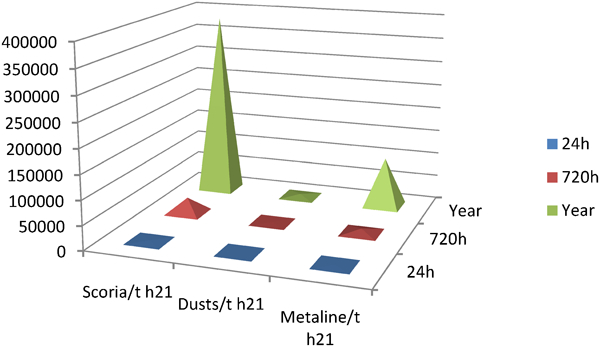
Quantity of scoria, dusts and metaline
Quantity of scoria, dusts and metaline
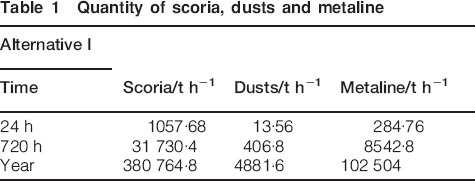
Quantity of scoria, dusts and metaline
Quantity of metaline, scoria and dusts per 24 h

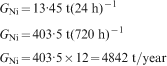
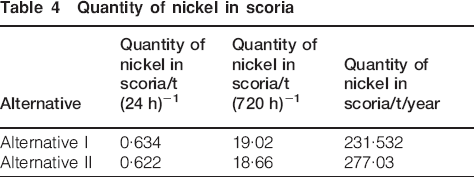
Quantity of nickel in scoria
Alternative II
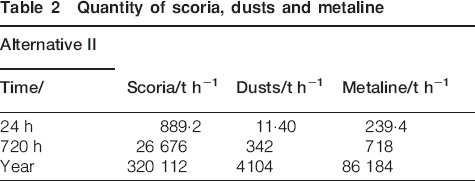
The load of electrical furnace with 10% of ore from Albania used in the plant is

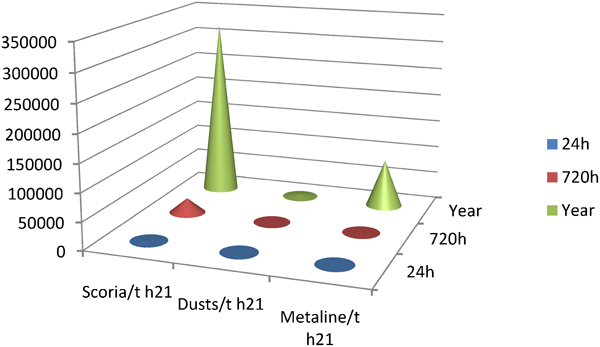
Quantity of scoria, dusts and metaline
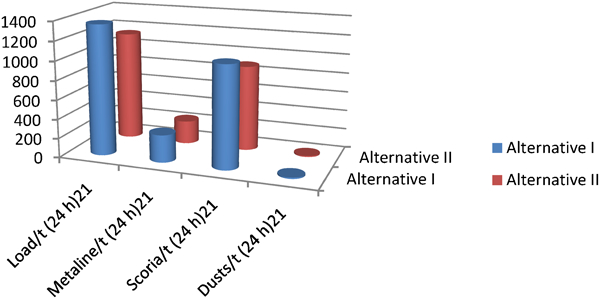
Quantity produced of metaline, scoria and dusts
Loss of nickel in scoria
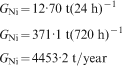
The loss of nickel with scoria is complex and depends on the quality of the load, and the melting process in the electrical furnace is calculated with the expression (Haxhiaj and Haxhiaj, 2010)
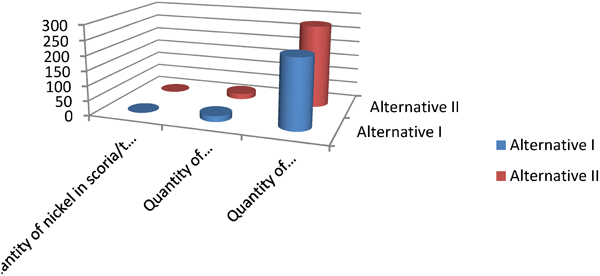
Quantity of nickel lost with scoria


Conclusion
We can conclude from all tables and graphics(1–4) also from experimental analyses derived from the lab that all the percentages of the composition of calcium carbonate and quartz have an important role in the optimisation of the melting process in the electrical furnace. In order to have the quality and quantity of metaline in the melting process in electrical furnace, we should simultaneously keep some parameters at certain value (temperature and furnace emptying) which depend on the quality of load and the parameter of mix of the ore from Kosovo and the ore from Albania which should be 1∶10 ratio. Based on the experimental and laboratorial results, we found that the production of the load with 7% of the ore from Albania reflects positively in the consumption of nickel in the load. The load produced with 10% ore of Albania tends to lower the consumption of nickel in the load. Moreover, a small increase is noticed in the quantity of nickel lost with scoria which negatively reflects on the economical and environmental sustainability of the melting process in the electrical furnaces in Drenas. The parameters used during the production of ferro-nickel and the experimental and laboratorial analyses done in the melting process positively reflect on the increase in the capacity of electrical furnace in Drenas at 403·5 t Ni per 30 days.