







Abstract
Thiosulphate leaching agent for silver is an alternative to cyanide leaching for certain types of refractory ores or secondary sources of the metal. Cementation of silver onto mechanically activated zinc powder after leaching is the most used method of the recovery of silver. The thiosulphate leaching of X-ray photos and cementation of silver by zinc from the solution are described in this paper. Application of cementation methods of processing silver from waste solutions represents economic as well as ecological importance for the whole society.
Introduction
Ag wastes represent the important source of the precious metal. The problem of recycling secondary resources containing noble metals is in the centre of interest of all developed economies of the world. Therefore, this problem is not only a technological, legislative or economical, but also one related to the environmental protection.
Obtaining of the metal from waste materials and lowering the environmental load by recycling is an extraordinarily complex issue that requires an all-round strategy and the application of a number of methods (Langner, 1994; Tomášek et al., 1999; Seadon, 2006).
Whereas the application of cyanide leaching is a highly toxic technology, the process still plays a pivotal role in silver hydrometallurgy. This can lead to environmental problems, where cyanide pollutants hit the water table and cause destruction of animal life, and so it is a serious problem in residential areas are developing closer to the plant sites. An alternative approach is to use thiosulphate solutions to leach silver from ores as well as from waste of precious metals (Ficeriová et al., 2008).
The thiosulphate presents another solvent for leaching of gold and silver. The advantages of thiosulphate leaching are high selectivity, low toxicity, high recovery and reasonable price (Ficeriová et al., 2005).
Several methods for a recovery of silver from the different solutions after leaching are available, but the cementation process is the most popular (Moghaddam et al., 2006; Sulka and Jaskula, 2003; Sulka and Jaskula, 2004; Gamboa et al., 2005; Karavasteva, 2009). The most used cementators are iron, zinc and copper and zinc (Sulka and Jaskula, 2003; Sulka and Jaskula, 2004; Moghaddam et al., 2006; Gamboa et al., 2005; Karavasteva, 2009). Zinc powder has been also used for cementation of a silver from sulphate industrial solutions (Sulka and Jaskula, 2004; Dib and Makhloufi, 2006; Sulka and Jaskula, 2002).
Silver cementation is an inexpensive and simple way to deposit thin films with a thickness usually not more than 0·1–0·3 μm. The advantages of this method are low concentration and good stability of solutions, simple composition, and the opportunity to deposit films with a uniform thickness on complex shaped parts without a special installation. According to the electrochemical theory of cementation, the reaction (Fabián et al., 2009)


Experimental
Materials
The silver containing thiosulphate solution by leaching of used X-ray photos was prepared. Small pieces of X-ray photos (3×2·10−2 m, total weight 34 g) in 1 dm3 of 0·4M sodium thiosulphate solution with the addition of sodium hydroxide (for pH adjustment, pH = 8·5) were leached under the following conditions: time of leaching: 120 min; stirring speed: 300 rev min−1 and ambient temperature. The content of silver, determined by AAS, to be about 130 μg 10−3 dm−3. Please note that the content of silver on the amount of precipitated silver is strongly depended and thus the reproducibility of leaching experiment is still questionable.
Physicochemical characterisation
The determination of silver content in the solution was carried out by the atomic absorption spectrometry using Spectra AA 240 FS (Varian, Australia). The SEM of precipitated product was carried out by BS 340 (TESLA Brno, Czech republic). The specific surface area SA of zinc powder was determined by the BET technique using low temperature nitrogen adsorption in a Gemini 2360 sorption apparatus (Micromeritics, USA).
Mechanical activation
Mechanical activation of zinc powder, in order to improve the rate and recovery of cementation was performed in a stirring ball mill and planetary ball mill as follows.
Stirring ball mill (attritor - Molinex PE 075, Netsch, Germany) equipped with a steel milling chamber (AM)
Volume of milling chamber: 0·5 dm3, weight of sample: 50 g, steel balls (2000 g of 2 mm diameter) as milling means, milling medium: 0·2 dm3 methanol, milling time: 60 min, the revolutions of milling shaft: 1000 min−1, ambient temperature.
Planetary ball mill (Pulverisette 6, Fritsch, Germany) equipped with a tungsten carbide milling chamber (PM)
Volume of milling chamber: 0·250 dm3, weight of sample: 5 g, tungsten carbide balls (360 g of 10 mm diameter) as milling means, milling medium: 0·05 dm3 methanol, milling time: 60 min, the revolutions of the mill: 500 rev min−1, ambient temperature.
Planetary ball mill (Pulverisette 6, Fritsch, Germany) equipped with a tungsten carbide milling chamber (PM + EDTA disodium salt)
Volume of milling chamber: 0·250 dm3, weight of sample: 5 g, tungsten carbide balls (360 g of 10 mm diameter) as milling means, milling time: 4 min, the revolutions of the mill 500 rev min−1, ambient temperature. To protect the effect of aggregation and agglomeration, 250 mg (5 wt-%) of EDTA disodium salt as a surfactant agent was added into the milling chamber.
Cementation
The cementation of silver from silver containing sodium thiosulphate solution was carried out in the reaction vessel maintained at constant temperature (25°C) and equipped with a stirring motor. First, 0·450 dm3 of the pregnant solution in the enclosed vessel maintaining the stirring speed constant (200 rev min−1) was placed, and a pre-determined amount of silver (0·45 g) was added to the solution. During the runs, 0·005 dm3 of each sample was taken for the determination of metal content at a convenient time interval.
Results and Discussion
Silver recovery through cementation was studied with pure zinc powder as well as with zinc powder after mechanical treatment in: stirring ball mill–attritor (AM), planetary ball mill (PM) and planetary ball mill with the addition of EDTA disodium salt as a surfactant (PM + EDTA disodium salt). Figure 1 presents the silver recovery as a function of reaction time. It was expected that mechanical activation of zinc powder will enhance the cementation process by creating of fresh surface and disorders in the structure of zinc powder (Fabián et al. 2009).
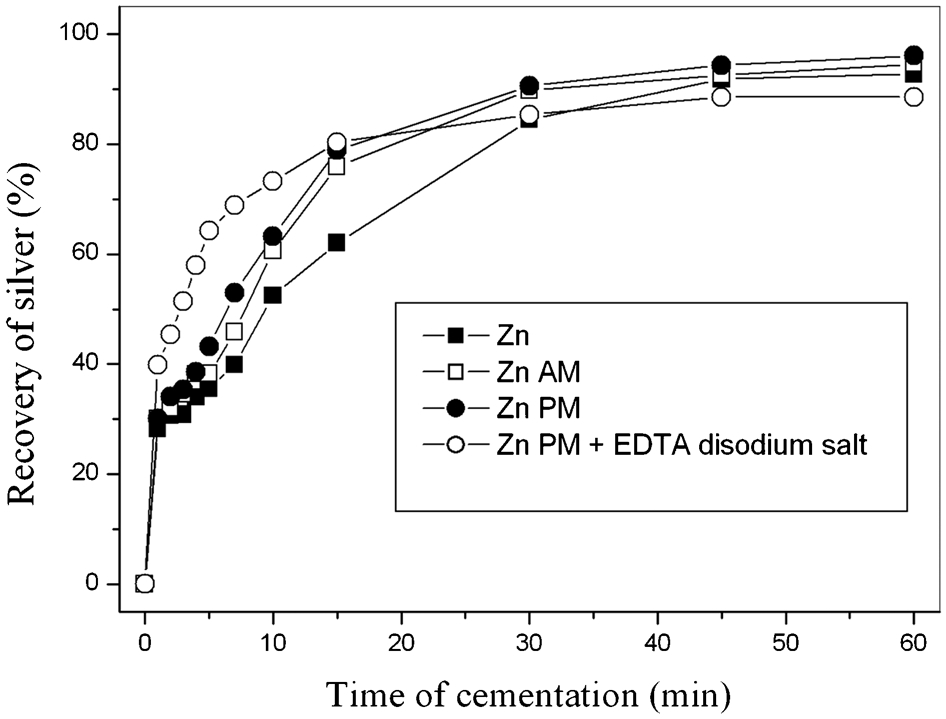
Cementation of silver from silver containing thiosulphate solution with zinc powder (Initial concentration of Ag = 130 μg 10−3 dm−3)
Only slide differences of cementation behaviour with zinc powder mechanically treated in stirring (attritor) and the planetary ball mill are visible. In comparison to cementation of silver with zinc powder without mechanical treatment, up to 30 min of reaction a favourable effect of mechanical milling on the reaction kinetics we can clearly see, despite it no difference in the final recovery of silver is visible. Addition of EDTA disodium salt significantly increased the reaction kinetics in a short time but ultimately the recovery is lower than cementation with zinc powder without mechanical activation. This phenomenon can be caused by the passivation of the surface layer of zinc powder. Taking into account the value of initial pH (pH = 8·5), the formation of ZnOH on the surface of cementator as a result of side reaction can be ascribed to the decrease in reaction kinetics (Kuntyi et al., 2011).
In our previous work, we have confirmed the formation of OH− and
 species on the surface of mechanically activated cementator (Fabián et al., 2009).
Figure 2 shows various morphologies of zinc powder mechanically treated under various regimes of milling as well as a product of cementation precipitated on the surface of cementator. The morphology of product of the cementation on the surface of pure zinc powder is on Fig. 2a. The effect of the mechanical activation in planetary and stirring ball mill induces the variation in the powder morphology, and increase in specific surface area.
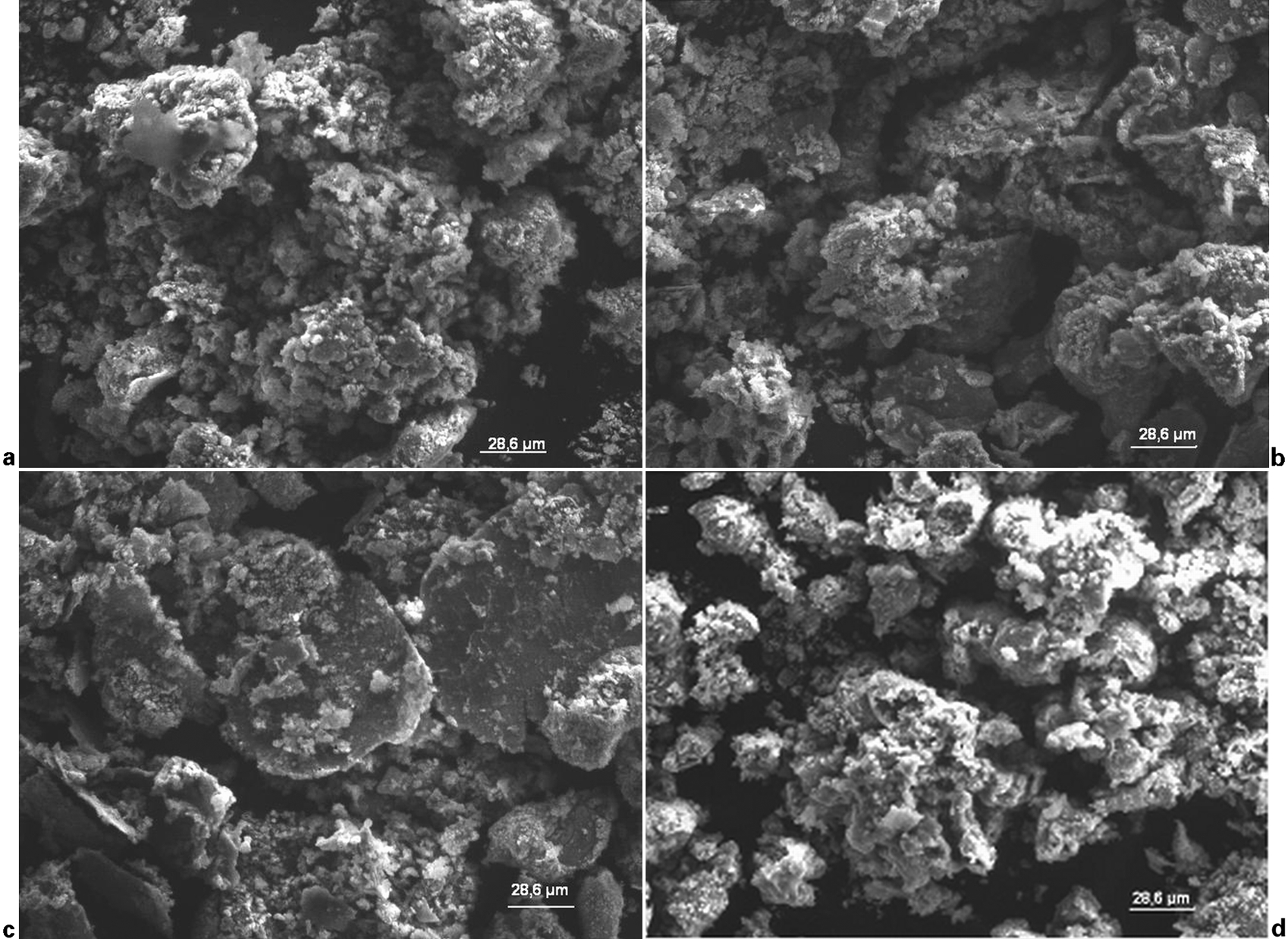
Images (SEM) of cement produced in recovery of silver from X-ray photos after their leaching in thiosulphate solution: a zinc powder after 15 min of cementation at initial concentration of Ag = 130 μg 10−3 dm−3; b zinc powder after mechanical activation in planetary ball mill (PM = 60 min) after 15 min cementation at initial concentration of Ag = 130 μg 10−3 dm−3; c zinc powder after mechanical activation in stirring ball mill (AM = 60 min) after 15 min cementation at initial concentration of Ag = 130 μg 10−3 dm−3; d zinc powder after mechanical activation in planetary ball mill with addition of EDTA disodium salt (PM+EDTA disodium salt = 4 min) after 15 min cementation at initial concentration of Ag = 130 μg 10−3 dm−3
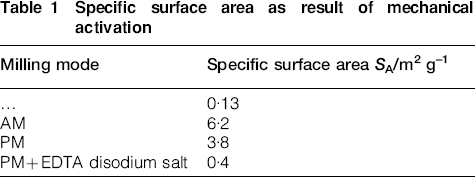
The morphology of deposits precipitated on the zinc powder after ball milling seems to be more porous, distributing uniformly and covering most of the entire surface (Fig. 2b and c). In fact, the surface of zinc powder after mechanical activation in planetary ball mill with the addition of EDTA disodium salt is more covered by the precipitated product of cementation (Fig. 2d). This can be explained by the fact, that the presence of surfactant during ball milling can influence and improve the structural properties of as received products (see e.g. Akdogan et al., 2012; Baláž et al., 2011; Crouse et al., 2012; Velasco et al., 2012; Zhang et al., 2012 and references therein). It can be followed by production of higher amount of cementation reaction centres in comparison to powder treated by ball milling without the presence of surfactant. Table 1 shows the value of specific surface area of zinc powder milled with the presence of EDTA disodium salt in comparison to the powder milled with the presence of methanol in planetary and stirring ball mill respectively. The value of zinc powder containing surfactant is significantly lower and subsequently the contribution of surface area to the kinetics of reaction seems to be not the rate determining step. This observation well fits with our previous study (Fabián et al., 2009).
Specific surface area as result of mechanical activation
Taking into account the cementation model presented by (Nosier and Sallam, 2000) the incorporation of the deposited metal atoms (namely Ag+) into a crystal lattice play an important role in the cementation process. In other words, we consider that enhanced reaction kinetics onto zinc powder milled with the presence of EDTA disodium salt can be a result of enhanced structural deformation. On the other hand, the presence of surfactant significantly influences the process of cementation itself. (Karavasteva, 1998) found, that the presence of surfactant during cementation of cadmium by suspended zinc particles can accelerate or inhibit the reaction.
While the presence of polyethylene glycol with a molecular weight of 400 increased the reaction kinetics, the presence of nonylphenolpolyethylene glycol decreased this value. The presence of dinaphthyl–methane–4, 4–disulphonic acid did not influence the reaction behaviour. To confirm the unpredictable behaviour of surfactant, we can cite the work of (Taha et al., 2004). They compared the presence of three various surfactants on the cementation of cadmium onto zinc.
It was found that sodium dodecyl sulphate (SDS) improves the rate of cadmium cementation, while Triton X–100 and cetyltrimethylammonium bromide (CTAB) inhibit it.
To the best of our knowledge, the systematic study on the possible favourable/contrary effect of the presence of EDTA disodium salt as surfactant in the cemented solution has been not reported yet. Nevertheless, according our observation, the EDTA disodium salt results in the enhanced kinetics of silver cementation onto zinc powder (milled with the presence of surfactant) by refinement and modification of the cementator structure and/or possible influence on the reaction kinetics.
The post process treatment of as–received products of cementation should also have been taken into consideration. As it was reported, the as received sponge containing metals after cementation can be directly processed in the pyrorefining circuit to recover metals separately (Raghavan et al., 1998). According this, we assume, that similar procedure would lead to the recovery of pure silver in metallic form and thus further research in this field is required.
Conclusion
The current situation in ore mining, as well as environmental problems related to waste and metal contents in Slovakia and abroad, stimulates many scientists, as well as private companies, to seek solutions focused on the processing of these secondary metal resources, aiming their recovery and further utilisation for society in practical life.
The silver from X-ray photos after their leaching in thiosulphate solution can be efficiently recovered through cementation with zinc powder. The impact of mechanical activation has a favourable effect on the kinetics of the reaction. The morphology of mechanically activated zinc powder, as well as the precipitated product, has been declared by SEM microphotographs.
The results show a positive fact that in the case of silver cementation with zinc powder was the maximum possible exclusion of silver. The silver cementation with zinc powder seems to be highly efficient, elegant also economically and technologically lucrative.
Footnotes
Acknowledgements
The support through the Slovak Research and Development Agency APVV (project APVV–0189–10) and the Slovak Grant Agency VEGA (project 2/0009/11 and 2/0139/10) is gratefully acknowledged.