







Abstract
The production of Al from its ores at present relies on the Bayer (alumina production) and the Hall–Heroult (Al production) process. The cost associated with alumina production and apparent disadvantages of the Hall–Heroult process have led to intensive research to find alternative routes for Al production. The direct carbothermal reduction process has been thoroughly investigated as an alternative technique. Another alternative includes the indirect carbothermal reduction route where alumina (or aluminous ores) is first reduced to intermediate Al compounds before reduced further to Al. The present study reviews and provides systematic thermodynamic analyses of alternative Al production routes. In this paper (Part 1), a comprehensive review of alternative Al production techniques focusing on the indirect carbothermal reduction routes is presented. These include carbochlorination, carbonitridation and carbosulphidation routes for the formation of intermediate Al compounds, followed by various Al extraction processes.
Keywords
Introduction
Aluminium is the most abundant metallic element in the Earth's crust (∼8%) and the second most widely used metal next to steel. The production of Al has increased by nearly four times in the last three decades (Mahadevan et al., 1996). Pure Al cannot be found in nature because of its high affinity to oxygen. In general, it is found in a variety of minerals combined with various elements such as silicon, oxygen, phosphates, fluorine and hydroxides. In the last century, a number of methods have been developed to extract Al from its ores. The current commercial production method relies on two energy intensive processes developed in the late 1800s: the Bayer process which produces pure alumina from bauxite ore, and the Hall–Heroult electrolysis process which produces Al metal from the alumina. The cost of the Bayer process represents ∼27% of the cost of Al production (IAI, 2010) and the Hall–Heroult process uses about three quarters of the total energy requirement, though these numbers vary depending on the specifics of the ores and sources of energy used.
The Bayer process is the principal industrial technique to refine bauxite to pure alumina. There have been little changes to the basic process since the first plant opened in 1893. In this process, bauxite (containing typically 10–30 wt-%Fe2O3, 4–8 wt-%SiO2 and 2–5 wt-%TiO2 as major impurities) is dried, ground, digested in sodium hydroxide under pressure (Rao and Soleiman, 1986). Impurities are separated by filtration, before alumina hydroxide is precipitated and calcined to produce commercial alumina. The relatively high purity alumina produced from the Bayer process is then transferred to the Hall–Heroult electrochemical cell for electrolysis.
The Hall–Heroult process was patented in 1886 and the basic process layout remains unchanged except for the form of the carbon anode (Brooks et al., 2007). There has been significant improvement in the process over last hundred years, through increasing cell size, greater automation and control, and improved control of emissions. Tarcy et al. (2011) provided an outline of the improvements in a recent review, showing that the overall energy usage per kg of metal has decreased from typically over 30 kWh kg−1 Al in 1914 to below 14 kWh kg−1 Al by 2000.
In the Hall–Heroult process, Al metal is extracted through electrolysis of Al2O3 dissolved in NaF–AlF3 (cryolite) solution according to the following overall reactions


The apparent disadvantages of the Hall–Heroult process have led to numerous researches to develop alternative routes throughout the twentieth and early twenty-first centuries. The most important alternatives that have been envisaged include modified Hall–Heroult process utilising inert anodes, direct carbothermal reduction of alumina (Russell et al., 1973), and indirect carbothermal reduction of alumina (e.g. formation of AlCl3 intermediate followed by Al extraction in the Alcoa process).
In this paper, a comprehensive review of various Al production methods, focusing on the indirect carbothermal reduction routes, is presented. There have been a number of major review papers on Al production routes. In 1964, Stroup (1964) provided a detailed review on the carbothermal production processes of Al. Russell (1981) provided another major review on various new technologies in 1981, including review and progress on the development of Alcoa process. This paper briefly reviews the recent development in the direct carbothermal routes followed by systematic reviews of different indirect carbothermal reduction routes. In Part 2, systematic thermodynamic analyses of selected indirect carbothermal reduction routes are presented. These include evaluation of Gibbs free energy formation and equilibrium calculations of various intermediate Al compounds and extraction of Al from these compounds.
Direct carbothermal reduction process
The direct carbothermal reduction of alumina to Al has potential for greater productivity, lower capital investment, less consumption of electric power, and lower overall greenhouse gases emission, compared to the Hall–Heroult process. It is well established that direct carbothermal reduction of iron oxide, through blast furnace technology, offers far greater productivity and energy efficiency than any comparable electrolytic process. It is this desire to duplicate the merits of pyrometallurgy processing to Al that has driven interest in the carbothermal reduction of alumina. The overall reactions for carbothermal reduction of alumina can be presented as


Recent developments in carbothermic production of Al evolved in the direction of a two-stage process. Cochran and Fitzgerald (1981) invented a stack type reactor in which Al2O3 and C is reacted in a high temperature upper reaction zone and produces liquid mixture of Al2O3 and Al4C3 which is then transferred to a lower reaction zone for Al extraction. Alcoa and Elkem companies thoroughly investigated carbothermic production of Al using the stack type reactor (advanced reactor process) (Johansen and Aune, 2002; Bruno, 2003; Johansen, 2003; Aune and Johansen, 2004; Fruehan et al., 2004a, b; Garcia-Osorio and Ydstie, 2004). In this process, alumina is carbothermally reduced at 2000°C in the first reaction compartment of a vessel producing liquid slag (50Al2O3–50Al4C3). Further reaction between alumina and Al carbide took place in the second compartment at 2200°C to produce an aluminium–carbon alloy. The reactions associated with each stage are given below


Similar two-zone concept was also researched by Persson (1983), and Dewing et al. (1981). Dmitriev and Karasev (2000) proposed an induction shaft furnace for Al4C3 production from alumina, where Al is then extracted by electrolysis in the lower zone of the furnace.
Other recent developments include the vacuum carbothermic reduction currently being developed under the ENEXAL project (Balomenos et al., 2011). This process uses an electric arc furnace with integrated shaft attachment. The electric arc furnace is the main reactor where liquid Al is produced and the shaft acts as condenser for the Al and Al2O vapours. The formation of Al rich vapour is favoured over liquid Al as the process is carried out under vacuum. The process can also be carried out at lower temperatures, e.g. 1500°C at 10 Pa pressure. Preliminary experimental study has been carried out using a solar furnace to demonstrate the process. At temperatures 1027–1727°C and pressures 350–1200 Pa, Al (up to 19%) along with Al4C3 and Al4O4C can be produced upon condensation (Murray et al., 1995; Kruesi et al., 2011). It is unclear whether yield can be improved and whether the proposed process has potential for commercialisation.
Sayad-Yaghoubi (2007) proposed a carbothermic process for the production of Al carbide by injection of carbon and Al2O3 into superheated Al (>1400°C). The reaction between the injected carbon with molten Al follows

Despite the significant scientific and technological developments to date, no processes based on direct carbothermal reduction have been successfully commercialised to full plant scale. Direct carbothermal processes have to date suffered generally from problems with yield, associated with the formation of other compounds other than Al.
Indirect carbothermal reduction processes
Researchers and industry have also directed their attention to a multistage process, in particular indirect carbothermal reduction of alumina. This involves two or more steps where in the first step (stage 1) alumina or Al ores are converted to intermediate Al compounds. The intermediate Al compounds are then further reduced to Al metal in subsequent steps (stage 2). This is schematically shown in Fig. 1.
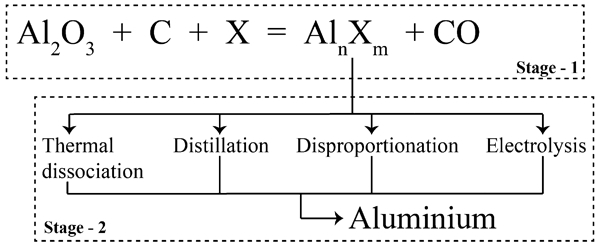
Schematic diagram showing indirect carbothermic aluminium production method from alumina
The following subsections review the various indirect carbothermal productions of Al, focusing on the carbochlorination, carbosulphidation and carbonitridation routes in stage 1 followed by various Al extraction techniques in stage 2.
Carbochlorination route
This route involves the formation of Al–chloride intermediate compounds from reactions of alumina (or aluminous ores) with carbon and chlorine sources. The production of volatile metal halides (including Al trichloride) from alumina has been known for many years, but most of the processes have difficulties in terms of operation and control. One of the earliest patented processes for the production of Al trichloride was from Ferguson and Cranford (1948), where they developed a continuous process using fluidised mixture reactor. In the case of carbochlorination of alumina, the process can be represented by the following reactions


Grob and Richarz (1984) attempted to chlorinate alumina in kaolinitic clay in Cl2 and CO gas mixtures. They found that the reactivity of alumina in the raw material increases when the material is first pretreated using ammonium sulphate (NH4)2SO4(g) or sulphur trioxide SO3(g). At temperatures below 727°C, the chlorination rates were found to be comparable to those reported for using pure gamma alumina as starting material. However, above 727°C, SiCl4 formed and interacted with alumina, leading to a decrease in the rate of Al chlorination.
Huapin et al. (1977) produced Al trichloride from alumina through reaction with carbon and chlorine in alkali metal halides and alkaline earth metal halides molten salt baths (AlCl3–NaCl–LiCl) at temperatures 400–950°C. Becker and Das (1978) used a mixture of high purity activated carbon and alumina heated in bubbling chlorine at temperatures 500–775°C and was able to obtain 100% conversion to AlCl3 vapour.
Toth (1971) patented a two-stage process for Al production where in stage 1, alumina is reacted with manganese chloride in the presence of carbon at temperatures 900–1300°C producing Al trichloride and manganese, through the reaction


Summary of previous major works/patents in chloride route

*p refers to patent; 1st stage refers to production of intermediate Al chlorides; 2nd stage refers to extraction of Al from the chlorides.
Extraction of Al from Al trichloride
The common routes for extracting Al from its chlorides are through disproportionation and electrolysis reactions. Other routes include distillation and direct reduction with other metals.
Disproportionation of Al halides (including chlorides)
Willmore (1939) discovered that AlF3 and several other fluorine compounds selectively distil Al at 900–1300°C. Klemm and Voss (1943) indicated that this occurs because of a formation of a monovalent compound (in this case AlF) at a temperature 1200°C. This compound was then disproportionated at a lower temperature of 800°C according to the following reaction

Gross (1944, 1949) proposed a process in which AlCl3 vapour is passed through a bed of impure crushed Al alloy above 1000°C and Al is extracted and condensed by disproportionation at 700°C according to the reaction

In the 1960s, Alcan developed an alternative process for production of Al which involved carbothermal reduction of aluminous ores followed by monochloride purification (Russell, 1981). This work was stopped due to problems associated handling of chlorides which included stress–corrosion cracking and inefficiency in separating manganese impurities. In the 1970s, Othmer (1974, 1975) proposed a separation of Al from aluminous ores (bauxite, clays, feldspar) through carbochlorination (to form AlCl3) followed by disproportionation or halogenation in a flash condenser. One of the recent works associated with carbochlorination of alumina followed by disproportionation was from Yuan et al. (2010). They carried out the carbochlorination in vacuum and observed AlCl(g) at temperatures 1430–1580°C and pressures from 40 to 150 Pa. The AlCl(g) was then disproportionate into Al and AlCl3(g) below 660°C. They were able to obtain Al metal with average purity of 95·32 wt-%.
Electrolysis of Al trichloride
It has been claimed that Al chloride electrolysis method is attractive both from an economic and technical point of view (Grjotheim et al., 1977). Ishikawa and Ichikawa (1979) argued that the potential advantages of Al chloride salt electrolysis process include:
chloride salts are much less corrosive than fluoride salts which results a longer cell life
the electrolysis process requires a closed system which limit the emission of gasses
chloride salts have higher conductivities compared to the fluoride salts resulting lower energy consumption, higher power and current efficiencies
the electrolysis process has a very broad operational range of Al concentration which results in no ‘anode effect’
it is possible to design an electrolytic process cell with bipolar electrodes which results in a much more compact cell with increased production potential per unit volume.
In the 1970s, Alcoa developed alternative processes to produce Al which focused in three major directions:
direct carbothermal reduction of alumina
indirect carbothermal reduction of aluminous ores that involved carbochlorination, monchloride purification
electrolysis of Al chloride (Russell, 1981).
The general schematic of the process routes is shown in Fig. 2.
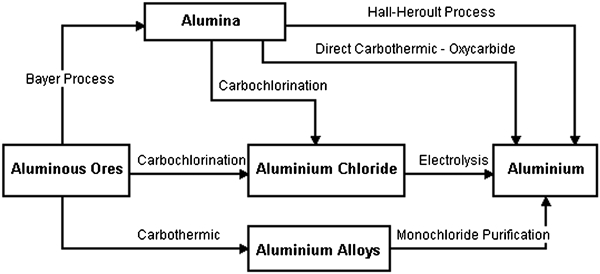
Schematic diagram showing process routes considered by Alcoa (Russel, 1981)
Russell et al. (1973) from Alcoa developed an Al chloride electrolysis process using NaCl–LiCl (50∶50, w/w) electrolyte at temperatures 660–730°C. They suggested operation with 1–15 wt-% concentration of AlCl3 in the bath. The anode–cathode distance in the process was suggested to be ∼25 mm. They were able to improve the current efficiency (up to 80%) and avoid the formation of sludge from the impurities using these proposed operating conditions. Dell et al. (1975) improved the process by developing a new design with bipolar electrodes. This allowed the process to operate with a lower anode–cathode distance (<19 mm). Alcoa developed the Al trichloride electrolysis route in the 1970s to a commercial level but halted the operations in the 1980s, because of difficulties associated with production and handling of pure Al trichloride (Thonstad et al., 2001).
Ishikawa and Ichikawa (1979) from Nippon Light Metal electrolysed AlCl3 in a molten AlCl3–LiCl–NaCl salt bath at 700°C. Additions of LiCl, CaCl2 or MgCl2 salts to the bath improved the electrical conductivity and the current efficiency. They were able to obtain 90–100% current efficiency. Cohen et al. (1986) from Pechiney proposed a continuous process through carbochlorination of alumina to form AlCl3 followed by electrolysis in AlCl3–alkali/alkali–earth metal halides electrolyte. One of the recent works on the electrolysis of AlCl3 was from Sharma (2000) where Al is produced through electrolysis in a chloride–fluoride salt bath at 750°C. The electrolytes used include Na3AlF6–NaCl–NaF, Li3AlF6–LiCl–LiF and K3AlF6–KCl–KF.
Wilkening (1990) produced Al through electrolysis where the bath consists of alkali halides and/or alkali earth halides. A mixture of Al oxide and carbon was used as a feed material. Different arrangements of the electrolytic cell were also proposed in the work. Tomaswick (2002) from Alcoa electrolysed Al2O3 directly in a bath containing AlCl3 and an alkali metal chloride (NaCl, LiCl, KCl, MgCl2, CaCl2, BeCl2, BaCl2). The process was carried at 300°C and Al was extracted as a solid metal at the cathode in a frozen layer of the alkali metal chloride.
Other Al extraction methods from Al trichloride
There are other methods used to extract Al from AlCl3. One example is through direct reduction using another metal (e.g. manganese). Toth (1971) patented a two-stage process where in stage 1, alumina is reacted with manganese chloride in the presence of carbon producing Al trichloride and manganese, as given in reaction in equation (10). The Al was extracted by reacting AlCl3 with manganese in stage 2 at a temperature sufficient to reduce AlCl3 to Al, according to the following reaction


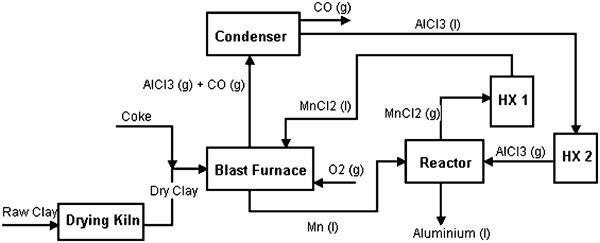
Flowsheet of Toth process (Toth, 1971)
Carbosulphidation route
Another alternative Al production method that has received a less attention is through the formation of Al sulphides (Al2S3 and AlS) as intermediate compounds. One of the first patented processes on the carbothermic production of Al2S3 was by Haglund (1931). Haglund produced a mixture of Al2O3 and Al2S3 from the reaction between Al2O3 containing ores, carbon as reduction agent, and sulphur sources in the form of FeS and ZnS. FeS was added in the form of a lump (mixed with uncalcined bauxite) where it was sink through the formed slag into the liquid iron alloy underlying the slag. Al sulphide was formed as part of the reaction products, while Al was contained in the iron alloy.
Weiss (1958) proposed a method for producing Al from a mixture of aluminous ores and Al2S3 reacted with carbon at temperatures above 1000°C at pressures below atmospheric pressure. The reaction resulted in vapours of Al subsulphide (such as Al2S) which upon cooling disproportionated into Al sulphide (Al2S3) and Al precipitate. The reactions are given below


Loutfy et al. (1981c) studied the thermodynamics of the carbosulphidation of alumina and patented an Al production process in 1981 (Loutfy et al., 1981b). Aluminous ores were reacted with carbon and sulphur containing gas at temperatures 1027–1227°C to obtain molten Al sulphide (Al2S3) and CO gas according to the following reaction



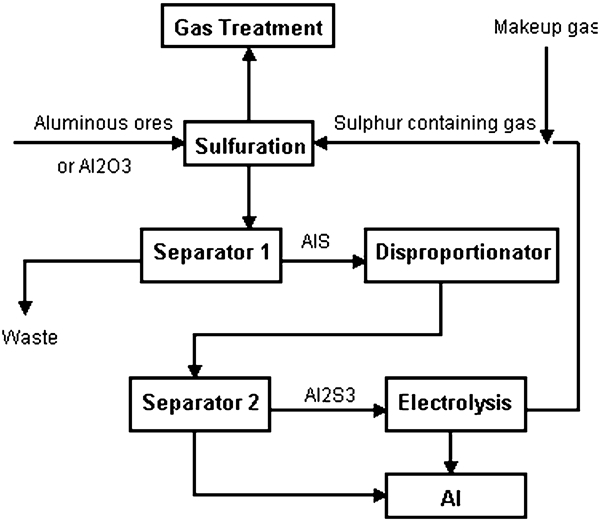
Flowsheet of aluminium production through carbosulphidation followed by combination of disproportionation and electrolysis proposed by Loutfy et al. (1981b)
Sportel and Verstraten (2003) (of Corus Al GmbH) produced Al2S3 from γ-Al2O3 using CS2 gas at 850°C according to the following reactions




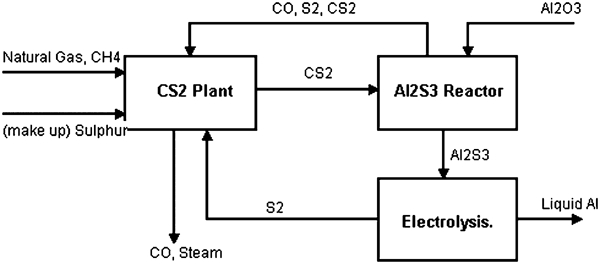
Flowsheet of compact aluminium production process (CAPP) (Sportel and Verstraten, 2003)
Xiao et al. (2004) studied the kinetics of the sulphidation of alumina with CS2 gas at ambient pressure. They suggested that the optimum temperature of 850°C for sulphidation of γ-Al2O3. In the experimental conditions studied, they reported that the particle size of γ-Al2O3 has no effect on the reaction rate. A maximum conversion ratio of ∼40% after 5 h reaction at the conditions studied was reported.
Li et al. (2006) investigated the possibility of direct formation of Al monosulphide (AlS) by reacting alumina–carbon mixture with FeS according to the following reaction

Previous major works on the production of Al from alumina (or aluminous ores) through carbosulphidation reactions followed by various Al extraction process (stages 1 and 2) are summarised in Table 2.
Summary of previous major works/patents in sulphide route
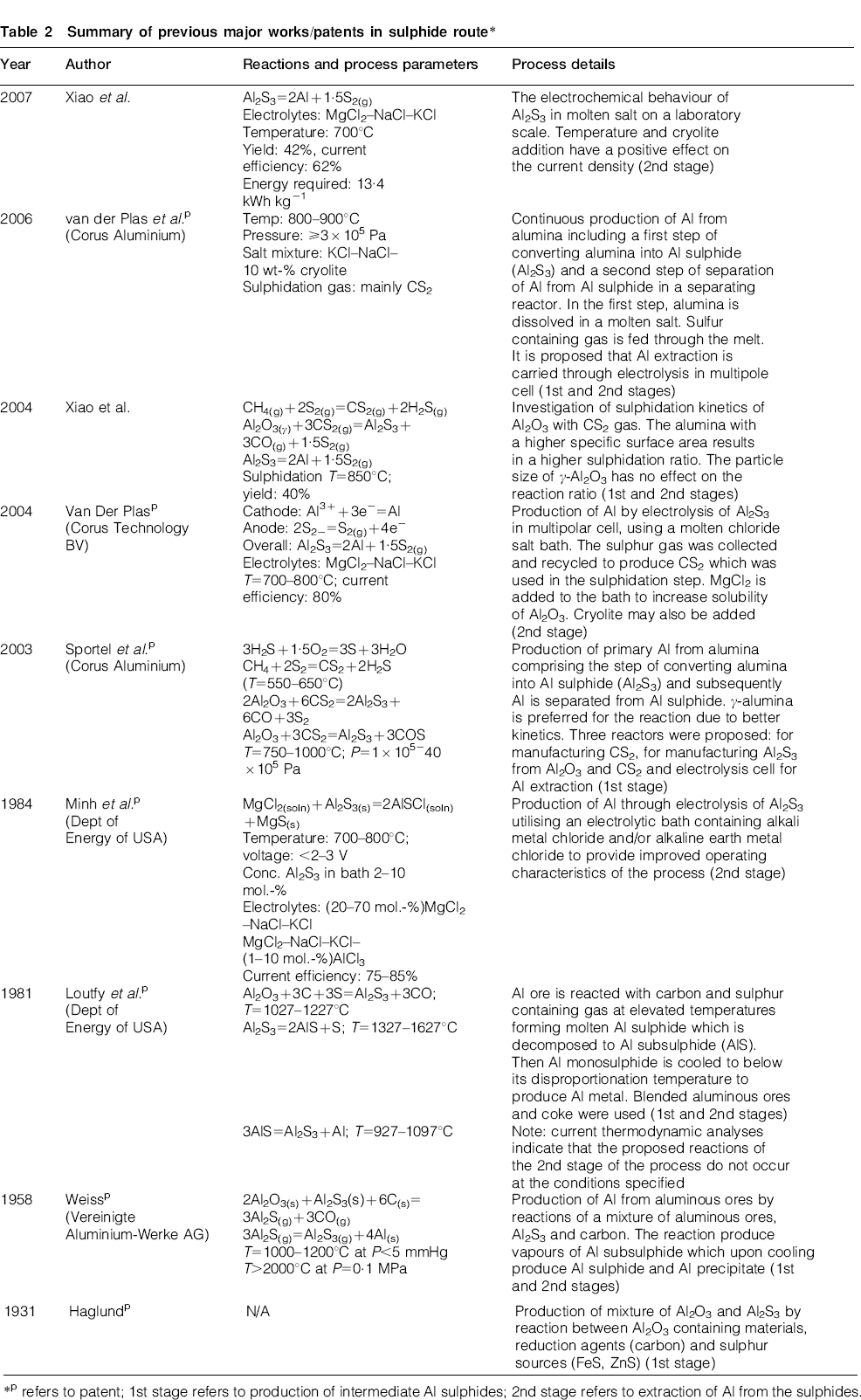
*p refers to patent; 1st stage refers to production of intermediate Al sulphides; 2nd stage refers to extraction of Al from the sulphides.
Extraction of Al from Al sulphides
The literature review on the production of Al through carbosulphidation route revealed that the methods proposed to extract Al from its sulphides are disproportionation and electrolysis.
Disproportionation of Al subsulphides
The basis of Al extraction by dispropotionation is through dissociation of Al subsulphides to Al sulphide (Al3S2) and Al upon cooling (e.g. at temperature below the disproportionation temperature of associated subsulphides). Weiss (1958) suggested the disproportionation of Al2S(g) subsulphide as per reaction given in equation (17) at pressure 5 mmHg and temperature of 1200°C. Loutfy et al. (1981c) proposed the extraction of liquid Al through disproportionation of AlS(l) subsulphide at temperatures between 927 and 1097°C following reaction in equation (20). Loutfy et al. (1981c) did not provide information on the pressure for the process. Thermodynamic analysis carried out by Dewan et al. (2012) showed that the reaction in equation (20) does not occur at ambient pressure. Although mentioned in a number of patents (Weiss, 1958; Loutfy et al., 1981c), there is a limited published work on the details of thermodynamics and kinetics of the disproportionation reactions of Al subsulphides. Further studies on the thermodynamics and kinetics of Al subsulphide disproportionation are needed for optimisation of the process.
Electrolysis of Al sulphide
The extraction of Al metal by electrolysis of Al sulphide in molten salts is attractive from the viewpoint of energy utilisation. By improving the cell design and electrolyte composition, the theoretical energy consumption can be reduced to 8·41 kWh kg−1 Al which is considerably lower than the value of 14 kWh kg−1 Al in the current Hall–Heroult process (Xiao et al. 2007). Al sulphide (Al2S3(s)) has a lower theoretical decomposition potential, compared to Al2O3(s) and AlCl3(l) (Minh et al. 1982), and can be electrolytically decomposed in a molten cryolite at 727–927°C (Loutfy et al. 1981b) to produce molten Al and sulphur gas that can be recycled for CS2 production.
The early works on the electrolysis of Al2S3 in a mixture of cryolite with NaCl were from German and Russian scientists (in 1930s and early 1940s). In these studies, a maximum current efficiency of 55% was reported (Rontgen and Borchers, 1933; Khazanov and Belyaev, 1935; Khazanov and Komarov, 1940). The overall reaction for electrolysis of Al2S3 in molten electrolyte follows



In 2006, Corus (van der Plas and Xiao, 2006) developed a continuous production process of Al from alumina. In the first stage, alumina was dissolved in a molten salt and a sulphur containing gas (in particular CS2) was fed through the melt; this resulted in a partial conversion of alumina to Al sulphide. Al was then separated from Al sulphide in a multipole electrolysis cell. The process was carried out at temperatures 800–900°C, at pressures above 3×10⁵ Pa in a KCl–10 wt-%NaCl cryolite mixture.
Carbonitridation route
Selvaduray and Sheet (1993) and Haussonne (1995) provided a review on various methods for the synthesis of Al nitride. In general the methods can be classified into: carbonitridation reactions, direct nitridation, floating nitridation, chemical vapour deposition, vapour phase reactions and reactions utilising organometallic precursors (Selvaduray and Sheet, 1993). Only the carbonitridation route will be described in this paper, as it is the route most relevant to industrial scale production of metal.
Carbonitridation of alumina and aluminous ores is a well known process. It follows an overall reaction of

Considerable disagreement exists in the literatures concerning the detailed reaction steps for nitride formation. Hirai et al. (1989) synthesised AlN(s) from Al2O3(s) and graphite at temperatures between 1500 and 1700°C. They observed a small quantity of Al oxynitride (AlON), when alumina graphite mixture is heated at 1700°C. Their results indicated that the reaction rate is not affected by the grain size of graphite, pellet diameter and flow rate of N2; and they suggested that the diffusion of the reactant gas through the AlN(s) layer (formed around Al2O3(s)) is the rate determining step. Lefort and Billy (1993) argued that the rate determining step suggested by Hirai et al. is unlikely as the apparent activation energy (∼530 kJ mol−1) is beyond what would be expected from a limiting gaseous diffusion. They suggested that the rate limiting process is the combustion of carbon and suggested the following reaction steps





Ide et al. (1999) produced AlN(s) through carbonitridation of alumina at temperatures 1350–1450°C using CaF2(s) as catalyst. They reported that nitridation rate tended to increase with decreasing particle size of alumina and was affected by the history of the alumina used in the reaction. They observed the formation of intermediate compounds CaO.6Al2O3 (CA6) and CaO.2Al2O3 (CA2) and suggested that the process proceeded through the nitridation of the intermediate compounds from liquid phase system CaF2–CA6–CA2. Molisani and Yoshimura (2010) investigated the effect of various additives (0·5–3 wt-%CaF2, Y2O3, Li2CO3 and SrCO3) on the carbonitridation of alumina at 1300–1400°C. The addition of these additives (and their mixture combinations) was reported to reduce the synthesis temperature by a maximum of 200°C. They attributed this to the formation of aluminate phases that easy to vapourise at lower temperatures.
Bartnitskaya et al. (2002) studied the carbonitridation reaction at temperatures 1800–1900°C in a static condition (closed system) under nitrogen atmosphere of 0·2–0·3 MPa. They obtained isometric AlN particles of 2–6 μm as opposed to fibrous type particles usually obtained in reaction carried out in a stream of nitrogen gas. They suggested that in the case of reaction at a high nitrogen pressure, alumina dissociation is suppressed which excludes the possibility of reaction in the gas phase, hence the formation of isometric particles. Chowdhury et al. (2006) synthesised nanosize AlN(s) by nitridation of C–Al2O3 composite particles at 1500–1600°C in an over pressure (0·4 MPa) flowing nitrogen gas. A mixture of fibrous and spherical particles was obtained.
Joo and Jung (2008) investigated the effect of CO content in the N2–CO gas mixture for carbonitridation reaction from 1000 to 1600°C. They used Al hydroxosuccinate as precursor for the reaction. The carbonitridation reaction was found to be retarded with increasing content of CO in the mixed gas. They observed conversion sequence from ρ-Al2O3 to γ-Al2O3 to AlN(s) (or to δ-Al2O3) depending on the CO content in the gas mixture. Qin et al. (2008) prepared C–Al2O3 composite particles from Al(NO3)3.9H2O, CO(NH2)2 and C6H12O6.H2O and carried out the nitridation at 1000–1600°C in a flowing nitrogen gas. They reported a conversion to γ-Al2O3 followed by direct conversion to AlN(s) upon nitridation. Complete conversion was observed at 1400°C.
Galvez et al. (2009) produced AlN(s) using concentrated thermal radiation through reduction of Al2O3 using activated C (and CH4) in flowing nitrogen. The radiative fluxes used were equivalent to solar concentration exceeding 4500 kW m−2 and the reaction was carried out at 1827–2027°C. In the case of carbothermal–nitridation reaction (reaction given in equation (28)), the experimental data were fitted into a solid–solid reactions model with an apparent activation energy of 360 kJ mol−1. In the case of reduction using CH4 (methanothermal reduction), the overall reaction follows

Galvez et al. (2007) also investigated the carbothermal reduction of alumina in nitrogen atmosphere at temperatures between 1500 and 1700°C. The kinetics were described as solid–solid reactions and fitted to Jander and Ginstling-Brounshtein models with activation energies of 815 and 757 kJ mol−1 respectively. They also evaluated various types of carbon sources and reported that the reaction rates vary for different carbons (listed in decreasing order of reaction rates: petcoke, activated carbon, wood charcoal and carbon black) (Galvez et al., 2008).
Baik et al. (1994) and Kuang et al. (2003) produced Al nitride through carbonitridation using sucrose precursors. Zhang and Gao (2006) produced nanocrystalline Al nitride from δ-Al2O3 nanoparticles in flowing ammonia. They reported that the nanocrystalline δ-Al2O3 was converted into AlN(s) completely at temperatures 1350–1400°C within 5 h in a single step synthesis process. Xi et al. (2008) synthesised AlN(s) by carbothermal reduction using a mechanically activated Al2O3. They showed that carbonitridation can be carried out at temperature as low as 1100°C and completed thoroughly at 1250°C when milled Al2O3 (for 20 h) was used.
There are two primary methods to prepare AlN powders at an industrial scale (Selvaduray and Sheet, 1993): direct nitridation of Al with N2 (2Al+N2 = 2AlN), and carbothermal reduction of Al2O3 with carbon black (or other carbonaceous sources) in the presence of N2(g) at 1500–2000°C (reaction in equation (29)). The former is beyond the scope of this paper. In terms of technological developments, a number of Al nitride production processes by carbonitridation in nitrogen or mixed gas atmosphere have been patented. A summary of these studies is presented in Table 3.
Summary of previous major works/patents in nitride route
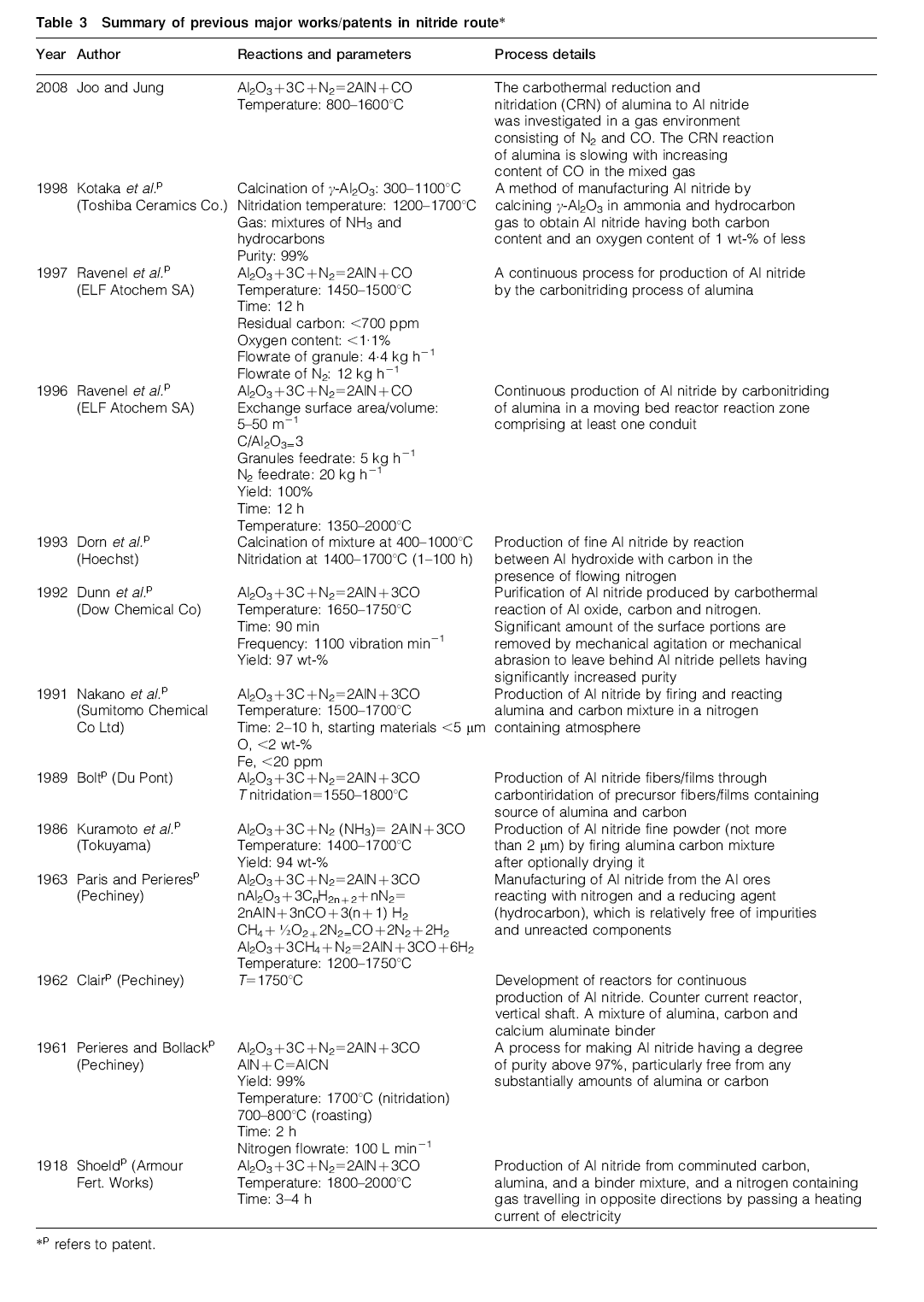
*p refers to patent.
One of the first patents in the carbonitridation of alumina is from Shoeld in 1918 where he carried out the reaction at 1800–2000°C. In the 1960s, Pechiney (Perieres and Bollack, 1961; Clair, 1962; Paris et al., 1986) patented various carbonitridation processes. Perieres and Bollack (1961) produced AlN powder to 99% by roasting the produced AlN(s) from carbonitridation reaction in an oxygen free atmosphere at 700–800°C to burn off the excess carbon. Clair (1962) developed a vertical shaft counter current reactor for continuous production of Al nitride, while Paris and Perieres (1986) used a mixed environment of nitrogen and hydrocarbon gas for carbonitridation of alumina at 1200–1700°C. The hydrocarbon gas was cracked to elemental carbon in a highly reactive state in uniform distribution throughout the Al oxide particle.
Kuramoto et al. (1986) produced AlN powder from alumina and carbon by firing the mixture at 1400–1700°C in nitrogen (or ammonia) atmosphere followed by heating at 600–900°C to improve the purity to 94%. Bolt (1989) patented a method to produce Al nitride films (and fibres) using precursors containing alumina and carbon.
In the 1990s, a number of AlN(s) production processes were patented by various companies. Nakano et al. (1991) patented a process using very fine source materials (<5 μm). Dunn et al. (1992) increased the purity of AlN(s) produced by carbonitridation by applying mechanical agitation. Most of the impurities remain in the outer zone of the pellet and a significant amount of the surface portion is removed to improve the purity of the final Al nitride product. Dorn et al. (1996) produced AlN(s) through calcinations of Al hydroxide–carbon mixtures at temperatures from 400 to 1000°C followed by nitridation from 1400 to 1700°C. Ravenel et al. (1996, 1997) patented a process for continuous production of Al nitride from 1350 to 2000°C using a moving bed reactor. Kotaka et al. (1998) patented a process to produce AlN(s) from γ-Al2O3 using mixtures of ammonia and hydrocarbons from 1200 to 1700°C and claimed to obtain purity of 99%.
Extraction of Al from Al nitride
One of the ways to extract aluminum from aluminum nitride is through thermal dissociation. The thermal dissociation of Al nitride occurs at a temperature above 2400°C at 0·1 MPa according to reaction

The theoretical decomposition voltage of Al nitride to Al and nitrogen is 0·75 V at 700°C. This is a lower decomposition voltage than that of AlCl3(l), Al2S3(s) and Al2O3(s) at the same temperature. From the thermodynamic point of view, electrolysis has a good potential for extracting aluminum from Al nitride. One of the major challenges is to find the appropriate electrolytes that can dissolve the very stable AlN(s). Bonomi et al. (1982) carried out a limited study on the solubility and the electrolysis of AlN in molten salt (Li3N–LiCl) bath at 660–700°C. The current efficiency for this system was 83% with a cathodic current density of ∼1·5 A cm2. No further results indicating the successful of the process have been presented. Goto et al. (2005) used the salt system of LiCl–KCl–Li3N to deposit AlN film onto Al substrate. Figure 6 shows the E-pN3− diagram for the Al–N system in a LiCl–KCl eutectic melt at 450°C showing the region where Al solid is stable. Yan (2008) conducted a direct electrochemical reduction of AlN cathode in a CaCl2–NaCl melt at 1133 K and observed a pure Al droplet. The yield, however, was low, i.e. 3–5%.
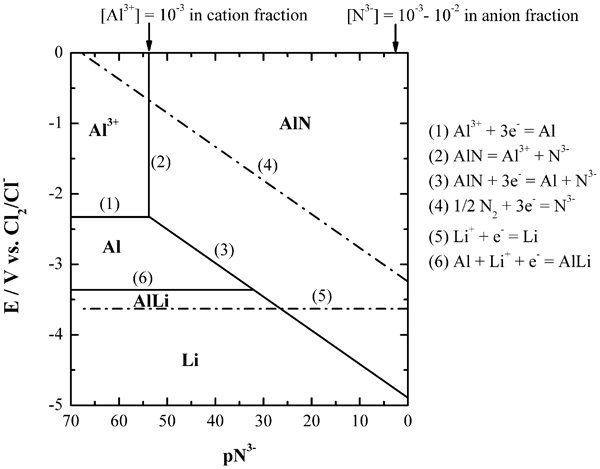
Potential-pN3− diagram for Al–N system of LiCl–KCl eutectic melt in presence of 10−3 cation fraction of Al3+ at 450°C (Goto et al., 2005).
Conclusion
Many researchers have pursued an alternative commercial method for Al production. Although carbothermal reduction of alumina or aluminous ores (direct or indirect) offers the potential for lower energy consumption and improved productivity, compared to existing process, to date, none of the proposed processes have been successfully commercialised in a plant scale. In the case of direct carbothermal reduction of alumina/aluminous ores, a mixture of Al carbide and metallic Al is formed. Equilibrium studies show that the driving forces for both Al carbide and Al metal formation by carbothermic reduction of alumina are similar, therefore it is difficult to obtain high yield of pure Al. This route has other difficulties, including a high operating temperature and yield problems associated with Al vapour loss and back reactions with carbon monoxide forming Al oxides and carbides. The recent technology in this area has shifted to a multi stage process, the Alcoa-Elkem process, where a slag of Al2O3 –Al4C3 is first produced followed by extraction of Al. Alcoa continued the development of the carbothermal process on its own, particularly on the improvement of the off-gas cooling system. They reported a successful test campaigns that run for several weeks, with each tap generates several hundred kilograms of metal with total yield in tonnage scale.
In the case of multistage production of aluminum through the formation of intermediate compounds; there had been intense developments of the chloride route in the 1960s and throughout the 1970s with major players including Alcoa and Toth Al Corporation. At one stage, the Alcoa chloride process (carbohclorination followed by electrolysis) was used to produce Al commercially. This, however, was halted in the mid-1980s due to problems associated with production and handling of pure Al chloride and chlorine at high temperatures.
In the sulphide route, Al2S3(l) can be produced by carbosulphidation of alumina or aluminous ores. Al metal can be extracted from Al2S3(l) by disproportionation and electrolysis processes. In the 2000s, Corus developed a process for making Al through carbosulphidation followed by electrolysis. This, however, is not yet commercialised.
There is also the nitride route where AlN(s) is produced from alumina–graphite mixture reacted at 1700°C in nitrogen containing gas. One of the major challenges is to find the economical route to extract Al from AlN(s). The nitride is a very stable phase but can be dissociated to Al metal at >2400°C at 0·1 MPa pressure. The theoretical decomposition voltage of Al nitride to Al and nitrogen is 0·75 V at 700°C. It is the lowest compared to the decomposition voltage of AlCl3(l), Al2S3(s) and Al2O3(s) at the same temperature. Therefore, electrolysis has potential to be used for extracting aluminum from Al nitride. However, to date no appropriate electrolytes are available to dissolve the very stable AlN.
In summary, direct carbothermic reduction has yet to be commercialised because of problems with extreme operating conditions and yield, while, two stage indirect carbothermic reduction using Cl, S and N sources to form intermediates have been investigated but still require significant developments. No systematic thermodynamic examination of all the options has been published in the literature.
Footnotes
Acknowledgements
The current study is funded by the ‘CSIRO – Breakthrough Technologies for Primary Aluminium’ Research Cluster.