







Abstract
It has been widely claimed that direct and indirect carbothermic reduction of alumina for the production of aluminium have the potential to consume less energy, generate fewer perfluorocarbons and have lower total greenhouse gas emissions compared to the Hall–Héroult process. A review of alternative aluminium production techniques focusing on the indirect carbothermal reduction routes has been presented in the Part 1 paper. In this Part 2 paper, systematic thermodynamic analyses of indirect carbothermal reduction routes are presented. These include the analyses of the Stage 1 of the process where alumina is converted to intermediate aluminium compounds before they are further reduced to aluminium metal in the subsequent stages. The results suggested that in the Stage 1, high alumina conversion at the process conditions studied can be achieved through three process routes: halide (chloride), nitride and sulphide routes. Thermodynamic analyses were also carried out for the Stage 2 where the intermediate aluminium nitride, chlorides or sulphides are reduced to aluminium through thermal dissociation, thermal disproportionation and/or electrolysis. Analysis of the results suggests aluminium may be extracted from AlN using thermal dissociation, while disproportionation and electrolysis are more suitable for AlCl3 and Al2S3.
Keywords
Introduction
Aluminium metal is currently produced from alumina using the Hall–Héroult (HH) electrolytic process, in which an electric current is passed between two electrodes to electrolytically reduce alumina [which is dissolved in cryolite (NaF–AlF3)] to aluminium metal. This process has high energy consumption, releases perfluorocarbons and significant quantities of greenhouse gases. The direct carbothermic reduction of alumina can be represented by equation (1)

Another approach of potentially lower energy consumption and greenhouse gas emissions is in Al production is through an indirect carbothermal reduction route. This route includes at least two stages where alumina (or aluminium ore) is reduced to an intermediate compound by carbothermal reduction in the Stage 1. This is then followed by extraction of aluminium from the intermediate compound (Stage 2). A schematic of the process is shown in Fig. 1. An example of an indirect carbothermal process is the compact aluminium production process (CAPP) where alumina is reacted with carbon disulfide (CS2) to form Al2S3 which subsequently electrolysed to extract aluminium (Sportel and Verstraten, 2003).
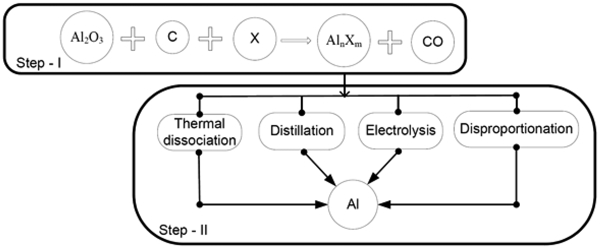
Schematic diagram showing indirect carbothermic aluminium production method from alumina
In the Part I paper (Rhamdhani et al., 2013), a review of the alternative aluminium production techniques focusing on the indirect carbothermal reduction routes has been presented. The majority of previous studies associated with indirect carbothermal reductions were published in patent literature; and some of them provide ambiguous information on the process conditions (e.g. temperature and pressure were presented in ranges). There is no systematic and clear information on the thermodynamics of the process, particularly on the comparison between different process routes. In this paper (Part 2), systematic thermodynamic analyses of different indirect carbothermal reduction routes are presented. The approach taken in the study include:
evaluation of Gibbs free energy formation of various aluminium compounds
equilibrium calculations for Al2O3-C-X systems, where X is various reactants
equilibrium calculations for Al extraction from selected aluminium compounds.
The process conditions used in the equilibrium calculations were chosen considering a set of criteria, e.g. feasible temperatures and pressures used in pyrometallurgical industry practice.
Thermodynamic analyses of formation of intermediate Al compounds
Two thermodynamic packages were used for the analysis, HSC Chemistry 6·1 and FactSage 6·2. Both the HSC Chemistry 6·1 and FactSage 6·2 utilise thermodynamic data from Barin (1993) and JANAF (1971). The details of FactSage 6·2 thermochemical package can be found elsewhere (Bale et al., 2009). This package has optimised databases for solutions, such as alloys, liquid and solid oxides and slags. A modified quasi-chemical model is used for solution modelling of liquid slag phases.
The Gibbs free energy formations of various Al compounds were evaluated using the HSC Chemistry 6·1. This package has an inbuilt module that allows simple comparison of the Gibbs free energy formation of various Al compounds. Selected output results from the HSC Chemistry 6·1 were compared to results from FactSage 6·2 for consistency test. Other equilibrium calculations, such investigation of Al-C-X systems (where X is various reactants) and extraction of Al from various intermediate Al-compounds, were carried out using the FactSage 6·2.
A number of elements (N, S, P, Cl, B, and Br) have been considered as possible reactants along with carbon to form intermediate compounds and phases. The process temperatures 1000 to 2000°C, and pressures 10−3 to 1 atm were assessed in the calculations. For the equilibrium calculations, the reactants and products were assumed to be pure and no solution effect was included.
Gibbs free energy formation evaluation
The Gibbs free energy of formation of various Al compounds (associated with N, S, P, Cl, B, and Br) were evaluated and compared to that of Al2O3. Figure 2 shows the plots of the Gibbs free energy (per unit mol of Al at 1 atm) with temperature for Al–nitride, Al–chlorides, Al–carbide, Al–borides, Al–bromides, Al–sulphides, Al–phosphides and Al–phosphates. The associated reactions are shown in each figure.
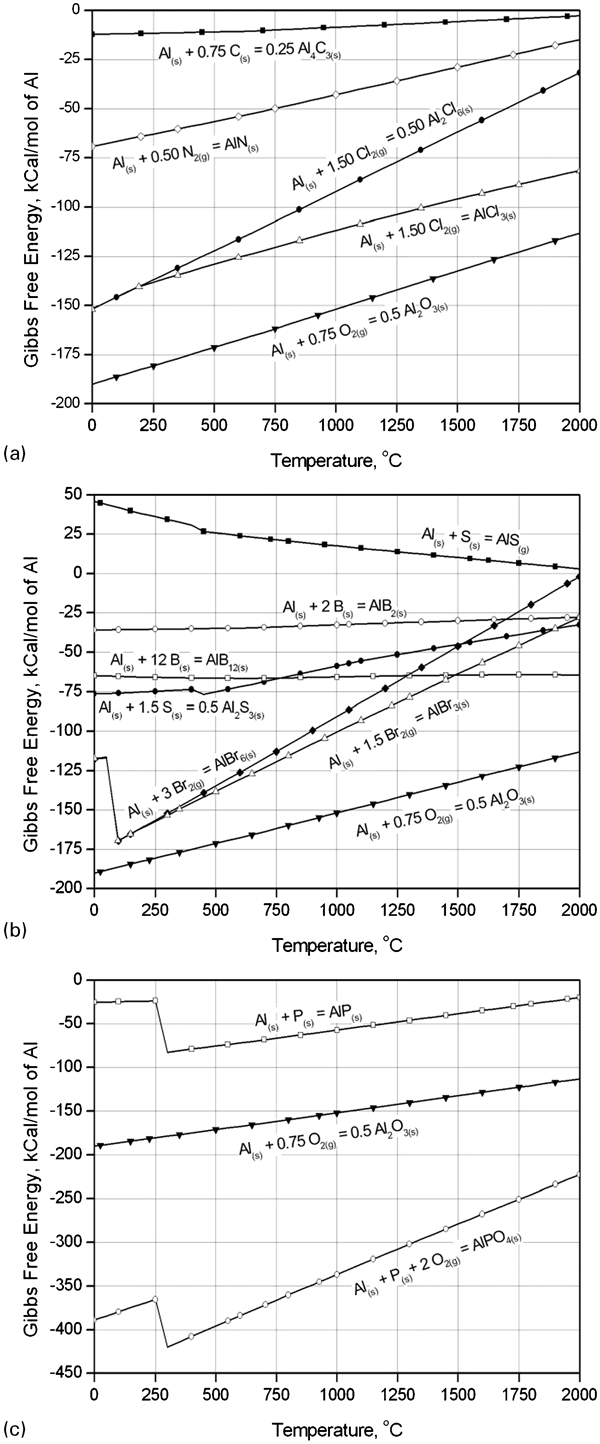
Gibbs free energy formation of aluminium compounds at various temperatures
It can be seen from the figures that the Gibbs free energy for Al2O3(s) is much lower compared to other Al compounds (with the exception of AlPO4(s) as shown in Fig. 2c), indicating the higher stability of Al2O3(s). It appears that direct reactions of alumina with proposed elements to form associated Al compounds will not be feasible as they are not favoured thermodynamically.
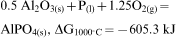
AlPO4(s) is more stable compared to Al2O3(s) at the temperature range studied. The reaction given in equation (2) has negative ΔG in the temperature range 800–1800°C
Equilibrium calculations of Al-C-X reaction systems
Further thermodynamic analyses were carried out considering carbon as an additional reducing reactant. To investigate the theoretical limits of potential routes, equilibrium calculations for Al2O3–C systems reacted with various potential reactants X (where X = N2, S, P, Cl2, B, and Br2) were carried out for temperatures of 1000 to 1800°C, at 1 atm. pressure. The initial (mole) amounts of carbon and X used in the calculations were determined based on the stoichiometric compositions from assumed reactions to reduce one mole of Al2O3(s). The followings were considered for reactants input for the calculations






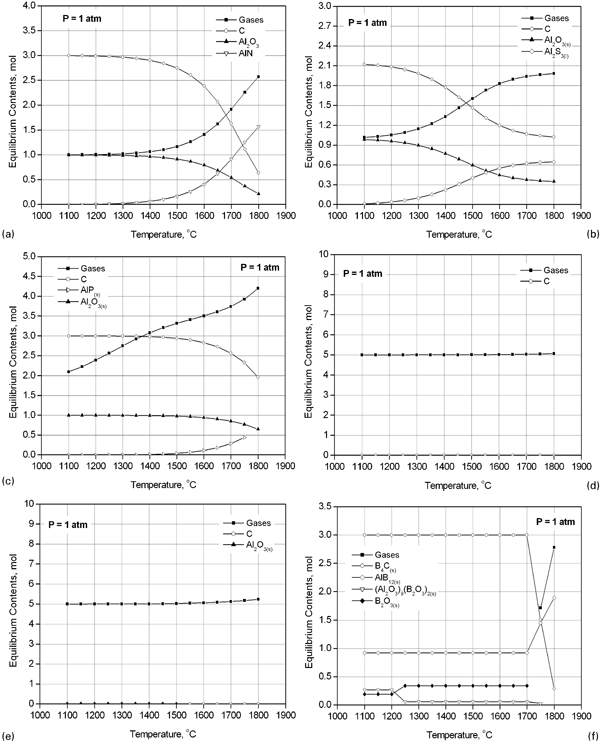
Predicted equilibrium compositions of solid/liquid/gaseous phases formed when various reactants X are reacted with alumina and graphite at T = 1100 to 1800°C, P = 1 atm: major component in gaseous phases is carbon monoxide
The results predict that the amount of AlN(s) in equilibrium at 1300°C is negligible and 0·98 mol of N2(g) remains unreacted, as shown in Fig. 3a. Further increasing temperature above 1300°C increases the formation of AlN(s). At 1800°C, nitrogen strongly reacts with alumina and 1·57 mol of AlN(s) is produced. In the gaseous phase, 0·21 mol (∼8·3 mol.-%) of N2(g) remain unreacted and 2·35 mol (∼91 mol.-%) of CO(g) is produced.
The phases predicted in equilibrium for the sulphur system at temperatures between 1100 and 1800°C are presented in Fig. 3b. Al2S3(l) is the main intermediate aluminium compound when sulphur is reacted with alumina and carbon. Formation of Al2S3(l) is low from 1100 to 1300°C (0·1012 mol) and increases with increasing temperature to 0·647 mol at 1800°C. At ambient pressure and 1800°C, sulphur cannot reduce all the Al2O3(s); only about 65 mol.-% of the alumina can be transformed to Al2S3(l) at these conditions. Formation of CO(g) is low at 1100°C (0·035 mol) and increases with increasing temperature to 1·94 mol (∼98%) at 1800°C. CS2(g) is predicted to form at 1100°C (0·84 mol ∼82%) but the equilibrium decreases to 0·015 mol when the temperature is increased to 1800°C.
It is predicted that addition of phosphorus to the Al2O3–C system (shown in Fig. 3c) does not produce aluminium phosphide at 1100°C. Phosphorus reacts with alumina at higher temperature producing AlP(s) and about 23 mol.-% of alumina can be transformed to AlP(s) at 1800°C. The amount of AlP(s) produced is low at 1500°C and most of the phosphorus remains unreacted and present in the gas phase. For example, at 1800°C only 0·66 mol of P (from the initial 7 mol) exist as AlP(s). The majority of the gas phase (4·2 mol) consists of P4(g) and CO(g) with concentrations of 74 and 24 mol.-% respectively.
It is predicted that alumina can be converted to aluminium chloride gases in the temperature range 1100 to1800°C as shown in Fig. 3d. In addition to CO(g) formation, the reaction between chlorine, alumina and carbon produces various aluminium chloride gases including AlCl3(g) (the major component), AlCl2(g), AlCl(g) and Al2Cl6(g). The concentrations of the other gases compared to AlCl3(g) are negligible. For example, at 1500°C, the composition of the gas (total 5 mol) is 59·9 mol.-%CO, 39·7 mol.-%AlCl3, 0·15 mol.-%AlCl2, and 0·14 mol.-%Cl. With increasing temperature, the amount of CO(g) remains similar, while AlCl3(g) slightly decreases with the expense of more formation of AlCl2(g) and Cl(g). At 1800°C, the composition of the gas is 59·2 mol.-%CO, 38·3 mol.-%AlCl3, 1·2 mol.-%AlCl2, and 1·12 mol.-%Cl.
Addition of bromine mostly converts all alumina to gaseous products including AlBr3(g) (Fig. 3e). The concentration of AlBr3(g) remains constant from 1100 to 1600°C at 39 mol.-% of the gas products; the rest is mostly CO. At temperatures above 1600°C other gas products, such as Br(g) and AlBr(g), are formed. At 1800°C, the composition of the gas (total 5·23 mol) is 57·3 mol.-%CO, 35·9 mol.-%AlBr3, 4·46 mol.-%Br, and 2·26 mol.-% AlBr.
In the case of the Al2O3–C–B system from 1100 to 1700°C, it is predicted that B4C(s), AlB12(s), B2O3(s) and (Al2O3)9(B2O3)2(s) are in equilibrium, as shown in Fig. 3f. When the temperature is further increased beyond 1750°C, the concentration of B4C(g) decreases and AlB12(s) increases. It appears that carbon reacts with boron rather than with oxygen (in the Al2O3(s)) at temperatures below 1700°C, where B4C(s) is a stable phase at the conditions studied. A gas phase starts to form above 1750°C. At 1800°C, the composition of the gas, totalling 2·78 mol, is 97·3 mol.-% CO and 1·58 mol.-% (BO)2 plus other.
To analyse the conversion efficiency of various routes in the conditions studied, conversion of alumina to the intermediate compounds was calculated and presented in Fig. 4. The alumina conversion was defined as

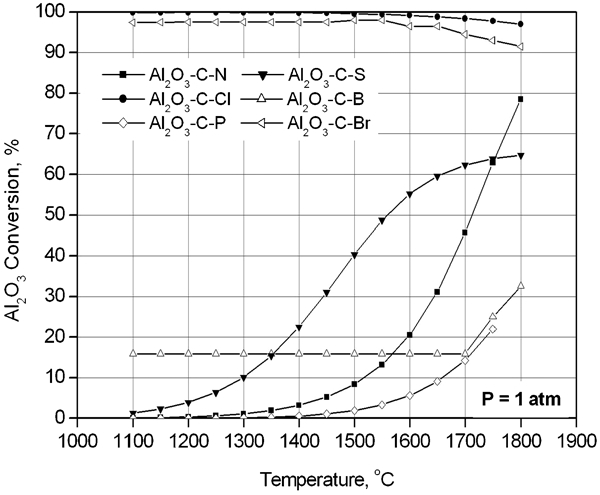
Comparison of Al2O3 conversion to various intermediate compounds at temperatures 1100 to 1800°C, 1 atm
Thermodynamic analyses of Al extraction from intermediate compounds
The results obtained from thermodynamic analyses of the formation of intermediate compounds from alumina (Stage 1) identified three potential routes with high alumina conversion yields: the halide (chloride), nitride and sulphide routes. These three routes were chosen for further thermodynamic analyses of the Stage 2. The carbochlorination route was chosen to represent the halide route. For the Stage 2, disproportionation, thermal dissociation, and electrolysis processes were analysed. The schematic of the chosen routes is shown in Fig. 5.
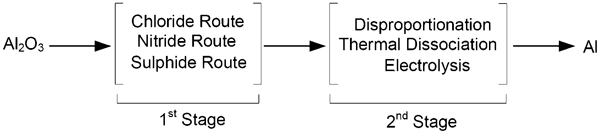
Schematic of chosen routes for thermodynamic studies
Extraction of Al from aluminium chlorides through thermal dissociation and disproportionation
AlCl3 is already in a gaseous form at 700°C and equilibrium calculation results predict that various aluminium chlorides are produced when the temperature is increased to 3000°C, forming complex equilibria. The formation of Al species at high temperatures is very low, as most of the Al is associated with the chloride gases. For example, at 2500°C, the majority of the gaseous compounds obtained are AlCl3 (0·565 mol ∼ 37·2 mol.-%), Cl (0·519 mol∼34·4 mol.-%), and AlCl2 (0·32 mol ∼ 21·3 mol.-%); while obtained gaseous aluminium is only 0·59×10−4 mol (3·9×10−3 mol.-%). Therefore, direct thermal dissociation of AlCl3 to a high temperature is not a suitable process for aluminium extraction.
It has been suggested that AlCl(g) disproportionate at 700°C through the following reaction (Gross, 1949)

To investigate the disproportionation of AlCl(g), the equilibrium compositions when AlCl(g) is heated from 500°C to 1500°C at 1 atm are investigated. The predicted equilibrium phases at various temperatures are presented in Fig. 6a. The results show that Al metal extraction from AlCl(g) by a disproportionation reaction is more complex than that given in equation (10). It can be seen from Fig. 6a that the formation of AlCl3(g) and Al(l) is increased when AlCl(g) is cooled down from high temperatures, e.g. from 1500°C. The maximum amount of aluminium (∼0·28 weight fraction) can be obtained at temperatures below 900°C at ambient pressure. Other gaseous compounds, such as Al2Cl6 and AlCl2 are also obtained at equilibrium.
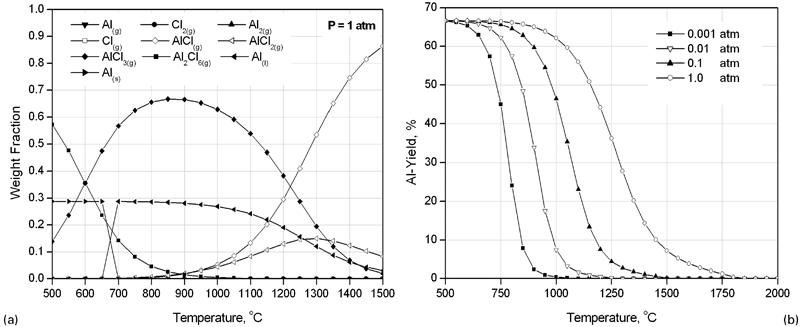
a predicted equilibrium compositions during disproportionation of aluminium chloride at temperatures between 500 and 1500°C, 1 atm and b effect of pressure on Al yield
Further equilibrium calculations were carried for lower pressures, i.e. 0·1, 0·01, and 0·001 atm. The results predict that pressure change has a significant effect on the equilibrium of aluminium chlorides; for example decreasing the pressure of the system results in the shifting of the curves in Fig. 6a towards lower temperatures. Figure 6b shows the effect of pressure on Al yield. The Al yield in the y axis is defined as

Extraction of Al from aluminium nitride through thermal dissociation and disproportionation
Extraction of aluminium from AlN(s) by thermal dissociation requires very high temperatures (>2434°C) at 1 atm. Unlike aluminium chloride, the equilibrium of AlN(s) dissociation is simpler. AlN(s) dissociates to aluminium gas and nitrogen gas at fixed temperature at specified pressure through the following reaction

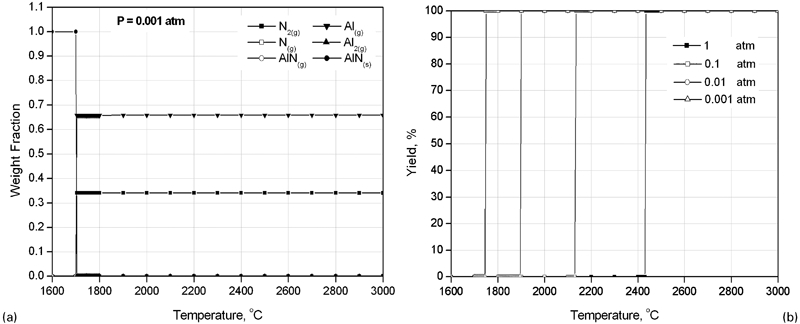
a predicted phases at equilibrium during AlN dissociation at P = 0·001 atm and b effect of pressure on dissociation temperature and Al yield
Aluminium nitride (AlN(s)) is a very stable compound. The current thermodynamic analysis predicts that AlN(s) does not disproportionate at the temperature range studied (500 to 2000°C), except under impractically low pressures. Therefore, disproportionation is not suitable for extracting aluminium from aluminium nitride.
Extraction of Al from aluminium sulphides through thermal dissociation and disproportionation
Aluminium can be extracted from aluminium sulphide (Al2S3(l)) through thermal dissociation. The current thermodynamic study suggests that Al2S3(l) is a stable phase, and does not dissociate as simple as AlN(s). Various gaseous sulphide phases are predicted to form upon dissociation of Al2S3(l) at temperatures above 2400°C at 1 atm pressure. At lower pressures the dissociation is simpler. Figure 8a shows the predicted equilibrium phases obtained at 0·001 atm pressure. Al2S3(l) starts to dissociate to various aluminium sulphide compounds, gaseous aluminium and sulphur at lower temperature (∼1700°C) when the pressure is reduced to 0·001 atm. Figure 8b shows the effect of pressure on the Al yield and the temperature where Al2S3(l) starts to dissociate. The Al yield is sensitive to pressure; by decreasing the pressure from 1 to 0·001 atm, Al yield can be increased from 0 to 61% at 1900°C. Technical challenges in the Al extraction through thermal dissociation include the combination of high temperature and low pressure; and separation of the gaseous Al from the other gaseous sulphides produced.
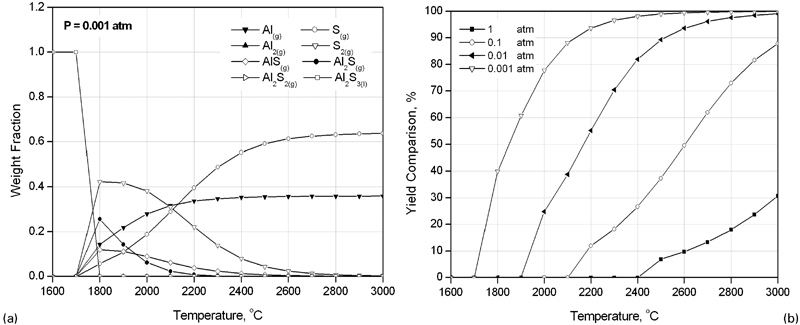
a predicted equilibrium phases during thermal dissociation of Al2S3 at 0·001 atm at T = 1600 to 3000°C and b aluminium yield at T = 1600°C to 3000°C at various total pressures
Loutfy et al. (1981) suggested that Al2S3(l) (produced from the carbosulphidation reaction) can be further heated at 1327–1627°C to produce aluminium monosulphide (AlS(l)) and sulphur following the reaction


Figure 9 shows the results of equilibrium calculations for disproportionation of AlS(l) at various temperatures and pressures. As seen in Fig. 9a, AlS(l) starts to form above 1100°C and completely dissociated to various aluminium sulphide compounds and aluminium gas above 2200°C at 1 atm. This suggests that the reaction in equation (14) cannot occur at ambient pressure. Further thermodynamic analysis was carried out to analyse the effect of pressure at 1500°C. The results are shown in Fig. 9b and suggested that aluminium can be extracted from AlS(l) by disproportionation if the pressure is kept below 10−4·5 atm. About 37·5 wt-% gaseous aluminium metal can be obtained when the pressure is about 10−5 atm. At 1500°C AlS(l) is a stable phase in equilibrium when pressure is higher than 10−4·4 atm.
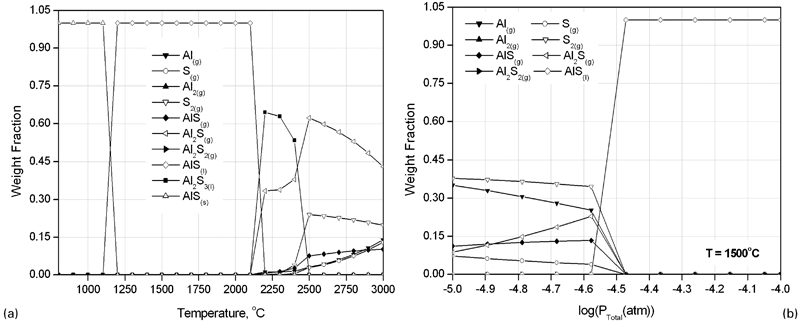
a predicted equilibrium phases obtained during disproportionation of AlS at T = 1000°C to 3000°C, 1 atm and b effect of pressure on disproportionation of AlS at 1500°C
Extraction of Al from intermediate compounds by electrolysis
The theoretical decomposition voltages of various aluminium compounds were evaluated. Fig. 10 shows the decomposition voltages of Al2O3(s), AlCl3(l), Al2S3(s) and AlN(s) in the temperature range 700–1100°C, 1 atm. The associated reactions are listed below, with their decomposition voltages ED





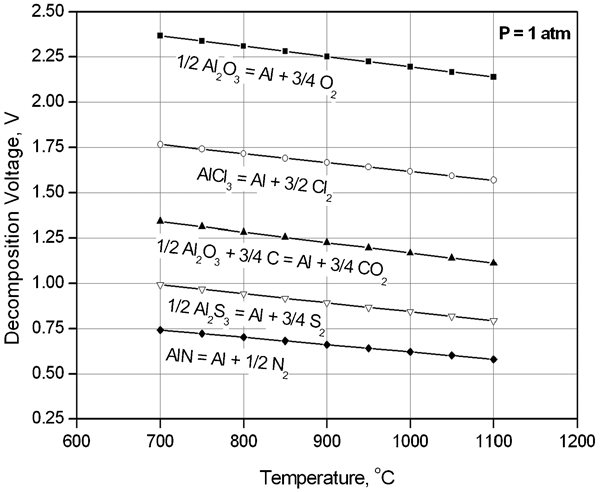
Decomposition voltage of various Al compounds (Al2O3, AlCl3, Al2S3, and AlN) at temperature range of 700–1100°C, 1 atm
There have been a number of studies focusing on the electrolysis of AlCl3. Ishikawa and Ichikawa (1979) carried out electrolysis of AlCl3 in a CaCl2–MgCl2–NaCl electrolyte at 680°C to 780°C; while Sharma (2000) used Na3AlF6–NaCl–NaF, Li3AlF6–LiCl–LiF and K3AlF6–KCl–KF electrolytes at 750°C. One of the major problems associated with Al2S3 electrolysis process is the low solubility of Al2S3 in the molten bath. Previous studies (Van Der Plas, 2004; Van Der Plas and Xiao, 2006; Xiao et al., 2007) have suggested the electrolysis of Al2S3 using the following electrolytes: MgCl2–NaCl–KCl, MgCl2–NaCl–KCl–AlCl3, and KCl–NaCl–Na3AlF6. In the case of AlN electrolysis, the problem includes finding the appropriate electrolytes that can dissolve the very stable AlN(s). There was a cursory study (Bonomi et al., 1982) which suggested the use of Li3N.3AlN.4LiCl electrolyte to dissolve AlN(s), but no further results have been forthcoming.
Conclusion
Thermodynamic analyses of the production of Al through indirect carbothermal reduction of Al2O3(s) have been presented. The indirect carbothermal reduction route consists of at least two stages, where in Stage 1 Al2O3(s) is reduced in the presence of C to form intermediate Al compounds, followed by extraction of Al from these compounds at Stage 2.
For Stage 1, thermodynamic analyses on the formation of various potential intermediate aluminium compounds suggest that high Al2O3 conversion at the process conditions studied can be achieved by three routes; namely halide (chloride), nitride and sulphide routes. By carbochlorination about 97% of the alumina can be converted to AlCl3(g) at 1800°C at 1atm. AlN(s) can be produced by carbonitridation of alumina with 78% conversion under the same conditions. Sulphur containing gases can be used for carbosulphidation of alumina in the presence of C, particularly given that carbon reacts with sulphur before it reacts with alumina. The equilibrium calculation predicts that Al2S3 can be produced at 1800°C, 1 atm with 65% conversion of alumina.
Thermal dissociation, disproportionation and electrolysis have been chosen to be analysed for the extraction of Al from the intermediate compounds in Stage 2 of the process. The results predict that the thermal dissociation can be used for both nitride and sulphide routes. It has been shown that the thermal decomposition of sulphides is very complex. Al2S3(l) is a stable phase and various gaseous sulphide phases are formed upon dissociation above 2400°C at ambient pressure. The challenges associated with the thermal dissociation include the high temperature requirement and formation of Al in gaseous form which needs to be separated. Carrying out the process at lower pressure can reduce the temperature (energy) requirement of the process. Disproportionation may be suitable for chloride and sulphide routes. However, it has been shown that disproportionation of sulphides is quite complex due to the formation of various other sulphides.
Aluminium chloride electrolysis can be operated at 700°C which is about 300°C lower than in the HH process. The chloride electrolytes have higher conductivities than fluoride salts which may result in lower energy consumption and higher power and current efficiencies. Aluminium may be extracted from AlN(s) by electrolysis. The dissociation voltage for AlN(s) is only 0·76V at 700°C; however, the solubility for aluminium nitride in cryolite or any other halide salts is negligible. A special type of electrolytic salt bath is required to dissolve AlN(s) and to increase the current efficiency. Challenges associated with the nitride route are dissociating the stable nitride and environmental issues (formation of cyanide gases) in Stage 1. Al2S3(l) has a higher solubility in a chloride bath, simplifying electrolysis. The required voltage (0·98 V) for electrolysis of Al2S3(l) is much lower compared to the Hall-Heroult process (1·82 V) and potentially can save 25% more energy than the chloride process.
It should be noted that the analyses presented in this paper are based on the results of equilibrium calculations which give the theoretical limits of the associated processes. The calculations also assume pure reactants and products, i.e. no solution effect is included. These limitations aside, the results may provide a basis for the comparison between the various routes, useful for development of new processes or further improvement and optimization of the current alternative routes for production of Al. We have also not considered the energy requirements as well as the cost analyses for these proposed process routes in detail. Once a preliminary flowsheet for these routes have been developed, a more detailed energy balance will be attempted.
Footnotes
Acknowledgements
The current study is funded by the ‘CSIRO – Breakthrough Technologies for Primary Aluminium’ Research Cluster.