







Abstract
In this work, the separation of total Fe and Zn leading to the purification of Mn from manganese nodule leach liquor were carried out from hydrochloric acid solution by tributylphosphate with methyl iso-butyl ketone (phase modifier) dissolved in kerosene. The simulated solution comprised of 0·29 mol L−1 Mn, 0·12 mol L−1 Fe, 0·087 mol L−1 Zn and 2·3 mol L−1 HCl was used for the study. Different parameters such as extractant and acid concentrations affecting the optimum extraction condition for the investigated metal ions were examined. The McCabe-Thiele plots for extraction and stripping were constructed and scrubbing studies were carried out. Total Fe was first separated and co-extracted Zn in the loaded organic was removed by scrubbing with ferric chloride solution; and the remaining Zn was then removed by tributylphosphate. Finally, extraction of 100%Fe and 99·7%Zn; and about 99·5% stripping efficiencies in both the cases were achieved.
Keywords
Introduction
The intrinsic nature of chloride leach liquors resulting from the hydrometallurgical treatment of ores/nodules is rather complex. These solutions usually contain relatively high concentrations of basic metals as well as small contents of other rare metals, frequently precious metals. Therefore, for the separation and/or purification of these valuable elements, the application of solvent extraction procedure is required (Paiva and Abrantes, 1999). Hydrometallurgical solvent extraction process have become major purification separations in practice with special emphasis on Zn(II) and Fe(III) separation from their co-exciting species such as Co(II), Ni(II) and Cu(II) (Sayer et al., 2007). Developing a suitable technique for the separation and purification of these impurities are necessary in the beneficiation of Mn from a named polymetallic nodules. A great interest in the potential exploitation has generated a great deal of activity among prospective mining consortia since 1960 and 1970s till date (Glover and Smith, 2003).
However, polymetallic nodules, ores, secondary materials, wastes, etc are major sources for recovery of nonferrous metals like Mn, Zn, Cu, Ni and Co. Iron is invariably associated with most of these materials and comes into solution during leaching. In hydrometallurgical processes, these metal values are generally recovered from leach liquors using combination of one or more of the following techniques: leaching, precipitation, solvent extraction and electro-winning (Sarangi et al., 2007).
Manganese nodules available in the beds of Pacific, Atlantic and Indian oceans appear to be a solution for Cu, Ni and Co. Concentrations of these metals are comparable to some of the land based resources. Availability of these metals in the ocean beds (in manganese nodules) is much more than in the terrestrial resources. Generally, these nodules contain a little over 2% of Cu, Ni and Co together, ∼10%Fe, 20%Mn and around 18% silica. So far, attempts have been made to extract Cu, Ni and Co from these nodules due to strategic reasons and their fast dwindling deposits. Though, manganese is the major element in ocean nodules, little attempt has been made on its extraction owing to its extensive terrestrial deposits (Alex et al., 2007).
Owing to many important uses of manganese in iron and steel production for sulphur fixing, deoxidising and alloying; as key component of low cost duplex stainless steels; corrosion protection of steel; and as a depolariser in zinc carbon and alkaline batteries for preventing formation of hydrogen at the electrode, etc. It is a worth while venture to develop a simple route for its extraction. It is the world fourth largest consumed metal (∼30 000Mlb year−1) after Fe, Al and Cu (Fisher, 2006).
Despite these and other important uses, its major problem is seen in the difficulty to separate from the primary valuable metals, including Fe, Co, Ni and Zn. Total Fe is present in the solution after hydrometallurgical process of recovering a number of non-ferrous metal ions. The removal of Fe from aqueous solution is a difficult task. Nowadays, the liquid-liquid extraction technique has been increasingly employed to combat the iron control problem in many hydrometallurgical industries (Reddy and Saji, 2001; Dutrizac and Harris, 1996). Studies on application of tributyl phosphate (TBP) in selective removal of Fe(III) from solution containing Mn(II), Cu(II), Ni(II) and Co(II) by solvent extraction and transport through polymer inclusion membranes process were studied. The commercial cationic and natural extractants have been proposed for the extraction in order to separate Fe(III) from other metal ions (Pospiech and Walkowiak, 2010, 2005).
The extractability of Fe(III) with the acidic organophosphorous compounds and carboxylic acid is the highest and it requires high acid concentration from stripping of Fe(III). Several attempts have been made to improve the stripping of Fe(III) from pregnant acidic extractants using mixed solvent systems. However, some problems such as phase disengagement and stripping of Fe(III) in a cost-effective fashion, associated with the iron purification remain unsolved (Reddy and Saji, 2001; Hirato et al., 1992). Some investigators have reported that Fe(III) extraction is mostly carried out in the concentration range of about 0·1 mol L−1 and their report was mostly concerned with the establishment of the mechanisms and species (Reddy and Bhaskara Sama, 1992). For instance, Saji et al. (1998) reported that extraction of iron increases with increasing HCl and extractant concentrations from 0·4 to 2·0 mol L−1 and from 0·02 to 0·2 mol L−1 respectively. The extracted species appeared to be HFeCl4.2Cyanex 923. Cyanex 923 extractant comprises a mixture of four trialkyl phosphine oxides, with the general formula R3PO (14%), R2R'PO (42%), RR'2PO (31%) and R3'PO (8%), in which R denotes n-octyl and R’ stands for n-hexyl group. The extent of Fe stripping decreased with increasing HCl concentration; and complete stripping of the loaded organic was achieved by 0·4 mol L−1 HCl in 2 stages at aqueous: organic ratio of 3∶1 respectively (Mishra et al., 2010).
Furthermore, application of organophosphorus extractants has been widely used for the separation and recovery of Zn(II) from hydrochloric acid medium (Vahidi et al., 2009; El-Dessouky et al., 2008; Bartkowska et al., 2002; Regel et al., 2001). These authors studied the synergistic effect with respect to the extracted species formed in each case; and concluded that solvent extraction with TBP is identified as the best option for Fe recovery, followed by either evaporation and/or electrowinning to recover Zn(II) (El-Dessouky et al., 2008). Therefore, the aim of this paper was mainly to study the separation of total Fe and Zn from manganese nodule leach liquor by solvent extraction with TBP. The manganese nodule was leached with 4 mol L−1 HCl at room temperature (30°C) and the pulp density (solid/liquid ratio) for leaching was 10%. The composition of manganese nodule leach liquor (with HCl) was 0·29 mol L−1 Mn, 0·12 mol L−1 Fe, 0·087 mol L−1 Zn, 0·015 mol L−1 Cu, 0·022 mol L−1 Ni, 0·002 mol L−1 Co and 2·3 mol L−1 HCl. As the leach liquor contains very less amount of Cu, Co and Ni, the study has been done from the simulated manganese nodule leach liquor containing only Fe, Mn and Zn in HCl. The data in this study were aimed at predicting optimum extraction conditions for further process design and optimization. The number of stages required for quantitative extraction and stripping can be known from McCabe-Thiele plot. In constructing this plot, the extraction isotherm is first drawn. A vertical line showing the original concentration of metal ion in feed solution is then drawn from the x axis. The operating line is next inserted, the slope of which is equal to the phase ratio (aqueous/organic) to be used. This line represents the fact that in any extraction stage, the increase in metal concentration in the organic phase is equal to the decrease in metal concentration in the aqueous phase multiplied by the phase ratio. It may not pass through the origin, depending on how low a metal concentration in the raffinate is desired, or on the shape of the extraction isotherm. Finally, lines representing the theoretical extraction stages are drawn. Starting from the intersection of the operating line and the vertical line representing the metal concentration in the feed solution, a horizontal line is drawn to intersect the extraction isotherm. At this point, a vertical line is dropped to intersect the operating line. These lines then represent the conditions in the first extraction stage (the metal concentration in the feed, in the solvent, and in the raffinate). The other stage lines are appropriately constructed (Ritcey and Ashrook, 1984; McCabe and Thiele, 1925).
Experimental methods
Materials and reagents
Typical simulated manganese nodule leach liquor containing 0·29 mol L−1 Mn, 0·12 mol L−1 Fe, 0·087 mol L−1 Zn and 2·3 mol L−1 HCl was used for this study. The Fe present in the leach liquor was in +3 valence state. This was confirmed by the addition of few drops of potassium thiocyanate solution to the leach liquor which gave blood red colouration. The extractants used were: tri-n-butyl phosphate (TBP) of analytical grade from Sisco Research Laboratories (India). Distilled kerosene (boiling point range (160–200°C) was used as the diluent and methyl-iso-butyl ketone (MIBK), equal to 20% (v/v) of TBP was used as the third phase modifier. Complexation stability, easy and quantitative metal recovery, and low toxicity level are reasons for choosing these extractants (Musikas et al., 1997). Other chemicals including FeCl3 and HCl were of good analytical reagent grade and double distilled water was used in the preparation of all aqueous solution.
Extraction procedure
Equal volume of aqueous and organic phases (10 mL each) was contacted in the separating funnel for 5 min. From some preliminary experiments, it was observed that 3 min shaking time was sufficient to achieve equilibrium for both Fe and Zn extraction. Therefore, the contact time for aqueous and organic phases in each experiment was kept constant at 5 min. After complete phase disengagement, the aqueous phase was separated, diluted and analysed with Perkin Elmer AAnalyst 200 Atomic Absorption Spectrometer. As TBP extracts some water, the volume of aqueous phase has been changed during equilibration and for each experiment this aqueous phase was measured and the actual concentration of metal ions in raffinate was calculated by taking into consideration this volume change. The distribution ratio, D was calculated as the ratio of the concentration of the metal ion in the organic phase to its concentration in the aqueous phase (Baba and Adekola, 2011; El-Dessouky et al., 2008; Sarangi et al., 2007; Allal et al., 1997; Reddy and Bhaskara Sama, 1996). The effects of extractant concentration, acid concentration and organic: aqueous phase ratio on total Fe and Zn separation from manganese nodule leach liquor were studied. The scrubbing of total Zn from the Fe loaded organic phase was done with ferric chloride solution; and stripping was done using double distilled water (Reddy and Bhaskara Sama, 1996). Extent of Fe and Zn separation from the simulated leach liquor is the main consideration of this study.
Results and Discussion
Effect of extractant concentration on metal ion extraction
Investigations were carried out to study the effect of extractant concentration on metal ion extraction from the leach liquor containing 0·29 mol L−1 Mn, 0·12 mol L−1 Fe and 0·087 mol L−1 Zn in 2·3 mol L−1 HCl. For extraction of Fe, TBP concentration was varied within the range 0·18–1·8 mol L−1 and for extraction of zinc that was varied from 0·54–2·93 mol L−1. Figure 1 illustrates the effect of TBP concentration on Fe, Zn and Mn extraction, while Fig. 2 shows the effect of TBP concentration on Zn and Mn extraction after total Fe removal. Figure 1 showed the increase in percentage extraction of Fe and Zn with increase in TBP concentration. The percentage extraction of Fe and Zn increased from 1·73 to 96·6 and from 2·05 to 33·4 respectively with increase in TBP concentration from 0·18 to 1·83 mol L−1. Figure 2 shows the extraction of Zn after Fe separation indicate an increase in percentage extraction of Zn from 6·91 to 95·91% with increase in TBP concentration from 0·54–2·93 mol L−1. No significant increase in percentage extraction of metal ions was observed beyond that concentration range. The co-extraction of Mn with Fe and Zn in both the cases was negligible.
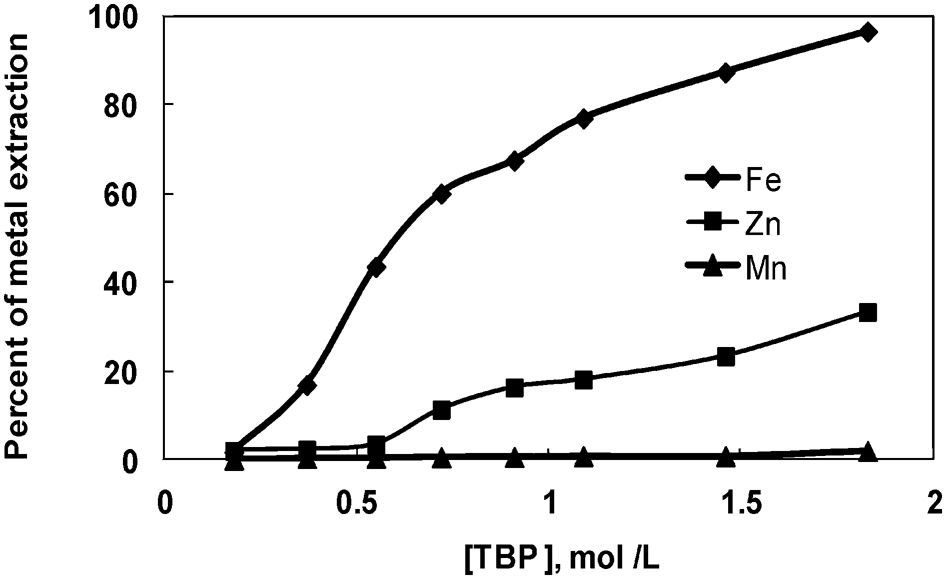
Effect of TBP concentration on metal ion extraction: composition of feed solution is 0·12 mol L−1 Fe, 0·087 mol L−1 Zn, 0·29 mol L−1 Mn, 2·3 mol L−1 HCl, A/O = 1
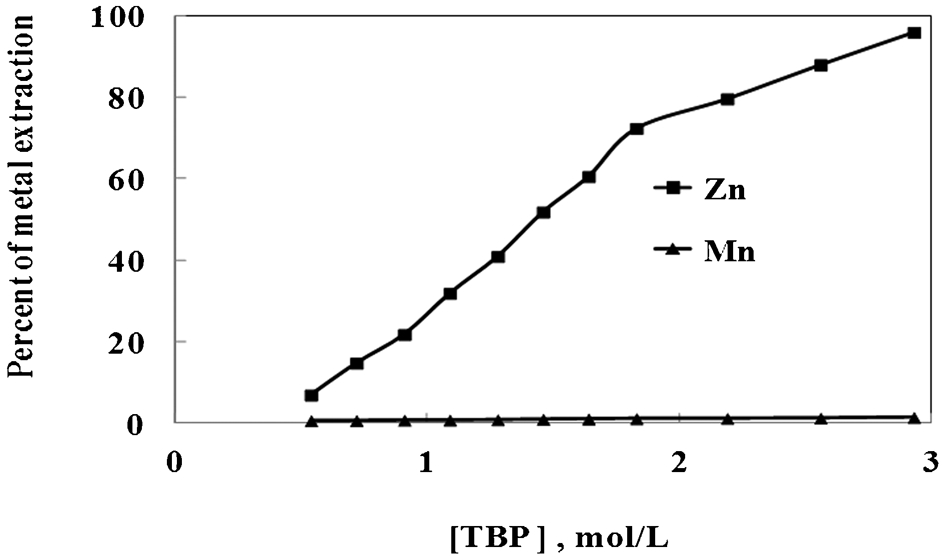
Effect of TBP concentration on Zn extraction (after total Fe removal): composition of feed solution is 0·057 mol L−1 Zn, 0·29 mol L−1 Mn and 1·67×10−5 mol L−1 Fe ≈ 0, 2·3 mol L−1 HCl, A/O = 1
To account for the number of moles of TBP participating in the extraction system for both Fe and Zn, log DFe and log DZn versus log [TBP] were plotted in Fig. 3. The slope values of both the plots were found to be 2·94 indicating the participation of three molecules of TBP in the formation of extractable complex of one mole of Fe and Zn.
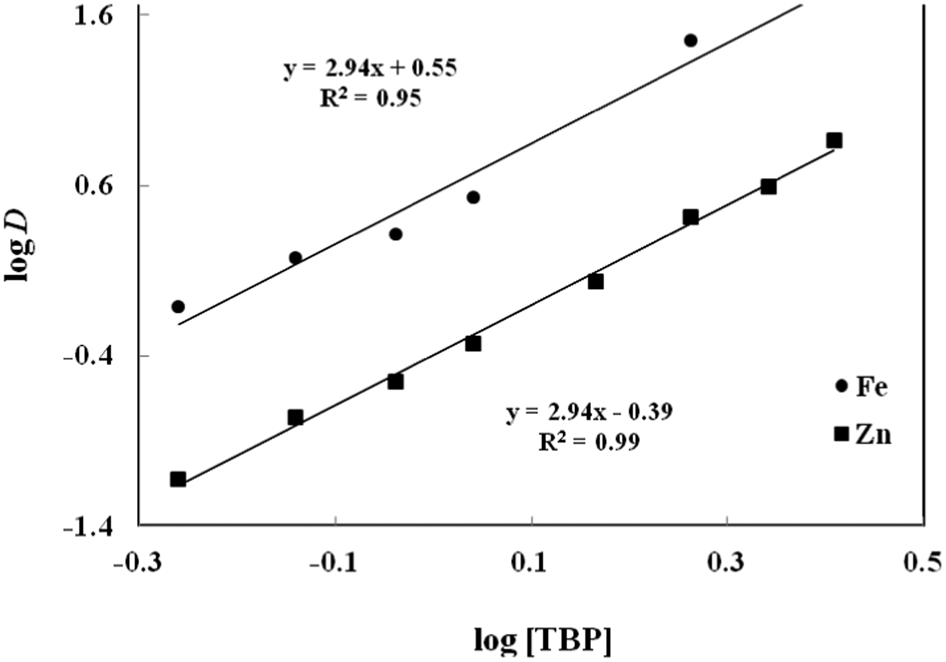
Plot of log DFe and DZn versus log [TBP]: Experimental conditions: Fe: 0·12 mol L−1 Fe, 0·087 mol L−1 Zn, 0·29 mol L−1 Mn, 2·3 mol L−1 HCl, A/O = 1; Zn: 0·057 mol L−1 Zn, 0·29 mol L−1 Mn and 1·67×10−5 mol L−1 Fe ≈ 0, 2·3 mol L−1 HCl, A/O = 1
Effect of acid concentration
To know the effect of acid concentration on extraction of Fe from the solution bearing Mn, Fe and Zn the concentration of HCl was varied in the range 1·15–7·25 mol L−1. The concentration of TBP was kept constant at 1·8 mol L−1. After equilibrating the solution bearing metal ion with TBP, the raffinate was analysed for equilibrium HCl concentration and the equilibrium HCl concentration was found to vary within the range 0·94–6·62 mol L−1. The co-extraction of HCl with metal ions varied from 0·21 to 0·63 mol L−1. The percentage extraction of Fe and Zn at various equilibrium HCl concentrations is shown in Fig. 4 which indicates that the percentage extraction of Fe and Zn increased from 4·19 to 84·81 and from 0·14 to 14·81 with increase of equilibrium acid concentration from 0·94 – 6·62 mol L−1. Also after Fe removal, the extraction of Zn was carried out with different concentration of HCl within the range 2·36–7·25 mol L−1. The equilibrium acid concentrations after extraction were found to be in the range 2·02–6·62 mol L−1. For Zn extraction the concentration of TBP was kept constant at 2·93 mol L−1. Figure 5 shows a linear increase in Zn extraction from 9·21 to 56·43% with increase in equilibrium HCl concentration from 2·02 to 6·62 mol L−1. As the percentage extraction of Zn with 1·15 mol L−1 HCl is only 0·14%, the concentration range of HCl for Zn extraction was increased to 2·36–7.25 mol L−1. For both these studies, the concentration of Cl− was kept at 5·3 mol L−1 by adding required amount of NaCl.
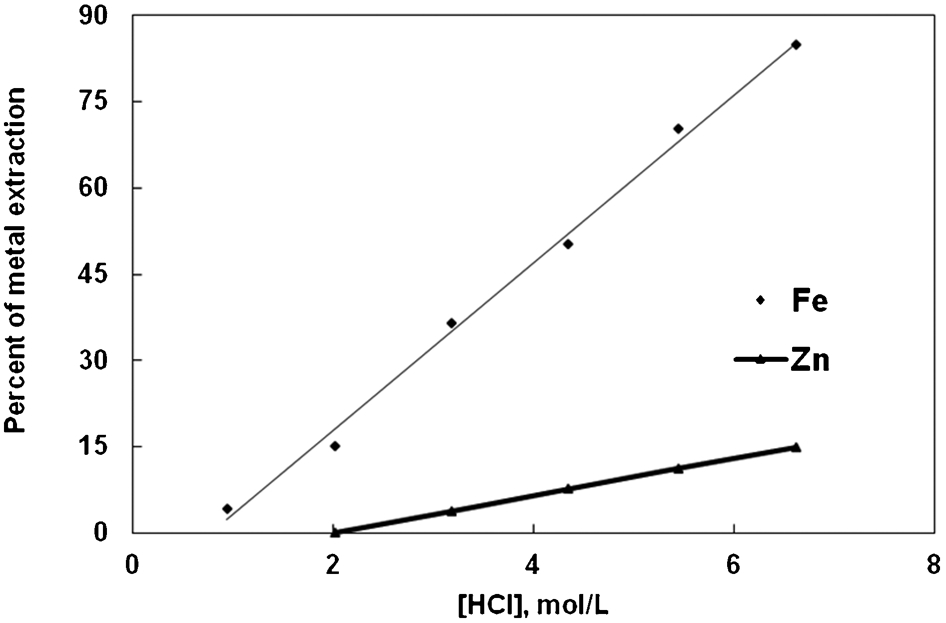
Effect of HCl concentrations on total Fe and Zn extraction: experimental conditions: 0·12 mol L−1 Fe, 0·087 mol L−1 Zn, 0·29 mol L−1 Mn, 1·8 mol L−1 TBP, A/O = 1
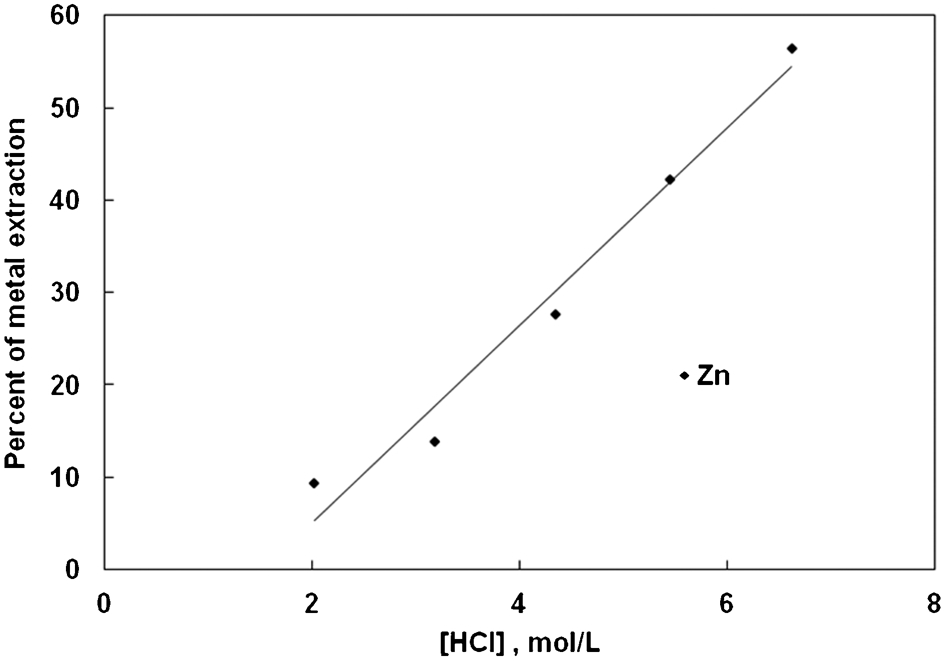
Effect of HCl concentration on Zn extraction after Fe removal: experimental conditions: 0·057 mol L−1 Zn, 0·29 mol L−1 Mn and 1·67×10−5 mol L−1 Fe ≈ 0, 2·93 mol L−1 TBP, A/O = 1
The log–log plots of the results obtained affirmed a linear increase in the extraction of the investigated metal ions with hydrogen ion concentration (Fig. 6) and the slope values were found to be 1·41 and 2·18 for Fe and Zn, which indicates the association of one hydrogen ion with Fe and two hydrogen ions with Zn respectively as the extracted species. Therefore, the extracted species of Fe and Zn may be HFeCl4.3TBP and H2ZnCl4.3TBP (Reddy and Bhaskara Sama, 1996).
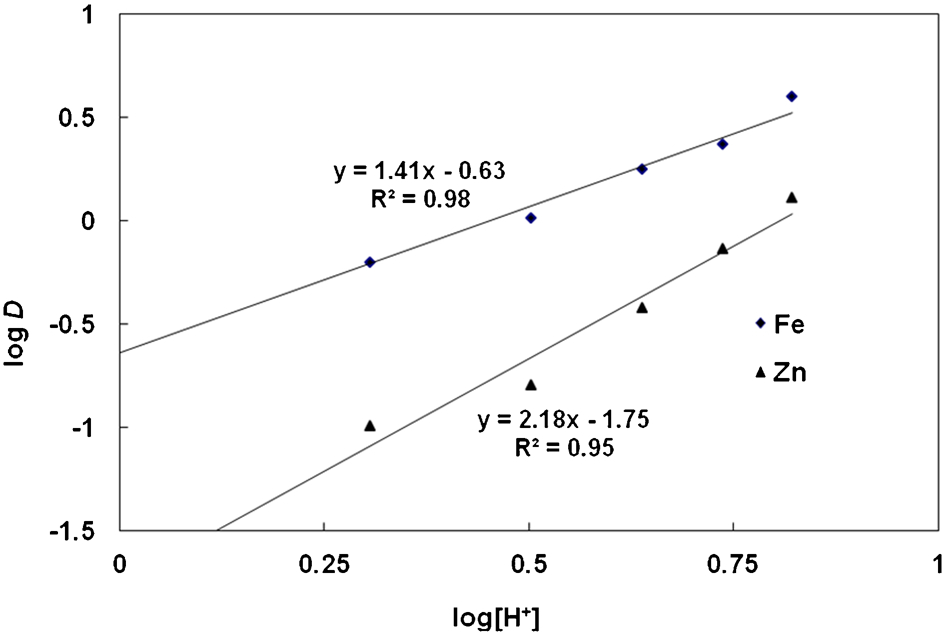
Plot of log DFe and DZn versus log [H+]: experimental conditions: Fe: 0·12 mol L−1 Fe, 0·087 mol L−1 Zn, 0·29 mol L−1 Mn, 1·8 mol L−1 TBP, A/O = 1; Zn: 0·057 mol L−1 Zn, 0·29 mol L−1 Mn and 1·67×10−5 mol L−1 Fe ≈ 0, 2·93 mol L−1 TBP, A/O = 1
Effect of scrubbing
It is important to note that initial leach liquor containing 0·29 mol L−1 Mn, 0·12 mol L−1 Fe and 0·087 mol L−1 Zn exhibit co-extraction with low concentration of TBP. For instance, using 1·8 mol L−1 TBP about 96·6 and 33·4% of Fe and Zn are simultaneously extracted into loaded organic phase respectively (Table 1).
Extraction data for Fe and Zn with TBP at different TBP concentrations
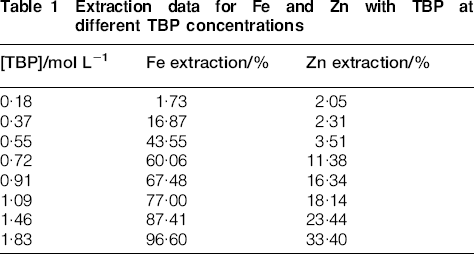
From Table 1, it is evident that about 33·4% Zn was co-extracted with Fe in the loaded organic. To separate Zn from the loaded organic, the loaded organic phase was scrubbed with different concentrations of ferric chloride at organic: aqueous (O/A) phase ratio of 1∶1. The result of this investigation is presented in Table 2.
Effect of ferric chloride concentration on scrubbing of Zn (O/A = 1∶1)
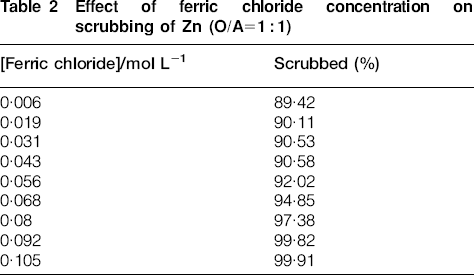
Table 2 shows that 99·9%Zn was removed from the loaded organic phase with 0·105 mol L−1 ferric chloride. Also scrubbing of Zn was carried out with different O/A phase ratio and the results are shown in Table 3.
Effect of working ratio for Zn scrubbing from Fe loaded organic phase
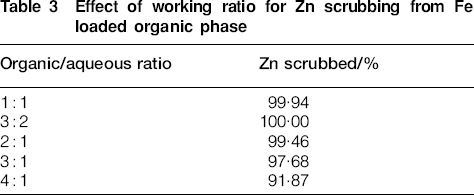
From Table 3, it is evident that using 0·105 mol L−1 FeCl3 at organic: aqueous ratio of 3∶2 complete (100%) removal of Zn from the loaded organic phase is possible.
Discussion
To achieve higher extraction efficiency with TBP, very high concentration of HCl is required (Reddy and Bhaskara Sama, 1996). During the course of this extraction, TBP poses different kinds of problems. It was observed that three distinct phases were formed at TBP concentrations lower than 1·8 mol L−1 for Fe and 2·93 mol L−1 for Zn. Above these stated concentrations, phase separation took about 20–25 min, although only two phases were formed. In solving the aforementioned problems, MIBK equal to 20% of TBP was added as phase modifier in the extraction system. After addition of MIBK, there was no problem of third phase and phase separation time reduced to 2–3 min.
Extraction Isotherm
To know the number of stages and A/O phase ratio for quantitative extraction of Fe, the extraction isotherm was constructed with aqueous solution bearing Mn, Fe and Zn and the mixture of 1·8 mol L−1 TBP and MIBK (20% of TBP) at different O/A ratios within 5∶1 to 1∶5. After equilibration and phase separation, the aqueous and organic phases were analyzed and the McCabe-Thiele plots were obtained as in Fig. 7 to indicate quantitative extraction of Fe in 2 stages at O/A ratio of 1∶1.
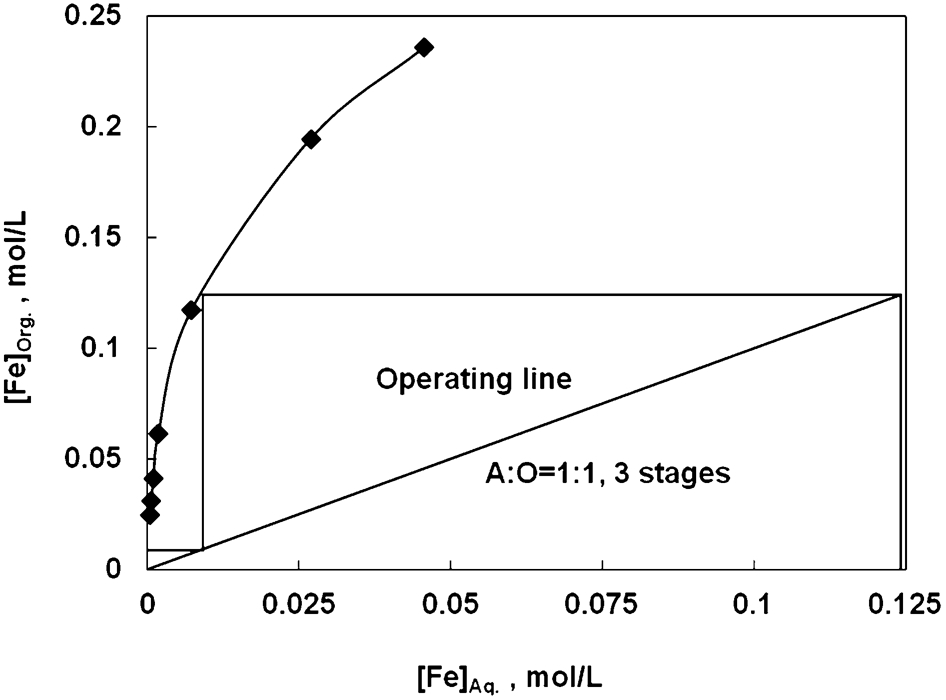
McCabe-Thiele diagram for Fe extraction: [Total Fe] is 0·12 mol L−1, [HCl] is 2·3 mol L−1, solvent is 1·8 mol L−1 TBP+MIBK (20% of TBP) in kerosene
To confirm the prediction, a three-stage counter-current simulation study was carried out with 1·8 mol L−1 TBP and MIBK (20% of TBP) at O/A ratio 1∶1. The analysis of first, second and third stage raffinates showed 1×10⁻³ mol L−1, 2×10⁻⁴ mol L−1 and 1·67×10−5 mol L−1 Fe indicating 99·2, 99·82 and 100% extraction respectively. The concentration of Fe and Zn in loaded organic was 0·12 and 0·029 mol L−1 respectively. As the loaded organic contains 0·029 mol/L Zn, this was scrubbed with 0·105 mol L−1 ferric chloride at O/A ratio of 3∶2 to have pure iron in the loaded organic phase.
After Fe removal, Zn was extracted from the solution containing Zn and Mn with 2·93 mol L−1 TBP and MIBK (20% of TBP). The extraction isotherm was constructed for Zn extraction with 2·93 mol/L TBP and MIBK (20% of TBP) at different A/O phase ratio ranging from 1∶5 to 5∶1 keeping the total volume constant. The Mc-Cabe Thiele plot (Fig. 8) for Zn extraction showed three-stages at A/O ratio of 1∶2 for quantitative extraction of Zn. To confirm this a three-stage countercurrent simulation study was carried out with 2·93 mol L−1 TBP and MIBK (20% of TBP) at A/O ratio of 1∶2. The analysis of first, second and third stage raffinate showed 0·01, 1×10⁻³ and 1·52×10−4 mol L−1 Zn indicating 84·71, 97·42 and 99·71% extraction respectively. Similar results of these nature in available in the literature (Reddy and Bhaskara Sama, 1996).
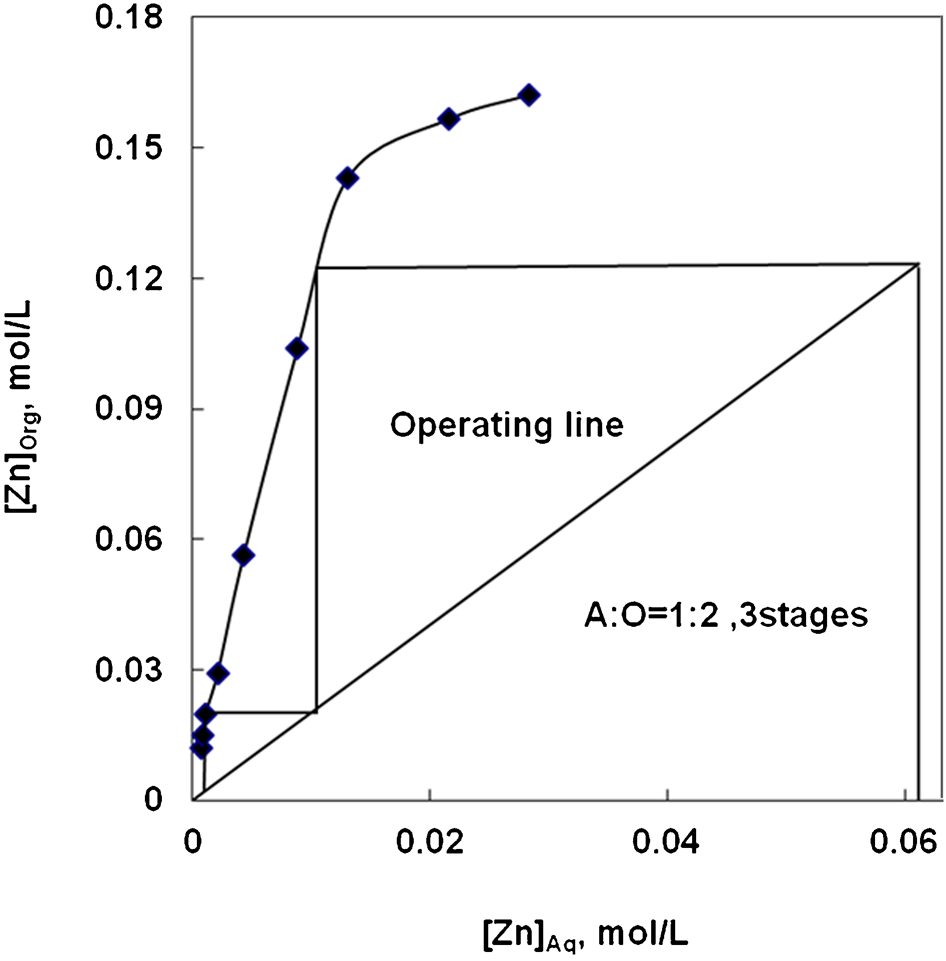
McCabe-Thiele diagram for Zn extraction: [Zn2+] is 0·057mol L−1, [HCl] is 2·3 mol L−1, solvent is 2·93 mol L−1 TBP and MIBK (20% of TBP) in kerosene
Stripping studies
After scrubbing of Zn the loaded organic of iron contains 0·12 mol L−1 Fe and after Fe removal, the loaded organic (LO) of Zn contains 0·057 mol L−1 Zn. The stripping of Fe and Zn from the loaded organic was carried out with distilled water. To know the number of stages and A/O phase ratio for stripping, the stripping isotherms were constructed with loaded organic and distilled water as shown in Figs. 9 and 10. The isotherms indicated quantitative stripping of Fe and Zn with two countercurrent stages at an aqueous: organic ratio of 1∶2 and three countercurrent stages at an aqueous: organic ratio of 3∶1 respectively.
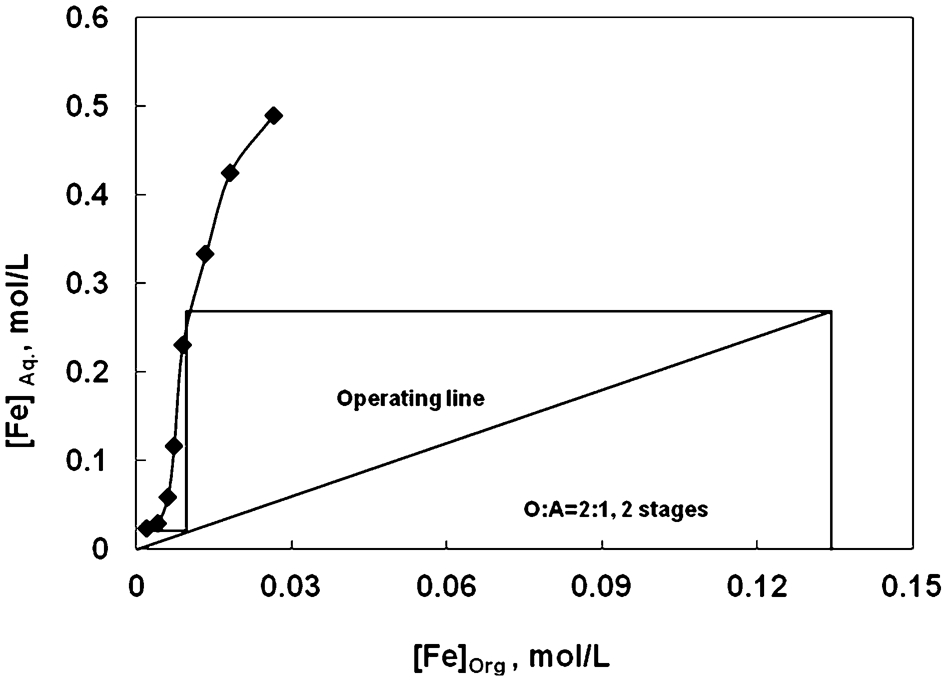
McCabe-Thiele diagram for total Fe stripping with distilled water, 0·12 mol L−1 Fe in LO (LO, loaded organic)
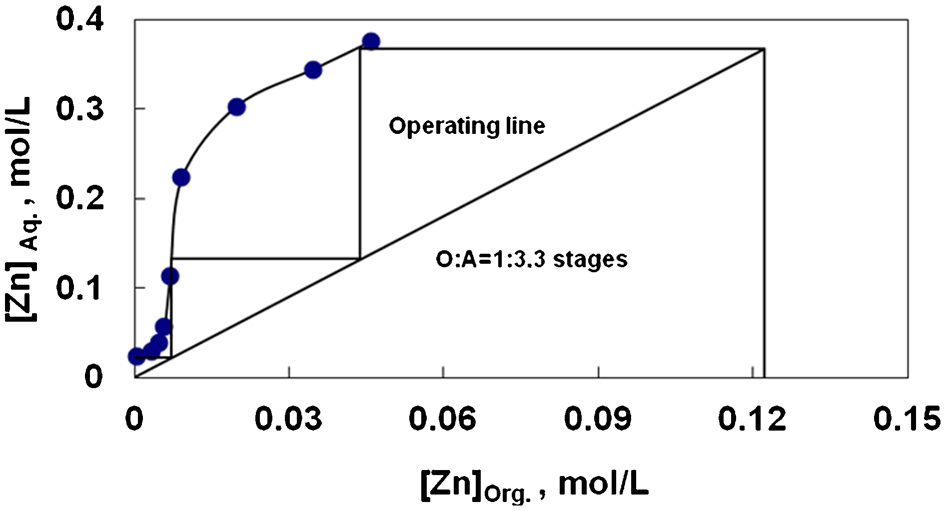
McCabe-Thiele diagram for Zn stripping with distilled water: 0·057 mol L−1 Zn in LO
The above stripping studies were confirmed by countercurrent simulation study. The analysis of two-stage countercurrent simulation study at A/O ratio of 1∶2 for Fe showed 0·01 and 5×10⁻⁴ mol L−1 Fe in first and second stage spent organic, respectively indicating 99·58% stripping efficiency. Similarly analysis of three-stage countercurrent simulation study for Zn showed 1·9×10−3, 1·2×10−3 and 3×10⁻⁴ mol L−1 Zn in first, second and third stage spent organic respectively indicating 99·47% stripping efficiency.
Conceptual flow diagram for manganese recovery
The conceptual flow diagram summarizing the extraction, scrubbing and stripping processes adopted for the separation of metal ions and recovery of Mn from typical simulated manganese nodule leach liquor is presented in Fig. 11.
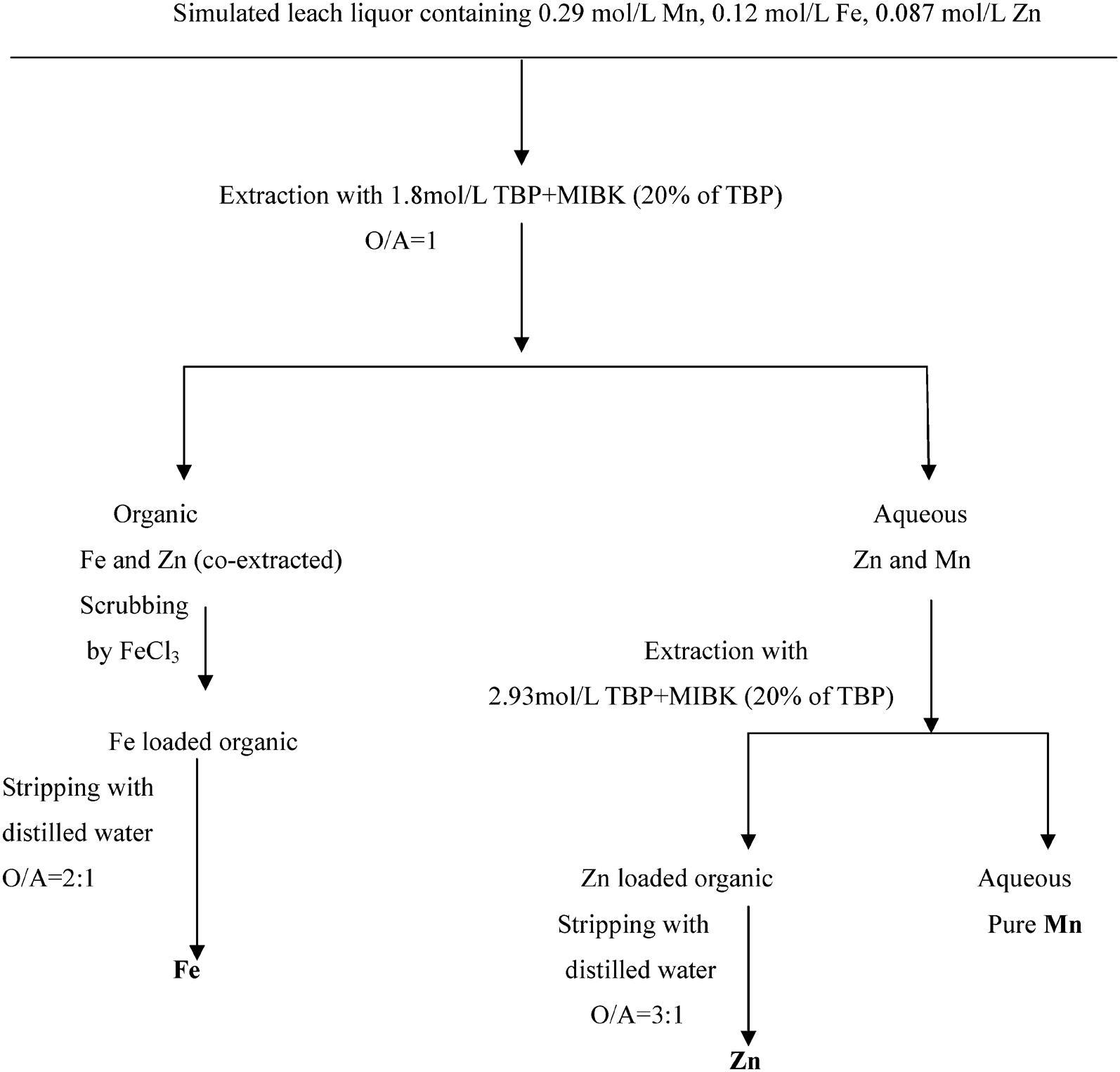
Flow sheet diagram for separation of metal ions and recovery of pure aqueous Mn from manganese nodule
Conclusion
The solvent extraction studies for separation of Fe and Zn for obtaining purified solution of Mn from simulated manganese nodule leach liquor from acidic solution was investigated using TBP and MIBK (a phase modifier) in kerosene. The extraction of total Fe and Zn were carried out using 1·8 and 2·93 mol L−1 TBP respectively. Total Fe was first separated, and co-extracted Zn was removed by scrubbing with ferric chloride solution. Extractions and stripping isotherms were obtained with the above mixtures. The efficiency of extraction processes were 100 and 99·7% for Fe and Zn respectively; while about 99·5% stripping efficiency was obtained for both Fe and Zn from the initial leach liquor containing 0·29 mol L−1 Mn, 0·12 mol L−1 Fe and 0·087 mol L−1 Zn. Finally, the process flow chart for the recovery of pure Mn solution is provided.