







Abstract
Pequi (Caryocar brasiliense) is a Brazilian oleaginous fruit, rich in fatty acids, with a predominance of oleic and palmitic acids. The fruit is composed of three major parts: the outer mesocarp (or white pulp), the inner mesocarp (or yellow pulp), which is very appreciated in the local cuisine, and the nut. The oil extracted from the nut (43.59 ± 0.16 oleic and 43.76 ± 0.04% palmitic acids) or from the yellow pulp (55.87 ± 0.30 oleic and 35.17 ± 0.27% palmitic acids) are used not only for nourishment but also as a medicinal product and in cosmetic formulations. The white pulp does not have any commercial application being a residue. This paper proposes to use the oil from pequi's yellow pulp as a collector in apatite microflotation, due to its rich fatty acid composition. The oil was saponified with NaOH and then applied in microflotation tests using a modified Hallimond tube and pure samples of apatite. The results indicate that pequi's yellow pulp oil can be used as a collector in the froth flotation of this mineral (recovery >95% for concentrations between 5 and 15 mg L− 1).
Introduction
Most of the phosphate ores extracted from phosphorus rocks belong to the apatite group [Ca5(Cl, F, OH)(PO4)3], a crystalline calcium phosphate fluoride, with a P2O5 content ranging from 4 to 15%. The apatite deposits have a complex mineralogy, containing impurities that influence phosphorus recovery in the beneficiation plants. As a result, researches and technological improvements have been made in an attempt to use this apatite (Souza and Fonseca, 2008).
The Brazilian production of phosphate in 2013 amounted to more than six million tons. The phosphate in the second half of 2013 also appears as the seventh mineral substance with the highest share in total the Financial Compensation for Exploiting Mineral Resources (Departamento Nacıonal de Produção Mıneral (DNPM), 2014). Among the largest reserves of phosphate rocks in Brazil, the States of Minas Gerais and Goiás stand out, focusing, respectively, 67.9 and 13.8% of the national reserves (Souza and Fonseca, 2008).
At the same time, the potential of fatty acids as collectors in froth flotation is recognised in the literature. Within the group of oxidrilic collectors, there is the carboxylic collector group that has fatty acids as components (Baltar, 2008). In this sense, vegetable oils, rich in fatty acids have been studied by researchers investigating their potential as collector agents.
As background, it is known that vegetable oils (rich in fatty acids) have drawn the attention of scientists for their potential as collectors. Researches about the application of vegetable oils as reagents in froth flotation have been performed in order to seek alternatives for commonly used collectors that have high costs and can entail high environmental degradation. According to Guimarães et al. (2005), certain vegetables and animal fat are capable of reacting self-contained glycerol and fatty acid molecules producing triacylglycerol or oil molecules. Oil extracted from the vegetables is then purified and submitted to a process that combines heat, high pressure and alkalinity, being converted into fatty acids. The fatty acids are saponified with NaOH to produce soluble soaps that act as apatite collector. Some examples are babaçu nut, castor oil plant, corn, olive, rice bran, soybean, tall oil and tallow.
Oliveira et al. (2011) worked with column flotation and samples of tailings from phosphate concentration circuit of Bunge Brazil SA, which processes a phosphate deposit that is part of the Barreiro carbonatite complex located in Araxá, state of Minas Gerais (MG) in midsouthern Brazil. The host rocks consist mainly of carbonates and glimmerites. As collector, a mixture of the synthetic reagent and rice bran oil soap was used and increased the selectivity of the concentrate considerably. A grade of 29.4%P2O5 and a recovery of 46.2% were obtained under selected operating conditions. After testing apatite's microflotation with saponified pure fatty acids as collectors, these authors concluded that linoleic, linolenic and oleic acids, which are unsaturated acids, presented the best performance as collectors for apatite, with linoleic being the best collector. The authors confirmed this result by bench scale froth flotation tests with igneous carbonate ore from Tapira (MG), Brazil, using vegetable oils, noting that the soybean oil, rich in linoleic acid, gave the best results.
Costa (2012) analysed the use of Amazon fruit oils in phosphate ores froth flotation, and the found results indicate that there is a great possibility of using these oils as collectors. Vieira et al. (2005) analysed the oil from castor beans, coconut, pequi and sesame. For making the water soluble oil, the researchers used the procedure of ester hydrolysis or saponification. The authors used calcite samples in a modified Hallimond tube in the tests. As a result, it was found that the saponified pequi and sesame oils performed well as collectors, producing results similar to those when pure sodium oleate was used. Alves et al. (2013) found that the collector of passion fruit's oil showed better performance than babaçu, suggesting that unsaturated fatty acids are responsible for the increased ability to collect mineral particles.
Studies with jojoba oil were carried out by Santos and Oliveira (2012), noting the efficiency of this oil as an alternative collector for selective separation between apatite and calcite. Jojoba, which grows naturally in the deserts of northwestern Mexico and southwestern USA, is a shrub that has become more popular in other regions, such as South America. The oil extracted from its seed is 50% of the seed's weight, and its main components are gadoleic acid (69.4%), erucic acid (14.3%) and oleic acid (12.4%), according to the authors. The hydrophobicity studies show that the selective separation of calcite and apatite can be obtained using jojoba oil at a pH below 7.0. In this condition, the apatite is hydrophilic and calcite is hydrophobic, allowing their separation through froth flotation.
Pequi (Caryocar brasiliense) is an oleaginous fruit with a strong and distinctive smell used in the cuisine of the midwestern, northern and northeastern parts of Brazil. The fruit and its tree have many utilities with applications in the craft industry, cuisine, popular pharmacy and cosmetics industry. In addition, it has potential uses for the production of fuels and lubricants (Oliveira et al., 2008). The tree produces from 100 to 2000 fruits per year depending on the variety and location, with a life expectancy ∼50 years. The fruit weight ranges from 30 to 400 g, typically containing one to two seeds and rarely three to four seeds (Lima et al., 2007; Carvalho, 2009). Besides being a typical species of the Brazilian Midwest, the fruit is also found in the southeastern, northeastern and northern states of the country and may be found in Bolivia and Paraguay (Carvalho, 2009).
Pequi has a large amount of fatty acids. Zuppa (2001) performed the analysis of many Brazilian savanna fruit oils, including the pequi. The oil extraction was carried out with a Soxhlet extractor and hexane as solvent, using dried and crushed seeds and pulp from the fruits. The author noted that the pequi's yellow pulp showed a high viability for oil extraction.
Lima et al. (2007), in his work for the characterisation of extracted pequi's yellow pulp oil, found that the fruit's pulp is rich in lipids, corresponding to 33 ± 4% of its composition. The results indicate that, in the yellow pulp, unsaturated fatty acids predominate (61.35% of the total). The highest concentration is oleic and palmitic acids, as shown in Table 1.
Percentage composition of pequi's yellow pulp fatty acids (adapted from Lima et al., 2007)

Brandão et al. (1994) performed microflotation tests in a Hallimond tube with pure apatite, using as collectors the sodium salts of palmitic, stearic, oleic, linoleic and linolenic fatty acids, as a function of pH. The results showed that the unsaturated fatty acids (linoleic, oleic and linolenic) exhibited superior performance compared to the saturated acids. Therefore, the pequi's fatty acid composition suggests its potential as a collector because, as described by Lima et al. (2007), unsaturated fatty acids predominate in pequi's yellow pulp.
Ledo et al. (2004) and Vieira et al. (2005) conducted microflotation tests with samples of calcite, using as collector vegetable oils from castor beans, coconut, pequi and sesame. The researchers used in the procedure 2 g of calcite conditioned in 100 mL of collector solution, conditioning time of 3 min, air flowrate of 197 mL min− 1 and flotation time of 1 min. Curves of recovery were determined in function of pH, at three different concentrations. The results reveal the potential of pequi's oil as collector in calcite's froth flotation.
Materials and Methods
The apatite samples were comminuted in a ball mill, granulometric classified by wet screening, vacuum filtrated and dried in a drying oven for 8 h at 80°C. After the preparation procedure, samples were submitted to optical microscope analysis. The presence of impurities were noted, resulting in a new stage of processing whereby the samples underwent a process of magnetic separation with rare earth magnet, where it was possible to remove the magnetic contaminants presents. Other impurities were remove by elutriation. An apatite sample was submitted for chemical analysis using an X-ray fluorescence spectrometer PANalytical, model AXIOX MAX series DY no. 5001.
The pequi's yellow pulp oil was characterise by wet methods (acidity, saponification and iodine index) all performed in triplicate. To be used as collector, the pequi's yellow pulp oil was subjected to alkaline hydrolysis, also called saponification, which made the oil soluble in water. Its saponification was performed adding a sample of 5 g of pequi's yellow pulp oil in 20 g of water under magnetic agitation. On agitation, 7.5 mL sodium hydroxide solution (10%) was added to saponify the solution. Water was then added until the solution reached 100 g and magnetic agitated for homogenisation.
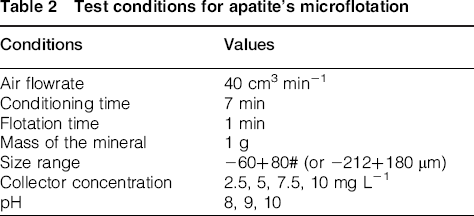
Microflotation tests were conducted with pure apatite samples (with granulometry between − 60+80# or − 212+180 μm), at pH 8, 9 and 10 (as usual in the industrial process for phosphate rock in Brazil, perform froth flotation in alkaline pH) and varying the concentration of the collector. The modified Hallimond tube was the equipment used in these tests because it is an easy method for the determination of mineral hydrophobicity or hydrophilicity, defining if the used collector is effective in recovering the analysed mineral. Hydraulic entrainment tests were performed to quantify how much apatite was carried up the tube due to this phenomenon. All tests were carried out in triplicate.
The mineral conditioning time was established as 7 min in a more concentrated form, i.e. the mineral was placed in the final part of the tube with the amount of collector that ensures the desired final concentration and to it was added water at pH 9 until the maximum volume for the conditioning solution, 50 mL. Towards the end of the 7 min, the remainder of the water required for the procedure, coming to a solution of 320 mL, was added, and then, the flotation started. This procedure was performed for a stronger contact between the mineral and the collector. Preliminary tests showed that the flotation is most effective when the conditioning is more concentrated, and therefore, this methodology was adopted. The recovery of apatite under the collector action was measured as a function of floated mass, i.e. the recovery of the mineral was calculated from the ratio between the floated mass and the total mass of the apatite sample.
To compare the pequi's yellow pulp oil recovery in apatite microflotation, additional tests were carried out using Flotigam 5806 from Clariant, which is a highly used collector for phosphate rock froth flotation worldwide. Table 2 summarises the conditions of microflotation tests using pequi's yellow pulp oil and Flotigam 5806.
Test conditions for apatite's microflotation
Results and Discussion
The X-ray fluorescence spectrometry of the apatite sample revealed the presence of barite and iron in small amounts. However, concentrations of P2O5 and CaO are high, consistently with a high purity sample (over 95% purity), as shown in Table 3. The pycnometry results show that the density of the apatite used in microflotation tests on average is 3.198 ± 0.037 g cm− 3. This value is consistent with the specific mass of the apatite presented by the National Department of Mineral Production and Brazilian Institute of Gems and Precious Metals, which is 3.18 ± 0.05 (Departamento Nacional de Produção Mineral (DNPM) and Instıtuto Brasileiro de Gemas e Metais Preciosos (IBGM), 2009).
Composition of apatite samples after comminution and classification ( − 60+80#)

The pequi's yellow pulp oil characterisation by wet procedures were performed in triplicate. The average value of the acidity index was 0.03 ± 0.00 mg KOH g− 1 of sample. Costa (2012) worked with oils from Brazilian native fruits used as collector in froth flotation and obtained the acidity indexes: passion fruit, 1.0 mg KOH g− 1; inajá, 2.8 mg KOH g− 1; buriti, 6.5 mg KOH g− 1; and açaí, 10.2 mg KOH g− 1. Therefore, the acidity index found for the pequi's yellow pulp oil is lower than the values reported in the literature for other Brazilian native fruits oils. This low acidity suggests that, in this oil, much of the fatty acids are esterified to glycerol. Therefore, the saponification reaction is required.
For the saponification index, the average value obtained was 192 ± 3.5 mg KOH g− 1. This result is in agreement with other values in the literature for this fruit's oil, as disclosed by Deus (2008), which was 194.29 mg KOH g− 1. Costa (2012) obtained values between 196 and 212 mg KOH g− 1.
The results for the iodine index was 49.04 ± 0.25 g I/100 g of pequi's yellow pulp oil. This value can be related to the amount of saturated fatty acids present in this fruit.
The tests with the modified Hallimond tube revealed a low rate of hydraulic entrainment ( < 1% at air flowrate of 40 cm3 min− 1) for apatite samples with granulometry between − 212+180 μm (or − 60+80#). Thus, the microflotation results will be presented disregarding values of hydraulic entrainment. All tests (hydraulic entrainment and microflotation) were performed in triplicate. In total, 72 microflotation tests were carried out.
The results of microflotation tests are shown in Fig. 1. Pequi's yellow pulp oil obtained excellent results (apatite recovery higher than 95%) as a collector in apatite's froth flotation.
Apatite recovery versus concentration using Pequi's yellow pulp oil and Flotigam 5806 as collectors at a pH 8, b pH 9 and c pH 10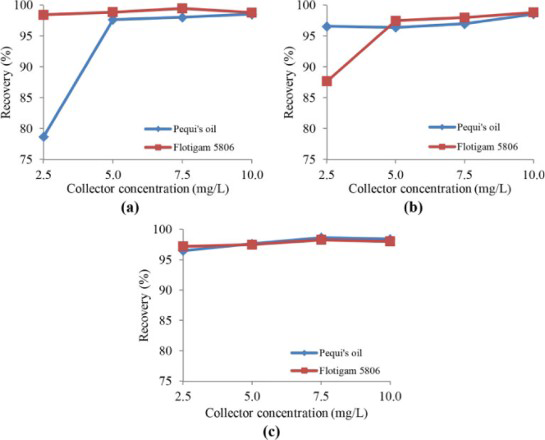
It is observed that the collector Flotigam 5806 showed better results in pH 8. At the concentration of 2.5 mg L− 1, this is the pH that the collector had the highest recovery, which was sufficient to obtain apatite recoveries near 100%. This implies that the collector can be effective in low concentrations at this pH. This same concentration at pH 9 did not achieve the same results, achieving a recovery of ∼88%. At this pH, the best result was in a concentration of 10.0 mg L− 1. In pH 10, the industrial collector obtained recovery percentage lower than that in the pH 8 at all concentrations tested. It was also observed that, at 5.0 mg L− 1 or over, recovery results in the tested pH were >95% recovery.
With respect to pequi's oil as collector, it is observed that the vegetable oil obtained recoveries above 95% at all concentrations tested in pH 9 and 10. At pH 8, the recovery was less in the concentration of 2.5 mg L− 1, with an average of 78.676%. The vegetable oil had similar results to industrial collector used as a parameter, and at certain points (for the concentration of 2.5 mg L− 1 at pH 9 and for concentrations from 5 mg L− 1 at pH 10), this oil obtained superior performance.
Conclusions
The microflotation tests using saponified pequi's yellow pulp oil indicate that this oil can be used satisfactorily as collector apatite microflotation. Pequi's yellow pulp oil showed better results working in pH 9 and 10, while the best results of Flotigam 5806, used as a parameter were in pH 8. In such cases, the results were similar collectors. Both showed over 95% of recovery at the lowest concentration tested, 2.5 mg L− 1.
The found results agree with other works using oils extracted from fruits. Results of microflotation tests performed by Costa (2012) shows that Amazon fruit oils showed apatite recoveries near 100% at concentrations of 2.5 mg L− 1 (for buriti, inajá, andiroba and açaí oils) and 5 mg L− 1 (for passion fruit and Brazil nut oils). Therefore, the results for pequi's yellow pulp oil (composed by 55.9% oleic and 35.2% palmitic acid) approach these results, reaching recoveries above 95% at concentrations from 5 mg L− 1, similar to passion fruit oil (composed by 48.8% linoleic, 28.9% oleic and 12.6% palmitic acids) and Brazil nut oil (composed by 47.0% oleic, 18.1% palmitic, 15.2% linoleic and 13.2% stearic acids).
This result encourages further studies about the application of this oil in the mineral flotation and provides a new source of reagent, contributing to the recovery of the species, encouraging the preservation and commercial production and generating innovation in Brazilian phosphate production. One hectare of pequi tree is capable of producing ∼3200 L oil per year, so it is possible to sustain the Brazilian phosphate rock production using this reagent. Pequi'soil cost ∼25% less than Flotigam 5806 (on a volume basis) if produced on a large scale. Therefore, the pequi oil is both technically and economically viable as a flotation collector for apatite.
Footnotes
Acknowledgements
The authors acknowledge the financial support from the Brazilian agencies CNPq, CAPES, FAPEG and FUNAPE. In addition, we wish to thank Anglo American Phosphate Brazil and Clariant for providing the samples and the Federal University of Goiás for supporting this research.