







Abstract
Mine planning is the foundation of value for a mining company. Good mine planning requires solid understanding of the ore body, rigorous standards and processes, robust and useful information technology and skilled people. Life-of-Mine planning is the key to identifying strategic direction for any mine and short range mine planning is the key to delivering forecast and budget expectations. Mine planning at Kinross Gold Corporation has been identified as a critical success factor and initiatives are being prepared to improve the quality of our plans and to build bench strength in our teams. The ‘Kinross Way for Mine Planning’ (KWMP) has been developed and implemented to establish standards to ensure a strong business foundation. This paper briefly describes the process used to develop the KWMP and presents a selection of mine planning best practice initiatives at Kinross mines up to 2012.
Introduction
The Kinross way is a strategic blueprint for the company, guided by four values: Putting People First, Outstanding Corporate Citizenship, High Performance Culture and Rigorous Financial Discipline. In support of this strategic blueprint, The Kinross Way for Mine Planning (KWMP) has been developed and implemented to establish mine planning standards and processes. Figure 1 presents the major components of the KWMP and this paper presents a selection of mine planning best practice initiatives at Kinross mines up to about 2012. The five principles providing the mine planning foundation of value are: putting safety first, world class quality and accuracy, executable and deliverable, aligned with strategy and aligned with partners. These five principles are discussed in the subsequent sections and conclusions follow.
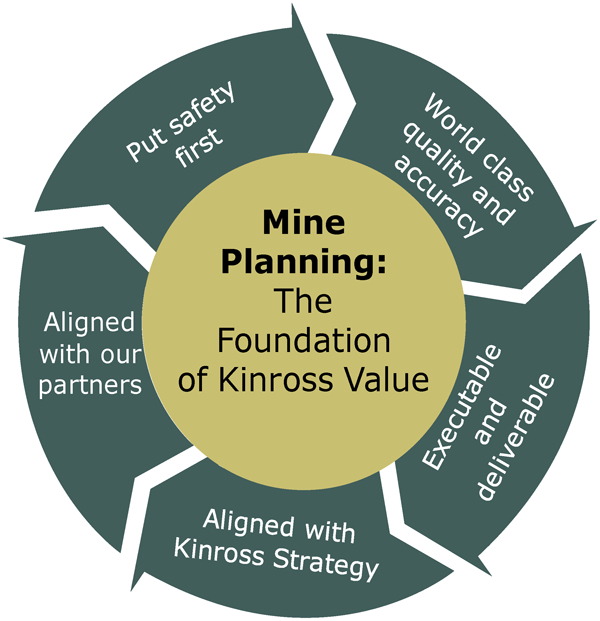
Kinross way for mine planning
Putting safety first
Safety has become the cornerstone of our industry, and it is our obligation to provide a safe working environment for all of our employees. The operational safety culture and environment provided at our mines is a reflection of the work done at the original design of the operation. Life-of-Mine designs for open pit or underground mines aim to provide an optimal excavation configuration in the context of prioritising safety, financial return and ore recovery. Safety has always been an integral part of the design process, with aspects as geotechnical design criteria, regulations for ramp widths, berm heights, ventilation, access and egress, adequate distribution of mine rescue stations and the list goes on. Failure to meet the design criteria through the execution will require modifications to the design, which in turn will drive up costs and impact the optimal design, potentially putting our employees at risk. The integration of safety into mine planning has developed beyond the initial design stage and is now an integral part of the planning process which by itself is an execution of the design process.
Geotechnical design criteria are typically the primary drivers for the size and shape of all safe excavations. Kinross requires all its operations to develop, maintain and implement an effective Ground Control Management Plan (GCMP). A GCMP is a comprehensive and coherent document covering all aspects of geotechnical practices relevant to a mining operation or project. It must be developed in conformation to local applicable regulations and in alignment with Kinross safety and health standards by application of sound geotechnical engineering principles and best practices. A GCMP is a component of the mine risk management system and should be updated or revised when there are major changes to existing practices or in any case annually. Geotechnical performance reviews or auditing will be conducted by internal and external specialists to identify areas for improvement or best practices for sharing with other operations. It is imperative that a rigorous mine planning review process is implemented to ensure the design criteria are met. This review is generally at the regional or corporate level to avoid any site bias and introduces a level of independence.
Proper equipment selection is also an important safety consideration in the design phase. In open pits, ramp width is generally a function of truck width, while drill selection is a function of planned productivity as well as geotechnical design utilizing buffer blasting and preshear requirements. Support equipment such as graders, rubber tired dozers and water trucks all play a key role in ensuring safe operations and must be considered in the design phase. Calculating the needs of this equipment is often underestimated or omitted from the planning process. This equipment is required to maintain safe operating conditions in varying climactic environments, must be included in the initial planning process and continually re-assed throughout the operating Life-of-Mine.
World class quality and accuracy
‘World Class’ is an expression or adjective commonly used within the mining industry to define the best quality of our business processes and physical operations. Management often uses the term to describe how they want to see the Company when compared to their peers within the industry. A simple statement, however a monumental task! The first challenge is clearly defining what ‘World Class’ is. Secondly, once defined, how do you get there? The concept of accuracy on the other hand is much easier to define, and if you are ‘World Class’ then accuracy becomes a condition of being ‘World Class,’ in the sense of how accurate one needs to be to meet safety and economic targets at the desired or acceptable level of risk. The feasibility and success of any mine plan is contingent upon the accuracy of input assumptions – note that at the time of preparing this manuscript risk assessment did not include stochastic simulations to assess risk, as for example in works by Dimitrakopoulos and Jewbali (2013) and Goodfellow and Dimitrakopoulos (2013). The level of granularity, accuracy and risk assessment should increase as mine plans progress from strategic to tactical to operational, as shown in Fig. 2.
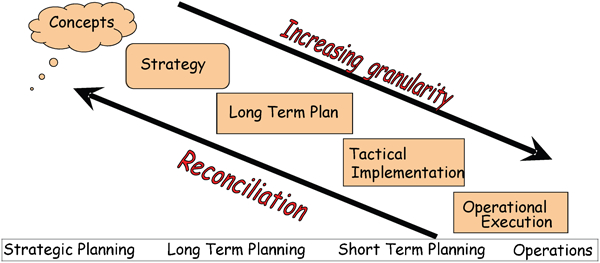
Mine planning phases
Strategic mine planning sets the overall business objectives for the mine, such as earnings, cash flow and return on investment. Strategic planning considers all potentially feasible alternatives, including those that may not currently be employed. The strategic planning horizon is long, typically exceeding the planned life of the mineral reserve estimate. Tactical mine plans focus on the detail necessary to implement a strategic plan, with particular focus on costs and sequencing of activities. Compared to the strategic mine plan, the tactical mine plan has a shorter planning horizon (3 months to 5 years) and a greater amount of detail, including bottom up models to estimate operating costs. Operational plans focus on managing short term activities and unforeseen disturbances to ensure the tactical plan is achieved. The monthly mine plan focuses on details of implementing the monthly budget. The weekly mine plan focuses on achieving the monthly plan objectives, taking into account any variation between month-to-date planned and actual performance. The daily mine plan is a highly detailed schedule of activities that operations personnel must carry out to ensure the weekly plan targets are achieved. Input assumptions to the tactical plans must be supplied by all disciplines in the organization, including geology, maintenance, finance, supply chain, environmental, human resources and corporate guidance. Once the ore has been mined and processed, actual performance must be measured and compared against the tactical plan. Following review and reconciliation, the objectives and input assumptions for subsequent mine plans should be updated in order to improve accuracy.
The Kinross Way for Mine Planning was initiated with the understanding that mine planning was a core activity, that improvement was needed and that accuracy was necessary to achieve ‘World Class’ status. Recognizing the challenges and acceptance of Corporate Initiatives that are often seen as ‘make work projects’, Kinross embarked on developing a process that would require the participation of all of our operations, regional offices, projects, and an independent global mine planning partner. This group became known as the Mining Advisory Team or MiAT for short. The first task was to audit and understand the baseline from which an improved process would be developed. A primary objective of the diagnostic was not only to understand where shortcomings existed, it was to identify where processes were working well, identify these processes and develop them as standards to be used going forward. In sharing the knowledge, and working with our peers within the Company, our objective of building a bridge to becoming one organisation was under construction. A three day audit was subsequently completed at each operating site, and regional supporting departments over a two month period. Upon completion of the audit and prior to leaving site, a close out meeting was held where the results were openly discussed. A mine planning scorecard and final report was issued within two weeks. The final step in the process involved developing an action plan, to address the shortcomings identified in the audit. In conjunction with the action plan, several conference calls were conducted with site representatives to share best practices identified in the process. An example of a mine planning scorecard is presented in Fig. 3, showing a simple three point scale with a rating of 3 meets requirements, 2 needs improvement, 1 very little awareness, and 0 required but not performed. In evaluating the collective audits, three major themes became apparent. First, we recognised a primary root cause of the poor scores was a result of insufficient manpower on site to meet the demands of an operating mine, compounded by the relatively low experience base of many of our engineers and the responsibilities we had placed on these individuals.
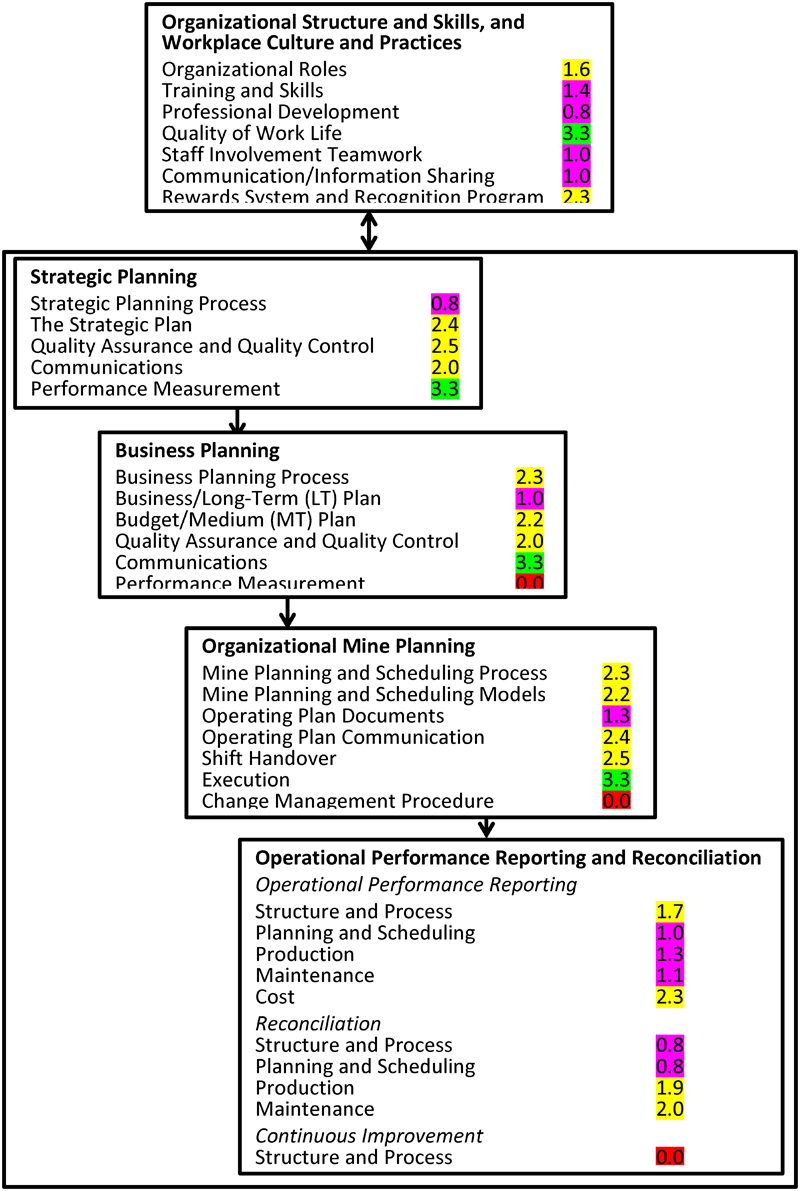
Mine planning scorecard
A key component of the audits involved benchmarking staffing levels against operations of similar size and geographic location. In most cases staffing levels were at or below the comparison data sets. The shortfall was most critical at mines with rotational work schedules, leaving some sites without adequate engineering support for as long as three days. In many cases as well, unfilled vacant technical positions compounded the situation. The Company has recognised the need to increase staffing levels and the experience base of our workforce and has embarked on a program to increase technical staffing worldwide by more than one hundred positions. This increased manpower will allow for adequate coverage and attrition, and build a work force that will prepare the Company for our future growth.
The second major theme we identified was the varied understanding of time frames and accuracy used to define short range mine plans, mid-range mine plans and long range mine plans, and the components of each plan. Although most long range plans were defined as the Life-of-Mine, short range and mid-range plans were often a single plan, and often were not subsets of a larger plan. Collectively MiAT introduced a standard set of time frames for each level of mine plans, with a key component being that each plan is a subset of the other.
The last major theme identified the financial modelling of the mine plans to develop operating costs and budgets. The accuracy of models varied from site to site. These models were in all cases a complex series of spreadsheets, built by individuals who no longer worked for the Company, were inflexible, and from a version control viewpoint, very difficult to manage and impossible to audit. The methodology used to develop operating costs was often written with coded values, making changes difficult if not impossible. In recognizing the need for a standard costing model, the Company adopted the use of Xeras (Xeras Financial Modelling Software, available at http://www.rpmglobal.com/mining-software/financial-modelling-xeras) an activity based cost modeling tool. The solution ensures that all sites are developing the costs from first principals by inputting key operating metrics, tied to a mine tonnage schedule. A key component of the model is that the underlying structure of the model cannot be overwritten; hence ensuring that all sites are developing costs in a consistent manner. Understanding that there are site specific variances, it ensures that the process and basis for cost modelling is consistent throughout the Company. The database structure ensures simple auditing and version control management. Standard unit cost inputs such as fuel price, reagents, tires, etc. can be flexed to allow for quick, easy and auditable financial evaluation of scenarios. The Xeras model structure for each mine was customized by site engineers to ensure that the appropriate cost driving activities were inputs for cost estimating. As an example, operating truck hours per year are required for calculating operating costs, fuel consumption, operating labour, maintenance costs and capital replacement. Ensuring the same base data is required, the process ensures all sites are being compared on a level playing field, but also ensures the planning process is providing the correct information for the financial evaluation.
Executable and deliverable
A mine plan is no different from any other plan in that it is a road map to define and communicate goals such as production volume, cost and revenue for a defined period of time. It is essential that the plan mirrors reality as close as possible so that expectations can be delivered. The mine plan must be safe, executable and deliverable. If it is not, then the plan needs to be adjusted and reconciliation provides a mechanism to assist in the adjustment. Reconciliation is essentially the process of identifying, analysing and managing variance between planned and actual results in such a way that it highlights opportunities. These opportunities commonly include: methods to create better estimates; improved designs; tighter and more accurate plans and schedules; improved mining techniques to minimise ore loss and dilution; and identifying ways to increase metal recoveries during the extraction processes (Fouet et al., 2009). Figure 4 presents some of the reconciliation key performance indicators (KPIs) reported by major mining companies. Reconciliation is important because mines are designed and planned based on estimated values. If predictions are difficult, then typically, reconciliation will be difficult. Complicating factors include the presence of stockpiles, poor data from truck counts, dispatch, etc. and inventory build-up in process plants such as heap leaches and mills. Understanding the causes behind reported reconciliation deviations is vital and it requires managerial intervention to take corrective action. Reconciliation has to be a simple and useful tool and not just a governance reporting requirement. For this reason, Kinross has elected to keep reconciliation reporting simple but visible and KPIs are communicated up to senior management.
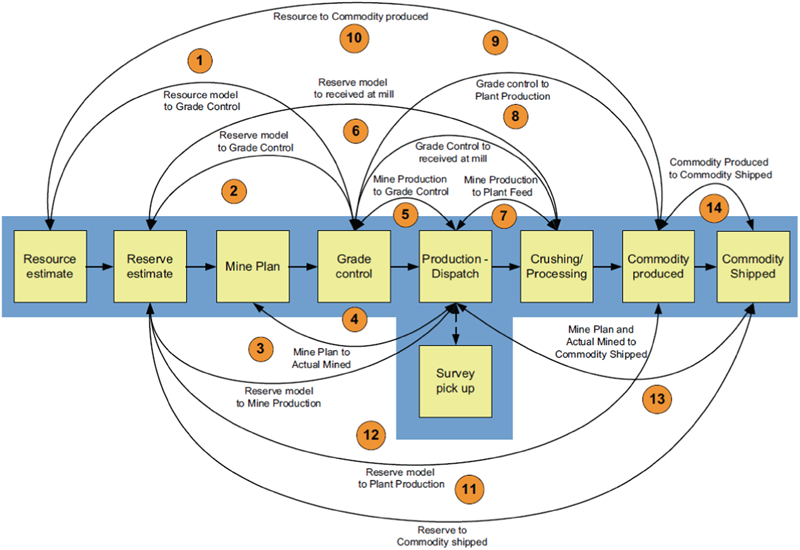
Reconciliation across mining value chain (Morley, 2008)
Kinross uses four of the ratios presented in Figure 4. Mine plan to actual mined, resource model to grade control, grade control to plant production and resource model to commodity produced. The first KPI is essentially a temporal reconciliation: did we mine the blocks of ore in the sequence we planned? The other three KPIs are more spatial in nature: was the actual grade and tonnage there as predicted? The mine planning effectiveness KPI addresses the extent of adherence to a plan over monthly, quarterly and annual time periods. M1 is the ratio of tonnes mined to tonnes planned i.e the productivity of the operation. M2 is the ratio of tonnes mined within plan to tonnes mined, i.e how well did we stick to the plan. The product of M1 and M2 provides M3, a measure of the effectiveness of the mine plan. M3 is the ratio of tonnes mined within plan to tonnes planned. The value of M3 cannot exceed 100% by definition and monthly values can be as low as 0-30% depending on the magnitude of the adverse changes experienced over the time period. Figure 5 presents some typical open pit monthly reconciliation data, where tonnes mined are 3.243mt, tonnes planned are 4.730mt, and tonnes mined within plan are 2.630mt. Mine planners will track this data to identify potential sources of error in their forecasts and to identify potential inefficiencies or delays in the operation.
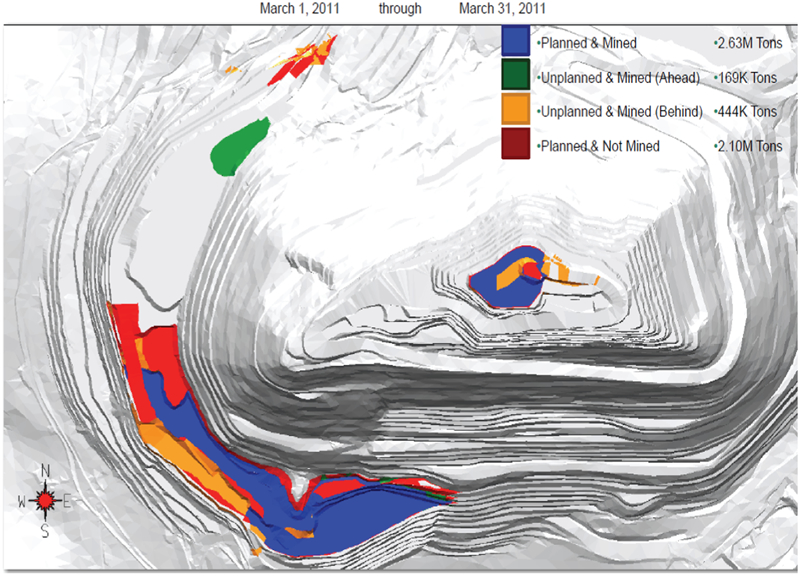
‘M’ reconciliation performance indicators: M1 = 3·243/4·73 = 68%; M2 = 2·63/3·243 = 81%; M3 = 0·68×0·81 = 55%
For spatial or geological reconciliation, F1 is the ratio of short range grade control or blasthole depletions to long range model depletions, F2 is the ratio of mill production to short range depletions and F3 is a product of F1 and F2 (Guardiano et al., 1955). Figure 6 presents typical data from an open pit mine. Understanding and interpretation of the monthly reconciliation performance indicators is essential. From Fig. 6 we can deduce that all appears well, however the long range model appears to be slightly under predicting the tonnage of ore and the pit can temporarily expect more ‘A’ ore than planned. Ideally, all the KPIs should be a value of 1·0 over a year, however, for gold mines, the data can be volatile and monthly swings of up to 50% can be seen. If F1 is consistently biased either up or down this indicates an error in the long range model that requires a correction to the model, typically done at the year end resource update. If monthly F2 (tonnes) is higher than 1·0 and F2 (grade) is less than 1·0, this is a sure sign that over digging is occurring in the pit. If F2 (tonnes) is consistently less than 1·0, there is a good probability that the pit's accounting system is failing. If F2 (tonnes) and F2 (grade) are both less than 1·0, or both greater than 1·0, there is a probable sampling problem in the mine or the mill. Very often short-term remedies are taken to solve problems, such as mining today from a convenient high-grade area scheduled to be mined in the future (Parker, 2002).
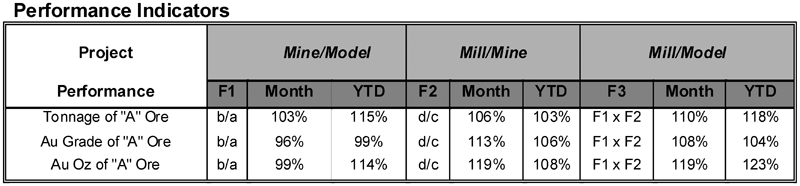
‘F’ reconciliation performance indicators
Aligned with Kinross strategy
Corporate strategy does affect mine planning decisions and the relationship between the two is centred around selection of the cut off grade. Higher than optimal cut off grades may increase short term profitability and shorten the pay-back period and lower than optimal cut off grades may increase project life and maximise the extraction of the mineral resource. The ‘mine’ or ‘internal’ cut off grade is used to answer the question of should a block of material remain in the ground or should it be mined and processed. The marginal cutoff grade formula (Rendu, 2008) is

The ‘mill’ or ‘external’ cutoff grade is used to answer the question of if a block of material has to be mined, should it be processed? In this case, the marginal cut off grade formula is

The denominator in the cutoff grade equation includes metal price and this is a significant factor affecting strategy. A high metal price will result in a low cutoff grade and vice versa. The gold mining industry has enjoyed a ten-year upward trend in metal prices; however, no-one can predict future prices and average type or consensus estimates are historically always wrong. Note that the consensus estimate is simply the average of the analysts’ guesses of the gold price and is typically lower than the actual gold price. Gold mining companies use reserve metal prices that are below spot prices as a means of minimizing the detrimental effect of price cycles and volatility. Figures 7 and 8 show the Kinross long term planning gold prices compared to spot and consensus estimates.
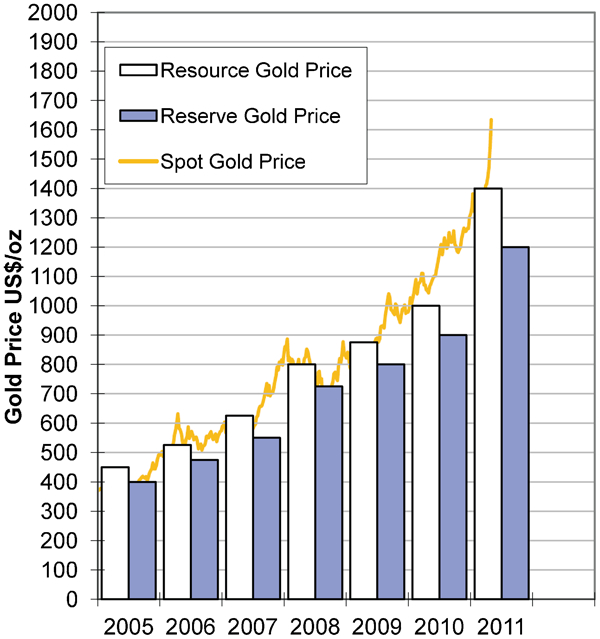
Kinross reserve price history
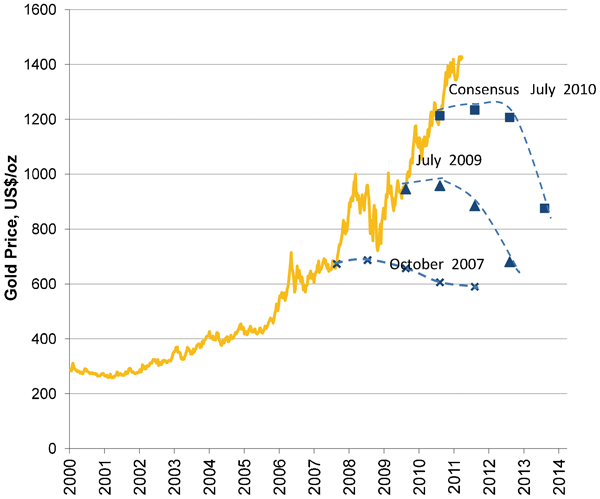
Gold spot price versus consensus estimates
In practice, the optimal cut off grade strategy is not determined via a simple equation. The optimal cutoff grade is typically defined at the feasibility stage and is iteratively determined by varying mining rates and cutoff grade scenarios and by conducting multiple discounted cash flow analyses on numerous mine plans to determine the maximum project NPV. The solution usually includes a low grade stockpile in order to advance higher grade ore to the mill. The robustness of the selected cut off grade strategy is then tested by evaluating the effect of metal price and operating cost. A robust cut off grade minimises the effect of price volatility (Fig. 9).
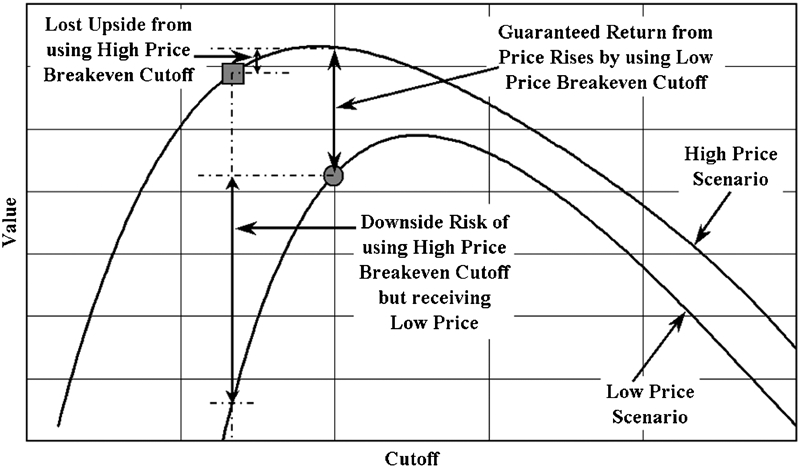
Risks and rewards of incorrect price predictions and suboptimal cutoffs (Hall, 2003)
Post-feasibility and once the mine is in operation, conditions typically change: exploration drilling will add additional ore, metal prices will change and operating costs will go up. Consequently, the operating cut off grade has to change in order to meet corporate strategy. For mature operating mines, Kinross bases mine planning decisions on a marginal cut off grade calculation (including sustaining capital), using corporate metal price guidance that is below spot price. This simplistic approach is effective and well illustrated in Fig. 9 (Hall, 2003).
It can be seen that a suboptimal breakeven or marginal cutoff grade using a low metal price will capture most of the upside gains realised from a rise in metal prices, compared to the significant downside loss experienced when using a higher price cutoff in a low metal price environment. This is typical of the asymmetric risk experienced in the mining industry and drives behaviour towards conservative planning. Therefore, in order to minimise negative surprises, plan with a higher cutoff grade.
Aligned with partners
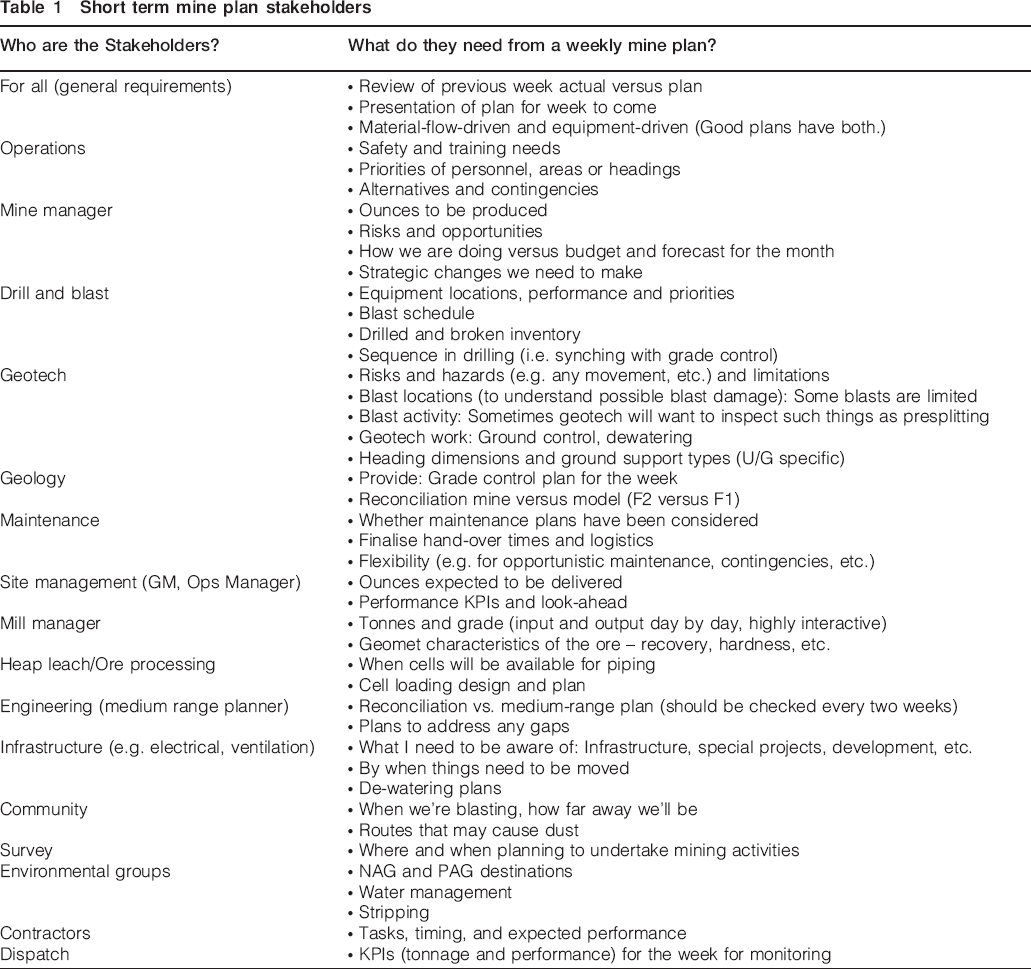
Mine planning is not an exercise done in isolation by mine engineers huddled over computer screens. There are many stakeholders in a mine plan and extensive consultation is necessary to ensure that stakeholder objectives are known and addressed, the plans are properly communicated and that the stakeholders are committed to the plan. This concept applies for both short range mine planning and longer range Life-of-Mine planning. Table 1 presents the typical stakeholders in a short term mine plan.
Short term mine plan stakeholders
Life-of-Mine planning or strategic business planning requires a more extensive list of stakeholders including:
Corporate responsibility Social licence to operate in our community
Exploration Future ore bodies requiring more definition
Finance Capital efficiency and project evaluation
Treasury Metal price forecasts and currency rates
Human resources Personnel needs and training requirements
Supply chain Commodity consumptions and prices
Taxation Tax planning and royalty issues
Environment Closure planning and asset retirement obligations
Conclusions
Mine planning is the foundation of value for a mining company. Good mine planning requires solid understanding of the ore body, rigorous standards and processes, robust and useful information technology and skilled people. In developing best practice guidelines, Kinross has focused on six critical elements of mine planning: Putting safety first, world class quality and accuracy, executable and deliverable, aligned with strategy, and aligned with partners. The mine plan must be safe, executable and deliverable. If it is not, then the plan needs to be adjusted and reconciliation provides a mechanism to assist in the adjustment. Reconciliation should not be overly complex and must be a useful tool to identify opportunities. Kinross mine planning KPIs are simple but visible. Corporate strategy does affect mine planning decisions and the relationship between the two is centered around selection of the cut off grade. Higher than optimal cut off grades may increase short term profitability and shorten the pay-back period and lower than optimal cut off grades may increase project life and maximise the extraction of the mineral resource. To maximise net present value, optimal cut off grades should be higher than the marginal cutoff grades. Typically, tactical and operational cut off grades are estimated as a marginal cut off grade calculation (including sustaining capital), using corporate metal price guidance that is below spot price.
The feasibility and success of any mine plan is contingent upon the accuracy of input assumptions and these assumptions must be supplied by all disciplines in the organisation. For economic modelling, the use of spreadsheets is discouraged and the use of activity based cost modeling software provides a solid and auditable platform. Mine planning is not an exercise done in isolation by mine engineers huddled over computer screens. There are many stakeholders in a mine plan and extensive consultation is necessary to ensure that stakeholder objectives are known and addressed, the plans are properly communicated and that the stakeholders are committed to the plan.
Footnotes
This paper is part of a special issue on Strategic Mine Planning