







Abstract
Ethylene–propylene–diene monomer (EPDM) rubber composites reinforced with 50 phr samarium oxide (Sm2O3), samarium borate (SmBO3) and Sb in antimony doped tin oxide (ATO) are aged at 150°C for different intervals. It is found that neutral Sm2O3 and alkaline SmBO3 can retard the oxidative degradation of EPDM by blocking radical passage. The acidic ATO particles can accelerate the oxidative degradation of EPDM. The trend of tensile strength of EPDM composites is consistent with that of cross-link density of EPDM composites. SmBO3 and ATO can retard the increase of dielectric loss until 10 days of aging, while Sm2O3 can keep the dielectric loss at low level until 14 days of aging. The increased surface charge of filler can make surface and volume resistivity decrease sharply. Antimony doped tin oxide can deteriorate the dielectric strength of EPDM, while SmBO3 and Sm2O3 can keep the dielectric strength of EPDM at a constant level.
Keywords
Introduction
Because of non-polar and saturated backbone, ethylene–propylene–diene monomer (EPDM) rubber consisting of ethylene, propylene and unsaturated diene possesses good resistance to heat, oxidation, electricity and polar solvent.1–5 These properties have extended its application to thermoplastic vulcanisates, electrical insulation, waterproof rolls and so on.
Owing to its low crystallinity, EPDM is not self-reinforced. Therefore, it is necessary to reinforce EPDM by introducing fillers into the matrix. In our previous study, we incorporate three types of inorganic fillers, i.e. samarium oxide (Sm2O3),6 samarium borate (SmBO3)7 and antimony doped tin oxide (ATO),8 into EPDM matrix to reinforce EPDM and at the same time endow EPDM with electric properties.9–11 In a previous study, it is found that the acidic ATO can retard cure to enhance the mechanical properties, and SmBO3 can promote the vulcanisation of EPDM to boost the mechanical properties.11 Moreover, the varied surface charge of Sm2O3, SmBO3 and ATO can affect the dielectric properties, surface and volume resistivity of EPDM composites.11 Thus, in this study, we aim to investigate how the varied pH level and surface charge of Sm2O3, SmBO3 and ATO affect the mechanical and electrical properties of EPDM composites during aging.
Like other polymers, in practical use, EPDM would degrade under thermal oxidation. As for stability of filled EPDM, it is reported that mineral fillers and carbon black can enhance the stability of EPDM composites by blocking reaction.12 Suek et al. and Park et al. found that the acidity of catalyst particles can accelerate degradation of low density polyethylene by providing more catalyst reaction.13–16
In the literature, more attention has been focused on the degradation mechanism and formation of various oxidation products by Fourier transform infrared spectroscopy (FTIR).17 However, for practical user of vulcanised rubber composites, it is more important to know how the mechanical and electrical properties of EPDM change during aging.18, 19
In this study, EPDM composites with Sm2O3, SmBO3 and ATO have been aged in hot air at 150°C for different intervals. The main aim is to investigate how the pH level and the surface charge of filler influence the mechanical and electrical properties of EPDM composites during thermal aging.
Experimental
Materials
The rubber used in this study was EPDM (J-4045) containing 5-ethylidene-2-norbornene (ENB) as diene, which is manufactured by Jilin Petrochem., SINOPEC. The EPDM is composed of 52·0 wt-% ethylene, 40·3wt-% propylene and 7·7 wt-%ENB. Compounding ingredients, such as dicumyl peroxide, zinc oxide, stearic acid, 2-mercapto benzimidazole and polymerised 2,2,4-trimethyl-1,2-dihydroquinoline, are of industry grade. Sm2O3 particles were supplied from Fangzheng Rare Earth Technology Co., Ltd in Liyang, China. SmBO3 particles are self-produced by sol–gel method, and ATO particles are prepared by coprecipitation method. The chemical/commercial name of KH845-4, obtained from Nanjing Shuguang Chemical Group Co., Ltd, is bis-[3-(triethoxysilyl)propyl]tetrasulphide, and the structure of KH845-4 is listed below:
Sample preparation
Surface modification of Sm2O3, SmBO3 and ATO
In this work, KH845-4 was applied for surface treatment of the Sm2O3, SmBO3 and ATO particles. The content of coupling agent was 1 wt-% of particle amount. For instance, 1·0 g of KH845-4 was mixed with 100 mL ethanol. Sm2O3 (100 g) was then added into the solution with a further 30 min stirring to ensure a uniform distribution of the coupling agent on the Sm2O3 surface. The treated Sm2O3 particles were then dried at 60°C for 4 h in an oven until weight remained constant. Similarly, SmBO3 and ATO particles were treated in the method above.10
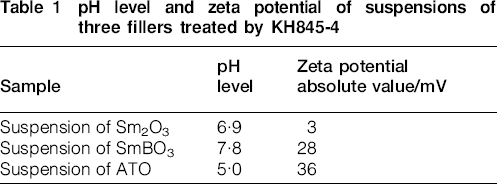
In our previous study, the pH value and surface charge of the three fillers have been tested and are given in Table 1.11
pH level and zeta potential of suspensions of three fillers treated by KH845-4
Compounding of EPDM/Sm2O3, EPDM/SmBO3 and EPDM/ATO vulcanisates
According to ISO 2393, EPDM filled with Sm2O3, SmBO3 and ATO treated by the coupling agent KH845-4 was mixed by a two-roll mixing mill (Shanghai Rubber Machinery Works, China). The amount of addition for the three fillers is 50 phr. The basic components of EPDM gum are 100 phr EPDM, 5 phr ZnO, 1 phr SA, 4 phr dicumyl peroxide, 0·5 phr 2-mercapto benzimidazole and 0·5 phr 2,2,4-trimethyl-1,2-dihydroquinoline. Vulcanisates were cured in an electrically heated press at 170°C and 10·0 MPa for 15 min. Vulcanisates were conditioned for 24 h before testing.
Hot air aging
Sheet and dumbbell samples of EPDM prepared above were both placed in a hot air aging testing chamber (401A; Jiangdu Mingzhu Testing Machinery Co., Ltd, China) with air blowing for aging testing at different intervals of time up to 21 days, where the temperature was 150±1°C. All conditions in the hot air aging refer to ISO 188.
Fourier transform infrared spectroscopy
Fourier transform infrared spectra of EPDM composites before and after aging were obtained by attenuated total reflectivity technique with a resolution of 4 cm−1 in the range of 680–4000 cm−1 in a Nicolet spectrometer (NEXUS 670 technique; USA).
Cross-link density
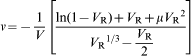
Cross-link density of EPDM specimens was measured by the solvent swell method. Ethylene–propylene–diene monomer samples were immersed in toluene for 72 h at room temperature. The cross-link density was determined by the Flory–Rehner equation17
Mechanical properties
Test specimens were cut off from vulcanised sheets >24 h after vulcanisation. The tensile test was carried out according to ISO 37 using a CMT 5254 type electromechanical universal testing machine (Shengzhen SANS Testing Machine Co., Ltd, China) at a stable rate of 500 mm min−1. The Shore A hardness of the specimens was measured using an LX-A rubber Shore A hardness degree tester (Jiangdu Mingzhu Testing Machinery Co., Ltd, China) according to ISO 7619-1.
Electrical property measurement
Measurement of volume and surface resistivity
The volume and surface resistivity of composites were measured at room temperature by a high insulation resistance meter (Shanghai Precision & Scientific Instrument Co., Ltd, China), following IEC 60093.
Measurement of dielectric constant and dielectric loss
The dielectric constant and dielectric loss were measured at 10 MHz (Agilent 4294A precision impedance analyser; USA), following IEC 60250.
Measurement of ac dielectric strength
The dielectric strength at 50 Hz was determined following IEC 60243-1. The voltage source is a YOJ 10 kVA step-up transformer (Xuzhou Power Transformer Factory, China). The voltage on the circular sample with a diameter of 100 mm is increased from zero until dielectric failure of the test specimen occurs. The power rating for this test was 1 kV s−1 for voltages <20 kV and 2 kV s−1 for voltages >20 kV. The formula was as follows

Results and discussion
Effect of hot air aging on FTIR spectra of EPDM composites
Fourier transform infrared spectroscopy was successfully applied to detect the products and evaluate mechanism of EPDM.21 Figure 1 displays the FTIR spectra of EPDM composites at different aging times. The absorption peaks between 1500 and 1800 cm−1 correspond to –C = O bond from carbonyl functional groups, such as ketone, aldehyde and ester.22, 23 It is clear that the absorption peak at 1720 cm−1 of EPDM control, EPDM/Sm2O3, EPDM/SmBO3 and EPDM/ATO appear after 10, 14, 14 and 4 days of aging. This means that the addition of Sm2O3 and SmBO3 can retard the oxidative degradation of EPDM composites, while the addition of ATO can accelerate oxidative degradation of EPDM composites.
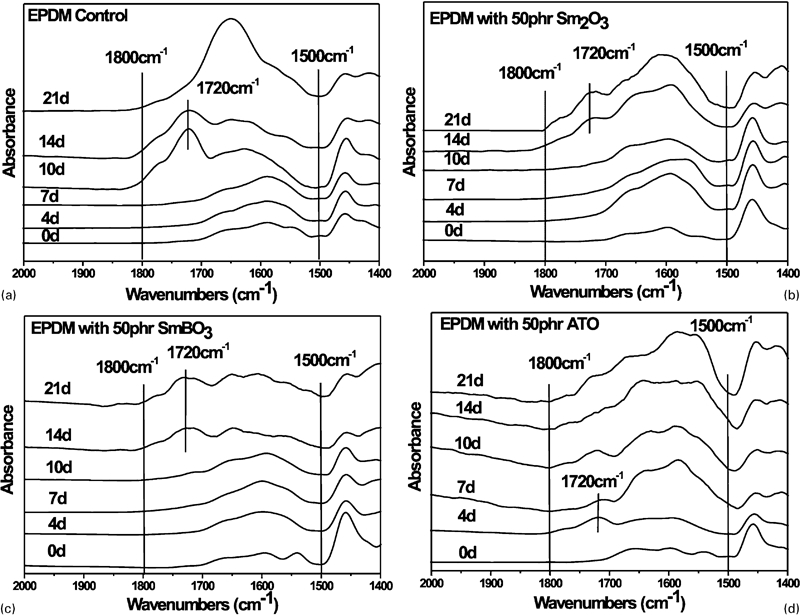
Fourier transform infrared spectra of EPDM composites before and after hot air aging
According to the literature, the pH value of SmBO3 produced by sol–gel method was 8,7 and the pH value of ATO produced by coprecipitation method was <6.8 In our previous study,10 it has been tested that the pH values of Sm2O3, SmBO3 and ATO particles are 6·9, 7·8 and 6·0 respectively. In the literature, the acidity of particles can provide more acid catalysed reaction and then accelerate the degradation of low density polyethylene.15, 16, 24 Thereby, it shows that the acidic ATO can accelerate the oxidative degradation of EPDM, which consisted of 52·0 wt-% ethylene and 40·3 wt-% propylene.
According to the report, the presence of fillers can block radical's passage in EPDM matrix by some degree and enhance the stability of EPDM composites.12 This can be used to explain why the carbonyl index (CI) of EPDM with Sm2O3 and SmBO3 are lower than that of EPDM control at the same aging time.
As mentioned above, there were some oxidation products generated during hot air aging, so the rate of thermal oxidation can be followed by monitoring the increase in absorbance in carbonyl region by FTIR. In this study, CI was used to follow the course of hot air aging and defined as the ratio of the peak area between 1800 and 1500 cm−1 (A1800–1500) and the absorption of the peak at 1463 cm−1 (A1463) listed below25

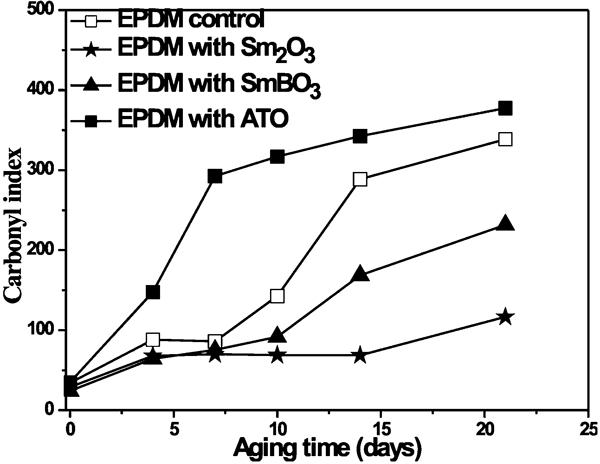
Effect of hot air aging on CI of EPDM composites
Effect of hot air aging on cross-link density of EPDM composites
Figure 3 exhibits cross-link density of EPDM composites during hot air aging. It is obvious that at the beginning of aging, the addition of filler can enhance the cross-link density of EPDM, which has been discussed in our previous study.11 In addition, it is clear that the cross-link density of EPDM with 50 phr ATO dropped in the first 4 days and then increased in the next days, while those of EPDM with 50 phr SmBO3, Sm2O3 and EPDM control decreased in the first 10 days and then grew in the next 11 days.
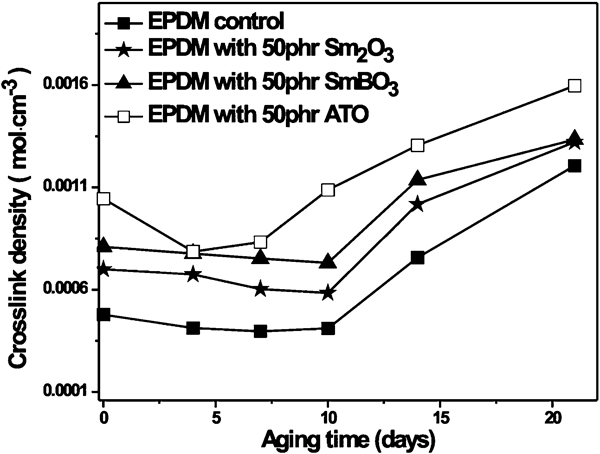
Effect of hot air aging on cross-link density of EPDM composites
According to the literature, there are two degradation stages of EPDM: the cross-link density decreases in the early stage of aging and then increases in the remaining stages of aging.26 Based on the discussion of CI, the first stage of EPDM with ATO was shortened by the catalysis effect of ATO. Although SmBO3 and Sm2O3 can prevent oxidation of EPDM, they did little effect on the trend of cross-link density of EPDM during hot air aging.
Effect of hot air aging on mechanical properties of EPDM composites
Figure 4 shows the mechanical properties of EPDM composites at various aging times. It is clear that the tensile strength of EPDM with 50 phr ATO decreased in the first 4 days and then increased in the remaining days of aging; those of EPDM with Sm2O3, SmBO3 and EPDM control fell down in the first 10 days of aging time and then rose in the remaining days of aging. This trend is confirmed by the results of cross-link density obtained above because tensile strength is dependent on cross-link density.27
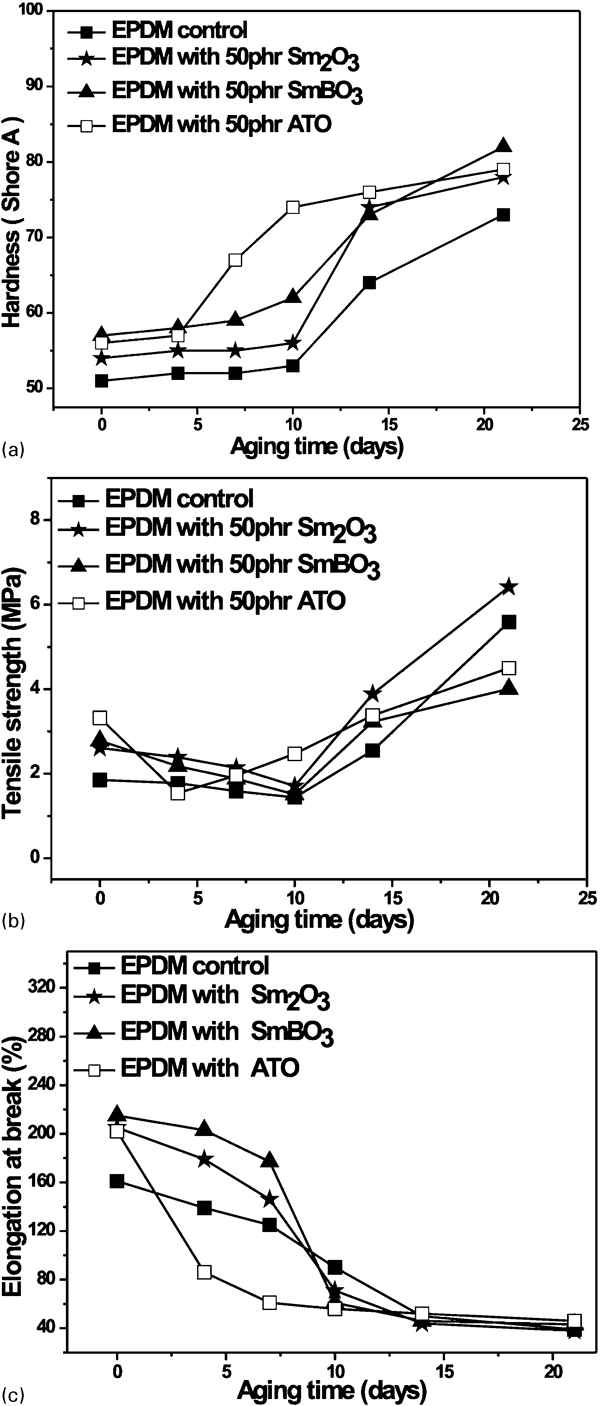
Effect of hot air aging on mechanical properties of EPDM composites
It is apparent that the elongation at break of EPDM with 50 phr ATO dropped in the first 4 days and then dropped slightly in the next 6 days; those of EPDM with 50 phr SmBO3, EPDM with 50 phr Sm2O3 and EPDM control descended in the first 4 days and then further decreased during the next 6 days. This can be explained by the fact that ATO can accelerate EPDM degradation, while SmBO3 and Sm2O3 would prevent EPDM from aging, which has been confirmed by the above results. Therefore, ATO makes the elongation at break of EPDM composite descend sharply, while the elongation at break of other samples dropped steadily.
Effect of hot air aging on dielectric constant and loss at 10 MHz of EPDM composites
The relative dielectric constant is a measure of the energy stored in a sample during a cyclic electric excitation.28 Generally, the dielectric constant of a material is mainly dependent on the polarisation of molecules, and the dielectric constant increases (decreases) with increasing (decreasing) polarisability.29
Figure 5 shows curves of dielectric constant and loss of EPDM composites during aging at 10 MHz. At the beginning of aging, it is noted that the addition of fillers can enhance the dielectric constant and loss of EPDM composites to some extent. This is attributed to the fact that the polarity of fillers is often higher than that of EPDM molecule.30 In our previous study, the surface charge of fillers follows the order ATO (36 mV)>SmBO3 (28 mV)>Sm2O3 (3 mV).11 Thus, the dielectric constant of EPDM composites followed the order EPDM with 50 phr ATO>EPDM with 50 phr SmBO3>EPDM with 50 phr Sm2O3>EPDM control.
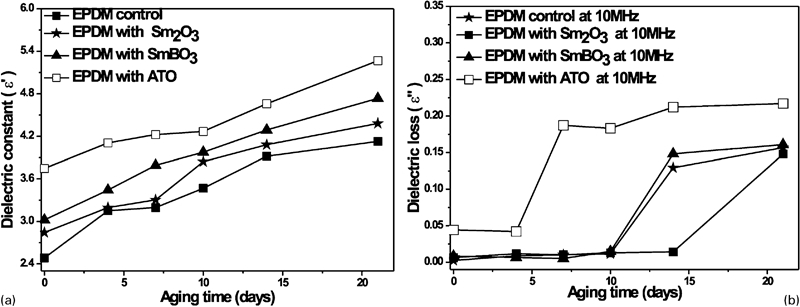
Effect of hot air aging on dielectric loss and constant of EPDM composites
In addition, the dielectric constant of EPDM composites grew with the increase in aging time. Commonly, the composite polarity is consisted of two main parts: filler polarity and EPDM molecular polarity. Because fillers in this study were little affected by hot air aging, it is the variation of EPDM molecular polarity that influenced the polarity of EPDM composites. There was a large amount of polar groups generated during aging, which has been confirmed by CI, so there were more dipoles aligning to cyclic electric excitation, and then dielectric constant of EPDM composites ascended during aging.29
The dielectric loss is a measure of the energy lost into a system during cyclic electric excitation.28 In this study, the dielectric loss is correlated with the combined effect of polarity and cross-link density of EPDM composites. More polar groups aligned in cyclic electric excitation meant more energy lost during such excitation. By contrast, more cross-link points generated during aging would prevent dipoles aligning in cyclic electric excitation. Thus, more energy is needed to overcome the resistance provided by cross-link points.
In the first few aging times when cross-link density of EPDM composites dropped (4 days for EPDM with ATO and first 10 days for other samples), the polarity and cross-link density were competing effects. Because ATO can accelerate degradation of EPDM, more polar groups were generated during the first 4 days and took the main effect, while for other samples, the two competing effects seemed to counteract with each other. Thereby, dielectric loss of EPDM with ATO increased in the first 4 days, while dielectric loss of other samples remained little changed during the first 10 days. When cross-link density of EPDM composites increased, polarity and cross-link points became two synergic effects, leading to the increase in dielectric loss of all EPDM samples.
Effect of hot air aging on dielectric strength, surface and volume resistivity of EPDM composites
Resistivity is a measure of resistance that the material exhibits to the passage of current. The variations in dielectric strength, surface and volume resistivity of EPDM composites are displayed in Fig. 6. Apparently, dielectric strength, surface and volume resistivity of EPDM composites descended with the increase in aging time. This trend is ascribed to the increased polar groups confirmed by CI. The increasing amount of polar groups can facilitate current motion, and then passage of current was improved. Thereby, dielectric strength, surface and volume resistivity declined during hot air aging.31
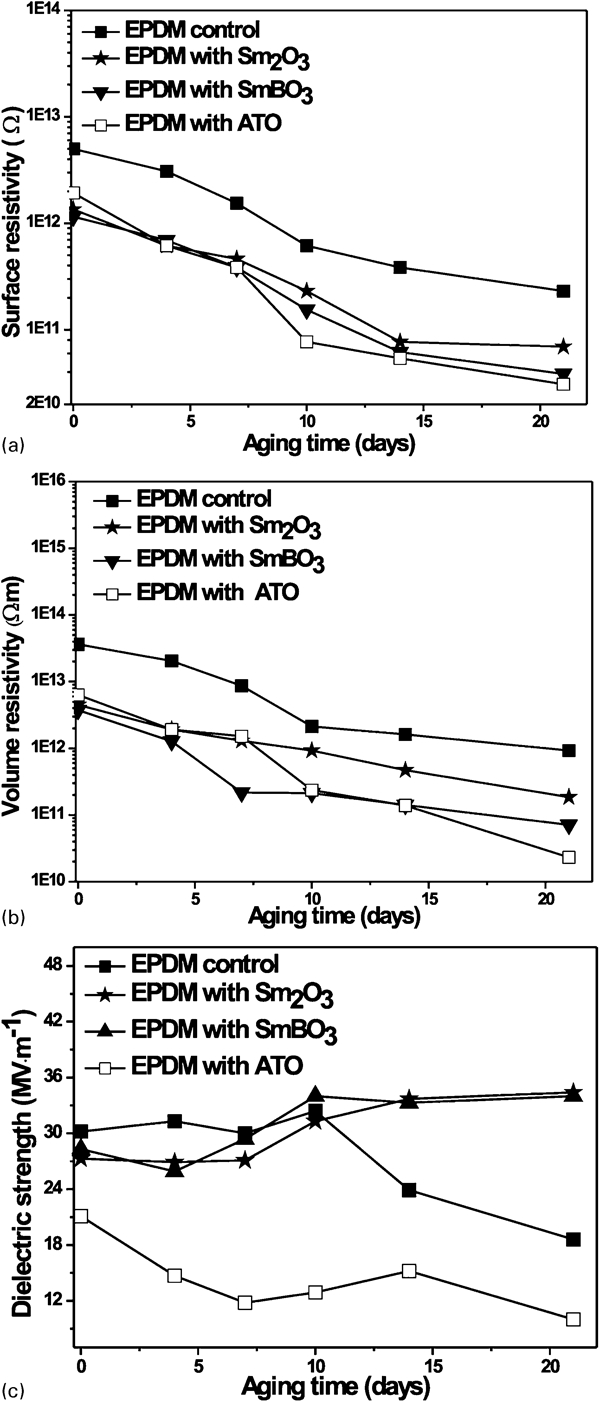
Effect of hot air aging on surface and volume resistivity and dielectric strength of EPDM composites
As for the variation in dielectric strength at the same aging time, because the cross-link densities of EPDM with SmBO3 and Sm2O3 are both higher than that of EPDM control, which has been discussed in our previous report,11 the extra cross-link points of such two EPDM composites made the two composites more difficult to be penetrated. Although adding ATO would increase the cross-link density of EDPM, EPDM with 50 phr ATO exhibits the lowest dielectric strength because ATO is a semiconductive material, while Sm2O3 and SmBO3 are both non-conductive particles.8
In terms of difference of surface and volume resistivity of EPDM composites at the same aging time, it is reported that electrons usually transport easier on the filler surface than EPDM matrix.32 The absolute values of zeta potential of particles indicate the amount of charge on the particle surface. According to our previous study, the zeta potentials of Sm2O3, SmBO3 and ATO were 3, 28 and 36 mV respectively.11 What is more, the more charges on particle surface, the easier for electrons to transport. Thefore, at the same aging time, the surface and volume resistivity of EPDM composites followed the order EPDM control>EPDM with Sm2O3>EPDM with SmBO3>EPDM with ATO.
Conclusions
Owing to their different pH levels and surface charge, Sm2O3, SmBO3 and ATO have different influences on mechanical and electric properties of EPDM composites during thermal aging. Sm2O3 and SmBO3 can prevent degradation process of EPDM by blocking radical passage in matrix. In contrast, the acidity of ATO can accelerate the degradation of EPDM with ATO. Thereby, EPDM with ATO presented the highest increase rate of CI.
The cross-link density of EPDM with ATO decreased in the first 4 days, and then increased in the remaining days of aging, while that of other samples descended in the first 10 days and then ascended in the next 11 days. The trend of tensile strength of EPDM composites correlated well with that of cross-link density. The elongation at break of EPDM with ATO dropped sharply in the first 4 days due to catalysis effect of ATO on degradation. By comparison, Sm2O3 and SmBO3 made the elongation at break dropped steadily.
The rise of polar products confirmed by CI would lead to the increase in dielectric constant and decrease in dielectric strength and resistivity of EPDM composites, while dielectric loss of EPDM composites is affected by the two competing factors: CI and cross-link density. At the same aging time, dielectric strength can grow with the increasing cross-link density; surface and volume resistivity would rise with the increasing surface charge on filler particles.
Footnotes
Acknowledgements
We would like to express our sincere thanks to the Scientific Achievement Transformation of Jiangsu Province for Financial Support (BA2010017) and the Priority Academic Program Development of Jiangsu Higher Education Institutions.