







Abstract
The effect of carbon black on nanoclay filled polychloroprene (CR) composites has been investigated. The nanoclay loading is fixed at 5 part per hundred rubbers (phr), and carbon black loading varied from 5 to 20 phr in rubber compounds. The rubber nanocomposites are prepared in laboratory by mixing in two-roll mill. The addition of nanoclay enhances mechanical properties especially tear strength and decreases water absorption without change in electrical properties compared to gum rubber vulcanisates. Wide angle X-ray diffraction and transmission electron microscopy are used to study the microstructure of CR nanocomposites. The addition of 5 parts of nanoclay to 15 phr carbon black filled samples shows synergistic effect between the fillers and suggests that the reinforcement is due to a more developed filler network formation in hybrid filler system than that in single phase filler. Significant improvement in mechanical, electrical and low water absorption properties has been obtained with these nanoclay and carbon black filled rubber nanocomposites. The paper concludes that nanocomposites containing a mixture of organoclay and carbon black in right proportion can be a substitute for rubber components used in underwater cable and device encapsulation applications.
Introduction
Nanocomposites are a composite in which inorganic filler is dispersed within the polymer matrix in a nanometre scale.1 The first polymer clay nanocomposite was developed by the Toyota Central Research laboratory and consisted of nylon 6 interspersed with layers of montmorillonite, a layered silicate clay.2 Afterwards, polymers like nylon,3, 4 polypropylene,5 polyethylene,6 natural rubber (NR),7 epoxidised NR,7 ethylene–vinyl acetate copolymer,8 styrene–butadiene rubber,9 butadiene rubber,10 acrylonitrile–butadiene rubber,10 etc. have been used to prepare nanocomposites. The application of organophilic clay in elastomers provides a new technology of rubber/clay nanocomposites with enhanced properties.
Conventional rubber composites usually contain carbon black (CB) and other inorganic fillers and requires a high content (>30%) in order to impart the desired mechanical properties. Such high filler loading increases the density of the product and can cause deterioration in properties through interfacial incompatibility between the filler and the organic matrix. Among many types of fillers, CB is the most important reinforcing filler used in the rubber industry. About 90% of the worldwide production of CB is used in the tyre industry in which the CB improves tear strength, modulus and wear characteristics of the tyres.12 In the past two decades, research was aimed to develop other reinforcing agents to replace CB partially or completely in rubber compounds such as sepiolite, kaolin, and precipitated silica. Arroyo et al.11 prepared NR nanocomposites with 10 phr organoclay with similar modulus, tensile strength and hardness as NR with 40 phr CB. Varghese and Karger-Kocsis12 also prepared NR nanocomposites with 7 phr of nanoclay (NC) functionalised with octadecylamine, which presented higher tensile strength and elongation than NR with 20 phr CB.
Polymers are increasingly used in a variety of underwater applications, for example, as cable sheathing and transducer encapsulation, because of their high resistance to abrasion and tear and excellent electrical properties. Rubber is an excellent material usable for underwater applications because of its easy fabrication. The successful long term operation of the sensors was found to be dependent on the correct choice of material for an elastomeric membrane intended to prevent moisture ingress into the underwater transducer system.13, 14 Conventional rubber composite filled with CB fillers are in use; however the effect of NC and CB for underwater rubber encapsulation has not been reported much in the literatures.
In this paper, polychloroprene (CR) filled with NC and CB was prepared and characterised. The synergistic behaviour of organoclay and CB was investigated in CR samples, which contained constant loading of NC (5 phr) and CB at different concentrations. In addition, the effect of CB on the cure behaviour, mechanical and electrical properties and morphology changes in polychloroprene clay nanocomposites have been examined.
Experimental
Materials
The elastomers used were CR (Neoprene W of DuPont Dow Elastomers, USA) purchased from their Indian distributor M/s. Pollmann India Limited, Mumbai. Organically modified montmorillonite containing 90 meq/100 g clay of quaternary ammonium ions (Cloisite15A) was purchased from the Southern Clay, USA. Fast extrusion furnace black, FEF (N550) with a specification of mean size 30–50 nm and surface area of 40–70 m2/g was procured from Philips Carbon Black, India. All other compounding ingredients such as antidegradents and vulcanising agents were obtained from local rubber chemical suppliers and used as such.
Compounding and sample preparation
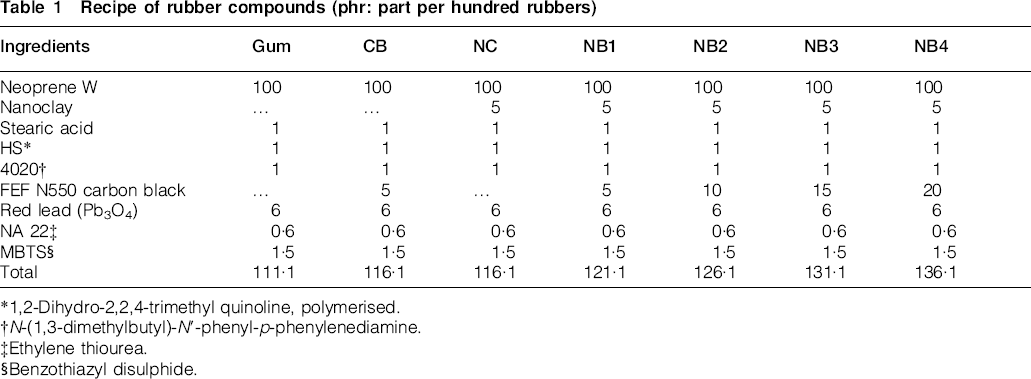
The compounding of CR with fillers and other ingredients was performed by laboratory size two-roll mixing mill. All the weights were taken in parts per hundreds of rubber, and the formulation is shown in Table 1. Master batch blending both rubber and NC (5 phr) was mixed at first in order to get better dispersion of the organoclay in the rubber matrix. After 3 min of mixing for master batch preparation, other ingredients are added as per the order given in the recipe. This technique of mixing is followed for all compounds except the conventional CB compound (CB in Table 1). In these recipes, the contents of CB were varied as 5, 10, 15 and 20 phr, whereas NC and other ingredients were kept constant.
Recipe of rubber compounds (phr: part per hundred rubbers)
1,2-Dihydro-2,2,4-trimethyl quinoline, polymerised.
N-(1,3-dimethylbutyl)-N′-phenyl-p-phenylenediamine.
Ethylene thiourea.
Benzothiazyl disulphide.
For improved water resistance, a lead oxide cure system is selected instead of conventional magnesia/zinc oxide combination. The following mixing sequence was followed in each case in order to disperse the NC in a rubber matrix: preparation of master batch containing rubber and NC and pass under tight nip three to four times (5 min), addition of activator followed by addition of antidegradents and addition of CB followed by addition of curatives. Final sheet can be prepared from the mixed compound by passing end wise through the tight rolls six times.
Characterisation
Cure behaviours
The rubber formulations were evaluated for cure characteristics at 150°C on a moving die rheometer (model MDR 2000), according of ASTM D2084. Vulcanisation was carried out on an electrically heated hydraulic press, at 150°C, for the optimum cure time t90, previously determined from MDR 2000. Scorch time t2, minimum torque and maximum torque also were evaluated.
Physicomechanical properties
Tensile and tear tests were performed using dumbbell and angle trouser specimens according to ASTM standards D412 and D624 on a universal testing machine (Zwick 1476) with a load cell of 500 N capacity. The tests were conducted at a crosshead speed of 500 mm min−1 at ambient temperature. Test specimens for the tensile and tear tests were punched out from the vulcanised sheets using appropriate dies. The tensile and tear properties were evaluated and printed out after each measurement by the microprocessor. Five samples were tested for tensile and tear, and the average of the values were taken in each case.
Electrical properties were determined as per ASTM D257 standard in a DavenPort electrical resistivity meter. Comparative study was undertaken on the water absorption (short term aging) behaviour of all compositions on rubber samples cut from moulded sheet of dimension (25×25×2 mm). Previously weighed samples were immersed in saltwater (3·5%NaCl solution) kept at room temperature, and the weight changes due to absorption were noted after 24 h and 7 days.
Dispersion and morphology studies
Wide angle X-ray diffraction (XRD) was used to study the dispersion of fillers in the CR matrix. The XRD measurements were carried out in an expert model of Philips diffractometer with a Cu Kα radiation (40 kV, 40 mA). The diffraction patterns were recorded from 2θ = 2–10°. The interlayer spacing, d-spacing of the organoclay, was derived from the peak position in the XRD diffractograms according to the Bragg law. The morphology of the nanocomposites was examined by transmission electron microscopy (TEM) images taken with a JEOL JEM-2100 electron microscope equipped with lanthanum hexaborate filament (acceleration voltage of 200 kV and beam current of 116 μA).
Results and discussion
Cure characterisation
Table 2 shows the effect of organoclay and organoclay/CB on neoprene rubber composites. ML and MH decrease slightly with the addition of 5 phr NC compared to gum CB filled rubber vulcanisate. However, combination of both fillers and addition of increasing CB loading on NC filled rubber composite increases both these values. It is observed that the viscosity increases with increase in CB loading. The incorporation of CB stiffens the rubber composite. A similar trend observed for torque difference (MH−ML), which indicates the extent of cross-linking and rubber–filler interaction of the composite.
Cure characteristics of different rubber compounds
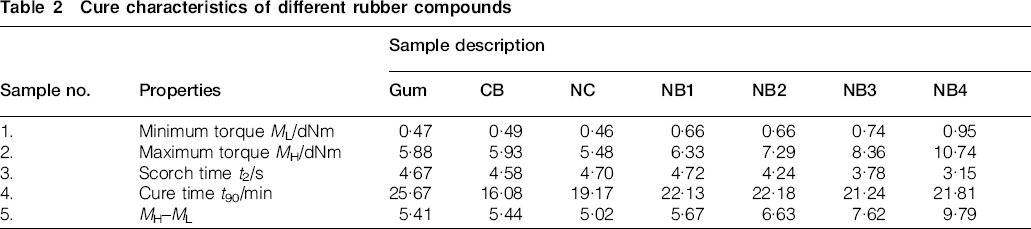
Curing study demonstrated faster scorch time and increase in maximum torque for the NC/CB incorporated CR compounds compared to gum and over that with CB or NC as single phase filler. It is seen from the table that cure time t90 reduced considerably with the addition of NC and CB on gum compound but increases with CB loading. This may be attributed to the presence of functional group on NC and basic nature of CB, which facilitate the curing reaction of CR stocks.
Physiomechanical properties
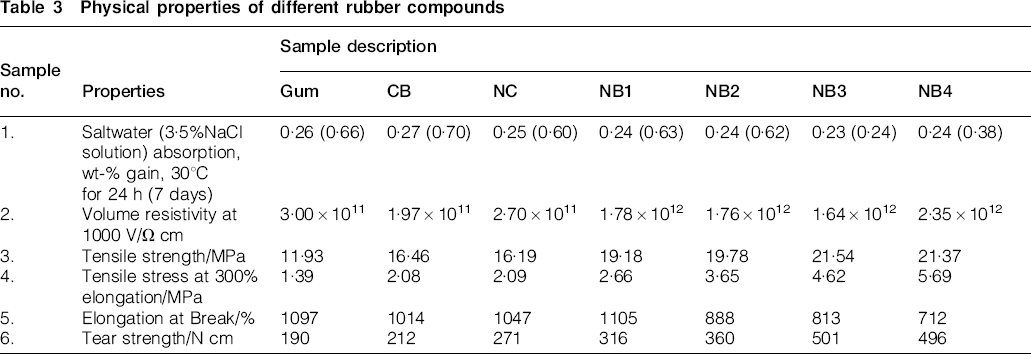
Polychloroprene rubbers are widely used in electrical and marine industries. The rubber has outstanding physical toughness, good bonding with different substrates and aging properties. Low water absorption and retention of electrical resistivity is important parameter for rubber components used in underwater environment apart from mechanical strength and acoustic transparency. Water absorption behaviour of all composites has been studied on rubber samples for short duration of time to select optimum rubber compound for water resistant property and better performance in sea water conditions. The absorption of water for NC filled composites reduced considerably compared to gum vulcanisate, and minimum values are retained even after 7 days of aging for hybrid filler composites. Volume resistivity of the rubber filled with NC and CB has been determined after 1 min of continuous electrification at 1000 V. It is observed that addition of fillers retains electrical resistivity requirement of rubber vulcanisates.
Addition of 5 parts nanoclay to the gum CR improves tensile strength from 11·93 to 16·19 MPa (>30% increase) and tear strength from 190 to 271 N cm−1 (>50% increase). The modulus (tensile stress at 300%) and tear strength values are higher for NC composite compared to CB composite at same loading. To understand the effect of CB loading on the mechanical properties of the nanocomposite, loading of N550 is varied from 5 to 20 phr.
With increasing filler loading, the tensile strength increases up to 15 phr loading, beyond which the properties are not changed considerably. The incorporation of 15 phr CB into NC filled composite enhances tensile strength by 90% and tear strength by more than 100%, which could be attributed to a synergistic effect between the fillers. These results depict that the CB filled nanocomposite (NB3) has outstanding tensile and tear strength when these are compared with the conventional CB and inorganic mineral filler filled vulcanisate reported by previous workers. Thus, it can be said that, although with the addition of NC there is some improvement over CB filled samples at every loading, the best improvement in mechanical strength can be seen with 15 phr of CB loading.
Structural analysis of nanocomposites
The XRD results on NC powder (C15A), NC filled CR composite (NC) and optimised compound containing both NC and CB (NB3) are shown in Fig. 1. The NC powder displayed two main diffraction peaks at 2θ = 2·7° (large peak) and 2θ = 4·3° (small shoulder peek), corresponding to interlayer spacing of 29 and 20 Å respectively. These two main peaks are attributed to the presence of different size of the alkyl chain and the amount of intercalant in the clay platelets. In addition, another small peak was observed at 2θ = 7·3°, which is typical of the pristine MMT platelet. For CR based nanocomposites with 5 phr of NC, broad peak at 3·75° was noted, which is assigned to an interlayer spacing of 24 Å. However, in case of nanocomposite (NB 3) containing both NC and CB, two peaks at 2θ = 2·08 and 4·14° corresponding to the interlayer distance of 43 and 22 Å were observed. The peaks displacement from the original 2θ value of NC powder (C15A) and lower angle shift with reduced intensity confirm the formation of intercalated structure in nanocomposites (NC and NB3).
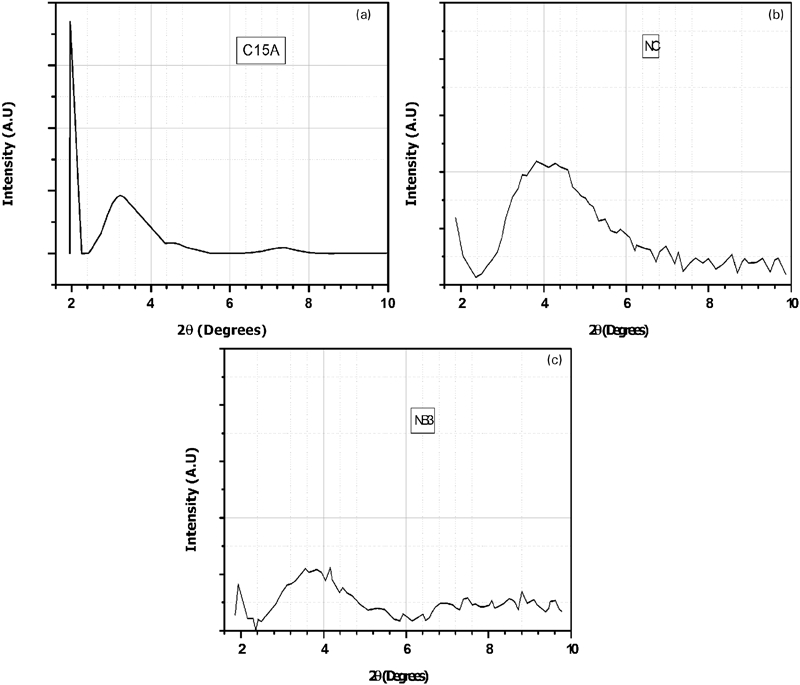
X-ray diffraction graphs for nanoclay (C15A), nanoclay composite (NC) and composites with nanoclay and CB (NB3)
Addition of CB and NC improves mechanical properties due to synergistic effect of these two fillers as shown in Table 3. This is due to good interaction of rubber matrix with both CB and NC and also CB might have enhanced the extent of intercalation of CR macromolecules through the clay platelets. It is understood from XRD graphs that CB filled nanocomposite does not have ordered exfoliated structures but shown aggregated and intercalated form in rubber matrix. To confirm the aggregate and intercalated structures, morphological investigation was carried out using TEM observation.
Physical properties of different rubber compounds
Morphology using TEM
Transmission electron microscopy, unlike XRD, provide the information about the spatial distribution of clay layers or structural heterogeneities in nanocomposites. The TEM images of CR nanocomposite and CR nanocomposite filled with CB loading is shown in Fig. 2. Images (TEM) for sample with 5 phr of NC shown in Fig. 2a reveal that the stacked silicate layers are partially peeled off, and in between the peeled layers, CR molecules could penetrate. In composite containing only NC, there is evidence regarding the presence of a small amount of clay aggregates and intercalated structures in the TEM images.
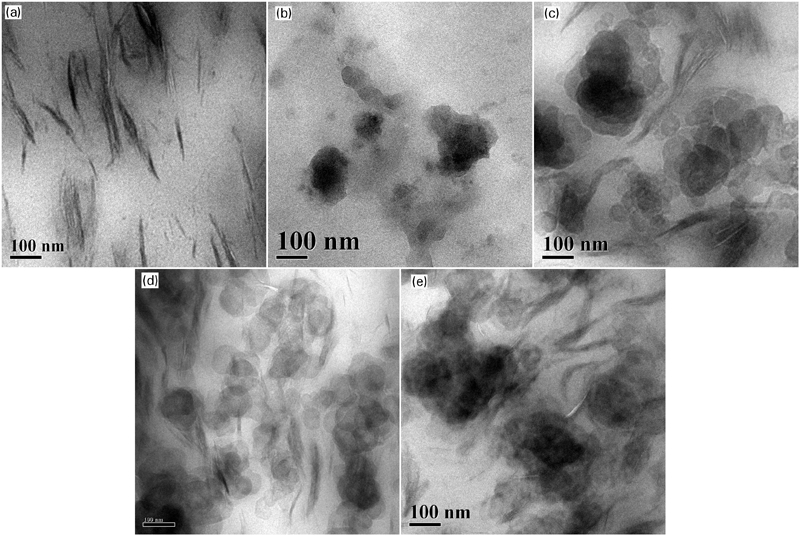
a CR with 5 phr nanoclay (NC); b CR with 5 phr nanoclay with 5 phr CB (NB1); c CR with 5 phr nanoclay with 10 phr CB (NB2); d CR with 5 phr nanoclay with 15 phr CB (NB3); e CR with 5 phr nanoclay with 20 phr CB (NB4)
But in case of CR containing a combination of fillers, there is a formation of a CB–NC local filler network, as indicated by TEM images (Fig. 2d). That is to say, inclusion of CB in CR/NC nanocomposite could induce a stronger and more developed filler network due to the reason of favourable interaction between CB and NC. On increasing the amount of CB above 15 phr (Fig. 2e), the nature of layered structures remains almost the same along with increased population of intercalated and aggregated structures.
Polychloroprene matrix enriched and filler starved regions are clearly visible in the TEM images (Fig. 2a and b). However, there is no evidence of filler starved regions in CR–NC nanocomposite containing CB. Addition of CB (10 phr and above) during mill processing of CR–NC nanocomposite creates compressive action, which facilitates in increasing the gap among the clay platelets.
In the TEM study, we have observed the development of a unique morphology of filler network between CB and NC. Images (TEM) displayed predominantly increased intercalated clay and aggregates of CB and clay structures in the presence of both NC and CB fillers in rubber matrix. The improvement of tensile and tear strength properties of the rubber composite, as observed in Table 3, also confirmed the TEM results. It can be concluded that CB plays a major role in the dispersion and intercalation of NC. These results indicate that nanocomposites containing a mixture of organoclay and CB suggest for a synergism between CB and NC and possess unique structure and properties. Addition of 15 phr CB along with 5 phr of NC in CR matrix produced optimum results.
Conclusion
Rubber nanocomposite based on polychloroprene was studied by varying the CB loading in rubber filled with 5 phr NC. Master batch blending of rubber and NC is adopted in early mixing cycle for better dispersion for all NC filled rubber composites. The incorporation of 15 phr CB into NC filled composite enhances tensile strength by 90% and tear strength by more than 100%. Low water absorption and improvement in electrical resistivity are also observed for the optimised compound (NB3) compared to gum vulcanisate. X-ray diffraction results indicated that CB might have enhanced the extent of intercalation of CR macromolecules through the clay platelets. In composite containing only NC, there is an evidence regarding presence of clay aggregates and intercalated structures in the TEM images. In case of CB filled CR–NC nanocomposites, there is a formation of a CB–NC local filler network due to the reason of favourable interaction between CB and NC and displayed predominantly increased intercalated clay and aggregates of CB and clay structures. These results indicate that nanocomposites containing a mixture of organoclay and CB in right proportion can be a substitute for rubber components used in underwater sensor application. Further works are in progress to study the polymer–filler interaction, curing agent effect, dynamic mechanical properties, acoustic transparency and long term water aging characteristics.
Footnotes
Acknowledgements
The authors are thankful to the Director, NPOL, for granting permission to publish this work. We wish to thank Dr S. Chatopadhyay for the recording of TEM images at IIT, Kharagpur.