






Abstract
Waterborne fluorinated polyurethan acrylate dispersion was prepared from the polyether polyol, isophorone diisocyanate, dimethylpropionic acid, hexafluorobutyl acrylate and trimethylolpropane triacrylate as monomers. Then, the prepolymer containing alkoxysilane Si(OR)3 was synthesised from dispersion and coupling agent methacryloxypropyl trimethoxy silane. The Si(OR)3 group was hydrolysed and reacted with different content tetraethoxysilane hydrolysis solutions in via hybridisation and gelatinous. A series of waterborne fluorinated polyurethane acrylate/SiO2 hybrids were prepared by sol–gel technique. The physical properties of dispersion such as storage stability, viscosity, particle size and surface tension were measured. The results indicated that all the prepared dispersions showed acceptable storage stability. The mechanical properties such as tensile strength, elongation at break and hardness and chemical resistance such as water absorption and acid resistance of the films were investigated. The hybrid materials were characterised using Fourier transform infrared, SEM and X-ray diffraction. The obtained hybrid materials have great potential application such as coatings, adhesion, leather finishing, adhesives, sealants, plastic coatings and wood finishes.
Introduction
In recent years, waterborne polyurethane acrylate (WPUA) has become one of the major research and development fields because of its environmental friendliness, good processability and mechanical properties.1–5 Waterborne polyurethane acrylate dispersions are widely used for applications such as coatings, adhesives, synthetic leather, construction and automatic industries. However, WPUA still has some drawbacks such as weak water resistance, mechanical properties and relatively low heat resistance, which restrict the extensive application of WPUA.6 Fluorinated polymers possess a whole range of very interesting bulk and surface properties, such as excellent environmental stability, water and oil repellency, low coefficient of friction, biocompatibility, excellent thermal stability and chemical resistance and low interfacial free energy.7–10 Among numerous fluorinated polymers, fluorinated acrylic polymers with perfluoroalkyl groups have shown extraordinary characteristic of an extremely low surface free energy of 5 dyn cm−1 and have many important applications in low surface energy modification of various substrates.11, 12 Patil et al.13 reported the copolymerisation of ethylene with 1H, 1H, 2H, 2H-perfluorodecyl vinyl ether (FAVE8) by oxidative addition of salicylaldimine ligand to bis(1,5-cyclooctadiene)nickel(0)/methylaluminoxane at room temperature and at different ethylene pressures. The obtained copolymers, analysed by Fourier transform infrared (FTIR) and solid state nuclear magnetic resonance spectroscopy, showed a small incorporation of the fluorinated vinyl ether. The results of thermogravimetric and differential scanning calorimetry analyses exhibited high thermal stability. Canak and Serhatli14 prepared fluorinated urethane acrylate monomer based on isophorone diisocyanate, 3,5-bis(perfluorobenzyl)oxy benzyl alcohol and 2-hydroxyethyl methacrylate (HEMA) via in situ method. The UV curable polyurethane acrylate (PUA) formulation was prepared with oligomers, PUA or epoxy acrylate, monomers (fluorinated urethane-acrylate, 1,6-hexanediol diacrylate [HDDA] and tripropyleneglycol diacrylate [TPGDA]) and photoinitiator, Darocur 1173. Some properties of UV cured coatings and films such as gel content, solvent resistance, hardness, gloss, flexibility, tensile tests, thermal degradation behaviour and contact angle were investigated.
Recently, organic–inorganic materials have been extensively investigated due to combining the advantages of organic polymers (flexibility, ductility, dielectric strength, etc.) and of inorganic materials (strength, rigidity, high thermal stability, high refractive index, etc.).15, 16 A lot of investigations have proved that incorporating inorganic fillers to a polymer is an effective method for overcoming the disadvantage of WPUA. The most commonly used materials for inorganic particles are SiO2, ZrO2, TiO2, ZnO, CaCO3 and Al2O3.17–20 Silicon resin exhibits desirable properties, such as low surface energy, water repellency, stain resistance, flexibility at low temperature and thermal stability at high temperature.21–23 Therefore, the integration of silica and waterborne fluorinated PUA (WFPUA) could be considered an effective approach to enhance the properties of materials. Yu et al.24 prepared water diluted hybrid coating, consisting of fluorinated PUA and colloidal silica by introducing a small amount of fluorinated methacrylate units into the PUA chains. The surface composition, surface morphology and the surface property of the hybrid were investigated with attenuated total reflectance spectra of infrared analyses and contact angle measurement. Sawada et al.25 reported the synthesis of fluoroalkyl end capped trimethoxyvinylsilane oligomers, trimethoxyvinylsilane-N, N-dimethylacryl-amide co-oligomers and trimethoxyvinylsilane-acryloyl- morpholine co-oligomers with hydrolysis and condensation between tetraethoxysilane (TEOS) and trimethoxysilyl segments in oligomers to afford homogeneous fluoroalkyl end capped oligomers/silica gel polymer hybrids under mild conditions. The result showed that thermal stability of a variety of fluoroalkyl end capped oligomers/silica gel polymer hybrids increased significantly compared to those of the parent fluoroalkyl end capped oligomers. In addition, in these fluorinated oligomers/silica gel polymer hybrids, their sol solutions are applicable to the surface modification of glass to exhibit not only a strong oleophobicity imparted by fluorine but also a good hydrophilicity on the glass surface. Xin et al.26 synthesised a series of cationic polyurethane fluorinated acrylic hybrid latex (PUFA) by solvent free method. The structure and properties of PUFA were characterised and investigated. The FPUA films exhibited good surface property, which could be enhanced at higher annealing temperature. Thermogravimetric analysis suggested that the PUFA hybrid latex film had a better thermal stability than pure PU.
In this work, a series of WFPUA/SiO2 hybrids were prepared by sol–gel technique. The resulting WFPUA/SiO2 hybrid materials were characterised using FTIR spectrometry, scanning electron microscopy (SEM) and X-ray diffraction (XRD). The physical property, chemical resistance and mechanical property of the prepared materials were investigated. The obtained results show that the WFPUA/SiO2 hybrids are suggested to have high potential for new functional materials through their unique properties imparted by not only fluorine but also by the hybrid counterparts.25
Experimental
Materials
Polyether polyol (NJ-330, Mn = 3000 g mol−1) was produced by Ningwu Chemical Co., Ltd in Jurong, China. Dimethylpropionic acid (DMPA) was obtained from PERSTOP Co. in Helsingborg, Sweden. Isophorone diisocyanate was supplied by Rongrong Chemical Ltd in Shanghai, China. Hydroxyethyl methyl acrylate was provided by Yinlian Chemical Ltd in Wuxi, China. Hexafluorobutyl acrylate (FA) was supplied by Harbin Xeogia Fluorine–Silicon Chemical Company in Haerbin, China. Trimethylolpropane triacrylate was supplied from Mingda Macromolecule Science and Technology Co., Ltd (Suzhou, China). Methacryloxypropyl trimethoxy silane (MPTS) was purchased from Nanjing Shuguang Chemical Plant. Tetraethoxysilane, N-Methyl-2-pyrrolidone, dibutylbis (lauroyloxy)tin, azobisisobutyronitrile and triethylamine were obtained from Sinopharm Chemical Reagent Co. Ltd in Shanghai, China.
Preparation of WFPUA/SiO2 hybrid
Polymerisation was performed in a 500 mL round bottom, four-necked separable flask with a mechanical stirrer, thermometer and condenser with a drying tube. Polyether polyol (NJ-330, 12·03 g), isophorone diisocyanate (5·55 g) and catalyst dibutylbis (lauroyloxy)tin (0·2g) were charged into the dried flask. The mixture was heated to 60°C for 2 h to obtain the NCO terminated prepolymer. A certain amount of DMPA (0·89 g) dissolved in N-methyl-2-pyrrolidone (15·0 g) was added the prepolymer at 70°C for another 2 h so that the NCO terminated prepolymer containing carboxyl group was obtained. Then, the reactants were cooled down to 60°C, and hydroxyethyl methyl acrylate (3·25 g) was added dropwise for 5 h. The prepolymer with ethylene linkage was obtained. The neutralising solution, triethylamine (0·89 g), was added and stirred for 30 min while maintaining the temperature at 40°C. The mixture of FA (5·18 g) and trimethylolpropane triacrylate (5·18 g) was added into the prepolymer. Then, the pH value of latex was adjusted to 4, and MPTS was added into the prepolymer. The prepolymer/monomer mixture was then dispersed into deionised water under vigorous stirring. Azobisisobutyronitrile (0·2 g) was added into the dispersion subsequently, and the solution was kept for 4 h at 70°C under vigorous stirring. After the reaction was completed, the WFPUA prepolymer containing alkoxysilane Si(OCH3)3 dispersion was obtained.
Waterborne fluorinated PUA
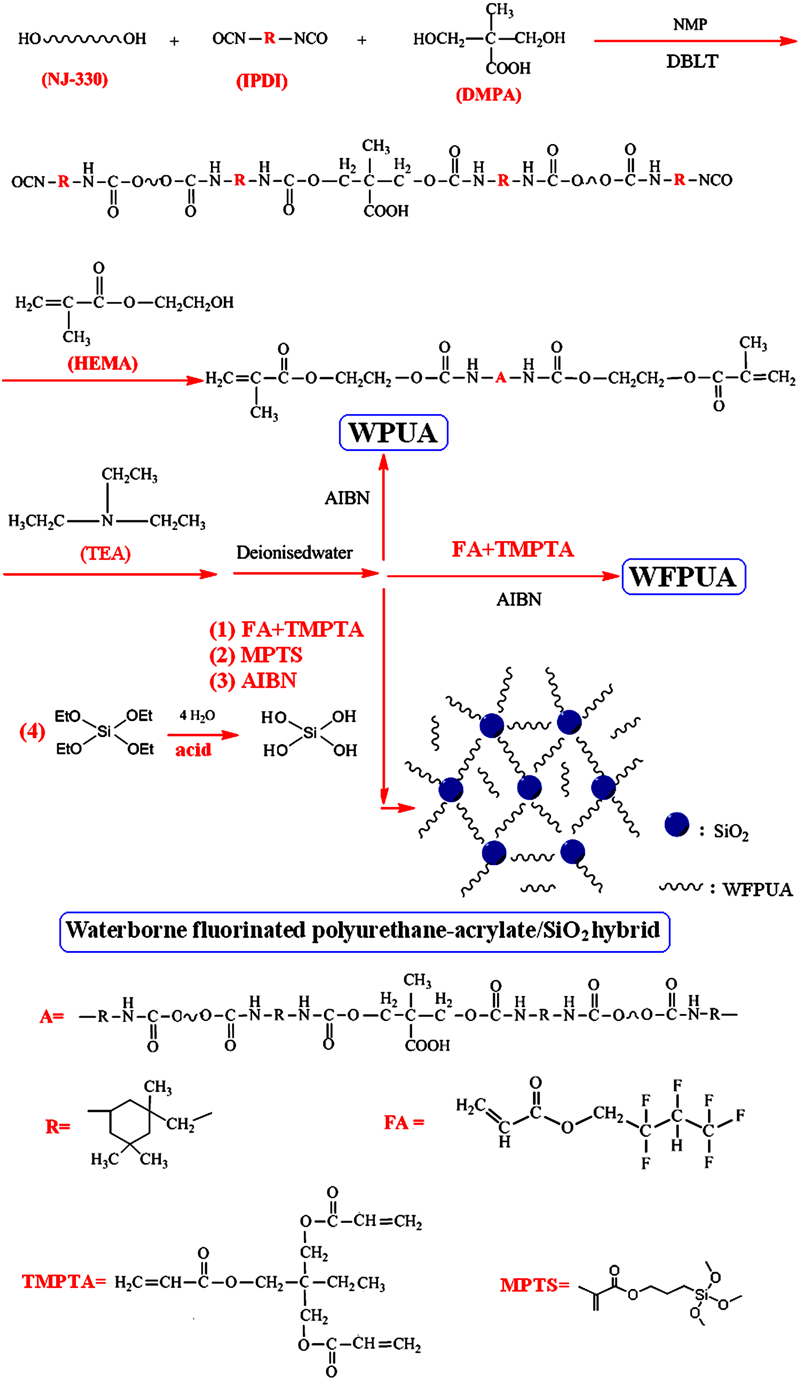
Synthetic route of waterborne fluorinated polyurethane acrylate/SiO2 hybrid
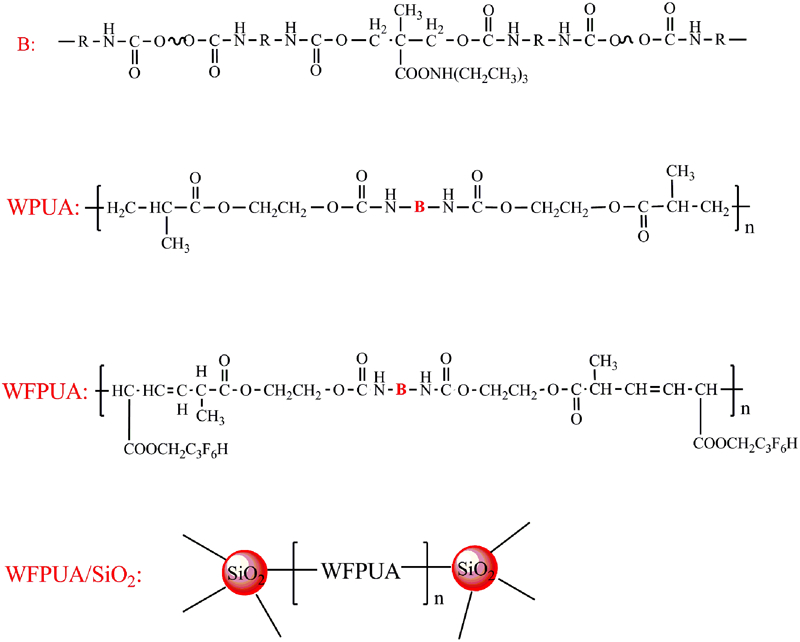
Chemical structures of materials
Physical properties of dispersions
Preparation of film
Waterborne PUA or WFPUA or hybrid film was prepared by casting the newly synthesised WPUA or WFPUA dispersions onto a poly(tetrafluoroethylene) at room temperature for 2 days; this was followed by drying at 60°C for 3 h. This trend of drying was just for slow drying. It was also possible to evaporate the solvent at a fixed temperature, either at room temperature or at elevated temperature. After demoulding, the films were stored in a desiccator at room temperature for further studies.
Apparent viscosity of dispersion
The apparent viscosity of WPUA or WFPUA or hybrid dispersion was measured by a numerical viscometer (NDJ-9S, Shanghai Precision and Scientific Instrument Co., Ltd, Shanghai, China); when the shear rate was 2000 s−1, the high shear rate warranted highly reliable measurements at a temperature of 25°C.
Particle size of dispersion
The WPUA or WFPUA or hybrid sample was added to 100 mL test tubes and diluted with deionised water. The particle diameter of the WPUA or WFPUA dispersion was measured by a laser particle size analyser (BIC-9010, Brookhaven Instrument Co.) (Holtsville, NY, USA).
Surface tension of dispersion
The surface tension of PUA, FPUA and FPUA/SiO2 dispersions were measured by a surface/interfacial tension tester (DCAT 11, the company of Dataphysics, Germany).
Tensile strength and elongation at break of film
Tensile strength and elongation at break testing for all specimens were carried out on a tensile tester (KY-8000A, Jiangdu Kaiyuan Test Machine Co., Ltd, Jiangdu, China) at room temperature at a speed of 50 mm min−1. All measurements had an average of three runs. The dumbbell type specimen was 30 mm length at two ends, 0·2 mm thick and 4 mm wide at the neck.
Hardness of film
The hardness was measured with a sclerometer (KYLX-A, Jiangdu Kaiyuan Test Machine Co.); measurements were performed three times for each film sample, and the average value was calculated.
Chemical resistance of film
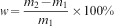
The measurements of water absorption or swelling degree of the films were the same procedures. The procedures for these measurements were briefly described as follows. The films were cut into the size of 20×20 mm, then put them into water or 2·0%HCl solution at 25°C after being weighted. After 24 h, the film was taken out, rub dry by wiping off the surface water with a piece of filter paper and then weighted again. The water absorption (or swelling degree) w was calculated using the following relation
Fourier transform infrared spectra
Fourier transform infrared spectra of the WPUA and WFPUA films were obtained between 4000 and 400 cm−1 on a KBr powder with an FTIR spectrometer (AVATAR 360, Nicolet, Madison, USA). A minimum of 32 scans was signal averaged with a resolution of 2 cm−1 in the 4000–400 cm−1 range.
Scanning electron microscopy
To investigate the morphology of the film, fracture surface was investigated with a 5 kV accelerating voltage with a field emission scanning electron microscope (S-4800, HITACHI Corp., Tokyo, Japan).
X-ray diffraction characterisation
The XRD patterns were recorded by the reflection scan with nickel filtered Cu Kα radiation (D8, Bruker-AXS German). The X-ray generator was run at 50 kV and 70 mA. All the XRD measurements were performed at 2θ between 5 and 80°.
Results and discussion
Physical properties of dispersions
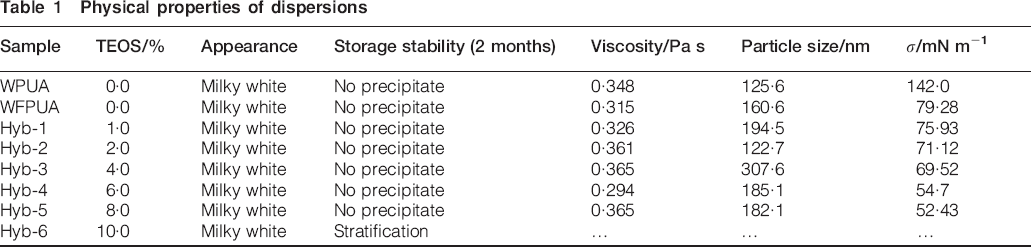
The physical properties of aqueous dispersion, such as storage stability, viscosity, particle size and surface tension, are shown in Table 1. As can be seen from Table 1, all the dispersions showed acceptable storage stability and had little apparent change in viscosity. According to Table 1, all of the dispersions were stored at room temperature for 2 months and exhibited satisfactory stability. The storage stability of the hybrid dispersions, which is an important parameter, depends upon many functions, such as pH, solid content, particle size and viscosity of the medium. Owing to the usages of DMPA and acrylic-silane (MPTS) in this study, which act as an internal emulsifier and coupling, the resulting hybrid materials also were stable. In this experiment, when TEOS content was 10·0 wt-%, the hybrid dispersion was unstable and appeared to be stratified.
According to Table 1, the particle sizes of WFPUA and WFPUA/SiO2 hybrids were bigger than that of pure WPUA. This was mainly due to the hydrophobicity of FA monomer; excess FA monomer could destroy the stability of the WPUA dispersion. On the other hand, the added FA monomer could enter into the WPUA latex particles internal for polymerisation and formed core–shell latex particles. These results made the particle size bigger. The dispersions have little apparent change in viscosity. Surface tension of dispersion is a significant physical performance parameter. It depends on the number and size of polarity base in the chain of big molecule. The obtained results showed that all dispersions had smaller surface tension σ values than water (72 mN m−1), showing an excellent infiltrative performance in the substrate. With the increase in ratio of TEOS, surface tension of hybrid dispersions decreased. In this experiment, hybrid material was synthesised via sol–gel process. The synthetic technique is based on creating two individual homogeneous inorganic and organic solutions. The TEOS is the most common and frequently acts as inorganic precursor for the sol–gel reaction. However, TEOS forms a phase separated silica network and does not have good compatibility with many polymers. In order to improve the compatibility of dispersion, it is essential to establish chemical linkages between the soft organic and the hard inorganic phases. Strong interfaces produced using a coupling agent increase the interfacial adhesion strength via the formation of chemical bonds. The coupling agent MPTS has two different reactive functionalities, namely, the organic functional group and the inorganic alkoxysilane groups. They have the ability to form simultaneously an organic network through the reaction of the organic functional groups with the organic binder and also an inorganic SiO2 network through the hydrolysis and subsequent condensation reactions of alkoxy silane groups. Therefore, all dispersions had smaller surface tension σ values and indicated that they had excellent infiltrative performance in the substrate.
Mechanical properties and of chemical resistance films
The tensile strength, elongation at break and hardness of the films are listed in Table 2. From the Table 2, the tensile strength of WFPUA was higher than that of the WPUA. This was mainly because FA monomer and polyurethane can be graft polymerised, and the relative molecular mass increases, and there exists a small amount of cross-linking. The results indicated that the tensile strength of vast majority of hybrids were higher than those of the WPUA and WFPUA. This is due to the formation of network of WFPUA and the inorganic moieties, which resulted from the restriction of polymer chain mobility and became more intertwined with the rigid silica network. Therefore, the existence of covalent bonds between WFPUA and silica imposes even more restraint to chain movement in hybrids. With the increase in TEOS content, the tensile strength increased. When the content of TEOS was 8·0 wt-%, the hybrid had the biggest tensile strength (1·31 MPa). From Table 2, the elongations at break for all hybrids were larger than that of pure WPUA. Owing to the particular flexibility of the macromolecular chain paragraph of polyurethane acrylic resin, the hybrid material showed better flexibility; besides, the hybrid material has the network structure of WFPUA and the inorganic moieties, which enabled it to have high elongation at break. As can be seen from Table 2, the hardness of the hybrid material was bigger than that of pure WPUA. This was mainly due to the polycondensation between the siloxane side of the coupling agent MPTS and the hydrolysis of TEOS, forming the Si–O–Si network. Polymer networks with WFPUA were generated and improved the effects of the interface between organic and inorganic phases. With the increase in the silica content, the structure of interpenetrating polymer network became denser; the hardness of the hybrid materials increased.
Mechanical properties of films

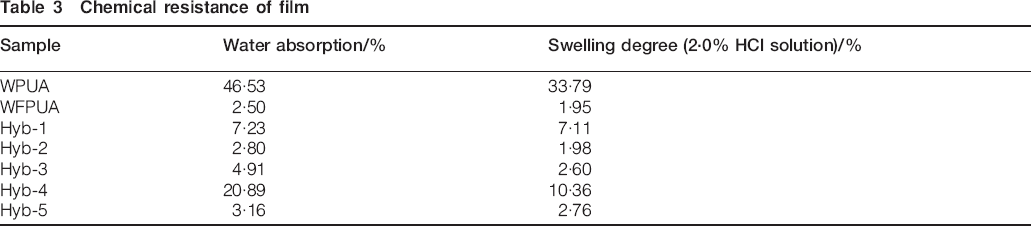
Chemical resistance, such as water absorption or acid resistance, is an important parameter for practical application of polyurethane. The chemical resistances for pure WPUA, WFPUA and hybrid films are shown in Table 3. From Table 3, water and acid absorptions of WFPUA and hybrid films were smaller than that of pure WPUA film and indicated that the WFPUA and hybrid films had excellent water and acid resistances. This was mainly because FA monomer and polyurethane can be graft polymerised and have unique properties imparted by not only fluorine but also the hybrid counterparts. When the content of TEOS was 2·0 wt-%, the hybrid film (Hyb-2) has the best water and acid resistances of all hybrids. Therefore, the prepared hybrid materials through the control of the content of fluorine atoms and silicon could be applied to commercial use in different regions.
Chemical resistance of film
Fourier transform infrared spectra of films
The FTIR spectra of the WPUA, WFPUA and Hyb-5 are shown in Fig. 3a–c respectively. As shown in Fig. 3, the disappearance of the peak at 2270 cm−1, which corresponded to –NCO group, proved the completed polymerisation. Besides, the broad and strong peaks at about 3350 cm−1 were characteristic of –NH stretching vibration. As be seen from Fig. 3, there was a progressive change in the absorption pattern of C = O stretching region at 1670 cm−1, which might be attributed to the presence of acrylate group. The –CH3 and –CH2 groups stretching vibrations were observed at about 2930 cm−1. The above results showed that PUA was synthesised successfully. In addition, the absorption bands dealing with the vibration absorption of C–F bond were observed from the spectra of Fig. 3b and c. The stronger characteristic absorption bands located at ∼1110, 1240 and 1370 cm−1 were attributed to stretching vibrations of CF2 and CF3 groups were overlapped by the strong absorption of C–O–C group.26, 27 From these analyses, fluorine was introduced to the PUA through containing fluorine acrylate copolymerisation method. From the spectrum of Fig. 3c, there was a wide and strong absorption peak from 1060 to 1190 cm−1, showing the existence of an Si–O–Si backbone. This was mainly due to the polycondensation between the siloxane side of coupling agent MPTS and the hydrolysis of TEOS, forming Si–O–Si network and generating the interpenetrating polymer network between the organic and inorganic phase. In addition, there were absorption peaks at ∼810 and 472 cm−1 corresponding to the Si–O–C asymmetric bond in the samples of hybrid materials. The result indicated that it was not a simple mixture of silicon dioxide and WFPUA, but the bonding of some kind of chemical bond; therefore, it formed a strong bond linked complex hybrid interaction system between the organic polymer and the inorganic phase.
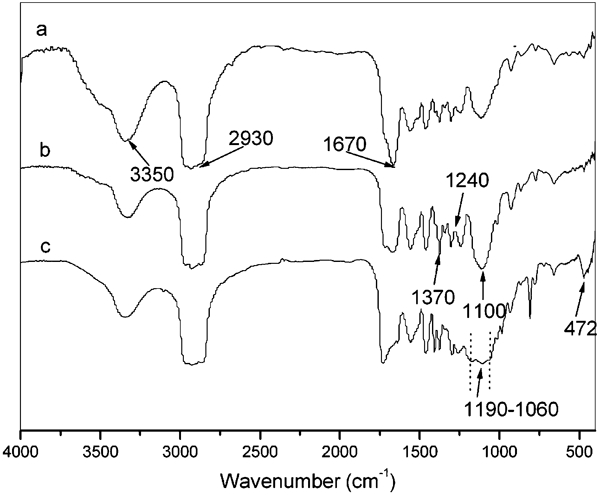
Fourier transform infrared spectra of a WPUA, b WFPUA and c Hyb-5
Scanning electron microscopy of hybrid
The SEM images of fracture surface of the Hyb-1, Hyb-2, Hyb-3 and Hyb-5 films are shown in Fig. 4a–d respectively. As can be seen from Fig. 4, the surface of Hyb-1 was relatively smooth and indicated that the particles were uniformly dispersed in the WPUA/SiO2 system, weakening the agglomeration phenomena.
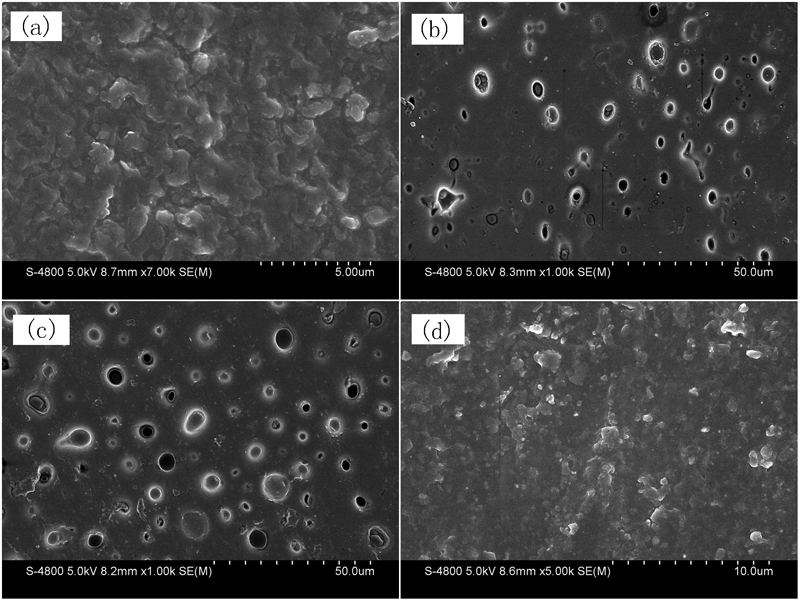
Images (SEM) of a Hyb-1, b Hyb-2, c Hyb-3 and d Hyb-5 films
As can be seen from the SEM images of Hyb-2 and Hyb-3, the inorganic particles were spherical and uniform. Obviously, the polymer as shell layer (in grey) were surrounding each SiO2 particles as cores (in bright black), and the cores of SiO2 particles were round. Depending on the degree of the interaction between the polymer and particles, there was higher or lower mobility than that of the bulk material. The size increased with the increase in TEOS content. This was mainly because the aggregation tendency increased as the TEOS content and the SiO2 particle number increased. However, with the increase in the content of TEOS to 8·0 wt-% (Hyb-5, Fig. 4d), it can be observed that there appear a lot of silica aggregates. This was mainly because as silica content increased, the system free of silica increased, easily causing the reunion of silicon. It happens to also explain why TEOS content increased to 10·0 wt-% (Table 1); storing for a period of time results in the emulsion having precipitation exhalation.
X-ray diffraction of hybrid
Figure 5 shows the XRD patterns of the selected Hyb-2 and Hyb-3. As shown in Fig. 5, a diffused diffraction peak appeared near 2θ = 20°, and this peak was attributed to the chain segments of amorphous PU and the formation of uniform three-dimensional network structure, which interspersed with the PUA segment. The fluorine and silicon modified polyurethane reduced the crystalline of inorganic particles and improved the toughness of the emulsion membrane.
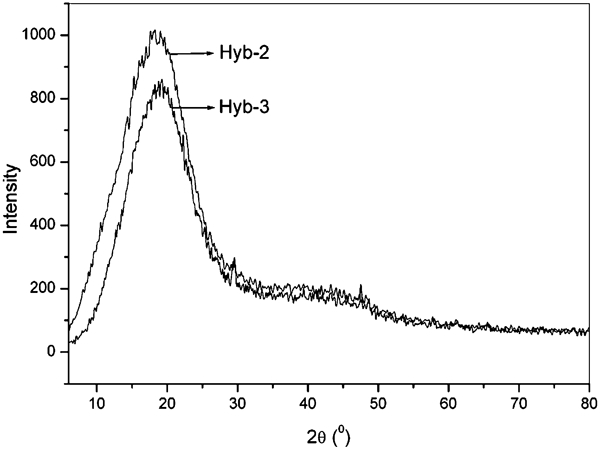
X-ray diffraction patterns of Hyb-2 and Hyb-3
Conclusions
A series of WFPUA/SiO2 hybrid materials were prepared by sol–gel process. The physical properties of dispersions and the mechanical properties of films were measured. As a result, hybrid dispersions exhibited satisfactory stability and lower surface tensions. In addition, mechanical properties of hybrid films were very excellent. Compared with the pure WPUA film, the obtained hybrid films containing fluorine and silicon exhibited higher chemical resistance. The hybrids were characterised by the methods of FTIR, SEM and XRD measuring apparatus to get their structures and surface morphologies. The results showed the fine interconnected or continuous phase morphologies, and the prepared hybrid materials to control the content of fluorine atoms and silicon could be applied to commercial use in different regions.
Footnotes
Acknowledgements
This project was supported by the Agricultural Independent Innovation of Jiangsu Province [grant no. CX(11)2032], the Innovation Program for Graduate Education of Jiangsu Province (grant no. CXZZ12_0696), Society Development Fund of Zhenjiang (grant no. SH2012014) and Sponsored by Qing Lan Project(2012–2015).